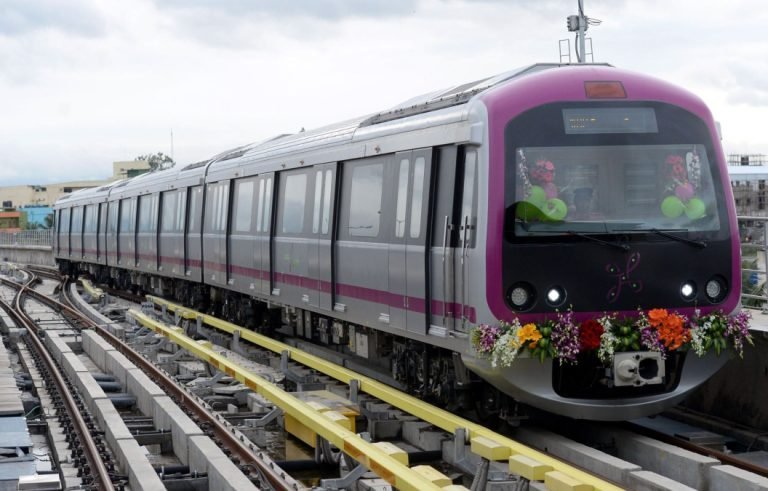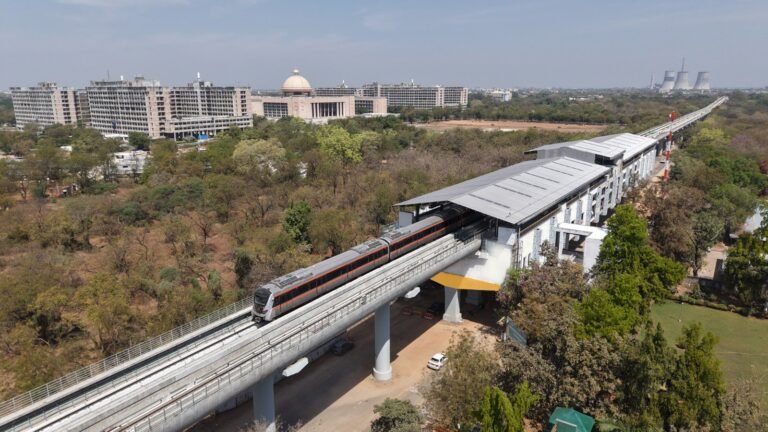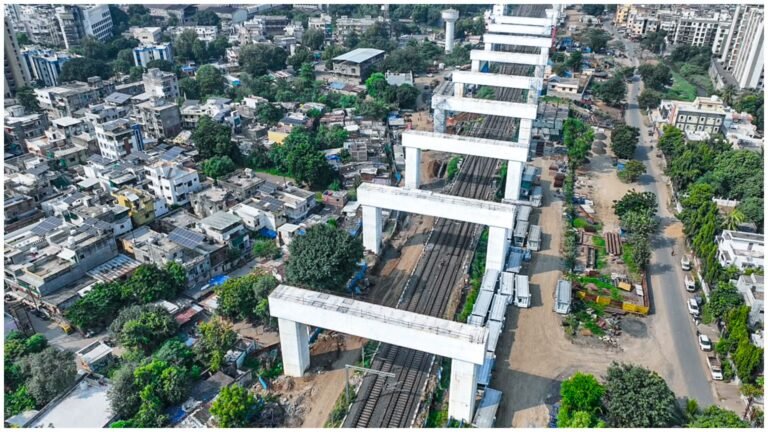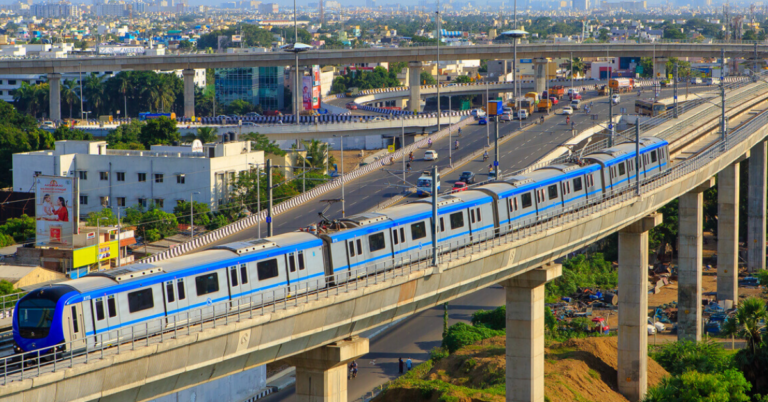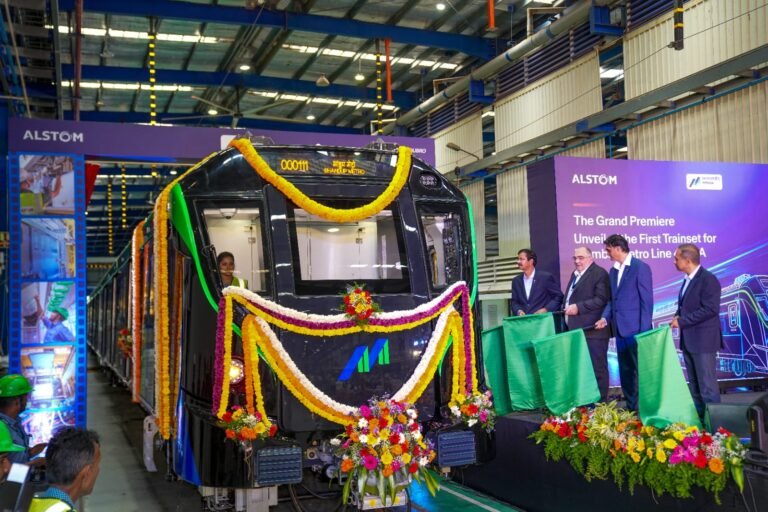
New Delhi: Prime Minister Narendra Modi has flagged-off the Delhi-Faridabad Metro Line that would allow hassle free travel for around two lakh daily commuters between the national capital and the industrial hub in Haryana.
The extension of the Delhi Metro connects Badarpur to Escorts Mujesar in Faridabad.
The total cost of the project from Badarpur to Escorts Mujesar is nearly Rs. 2,500 crore. Out of this, Rs. 1,557 crore was borne by the Haryana Government, the Centre contributed Rs. 537 crore, while the Delhi Metro provided Rs. 400 crore.
All these are elevated and located on either side of the Delhi-Mathura Road (NH-2).
“The nine-station metro corridor which was 95 per cent indigenously built will provide people a safe, affordable, quick, comfortable, reliable, environment-friendly and sustainable transport facility,” a Haryana government spokesperson said.
Haryana Chief Minister ML Khattar, addressing a press conference on Saturday, had thanked the Prime Minister for “gifting” the Metro service which would take the city to “another level of progress” with better connectivity with other NCR towns.
He had also said that the Prime Minister would be announcing the go-ahead for connecting Gurgaon with Faridabad by Metro.
MUMBAI (Metro Rail News): The Mumbai Metropolitan Region Development Authority will build 7 foot over bridges (FOBs) along the Metro Line 9 corridor. It will improve pedestrian safety and make it easier for people to reach metro stations in Mira-Bhayandar.
The bridges form part of MMRDA’s Multi-Modal Integration (MMI) plan, which focuses on improving connectivity between metro services and other modes of transport while making daily travel more convenient. Metro Line 9 runs between Dahisar East and Mira-Bhayandar. The 11-km corridor has 8 stations and is about to be completed. To improve access to stations and help pedestrians cross busy roads safely, MMRDA has planned 7 foot over bridges under Package 1 of the project.
Location of the proposed FOBs
Western Express Highway
Dahisar Toll Naka – 145 metres
Miragaon – 87 metres
Mira-Bhayandar Road
Kashigaon – 92 metres
Shivar Garden – 80 metres
Maxus Mall – 83 metres
Veg Sagar Hotel – 88 metres
Sai Baba Nagar – 80 metres
Designed for safety and easy access
The bridges will help people cross two of the busiest roads in the area, the Western Express Highway and Mira-Bhayandar Road. These roads carry heavy traffic and range from 30 to 60 metres in width. Each bridge will be three metres wide and include:
Staircases
Lifts for easier access
CCTV cameras for security
The lifts will help senior citizens, people with disabilities and passengers carrying luggage reach metro stations more comfortably.
Part of larger connectivity plan
MMRDA has already introduced similar multi-modal integration facilities on Metro Lines 2A and 7. The authority now plans to extend the same model to Metro Line 9. According to MMRDA, the new bridges will,
Improve access to Metro Line 9 stations
Make road crossings safer for pedestrians
Reduce the chances of accidents
Help commuters move more easily during rush hours
Improve last-mile connectivity
Strengthen links between metro services and other transport options
Encourage more people to use public transport
The bridges will also reduce dependence on signal-controlled pedestrian crossings, which could help improve traffic flow at busy junctions.
Metro Line 9 moves towards full operations
MMRDA, in their press release also mentioned that civil construction on Metro Line 9 is almost complete. The authority opened the first phase of the corridor on April 7, 2026, and now wants the pedestrian infrastructure ready before full operations begin. To carry out the work, MMRDA has appointed Speco Infrastructure JV and PRS Infraprojects LLP. The contract for the seven bridges is worth about Rs 82.09 crore.
Officials’ statements
Chief Minister Devendra Fadnavis said, “While expanding Mumbai’s metro network, it is equally important to ensure that commuters can access and use these systems safely, conveniently, and seamlessly. Multi-Modal Integration plays a critical role in connecting people from their homes, workplaces, and surrounding neighbourhoods to metro stations through well-planned pedestrian and transport infrastructure. Maharashtra is witnessing rapid growth in metro connectivity, with nearly 50 kilometres of metro lines being added every year. Our objective is not only to build metro corridors but also to create an efficient and commuter-friendly transport ecosystem where people can travel effortlessly across Mumbai. The Foot Over Bridges being developed along Metro Line 9 are an important step towards achieving this vision by enhancing safety, accessibility, and overall commuter convenience.”
MMRDA Metropolitan Commissioner Dr. Sanjay Mukherjee also said that, “Multi-Modal Integration is a critical component of modern urban mobility planning. The proposed Foot Over Bridges along Metro Line 9 have been carefully planned to improve pedestrian movement, enhance station accessibility, and support efficient dispersal of commuters within station influence areas. By integrating these facilities with the metro corridor, MMRDA is working towards providing a safer, more convenient, and seamless travel experience for citizens while strengthening the overall public transport network of the Mumbai Metropolitan Region.”
UTTAR PRADESH (Metro Rail News): Northeast Railway has invited bids for the construction of two Road Over Bridges (ROBs) in Uttar Pradesh. The estimated cost of the project is around Rs 93.8 crore. It will replace two level crossings in the Lucknow Division and improve both road and rail movement in the region.
The project includes a two lane ROB with a Limited Height Subway (LHS) between Sarju and Jawahal road stations and another two lane ROB between Chauka Ghar and Burhawl stations. Once completed, the bridges will help reduce traffic congestion and improve safety at railway crossings.
Tender Information
Tender
Information
Tendur Number
NER-LJNRSP-2026-15
Tender Type
Open
Bidding System
Two Packet System
Estimated Cost
Rs 93.8 crore
EMD
1.88 crore
Bidding Start Date
12 June 2026
Tender Closing Date
26 June 2026, (15:00)
Completion period
24 months
Scope of Work
The contractor will construct a two-lane Road Over Bridge along with a Limited Height Subway in place of Level Crossing No. 295/A between Sarju and Jarwal Road stations. The project also includes a two-lane Road Over Bridge in place of Level Crossing No. 300/Spl between Chauka Ghat and Burhwal stations. The project aims to improve safety, reduce waiting time at level crossings, and ensure smoother movement of road traffic and trains.
About the Project
The two level crossings lie on important railway routes in Uttar Pradesh and handle regular rail and road traffic. Vehicles often face delays when trains pass through these crossings. The new Road Over Bridges will allow vehicles to cross the railway line without interruption, improving connectivity for local residents and reducing congestion. The project will also enhance safety by removing direct interaction between road traffic and train operations.
MUMBAI (Metro Rail News): Mumbai Metropolitan Region Development Authority has invited bids for track works at the Kasheli Depot of Mumbai Metro Line 5. The project is worth around Rs 84.35 crore. It includes the design, supply, installation, testing, and commissioning of standard gauge tracks required for depot operations.
Tender Information
Information
Details
Tender Number
MMRDA/MPIU/ML5/CA-303
Project
Kasheli Depot Track works for Mumbai Metro Line 5
Estimated Cost
Rs 84.35crore
EMD
Rs 42.17 lakh
Tender Fee
Rs 3000 + 18% GST
Bid Submission Deadline
30 June 2026, (18:00 hrs)
Pre-Bidding Meeting
10 June 2026, (15:00 hrs)
Completion Period
20 months
Scope of Work
The scope of work includes Design, Development, Supply, Installation, Testing & Commissioning of Standard Gauge Trackworks (Ballasted and Ballastless) in Kasheli Depot Track Work for Line 5 Corridor of Mumbai Metro Rail Project.
About the Project
Mumbai Metro Line 5, also known as the Orange Line, will connect Thane, Bhiwandi, and Kalyan. The corridor aims to provide a faster and more reliable public transport option for commuters travelling between these growing urban centers. Kesheli Depot will serve as the operations and maintenance hub for the corridor.
DELHI (Metro Rail News): East Coast Railway has invited bids for the redevelopment of Brahmapur Railway Station under Phase-1. The project aims to upgrade passenger facilities and transform the station into a modern transport hub. The work falls under the Khurda Road division and will be executed through the Engineering, Procurement and Construction (EPC) model.
Brahmapur is one of the major railway stations in Odisha and serves thousands of passengers travelling across eastern and southern India. The redevelopment project forms parts of Indian Railways broader station modernisation programme.
Tender Information
Information
Details
Tender Number
EPC-CECONIIBBS2026022
Project
Brahmapur Railway Station Redevelopment (Phase-1)
Tender Type
Open Tender
Bidding System
Two Packet System
Estimated Cost
Rs 182.57 crore
EMD
Rs 3.65 crore
Pre-Bidding Meeting
25 June 2026, 11:00
Bid Submission Start Date
18 July 2026
Tender Submission Deadline
1 August 2026
Completion Period
20 months
Scope of Work
The contractor will redevelop Brahmapur Railway Station under Phase-1 of the project. The work will include construction and upgradation of the station infrastructure. The project aims to improve passenger movement, accessibility, and overall station experience. The contractor will execute the entire package under the EPC model.
About the project
Brahmapur Railway Station is an important station on the Howrah-Chennai main line and serves as a key gateway to southern Odisha. The station handles a large number of passengers every day and provides connectivity to major cities across the country. Through the redevelopment project, Indian Railways aims to improve passenger amenities, and create a more efficient and comfortable travel experience.
DELHI (Metro Rail News): The Mumbai-Ahmedabad Bullet Train project has achieved another major milestone with the breakthrough of its third mountain tunnel in Maharashtra. Engineers completed the excavation of the tunnel at Ambesari village in Dahanu taluka of Palghar district.
The breakthrough marks significant growth on one of the most challenging stretches of India’s first high-speed rail corridor, where the alignment passes through hilly terrain between Maharashtra and Gujarat.
Third tunnel completed in Palghar district
The newly completed tunnel, known as MT- 07 meters, is 417 meters long and 14.4 meters wide. It will carry both up and down bullet train tracks. Construction teams excavated the tunnel from both ends using the controlled drilling and blasting method. Throughout the work, engineers closely monitored the tunnel and surrounding area to ensure safety and stability.
Project teams installed several monitoring instruments to track tunnel behaviour and ground movement in real time. These include,
Surface settlement points
3D targets
Strain gauges
Seismographs
These systems helped engineers monitor vibrations, tunnel performance and nearby structures during excavation. Teams also focused on worker safety by maintaining proper ventilation inside the tunnel, fire safety arrangement, controlled entry systems and continuous geotechnical monitoring.
Three mountain tunnels completed in five months
The latest breakthrough comes as construction gathers pace in Maharashtra. Over the last five months, engineers have completed excavation of three mountain tunnels.
Tunnel
Length
Breakthrough Date
MT-05
1.5 km
2 January 2026
MT-06
454 m
3 February 2026
MT-07
417 m
1 June 2026
Earlier, MT-08, which is 350 metres long, achieved a breakthrough on 5 October 2023. With the completion of MT-07, the project has now excavated three mountain tunnels in Maharashtra within a span of 5 months.
Status of remaining mountain tunnels
The Mumbai-Ahmedabad Bullet Train project includes eight mountain tunnels in total.
Seven tunnels are located in Palghar district of Maharashtra
One tunnel is located in Valsad district of Gujarat
Construction progress on the remaining tunnels stands at:
MT-01
Work progressing gradually
MT-02
Work progressing gradually
MT-03
More than 80% excavation completed
MT-04
Nearly 60% excavation completed
Boisar-Vapi section records major progress
The route between Boisar in Maharashtra and Vapi in Gujarat passes through a major industrial belt. It includes three mountain tunnels (MT-08, MT-07, MT-06). With the latest breakthrough, all 3 tunnels on this section have now been fully excavated. This marks significant progress on a key stretch of the Mumbai-Ahmedabad Bullet train corridor, where construction activity has gathered pace in recent months.
Railways are the circulatory system of modern economies. In India, where Indian Railways operates one of the world’s largest rail networks running approximately 25,000 trains daily across 69,439 route kilometres and serving over eight billion passengers annually, the stakes of operational efficiency are not merely commercial. They are national. Yet for decades, the gap between the scale of India’s rail network and the sophistication of its operational infrastructure has been wide and consequential. Delayed trains, manual signalling systems, fragmented passenger information, and reactive maintenance have been persistent features of a network that was largely built in the 19th century and expanded through the 20th.
That calculus is now changing. India has achieved one of the world’s fastest electrification drives as of January 2026; 99.4 per cent of its broad-gauge network stands electrified, covering 69,744 route kilometres, making it the operator of the world’s largest electrified rail system. Metro systems now operate across 26 cities, with a total operational network of approximately 1,095 kilometres, the third-largest in the world. But electrification and network expansion, for all their significance, are enablers, not a transformation. The next frontier is digitalisation. If electrification is about where the energy comes from, digitalisation is about how smartly it is used.
The global digital railway market is estimated at USD 82.76 billion in 2025 and is projected to reach USD 127.54 billion by 2030, growing at a CAGR of 9 per cent. India, with its massive network and growing urban metro ecosystem, stands at the intersection of this global shift with meaningful progress already made, significant gaps still to be bridged, and a policy framework that is, for the first time, beginning to treat digital infrastructure with the same urgency as physical infrastructure.
The Case for Digital Infrastructure in Railways
The business case for digitising railway and metro operations is not theoretical it is grounded in measurable outcomes across three dimensions: operational efficiency, passenger experience, and financial sustainability.
On the operations side, digital systems enable real-time monitoring of train locations, predictive maintenance of assets, automated signalling, and data-driven scheduling all of which reduce delays, lower maintenance costs, and improve network reliability. On the passenger side, digital infrastructure enables accurate real-time information, seamless ticketing across modes, and personalised journey planning, reducing friction and improving the perceived quality of service. On the financial side, digital systems reduce waste, enable non-fare box revenue through data monetisation and targeted commercial offerings, and extend the operational life of assets through condition-based rather than time-based maintenance.
The Internet of Things in Railways market is expected to grow at a CAGR of 9.1 per cent, reaching USD 50.58 billion by the end of 2030, driven by the rising adoption of IoT in railways and advancements in communication technology. The shift is no longer a question of whether to invest in digital infrastructure; it is a question of how fast, and whether the institutional capacity exists to absorb and leverage it effectively.
What India Has Built: The Government’s Digital Push
The Indian government’s investment in digital railway infrastructure has accelerated significantly in the 2025-26 period, spanning safety systems, communication backbone, passenger information, and ticketing platforms.
Communication Backbone
A key development has been the enhancement of the Unified Telecom Backbone Infrastructure through Internet Protocol Multi-Protocol Label Switching (IP MPLS) technology. This high-capacity network is being developed to meet present and future bandwidth requirements of mission-critical railway applications, enabling centralised accessibility of video surveillance and supporting core systems such as Mobile Train Radio Communication, the Passenger Reservation System, the Unreserved Ticketing System, and the Freight Operations Information System. The IP MPLS backbone has been commissioned at 1,396 stations, providing a resilient digital foundation across the network.
This is not incidental infrastructure; it is the nervous system upon which every other digital application depends. Without a high-bandwidth, low-latency communication backbone, real-time train control, AI surveillance, and passenger information systems cannot function reliably at scale.
AI-Enabled Safety and Surveillance
AI-enabled video surveillance systems have been deployed across 1,874 stations. Equipped with advanced analytics, these systems can automatically detect suspicious activities such as intrusion and loitering, while facial recognition technology enables real-time monitoring and identification. The scale of deployment nearly 1,900 stations, makes this one of the largest AI surveillance rollouts on any railway network globally.
Real-Time Passenger Information
Automatic train announcements are now operational at 1,405 railway stations, integrated with the National Train Enquiry System, ensuring timely and accurate updates for passengers through electronic display boards, coach guidance systems, and public address networks. For a network that has historically been criticised for poor passenger communication, particularly during delays, this represents a structural improvement in the passenger information ecosystem.
Kavach 4.0: Digital Safety at the Train Level
Perhaps the most strategically significant digital infrastructure investment is Kavach, India’s indigenously developed Automatic Train Protection system. As of early 2026, Kavach 4.0 the latest version, has been formally commissioned on 1,452 route kilometres, covering the high-density Delhi-Mumbai and Delhi-Howrah corridors. In March 2026, it was further commissioned on the Prayagraj-Kanpur section of the Delhi-Howrah corridor, covering an additional 190 route kilometres.
The broader rollout picture is more extensive. Trackside Kavach implementation work has been taken up on 24,427 route kilometres covering the Golden Quadrilateral, Golden Diagonal, and other high-density segments. Supporting infrastructure already in place includes 8,570 kilometres of optical fibre cable, 1,100 telecom towers, 767 station data centres, and onboard Kavach devices fitted on 4,154 locomotives. Bids have been issued to equip a further 9,069 locomotives. The safety impact is already visible: consequential train accidents declined from 135 in 2014-15 to just 14 in 2025-26 a reduction of nearly 90 per cent.
Kavach uses a combination of Radio Frequency Identification, GPS, and ultra-high frequency radio communication to automatically apply brakes if a driver fails to respond to a signal. It is the digital layer at the train-track interface, translating sensor data into real-time safety actions without human intervention. The challenge now is scale: with the broad-gauge network exceeding 70,000 km, the gap between what is commissioned and what remains to be covered is still substantial.
The RailOne App and Digital Ticketing
In July 2025, Indian Railways launched the RailOne App, which consolidated ticketing, enquiries, and grievance redressal into a single platform, while over 30.4 million suspicious user accounts were removed to promote fair access. The consolidation of previously fragmented digital touchpoints, the IRCTC app, UTS app, and various enquiry platforms into a unified interface is a significant step toward a seamless passenger digital experience.
Rail Tech Policy 2026
At the policy level, the Rail Tech Policy 2026 is a comprehensive framework designed to bring cutting-edge technology into Indian Railways’ operations at scale. Under this policy, the railways will actively engage with startups, innovators, industry experts, and academic institutions to adopt advanced technologies, including Artificial Intelligence and drone-based monitoring systems. A major highlight is the dedicated Rail Tech Portal, a 24×7 digital platform that allows innovators and startups to submit proposals online, interact with railway departments, and pilot innovative solutions directly with the railways. This institutionalisation of technology adoption, moving from ad hoc procurement to a structured innovation pipeline, is arguably the most important structural development in India’s railway digital transformation agenda.
Operational Impact: Punctuality as a Metric
The operational impact of digital investment is beginning to show in punctuality data. In financial year 2025-26, the railway network recorded an overall punctuality of more than 77 per cent, with several divisions crossing 90 per cent. Systems such as the Integrated Coaching Management System, the Control Office Application, and the National Train Enquiry System enable a continuous flow of information on train movements, allowing controllers to monitor delays and quickly adjust timetables. Real-Time Train Information System devices, based on GPS technology, enable a train’s location to be transmitted to the central control system automatically, a fundamental shift from the manual train charting that long defined Indian railway operations.
Global Example
Deutsche Bahn and Europe’s Shift2Rail Programme
DB Netz, a major subsidiary of Deutsche Bahn, has been digitalising its train control systems through a research programme on digital control command and signalling technology. The broader European Shift2Rail public-private partnership has examined the potential of digital applications across multiple railway subsystems: X2Rail for control, command and signalling, Pivot for rolling stock, In2Track for infrastructure, and In2Stempo for energy, with Research and Innovation activities contributing to more efficient ways to predict and control the performance of rail assets.
The Shift2Rail model is significant not just for its technological output, but for its governance structure: a formal public-private partnership that pools funding from both European Union Horizon 2020 grants and industry members, creating a shared incentive structure for innovation. India’s Rail Tech Policy 2026 draws conceptual parallels with this model, but lacks the structured co-funding mechanism that gives Shift2Rail its durability.
The Gaps: What Still Needs to Be Addressed
For all the progress made, India’s digital railway transformation has significant structural gaps that must be acknowledged.
Fragmented Implementation Across Zones
Indian Railways operates across 18 zonal railways and numerous metro corporations, each at different stages of digital maturity. The IP MPLS backbone reaching 1,396 stations is meaningful, but India has over 7,000 stations. AI surveillance deployed at 1,874 stations leaves thousands of smaller stations unmonitored. The risk is that digital investment concentrates on high-visibility urban and trunk routes while leaving the vast secondary network which serves the majority of the population underserved.
Kavach Rollout Speed vs. Network Scale
Kavach 4.0 has been commissioned on 1,452 route kilometres, with trackside work taken up on 24,427 kilometres but India’s broad-gauge network spans over 70,000 kilometres. The December 2025 deadline for completing the Delhi-Mumbai and Delhi-Howrah corridors was missed. While the rollout is accelerating with bids issued for 9,069 additional locomotives and the number of approved installation vendors growing beyond five the constraint remains supply chain capacity and the speed at which the OFC backbone can be laid to support Kavach’s communication requirements. Every kilometre without Kavach is a kilometre operating on the assumption of human infallibility.
Data Integration and Interoperability
India’s railway digital systems have grown organically the Passenger Reservation System, the Freight Operations Information System, the National Train Enquiry System, and metro AFC systems across 26 cities each operate on different technology stacks with limited interoperability. A passenger travelling from a suburban metro station to an intercity train cannot yet access a unified journey planner, book an end-to-end ticket, or receive integrated real-time updates across modes. This is not a technology problem it is an integration and governance problem that requires deliberate cross-institutional architecture.
Cybersecurity
As railway systems become more digitally integrated, their attack surface expands. The use of passenger data to improve service and comfort must be balanced with strict protocols and laws. Anonymisation techniques and increased data usage controls are needed to protect passenger privacy, and robust safeguards are essential to address data handling concerns. Indian Railways has not yet articulated a comprehensive public cybersecurity framework for its growing digital infrastructure, a gap that becomes more consequential with every new system commissioned.
Human Capital and Digital Literacy
Technology cannot transform railways on its own. Engineers, drivers, and operators must be trained to use automation tools effectively. Indian Railways has trained over 40,000 personnel, including 30,000 loco pilots and assistant loco pilots, on Kavach systems in collaboration with IRISET. However, this is a narrow slice of a workforce that numbers in the millions. The International Transport Forum emphasises that digital literacy is essential for resilient rail systems in fast-growing economies, and India must invest as much in people as in platforms.
Conclusion
India’s railway and metro digital transformation is real, accelerating, and consequential. The investments made in 2025-26 in communication backbone, AI surveillance, real-time passenger information, Kavach 4.0 deployment across 1,452 route kilometres, and the unified RailOne platform represent the most substantive digital infrastructure push in the network’s history. With 99.4 per cent electrification achieved, a 69,439-kilometre network, and metro systems operational across 26 cities, India has built a foundation that digital systems can now leverage.
But the gap between what has been built and what a fully digitised, interoperable, data-driven railway network looks like remains large. India’s urban population is set to grow by 270 million by 2040. Building new tracks and trains alone cannot meet this demand in a sustainable way. What the railways need is a digital nervous system, one that helps existing infrastructure deliver more, faster, and better.
The global railway digital market is growing at 9 per cent annually. The technology exists, the policy intent is declared, and the business case is unambiguous. The constraint now is execution the speed at which India can close the gap between its most digitally advanced corridors and its vast secondary network, and the discipline with which it integrates fragmented systems into a coherent, interoperable whole. That is the work of the next decade, and it will determine whether Indian Railways becomes a global model for digital transformation in large, complex public infrastructure.
In Jaipur, rising population and rapid motorisation have placed sustained pressure on the city’s transport network. The city records an estimated daily travel demand of 36 lakh passenger trips, with peak-hour demand reaching 3.6 lakh trips. Its population is approaching 4.45 million, and vehicle density at 25,048 vehicles per square kilometre, far above the state average of 4,299. Average travel times have stretched to 28 minutes and 28 seconds per 10 kilometres.
Against this backdrop, the Jaipur Metro was introduced as a mass transit solution to reduce congestion and improve urban mobility. The project also reflects the broader challenges of planning and operating metro systems in Indian cities with evolving demand patterns.
This article examines the metro’s progression from initial planning and political debate to its current operational status. It also assesses proposed expansions and highlights the financial and operational constraints that will determine its long-term role in the city’s transport system.
A Brief History: From Vision to Reality
The conception of the Jaipur Metro dates to the early 2000s, when rapid urbanisation began to overwhelm the city’s road infrastructure. The Detailed Project Report (DPR) was initially submitted by the Delhi Metro Rail Corporation (DMRC) in March 2010, proposing two corridors: an East-West Corridor and a North-South Corridor. The Jaipur Metro Rail Corporation (JMRC) a state-owned Special Purpose Vehicle was formally established on 1 January 2010 to oversee implementation.
Physical construction of Phase 1A commenced on 24 February 2011, covering 9.63 kilometres from Mansarovar to Chandpole Bazaar, largely elevated with a short underground stretch. The project consulted DMRC on rapid transit operation and construction techniques, and notably set a national record by conducting trial runs on 18 September 2013 the fastest from construction commencement for any Indian metro at the time.
Commercial services on the Jaipur Metro commenced on 3 June 2015, inaugurated by Vasundhara Raje, the then Chief Minister of Rajasthan. With this, Jaipur joined the ranks of Kolkata, Delhi, Bangalore, Gurugram, and Mumbai as one of India’s six rapid transit cities. Phase 1B a 2.34 km underground stretch from Chandpole to Badi Chaupar, adding two underground stations at Chhoti Chaupar and Badi Chaupar completed the Pink Line and began operations on 23 September 2020, bringing the total operational length to approximately 12 km across 11 stations.
The metro holds the distinction of being India’s first to feature a triple-storey elevated structure, combining road and metro tracks, an engineering achievement that set new benchmarks for urban infrastructure in the country.
Existing Routes
The Pink Line Jaipur’s Sole Operational Corridor
As of 2026, Jaipur Metro operates a single corridor: the Pink Line, spanning 11.97 km from Mansarovar in the west to Badi Chaupar. The line serves 11 stations, a mix of 8 elevated and 3 underground, connecting residential neighbourhoods to the commercial and heritage core of the city.
Line-1 – Pink Line: Mansarovar – Badi Chaupar
Length: 9.63 km (Phase 1A) and 2.35 km (Phase 1B)
Type: Elevated & Underground
Depot: Mansarovar
Number of Stations: 11
Station Names: Mansarovar, New Aatish Market, Vivek Vihar, Shyam Nagar, Ram Nagar, Civil Lines, Railway Station, Sindhi Camp, Chandpole, Chhoti Chaupar, and Badi Chaupar
Upcoming Expansions of Jaipur Metro
Phase 1C: Extending the Pink Line East
Line-1 –Pink Line: Badi Chaupar – Transport Nagar (Phase 1C)
Length: 3.41 km
Type: Underground (2.65 km) & Elevated (0.76 km)
Number of Stations: 2
Station Names: Ramganj Chaupar (underground) & Transport Nagar (elevated)
Status: Approved
This extension would deepen metro connectivity into the densely populated old city and improve access to one of Jaipur’s key commercial and transport hubs. Once completed, estimated ridership across the full Mansarovar-Transport Nagar stretch is projected to exceed 1.38 lakh daily passengers by 2031.
Phase 1D Western Extension to Ajmer Road
Line-1 –Pink Line: Mansarovar to Ajmer Road Chauraha (Phase 1D)
Length: 1.35 km
Type: Elevated
Number of Stations: 1
Station Names: Ajmer Road Chauraha
Status: Proposed
Phase 1D is a more modest extension of 1.312 km, taking the Pink Line westward from Mansarovar to Ajmer Road Chauraha. It connects the metro terminus to Ajmer Road, one of Jaipur’s primary arterial roads and a gateway to the city’s densely populated western suburbs.
Phase 2: The Orange Line: Jaipur’s North-South Corridor
The centrepiece of Jaipur Metro’s expansion ambitions is Phase 2, the Orange Line, a 41 km corridor that will form the city’s north-south transit backbone. The project, announced in the State Budget 2025-26, proposes 36 stations (34 elevated, 2 underground) connecting Todi Mod in the north to Prahladpura in the south.
Key commercial and residential destinations along the proposed Orange Line include Sitapura Industrial Area, Jaipur’s major IT and manufacturing hub along with Tonk Phatak, Rambagh, Sindhi Camp, and Bani Park, connecting densely populated and economically active zones
Union Cabinet’s Approval
Jaipur Metro received a big push in the first week of April 2026 with the Central Government’s approval. The Union Cabinet approved the project at a cost of ₹13,037.66 crore. The Rajasthan Metro Rail Corporation Limited will be responsible for implementing the project.
Business and Economic Impact
Real Estate and Urban Development
One of the most measurable business impacts of the Jaipur Metro has been its effect on real estate values. The areas near operational and planned metro corridors have seen property prices and rental demand rise since 2015. The Phase 2 expansion is expected to accelerate this trend, particularly along the Sitapura and Tonk Road corridors. Against this backdrop, the residential and commercial projects are emerging rapidly in anticipation of improved connectivity. Metro expansion is widely projected to drive 15-20% appreciation in property prices near new corridors.
Employment and Commercial Activity
The construction and operation of metro infrastructure has contributed to employment generation across engineering, construction, security, operations, and retail sectors. JMRC has entrusted station security to the Rajasthan Police, while operations employ a substantial permanent workforce. The planned Phase 2 connectivity to Sitapura Industrial Area is expected to boost economic activity, improve last-mile access to the city’s commercial and IT clusters, and make Jaipur more attractive to businesses and investors.
Tourism and Heritage Connectivity
Jaipur’s economy is deeply anchored in tourism and heritage, and the metro plays a growing role in this ecosystem. The Pink Line’s eastern terminus at Badi Chaupar places visitors within walking distance of iconic landmarks such as Hawa Mahal and Jantar Mantar, while Chandpole provides access to the Walled City’s markets and temples.
Environmental Sustainability
As Jaipur’s population is projected to reach 8.1 million by 2031, the metro’s role in reducing private vehicle dependency is central to the city’s sustainability agenda. Phase 2 is projected to meaningfully decrease the city’s carbon footprint, aligning Jaipur’s growth with national Smart City and climate commitments.
Challenges: The Business Case Under Scrutiny
Ridership and Revenue Gaps
The Jaipur Metro’s most persistent business challenge has been ridership. In its first 22 months of operation, average daily ridership reached only 19.17% of projected figures a deficit that drew sharp criticism from the Comptroller and Auditor General (CAG), whose 2018 report questioned whether a metro was necessary.
However, the ridership has improved over the years, growing from a prolonged plateau of 19,000 to 25,000 daily passengers to approximately 55,000- 60,000 passengers per day in recent years, a positive trajectory, but still well below full operational capacity and the volumes needed for financial self-sustainability.
Financial Sustainability
JMRC continues to face financial challenges rooted in the structural economics of public transit. Operating costs covering salaries, maintenance, administrative expenses, depreciation, and debt servicing on the massive initial capital investment are substantial and fixed, regardless of ridership levels. Ticket revenue, the primary income stream, is inherently limited by the fare structure, which is deliberately kept affordable for public accessibility but constrains revenue maximisation.
JMRC has explored supplementary revenue streams including advertising within stations and commercial space leasing, though these contribute relatively modestly compared to fare box revenue. In financial year 2022-23, JMRC achieved a net profit of ₹14,329.51 lakh but primarily due to the sale of land assets, rather than operational profitability. Without such one-off gains, operational losses persist.
Competition and Limited Network Coverage
The metro competes directly with Jaipur’s dense network of buses, auto-rickshaws, and increasingly, app-based ride-sharing services modes that offer greater geographic flexibility at comparable or lower cost. The Pink Line’s 12 km coverage, while valuable, does not yet reach enough of the city’s key origins and destinations to drive mass modal shift. Delays in Phase 2 execution have compounded this limitation.
Execution and Governance Risks
The JMRC has seen more than 12 chiefs in nine years of operation a rate of leadership turnover that has raised governance concerns. Phase 2 delays, driven by multiple DPR revisions, contract disputes, and funding uncertainties, have extended from an originally projected 2021 completion to a current target of 2031. Each delay defers the business case for the expanded network and erodes public confidence. The state government’s decision to conduct yet another feasibility survey for Phase 1C in 2025 was widely seen as a setback for project momentum.
Conclusion
The Jaipur Metro is a system caught between its past ambitions and future potential. As a business proposition, it has delivered real but incomplete dividends: improved urban mobility, real estate appreciation along its corridor, and a foundation for a more sustainable city. Yet it has not achieved financial self-sufficiency, its network remains too limited to drive transformative modal shift, and its expansion has been marked by delays that have tested public and political patience.
The next five years are critical. The successful delivery of Phase 1C and 1D extensions, combined with timely execution of Phase 2’s Orange Line, could fundamentally alter the metro’s business case unlocking the ridership volumes, real estate value capture, and economic multipliers that the project was always designed to generate.
Jaipur Metro’s story is, in many ways, the story of urban India’s infrastructure ambitions that are bold in vision, complex in execution, and ultimately indispensable for the cities of tomorrow. For the Pink City, the rails are laid; now it is a question of will, capital, and execution to realise their promise.
BANGALORE (Metro Rail News): Bangalore Metro Rail Corporation Limited (BMRCL) has invited bids for the extension of Namma Metro beyond Whitefield Metro Station in Bangalore. The project carries an estimated cost of Rs 62.51 crore and will add 482.80 metres of metro line beyond the existing station under Reach-1B of Phase 2. The extension forms part of BMRCL’s efforts to strengthen metro infrastructure in the eastern part of the city and support future operational requirements on the corridor.
Tender Information
Information
Details
Tender Number
BMRCL/Phase-2/Reach-1B Extn./Via/2026/150
Tender Type
Open e-Tender
Bidding System
Single Stage – Two Cover System
Estimated Cost
Rs 62.51 crore
EMD
Rs 62.51 lakh
Tender Fee
Rs 59,000
Completion Period
18 Months
Tender Documents Available
1 June 2026 to 29 June 2026 up to 3:00 PM (IST)
Pre-Bid Meeting
16 June 2026, (11:30 AM)
Bid Submission Period
23 June 2026, (10:00 AM) to 29 June 2026, (3:00 PM)
Technical Bid Opening
30 June 2026, (3:30 PM)
Financial Bid Opening
To be announced after technical evaluation
Scope of Work
The contractor will construct a 482.80-metre extension beyond Whitefield Metro Station in Reach-1B of Bengaluru Metro Phase 2. The contractor will complete all associated infrastructure works needed for the extended section. The project aims to support future metro operations and corridor expansion requirements. BMRCL has set the completion period at 18 months.
About the Project
Whitefield is one of Bangalore’s fastest-growing residential and IT hubs. The metro corridor serves thousands of daily commuters travelling between Whitefield and other parts of the city. Through this extension, Bangalore Metro Rail Corporation Limited aims to strengthen infrastructure at the end of the corridor and support future development plans for the metro network.
Indian Railways has maintained its freight growth momentum by loading 145 million tonnes of freight in May 2026 despite ongoing geopolitical tensions in West Asia. A 1.3% increase was also seen in freight growth over the previous year.
The growth was driven by high performance in Iron Ore, Steel, Fertilisers and Balance Other Goods segments. This growth was recorded despite the global market turbulence in West Asia, which indirectly impacted the growth and supply chain.
Across major commodities, Balance Other Goods recorded a solid growth of 16%, while Iron Ore loading increased by 4.8% and Pig Iron & Finished Steel loading grew by 3.5% over the corresponding period of the previous year. Loading of fertilizers also recorded a healthy growth of 6.2%, reflecting the Railways’ commitment towards supporting key sectors of the economy.
Coal, which is the backbone of railway freight traffic, was seen maintaining steady growth with loading increasing by nearly 1% over 2025. Indian Railways accorded priority to coal movement and closely monitored its transit across the network to meet the requirements of thermal power plants, and ensure energy security.
Indian Railways took clear measures to sustain freight growth and maintain supply chain efficiency under challenging circumstances through intense monitoring of both domestic and EXIM container traffic to facilitate seamless freight movement and support economic activity across regions.
With sustained growth in freight loading, strong performance across key commodity segments, Indian Railways continues to strengthen its role as the backbone of the nation’s transportation network, facilitating economic activity and connecting people across the country.
DELHI (Metro Rail News): Delhi Metro Rail Corporation (DMRC) is planning to expand its presence in global metro projects. The corporation has created a new company, Delhi Metro International Limited (DMIL), to pursue opportunities in foreign countries and generate additional revenue. The move comes at a time when DMRC needs funds to upgrade parts of the Delhi Metro Network, which has been operating for more than two decades.
Several Countries showed interest in working with DMRC
DMRC Managing Director Dr. Vikas Kumar said a number of countries have approached the corporation for possible metro collaborations. These include,
Israel
Egypt
Kenya and other African countries
While discussions with some countries are still at an early stage, DMRC now plans to actively bid for projects outside India through its newly formed international arm. Kumar said DMIL will focus on securing contracts related to metro planning, consultancy, project execution, operations and maintenance.
DMRC’s association with Dhaka Metro
DMRC is currently involved in Metro projects in Dhaka, Bangladesh. The corporation is providing consultancy services, helping with project execution and supporting operations and maintenance activities. According to Kumar, the Dhaka assignment has given DMRC valuable international experience that can help it expand into other markets.
Need for additional revenue
Kumar said Delhi Metro now needs significant investment for modernization and refurbishment work. The network started operations in 2002, and many stations, systems and trains have aged over time. DMRC wants to generate additional income beyond passenger fares to support these upgrades. He said revenue from overseas projects can help fund mid-life refurbishment of infrastructures across the Delhi Metro network.
DMRC believes its experience in operating driverless metro trains can help it compete for international contracts. According to Kumar, more than 90 km of the Delhi Metro network currently operates with driverless technology. This experience makes DMRC one of the few metro operators with large scale driverless operations. As more cities adopt advanced metro systems, DMRC sees this expertise as an important advantage.
Expanding across India as well
Along with its international ambitions, DMRC continues to expand its presence in other Indian cities. The corporation has secured long-term operations and maintenance contracts for
Mumbai Metro
Chennai Metro
It also provides operational support in:
Patna
Noida
Gurugram
Jaipur
DMRC is also exploring partnerships with foreign companies and plans to work more closely with embassies and international organizations to strengthen its position in the global urban mobility sector. As Delhi Metro enters its third decade of operations, DMRC is looking beyond the national capital for future growth. Through its new international arm, the corporation hopes to win overseas projects, earn additional revenue and use that income to modernize one of India’s largest metro networks.