New Delhi: Prime Minister Narendra Modi has flagged-off the Delhi-Faridabad Metro Line that would allow hassle free travel for around two lakh daily commuters between the national capital and the industrial hub in Haryana.
The extension of the Delhi Metro connects Badarpur to Escorts Mujesar in Faridabad.
The total cost of the project from Badarpur to Escorts Mujesar is nearly Rs. 2,500 crore. Out of this, Rs. 1,557 crore was borne by the Haryana Government, the Centre contributed Rs. 537 crore, while the Delhi Metro provided Rs. 400 crore.
All these are elevated and located on either side of the Delhi-Mathura Road (NH-2).
“The nine-station metro corridor which was 95 per cent indigenously built will provide people a safe, affordable, quick, comfortable, reliable, environment-friendly and sustainable transport facility,” a Haryana government spokesperson said.
Haryana Chief Minister ML Khattar, addressing a press conference on Saturday, had thanked the Prime Minister for “gifting” the Metro service which would take the city to “another level of progress” with better connectivity with other NCR towns.
He had also said that the Prime Minister would be announcing the go-ahead for connecting Gurgaon with Faridabad by Metro.
NEW DELHI (Metro Rail News): On Sunday, Prime Minister, Shri Narendra Modi, made a historic move by laying the foundation stone for the redevelopment of 508 Railway Stations across the country through video conferencing. The ambitious project is estimated to cost more than Rs 24,470 crores. The selected 508 stations for redevelopment are spread across 27 states and union territories. States like Rajasthan and Uttar Pradesh have 55 stations each, Bihar has 49 stations, Maharashtra has 44 stations, West Bengal has 37 stations, Madhya Pradesh has 34 stations, Assam has 32 stations, Odisha has 25 stations, Punjab has 22 stations, and Gujarat and Telangana have 21 stations each. Additionally, Jharkhand has 20 stations, Andhra Pradesh and Tamil Nadu have 18 stations each, Haryana has 15 stations, and Karnataka has 13 stations, among others.
Addressing the gathering, the Prime Minister emphasized that the country is moving towards the goal of Viksit Bharat (Developed India) and is entering the Amrit Kaal. He expressed that there is new energy, inspiration, and determination in the country, which marks the beginning of a new chapter in the history of Indian Railways. He announced that almost 1300 prime railway stations in the country will be redeveloped as ‘Amrit Bharat Stations’, ushering in modernity and giving them a new lease of life.
The Prime Minister stressed that this redevelopment project will not only benefit the railways but also contribute to overall infrastructure development in the country. The benefits of this initiative will be extended to all states, with 55 Amrit Stations to be developed in Uttar Pradesh at an approximate cost of Rs 4,000 crores, and another 55 stations in Rajasthan. Similarly, 34 stations in Madhya Pradesh will undergo redevelopment at a cost of around Rs 1,000 crores, 44 stations in Maharashtra at approximately Rs 1,500 crores, and prime railway stations in Karnataka, Tamil Nadu, Kerala, and other states will also be redeveloped.
The Prime Minister applauded the Ministry of Railways for undertaking this historic project and congratulated the citizens on this significant step towards progress and development.
The revamp will offer modern passenger amenities, seamless traffic flow, inter-modal integration, and well-crafted signage for passenger guidance. The station buildings’ designs will draw inspiration from the region’s local culture, heritage, and architectural styles.
The provision of Metro Rail in cities is welcomed by citizens; however, the ease to use the facility has been a challenge for most. The intent of this paper is to create citizen interest in promoting the usage of the Metro in their city with active participation with authorities.
The idea is to evolve practical solutions which can be jointly implemented by authorities with citizen participation.
Background
The intent of Metro is to promote mass transport, thereby reducing traffic on city roads and contain pollution caused. It is observed that there is reluctance amongst citizens to give up cars/two-wheelers and ride the metro for a variety of reasons. A WRI study shows that except Mumbai, amongst all other cities where the Metro is functional, the actual ridership is much lower (i.e. 5- 10%) than the potential for which the Metro is designed (WRI, 2023).
Apart from this, there are challenges faced by citizens in attempting to use the public transport facilities offered in cities in addition to Metro, as the services are not conceptualised based on end-user expectations; further, these transport options often do not complement each other to get a synergy for their usage.
Non-usage of Metro leads to investments turning non-viable, leading to loss and deteriorating facilities over time for lack of maintenance on account of the shortage of funds. It’s the behaviour we intend to change by addressing the underlying causes.
Literature Review
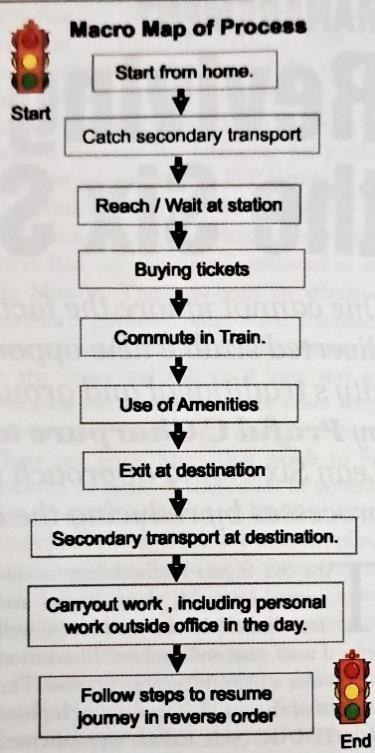
Different studies have been carried out for the feasibility of urban transport systems with respect to traffic conditions in cities; however, the post-implementation usage data, as cited above, reveals very low usage in cities barring Mumbai. For the analysis of end-user requirements, it is important to understand the Macro map of the process one follows to use public transport, as explained in Figure 1 below.
The end user requirements of secondary transport to reach the metro station is a challenge in the process due to
1. Non-availability of feeder buses/autos/taxis from the starting point of the user.
2. Non-availability of parking spaces at metro stations.
3. Non-availability of secondary transport at the alighting station to reach the destination.
The ticket buying is simplified reasonably with metro cards / mobile apps / QR codes/ monthly passes at stations to save on time. Further, amenities at stations are decent, plus the comfort of commuting in Metro is provided. But secondary transport at the alighting station is still a challenge.
Figure 1- Macro-map of citizen Activities to use Metro
There are studies done for the feasibility of Metros and Bus transport independent of each other as such, the routes of these are found to be non-converging leading to minimal change over points for modes of public transport in cities. As such, Transit Oriented Development (TOD) initiatives are forced to provide measures to bridge the gap among the modes of transport, as mentioned above. This leads to TOD projects mainly converging to improve the ease of shift for travellers between two modes. The focus of TOD is to bring in land use interventions to ease accessibility to stations and improve walkability, as illustrated in Figure 2.
Figure 2 – TOD Policy Measures – Illustration
Parking management is a key thrust area in TOD policy by the Ministry of Housing and Urban Affairs (MOHUA), and the idea leverages this focus to promote citizen participation and proposes to integrate the initiative as part of TOD initiatives to encourage citizens to participate. In addition, a little focus on the end-user requirement, as illustrated in Figure 3 below, shall help to make the commute easier and more beneficial to both the provider and consumer.
Figure 3 – Approach to identify solutions for fulfilment of Citizen expectations on Service
There is a need to analyse citizen requirements, as explained in the graphic above, where an approach to identify suitable solution sets for the viability of bus service is illustrated. These solutions need to be prioritised based on viability to fulfil user as well as provider requirements.
The reason for the distinctly low usage of metro rail in cities, despite efforts to make stations good with amenities, ease of ticket buying etc., is the visibly striking gap in transfer between two modes of transport like in the ease of reaching the station and availability of hop on services etc. The idea is focused on this aspect with the intent of identifying avenues to complement TOD policy with citizen participation.
Approach for measures to enhance the usage of Metro rail
The idea behind the solution is built around the TOD policy of MOHUA for enhancing land use in the vicinity of the transit nodes and improve parking facilities. The idea thus focuses on:
Encouraging citizens to reach the nearest point to take the metro/feeder bus to a metro station.
The target audience is users of cars and two-wheelers by providing them with a facility to park near the metro station or close to a feeder bus stop.
The element of service assurance shall be built into the solution thereby, the usage can scale up with information on parking availability.
Focus on the involvement of citizen/housing societies in the vicinity of the station or on the route of feeder buses to the metro station.
Idea leverages the existing Metro App, Maps, Metro Cards and Payment channels like UPI for easily locating available parking, booking of available lot and payment of parking fees.
For implementation, a partnership of Local authority is proposed for parking lot mapping and tariff fixation with an arrangement to share benefits with participating citizens by Metro along with local authority.
The idea shall surely have a prerequisite solely with participating authorities who need to show constructive interest in implementation, with assurance to participating citizens for any conflict resolution if it arises.
Potential Solution
The solution proposed has two components A – Spatial components, which constitute
Initiative by Metro and Local ULB to encourage citizens to offer spaces within their premises closer to metro stations for parking provisions/ bicycle stands.
Provide channel to citizens to express their interest and get empanelled post validation of locations/parking potential.
Plan a feeder bus route linking parking lots offered for commuting those willing to use parking lots to finally use Metro.
Also, include a bicycle option to provide cycles on rent by extending current ongoing initiatives.
The point-to-point service offering via e-auto rickshaw with a fixed fare to be paid via MetroCard.
B – Technological components of the idea constitute
Make available the offered slots for pre-booking by the existing metro app.
Bus route and cycle booking options to be part of the metro app.
Provision of payment of fees through various payment options
Assurance of vehicle security with insurance on lines of the railway at a low premium.
Revenue sharing via app for participating citizen / Metro / ULB
Some of the solutions for improving bus service outlined in Figure 3 can also be developed.
Figure 4 A and B below illustrate the Spatial & Technical components of the idea.
Figure 4 – A and B – Spatial and Technical Components of Idea
Testing Plan
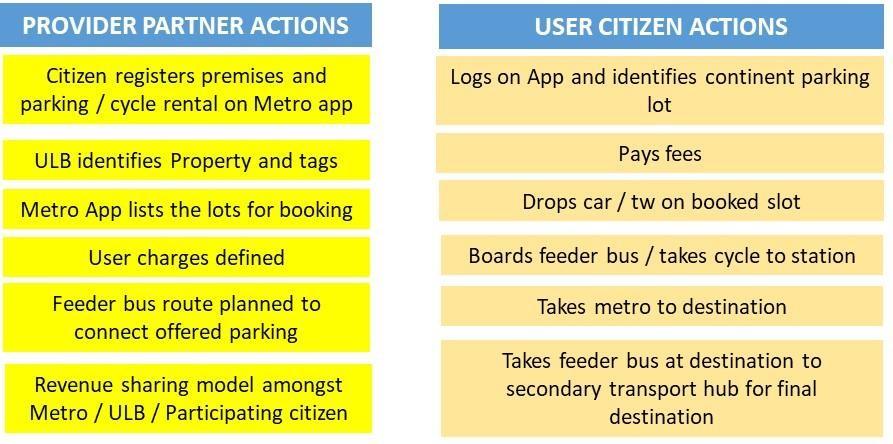
The idea is proposed to be run as a pilot with clear actions defined by participating stakeholders and user citizens, as outlined in Figure 5 below.
Figure 5 – Provider and User Actions for Idea Testing and Implementation
Conclusion
Increasing awareness amongst citizens regarding the potential of public transport towards contribution for reduction in pollution and the need for citizen contribution to the environment is the central theme of the idea.
The element of Incentive-based service provision is taken as a driver for encouraging citizens to participate in implementing initiatives of such nature. The idea leverages the synergy amongst the currently ongoing initiatives like
As a Unique Selling Proposition (USP), the idea ropes in citizens (Users and Residents) to participate with city administration in the initiative by offering their premises at a use-based charge.
Promoting cycles / fixed fare e-rickshaw as part of TOD initiatives
Promoting TOD policy measures of land use interventions in the catchment area around metro transit routes.
Integrates ongoing initiatives like feeder bus/bicycle rentals / insurance-based assurance (like railways) to promote active citizen participation in the usage of public transport like Metro.
Giving citizens to contribute to the environmental protection measures.
By Dr Praful Gharpure Architect – Urban Planner Sr. Consultant Infrastructure Planning & Development Tata Consultancy Services
MUMBAI (Metro Rail News): State Bank of India (SBI) has taken legal action against Mumbai Metro One (MMOPL) by approaching the National Company Law Tribunal (NCLT) to initiate the Corporate Insolvency Resolution Process (CIRP). MMOPL is a joint venture between Mumbai Metropolitan Regional Development Authority (MMRDA) and Reliance Infrastructure (RInfra).
SBI has filed a petition with NCLT’s Mumbai bench to recover its dues of over Rs 416 Crore from MMOPL, also known as Metro Line 1 in Mumbai City. Other lenders involved are IDBI Bank, Canara Bank, Indian Bank, Bank of Maharashtra, and India Infrastructure Finance Company (UK). Reliance Infrastructure stated that MMOPL is seeking legal advice to protect its interests in this matter. The financial impact on the company is uncertain and depends on the outcome of the proceedings.
This project, awarded on a public-private partnership basis, involves the design, financing, construction, operation, and maintenance of a 12 Km elevated metro between Versova and Ghatkopar with 12 stations en-route.
Reliance Infrastructure owns 74% stake in the metro line operator, while the remaining 26% is held by MMRDA. MMRDA is reportedly looking to take over the operation from MMOPL.
In 2007, the Mumbai Metropolitan Region Development Authority (MMRDA) awarded the Versova-Andheri-Ghatkopar corridor to the Reliance infrastructure consortium through a global competitive bidding process on a public-private partnership framework. Subsequently, a special-purpose vehicle called Mumbai Metro One was established to carry out the project.
NEW DELHI (Metro Rail News): Union Minister for Railways, Ashwini Vaishnaw, disclosed that Visakhapatnam has been allocated nearly ₹800 crore for various railway infrastructure projects this year, in response to a query from BJP’s Rajya Sabha member G.V.L. Narasimha Rao.
The newly-sanctioned projects include:
1. Railway line project of 3rd and 4th lines between Visakhapatnam and Gopalapatnam (15.3 km) at a cost of ₹159.47 crore.
2. New railway line project of 3rd and 4th lines between Duvvada and Simhachalam North (20.543 km) sanctioned at a cost of ₹302.20 crore.
3. New railway line project of 3rd and 4th lines between Vadlapudi and Gate Junction cabin including Tie line between Gangavaram Port-Visakhapatnam Steel Plant (12.04 km) sanctioned at a cost of ₹154.28 crore. 4. Flyover between Pendurthi and Simhachalam North at Simhachalam (7.135 km) was also sanctioned at a cost of ₹183.65 crore.
The Minister highlighted that these projects were sanctioned to address capacity constraints, reduce train detention, and cater to future traffic growth in Visakhapatnam. Land acquisition works for these projects have already been initiated.
Shri G.V.L. Narasimha Rao, who was recently nominated from Parliament as a Member of the Railway Users’ Consultative Committee of East Coast Railway, expressed his gratitude to Prime Minister Narendra Modi and the Railway Minister for the substantial financial allocations for railway projects in Visakhapatnam. He hopes that these projects will significantly improve the growth of railways in the Visakhapatnam region and enhance passenger convenience.
NEW DELHI (Metro Rail News): On 6th August, Prime Minister Shri Narendra Modi will take a historic step by laying the foundation stone for the redevelopment of 508 railway stations across India through video conferencing.
The Prime Minister has consistently emphasized the importance of providing state-of-the-art public transport. With railways being the preferred mode of transport for people all over India, PM Modi’s vision is to ensure that passengers receive world-class amenities and services.
To fulfill this vision, the government launched the Amrit Bharat Station Scheme, which aims to redevelop a total of 1309 railway stations across the nation. As part of this ambitious plan, the foundation stone for the redevelopment of 508 stations will be laid by PM Modi himself. These stations are set to undergo a transformative makeover with a budget of over Rs 24,470 crores.
The redevelopment project comes with a comprehensive approach, as master plans are being prepared to develop these stations as ‘City Centres’. The objective is to create well-integrated spaces that seamlessly blend with the surrounding areas and cater to the overall urban development of the cities where the stations are located.
The selected 508 stations for redevelopment are spread across 27 states and union territories. States like Rajasthan and Uttar Pradesh have 55 stations each, Bihar has 49 stations, Maharashtra has 44 stations, West Bengal has 37 stations, Madhya Pradesh has 34 stations, Assam has 32 stations, Odisha has 25 stations, Punjab has 22 stations, and Gujarat and Telangana have 21 stations each. Additionally, Jharkhand has 20 stations, Andhra Pradesh and Tamil Nadu have 18 stations each, Haryana has 15 stations, and Karnataka has 13 stations, among others.
The revamp will offer modern passenger amenities, seamless traffic flow, inter-modal integration, and well-crafted signage for passenger guidance. The station buildings’ designs will draw inspiration from the region’s local culture, heritage, and architectural styles.
Patna Metro Rail Project will use the best Communication based Train Control for communications at all stations and depots.
PATNA (Metro Rail News): All Stations and depots of the Patna Metro Rail Project will use the best Communication-based Train Control (CBTC) system for communications.
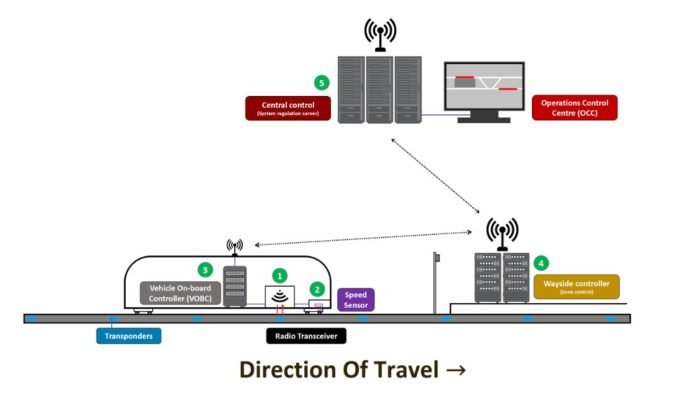
CBTC is a cutting-edge signalling system that aids in managing train movement on the Mass Rapid Transit System (MRTS). In this communications system, information is transmitted wirelessly between trains and the control centre.
CBTC will benefit the commuters in Patna greatly as it will have:
Improved sustainability:CBTC is more energy efficient than traditional manual operation. With automatic speed regulation provided by the system, unnecessary acceleration and braking are not required, which leads to big energy savings. Environmental sustainability will improve with reduced power consumption, and there will be less air pollution.
Improved Safety: CBTC allows for real-time monitoring and control of train movements, which helps to prevent accidents and collisions. The system also automatically detects and reacts to any abnormalities or malfunctions in the train system, increasing the overall safety of the metro.
Increased Capacity and Efficiency: CBTC can increase the frequency and speed of train operations, resulting in faster travel times and more efficient use of the metro system. This allows for more passengers to be transported in a shorter amount of time, reducing crowding and wait times.
Reduced Maintenance Costs: CBTC systems can help reduce maintenance costs as the system constantly monitors and alerts the maintenance team to any potential issues or failures. This allows for preventative maintenance, reducing the likelihood of major failures or disruptions in train services.
Enhanced Passenger Experience: CBTC allows for smoother and more predictable train operations, which can improve the overall passenger experience. Passengers can rely on a more efficient and punctual service, and the system can also provide real-time information on train schedules and delays.
It is to be noted that the CBTC system will reduce the waiting period between two trains and also increase passengers’ commuting capacity. The technology relies on continuous two-way digital communication between each train and the control centre. Each train transmits its location, direction and speed to the control system, which makes necessary calculations for safe travel. The implementation of Communications-Based Train Control (CBTC) technology in the upcoming Patna Metro project is expected to revolutionize the way passengers travel in the city.
Two Special Steel Span for RRTS Corridor Installed in Kondali, Delhi
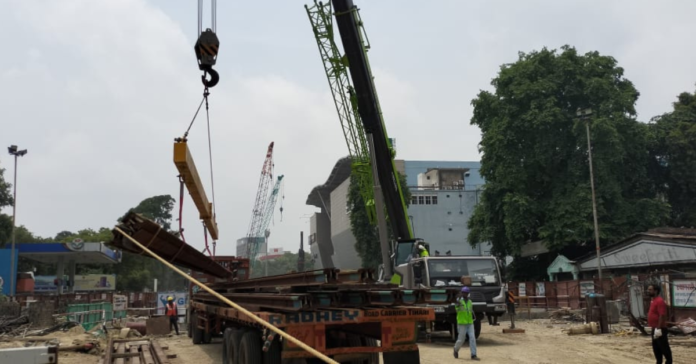
DELHI (Metro Rail News): NCRTC has successfully installed two special steel spans for the RRTS Corridor in Kondali, Delhi. These special steel spans are part of a total of six special span structures being installed to cross the Ghazipur drain from New Ashok Nagar towards Anand Vihar.
The combined length of these 6 special steel spans is 360 meters. This is the only place on the entire RRTS corridor where such a long viaduct is being constructed with steel spans. Out of these 6, two special steel spans have been successfully installed, and work on the third is being done. These two special steel spans, weighing 540 tonnes, have been installed in the Kondli area near the New Ashok Nagar RRTS station.
The RRTS corridor is progressing parallel to the Ghazipur drain. These special steel spans are being installed where the corridor will cross the drain. These spans will also cross over the road near Kondli Chowk. Out of these 6 special steel spans, the length of 3 spans will be approximately 70 meters each, and the remaining 3 will be 50 meters, each weighing 380 tonnes.
default
The spans installed parallel to the Ghazipur drain is about 70 meters long and 14 meters wide. It was placed on the pillars, at the height of about 6 meters from the ground level, with the help of big cranes. Another four spans to be installed in the area are under construction, out of which construction of another 70-meter-long span is almost 50 per cent complete. A little ahead of these spans in the direction of Khichripur, an underground ramp is being constructed, which will connect this elevated section to the underground Anand Vihar Station via Underground tunnels.
NCRTC usually erects pillars at an average distance of 34 meters for the construction of an elevated viaduct of the RRTS corridor. These pillars are joined by pre-cast segments with the help of a launching gantry (Tarini) to form the RRTS viaduct span. However, in some complex areas where the corridor is crossing rivers, bridges, rail crossings, metro corridors, expressways or other such existing infrastructure, it is practically not possible to maintain this distance between pillars. In such areas, steel spans are being used to connect the pillars.
The installation of the steel span near the 40-50 meters wide Ghazipur drain, which is flowing diagonally to the corridor alignment, is a challenging task. Team NCRTC, following all the norms and taking all the precautions, completed it successfully.
Special steel spans are massive structures consisting of beams made of structural steel. Segments of structural steel are first manufactured in the factory and then laden onto trailers brought to the site during the night to avoid any traffic problems.
These parts are then assembled at the site by systematically joining together with the help of a special process. The shape and structure of these steel spans are specially designed to suit all the requirements of construction, installation and usage.
So far, six special steel spans have been installed on the Delhi Meerut RRTS corridor, including a 50-meter-long span at Meerut on the Delhi-Meerut Expressway (DME), a 73-meter-long special span at Vasundhara on the main line of the railway, a 150-meter long span Steel Spans Near Ghaziabad station, two 45 m long steel spans for RRTS viaduct going towards Duhai Depot and 73 m long span for crossing EPE.
The process of lowering the rail commenced at under construction Bada Chauraha underground station of the Chunniganj-Nayaganj underground section.
KANPUR (Metro Rail News): Under Corridor-1 (IIT to Naubasta) of the Kanpur Metro Rail Project, the process of lowering the rail commenced at under construction Bada Chauraha underground station of the Chunniganj-Nayaganj underground section. An 18-meter rail (track) weighing 1 ton was lowered about 17.5 meters below the existing cut-out at the station. In the coming days, about 228 such rails will be brought down, which will be laid in the ‘upline’ and ‘downline’ tunnel between Bada Chauraha and Nayaganj underground station. With this, the process of laying the metro track inside the underground tunnel will begin.
A few days back on July 30, the FBW (Flash Butt Weld) plant at the said station has already been brought down. This plant is utilized for the welding of tracks. Like the elevated metro, the ballastless track will also be utilized for the underground metro.
Advantages of ballastless track:
Ballastless tracks are used in the Metro Projects as they don’t have ballast (stones), and the least maintenance is required.
Metro trains operate continuously for 15-16 hours with tight schedules, leaving minimal time for maintenance. Therefore, an efficient system is crucial to ensure high ridership while minimizing maintenance needs. There are additional benefits of a long life-cycle, stability & ride comfort with such tracks.
At present, under the first corridor of the Kanpur Metro Rail Project, construction work is progressing at a fast pace on the Chunniganj-Nayaganj underground section, on the Kanpur Central-Transport Nagar underground section and also on the Baradevi-Naubasta elevated section.
SHRI CHANDRA PAL SINGH JOINS AS DIRECTOR – WORKS & INFRASTRUCTURE, UPMRC
LUCKNOW (Metro Rail News): Shri Chandra Pal Singh has joined as Director (Works and Infrastructure), Uttar Pradesh Metro Rail Corporation Limited. Shri C.P. Singh was working as the Executive Director in DMRC before joining UPMRC. He has successfully handled significant civil responsibilities in Delhi Metro (DMRC) for the last 17 years. During his tenure, the Noida-Greater Noida Metro created the record of launching 200 U-girders in 1 month twice and was recognised by the LIMCA Book of Records for its fast construction on this 30-kilometre-long section.
Shri CP Singh joined Delhi Metro in 2005 as Deputy Chief Engineer, and in his tenure of 17 years, he has played an essential role in the construction of 42 upstream metro stations built on a total of 60 kilometres.
Under his direct supervision, the construction of the tunnels and 1 metro station of the 2-kilometre-long stretch were executed successfully. In his vast expertise in metro construction, he also made exceptional contributions to the construction work of 2 depots – Greater Noida – NGN Line and Badli – Line – 2.
A civil engineer by profession, he has a vast experience of 30 years in the construction of underground and elevated metro projects, along with other civil structures. Before Delhi Metro, Shri Singh has worked for other Public Sectors under the Ministry of Heavy Industry and Misntry of Health, completing many large civil engineering projects.
Managing Director, UPMRC Shri Sushil Kumar, congratulated Shri CP Singh on taking over as Director (Works & Infrastructure), UPMRC. He said that with his expertise and experience, he will be an asset to UPMRC.
CHENNAI (Metro Rail News): The Tamil Nadu government has given the green light to acquire 28 six-coach trains at a cost of ₹2,820.90 crore for Chennai Metro Rail’s phase I project, including its extension. The decision comes in response to the growing demand and an increasing number of passengers using the metro service.
Chennai Metro Rail Limited (CMRL) conducted a study to assess the need for additional trains in the existing 54-km phase I stretch, and the findings were presented to the State government for approval. The State government’s Planning, Development, and Special Initiatives Department stated that the proposal for external funding from multilateral funding agencies through the Government of India would be made.
Currently, CMRL operates train services for 19 hours a day, from 5 a.m. to midnight, and has 45 trains in operation. However, due to the rapidly rising number of metro users, with passenger numbers reaching 82.5 lakh in July, the decision to purchase 28 more trains with six coaches each was taken to meet the future passenger demand by the year 2028. The estimated cost for this procurement is ₹2,820.9 crore, with funding expected from multilateral funding agencies.
The move is aimed at preparing Chennai Metro to efficiently handle the increasing demand and provide a comfortable commuting experience to its passengers.