Home Blog Page 196

Installation of Two Special Steel Spans Completed in Kondali, Delhi for RRTS Corridor

0
Two Special Steel Span for RRTS Corridor Installed in Kondali, Delhi

DELHI (Metro Rail News): NCRTC has successfully installed two special steel spans for the RRTS Corridor in Kondali, Delhi. These special steel spans are part of a total of six special span structures being installed to cross the Ghazipur drain from New Ashok Nagar towards Anand Vihar.

The combined length of these 6 special steel spans is 360 meters. This is the only place on the entire RRTS corridor where such a long viaduct is being constructed with steel spans. Out of these 6, two special steel spans have been successfully installed, and work on the third is being done. These two special steel spans, weighing 540 tonnes, have been installed in the Kondli area near the New Ashok Nagar RRTS station.

The RRTS corridor is progressing parallel to the Ghazipur drain. These special steel spans are being installed where the corridor will cross the drain. These spans will also cross over the road near Kondli Chowk. Out of these 6 special steel spans, the length of 3 spans will be approximately 70 meters each, and the remaining 3 will be 50 meters, each weighing 380 tonnes.

DJI 0456
default

The spans installed parallel to the Ghazipur drain is about 70 meters long and 14 meters wide. It was placed on the pillars, at the height of about 6 meters from the ground level, with the help of big cranes. Another four spans to be installed in the area are under construction, out of which construction of another 70-meter-long span is almost 50 per cent complete. A little ahead of these spans in the direction of Khichripur, an underground ramp is being constructed, which will connect this elevated section to the underground Anand Vihar Station via Underground tunnels.

NCRTC usually erects pillars at an average distance of 34 meters for the construction of an elevated viaduct of the RRTS corridor. These pillars are joined by pre-cast segments with the help of a launching gantry (Tarini) to form the RRTS viaduct span. However, in some complex areas where the corridor is crossing rivers, bridges, rail crossings, metro corridors, expressways or other such existing infrastructure, it is practically not possible to maintain this distance between pillars. In such areas, steel spans are being used to connect the pillars.

The installation of the steel span near the 40-50 meters wide Ghazipur drain, which is flowing diagonally to the corridor alignment, is a challenging task. Team NCRTC, following all the norms and taking all the precautions, completed it successfully.

Special steel spans are massive structures consisting of beams made of structural steel. Segments of structural steel are first manufactured in the factory and then laden onto trailers brought to the site during the night to avoid any traffic problems.

These parts are then assembled at the site by systematically joining together with the help of a special process. The shape and structure of these steel spans are specially designed to suit all the requirements of construction, installation and usage.

So far, six special steel spans have been installed on the Delhi Meerut RRTS corridor, including a 50-meter-long span at Meerut on the Delhi-Meerut Expressway (DME), a 73-meter-long special span at Vasundhara on the main line of the railway, a 150-meter long span Steel Spans Near Ghaziabad station, two 45 m long steel spans for RRTS viaduct going towards Duhai Depot and 73 m long span for crossing EPE.

Advertisement1
InnoMetro_2026

Kanpur Metro Initiates Rail Lowering in Chunniaganj-Nayaganj Underground Section

0
The process of lowering the rail commenced at under construction Bada Chauraha underground station of the Chunniganj-Nayaganj underground section.

KANPUR (Metro Rail News): Under Corridor-1 (IIT to Naubasta) of the Kanpur Metro Rail Project, the process of lowering the rail commenced at under construction Bada Chauraha underground station of the Chunniganj-Nayaganj underground section. An 18-meter rail (track) weighing 1 ton was lowered about 17.5 meters below the existing cut-out at the station. In the coming days, about 228 such rails will be brought down, which will be laid in the ‘upline’ and ‘downline’ tunnel between Bada Chauraha and Nayaganj underground station. With this, the process of laying the metro track inside the underground tunnel will begin.

WhatsApp Image 2023 08 03 at 15.11.38

A few days back on July 30, the FBW (Flash Butt Weld) plant at the said station has already been brought down. This plant is utilized for the welding of tracks. Like the elevated metro, the ballastless track will also be utilized for the underground metro.

Advantages of ballastless track:

  • Ballastless tracks are used in the Metro Projects as they don’t have ballast (stones), and the least maintenance is required.
  • Metro trains operate continuously for 15-16 hours with tight schedules, leaving minimal time for maintenance. Therefore, an efficient system is crucial to ensure high ridership while minimizing maintenance needs.
    There are additional benefits of a long life-cycle, stability & ride comfort with such tracks.

    At present, under the first corridor of the Kanpur Metro Rail Project, construction work is progressing at a fast pace on the Chunniganj-Nayaganj underground section, on the Kanpur Central-Transport Nagar underground section and also on the Baradevi-Naubasta elevated section.
Advertisement1
InnoMetro_2026

Mr. C.P. Singh Assumes Role as Director – Works & Infrastructure at UPMRC

0
SHRI CHANDRA PAL SINGH JOINS AS DIRECTOR – WORKS & INFRASTRUCTURE, UPMRC

LUCKNOW (Metro Rail News): Shri Chandra Pal Singh has joined as Director (Works and Infrastructure), Uttar Pradesh Metro Rail Corporation Limited. Shri C.P. Singh was working as the Executive Director in DMRC before joining UPMRC. He has successfully handled significant civil responsibilities in Delhi Metro (DMRC) for the last 17 years. During his tenure, the Noida-Greater Noida Metro created the record of launching 200 U-girders in 1 month twice and was recognised by the LIMCA Book of Records for its fast construction on this 30-kilometre-long section.

Shri CP Singh joined Delhi Metro in 2005 as Deputy Chief Engineer, and in his tenure of 17 years, he has played an essential role in the construction of 42 upstream metro stations built on a total of 60 kilometres.

Under his direct supervision, the construction of the tunnels and 1 metro station of the 2-kilometre-long stretch were executed successfully. In his vast expertise in metro construction, he also made exceptional contributions to the construction work of 2 depots – Greater Noida – NGN Line and Badli – Line – 2.

A civil engineer by profession, he has a vast experience of 30 years in the construction of underground and elevated metro projects, along with other civil structures. Before Delhi Metro, Shri Singh has worked for other Public Sectors under the Ministry of Heavy Industry and Misntry of Health, completing many large civil engineering projects.

Managing Director, UPMRC Shri Sushil Kumar, congratulated Shri CP Singh on taking over as Director (Works & Infrastructure), UPMRC. He said that with his expertise and experience, he will be an asset to UPMRC.

Advertisement1
InnoMetro_2026

Chennai Metro Phase 1 to Add 28 Trains with ₹2,820.90 Crore Approval

0
Chennai metro/Representational image

CHENNAI (Metro Rail News): The Tamil Nadu government has given the green light to acquire 28 six-coach trains at a cost of ₹2,820.90 crore for Chennai Metro Rail’s phase I project, including its extension. The decision comes in response to the growing demand and an increasing number of passengers using the metro service.

Chennai Metro Rail Limited (CMRL) conducted a study to assess the need for additional trains in the existing 54-km phase I stretch, and the findings were presented to the State government for approval. The State government’s Planning, Development, and Special Initiatives Department stated that the proposal for external funding from multilateral funding agencies through the Government of India would be made.

Currently, CMRL operates train services for 19 hours a day, from 5 a.m. to midnight, and has 45 trains in operation. However, due to the rapidly rising number of metro users, with passenger numbers reaching 82.5 lakh in July, the decision to purchase 28 more trains with six coaches each was taken to meet the future passenger demand by the year 2028. The estimated cost for this procurement is ₹2,820.9 crore, with funding expected from multilateral funding agencies.

The move is aimed at preparing Chennai Metro to efficiently handle the increasing demand and provide a comfortable commuting experience to its passengers.

Advertisement1
InnoMetro_2026

Chennai Metro Phase II: TBM S1075B Clears Factory Acceptance Test

0
TBM S1075B passes Factory Acceptance Test/ Image by Arjun Dhotre

CHENNAI (Metro Rail News): Chennai Metro Rail Limited (CMRL) is working on an ambitious Phase II project, aiming to build a network of 116.1 kilometres, the first of its kind in India. This extensive project includes three corridors and a total of 119 Metro Stations.

The three corridors are as follows:
Corridor-3: Madhavaram to Siruseri-SIPCOT, covering a distance of 45.8 kilometres.
Corridor-4: Light House to Poonamalee Bypass, spanning 26.1 kilometres.
Corridor-5: Madhavaram to Sholinganallur, with a length of 47 kilometres.

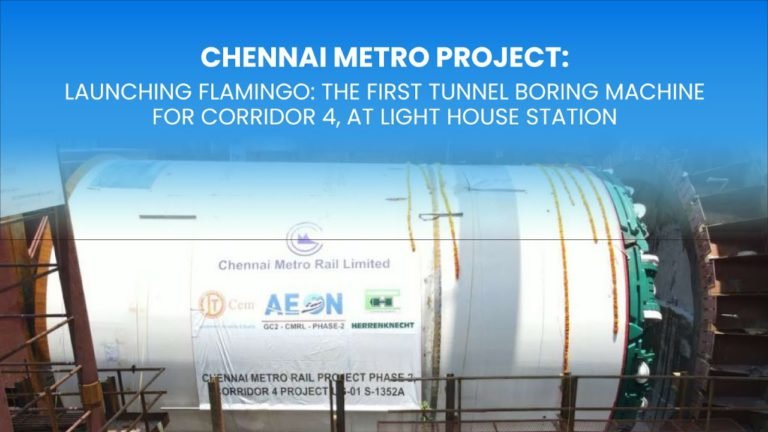
Currently, CMRL is constructing the underground metro rail project corridor 4, which connects Light House Station at Marina Beach to Kodambakkam Flyover. The underground section is divided into two packages, UG-01 and UG-02, each comprising 4 km of twin tunnels. To complete approximately 16 kilometres of tunnelling for both Upline and Downline tunnels, CMRL plans to use four Tunnel Boring Machines (TBMs) manufactured by the renowned German company M/s Herrenknecht, assembled at Herrenknecht India Pvt. Ltd (HAI) in Chennai. These TBMs will be operated by M/s ITD Cementation India Limited, the contractor for CMRL.

The successful Factory Acceptance Test of the 4th and final Tunnel Boring Machine (TBM) for the corridor, which is the 2nd TBM for UG-02 package, took place at the HK factory in Thiruvallur District, Ponneri Thaluk, Alinjivakkam village, Chennai, in the presence of R. Ranganathan, General Manager (Construction) CMRL, and various officials from General Consultants, M/s AEON Consortium.

The Tunnel Boring Machine, known as S1075B, has a bore diameter of 6.670 meters and is 110 meters long Earth Pressure Balance Machine. It weighs approximately 700 metric tons. The machine will be dismantled into parts, packed, and transported to its destination at Panagal Park Station, T Nagar. The construction of the TBM launching Shaft at Panagal Park Station is currently in progress and is likely to be completed for lowering and assembly of the TBM by October 2023.

The Tunnel Boring Machine (TBM) will tunnel at a maximum depth of 26 meters below the ground, starting from Boat Club, Nandanam, Panagal Park, Kodambakkam, and finally reaching the retrieval shaft after Kodambakkam Flyover in September 2024.

Advertisement1
InnoMetro_2026

Mumbai Metro Expansion: Connecting Suburbs and Peripheral Areas

2
Mumbai Metro
Mumbai Metro/ Representational Image

According to SVR Srinivas, Metropolitan Commissioner of the MMRDA, “The important thing is that for the first time in Mumbai, we have a metro network,” “That is significant.” It has been almost a year since the partial launch of Mumbai metro lines 2A and 7. With the inauguration of Phase 2 of the lines by Prime Minister Narendra Modi, Mumbaikars can now travel the length of the city from Dahisar to Andheri in 40 minutes, via Line 2A in the west and Line 7 in the east.

The six-car trains with a capacity of 2,280 passengers will easily be the speedier and more enjoyable option for travel, running parallel to the Western railway line and Western Express Highway (WEH) at 80 kilometres per hour. Their connection to Metro Line 1, which runs from Andheri to Ghatkopar, opens up the east-west corridor to passengers. It is not surprising, then, that the Mumbai Metropolitan Region Development Authority (MMRDA) estimates a tenfold rise in ridership, from a maximum number of riders from around thirty thousand to three lakh per day. It has been projected that by the year 2031, ridership on both lines shall double to almost 6 lakh passengers.

Upcoming Summary

Mumbai’s developing metro network continues to remain far from being completed as planned: 14 lines, 300+ kilometres, over 225 stations, and many interchanges. However, Mumbai residents are now on the verge of another lengthy gap before any new metro rail corridor opens up for them. Many metro lines will open by the end of 2025, but some may be ready to begin operations in 2024.

LineColourCorridorLength (Km)StationsStatusLaunch
Line-1BlueVersova – Andheri – Ghatkopar11.412Operational2014
Line-2AYellowDahisar – DN Nagar18.617Operational2023
Line-2BYellowDN Nagar – Mandale23.620Under Construction2025
Line-3AquaColaba – BKC – SEEPZ33.527Under Construction2025
Line-4GreenWadala – Kasarawadavali32.330Under Construction2025
Line-4AGreenKasarawadavali – Gaimukh2.92Under Construction2025
Line-5OrangeThane – Bhiwandi – Kalyan23.517Under construction2025
Line-6PinkSwami Samarth Nagar – Vikhroli14.713Under Construction2025
Line-7RedDahisar – Andheri (E)16.514Operational2023
Line-7ARedAndheri (E) – CSI Airport3.22Under Construction2025
Line-8GoldCSI Airport – NMIA357Planned
Line-9RedDahisar – Mira Bhayander11.48Under Construction2025
Line-10GreenGaimukh – Mira Road94Tendering
Line-11GreenWadala – Chhatrapati Shivaji Maharaj Terminus12.710Tendering
Line-12OrangeKalyan – Dombivali – Taloja20.717Tendering
Line-13PurpleMira Road – Virar2320Planned
Line-14MagentaKanjurmarg – Badlapur4540Planned

 The current status and expected year of the launch of each Mumbai metro 

Partial opening in 2024 possible

Line 2B: Andheri West to Mandale, in the eastern suburbs

Line 2B, an important east-west connection, is one of the lines that could see a partial start in 2024. It would connect the newly operational Line 2A from its end in DN Nagar in Andheri West to Mandale in the eastern suburbs. It will cross the upcoming Line 3 in Bandra, the Line 4 and the trains at Kurla, and shall meet and connect to the monorail in Chembur. The popular east-west segment, however, will not be the first to open. Only thirty per cent of the construction on the line has been completed. However, Mumbai’s largest Mandale depot has more than fifty-four per cent of its civil work been completed. If Phase 1 opens in 2024, it will only connect DN Nagar to National College in Bandra.

Line 3: Colaba to BKC to SEEPZ

Mumbai Metro 4 1

To say the least, the last year has been an eventful period for the underground Line 3. All of the tunnelling work has been accomplished, more than fifty per cent of the track installation has been completed, and about ninety per cent of the stations have also been constructed. Bids for the Navy Nagar extension were invited. A trial run with the first prototype rake has been performed and carried out successfully, and a second train has also been delivered. Work on the controversial depot in Aarey, which was transferred due to environmental concerns to Kanjurmarg, where it had been stalled in litigation, is now picking up the pace with the construction work now approximately forty per cent complete, up from thirty per cent when it had been paused and suspended. Still, there is a lot of work to be done on the highly awaited line. Phase 1 has been planned to run between BKC and SEEPZ and is expected to begin late this year or early next year. Phase 2 is scheduled to complete a viable alternative to the Western railways and the Western Express Highway (WEH) to Cuffe Parade and, eventually, till Navy Nagar.

Line 4 and 4A: Wadala to Kasarvadavali to Gaimukh

The green Line 4 runs parallel to Line 3 in the eastern suburbs, from Wadala in the south to Kasarvadavali in Thane in the north. It has been planned to travel through Ghatkopar, BS Marg, and Ghodbunder Road until reaching Kasarvadavali. Line 4A, an extension, shall connect the corridor to Gaimukh. It shall intersect with metro lines 2B, 5, 6, 8, the central railway, and the monorail along the route. Forty-three per cent of the civil work on the line has been completed, demonstrating little development since this time last year, when 40-50% of the work had been claimed to be finished. For the past four years, land acquisition for the depot in Mogharpada on Ghodbunder Road has been stalled. The MMRDA requested the land in a letter to the revenue department in January. Bids have been sought for the car shed. Fresh tenders for rolling stock shall also be required, as contracts were cancelled due to the slow development. Line 4A, which consists of two stations, is 45% complete.

Line 5: Thane to Kalyan

The initial and first phase of the orange Line 5, which connects Thane and Bhiwandi, is seventy per cent complete. Phase 2 construction, which would span between Bhiwandi and Kalyan, will begin this year. This phase will be underground in order to avoid the demolition of nearly 1,500 establishment and structures that are both residential and commercial. However, it is on hold due to the Maharashtra government’s pending clearance. The current deadline is December 20, 2025.

Line 9 and 7A: Augmenting Line 7 between CSIA and Mira Road

Lines 9 and 7A are expansions to the recently opened Line 7 between Dahisar and Gundavali in Andheri East. Line 9 shall stretch and extend the corridor north of Mumbai to Mira Road, while Line 7A will connect it to Chhatrapati Shivaji International Airport (CSIA) Terminal 2. The civil work on both the lines has been completed to nearly twenty-five per cent. Farmers in Mira Bhayandar’s Rai, Morve, and Murdha villages have all opposed the depot, fearing for their livelihoods. However, since there are no feasible alternatives, the MMRDA is proceeding with their proposal.

 A map of all the metro lines planned for Mumbai

Under construction

Line 6: Lokhandwala to Vikhroli

Line 6 will be another east-west connector connecting Swami Samarth Nagar in Lokhandwala, Andheri, and Powai to Vikhroli through the Jogeshwari Vikhroli Link Road (JVLR). It is planned to build an elevated road on the first level, allowing for an additional vehicle lane. The civil work on the line is 65% finished. The Maharashtra government is yet to approve the proposed depot at Kanjurmarg on saltpan land for this route. Given the bids for rolling stock, signalling, and communication still needs to be solicited and carried, it may be fair to predict that the line will begin operations in 2025 or later.

In planning

Line 8: Airport Express

In comparison to the other lines proposed for Mumbai, the gold Line 8 is an oddity. It connects the Chhatrapati Shivaji Maharaj International Airport (CSIA) to the Navi Mumbai International Airport (NMIA) through an express route. The 35-kilometre stretch has been planned to have only seven stations. Considering that the NMIA is not expected to begin operations until late 2024 or 2025, there has been minimal development on this route.

Lines 10, 11 and 12: To be tendered

Following an unsuccessful attempt in 2020, the company SYSTRA – DB JV was appointed general consultant for lines 10 and 12. The survey and alignment drawing are currently being prepared. Last August, a draught MoU for cost-sharing with the Mumbai Port Trust has been pending, and the tendering process is yet to begin. Lines 10 and 11 are extensions of the green line; the first connects the Gaimukh, Thane terminus of Line 4 to Mira Road. Line 11, on the other hand, will connect Wadala to CSMT in the south. Line 12 is an extension of Line 5, which runs from Thane to Kalyan, Dombivali, and Taloja.

Lines 13 and 14: Connecting the outskirts of Mumbai

Lines 13 and 14 are two more that are in the planning stages. Line 13 would connect Mira Road and Virar, while Line 14 will connect Vikhroli and Badlapur. Line 14 has emerged as an especially sought line, with a number of campaigns and letters submitted to speed up its construction. It serves the people of Badlapur, Kalyan, Dombivli, Ghansoli, and Airoli who have to commute between Navi Mumbai and Mumbai through crowded central and harbour line trains or congested roads and highways. The MMRDA has planned to assign a consultant to the corridor soon.

Summary & Latest Update

The Metro Rail network in India’s financial capital has been planned to expand to a significant level in the near future. According to the state economic assessment released before the budget, as many as nine Metro lines and stretches are under development in Mumbai, with two of them projected to be operational by 2024. According to the economic analysis, five more metro lines will open in 2025, with two additional lines joining the network in 2026.

Metro 3, commonly known as the ColabaBandra-SEEPZ Line, will be the first to open. Nearly eighty per cent of the construction work has been done, and the route has been planned to open in two stages. The Aarey-BKC section will hopefully open in December 2023, while the BKC-Cuffe Parade section has been scheduled to open in July 2024. Another corridor set to open in 2024 is the Metro Line 6, which will connect Swami Samarth Nagar in Lokhandwala to Vikhroli. This 15.31-kilometre link being an important stretch, shall connect the Western and Eastern Express Highways, passing through Jogeshwari and Powai. In addition, the Mumbai Metro 2B has also been planned to be partially operational in 2024. The 5-kilometre segment between Diamond Garden and Mandale is likely to be operational within a year. The corridor extends from DN Nagar to Mandale.

A 5km segment of Line 9 between Dahisar and Mira Road is also expected to open within a year. Line 9 is an expansion of Line 7 that connects Andheri to CSMIA and Dahisar to Mira Road, thereby stretching and extending the Red Line. The 32.32-kilometre-long Metro Line 4 from Wadala (Mumbai) to Kasarvadavali (Ghodbunder road, Thane) via Ghatkopar, Mulund, and Teen Hath Naka is also under construction. The Mumbai Metro Rail Corporation (MMRC) is in charge for 32.5 kilometres of the 185-kilometre-long Metro 3 route and project, while the remaining section is being developed and executed by Mumbai Metropolitan Region Development Authority (MMRDA).

Mumbai Metro Route in Nutshell

  • The Mumbai Metro Line 1 Aqua Line, also known as the Versova-Andheri-Ghatkopar Line, includes 12 stations. 
  • The Mumbai Metro Line2A (Yellow Line) runs from Dahisar East to Dhanukarwadi. There are a total of nine stations. The Yellow Line is expanding, with eight new stations under construction. It will begin in Dhanukarwadi and terminate at DN Nagar. 
  • The planned and proposed route of the Yellow Line, Line 2 B is D.N. Nagar – Bandra – Mandale, with 22 stations in the middle. 
  • The Aqua Line, also known as Line 3, has twenty-two stations in total. 
  • Line 4 (Green Line) runs through Bhakti Park, Ghatkopar, Thane, and Kasarvadavali. 
  • Line 5 is another name for the Orange Line, which connects Thane, Bhiwandi, and Kalyan through seventeen metro stations along the route. 
  • Line 6 is known as the Pink Line, and it has thirteen stations which stretches from Swami Samarth Nagar to Vikhroli.
  • The Red Line, also known as Metro Line 7, has only four stations. 
  • The Mumbai Metro Orange Line connects Navi Mumbai with Kalyan-Dombivali city. Mumbai metro lines go on, with Line fourteen being the last one.
Advertisement1
InnoMetro_2026

L&T Wins INR 2447Cr Contract for Kolkata’s Joka-Esplanade Metro Corridor

1
Kolkata Metro
Kolkata Metro/ Representational image

KOLKATA (Metro Rail News): Larsen and Toubro Construction has been awarded a significant contract by Rail Vikas Nigam (RVNL) to design and construct the Joka-Esplanade Metro Corridor’s underground metro project in the city. The contract is valued at INR 24,47,91,31,603, as stated in the official announcement.

According to a press release, the major works for the project involve Design and Construction of the Ramp and Underground Metro Railway Works from Mominpur (Excl.) to Esplanade, 5.05 Km ( chainage 9063.00m to 14113.00m), including four underground stations (viz. Khidderpore, Victoria, Park Street and Esplanade), tunnels by Tunnel Boring Machine (TBM) and Cut & Cover methods, architectural finishing works, track works, etc.

Additionally, L&T Construction received another order from a reputable client in the Middle East. This contract involves rehabilitating structures for strategic purposes, making it the first of its kind for L&T in the Middle East market.

Advertisement1
InnoMetro_2026

Chennai Metro Phase II: Ayanavaram Underground Work Begins

0
Chennai Metro
Chennai Metro/ Representational image only

CHENNAI (Metro Rail News): Chennai Metro Rail Ltd.’s (CMRL) phase II underground work has begun at Ayanavaram after completing the Madhavaram and Greenways Road sections.

In the second phase of the project, an underground station will be constructed at Ayanavaram for the Madhavaram-SIPCOT corridor 3. This ambitious phase II project, costing ₹61,843 crore and spanning 116 km, includes two more corridors – Light House-Poonamallee (corridor 4) and Madhavaram-Sholinganallur (corridor 5).

An official stated that three TBMs (Tunnel Boring Machine) named Kalvarayan, Melagiri, and Kolli were deployed recently at the Ayanavaram site. Among them, two TBMs have already started their tunnelling operations. At Ayanavaram, two tunnel boring machines (TBMs) will be used to construct an underground network towards Perambur and Otteri, respectively. Currently, one TBM has already tunnelled about 100 meters towards Perambur, while the other has drilled nearly 50 meters towards Otteri. Additionally, officials mentioned that one more TBM will begin its work next week, and another TBM will be lowered to the site shortly.

The sandy soil in Ayanavaram offers favorable conditions for tunnelling, and CMRL is optimistic that the work will progress smoothly. In other areas like Madhavaram and Greenways Road, tunnelling has been progressing well, with the machines drilling an average of 8-10 meters a day. The authorities hope to maintain this efficiency in the Ayanavaram section as well.

Advertisement1
InnoMetro_2026

Transforming Commuting: Mumbai Metro Lines 4 & 5 and Thane Metro

1
Mumbai Metro/ Representational image only

Infrastructure Development in Thane & Suburbs

Thane has seen a series of infrastructure improvements in recent years, bridging gaps between the city and several other significant places in Mumbai and thereby improving connectivity. Today, Thane has emerged as one of the popular options in Mumbai Suburbs for those seeking the intimacy of city living without having to deal with the chaos of the daily commute. 

Thane provides inhabitants with cosmopolitan lives, complete with retail malls, educational institutions, restaurants, hospitals, and other amenities, as well as amusement parks, botanical gardens, and exquisite riverside promenades. Thane has a number of beautiful lakes and water bodies and important attractions like Kelwa Beach, Masunda Lake, Kanheri Caves, Sanjay Gandhi Park, Kopileshwar Temple, and many more. Thane has good connectivity with the National Highways 3 and 4 as well as the National Highway 8, the Eastern Freeway, the SCLR, the Ghodbunder Road, the Mumbai-Nashik Highway, the Thane-Belapur Road, and the JVLR. The Mumbai-Pune Expressway is also easily accessible. The Trans-Harbour, Central, and Thane-Panvel railway lines provide excellent train connectivity. Thane is also 27 kilometres from the airport. The City of Lakes, Thane, is unquestionably a strong option for both investors and residents in the current scenario, especially now that metro connectivity has been established for the city.

Thane-Wadala Metro and Thane-Bhiwandi-Kalyan Metro Lines

Metro Line 4 in Thane spans 32.32 km from Wadala to Kasarvadavli and comprises 32 stations. It will connect to existing infrastructure links such as the Eastern Expressway, the Central Railway, the Monorail, the ongoing Metro Line 2B (DN Nagar to Mandale), the proposed Metro Line 5 (Thane to Kalyan), the Metro Line 6 (Swami Samarth Nagar to Vikhroli) and the Metro Line 8 (Wadala to General Post Office). This entire route would provide train access to rapidly expanding and developing micro-markets like Wadala and Thane. The Metro will make these marketplaces more accessible and appealing to prospective residents and commuters by cutting current journey time in half. Metro Line 5 would connect the rapidly developing Thane-Bhiwandi-Kalyan corridor with an effective mass transportation system. This elevated section will be 24.9 kilometres long and shall include 17 stations. By 2031, it hopes and aims to have 3.25 lakh daily riders. The proposed Metro line, which would connect Wadala to Kasarvadavli via Ghatkopar and Mulund, will have an interchange facility at Kapurbawdi. 

The Metro line, once operational, shall benefit commuters from Mumbai and Thane. Along with Line 6, this project shall contribute to the development of a circular Metro route in Thane and its integration into the Mumbai Metro network. The Metro link will also help the formation of growth centres like Nilje, Bhiwandi, and Kalyan, resulting in increased demand for various amenities and overall development in these outlying areas. Metro Lines 4 (Kasarvadavli to Wada-la), 4A (Kasarvadavli to Gaimukh), and 5 (Thane-Bhiwandi-Kalyan) are all scheduled and expected to be accomplished by 2025. In addition, twin tunnels connecting Borivali and Thane by road are expected to take up to five years from now. These tunnels will connect Thane’s Tikuji-ni-Wadi to the Western Expressway near Borivali. These tunnels are expected to stimulate the real estate and commercial development in Borivali, Ghod-bunder Road, Thane City, and Dahisar as the travel time between Thane and Borivali shall be reduced to 15 minutes from the current journey and commute time of nearly an hour.

Other major projects

The Inland Water Transport System will connect Vasai-Virar and Kalyan to Mumbai city and suburbs via Thane. There are also projects like Alibaug-Virar Multimodal Corridor, which will divert heavy truck traffic away from Thane, while the Balkum-Ghodbunder Coastal Road and bridges spanning the Ulhas River will help Thane grow through developments in locations that are presently being viewed as future expansion areas- the ‘New Thane’. All of these projects will have a positive impact on Thane’s development. According to the information provided by officials, the Inland Water Transport System would be completed around a year’s time. The Inland Water Transport System will enable smooth and speedier connectivity between Vasai-Virar and Kalyan via Thane, resulting in increased commercial activity and employment opportunities. 

The connections to the road parallel to Ghodbunder Road shall link and connect Gaimukh to Paygaon and Kasarvadavli to Kharbao. These projects will take some time to complete because they are currently in the planning stages. Station Area Traffic Improvement Scheme (SATIS)-2 is also being implemented, with completion expected this year. As these projects are spaced across a long and lengthy corridor, the advantages are expected to spread and diffused across an extensive influence area. The connectors to the road parallel to Ghodbunder Road will help markets on the Vasai-Bhiwandi Road, which will have greater connectivity with Thane and Mumbai. Paygaon and Kharbao are examples of such places. The Thane East SATIS-2 projects shall predominantly help commuters who use public transportation, such as buses and local trains from the Eastern Express Highway, Ghodbunder Road, and beyond.

Residents in Mumbai’s periphery and suburbs are looking for affordable amenities such as sustainable transportation, housing, and other conveniences. Commuters also favour locations that are expanding in an orderly and progressive manner. The construction of flyovers at Mumbra Bypass Junction, Shil Kalyan Phata, Shil Phata, and Kalyan Phata Junction, as well as the widening of the highway and construction of an underpass at Kalyan Phata, which is related to projects such as Thane’s Coastal Road, will allow residents in these areas to choose facilities on Thane’s outskirts. Additionally, an improved connection will help to alleviate traffic congestion. It will also generate new jobs and promote overall growth in the region.

Thane Metro

Thane Municipal Corporation (TMC) has abandoned its plan to establish a light rail transit system in the city in favour of constructing a traditional Thane metro rail system. During its general body meeting in mid-September 2021, the TMC approved and acknowledged a new proposal. Although the 32.32-kilometre-long elevated line of the Mumbai Metro’s Line-4 connects Kasarvadavali near Thane in the north MMR to Wadala in the south, the TMC shall additionally develop an internal metro network to connect other parts of the city. The TMC formerly planned and proposed an internal metro to connect several parts of Thane to Mumbai Metro Line-4, but on the recommendation of the central government, it decided to establish a light rail transit system instead. The idea was made while keeping the cost-effectiveness of the Thane Metro project in view.

Considering Thane’s expanding demographics and burgeoning population, the TMC believes that a traditional metro system would be more appropriate than light rail transit. Moreover, connecting a light rail transportation system to a conventional metro line would not be possible. As a result, the Maharashtra Metro Rail Corporation Limited, or Maha Metro, has proposed building a metro station in Thane with one circular line and 22 stations. The Thane metro line will be a 29-kilometre-long light rail transit (LRT) system. The Thane metro project was originally intended to be a regular or heavy metro line, but due to financial difficulties, the project was redesigned as a light rail transit or a metro line in early 2020.

Thane metro station construction work commenced in 2017. The construction of Metro Line 5 started in December, whereas the development of Metro Line 4 began in October of the same year. Both metro lines 4 and 5 need to first overcome a number of obstacles and challenges. Metro Line 4 has a lot of ground to make up in order to meet the deadline. One of the reasons for the delay has been the approval of the Mogharpada area and plot, which has been planned to be used for the metro car shed. 

The construction of metro line 5 has been divided into two phases: Phase 1 covers the Thane-Bhiwandi route, while Phase 2 covers the Bhiwandi-Kalyan route. The second phase is a little more complicated since its construction will have an impact on a number of establishments and businesses. Therefore, an alternative route seemed to be necessitated. The proposal took the shape of a 3-kilometre underground route. The alternative path is expected to save 735 of the total 1,597 structures that were potentially on the verge of being destroyed and affected. The second phase, which shall include rehabilitation and demolition, is yet to commence. Lines 4 and 5 of the Mumbai Metro will intersect and cross each other near Kapurwadi. The station will connect both lines. Thane Municipal Corporation, TMC, approved the Thane Metrolite’s Detailed Project Report in December 2019, but it is now on hold for clearance from the State government. The Thane metro is scheduled to become operational in approximately five years.

Proposed metro station in Thane

Thane’s metro map is similar to Noida’s Aqua Line and Gurgaon’s Rapid Metro in that the metro stations will be located within the city. The metro will connect to Line 4 at Dongripada and Line 5 at Majiwada junction, with 22 stations along its route and course. In the coming years, the proposed and projected route has been planned to connect the city’s age-old, crowded and congested areas with the newly developed and constructed regions. New Thane, Rayla Devi, Wagale Square, Lokmanya Nagar bus depot, Shivaji Nagar, Nilkanth Terminal, Gandhi Nagar, Ghanekar Theatre, Manpada (Ghodbunder road), Dongripada, Vijay Nagari, Waghbil, Water Front, Patlipada, Azadnagar bus station, Manoranjan Nagar, Kolshet, Balkum, Rabodi, Shivaji Chowk and Thane station is the route of metro proposed. 

The Thane Metro is expected to carry around 5.8 lakh commuters per day, according to Thane Municipal Corporation. During peak hours, about 23,000 passengers are expected to ride. Metro Lines 2A and 7 began partial service on April 2, 2020. The two metro lines cover a 20-kilometre stretch from Dhanukarwadi to Aarey. Dhanukarwadi is served by Metro Line 2A, which connects to Aarey through Metro Line 7. The fare is calculated based on the number of km travelled. However, there are currently no monthly passes available for the commuters. 

Project Development & Timeline

  • December 2018: Thane Municipal Corporation (TMC) approved the DPR.
  • January 2019: The Detailed Project Report (DPR) submitted to Maharashtra Government by Thane Municipal Corporation.
  • March 2019: The DPR approved by the Maharashtra Cabinet.
  • December 2020: Revised DPR for Metrolite approved by the Thane Municipal Corporation.
  • September 2021: The Metrolite plan scrapped, and the revised regular Metro DPR approved by TMC (Thane Municipal Corporation).

Key Information

  • Operational: 0 km
  • Under Construction: 0 km
  • Approved: 0 km
  • Proposed: 29 km
  • Total Estimated Cost: Rs. 7165 crore
  • Thane Metrolite Deadline: 2025

System Specifications

  • Track Gauge: Standard Gauge – 1435 mm
  • Electrification: 25 kV, 50 Hz AC OHE
  • Signalling: Communications-based train control (CBTC)
  • Total Capacity: 300-425 passengers (3 coach train)
  • Thane Metrolite Route Information
  • Length: 29 km
  • Type: Elevated (primarily) and Underground (2-3 km)
  • Number of Stops/Stations: 22
  • Stations: Raila Devi, Wagle Circle, Lokmanya Nagar Bus Depot, Shivaji Nagar, Neelkanth Terminal, Gandhi Nagar, Kolshet Industrial Area, Manpada, Dongripada, Vijaynagar, Waghbil, Waterfront, Patlipada, Azad Nagar Bus Stop, Manorma Nagar, Balkum Naka, Balkum Pada, Rabodi, Shivaji Chowk, Thane Junction (underground) and New Thane (underground).

Metro Line 4 & 5

Metro Line 4

The Mumbai Metro Line 4 (Wadala – Kasaravadavali) metro line is 32.32 km long and has 32 stations from Wadala to Kasaravadavali. The line will connect the Eastern Express Highway, Central Railway, Mono Rail, Metro Line 2B (D N Nagar to Mandale), as well as the proposed Metro Line 5 (Thane to Kalyan), Line 6 (Swami Samarth Nagar to Vikhroli), Line 8 (Wadala to General Post Office) and Line 11 (Wadala to CSMT). On September 27, 2016, the Maharashtra cabinet approved the Metro Line 4 corridor project. Prime Minister Narendra Modi laid the foundation stone of the project on December 24, 2016.

The MMRDA has plans to construct metro car depots, one at Owala village in Thane and the other at Vikhroli. MMRDA is responsible for the entire Metro Line 4 project.

– Kasarvadavali, Vijay Garden, Dongari Pada, Tikuji-Ni-Wadi, Manpada, Kapurbawdi, Majiwada, Cadbury Junction, Mahapalika Marg, RTO Thane, Thane Teen Haath Naka, Mulund Naka, Mulund Fire Station, Sonapur, Shangrila, Bhandup Metro, Bhandup Mahapalika, Naval Housing, Kanjur Marg (Gandhi Nagar), Surya Nagar, Vikhroli Metro, Godrej Company, Shreyes Cinema, Lakshmi Nagar, Pant Nagar, Garodia Nagar, Amar Mahal Junction, Siddharth Colony, Suman Nagar, Anik Nagar Bus Depot, Wadala TT, Bhakti Park Metro are the thirty-two stations covered under the Metro Line 4 corridor plan. At Kasarvadavali Station, commuters can connect to Metro Line 4A and Metro Line 10, Metro Line 5 at Kapurbawdi Station, Metro Line 6 at Kanjur Marg (Gandhi Nagar) Station and Metro Line 2B at Amar Mahal Junction Station. The corridor is expected to cut the current travel time by fifty to seventy-five per cent, depending on road conditions. Construction on the corridor began in June 2018 and is scheduled to be completed in 2023. 

Metro Line 5:

Mumbai Metro Line 5, also referred to as the Orange Line is a 24.90 km elevated line that connects the suburbs of Thane, Bhiwandi, and Kalyan. The line will have 17 stations in total and will be built in two parts. It will also link the current Metro Line 4 (Wadala to Kasarvadavali), the proposed Metro Line 12 (Kalyan to Taloja), and the existing Central Railway. This will greatly improve rail-based access to commercial and government entities, as well as geographical landmarks, in these locations. Work on Phase 1 from Thane to Bhiwandi is now underway. The Maharashtra government cabinet approved the Detailed Project Report (DPR) for the Orange Line in October 2017 for Rs 8,416 crore. In December 2018, the Prime Minister laid the foundation for the project. The Orange Line is scheduled to open in 2025, featuring a number of interchanges and will connect to other metro lines such as the Green Line-4 at Kapurbawdi and the Navi Mumbai Line-1 at Taloja, as well as bus and suburban rail services all through its route.

Metro Line 5 will considerably reduce existing travel times, providing passengers with a more convenient and efficient form of transportation once completed. Commuters are expected to save 50% to 75% on travel time. The Orange Line is expected to give much-needed respite to inhabitants of Thane, Bhiwandi, and Kalyan, who currently rely on buses and local trains for travel to Mumbai.

The Urban Development Department of the Maharashtra government has approved the construction of a 3-kilometre underground stretch as part of the second phase of Mumbai Metro Line 5, which connects Thane to Kalyan through Bhiwandi.

The Mumbai Metropolitan Region Development Authority (MMRDA), the city’s infrastructure development agency, has put on hold the work on the underground section between Dhamankar Naka and Temghar, which is part of the 11.8-kilometre-long second phase from Bhiwandi to Kalyan. Temghar is part of the second phase of the 11.8-kilometre-long route connecting Bhiwandi and Kalyan. The MMRDA stated that the intention was to remove the 3 km stretch underground since restoration would be difficult due to the number of structures in the vicinity. According to officials, more than seventy per cent of the work on the elevated 12.7 km route connecting Thane and Bhiwandi had been completed under Phase 1.

Salient features of Metro Lines 4 and 5

Metro 4

Project cost: Rs. 14,549 Cr

Ridership in 2031: 12.13 lakh

Metro 5

Project cost: Rs. 8,416.51 Cr

Ridership in 2031: 3.025 lakh

With the ongoing Metro Line 4 work being delayed for the past four years, the MMRDA has decided to change some of the previous subcontractors to expedite the construction work; the two lines connecting Thane to different cities will have a combined estimated ridership of over 15 lakh commuters by 2031. As per authorities, the work on Metro Line 4, which would connect Wadala in Central Mumbai to Gaimukh in Thane and Line 5, that will connect Thane, Bhiwandi, and Kalyan, will not be completed until 2025. By 2031, the combined ridership of the two lines is expected to exceed 15 lakhs. The first phase of Line 5 is currently under construction. Metro Line 4 construction began in October 2018, while construction on Line 5 started in December 2017.

Both routes had been littered with a number of difficulties. Metro Line 4 is currently running much behind schedule. The finalisation of the Mogharpada plot for the Metro car shed had been one of the principal reasons for the delay. The Mogharpada plot is owned by the government with no CRZ restrictions. Mogharpada is inhabited by approximately 4,000 people and 1,200 families. Around 200 farmers claim that, although the land is owned by the government, it was leased to them for agriculture in 1960. They have raised certain demands before the authorities in order to secure and obtain the land.

In Kapurbawdi, Metro Lines 4 and 5 will intersect. A station will be built here to connect both lines. According to MMRDA, the construction work of Metro Line 4 is running behind schedule, whereas Metro Line 5’s first phase is on time. The bulk of the pillar construction work for Metro Line 4 has been completed, and work on the stations is underway. Although girders have been installed at multiple places, the construction on this route (Metro Line 4) is well behind schedule. Around thirty per cent of Metro Line 5’s phase 1 work has been completed. Metro Line 5 is divided into two phases: Phase 1 comprises the route from Thane to Bhiwandi, and Phase 2 includes the route from Bhiwandi to Kalyan. A lot of institutions and establishments are expected to be impacted during the second phase. As a result, a new 3km underground route has been planned and designed, which shall protect and safeguard more than seven hundred of nearly sixteen hundred structures that had been formerly envisaged to be affected. The repair and demolition of establishments in Phase 2 is yet to begin.

These two Metro lines are critical for reducing the pressure on trains, as a majority of people from Thane, Bhiwandi, and Kalyan commute to Mumbai for work. In addition, with construction work going on in most parts of the city, regular commuters suffer and face multiple traffic-related problems. If the construction is delayed further, it might lead to various troubles during the monsoon.

Summary

The Mumbai Metro is expanding, with the completion of the MMR’s first metro viaduct that shall cross a water body. The final span of the 550-meter-long Kasheli Creek Metro viaduct was recently completed as part of Phase I of Mumbai Metro Line 5, which connects Thane to Kalyan through Bhiwandi. The Mumbai Metropolitan Region Development Authority (MMRDA) is the project developer for Metro Line 5.

The Thane-Kalyan Line’s Phase 1 will be elevated. Phase 2 is still in the planning stage. The line will also connect to Metro Line 4, which runs from Wadala to Kasarvadavli. The Kasheli Creek Bridge is the first to exceed 15 metres above a body of water, with 15 segments and 13 spans, nine of which are on the water. Each bridge measures 42.23 metres in length. The spans have been constructed in 123 days, or around four months, using launching girders.

The Mumbai Metro Rail Corporation (MMRC) will commence construction of Metro Line 12 in the next months. Metro Line 5 Thane-Bhiwandi-Kalyan passes through APMC Market Kalyan. Taloja is located in Navi Mumbai. Kalyan and Taloja will be connected by Metro Line 12. Work will start soon. APMC Market Kalyan will serve as an interchange for Metro Line 12, popularly known as the Kalyan-Taloja line. Thane, Bhiwandi, and Kalyan are Mumbai’s eastern suburbs and popular residential areas. Kapurbawdi, Balkum Naka, Kasheli, Kalher, Purna, Anjur Phata, Dhamankar Naka, Bhiwandi, and Gopal are among the stations on the Thane-Kalyan line. The project will cost INR 5,494 crores. The Japan International Cooperation Agency is funding the project. The completion date is set for October 2025. Ridership is projected to reach 1.92 lakhs by 2031.

Maharashtra Metro Rail Corporation Limited (Maha Metro) plans to build a 29-kilometre light rail transit (LRT) system in Thane, Maharashtra, with one circular route and 22 stations. Thane’s mass transport project was originally planned as a standard (heavy) metro line, but it was abandoned in 2019 owing to financial issues and then resurrected as a metrolite or light rail transit (LRT) system in early 2020. The system will be developed in accordance with the Government of India’s July 2019 metrolite specifications, meaning that it would be cheaper to construct (about Rs. 100 crore/km), operate and maintain due to its smaller size and lower capacity compared to regular heavy-rail metro systems.

Metrolite trains will primarily operate at-grade (road level) on dedicated/fenced-in corridors and will serve as an excellent feeder to the Mumbai Metro (Line-4 Green Line & Line-5 Orange Line) and local suburban train system. Its standard gauge system will be developed with trains capable of reaching speeds of up to 60 km/h. Two of the 22 stations will be underground, with the remaining being elevated. A train maintenance depot has been planned to be set up at Wadavli. Thane Metrolite’s Detailed Project Report was approved by Thane Municipal Corporation (TMC) in December 2020 and is now awaiting clearance from the state government.

Project Cost, Ridership & Metro Stations 

According to the earlier proposals, the Thane Metro, which is expected to cost Rs 10,000 crores, will be funded by the centre and the Maharashtra government, accounting for thirty-three per cent of the project cost, with TMC arranging the remaining funds through low-interest loans. According to forecasts and projections made by the Thane Metro Corporation in 2019, the Thane Metro is expected to carry 5.76 lakh people every day, with peak-hour ridership estimated to exceed more than 23,000 commuters. The initial Detailed Project Report (DPR) called for 22 metro stations spread across 29 kilometres. The internal Thane Metro has been planned to connect to the Wadala-Kasarvadavli Metro at two points: the planned and proposed New Thane station and Dongripada. It shall also link Mumbai Metro Line-5 (Thane-Bhiwandi-Kalyan) at Majiwada.

Advertisement1
InnoMetro_2026

PM Narendra Modi Inaugurates Pune Metro’s Two Completed Stretches

0
PM Modi flags off Pune Metro's two completed Sections

PUNE (Metro Rail News): On Tuesday, Prime Minister Narendra Modi inaugurated the completed sections of Pune Metro Phase I, which include the stretches from Phugewadi to Civil Court and Garware College to Ruby Hall Clinic stations. These sections have a total of 11 stations each and cover a distance of 12 km. The foundation stone for this project was laid by the Prime Minister in 2016.

The stretch from Garware College to Ruby Hall Clinic is elevated, while trains will run on both elevated and underground sections between Phugewadi and Civil Court.

On Monday, a trial run was conducted ahead of the inauguration between Ruby Hall Clinic and Shivajinagar stations. From now on, commuters can use the Metro to travel from Pune to Pimpri, as well as to Pune and Shivajinagar railway stations.

The Metro stations have been designed with at least one entry-exit gate, allowing commuters to access the concourse level and platforms easily. Metro services will be available from 7 am to 10 pm, with a frequency of trains every 10 minutes during rush hours and every 15 minutes in non-peak hours.

Notably, the Civil Court metro station is one of the deepest in the country, having the deepest point at 33.1 m., and has a unique design that allows direct sunlight onto the platform. Some metro stations draw inspiration from Chhatrapati Shivaji Maharaj’s iconic elements.

These new Metro sections will connect important locations in Pune, making commuting easier and more convenient for the citizens.
The Prime Minister’s vision for modern and eco-friendly mass rapid urban transport systems across India is furthered by this inauguration.

Advertisement1
InnoMetro_2026