Home Blog Page 176

Pune Metro Extension Phase 01 Gets a Green Nod

0
Pune metro
Pune metro

PUNE (Metro Rail News): The Ministry of Housing & Urban Affairs approved the 4.413 Km extension of the Pune metro’s Purple line at an estimated cost of Rs 910.18 Crore. The line is proposed to be extended from Pimpri Chinchwad Municipal Corporation (PCMC) to Nigdi. 

The proposed extension includes the construction of elevated stations at Chinchwad, Akurdi & Nigdi. The DPR was approved by the Maharashtra Government in February 2021 & received PIB sanction in September 2023. 

MMRC has already floated tenders for appointing a general consultancy to speed up the work and make a social impact assessment of the project.

The proposed expansion will add a length of 4.413 Km to the Pune metro, which already exists at 54.14 Km, divided into three lines, of which 27.15 Km length is operational as of now. ‘


Discover the endless possibilities of our city’s Metro at InnoMetro, our flagship Expo and Conference. Be an active participant in shaping its future towards a more sustainable tomorrow. Stay informed and join us to take a step towards a brighter future.
Advertisement1
InnoMetro_2026

PM Modi Is Likely to Inaugurate The Navi Mumbai Metro on 30th October 2023

0
PM Narendra Modi
PM Narendra Modi

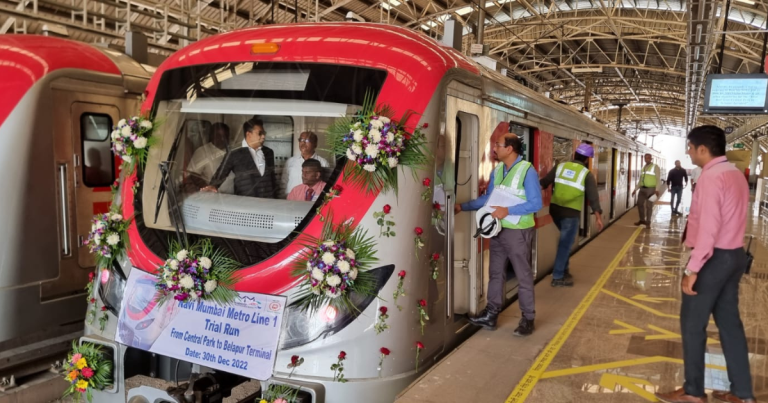
NAVI MUMBAI (Metro Rail News): Prime Minister Narendra Modi will likely inaugurate The Navi Mumbai metro between Belapur & Pendhar on Monday 30th October 2023. 

The Navi Mumbai Metro CIDCO agency has invited bids to organise the inauguration ceremony on 30 October 2023. The inauguration was expected to be held on October 13 14, followed by October 17. Finally, considering the availability of the Prime Minister, 30th October has been finalised for the inauguration. 

The Prime Minister will also launch the Namo Women Empowerment Campaign at the Navi Mumbai International Airport site, with about a lakh or more women from self-help Groups joining him. 

Navi Mumbai metro Line 1 runs Belapur and Pendhar with 11 stations covering a distance of 11 kms. It also entails a dedicated maintenance depot at Taloja & two traction sub-stations positioned at Panchanand and Kharghar. CIDCO, the agency responsible for Navi Mumbai Metro Operations, has appointed the Maha Metro to manage the operations of Line 1. 


Discover the endless possibilities of our city’s Metro at InnoMetro, our flagship Expo and Conference. Be an active participant in shaping its future towards a more sustainable tomorrow. Stay informed and join us to take a step towards a brighter future.
Advertisement1
InnoMetro_2026

First PSC Box Girder Span Erected on Surat Metro’s CS4 Project

0
First PSC Box Girder Span Erected on Surat Metro’s CS4 Project
First PSC Box Girder Span Erected on Surat Metro’s CS4 Project P.C: Anuj Chokshi

AHMEDABAD (Metro Rail News): Ranjot Buildcon Ltd erected the first PSC box girder of the CS4 package of Surat Metro running between Sarthana & North Ramp. The package lengths to about 4.15 km. 

Ranjit Buildcon was awarded the contract for the CS4 Package of the Surat metro in July 2023 at an estimated cost of Rs 384.47 Crores, including the construction of a 4.15 Km elevated viaduct with four metro stations. 

CS4 Pacage is the fourth and final section of 22.7 Km Line 1, which will connect Sarthana-Dream City via 20 stations. It includes four elevated stations at Sarthana, Nature Park, Varaccha Chopati Garden and Shri Swaminarayan Mandir Kalakunj in the northeast part of the city.

Surat Metro is an under-construction mass rapid transit system consisting of two lines totaling 40.35 kilometers at an estimated cost of 12, 020.32 Crores. The two lines, the Red line & Green line, Connect Sarthana to Dream City with 20 stations in between, while the other connects Bhesan to Saroli with 18 stations. 


Discover the endless possibilities of our city’s Metro at InnoMetro, our flagship Expo and Conference. Be an active participant in shaping its future towards a more sustainable tomorrow. Stay informed and join us to take a step towards a brighter future.
Advertisement1
InnoMetro_2026

Engineers Develop Himalayan Tunnelling Method for Katra-Banihal Section of the Kashmir rail Link Project

0
Udhampur- Srinagar- Baramulla Rail Link

New Delhi (Metro rail News): The Engineers involved with the construction of the Kashmir Rail Link have developed a new Tunneling Method called the Himalayan tunnelling method to construct Tunnel-01 on the Katra-Banihal section of the  Kashmir rail link project. 

The length of the Tunnel would be 3.2 km with a tube shape. It is located at the foot of Trikuta hills in the Katra-Reasi section of the Project. The section has been termed as the most trickiest section of the project. 

To count, the challenges are: 

  1. Mountainous Terrain: The area is characterised by steep, mountainous terrain with varying elevations. The Himalayan mountains are known for their high peaks, deep valleys, and rugged landscapes. Such a terrain poses heavy and indispensable challenges for constructing Tunnels, etc. 
  2. Geological Challenges: The Himalayas are geologically active, with tectonic forces continuously shaping the landscape that results in complex geological conditions, such as the presence of different types of rocks, fault lines, and potential for landslides, which can pose significant challenges for tunnel construction.
  3. Harsh Weather Conditions: The Himalayan region experiences extreme weather conditions, including heavy snowfall in the winter and monsoon rains in the summer that can lead to issues such as snow accumulation, landslides, and flooding, which need to be considered in the design and construction of infrastructure projects like railways.

The New Tunneling method involves providing pre-excavation support measures to tackle the flowing conditions encountered while excavating the tunnel. It aims to stabilise the soil and rock structure before excavation begins. It differs significantly from NATM, as NATM primarily relies on immediate support using lattice girders and shotcrete after excavation. 

This method involves making stress-release holes and wing drainage holes to allow the strata to relax and lose water. This is done to address the geological challenges of the Himalayan terrain. NATM may use different methods for dealing with groundwater and strata pressure, but it doesn’t mention stress-release and drainage holes as part of its standard procedure.

The Himalayan Method is specifically developed to address the unique challenges of the Himalayan geological conditions. In contrast, the NATM is a widely recognised tunnelling method used in various parts of the world, including Austria, and adapted to local geological conditions.

The engineers also had to change the alignment of the train to ensure that a very short length of the rail link passed through the tricky terrain. 

Work on the rail link has held up since 2017, but the engineers hope to complete it by early next year. The project involves the construction of 27 main tunnels & 8 escape tunnels, along with 37 bridges that include 26 Major & 11 Minor bridges. 


Discover the endless possibilities of our city’s Metro at InnoMetro, our flagship Expo and Conference. Be an active participant in shaping its future towards a more sustainable tomorrow. Stay informed and join us to take a step towards a brighter future.
Advertisement1
InnoMetro_2026

Nagasandra to Madavara and RV Road to Bommasandra stretches of Bangalore metro to be active by April 2024

0
CM of Karnataka made the affirmation in his address after the inauguration of two stretches of the Purple Line.

BANGALORE (Metro Rail News): Chief Minister of Karnataka on Friday affirmed that the Nagasandra to Madavara (3.14 km) and RV Road Metro Station to Bommasandra (19.15 km) will be made open for Public use by April 2024. 

Nagasandra to Madavara is the northern extension of 3.8 Km or the green line that currently runs north to south and connects Nagasandra in the northwest to Silk Institute in the southwest. Covering a distance of 30.4 kilometres. It runs through key industrial areas like Peenya & Yeshwanthpur in the north and Commercial Hubs like City Market and Majestic. 

The RV Road Metro Station to Bommasandra stretch runs along ORR & Hosur Road and is called the Yellow Line. This line will increase the metro accessibility for the population in Electronic City & Bommasandra industrial areas. Currently, the Bangalore metro has two active lines, namely Green Line & Purple Line, taking its total operational length to about 74 km. 

The Chief Minister also requested the Prime Minister to approve the DPR for Phase III of the Bangalore metro, which entails two lines. First connecting JP Nagar to Kempapura & the Second connecting Hoshalli to Kadbagere. The total length for Phase III would be 45 km. 


Discover the endless possibilities of our city’s Metro at InnoMetro, our flagship Expo and Conference. Be an active participant in shaping its future towards a more sustainable tomorrow. Stay informed and join us to take a step towards a brighter future.

Advertisement1
InnoMetro_2026

NAGPUR METRO: A METRO SYSTEM FOR EVERYONE WITH A FEEDER BROAD GAUGE METRO 

0
Pune metro
Pune metro

Nagpur Metro: An Overview

Nagpur Metro Rail is Maharashtra’s new rapid transport system. The MRTS spans 38.21 kilometres. Nagpur Metro is a modern public transportation system that operates in Nagpur City. It is in its early stages, with 24 metro stations and a total route length of 26.1 km. Nagpur Metro is being constructed in two phases, each with a single line. The system is based on a three-coach train that travels at Nagpur Metro and operates on standard gauge lines with overhead wires producing 25 kV AC. The vehicle’s maximum speed is 90 kilometres per hour, while its average speed is 33 kilometres per hour. The concept was proposed in 2012 when cities with a population of over 20 lakh became eligible for a metro rail system. The government’s decision made twelve cities in India eligible for metro rail, including Nagpur. Then-Union Minister for Urban Development Kamal Nath suggested a metro rail in Nagpur and sought a detailed project study from the state government. The Nagpur Improvement Trust (NIT) signed a deal with the Delhi Metro Rail Corporation (DMRC) on February 22, 2012, to develop the Detailed Project Report (DPR) for Nagpur’s metro rail. The Central Ministry allocated Rs. 2.4 crore to the State Government to carry out the comprehensive and detailed project work.

The Cabinet approved and permitted the establishment of Nagpur Metro Rail Corporation Limited (NMRCL), currently designated and known as Maharashtra Metro Rail Corporation Limited (MAHA-METRO), to carry out the project. Maha Metro is a Special Purpose Vehicle (SPV) formed to ensure the seamless execution and operation of the Nagpur Metro Rail Project. It is a 50:50 joint venture between the Government of India and the Government of Maharashtra. Maha Metro will exclusively be responsible for the project’s successful and timely completion and ongoing operations.

The initial cost of Phase I of the metro project was expected to be around Rs. 8,650 crores, which was later revalued and the final cost was estimated to be Rs. 9,279 crores. The Maharashtra government approved the project in February 2014. The Union Cabinet also approved the project on August 20 2014. PM Narendra Modi laid the foundation stone on August 21 during his visit to the city. The project’s construction began on May 31, 2015, with the trial run beginning on September 30, 2017.

On March 8, 2019, the Prime Minister, Maharashtra Chief Minister Devendra Fadnavis and Union Cabinet Minister Nitin Gadkari inaugurated the operations of the Nagpur Metro.

Through video conference. With the inauguration, Nagpur Metro became India’s 13th operational metro system. Nagpur Metro is referred to as the country’s greenest metro system. The then Chief Minister of Maharashtra, Uddhav Thackeray, inaugurated a 1.6-kilometre extension between Sitabuldi and Kasturchand Park on August 21, 2021. This included the Zero Mile Freedom Park station, which also features a 60,000-square-foot park and a 20-story skyscraper created by a French architect. On December 11, 2022, Prime Minister Narendra Modi formally inaugurated Phase 1 of the Nagpur Metro and laid the groundwork for Phase 2. Phase II work is currently underway.

Metro Lines:

Nagpur Metro currently has two lines in operation.

They are as follows:

Sitabuldi to Khapri:

The Orange Line Metro or Line 1

Sitabuldi to Lokmanya Nagar:

The Aqua Line Metro or Line 2

Orange Line in Nagpur Metro Rail

Line 1 is also known as the Orange Line. It opened its first section to passengers and travellers on March 8, 2019. The distance covered by the Orange Line is 13.5 kilometres, starting from Sitabuldi and ending at Khapri station. There are now eleven stoppages on the route, with twenty stations planned. Line 1 runs north-south, connecting the city’s core and southern districts. The Orange Line has been extended in both directions, with 20 stops and a travel length of about 23 km. It runs from Khapri to Metro City in the south and from Sitabuldi to Automotive Square in the north.

Aqua Line

The Aqua Line, which runs from Prajapati Nagar to Hingna Mount View Metro Station, has 19.407 kilometres and 21 stations. The Aqua Line’s metro stations are all elevated. On January 28, 2020, the Nagpur Metro’s Aqua Line became partially operational. Both the Aqua Line and The Orange Line share a single interchange station.

The North-South Corridor: Orange Line

Khapri, New Airport, Airport, Ujwal Nagar, Jayprakash Nagar, Chhatrapati Square, Ajni Square, Rahate Colony, Congress Nagar, Sitabuldi, Zero Mile, Kasturchand Park, Gaddigodam Square, Kadvi Square, Indora Square, Nari Road, and Automotive Square are the stations on the Orange Line.

East-West Corridor: Aqua Line

Prajapati Nagar, Vaishno Devi Square, Ambedkar Square, Telephone Exchange, ChittarOli Square, Agrasen Square, Dosar Vaisya Square, Nagpur Railway Station, Sitabuldi, Jhansi

Rani Square, Institute of Engineers, Shankar Nagar Square, LAD Square, Dharampeth College, Subhash Nagar, Rachana Ring Road Junction, Vasudev Nagar, Bansi Nagar and Lokmanya Nagar are the various stations along the Aqua Line.

Interchange Station

The Sitabuldi Metro Station in Nagpur’s Sitabuldi area shall act as an interchange station for commuters desiring to switch their journey or transition from the Orange Line to the Aqua Line. The station is a T-shaped structure of 250,000 square feet.

Metro Connectivity

Initiatives such as battery-powered vehicles are also a part of the Nagpur Metro project; it provides pedestrian facilities and options like bicycle sharing and vehicle renting for last-mile connectivity. Twenty-four metro stations are operational, while fourteen metro stations are under construction. Further, the total route length planned for the Nagpur Metro Rail is 43.8 kilometres.

Station Facilities

Every station of the Nagpur Metro station is being built distinctively, with the motto ‘Metro for Everyone.’ In addition to convenient access, these metro stations have a childcare facility room and CCTV surveillance. Further, these metro stations offer first-rate facilities for physically disabled travellers and provide multi-modal amenities.

Automated Fare Collection System

Nagpur Metro Rail Ticketing is a cutting-edge Automated Fare Collection System that uses Contactless Fare Media Technology. The fare collection process categorises metro stations as paid or unpaid. Automatic entry/exit gates and barriers separate the paid and unpaid zones. It ensures that only those who have a valid ticket can enter the system. The system is designed to be closed with ticket checks at entry and exit, ensuring that all tickets are checked a hundred per cent % of the time.

Tickets for Contactless Smart Cards (CSC) and Contactless Smart Tokens (CST) are available. Tokens are pre-paid fare media that can travel between fixed stations. Tokens, purchased for a single or return trip, are a better fare media option for occasional riders. Contactless Smart Cards have stored-value cards that can be monetary (e-Purse), non-monetary (Pass), or a combination of both, and offer a variety of features to entice regular and frequent users.

The AFC System accepts a variety of passes/tickets and has a price structure based on stage. It’s also extensible and adaptable enough to support alternative fare structures/ ticketing options, such as flat fares, time-based fares, free transfers across modes, etc.

SBI MAHA Card

As consortium leader, SBI and its AFC and System Integrator partners implemented the Nagpur Metro Project’s Automated Fare Collection (AFC) system. The MAHA Card contains a stored value balance allowing offline transactions at Nagpur metro stations. After concluding the journey, passengers must tap their MAHA Card at the platform’s entry gate and then again at the destination station’s exit gate.

The card incorporates a dual interface (EMV chip) with stored value functionality for a secure, convenient, and seamless payment process. Metro riders can obtain an MAHA Card by applying at a metro station’s ticket counter. Before authenticating a one-time PIN provided to their phone number, commuters must fill up basic information in an application form. Commuters must pay a one-time card issuing charge of INR 150 after completing the application process and then top up the card with a minimum of INR 100 and multiples of INR 100, up to INR 2,000, for hassle-free metro travel. The MAHA card features a one-of-a-kind feature called stored value balance, which allows users to undertake offline transactions at Nagpur Metro stations. After the exit tap, The fare amount will automatically deducted from the card’s stored value balance. Ticket Readers (TRs) at metro stations allow commuters to check the balance of their MAHA cards.

App for Purchasing Tickets

The Nagpur Metro’s official ticketing mobile application makes purchasing tickets simple and easy. It allows the users to order tickets, look up station information, check routes, see first and last train schedules, and locate nearby tourist sites. It also allows passengers and travellers to contact the metro station and provide feedback on its services and features. Metro riders will find all the necessary information in the app, including how to purchase a ticket. The app is handy for tourists since it takes visitors and passengers to the nearest Metro station and sites of interest and provides other transit-related information.

Guinness World Records

The Nagpur metro has achieved the coveted Guinness World Record for building the largest double-decker viaduct for a metro line. The Nagpur Metro Wardha Road, part of the viaduct, is approximately 3.14 kilometres long. Brajesh Dixit, MD of Maharashtra Metro, received the record certificate from the Guinness World Record management at the elicitation ceremony. He stated that building the viaduct was one of the most challenging aspects of the metro project.

The Asia and India Books of Records have already recognised the stretch as the longest viaduct in Asia and India, respectively. The concerned viaduct is a double-decker viaduct built in collaboration with the National Highways Development Authority (NHAI) and Maharashtra Metro. While the first layer has an existing highway, the second layer has a flyover highway, and the third tier has Nagpur metro rail. The flyover highway is nine metres above the ground, while the Nagpur metro level is roughly twenty metres. A similar construction has also been proposed for Pune’s Ganeshkhind Road.

The Nagpur Broad Gauge Metro

Nagpur Broad Gauge Metro is a 268.63 km regional rapid transit system (RRTS) that proposes to use existing Central Railways tracks to connect Nagpur with nearby towns Wardha, Katol, Narkhed, Ramtek, and Bhandara via a modern, comfortable railway system. The DPR (Detailed Project Report) for Nagpur Broad Gauge Metro was prepared by Urban Mass Transit Company (UMTC) in 2019, which envisioned the project to cost Rs 418 crore, half of which has been expected to be incurred and spent buying present-day rolling stock and equipment. The Railway Board approved the DPR in November 2019, and the Maharashtra state cabinet approved it in October 2020. The DPR proposes a loan covering seventy per cent of the overall cost, with the other thirty per cent to be financed and shared equally between Maharashtra and the central government.

Project Detail & Key Information: 

• Operational: 0 km

• Under Construction: 0 km

• Approved: 0 km

• Proposed: 268.63 km

• Top Speed: 200 Kmph

• Operating Speed: 160 Kmph

• Track Gauge: Broad Gauge (1676 mm)

• Rolling Stock: 3 coaches (DT-T-DT)

• Capacity: 885 passengers

• Expected Deadline: 2025

Cost Details

• Project Cost: Rs 418 Crores

• Rolling Stock: Rs. 200 cr

• Depot: Rs. 80 cr

• Station Integration with Nagpur Metro: Rs. 25 cr

Station upgrades: Rs 23.12 cr

IT Infrastructure: Rs. 15 cr

Automatic Fare Collection (AFC) System: Rs. 11.64 cr

Pre-operative / Admin Expenses: Rs. 4.97 cr

Taxes: Rs. 48 cr

Route Information

Line 1: Nagpur – Wardha

Length: 78.8 km

Estimated Daily Ridership: 5,669

End-to-End Travel Time: 70 mins

Number of Stations: Thirteen (13)

Stations: Nagpur Junction, Ajni, Khapri, Gumgaon, Bori, Borkhedi, Sindi, Tuljapur, Dahegaon, Seloo Road, Varud, Sewagram, Wardha Junction. 

Line-2: Nagpur – Narkhed

• Length: 85.53 km

• Estimated Daily Ridership: 2,616

• End-to-End Travel Time: 75 mins

• Number of Stations: Eleven (11)

• Stations: Nagpur Junction, Godhani, Bharatwada, Kalmeshwar, Kohali, Sonkhamb, Metpanjra, Katol, Kalambha, Tinkheda, Narkher Junction

Line-3: Nagpur – Ramtek

• Length: 41.6 km

• Estimated Daily Ridership: 3,929

• End-to-End Travel Time: 60 mins

• Number of Stations: 7 (Seven)

• Stations: Nagpur Junction, Kalamna, Kamptee, Kanhan Junction, Dumri Khurd, Amdi Halt, Ramtek

Line-4: Nagpur – Bhandara Road

• Length: 62.7 km

• Estimated Daily Ridership: 2,556

• End-to-End Travel Time: 55 mins

• Number of Stations: 8 (Eight)

• Stations: Nagpur Junction, Kalamna, Kamptee, Kanhan Junction, Chacher, Rewral, Khat,

Bhandara Road

The commuter rail project (Nagpur BG-Metro) planned for Nagpur and extended up to adjacent areas of Wardha, Yavatmal, Narkhed, Ramtek, Bhandara, Amravati, Wadsa, and Chhindwara (also Nagbhid shortly) in Maharashtra’s Vidarbha region has been planned to be executed by Maharashtra Metro Rail Corporation Limited. According to sources, the first broad gauge metro will run via Wardha in December 2023 on the Nagpur to Yavatmal line.

Urban Mass Transit Company has prepared a feasibility report regarding identifying routes and corridors and the viability of the metro system. Four routes of approximately 270 km have been proposed at Rs.418 crore. Three coach trains have been planned to run on the broad gauge tracks at a maximum operating speed of 160 km/h. Each train can carry 885 passengers. In August 2019, the detailed project report was submitted. Wardha 5,669, Narkhed 2,616, Ramtek 3,929, and Bhandara Road 2,556 are the estimated ridership figures for the Metro routes in 2021. The maximum design speed is projected to be around 200 km/h. In March 2019, the Maharashtra government approved a broad gauge metro plan. The DPR was approved by the Railway Board, Ministry of Railways, Government of India in November 2019. The proposed routes are as follows:

• Nagpur – Wardha – Yavatmal

• Nagpur – Wardha – Amravati

• Nagpur – Wardha – Chandrapur

• Nagpur – Bhandara

• Nagpur – Ramtek

• Nagpur – Narkhed

Interchanges have been proposed at Khapri, Nagpur Railway Station, and Ajni with Phase 1 of the Nagpur Metro.

Summary & Conclusion: 

Nagpur Metro provides citizens with a quick, dependable, and inexpensive mode of transportation. It registered the highest single-day ridership of nearly 2 lakh 20 thousand passengers in the first week of 2023. BG Metro services will be rolled out in phases depending on its efficacy and success. After being interfaced with railway stations at mutually agreed-upon locations, they will serve as a feeder service to the Nagpur Metro rail project.


Discover the endless possibilities of our city’s Metro at InnoMetro, our flagship Expo and Conference. Be an active participant in shaping its future towards a more sustainable tomorrow. Stay informed and join us to take a step towards a brighter future.

Advertisement1
InnoMetro_2026

First U Girder Launched on Janakpuri West to RK Ashram Extension of Delhi Metro’s Magenta Line

0
A 27.90 m long U-girder was launched on the DC-01A package of the Delhi Metro by HGIEL in a record nine months.
A 27.90 m long U-girder was launched on the DC-01A package of the Delhi Metro by HGIEL in a record nine months. P.C: Adarsh tripathi

DELHI (Metro Rail News): The first U-girder for the Delhi Metro’s DC-01A package was launched by H.G. Infra Engineering Limited (HGIEL). 

The contract was awarded to HGIEL in January 2023, and this milestone was recorded along the northbound lanes in Paschim Vihar. It was originally a part of Delhi Metro’s 12.375 Km long DC-01 package that was awarded to CECC-KEC JV in November 2019. It included the construction of 4 stations, namely Keshopur, Paschim Vihar, Peeragarhi & Mangolpuri. 

DC01As U Girder 02
P.C: Adarsh Tripathi

A few portions of the Krishna Park Extension ramp-Mangolpuri section were held up owing to some environmental clearances. The DC-01 package was then spun off to produce a separate DC-01A package. 

The Contract for the Dc-01A package was awarded to HGIEL in January 2023 at an estimated cost of Rs 412.111 crore, for which the First pier (P116) was installed in June 2023. 


Discover the endless possibilities of our city’s Metro at InnoMetro, our flagship Expo and Conference. Be an active participant in shaping its future towards a more sustainable tomorrow. Stay informed and join us to take a step towards a brighter future.

Advertisement1
InnoMetro_2026

PM Modi Dedicates Two Stretches of Bangalore Metro to The Nation

0
PM Modi dedicates two stretches of Bangalore Metro to the nation through VC

BANGALORE (Metro Rail News): PM Modi dedicated the KR Puram-Baiyyappanahalli & Kengeri-Challaghatta stretches of the Purple Line of the Bnagloare metro to the nation on 20th October through video conferencing. 

The event was witnessed by the Chief Minister and Deputy Chief Minister of Karnataka. PMO India, in a tweet, said, ”  I congratulate all the people of Bengaluru for the new metro facility: PM”. PM Modi did the inauguration from Uttar Pradesh itself, where he was already there to flag off the Namo Bharat trains. 

The Chief Minister of Karnataka, in a tweet, said,” Delighted by the complete launch of the Purple Line in #Bengaluru Metro! Our monumental step towards better connectivity, reduced traffic, and a greener city. Together, we’re moving #Karnataka forward, ensuring every citizen reaches their destination more efficiently”. 

Purple line Bangalore Metro Inauguration 02 1

The two stretches had passed the CMRS inspection by the first week of  October, after which they were thrown open for commercial operations without any formal inauguration owing to public pressure. With this, the Operational length of the Bangalore Metro Network achieved a figure of 74 Km. 

The Purple line of the Bangalore Metro runs between Challaghatta and Whitefield, covering major stations related to IT hubs in between. It has reduced the travelling time of the people of Bangalore, a traffic-stricken city. It saves the travel time by 40%. The total ridership for the same has gone up to 7.5 Lakhs per day. 


Discover the endless possibilities of our city’s Metro at InnoMetro, our flagship Expo and Conference. Be an active participant in shaping its future towards a more sustainable tomorrow. Stay informed and join us to take a step towards a brighter future.
Advertisement1
InnoMetro_2026

India’s first Semi High-Speed Regional Train by Alstom- RAPIDX 1 gets inaugurated, sets a new world standard in advanced signalling technology

0
Namo Bharat Train
Namo Bharat Train

NEW DELHI (Metro rail News): India’s Rail Revolution reached a milestone today with the inauguration of RAPIDX with its rolling stock and signalling solutions provided by Alstom India. India’s first semi-high-speed regional rail service was flagged off today by the Hon’ble Prime Minister, Shri Narendra Modi, alongside the Chief Minister of Uttar Pradesh, Shri Yogi Adityanath and other government dignitaries. The first phase, i.e., The Duhai-Sahibabad section (17 kms) of the Delhi-Meerut corridor, which will be operational from 21 October for the general public, also marks the world debut of the Level 3 ETCS (European Train Control System). This will not only contribute to safety but also will facilitate interoperability, reduce wait time and enable efficiency. It will be equipped with Automatic Train Operation (ATO) over Long Term Evolution (LTE) in the future to further increase network performance and capacity.

Designed and manufactured in India, the RAPIDX reinstates Alstom’s commitment to  Atmanirbhar Bharat with end-to-end engineering, manufacturing and signalling work done in India. In the last two years, Alstom’s 360+ engineers & and designers devoted thousands of safe manhours and ran hundreds of hours of tests to deliver the phase-I commitments to National Capital Region Transport Corporation Ltd. (NCRTC). The company is aiming to also achieve its delivery commitments by 2025.

Commenting on this landmark moment, Olivier Loison, Managing Director – Alstom India, said, “It is a moment of pride for us at Alstom to yet again be a part of India’s Rail Revolution. RAPIDX will be a first-of-its-kind experience for Indian commuters because of its speed, advanced technology and passenger experience. This project also marks the world premiere of several new Signaling technologies, which will set new benchmarks in the rail space globally. All of this is set to make Sustainable Mobility at scale real in India. These Made in India trains reflect our robust capabilities, and we are truly humbled to be contributing to India’s rail-based infrastructure growth.”

Alstom built RAPIDX sets a new world standard in advanced signalling technology

World Debut of Signaling Technologies Towards Modernization and Improved Efficiencies

Alstom India is making the world debut of the European Train Control System (ETCS) Level Three signalling, with integrated Platform Screen Doors using Long Term Evolution (LTE) communication with the RAPIDX. These solutions are designed and stacked together to provide the utmost safety to passengers. A key feature of the technology being introduced in RRTS is interoperability, which facilitates seamless commuter movement across the corridors without the hassle of changing the trains for passengers. ETCS signalling system will not only facilitate interoperability but will also allow to optimise the usage of existing infrastructure, thus reducing the waiting time for passengers. This signalling system provides a high level of safety for trains running at a close headway of 180 seconds by virtual block implementation (hybrid level 3) to ensure continuous and safe separation and eliminate accidents due to human error. This service also comes with an Automatic Train Protection (ATP), Traffic Management System (TMS), and Platform Screen Door (PSD) sub-systems using Long Term Evolution (LTE) communication between the trackside and the train.

A One-of-its-Kind ‘Make in India’ Marvel

Designed at Alstom’s Hyderabad Engineering Centre and manufactured at Savli (Gujarat), these trains perfectly align with the government’s Make-in-India and Aatmanirbhar Bharat ambition. The rolling stock is based on Alstom’s ‘commuter’ train family, incorporating worldwide experience. The propulsion systems and electricals are manufactured at the company’s factory in Maneja (Gujarat).

The RAPIDX will play a key role in promoting balanced and sustainable economic development of the region. The advanced, eco-friendly design will bring significant efficiencies through the incorporation of energy-saving technologies, including the modern car body, reliable bogies, efficient propulsion system and regenerative braking.

Outstanding ergonomics, safety and comfort, low life cycle costs and high recyclability also contribute to making these new commuter trains an attractive, sustainable choice to promote public transport, thereby reducing traffic congestion, air pollution and fuel consumption. They help to save travel costs and time as well as to change the lives of millions of citizens by connecting suburban places with the economic centre of the region.

Alstom and RAPIDX Project Commitment

In 2020, Alstom was awarded the contract, and the scope of work includes:

  1. Design, build, and deliver the trainsets. Delivery of 210 commuter and transit train cars.
  2. Design, supply and install the Signaling, train control and Telecommunication system, Platform Screen Door &, and long-term Evolution, which is completed for the 17km priority section for the launch.
  3. Provide comprehensive maintenance services for 15 years.

The primary purpose of this Regional Rapid Transit System (RRTS) is to relieve the traffic congestion in the national capital and de-urbanize the city by allowing faster commutes between nearby satellite towns. Since 2002, after the opening of 1st section of DMRC, the metro network has grown at a rapid pace. The RRTS network will complement the metro and is expected to grow very fast in the country.

Alstom designed the train inspired by Delhi’s iconic monument, the Lotus Temple, and unveiled it in September 2020. It is a game changer in the commuter and inter-regional rail transport space, which is set to change the way India travels.

Advertisement1
InnoMetro_2026

PM Narendra Modi Flags off India’s First Namo Bharat Train on Delhi-Meerut RRTS Corridor 

0

NEW  DELHI (Metro Rail News): PM Narendra Modi today inaugurated India’s first RAPIDX train named Namo Bharat from Sahibababd Station. The Prime Minister was accompanied by the Chief Minister of Uttar Pradesh & Minister of Housing & Urban Affairs at the event. 

Untitled design 2023 10 20T135207.141
PM Modi, along with the CM of UP, taking a ride in the Namo Bharat train

Prime Minister flagged off the train at 10:00 AM this morning. Along with this, PM also launched the commuter App- a companion for seamless commuting in Namo Bharat trains. It will serve as a single platform for digital ticket booking, station navigation & trip planning. The trains were renamed Namo Bharat on 19th October 2023, a day before the inauguration.

The Namo Bharat trains will run at a maximum speed of 180 kmph, costing around Rs 20- Rs 50 for standard coaches & Rs 50- Rs 100 for premium Coaches. The trains would run at a frequency of a train every 15 minutes that can even be brought down to 5 minutes, depending on the demand. 

The Delhi-Ghaziabad-Meerut corridor is being built at a cost of Rs 30,000 crore. The priority corridor inaugurated by PM Modi spans 17 Km with five stations: Sahibabad, Ghaziabad,  Guildhar, Duhai, and Duhai Depot. 

Untitled design 2023 10 20T134507.110 1
PM Modi flagging off the Namo Bharat Train

Discover the endless possibilities of our city’s Metro at InnoMetro, our flagship Expo and Conference. Be an active participant in shaping its future towards a more sustainable tomorrow. Stay informed and join us to take a step towards a brighter future.
Advertisement1
InnoMetro_2026