New Delhi: Prime Minister Narendra Modi has flagged-off the Delhi-Faridabad Metro Line that would allow hassle free travel for around two lakh daily commuters between the national capital and the industrial hub in Haryana.
The extension of the Delhi Metro connects Badarpur to Escorts Mujesar in Faridabad.
The total cost of the project from Badarpur to Escorts Mujesar is nearly Rs. 2,500 crore. Out of this, Rs. 1,557 crore was borne by the Haryana Government, the Centre contributed Rs. 537 crore, while the Delhi Metro provided Rs. 400 crore.
All these are elevated and located on either side of the Delhi-Mathura Road (NH-2).
“The nine-station metro corridor which was 95 per cent indigenously built will provide people a safe, affordable, quick, comfortable, reliable, environment-friendly and sustainable transport facility,” a Haryana government spokesperson said.
Haryana Chief Minister ML Khattar, addressing a press conference on Saturday, had thanked the Prime Minister for “gifting” the Metro service which would take the city to “another level of progress” with better connectivity with other NCR towns.
He had also said that the Prime Minister would be announcing the go-ahead for connecting Gurgaon with Faridabad by Metro.
Contract Agreement Signed for Electrification Works for MAHSR Corridor
NEW DELHI (Metro Rail News): In a major step towards progress in the execution of the Mumbai Ahmedabad High-Speed Rail (MAHSR) Project, NHSRCL has signed a contract agreement with M/s Sojitz & L&T Consortium for executing Electrical works under the EW-1 package in the presence of MD/NHSRCL, Directors, seniors officers of NHSRCL and representatives from MLIT Japan (Ministry of Land, Infrastructure, Transport and Tourism), JICA (Japan International Cooperation Agency), Japanese embassy and Japan HSR Electric Engineering Company.
The signing of the contract agreement sets a benchmark for enhanced collaboration for India’s first bullet train operation based on the Japanese Shinkansen technology.
EW-1 works include the Design, Manufacture, Supply, Construction, Installation, Testing and Commissioning of 2 x 25 kV Electrification Systems suitable for speeds up to 320 km/h, involving Japanese Shinkansen system-based traction power supply.
They include Traction Substations (TSS) -14 Nos., Sectioning Post (SP)- 11 Nos., Sub-Sectioning Post (SSP)- 19 Nos., and Auto Transformer Post (ATP)- 1 No., Overhead Equipment (OHE): Mainline: 508 route km, double line and three depots: Surat, Sabarmati & Thane, Elaborate Distribution System with an 11 kV backbone and more than 125 substations and Associated Civil Utility Buildings, Training Institute Equipment, etc. for the entire MAHSR corridor of around 508 kms.
Discover the endless possibilities of our city’s Metro at InnoMetro, our flagship Expo and Conference. Be an active participant in shaping its future towards a more sustainable tomorrow. Stay informed and join us to take a step towards a brighter future.
Boundary Walls of Delhi Metro’s Gokulpuri Station on the Pink Line Collapses
NEW DELHI Metro Rail News): On Thursday morning, a section of the boundary wall at the Gokulpuri metro station in Delhi collapsed, resulting in one fatality and four injuries.
One Fatality
As per the latest development, a 53-year-old man died trapped under the debris of the collapsed portion. The deceased was identified as Vinod Kumar by police, a resident of Shaheed Bhagat Singh Colony in the nearby Karawal Nagar area. Kumar was on his scooter when he came under the debris of the collapsed wall of the elevated station platform.
Reaction of DMRC
Meanwhile, the Delhi Metro Rail Corporation (DMRC) has ordered the suspension of two officials in the Gokulpuri Metro Station collapse incident.
“In modification of the earlier announcement on payment of ex-gratia to the injured, DMRC has now decided to pay Rupees One lakh for minor injury, Five lakhs for grievous injury and an amount of 25 lakhs to the next of kin of the deceased,” a tweet by DMRC said.
In modification of the earlier announcement on payment of ex-gratia to the injured, DMRC has now decided to pay Rupees One lakh for minor injury, Five lakhs for grievous injury and an amount of 25 lakhs to the next of kin of the deceased. pic.twitter.com/2A01xsZ9sJ
To ensure precaution, train services along the short route from Maujpur to Shiv Vihar are currently operating on a single line due to a section of the track towards the Up platform at Gokulpuri station being closed temporarily. However, train services on the remainder of the Pink Line are running as usual.
Further Updates
The metro station has been shut down as of now. An inspection of the metro stations by a team of experts remains pending before the repair work can be done. Further, a case will be registered under the applicable sections of the law regarding this matter.
Discover the endless possibilities of our city’s Metro at InnoMetro, our flagship Expo and Conference. Be an active participant in shaping its future towards a more sustainable tomorrow. Stay informed and join us to take a step towards a brighter future.
BHOPAL (Metro Rail News): MPMRCLhas declared Kalpatru Projects International Limited (KPIL)-Gulermak JV the Lowest Bidder for the Underground tunnelling & Construction Works on the Bhopal metro’s Orange Line.
Package BH-04
It entails a package connecting a ramp south of Sindhi Colony Station with a ramp west of Aish Bagh Crossing Station via two underground stations at Bhopal Junction Station and Nadra Bus Stand.
Scope of the Project
It entails the design and Construction of Twin Tunnel Cut Cover Cross passages with OR without sump Ramps, two UG Stations, including Architectural finishing, Water Supply, Sanitary Installation and Drainage works in the entire UG from CH 28375 to 31765 for Bhopal Metro.
Bids
MPMRCL had already invited bids for the same in May 2023. The project’s estimated cost is Rs. 892 crore, with a 3.5-year construction deadline.
The bids received are:
Firm
Bid (Rs. Crore)
KPIL – Gulermak JV
768.99
Larsen & Toubro (L&T)
823.14
ITD Cementation India
835.46
Afcons Infrastructure (AIL)
847.26
Tata Projects Ltd. (TPL)
869.38
Hindustan Construction Company (HCC)
917.54
Bhopal Metro
Currently, the priority corridor inaugurated by the Chief Minister of MP includes eight stations, namely AIIMS Hospital, Alkapuri, DRM Office, Rani Kamalapati Railway Station, Sargam Talkies, DB Mall, Kendriya School and Subhash Nagar Station.
The Bhopal Metro promises to offer efficient and eco-friendly commutation in the city. The trial run is a testament to the goals of the Bhopal metro mentioned above. Alstom Transport India has manufactured the 3-coach train running on the Bhopal Metro with a passenger seating capacity of 50 & room for 300 standing passengers.
It will transform how people commute in Bhopal and facilitate an easy, efficient & eco-friendly commutation.
Discover the endless possibilities of our city’s Metro at InnoMetro, our flagship Expo and Conference. Be an active participant in shaping its future towards a more sustainable tomorrow. Stay informed and join us to take a step towards a brighter future
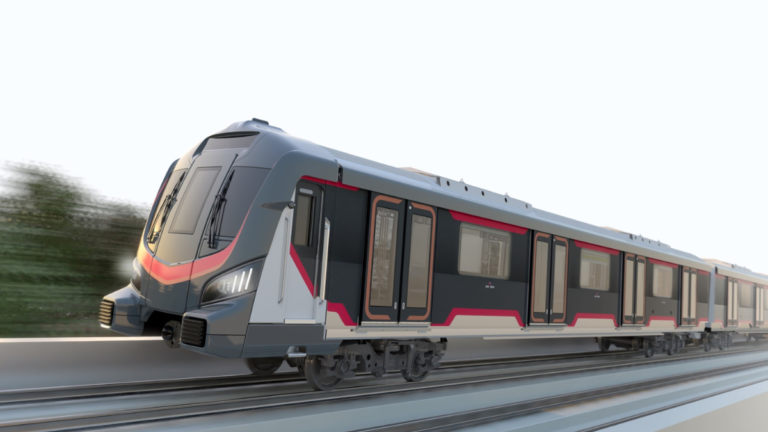
Alstom Commences Production Of Driverless Trainsets For Chennai Metro Phase II
SRICITY (Metro Rail News): Alstom, a global leader in smart and sustainable mobility, began producing its world-class Metropolis trainsets for the Chennai Metro Phase II from its state-of-the-art manufacturing facility in Sricity.
Order Size
This order aims to deliver 36 metro trainsets, each comprising three cars capable of operating at 80 kmph. These trains are designed to run on the 26 km corridor, a segment of Phase-II linking Poonamallee Bypass to Light House via 28 stations (18 elevated and ten underground). The production commenced at a commemorative ceremony led by leaders from Chennai Metro Rail Ltd. and Alstom India.
Project Value
The project is valued at 124 million euros, including personnel training for Chennai Metro for operation and maintenance. With a 25 KV power supply for optimal energy efficiency, Alstom’s Metropolis metros will ensure safe and reliable passenger transport for over 11 million city citizens. The project will also significantly contribute to socio-economic development by connecting key zones.
Mr. M.A. Siddique, I.A.S., Managing Director of CMRL, said,“Chennai Metro has established itself as a cornerstone of efficient and reliable transportation for our citizens. It not only boosts the economy by improving connectivity but also champions sustainable mobility by reducing emissions and de-congesting roads. CMRL will be introducing Driver-less trains in Phase-II. These modern trains prioritize safety and passenger comfort, further elevating the commuting experience. We are happy that out first set of Driverless trains will be manufactured near Chennai by Alstom. We look forward to operating these technologically advanced trains on the Phase-II network by end of 2025, marking a significant milestone for the city’s transportation infrastructure.”
On the occasion, Olivier Loison, managing director of Alstom India, said, “We have had a long-standing association with Chennai Metro for over a decade. The rolling stock order for Chennai Metro Phase-I began our manufacturing journey in India. As we begin production for the second phase, we are thrilled to be bringing more innovation to Chennai Metro that promises to redefine the commuting experience for the residents of Chennai.”
Rolling Stock Highlights of the trains for Chennai Metro Phase II
The metro system boasts impressive features, including three-car trains accommodating up to 1000 passengers, ensuring a seamless boarding experience with wide internal gangways. The air-conditioned environment prioritises comfort, with dedicated spaces for women and differently-abled individuals. Dedicated to creating a women-friendly travel experience, the new metro introduces special features catering to the comfort and safety of female passengers. One car reserved 2/3rd of its space as a designated ladies’ section. Recognising the importance of accessibility, distinct colours mark grab handles within this area, and their installation at a lower height ensures easy access. Perch seats will support standing passengers, complemented by enhanced security through CCTV cameras. Safety remains paramount with emergency evacuation doors and strategically placed fire extinguishers. The system is equipped with obstacle and detrainment detectors for swift issue resolution, and it emphasises sustainability with regenerative electric braking for enhanced energy efficiency. These driverless trains have advanced passenger announcement systems, ensuring timely updates and information dissemination throughout the journey. The new metro is set to redefine urban transportation, focusing on comfort, safety, and environmental responsibility.
Design highlights of the trains for Chennai Metro Phase II
Inspired by the graceful ‘Mudras’ of the Indian classical dance form, Bharatnatyam, the exterior front mask forms a unique and culturally rich design. The saloon draught screen pattern (the glass support against every corner seat in the metro) pays homage to Tamil Nadu’s traditional decorative art form, ‘Kolam’. These trains will be the first in India to introduce Perch seats, enhancing passenger experience and comfort. The colour palette is based on the region’s landscape, architecture, state heritage, vibrant communities, rich traditions, diverse art, and cultural expressions.
These metro train sets are engineered and designed to operate driverless with Unattended Train Operations (UTO). The metro coaches are equipped with Automatic Train Operation (ATO), Automatic Train Protection (ATP), and a regenerative braking system, ensuring substantial energy conservation. Featuring GOA 4 driverless features, these trains will offer an environmentally friendly and comfortable metro solution for passengers of Chennai. Alstom also manufactured and delivered 208 metro cars for the 54km of the first phase and Extension of Corridor-I from Airport to Wimco Nagar and Corridor-II from Chennai Central to St. Thomas Mount. In addition to this, the company has also successfully designed, tested, and commissioned the track works covering 45 kms of corridors I & II for the Chennai Metro.
Alstom also manufactured and delivered 208 metro cars for the 54km of the first phase and Extension of Corridor-I from the Airport to Wimco Nagar and Corridor-II from Chennai Central to St. Thomas Mount. In addition to this, the company has also successfully designed, tested, and commissioned the track works covering 45 km of corridors I & II for the Chennai Metro.
Discover the endless possibilities of our city’s Metro at InnoMetro, our flagship Expo and Conference. Be an active participant in shaping its future towards a more sustainable tomorrow. Stay informed and join us to take a step towards a brighter future.
CMRS Inspection Conducted for The Kolkata Metro Green Line's Howrah Maidan to Esplanade Stretch
Photo by Amiya Chakraborty
KOLKATA (Metro Rail News): Shri Janak Kumar Garg, Chief Commissioner of Railway Safety (CCRS), inspected all the stations from Howrah Maidan to Esplanade of Green Line for the second consecutive day on 06.02.2024.
Need Of Inspection
He inspected the same stretch of this corridor under the river Hooghly and the tunnels by undertaking a trolley inspection on 05.02.2024. It was a historical moment as CCRS inspection and approval are mandatory and a must for the commissioning and commencement of commercial services on this stretch.
The Inspection
Shri Garg started station inspection on this stretch from Howrah Maidan Metro station in the morning. He travelled by Metro up to Esplanade Metro station under River Hooghly. He inspected the Entry and Exit Gates, AFC-PC Gates, Ticketing System, Based Ticketing System, Station Control Room, Air Conditioning System, Traction Sub-System, Back-Up Control System, Escalators, Lifts, Signage Boards, Fire Detection and Suppression System, Efficiency of Fire Alarms, Emergency Talk Back System, Blue Light System and other passenger amenities provided at each station i.e Howrah Maidan, Howrah, Mahakaran and Esplanade.
Interchanges at Howrah station
At Howrah station, Shri Garg also inspected passenger interchanging points with Eastern Railway and South Eastern Railway as this station will be a junction station of the Kolkata Metro and Eastern and South Eastern Railway network. Lakhs of passengers are expected to use this station to reach their destinations in the coming days.
Signalling & Speed Test
Later, the CBTC Signalling System was also examined in his presence, and an Anti-Collision Test was also conducted. A speed Trial was also conducted in the evening, and during this trial, a rake was run at a maximum speed of 91 kmph from Howrah to Esplanade station.
Officials Present
During this inspection, Shri V.K.Srivastava, Principal Chief Engineer and Additional General Manager (AGM) and other high-level officials of Metro Railway and Kolkata Metro Rail Corporation Limited (KMRCL) accompanied him.
Discover the endless possibilities of our city’s Metro at InnoMetro, our flagship Expo and Conference. Be an active participant in shaping its future towards a more sustainable tomorrow. Stay informed and join us to take a step towards a brighter future.
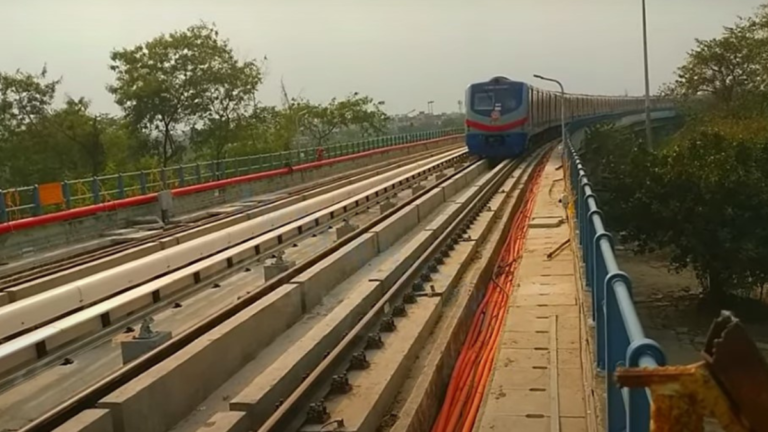
AGRA (Metro Rail News): Uttar Pradesh Metro Rail Corporation (UPMRC) unveiled the names of the bidders for the Agra Metro’s Package AGCC-05 on 14.15 Km long Line 1.
AGCC-05
The civil package AGCC-05 runs from Sikandra to Khandari Ramp, a distance of around 3.725 Km with stations in the stretch. The stations are : ISBT, Guru Ka Taal & Sikandra. It runs parallel to National Highway NH-19 (formerly called NH-2).
Scope of the Contract
The scope of the package ranges from Design to Construction of an elevated viaduct and 3 Nos. elevated stations (viz. ISBT, Guru Ka Taal & Sikandra Metro Station) including Civil, Associated and Ancillary Structure, Architectural Finishes, Water Supply, Sanitary Installation, Drainage, External Development, Fire Fighting, Fire Detection, E&M works and PEB structures of Balance Section chainage (-) 42.96 m to 3682.941 m of Corridor-1 of Agra Metro at Agra, Uttar Pradesh, India.
Bidders
The bidders for the package are :
Ceigall India Ltd.
Dineshchandra R Agrawal Infracon Ltd.
HG Infra Engineering Ltd.
NCC Ltd.
PNC Infratech Ltd.
Specifications of the Contract
Specifications of the contract are listed below:
Estimated Cost: Rs. 296.78 crore
Deadline: 24 Months
Further Developments
The bids would undergo a technical evaluation round to determine the lowest bidder and the most probable contractor for the project.
Latest Update on Agra Metro
As of the latest reports, The 6km-long priority corridor, consisting of three elevated and three underground stations, is expected to be completed by the end of February. The priority corridor of the Agra metro is 6 km long and runs from the Taj Mahal east gate to the Jama Masjid.
“The metro operations on the priority corridor will begin in the first half of March. The civil work on the 3 km-long elevated section is complete, with the finishing work in an advanced stage. The underground section is also being executed at a fast pace and TBMs (tunnel boring machines) ‘Ganga’ and ‘Yamuna’ are constructing the tunnel for the underground section,” Panchanan Mishra, spokesperson of UPMRC, said.
Agra Metro
Agra metro is a Rapid Transit Metro Project in Agra consisting of 2 metro lines totalling 29.65 Kilometers. The Agra Metro has two corridors:
Corridor 01
The length of the Sikandra to Taj East Gate corridor is 14.00 km, which is partly elevated and partly underground and comprises 13 stations (6 elevated and seven underground).
Corridor 02
The length of the Agra Cantt to Kalindi Vihar corridor is 15.40 km, comprising 14 elevated stations.
Commercial operations on the Priority Corridor running from the Taj Mahal Esttae to the Taj Mahal Ramp are scheduled to begin in February 2024 ahead of the initial August 2024 deadline.
Intrigued by the future of Metro and its impact on our city? Join us at our upcoming InnoMetro event to delve deeper into this vital issue. Stay informed, get involved, and let’s ride the Metro towards a brighter, more sustainable future together.
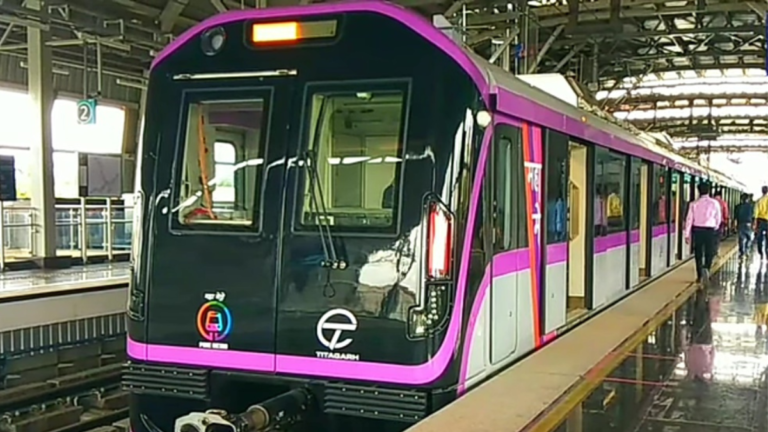
BANGALORE (Metro Rail News): The first of the two trains to have arrived from China for the Bangalore Metro’s 19.143 Km long yellow Line arrived at the Chennai Port yesterday after completing a voyage of 13 days from the Shanghai Port.
Total no of Trains
The Bangalore Metro’s Yellow Line will be graced by 15 trains to maintain a decent frequency. Additionally, the Chinese company will ship only two trains of 6 coaches each, while the remaining 75% will be made in India by the Kolkata-based Titagarh Rails.
Arrival at Hebbagodi Depot
Driverless Coaches for Bangalore Metro’s Yellow Line at Chennai Port
“Unloading is scheduled for February 7. Following customs clearance, it will be transported to Bengaluru by road. It is expected to reach Hebbagodi depot near Electronics City,” a senior BMRCL official told Moneycontrol.
Further Tests
Further, the trains would undergo multiple tests & trials. The processes are as follows:
Assembling & further on the test track
Then, on the mainline for 15 tests.
Further RDSO trials and then CMRS inspection
The Driverless technology
The upcoming driverless coaches will be integrated into the Communication-Based Train Control (CBTC) System, often called “Driverless Technology.” This implementation will reduce headway to 90 seconds from the current two and a half minutes. Despite the trains being driverless, the BMRCL has assigned Loco Pilots to reassure passengers.
Driverless Coaches for Bangalore Metro’s Yellow Line at Chennai Port
First Experience
Bengaluru is poised to welcome its inaugural venture into driverless metros along this route, with the primary objective of enhancing connectivity to key areas housing major corporations such as Infosys & Biocon in South Bengaluru.
The Contract
BMRCL awarded the contract for the same in December 2019. As per the contract, 4RS-DM 2 trains will be supplied by CRRSC, while the remaining 36 will be assembled locally by Titagarh Rail Systems in West Bengal.
Distinct from other BMRCL Coaches
The metro trains will be produced by the China Rolling Railway Stock Corporation (CRRSC) instead of the typical supplier BEML, which provides metro coaches to BMRCL. These trains will consist of 6 coaches, with only 12 coaches (equivalent to 2 trains) being imported from China. The remaining 204 coaches will be manufactured domestically by Titagarh Rail in India.
Big Connectivity Boost
It aims to boost connectivity to areas that are home to big companies like Infosys & Biocon and South Bengaluru. It will ease the daily struggles of Bangalore’s metro commuters by a substantial amount. It will also increase the overall metro connectivity in the city to facilitate easy and efficient commute.
Yellow Line
The 18.82 Km long under-construction metro line connects RV Road with Bommasandra. It is a fully elevated metro route with 16 stations. It connects with the Green Line of Bangalore Metro at RV Road Station & with the Pink Line at Jayadeva Hospital station. It is expected to open by early 2024.
While it was to be made operational by 2021, the deadline was extended many times. The yellow line will go to stations like Bommamanahalli, BTM Layout, HSR Layout, Jayadeva Hospital, etc.
Discover the endless possibilities of our city’s Metro at InnoMetro, our flagship Expo and Conference. Be an active participant in shaping its future towards a more sustainable tomorrow. Stay informed and join us to take a step towards a brighter future.
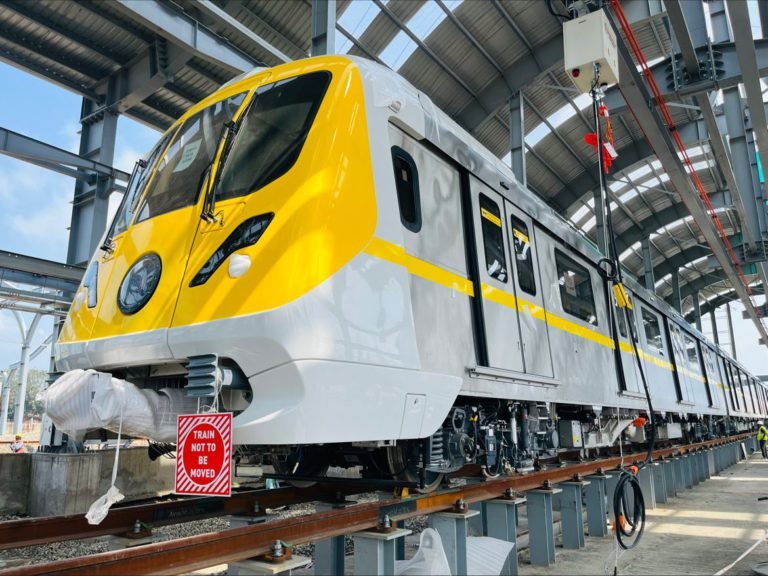
PUNE (Metro Rail News): Maha Metro conducted the trials of the Pune metro stretch on the underground section from the Civil Court to Swargate Metro Station on 5th Feb 2024.
Trials
The trials for the 3-coach train of the Pune metro from Rnage Hills Depot to Swargate Metro Station were conducted at an average speed of 7.5 km/hr.
“It commenced at 10:58 Hrs from Civil Court underground metro station with a speed of less than ten kmph (averaging 7.5 kmph), crossed the Civil Court metro station, then the Mutha riverbed, Budhwar Peth, Mandai, and finally reached Swargate UG metro station at 11:59 Hrs,” the press release said.
The trial aimed at ensuring the Schedule Of Dimensions (SOD) clearances & the train’s interaction with the civil structure to ensure there are no obstructions on the way.
The Under-river Milestone
“Passing between Civil Court and Swargate, it crossed beneath the Mutha river bed. Crossing the Mutha riverbed marks a historic event for Pune Metro,” the press release said.
Post this, the Pune metro becomes the 3rd metro in India to pass through an underwater stretch after Chennai 7 Kolkata.
Work Update
“As of today, 98% of the work of Pune Metro has been completed, and work on the remaining stretch is in full swing. Very soon, it (Civil Court to Swargate metro stretch) will be commercially operational for the citizens of Pune,” the release said.
Stations on the Stretch
It includes three new stations at Budhwar Peth, Mandai and Swargate. The Budhwar Peth metro station sits approximately 30 meters beneath the surface, with Mandai and Swargate stations at around 26 and 29 meters, respectively. Additionally, the Civil Court metro station boasts a depth of approximately 33.1 meters, ranking it among the deepest metro stations in India.
Metro Stations
Dsiatnce
Civil Court to Swargate
3,641 m
Civil Court to Budhwar Peth
853 m
Budhwar Peth to Mandai
999 m
Mandai to Swargate
1,489 m.
A Historic Moment: Metro Train Travels Below Mutha River
Today, on 5th Feb 2024, metro train trial run was conducted in a approx 3.34 km section starting from Civil Court UG station to Swargate UG metro station. As of today, 98% of the work of Pune Metro has been completed, and… pic.twitter.com/KL49Kqfjv3
Pune metro is a rapid transit system for the city of Pune that has three lines running with a combined length of 54.14 km, of which two lines are operational as of now. The three lines are:
Purple Line: PCMC Bhavan to Swargate
Aqua Line: Vanaz to Ramwadi
Line 3: Hinjawadi to Civil Court via Balewadi
Discover the endless possibilities of our city’s Metro at InnoMetro, our flagship Expo and Conference. Be an active participant in shaping its future towards a more sustainable tomorrow. Stay informed and join us to take a step towards a brighter future
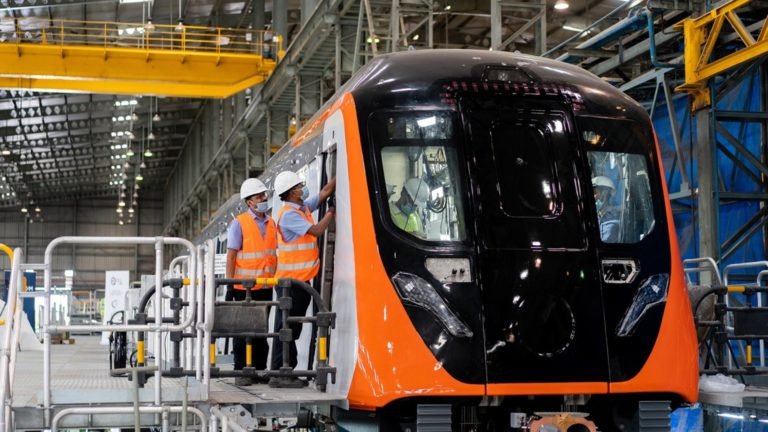
MUMBAI (Metro Rail News): Mumbai Metro Rail Development Authority (MMRDA) declared Sam India Builtwell the lowest bidder for the Mumbai Metro’s Kanjurmurg Depot Contract.
Package CA-209
It entails the construction of a depot to support the Mumbai metro’s 15.18 Km long Pink Line or Metro Line 6. It will connect Swami Samarth Nagar (Lokhandwala) to Vikhroli via 13 elevated stations. Further, the depot will be connected to the main line through a 4.771 km Package BC-01R1, under construction by J Kumar Infraprojects.
Scope of the Contract
The scope of the contract entails the construction of a depot and essential staff quarters at Kanjurmarg for metro line 6 of the Mumbai Metro Rail Project.
Higher than estimation
Sam India’s bid is higher than the total project cost estimated by MMRDA. It is 7.64% more than the MMRDA’s estimate of Rs. 508.57 crore.
Award of the Contract
MMRDA usually takes 5-6 months to award a contract. Either we take the case of Line-5’s depot contract to Rithwik, which took around six months or Line-4’s depot contract to SEW – VSE JV, which took around five months.
The process would likely enter negotiations as the bid exceeds the estimate. Further, a waiting period of nearly 5-6 months is expected in the awarding of the contract.
Latest Updates on Line 6
As of the latest reports, the Mumbai Metropolitan Region Development Authority (MMRDA) has reinvited bids for the strategic 15.18 km long metro Line 6 running from Swami Samarth Nagar to Vikhroli for rolling stock (18 trains of 6 coaches), CBTC signalling & train control (S&TC), telecommunication, platform screen doors (PSDs), and depot machinery & plant (M&P) for Kanjurmarg Depot.
Line 6, Mumbai Metro
The Mumbai Metro Line 6 is a high-speed transit system in Mumbai, Maharashtra, India. Stretching over 14.477 km (8.996 mi), this elevated metro line will link Lokhandwala Complex to Vikhroli, featuring 13 stations along its route. Notably, it provides seamless connectivity to the Western line of the Mumbai Suburban Railway at Jogeshwari and the Central line at Kanjurmarg.
The anticipated timeframe for completion is November or December of 2024.
Discover the endless possibilities of our city’s Metro at InnoMetro, our flagship Expo and Conference. Be an active participant in shaping its future towards a more sustainable tomorrow. Stay informed and join us to take a step towards a brighter future.
NOIDA (Metro Rail News): To ensure seamless connectivity of the Aqualine of NMRC and the Blue Line of DMRC, slight changes in alignment were envisaged in the DPR of the Aqua line metro rail corridor from Sector — 51 station (Noida) to Knowledge Park – V (Greater Noida).
DPR Submission
Accordingly, DMRC was entrusted with preparing the modified DPR of the Aqua Line Metro Rail Corridor from Sector — S1 Station (Noida) to Knowledge Park V (Greater Noida). Now, DMRC has submitted the DPR adopting the detour alignment.
Decongestion
This project will provide ease to the commuters of Noida, Greater Noida West, and Greater Noida via. Vikas Marg & Noida- Greater Noida Link Road will help decongest heavy traffic along these roads.
Connectivity with DMRC’s Blue Line
This project will connect the commuters to the existing operational Aqua line of NMRC and the Blue line of the DMRC network. Noida Sec-61 Station will be an interchanging station between NMRC’s Aqua Line and DMRC’s Blue Line.
Total Cost of the Project
As per the DPR, the total completion cost of the project is estimated at INR. 2,991.60 Cr covering the length of 17.435 km will have 11 stations. The names of the stations are tabulated below:-
Sr. No.
Name of the station
Start
Noida Sec.-51(Existing)
1
Noida Sec.-61
2
Noida Sec.-70
3
Noida Sec.-122
4
Noida Sec.-123
5
Gr. Noida See.-4
6
Eco Tech — 12
7
Gr. Noida Sec.-2
8
Gr. Noida Sec.-3
9
Gr. Noida Sec.-10
10
Gr. Noida Sec.-12
11
Gr. Noida Knowledge Park-V
Milestone of Connectivity
The importance of the project is due to the proposed inter-connectivity of the existing operational Aqua Line to the DMRC’s Blue line at Sector-61 Station and benefiting the commuters of Noida, Greater Noida West area and Greater Noida area with faster and direct connectivity towards Noida & Delhi and vice versa.
Approval of the DPR
The DPR for the said Project has been approved by the NMRC Board today. DPR will be processed for approval by the Government of Uttar Pradesh and the Government of India.
Discover the endless possibilities of our city’s Metro at InnoMetro, our flagship Expo and Conference. Be an active participant in shaping its future towards a more sustainable tomorrow. Stay informed and join us to take a step towards a brighter future