New Delhi: Prime Minister Narendra Modi has flagged-off the Delhi-Faridabad Metro Line that would allow hassle free travel for around two lakh daily commuters between the national capital and the industrial hub in Haryana.
The extension of the Delhi Metro connects Badarpur to Escorts Mujesar in Faridabad.
The total cost of the project from Badarpur to Escorts Mujesar is nearly Rs. 2,500 crore. Out of this, Rs. 1,557 crore was borne by the Haryana Government, the Centre contributed Rs. 537 crore, while the Delhi Metro provided Rs. 400 crore.
All these are elevated and located on either side of the Delhi-Mathura Road (NH-2).
“The nine-station metro corridor which was 95 per cent indigenously built will provide people a safe, affordable, quick, comfortable, reliable, environment-friendly and sustainable transport facility,” a Haryana government spokesperson said.
Haryana Chief Minister ML Khattar, addressing a press conference on Saturday, had thanked the Prime Minister for “gifting” the Metro service which would take the city to “another level of progress” with better connectivity with other NCR towns.
He had also said that the Prime Minister would be announcing the go-ahead for connecting Gurgaon with Faridabad by Metro.
NOIDA (Metro Rail News): To ensure seamless connectivity of the Aqualine of NMRC and the Blue Line of DMRC, slight changes in alignment were envisaged in the DPR of the Aqua line metro rail corridor from Sector — 51 station (Noida) to Knowledge Park – V (Greater Noida).
DPR Submission
Accordingly, DMRC was entrusted with preparing the modified DPR of the Aqua Line Metro Rail Corridor from Sector — S1 Station (Noida) to Knowledge Park V (Greater Noida). Now, DMRC has submitted the DPR adopting the detour alignment.
Decongestion
This project will provide ease to the commuters of Noida, Greater Noida West, and Greater Noida via. Vikas Marg & Noida- Greater Noida Link Road will help decongest heavy traffic along these roads.
Connectivity with DMRC’s Blue Line
This project will connect the commuters to the existing operational Aqua line of NMRC and the Blue line of the DMRC network. Noida Sec-61 Station will be an interchanging station between NMRC’s Aqua Line and DMRC’s Blue Line.
Total Cost of the Project
As per the DPR, the total completion cost of the project is estimated at INR. 2,991.60 Cr covering the length of 17.435 km will have 11 stations. The names of the stations are tabulated below:-
Sr. No.
Name of the station
Start
Noida Sec.-51(Existing)
1
Noida Sec.-61
2
Noida Sec.-70
3
Noida Sec.-122
4
Noida Sec.-123
5
Gr. Noida See.-4
6
Eco Tech — 12
7
Gr. Noida Sec.-2
8
Gr. Noida Sec.-3
9
Gr. Noida Sec.-10
10
Gr. Noida Sec.-12
11
Gr. Noida Knowledge Park-V
Milestone of Connectivity
The importance of the project is due to the proposed inter-connectivity of the existing operational Aqua Line to the DMRC’s Blue line at Sector-61 Station and benefiting the commuters of Noida, Greater Noida West area and Greater Noida area with faster and direct connectivity towards Noida & Delhi and vice versa.
Approval of the DPR
The DPR for the said Project has been approved by the NMRC Board today. DPR will be processed for approval by the Government of Uttar Pradesh and the Government of India.
Discover the endless possibilities of our city’s Metro at InnoMetro, our flagship Expo and Conference. Be an active participant in shaping its future towards a more sustainable tomorrow. Stay informed and join us to take a step towards a brighter future
It includes rolling stock (18 trains of 6 coaches), CBTC signalling & train control (S&TC), telecommunication, platform screen doors (PSDs), and depot machinery & plant (M&P) for Kanjurmarg Depot.
Key Specifications of the Tender
Key specifications of the tender are as follows:
Estimate: Rs. 2064.63 crore
Contract Period: 17 years (15 +2)
Pre-Bid Meeting: February 26, 2024 at 11 am
Bid Submission Deadline: April 2, 2024 at 2 pm
Technical Bid Opening: April 3, 2024 at 2 pm
Scope of the tender
The scope of the contract entails the design, manufacturing, supply, installation, integration, testing and commissioning of rolling stock, communication-based signalling & train control, telecommunication, platform screen doors systems and depot machinery & plant, including 15 years of comprehensive maintenance after two years, of defect liability maintenance period of line 6 of Mumbai Metro Rail Project of MMRDA.
Previous Tender
The previous tender of the MMRDA was cancelled owing to various anomalies ranging from in-compliance with CVC guidelines. The tender documents lacked essential value engineering, asset replacement, and whole-life cost assessment clauses. Furthermore, there were inaccuracies even in contract management, including document priority, maintenance, safety, and payment terms, which required thorough correction.
Funding of Line 6
Line 6 of the Mumbai metro has already achieved 60% completion at an estimated cost of Rs 6,716 crore with funding from the National Development Bank (NDB).
Line 6, Mumbai Metro
The Mumbai Metro Line 6 is a high-speed transit system in Mumbai, Maharashtra, India. Stretching over 14.477 km (8.996 mi), this elevated metro line will link Lokhandwala Complex to Vikhroli, featuring 13 stations along its route. Notably, it provides seamless connectivity to the Western line of the Mumbai Suburban Railway at Jogeshwari and the Central line at Kanjurmarg.
The anticipated timeframe for completion is November or December of 2024.
Discover the endless possibilities of our city’s Metro at InnoMetro, our flagship Expo and Conference. Be an active participant in shaping its future towards a more sustainable tomorrow. Stay informed and join us to take a step towards a brighter future
Vivek Kumar Gupta assumes Control as the Managing Director of NHSRCL
NEW DELHI (Metro Rail News): On February 5th, 2024, Shri Vivek Kumar Gupta, a member of the 1988 batch of the Indian Railway Service of Engineers (IRSE), officially took on the role of Managing Director at the National High-Speed Rail Corporation Ltd (NHSRCL).
The Gati-Shakti Program
Before his current position, he held the Principal Executive Director/Gati-Shakti role at the Railway Board within the Ministry of Railways. In this role, he coordinated the operations of seven departments: Civil (Works, Project Monitoring & Station Development), Electrical (RE), Signal & Telecommunication, Traffic, Finance, Planning, and Economic Directorates.
Only the combined efforts of these departments played a crucial role in planning and implementing numerous projects in line with the PM Gati-Shakti program.
Successful Track Record
While serving as Chief Engineer at Mumbai Rail Vikas Corporation (MRVC), he was pivotal in orchestrating projects like MUTP I/MUTP II and MUTP III, with a total expenditure nearing Rs 20,000 crore. Additionally, he led the preliminary efforts for the MUTP 3A initiative, valued at around Rs 34,000 crore.
Boost to HSR
Shri Vivek Kumar Gupta’s appointment as Managing Director of NHSRCL is poised to infuse the organisation with a wealth of experience and strategic foresight, crucial for propelling India’s high-speed rail project forward.
With a proven history of effective project management and deep expertise in railway operations, Gupta emerges as a pivotal figure in driving the enhancement of the country’s railway infrastructure.
Discover the endless possibilities of our city’s Metro at InnoMetro, our flagship Expo and Conference. Be an active participant in shaping its future towards a more sustainable tomorrow. Stay informed and join us to take a step towards a brighter future
MUMBAI (Metro Rail News): Mumbai Metro Rail Development Authority (MMRDA) unveiled the names of the bidders for the package CA-222 falling on the Metro Line 4.
Package CA-222
It entails the architectural finishing and pre-engineered building (PEB) roof contract at seven 32.32 km Mumbai Metro Line-4 project stations, connecting Wadala – Kasarvadavali via 32 stations.
Stations of the Package
The seven stations falling on the line’s southern end are Garodia Nagar, Pant Nagar, Laxmi Nagar, Shreyas Cinema, Godrej Company, Vikhroli Metro & Surya Nagar.
Scope of the Contract
It entails Architectural Finishing and plumbing Works including interior fit-outs, façade etc., along with Part Design, Fabrication, Supply and Erection of Pre-Engineered Structure including Entry-Exit Structures for 07 elevated stations viz Garodia Nagar, Pant Nagar, Laxmi Nagar, Shreyas Cinema, Godrej Company, Vikhroli Metro & Surya Nagar of Line-4 corridor of Mumbai Metro Rail Project of MMRDA.
Key Specifications
Deadline: 20 months
Estimated Cost: Rs. 200.83 crore
Bidders
The Bidders are:
Eagle Infra India Ltd.
Godrej and Boyce Mfg. Co. Ltd.
Landmark Corporation Pvt. Ltd.
Further Development
The Bids will now undergo a technical evaluation, unveiling the name of the Lowest Bidder and the most likely contractor.
Line 4, Mumbai Metro
Line 4, also known as the Green Line, of the Mumbai Metro, serves as a rapid transit system within Mumbai, Maharashtra, India. Stretching across 32.32 kilometres, this line is meticulously designed to be fully elevated, spanning from Wadala in Mumbai to Kasarvadavali in Thane along the Ghodbunder road. It encompasses 32 stations, including key stops at Chembur, Bhandup, Mulund, and Teen Hath Naka in Thane, a bustling traffic junction.
The project is estimated to require an investment of approximately ₹14,549 crore. Its primary objective is to enhance connectivity by linking vital transportation arteries such as the Eastern Express Highway at Chembur, the Central Railway, the MonoRail, and other ongoing metro projects. This extensive network aims to offer convenient rail-based access to various commercial hubs, governmental establishments, and prominent landmarks across Mumbai.
Upon completion, Line 4 is poised to significantly reduce travel times, slashing them by 50% to 75%, contingent on prevailing road conditions.
Discover the endless possibilities of our city’s Metro at InnoMetro, our flagship Expo and Conference. Be an active participant in shaping its future towards a more sustainable tomorrow. Stay informed and join us to take a step towards a brighter future
FM Announces 3 Major Pushes for Rail Mobility in the Budget 2024-25
NEW DELHI (Metro Rail News): In a move signaling renewed focus on infrastructure development, the Indian government unveiled its Interim Rail Budget 2024 today, allocating a significant ₹2.55 lakh crore – a 5.8% increase over last year. This budget outlines ambitious plans to modernize the nation’s vast railway network, enhance connectivity, and prioritize passenger experience.
Boosting the Engine of Growth: The budget lays the foundation for three new economic corridors dedicated to energy, minerals and cement, port connectivity, and high-traffic density. These PM Gati Shakti corridors aim to decongest existing lines, improve logistics efficiency, and ultimately accelerate GDP growth.
Upgrading on Track: Recognizing the need for improved passenger comfort and safety, the budget announces the conversion of 40,000 existing rail bogies to the advanced Vande Bharat standards. This ambitious project promises enhanced features, smoother rides, and world-class amenities, marking a significant leap forward in passenger travel.
Northeast on the Fast Track: Reflecting the government’s commitment to regional development, the budget allocates a substantial ₹10,269 crore for the Northeast, a massive increase from previous years. This investment signifies a drive to expand the rail network in this crucial region, fostering better connectivity and economic opportunities.
Sustainable Journey: The budget underscores the government’s continued focus on green initiatives. Increased adoption of solar power and energy-efficient technologies within the railways aims to minimize environmental impact and ensure a sustainable future for the sector.
Looking Ahead: While the Rail Budget paints a promising picture, experts caution that successful implementation is key. Continued monitoring, addressing potential challenges, and exploring further avenues like Public-Private Partnerships (PPPs) and data-driven operations will be crucial to achieving the budget’s ambitious goals.
Reactions from the industry leaders started to pour in as soon as the allocations for various sectors were announced today in the parliament.
Some of the reactions are:
“The Interim Budget presented today highlights the government’s intent to continue its focus on inclusive and sustainable development. The government stands committed with a special emphasis on empowering the poor, women, youth, and farmers and is focused on driving policies that resonate with their aspirations. As a responsible brand focused on implementing sustainability, we are pleased to see the government’s focus on promoting electric vehicles (EVs) which is a visionary step towards environmental sustainability as well as overall economic growth. Additionally, the commitment towards expanding the e-vehicle ecosystem brings an exciting prospect for the youth, which will create employment opportunities that align with the demands of the future. The introduction of biomanufacturing and bio-foundry schemes is also a welcome move that will be a great alternative to bio-degradable production”.
– Mr. Rohit Saboo, President & CEO, National Engineering Industries Ltd.
“We welcome the government’s focus on infrastructure creation which is expected to be an economic force multiplier and also lead to a positive cascading effect on ancillary industries and lend to job creations. The multifarious initiatives to boost agricultural productivity is also a part of the piece. This infrastructure push, which entails development of triple railways corridors as well as well as the construction of airports is expected to catalyse investments and spur demand in sectors such as steel, cement, iron ore and transportation. Maccaferri is uniquely poised to partner with the government in this transformative journey which is ultimately expected to propel India into the growth orbit of the top three economies of the world.”
-Mr. Vikramjiet Roy, Managing Director, Maccaferri India
“The announcement in the Union Budget 2024 regarding the upgrade of 40,000 regular rail bogies to Vande Bharat standards marks a significant milestone in India’s railway modernization journey. This initiative reflects a dedicated effort to elevate passenger safety, comfort, and operational efficiency to global standards. As the nation progresses towards modernizing its railway infrastructure, this move underscores a commitment to excellence and sets a benchmark for future development. It is a testament to the ongoing efforts to enhance the quality and reliability of our railway services, ultimately benefiting millions of passengers across the country”.
– Mr. Vivek Lohia, Managing Director, Jupiter Wagons Limited
“ The Union Budget promises to drive development and innovation, taking India’s infrastructure to the next level and by bringing together its transportation ecosystem for rail, road, aerospace and more to benefit individuals and businesses alike. The continued focus on infrastructure with an increased outlay of INR 11.11 lakh crores in FY25 will play a key role in boosting India’s economic growth.
As the frontrunners in sustainable mobility and drivers of India’s rail revolution, the announcement of metro and NaMo Bharat expansion, three major railway corridor program and transformation in existing rail ecosystem will create opportunities for us to introduce world class rolling stock, rail equipment & infrastructure, signalling and services in India. It will not only strengthen the overall efficiency of transportation network but also improve the reliability and safety of passenger trains.”
– Olivier Loison, Managing Director- Alstom India
“Vishwa Samudra Group commends the Interim Budget’s focus on boosting capital expenditure by 11% to over ₹11 lakh crore that will lead to asset creation in the economy. We are keen to collaborate with the government on building new ports and infrastructure corridors. With our substantial experience in infrastructure development, we are well-positioned to support this vital push to strengthen India’s economic expansion”.
– Mr. Anil Yendluri, Managing Director- Vishwa Samudra Group
“The 11.11 lakh crore strong infrastructure push, supported by the three railway corridors, as well as the continued focus on housing for the middle class, underscores the government’s unrelenting attention towards bolstering domestic infrastructure. This push is expected to spawn its own ecosystem of ancillary players, equipment OEMs, and heavy machinery players. GMMCO is uniquely poised to leverage the emerging opportunities and play a significant role in contributing to India’s infrastructure push, in sync with PM Modi’s vision of Atmanirbhar Bharat.”
– Chandrashekar V, MD& CEO of GMMCO (a part of the USD 2.9 billion CK Birla Group).
“The increase in capital outlay has increased by 11.1%. When seen in the context of the constraints presented by the debt situation, this is a very welcome step especially on the back of significant increases in the previous years. This demonstrates the commitment of the Government of India to address the infrastructural bottlenecks. The announcement on Railways is on expected lines especially with the commitment to increase the modal share of Railways to 40-45%. There has been a thrust to improve logistics efficiency and therefore dedicated corridors for port connectivity, energy, cement, minerals and high traffic density is a critical step in that direction The renewed focus on developing tourism infrastructure at iconic destinations will provide a further boost to tourism. Considering the immense potential in this sector, this will complement the existing ongoing initiatives that are already ongoing. The announcements on other infrastructure sectors such as housing for middle class, focus on food processing and modernization of agriculture infrastructure will help bring in efficiencies in the entire agriculture value chain and reduce losses.”
– Sudeep Kumar Sinha, Partner, Deloitte India
“Aligned with the government’s strategy to ‘Reform, Perform, Transform’, to stimulate strategic growth. In parallel, Jakson aligns seamlessly with the government’s visionary initiatives, including a substantial 11.11 lakh crore infrastructure investment and the introduction of ‘Pradhan Mantri Suryodaya Yojana.’ This program aims to provide 1 crore households with 300 units of free electricity through rooftop solarization, symbolizing our shared commitment to economic growth and net zero journey. These dynamic measures not only enhance energy security and promote clean energy accessibility but also drive a tech revolution, supported by a INR 1 lakh crore corpus for R&D. Jakson is committed to this journey towards a sustainable, and inclusive future, championing synergies between innovation and economic empowerment.”
– Mr. Sameer Gupta, Chairman & Managing Director of Jakson Group.
“Heartening to see the focus and impetus by the central government towards infrastructure development and the commitment to transform the country to a ‘Viksit Bharat’ on the backbone of infrastructure development. This would provide the much-needed guidance to municipal and state level planners to take the country and infrastructure development forward.”
– Jatin Aneja, National Practice Head Infrastructure, Energy and Project Finance, Shardul Amarchand Mangaldas & Co.
“The Pradhan Mantri Awas Yojana- Gramin (PMAY-G) was devised in line with Government’s commitment to provide ‘Housing for All’. The scheme aimed at providing a pucca house with basic amenities to all houseless people living in kutcha and dilapidated houses. FM in her budget speech mentioned that despite the challenges, the implementation of the scheme continued, and they are close to achieving the target of 3 crore houses and 2 crore more houses will be taken up in the next five years. This will significantly improve the quality of life and socio-economic conditions of the rural poor – effectively, covering around 20Cr – 25Cr of our population. Implementation of housing at such scale will provide boost to the rural economy by generating increased economic activity, wages, and jobs. Increased spending in this area will also stimulate the demand for construction materials like cement, iron, bricks etc., thereby benefiting related industries. The labor-intensive approach required for such large-scale construction will also create huge employment opportunities for rural construction workers, carpenters, etc. This will also raise incomes and spending capacity in rural areas. On an overall basis, this will give good boost to the economy and will plug the overall housing shortage faced by the nation”.
– Vishal Hakani, Partner, Deloitte India, on Announcements made in Budget 2024-25 for the Real Estate.
Discover the endless possibilities of our city’s Metro at InnoMetro, our flagship Expo and Conference. Be an active participant in shaping its future towards a more sustainable tomorrow. Stay informed and join us to take a step towards a brighter future.
FM Announces 3 Major Pushes for Rail Mobility in the Budget 2024-25
NEW DELHI (Metro Rail News): Finance Minister Smt Nirmala Sitharaman presented the Union budget in the parliament today. It included allocations for all major sectors of our economy. The government has allocated Rs 11.11 lakh crores in FY25 for infrastructure development in the country.
Boost to Railways
The railway has received a significant boost towards its goal of decongesting lines and introducing new lines and locomotives. The budget has been allocated under the following two heads:
3 Rail Connectivity Corridors – Corridors for Port, Corridors for Energy, Cement and Mineral; High-Traffic Density Corridor
Vande Bharat Makeover for 40,000 Rail Bogies
A rail corridor facilitating corridor-port connectivity under the DFC will be established. More than two corridors will be set up under this to facilitate growth and development for business in India by providing an efficient and dedicated corridor.
Three dedicated corridors for easy and efficient transportation of Energy, Cement and Minerals will be established. It will facilitate a seamless flow of goods nationwide, encouraging our economic prowess. These corridors will be in addition to the DFCs. The Third and most crucial corridor is the high-traffic-density corridor. In this, routes having high-density passenger traffic will be given priority Such routes will be made into a dedicated corridor.
In a significant push, 40,000 normal bogies will be converted into Vande Bharat trains. This will ensure safety and efficiency for the commuters on the route.
Smt Nirmala Sitharam said, “The resultant decongestion of the high-traffic corridors will also help improve the operations of passenger trains, resulting in safer and higher travel speeds for passengers. Together with dedicated freight corridors, these three economic corridor programmes will accelerate our GDP growth and reduce logistic costs.”
Boost to Urban Transport
Per the announcements, the flagship Namo Bharat trains will be expanded to more cities to ensure better solutions to mobility problems in the continuously expanding Urban Centres.
Smt Nirmala Sitharam said, “We have a fast-expanding middle class and rapid urbanisation is taking place. Metro Rail and NaMo Bharat can be the catalyst for the required urban transformation. Expansion of these systems will be supported in large cities focusing on transit-oriented development.”
Further
The announcements offer an exciting picture of rail mobility taking shape in India rapidly, with a handsome investment of Rs 11.11 lakh crores through infrastructure.
Discover the endless possibilities of our city’s Metro at InnoMetro, our flagship Expo and Conference. Be an active participant in shaping its future towards a more sustainable tomorrow. Stay informed and join us to take a step towards a brighter future.
TBM Pelican of Chennai Metro Launched Yesterday at Panagal Park Station
CHENNAI (Metro Rail News): Chennai Metro Rail Limited has commenced the expansion of Chennai city’s metro rail network as part of Phase 2 after the successful completion of Phase 1 and Phase 1 Extension Corridors in stages since June 2015 and the growing ridership in Corridors 1 & 2. Now, CMRL has ventured into extensive infrastructure development in the city, comprising three more metro rail corridors for a total of 116.1 km with 119 metro stations.
Chennai Metro Rail Phase II Corridor 4 is an east-west alignment for a length of 26.1 km, connecting the beachfront from Light House station to Poonamallee Depot. It has nine underground stations and 18 elevated stations. Corridor 4 underground part stretching over 10 km, originating from the Lighthouse and passing through Chennai’s oldest areas like Mylapore and Kutchery Road to new and upmarket areas like Alwarpet, Bharatidasan, Boat Club, Panagal Park & Kodambakkam.
A total of four TBMs will be utilised in Corridor 4. In this, the underground projects, namely C4-UG01 (Light House to Bharathidasan Road) & C4-UG02 (Bharathidasan Road to Kodambakkam Powerhouse Ramp) bagged by ITD Cementation India Limited to construct both Metro Stations and its tunnels. Two TBMs, namely Flamingo and Eagle, have already been launched from Light House Station towards Thirumayilai Metro Station, and two TBMs, namely Peacock and Pelican, are being launched from Panagal Park station towards KodambakkamPowerhouse Ramp.
Thiru. T. Archunan, Director Projects, CMRL, launched the TBM (Pelican) of Corridor – 4, a total length of 2.1 km from Panagal Park Station to Kodambakkam Powerhouse Ramp (upline) on 31st Jan, in the presence of senior officials from CMRL, General Consultants, M/s AEON Consortium, and ITD Cementation.
This TBM Pelican is launched in the line of Corridor- 4 and will mine at a maximum depth of 18.5m from ground level. It will complete this stretch by the end of December 2024. This TBM will pass through the North Usman Road flyover and the Kodambakkam flyover in this stretch. The retrieved TBM will start tunnelling from Panagal Park towards Boat Club Station. TBM peacock will commence its journey on April 1, 2024, from Panagal Park to Kodambakkam Powerhouse Ramp, retrieving the shaft in Downline.
Intrigued by the future of Metro and its impact on our city? Join us at our upcoming InnoMetro event to delve deeper into this vital issue. Stay informed, get involved, and let’s ride the Metro towards a brighter, more sustainable future together.
Ahmedabad, the vibrant city of Gujarat, saw the development of its rapid transit dream in February 2010 with the establishment of the Gujarat Metro Rail Corporation Limited. The ambitious project, christened Ahmedabad Metro, aimed to weave a web of swift and efficient connections across the city and its neighbouring Gandhinagar. Phase-1, approved in 2013, envisioned two corridors – North-South and East-West – spanning 40.03 km. Construction commenced in March 2015, and the first ride of the Metro came in March 2019 with the inauguration of a 6.5 km section of the East-West corridor. The remaining sections of Phase-1 followed suit in September 2022, except the Thaltej Gam end and three stations. By October 2022, the Metro was fully operational, offering a convenient alternative to navigate the bustling city.
Phase 2, initiated in January 2021, extends the Metro’s reach further, connecting Ahmedabad with Gandhinagar through a 28.26 km corridor. This phase also includes a branch line to GIFT City, which is expected to be operational by early 2024. Ahmedabad Metro is more than just a transportation system; it symbolises progress and connectivity. It’s weaving together the city’s vibrant neighbourhoods, offering a glimpse into a future where commuting is efficient, sustainable, and enjoyable. As the network expands, so does the potential to transform how people move around, live, and work in Ahmedabad and Gandhinagar.
Historical Overview
The Gujarat Infrastructure Development Board (GIDB) initiated a study for urban transport between Gandhinagar and Ahmedabad in 2003. This study led to the preparation of a Detailed Project Report (DPR) for a Metro Rail System in these cities, carried out through collaboration with the Delhi Metro Rail Corporation (DMRC) and RITES. The DPR was submitted in June 2005 and received approval from the central government in the same year.
However, due to cost considerations and a focus on other transportation projects, such as the Ahmedabad BRTS and suburban railways, the project was abandoned in 2005. The project was revived in 2008, recognizing the need for future development in the region. New corridors were designed to ensure its viability. To execute this project, the Government of Gujarat established a special-purpose vehicle company called Metro Link Express for Gandhinagar and Ahmedabad Company Ltd. in 2018, the company was renamed the Gujarat Metro Rail Corporation Limited (GMRC). Initially capitalized with Rs. 202 crores, it was later decided in 2014 that the central government would hold a fifty per cent stake in the company.
Phase-1
Phase 1 of the project received approval from the central government in October 2014, with a budget allocation of Rs. 10,773 crore. In November 2014, the central government gave the green light for the utilization of vacant land of the Western Railways along the Botad-Sabarmati meter gauge line. The initial plan, which involved the Metro running along Ashram Road, was later modified, shifting the track towards the west. Although increasing the cost by Rs. 600 crore, this revised plan and adding two more stations resulted in fewer land acquisition issues and reduced traffic congestion on Ashram Road. In the 2015 Gujarat budget, an additional Rs. 611 crore was earmarked for the metro project.
On 14th March 2015, a ground-breaking ceremony took place to construct the 6.5 km Vastral – Apparel Park section of the East–West corridor. The then-chief minister of Gujarat, Anandiben Patel, attended this event. Another significant event, the commencement of the North-South Corridor, was marked with a ceremony on 17th January 2016, also graced by Anandiben Patel. The construction work for this project began in March 2016. In June 2016, the railways permitted the North–South corridor stretch on its land. The Japan International Co-operation Agency (JICA) pledged to fund Rs. 5,968 crore for Phase 1 of the project in November 2015. The first instalment of this funding, amounting to Rs. 4,456 crores, was disbursed in 2016.
In February 2019, trial runs commenced on the 6.5 km Vastral – Apparel Park section of Phase-1. This section was officially inaugurated by Prime Minister Narendra Modi on 4 March 2019 and was opened to the public two days later, on 6 March 2019. The Thaltej-Thaltej Gam stretch, which is 1.4 km long, along with three metro stations – Kankaria East, Thaltej Gam, and Sabarmati, had been slated for completion by December last year. Prime Minister Modi inaugurated the remaining part of Phase-1 on 30th September 2022. The east–west and north–south corridors were subsequently opened to the public on 2nd October 2022 and 6th October 2022, respectively. The total expenditure for the construction of Phase 1 amounted to Rs. 12,900 crore.
Phase – 2
Phase 2 of the project received approval from the government of Gujarat in October 2017 and underwent revisions in October 2018. The union cabinet gave its nod to Phase 2, valued at Rs. 5,384.17 crore, in February 2019. This phase will see the north–south corridor extending from Motera in Ahmedabad to Mahatma Mandir in Gandhinagar, spanning 23.838 km. Additionally, a branch line from the Gujarat National Law University (GNLU) will connect Pandit Deendayal Energy University (PDEU) and GIFT City, covering 5.416 km. The total length of the elevated corridor in Phase 2 will be 28.26 km, featuring 22 stations. The tender process for Phase 2 started in January 2020. Prime Minister Modi laid the foundation stone for this phase on 18th January 2021. The branch line leading to GIFT City will be operational by early 2024. In February 2023, Titagarh Rail Systems secured a contract worth Rs. 350 crore to supply rolling stock for Phase 2. Although the trial run for Phase 2 was scheduled to begin in June 2023, it has not started yet.
Blue Line
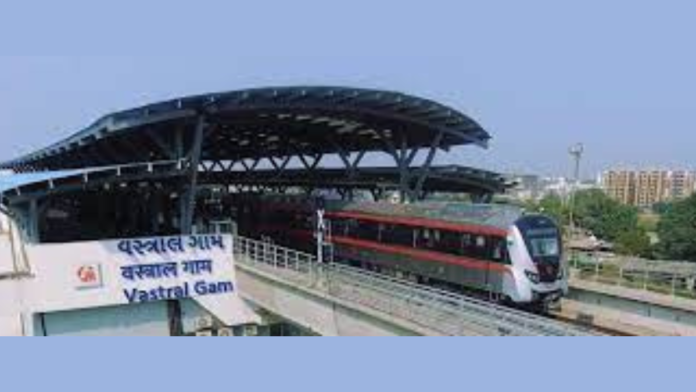
The Blue Line of the Ahmedabad Metro is the city’s first underground rapid transit system, carving a 21.23 km path through the heart of Ahmedabad. Spanning 18 stations (two currently under construction), it stretches from Vastral Gam in the north to Thaltej Gam in the south, offering a convenient and elevated city perspective for commuters.
The Blue Line’s journey began in 2015 with a groundbreaking ceremony for the initial 6.5 km stretch from Vastral to Apparel Park, marked by the presence of Gujarat Chief Minister Anandiben Patel. Construction work officially commenced in March 2016; by February 2019, trial runs were underway on this section. The grand inauguration followed on March 4, 2019, with Prime Minister Narendra Modi, Chief Minister Vijay Rupani, and Deputy Chief Minister Nitinbhai Patel gracing the occasion.
The Blue Line’s significance goes beyond mere transportation. It symbolizes Ahmedabad’s commitment to modernizing its infrastructure and providing its residents a faster, more efficient, and eco-friendly way to navigate the city. The elevated tracks offer scenic vistas and help ease congestion on the ground below. As the remaining two stations are near completion, the Blue Line promises to enhance connectivity further and contribute to a more vibrant and sustainable Ahmedabad.
The first operational corridor of the Ahmedabad Metro, the Blue Line, opened its doors to the public on March 6th, 2019, offering a swift and convenient way to navigate the city. While the initial phase covered a 6.5 km stretch, Prime Minister Modi officially inaugurated the rest of the line, spanning 21.23 km, on September 30th, 2022. However, the journey isn’t quite over yet.
The final leg, a 1.4 km section extending to Thaltej Gam and encompassing two additional stations, Thaltej Gam and Kankaria East, is expected to be completed soon. This final touch will further enhance Blue Line’s significance connecting Vastral Gam to Thaltej Gam through 18 stations. The Blue Line encompasses a diverse system of elevated and underground sections. While most of its journey takes place above the bustle of the city, four stations – Apparel Park, Kalupur Railway Station, Gheekanta, and Shahpur – dive deep, reaching 22 meters below ground at their lowest point near Gheekanta. The remaining underground stations, nestled 12-14 meters below the surface, offer a glimpse into the city’s hidden depths.
Old High Court station is a vital interchange point, allowing seamless transfers between the Blue Line and the upcoming Red Line. This connectivity promises to enhance the network’s efficiency further and reach.
The Blue Line’s opening day was a resounding success. With over 41,700 tickets sold and 72 trips completed, it quickly became a popular choice for commuters. The enthusiasm continued the next day, with 17,000 passengers taking advantage of its swift and comfortable rides. As the Blue Line expands, it promises to become the lifeblood of Ahmedabad’s transportation system, connecting communities, reducing traffic congestion, and offering a greener alternative for city travel. Its journey, from inauguration to expansion, is a testament to the city’s commitment to progress and a glimpse into a future where efficient and sustainable transportation takes centre stage.
Stations
Eighteen stations are proposed to be constructed on the route, with four stations underground and the rest elevated. The details are as under:
Sr. No.
Station Name
Layout
01
Thaltej Gam
Elevated
02
Thaltej
Elevated
03
Doordarshan Kendra
Elevated
04
Gurukul Road
Elevated
05
Gujarat University
Elevated
06
Commerce Six Road
Elevated
07
SP Stadium
Elevated
08
Old High Court
Elevated
09
Shahpur
Underground
10
Gheekanta
Underground
11
Kalupur Railway Station
Underground
12
Kankaria East
Underground
13
Apparel Park
Elevated
14
Amraiwadi
Elevated
15
Rabari Colony
Elevated
16
Vastral
Elevated
17
Nirant Cross Road
Elevated
18
Vastral Gam
Elevated
Operations, Network & Route Length
The Metro saw a dramatic surge in ridership following the opening of Phase 1 in September 2022. The following year, over 186 million people hopped aboard the sleek trains, with an average of 90,000 daily riders on regular days and 75,000 on holidays. Even on less bustling days, the Metro still carried 51,000 passengers. This surge in popularity translated into financial success, with ticket sales generating Rs. 28 crore within the same period.
The success of Phase 1 has undoubtedly fuelled excitement for the future of the Metro. With further expansion plans underway, one can only imagine the network’s potential to revolutionize how people move around Ahmedabad.
Line
Phase-1
Phase-2
Total Length
Blue Line
21.16 km
—
21.16 km
Red Line
Main Line
18.87 km
22.84 km
41.71 km
Branch Line
—
5.42 km
5.42 km
Total Length
40.03 km
28.26 km
68.29 km
Current Status
Line
First Operational
Last Extension
Number of operational stations
Operational length
Blue Line
4 March 2019
30 September 2022
16 (except Thaltej Gam and Kankaria East)
19.76 km
Red Line
30 September 2022
N/A
14 (except Sabarmati Railway station)
18.87 km
Total
29 (with Old High Court interchange)
38.63 km
Project Specifications & Key Information
Ahmedabad, the bustling commercial hub of Gujarat, and Gandhinagar, the state’s capital, are set to be connected by a sophisticated urban Mass Rapid Transit System (MRTS) known as the Ahmedabad Metro. This ambitious project, spearheaded by the Gujarat Metro Rail Corporation (GMRC), promises to revolutionize transportation in the region, bringing many benefits to both cities.
Construction work on Ahmedabad Metro’s Phase 1 began in 2015, encompassing two crucial corridors spanning 39.259 km. The initial phase saw the inauguration of a 6 km section of Line-1 in March 2019, offering a glimpse into the Metro’s potential. By September 30, 2022, most of Phase 1 became operational, except a 1.4 km stretch. This partial opening provided commuters a convenient and efficient way to navigate Ahmedabad’s bustling streets.
With Phase 1 successfully underway, the focus shifted to Phase 2 in February 2016. The Gujarat state government allocated Rs 2 crore to prepare the Detailed Project Report (DPR) and entrusted the Delhi Metro Rail Corporation (DMRC) with this critical task. The draft DPR charted the 18.522 km Line-2 extension course, aiming to connect Ahmedabad with Gandhinagar’s Mahatma Mandir. Additionally, branch/spur lines to GIFT City were envisioned, further enhancing the network’s reach.
February 2019 marked a significant milestone as the union cabinet approved the construction of a 28.254 km Phase 2. This phase comprised two crucial corridors: a northward extension of Line-2 with a short spur and an additional corridor connecting Ahmedabad with Gandhinagar. Prime Minister Narendra Modi laid the foundation stone for Phase 2 in March 2019, signifying the project’s importance for the region’s development. Plans include adding a roughly 5 km line connecting Koteshwar Road with Sardar Vallabhbhai Patel International Airport. This proposed spur, if materialized, would further bolster the Metro’s reach and convenience.
A Boon for Ahmedabad and Gandhinagar
The Ahmedabad Metro is more than just a transportation system; it symbolises progress and connectivity. By weaving together these two vibrant cities, the Metro promises to:
Reduce traffic congestion: With a reliable and efficient alternative, the Metro is expected to ease the burden on Ahmedabad and Gandhinagar’s roads, leading to smoother traffic flow and reduced travel times.
Boost economic growth: Improved connectivity will likely attract businesses and investments, fostering economic growth and creating new job opportunities in both cities.
Enhance quality of life: Reduced pollution and congestion will contribute to a cleaner and healthier environment, improving residents’ overall quality of life.
As the Ahmedabad Metro continues to expand, it has the potential to transform the way people live, work, and travel in Gujarat. By providing a sustainable and efficient transportation system, the Metro paves the way for a brighter future for both Ahmedabad and Gandhinagar. The key information of the project is as follows:
Operational: 37.86 km (Phase 1)
Under Construction: 29.65 km (Phase 1, Phase 2)
Proposed: 5 km
Daily Ridership: 90,000/day (March 2023)
Rolling Stock: 96 coaches (32 train sets x 3) supplied by Hyundai Rotem
Top Speed: 80 kmph
Average Speed: 33 kmph
Track Gauge: Standard Gauge (1435 mm)
Electrification: 750 V DC Third Rail
Signalling: Communication-based Train Control (CBTC)
Line-3 (Eastern Spur of Line-2): Gujarat National Law University (GNLU) – GIFT City (5.416 km, 2 stations)
Summary
Ahmedabad Metro, designed for swift and effortless travel, is currently operational within the city limits, connecting passengers to key destinations. But its ambitions stretch beyond, aiming to connect the urban hub of Gandhinagar and the modern metropolis of GIFT City in the near future. Ranked amongst India’s top eight metro systems, Ahmedabad Metro boasts ambitious expansion plans. Phase 1, already partially operational, envisioned two lines with 32 stations, while Phase 2 promises another two lines with 22. This intricate network aims to combat traffic congestion and offer commuters a convenient, affordable, and safe travel solution. Metro smart cards offer attractive discounts, further incentivizing commuters to embrace this eco-friendly alternative.
Prime Minister Narendra Modi’s inauguration of Phase 1 in September 2022 marked a significant milestone. His journey from Gandhinagar Station on the brand-new Vande Bharat Express 2.0 train to Kalupur Station in Ahmedabad symbolized the project’s potential to bridge distances. Following the inauguration, the state urban development department swiftly swung into action. Recognizing the transformative power of metro connectivity, they initiated an action plan to explore extending the network to other parts of Ahmedabad. The Prime Minister himself directed officials to prioritize metro access for outlying areas. Mapping services were commissioned to identify potential routes in the eastern and western parts of the city, with areas like SG Road and SP Road emerging as promising candidates for future expansion.
Commercial operations for the North-South corridor, a fully elevated line spanning 18.87 km, commenced on October 6th, 2022. This popular corridor serves as a testament to the metro’s commitment to improving urban mobility and enhancing the lives of Ahmedabad’s residents. As Ahmedabad Metro embarks on its ambitious expansion plans, it promises to transform the city’s landscape. By weaving a web of efficient connections, it will not only ease traffic woes but also unlock economic growth and enhance its citizens’ overall quality of life. The journey has just begun, and the future of Ahmedabad looks bright, fueled by the convenience and connectivity of its ever-growing metro network.
New Heights
With the launch of the Ahmedabad metro, India’s metro network has exceeded Japan’s operational metro network length. The total extent of India’s metro rail has reached more than 800 Kms. Beyond the operational network, India has nearly a thousand kilometres of metro rail under construction. Once completed, India will surpass South Korea and the USA in the route length.
On 2nd October, a 21-km stretch of the Ahmedabad Metro project, with 17 stations between Thaltej and Vastral, was opened to the public. According to the Gujarat Metro Rail Corporation (GMRC), the project includes a 6.6 km underground section with four stations. On 4 March 2019, the Prime Minister inaugurated a segment of phase 1, linking Vastral to Apparel Park, covering a distance of 6.5 km. The Metro Rail project received approval in 2014. Phase 2 of the project will extend from Gandhinagar (the state capital) to Ahmedabad, primarily expanding Phase 1. It is anticipated to consist of two corridors – one from Motera Stadium to Mahatma Mandir (a 22.8-km stretch with 20 stations) and the other from Gujarat National Law University to GIFT City (a 5.4-km route with two stations).
The complete route under phase 2 of the project will be elevated. Phase – 1 is supposed to run for 40.03 km, and Phase – 2 is supposed to run for 28.26 km. A part of Phase – 1, comprising 6 stations, has already been constructed and is now operational. The remaining part of Phase – 1 and all of Phase – 2 are still under construction. A Blue Line identifies the East-West Corridor of the Ahmedabad Metro route, the North-South Corridor is identified with a Red Line, and the GNLU-GIFT City Branch is identified with a Purple Line. The Ahmedabad Metro Rail Project is managed by the GMRC (Gujarat Metro Rail Corporation). A government initiative was taken to develop the Metro in Gujarat, and thus, GMRC was formed to oversee the construction of the metro rail in Gujarat.
Route History
Ahmedabad Metro, which already offers commuting facilities to metro travellers, currently operates through six stations on the East-West Corridor. This 6.53 km underground stretch, running between Vastral Gam and Apparel Park, has been operational since March 6th, 2019. The remainder of Phase 1, eagerly awaited by commuters, is on track for completion, further expanding the network and its reach.
But Ahmedabad Metro’s vision extends beyond Phase 1. Construction for Phase 2 commenced in January 2021, promising even greater connectivity. One fascinating aspect is the line connecting Gujarat National Law University (GNLU) to the modern GIFT city, which is slated to be operational in early 2024. This link will benefit students and professionals and foster economic growth and collaboration between the hubs.
Speeding towards a future of seamless travel, the operational Metro trains and those soon to join the fleet boast an average speed of 33 km/h and a top speed of 80 km/h. This efficiency is further enhanced by the 1435 mm (4 feet 8 inches) track gauge and 750 V DC Third rail electrification system, ensuring smooth and reliable operations.
Ahmedabad Metro is more than just a network of trains; it’s a symbol of progress and a promise of a better future for the city. It’s poised to transform how people live, work, and travel in Ahmedabad by tackling traffic congestion, promoting sustainable transportation, and connecting key destinations. With each phase completed, the city moves closer to a future woven with convenience, efficiency, and endless possibilities.
Metro Station Construction Updates
The Kankaria East underground station, nestled on the East-West corridor stretching from Thaltej to Vastral, is gearing up for an operational debut by February 2024. The recent inspection by the Commissioner of Metro Rail Safety (CMRS) is a crucial step towards its launch, with the report due shortly. Joining Kankaria East on the path to completion are Thaltej Gam and Sabarmati stations. Situated close to the bullet train and Ramnagar railway station, connecting passengers to North India, Sabarmati is nearly ready to open its doors. Once the final touches are complete, CMRS will return for another inspection, paving the way for its operation.
While Kankaria East and Sabarmati stations inch closer to reality, Thaltej Gam might take a little longer. Its integration might be more in sync with the second phase, extending the network to Gandhinagar. For nature enthusiasts and picnickers, Kankaria East station holds much promise. Its strategic location near Kankaria Lake anticipates bustling footfall, especially on weekends and holidays. Imagine a convenient Metro ride followed by a serene lakeside stroll – a perfect recipe for rejuvenation!
Ahmedabad Metro’s expansion reflects a commitment to efficient and sustainable transportation. By adding these stations, the network not only eases traffic congestion but also connects key destinations, enhancing the city’s vibrancy and convenience. Kankaria East, a bright spark amidst this growth, promises a gateway to leisure and relaxation, adding a new dimension to the Metro’s impact. As construction progresses and inspections pave the way, Ahmedabad eagerly awaits the day these stations become operational. Each new stop signifies a step forward, weaving a web of connectivity and progress that promises to transform the city’s landscape, one station at a time.
Ridership, fare and other details
On October 14, 2023, the Ahmedabad Metro witnessed its highest daily ridership with approximately 1,13,000 passengers. This surge coincided with the India-Pakistan cricket match at the Narendra Modi Stadium. Since the start of commercial operations in October 2022, the previous daily ridership record was 107,552, set on May 28, 2023, during an IPL match. The metro typically transports around 75,000 passengers daily, generating a ticket revenue of Rs 11 lakh to Rs 12 lakh. However, on October 14, the ticket revenue soared to Rs 20.3 lakh. To meet the increased demand, the number of metro trips was raised from 313 to 383, with an average of 290 passengers per trip, compared to the usual average of about 220 passengers.
As the Ahmedabad Metro route is still largely under construction, metro officials have proposed an estimated fare structure. The fare for the first 2.5 km on the Ahmedabad Metro route would be INR 5; for up to 7.5 km, the fare will be INR 10. The fare for the initial 6.5 km stretch from Vastral Gam Metro Station to Apparel Park Metro Station will be INR 10. The 21 km stretch from Vastral Gam to Thaltej, the Ahmedabad Metro fare will range between INR 5 and INR 15. The metro fare for the first three metro stations is INR 5, and the smart card fare is INR 4.5. After three stations, the metro fare increases to INR 10, and the smart card fare is INR 9. Any updates or changes regarding the Ahmedabad Metro fare can be found at the metro stations, displayed in an easy-to-understand format.
Smart Card
Passengers on the metro route can acquire an intelligent card at any functioning station by paying INR 100, which includes INR 50 as a security deposit and INR 50 as stored value. This can be done using cash or a debit/credit card. The smart card can be topped up multiple times, from INR 50 to a maximum of INR 3000. Passengers can recharge their smart cards at any operational Ahmedabad Metro Station using the Ticket Vending Machine (TVM) and Recharge Card Machine (RCM). The validity of the Smart Cards is five years, contingent on the date of the last recharge.
Intrigued by the future of Metro and its impact on our city? Join us at our upcoming InnoMetro event to delve deeper into this vital issue. Stay informed, get involved, and let’s ride the Metro towards a brighter, more sustainable future together.
TBM Tapi of Surat Metro Achieves Breakthrough at India’s 2nd Deepest Metro Station
SURAT (Metro Rail News): TBM S94, or TBM Narmada of the Surat metro, achieved the hidden breakthrough for the Suart Metro Phase 1’s 22.7 Km Line 1.
Assignment
The TBM S94 was launched in January 2023 from the western shaft of the Kapodra Station. It was assigned the task of building an up-line tunnel from there. From there, it took roughly a year for the TBM to tunnel a length of about 1.5 kms.
Labheshwar Chowk
The TBM has achieved a hidden breakthrough at the unique Labheshwar Chowk Metro Station, which is 30 meters deep, with two platforms and two concourse levels. It will be 2nd deepest metro station in India after Howrah Metro station of Kolkata Metro’s East-West Corridor.
S. No
Metro Station
Deepest
01.
Howrah Metro Station
33 meters (Post Completion)
02.
Labheshwar Chowk Metro Station
30 meters (Post Completion)
03.
Hauz Khas metro Station
29 meters
Further Excavation
S94 & S78 have reached the desired position and will be retrieved from the eastern shaft of Surat Metro Station in due course.
Scope of Work
The TBM S94 & TBM S78 have been assigned to construct six tunnels for the 3.46 km Package CS2 / UG1, awarded in March 2021 by Gujarat Metro Rail Corporation (GMRC). The scope of work also includes the construction of metro stations at Kapodra, Labheshwar Chowk and Central Warehouse.
Surat Metro
The 41.93 km-long Surat Metro Rail Project Phase 01 has two lines: Sarthana – Dream City- 22.77 km with a total of 20 stations & Bhesan – Saroli-19.26 km with 18 stations. It is expected to be completed in 2027.
Intrigued by the future of Metro and its impact on our city? Join us at our upcoming InnoMetro event to delve deeper into this vital issue. Stay informed, get involved, and let’s ride the Metro towards a brighter, more sustainable future together.
NEW DELHI (Metro Rail News):Delhi Metro Rail Corporation (DMRC) has changed the colour of the Aerocity-Tughlaqabad 23.60 Km long metro corridor to Golden Line, an earlier silver line.
Change in Effect
DMRC issued a notification related to the change of colour in November 2023. The line will be facilitated by thirteen 6 Coach Alstom trains.
DMRC’s Love with Colors
The entire metro corridor of Delhi has been given a name based on the different colours. Ranging from Blue to Pink & Magenta to Green, the Delhi metro has it all with its Trains, maps and even the stations resonating the same.
Trouble En-route
Unknown to the reasons for the colour change, this step may prove terrible as the same Golden Line (formerly called Silver Line) has interchanges with the Yellow Line. There’s not much difference between the two colours other than the glittering.
Construction Updates
Sixteen stations of Delhi Metro’s Golden Line are currently under construction at Aerocity, Mahipalpur, Vasant Kunj, Kishangarh, Chhatarpur, Chhattarpur Mandir, IGNOU, Neb Sarai, Saket G-Block, Ambedkar Nagar, Khanpur, Sangam Vihar, Maa Anandmayee Marg Junction, Tughlakabad Railway Colony (Pul Prahaladpur) and Tughlakabad.
Update on Golden Line
In the latest developments on Delhi Metro’s Golden Line, the UIC-60 turnouts and scissor crossover contract (Package DT-07) were awarded to Voestalpine VAE VKN India in August 2022. However, the track-installation work (Package DT-10) faced a setback when DMRC abruptly cancelled the tender in August 2023, leaving the project’s progress in limbo.
On a positive note, Kalpataru Projects International Ltd. secured the lowest bid for the 25 kV AC OHE traction contract (Package DE-08), marking a significant stride forward in advancing the Silver Line project.
Golden Line, Delhi Metro
The Golden Line of the Delhi Metro runs from Delhi Aerocity to Tughlaqabad. It is a 23.62 Km long line with four elevated & 11 underground stations. It has a total of 15 stations as Tughlakabad, Tughlakabad Railway Colony, Anandmayee Marg Junction, Tigri, Khanpur, Ambedkar Nagar, Saket G Block, Saket, Lado Sarai, Mehrauli, Kishangar, Masoodpur, Vasant Kunj (Sec-D), Mahipalpur and Delhi Aerocity.
Intrigued by the future of Metro and its impact on our city? Join us at our upcoming InnoMetro event to delve deeper into this vital issue. Stay informed, get involved, and let’s ride the Metro towards a brighter, more sustainable future together.