Home Blog Page 134

Bengaluru Metro’s Green Initiative: 15,000 Saplings to Counter Phase 2 Expansion Impact

0

BENGALURU (Metro Rail News): The Bengaluru Metro Rail Corporation Limited (BMRCL) has committed to a large-scale greening initiative. This project, involving the planting of 15,000 saplings, responds to the ecological impact of the Namma Metro Phase 2 expansion. With an investment of approximately Rs 76.9 crores, the project aims to restore the green cover affected by recent urban development.

Planned Planting and Locations

The initiative will kick off in Dabus Town, where approximately 5,000 saplings will enhance the landscape of the 4th Industrial Area and nearby government properties in the Bengaluru Rural District. This area was specifically chosen to begin the reforestation, addressing the urgent need for greenery amidst heavy industrialisation.

Following the initial phase, the project will extend to Doddaballapur‘s KIADB lands, specifically targeting the 2nd, 12th, and 13th garden and buffer zones. 

Past Efforts, Maintainance and Community Participation

From 2021 to 2022, BMRCL undertook significant efforts to mitigate the impact of tree removal due to metro construction. A total of 856 trees were relocated, and an additional 1,193 were transplanted to safer locations.

Anticipating the upcoming monsoon, BMRCL is set to trim over 750 trees along the East-West Corridor and 380 along the North-South Corridor. This preventive measure aims to safeguard the metro operations and the city’s greenery from potential damage caused by falling branches during heavy rains.

The reforestation initiative has garnered attention from various environmental groups as many actively participate in the tender process of planting, which is currently under evaluation. This collaboration highlights the community’s vested interest in the success of this green project.

Future Planting Plans

The saplings will be planted during the monsoon season, leveraging the favourable weather conditions for optimal growth and sustainability. BMRCL’s strategic planning ensures that the newly planted saplings will have a higher chance of thriving, contributing to the city’s long-term ecological health.


Discover the endless possibilities of our city’s Metro at InnoMetro, our flagship Expo and Conference. Be an active participant in shaping its future towards a more sustainable tomorrow. Stay informed and join us to take a step towards a brighter future.

Advertisement1
InnoMetro_2026

Bangalore Metro Phase III: Geotechnical Investigation To Begin on 45 Km Corridor

0

Bangalore (Metro Rail News): The Bangalore Metro Rail Corporation Limited (BMRCL) is set to commence the geotechnical investigation for the expansion of the Bangalore Metro system under its Phase III project. This new phase aims to add 44.65 km of metro lines across the city, encompassing two elevated corridors and 31 metro stations in total.

Phase III of the metro expansion includes two main corridors:

  • Western Corridor: Spanning 32.15 km from J P Nagar’s fourth phase to Kempapura, this corridor will connect 22 stations and link directly to the Airport Line.
  • Eastern Corridor: This segment will have nine stations and cover 12.5 km from Hosahalli to Kadabgere on Magadi Road.

The Karnataka government approved the Phase III expansion earlier this year, with plans to integrate the new lines into the existing network by 2028. The project, estimated to cost Rs 15,611 crore, will be primarily funded by the state government, covering 80-85% of the total cost. The remainder will be financed by the central government, which has already approved the project and finalised the Detailed Project Report (DPR).

Geotechnical Investigation

The geotechnical investigation, which has a budget of Rs 6 crore, is scheduled to start next week. Officials from BMRCL highlighted that the investigation will focus on examining the physical properties of soil and rock along the proposed routes. This process is essential for determining the depth and design of the foundations needed for metro pillars.

Current Metro Network

Untitled design 57
Bangalore Metro Rail

Bangalore’s metro, currently the second longest operational network in India, spanning 73.81 kilometres after Delhi, consists of two operational corridors:

  • East-West Corridor: Runs 43.49 km from Whitefield Station east to Challagatta Terminal west.
  • North-South Corridor: Extends 30.32 km from Nagasandra Station north to Silk Institute Station south.

With the initiation of Phase III, Bangalore is poised to significantly enhance its metro connectivity, further easing the city’s transportation woes and contributing to its urban development.


Discover the endless possibilities of our city’s Metro at InnoMetro, our flagship Expo and Conference. Be an active participant in shaping its future towards a more sustainable tomorrow. Stay informed and join us to take a step towards a brighter future.

Advertisement1
InnoMetro_2026

RITES Partners with ItalCertifier for Safety Assessments of Vande Bharat Sleeper Trains

0
vande bharat sleeper train
Vande Bharat Sleeper Train

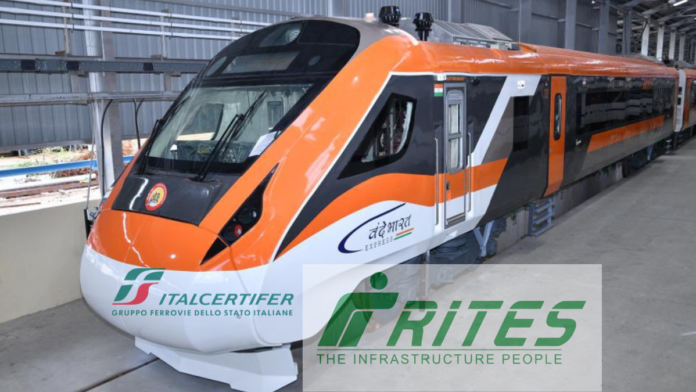
NEW DELHI(Metro Rail News): RITES Limited, a Navaratna central PSU(public sector undertaking) under India’s Ministry of Railways and a top transport consultancy in India partnering with ItalCertifier SPA from Italy, has won a contract for safety assessments of Vande Bharat sleeper trains. This marks a significant step for RITES as it expands into new business in safety assessments.

This contract was awarded to the Integral Coach Factory (ICF) in Chennai, part of the Ministry of Railways. The agreement includes design reviews, final safety acceptance assessments, and test result reviews, ensuring the highest standards of safety and reliability for the sleeper versions of the Vande Bharat trains.

RITES has over fifty years of experience and has worked in over 55 countries. This project adds to their growing portfolio as the only ISA-certified public sector company in India focused on safety assessments.The ItalCertifier SPA(Founded: 2001) is an Italian company that provides certification, inspection, and testing services, primarily in the railway sector.

About the Vande Bharat Express

Launched as a flagship initiative under the ‘Make in India’ campaign, the first Vande Bharat Express was inaugurated on February 15, 2019, serving the New Delhi-Kanpur-Allahabad-Varanasi route. Known for its semi-high-speed capability, the train reaches speeds of up to 160 kmph. It offers facilities superior to those found in Shatabdi trains, including two executive-class coaches with rotating chairs, automatic doors, a GPS-based passenger information system, and onboard Wi-Fi.

This initiative will ensure improved safety measures and boost passenger confidence in Indian train travel. With RITES and ItalCertifier working together, passengers can look forward to safer and more reliable journeys on the Vande Bharat trains.


Discover the endless possibilities of our city’s Metro at InnoMetro, our flagship Expo and Conference. Be an active participant in shaping its future towards a more sustainable tomorrow. Stay informed and join us to take a step towards a brighter future.

Advertisement1
InnoMetro_2026

Mumbai Metro Line 3 to Launch in Phases, Initial Operations Expected by June-July

0
Mumbai metro
Mumbai metro line 3 (Representational image)

MUMBAI (Metro Rail News): Mumbai’s much-anticipated Line 3 is about to enter its operational stage. The initial plan is to operate the train up to Dadar station to set the stage for trial runs. This initial operation is crucial for collecting important data before starting the official trial runs, which are planned to extend till Acharya Atre Chowk in Worli.

Essential infrastructure tasks, including overhead electrification (OHE) and track installation, have been finalised up to Dadar station. “While not a trial run in itself, this step is crucial for the project’s progress,” said a Mumbai Metro Rail Corporation Ltd (MMRCL) senior official.

Phased Implementation and Timeline

The Metro Line 3 project is structured to roll out in three phases:

– Phase 1 (Aarey to BKC): This vital stretch includes strategic stops such as the Chhatrapati Shivaji Maharaj International Airport and major business districts. It aims to drastically reduce travel times and offer a reliable alternative to the city’s congested roadways. Originally scheduled to open by April 2024, Phase 1 of Metro Line 3 is anticipated to become operational by June-July, following several missed deadlines.

– Phase 2 (BKC to Worli): Following the operation of Phase 1, Phase 2 will connect BKC to Worli, including stops at cultural and residential areas. This phase was initially targeted to launch shortly after the completion of Phase 1 but may face delays depending on the completion and operational success of the earlier phase.

– Phase 3 (Worli to Cuffe Parade): The final phase aims to complete the southern extension of the metro line, linking it with southern Mumbai. This phase was scheduled for completion shortly after Phase 2, aiming for a seamless expansion of the network.

Operational Capacity and Commuter Benefits

Upon completion, Metro Line 3 will serve about 17 lakh passengers daily, with trains every three to four minutes during peak times. Each train can accommodate approximately 2,500 passengers, enhancing the system’s capacity to manage large volumes of commuter traffic efficiently.

Metro Line 3 will connect major business and employment centres and link over 30 educational institutions, 13 hospitals, and several recreational and religious places. It will also integrate with other Mumbai Metro lines, the Monorail, Suburban Rail, and ST Bus Services, aiming to reduce congestion on suburban railways by up to 15%.

Progress Already Achieved

The Mumbai Metro Rail Corporation Limited (MMRCL) has begun integrated trial runs for the underground Metro Line-3. Final approval from the Commissioner of Metro Railway Safety is pending, which is the last regulatory hurdle before the service can begin.

The phased rollout of Mumbai’s Metro Line 3 is keenly awaited by the city’s residents and commuters. Once operational, it promises to significantly cut down travel times and improve the overall quality of urban transportation in Mumbai, marking a major stride forward in the city’s infrastructure development.


Discover the endless possibilities of our city’s Metro at InnoMetro, our flagship Expo and Conference. Be an active participant in shaping its future towards a more sustainable tomorrow. Stay informed and join us to take a step towards a brighter future.

Advertisement1
InnoMetro_2026

Kolkata Metro: D-Wall Construction Begins for Victoria Station on Line 3

1
Construction Work at Victoria Metro Station of Kolkata Metro
Photo Credit: Nikhil Pandey

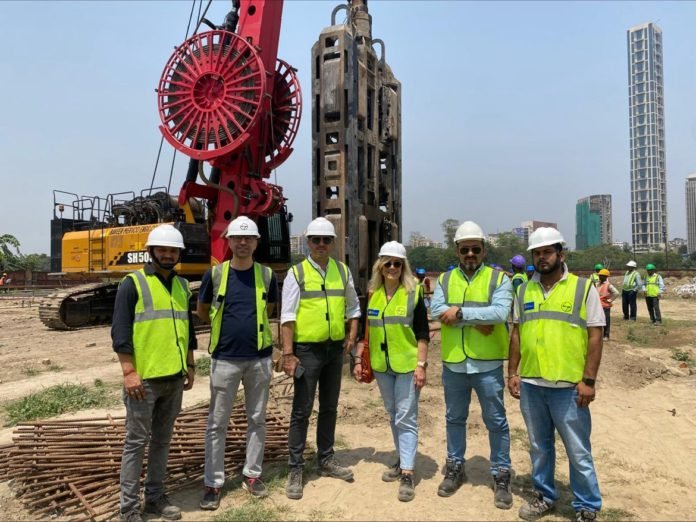
Kolkata (Metro Rail News): Last week, Kolkata Metro’s 15.215 km Purple Line gained traction when Larsen & Toubro officially initiated the construction of Victoria Memorial Station under the 5.05km long package UG1.

Work commenced following the barricading work, which began in September 2023 to set up ground for the Victoria Memorial station’s construction. Larsen & Toubro deployed a trench cutter to facilitate the construction of a Diaphragm wall (D-wall) for the station box which will span 325 meters.

This section is located in the northern part of Corridor 3 (Purple Line) which extends 15.215 km from Joka to Esplanade. It will feature twin tunnels that pass through four underground metro stations: Kidderpore, Victoria Memorial, Park Street, and Esplanade. The Esplanade station holds great importance as it will be the first to offer interchange among three lines (Purple Line, Blue Line, and Green Line), ensuring a smooth transition for commuters.

1714727592707
Photo Credit: Nikhil Pandey

Contract

Rail Vikas Nigam Limited (RVNL) awarded this 5.05 km underground package UG1 to Larsen & Toubro at Rs. 2447 crore in June 2023. L&T is likely to deploy two tunnel boring machines (TBMs) that will construct underground tunnels for this package.

1ee6b3e9 2a91 4f53 acf5 20aeb2fa8a2c 1 1
Photo Credit: Nikhi Pandey

Progress of Kolkata Metro’s Line 3

Due to extreme delays, the Purple Line has yet to be connected with the rest of the lines of the Kolkata Metro. The fully planned route of the Purple Line will extend 15.08 km from Diamond Park in Joka to Esplanade in central Kolkata. 

Currently, the 7.74km long Joka – Majerhat section is open for commercial operations. Once fully operational, the Purple Line is expected to play a vital role in connecting the residential areas of South Kolkata to the commercial hubs of central Kolkata, improving convenience and accessibility for commuters.

Advertisement1
InnoMetro_2026

Delhi Metro Celebrates Three Decades of Service

0

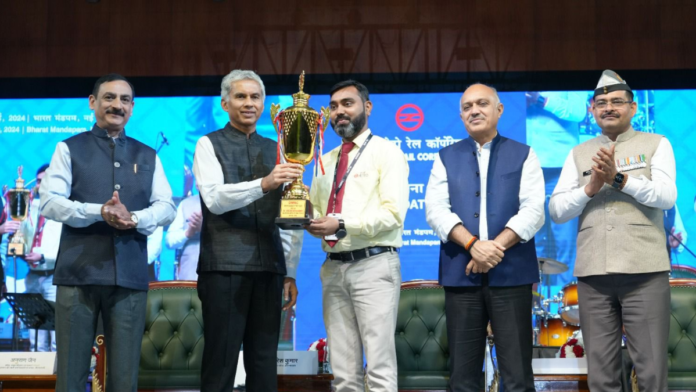
DELHI (Metro Rail News): The Delhi Metro Rail Corporation (DMRC) marked its 30th foundation day with grand celebrations at Bharat Mandapam in New Delhi on May 3. The event was attended by distinguished guests, including Anurag Jain, Secretary of the Ministry of Road Transport & Highways (MoRTH), who emphasised the crucial role of Delhi Metro in facilitating everyday travel across the capital. Jain praised the metro service for enhancing connectivity and declared it the city’s lifeline.

In his address, Anurag Jain reflected on the widespread influence of the Delhi Metro, noting its role as a benchmark in discussions about metro expansion across India. He shared insights from a recent inspection tour of metro projects in another state, revealing that many senior officials had trained or worked with DMRC, underscoring its far-reaching impact on nationwide urban transit development.

Celebratory Highlights

The event was not just about speeches; it also featured cultural performances. Renowned singer Kavita Krishnamurti Subramaniam and popular comedian Sunil Grover entertained the audience, adding a blend of melody and humour to the celebrations.

Awards and Accolades

During the celebrations, several awards were handed out. The Botanical Garden metro station received the accolade of the best metro station, while the Shastri Park depot was recognised as the best metro depot. A special award for promoting the use of Raj Bhasha was also given to Gopesh Kumar Verma, a senior station manager.

Overview of DMRC

The DMRC kicked off its journey with the opening of its first corridor between Shahdara and Tis Hazari on December 25, 2002. Today, the Delhi Metro spans approximately 392.44 kilometres and includes 288 stations, playing a pivotal role in the urban landscape of the national capital and beyond. As it celebrates 30 years, the Delhi Metro continues to set standards in urban transportation, making daily commutes smoother and the city more accessible.


Discover the endless possibilities of our city’s Metro at InnoMetro, our flagship Expo and Conference. Be an active participant in shaping its future towards a more sustainable tomorrow. Stay informed and join us to take a step towards a brighter future.

Advertisement1
InnoMetro_2026

Hyderabad Metro Loyalty Program: Travel More, Grab Exciting Gifts

0

HYDERABAD (Metro Rail News): Hyderabad Metro Rail has launched an innovative “Metro Loyalty Program” designed to reward the frequent commuters of its network. This initiative aims to appreciate loyal passengers by offering them a variety of exciting gifts, thus motivating them to use the metro services more frequently.

https://twitter.com/ltmhyd/status/1786379056688042453
L&T Hyderabad Metro Rail’s tweet launching Metro Loyalty Program

The program is accessible to passengers who use any type of Smart Card, which includes the Nebula smart card, Student pass, and Holiday card. This inclusivity ensures that all segments of commuters can benefit from the program, regardless of the card type they possess.

Program Mechanics

To qualify for the rewards, passengers must complete a specified number of trips in a single calendar month. The rewards can then be claimed in the following month. For example, trips completed in March can be used to claim gifts in April. However, trips completed in March will expire after April 30th, and cannot be used for claims in subsequent months. Additionally, once a gift is claimed for a certain number of trips, those trips cannot be used again for more rewards.

Hyderabad Metro's loyalty program details.
Hyderabad Metro’s loyalty program details.
  • Validity: The eligibility to claim a gift is solely based on the number of trips completed in the immediately preceding calendar month.
  • Reset of Trips: Trips used to claim gifts will be nullified in terms of eligibility for future rewards.
  • Non-Accumulation: Trips cannot be carried over across different months to accumulate and claim higher-tier gifts.

Gift Redemption Process

Eligible customers can claim their gifts at the Metro Merchandise stall located at Ameerpet station. The redemption is available from Monday to Friday between 4 pm to 8 pm. However, the distribution of gifts is subject to the availability of stock, which means early redemption is encouraged to ensure the availability of preferred items.

Based on the number of trips completed, the rewards are categorized into different slabs:

  • 40-50 trips: Options include a Keychain, Caps, or a Branded Notepad.
  • 50-60 trips: Rewards include Mugs or a Mobile Stand.
  • 61-70 trips: Commuters can claim a T-Shirt.
  • 71 trips & above: A model train set is available for the most frequent travellers.
Hyderabad Metro: Customer Loyalty Stall at Ameerpet Metro Station

This loyalty program rewards commuters and is strategically positioned to boost ridership and promote the use of public transport. Hyderabad Metro aims to increase daily ridership and enhance the commuting experience by incentivising frequent travel through tangible rewards. The program also serves as a marketing tool to attract new users to the metro system, showcasing the benefits of regular travel beyond just convenience and cost-effectiveness.


Discover the endless possibilities of our city’s Metro at InnoMetro, our flagship Expo and Conference. Be an active participant in shaping its future towards a more sustainable tomorrow. Stay informed and join us to take a step towards a brighter future.

Advertisement1
InnoMetro_2026

RailTel Signs MoU with Quadrant FutureTek to Deploy KAVACH Technology Globally

0

NEW DELHI (Metro Rail News): To enhance train safety across India and internationally, RailTel Corporation of India Limited has entered into a Memorandum of Understanding (MoU) with technology firm Quadrant FutureTek Limited, formerly Quadrant Cables Private Ltd. This strategic partnership aims to explore and implement the indigenous automatic train protection system, KAVACH, within India and in various global markets.

RailTel signs MoU with Quadrant FutureTek to deploy KAVACH (Rail Safety Technology) globally

About the KAVACH System

KAVACH, which stands for ‘armor’ in Hindi, is an advanced automatic train protection (ATP) system developed by the Research Design and Standards Organisation (RDSO) in collaboration with the Indian industry. It is designed to prevent train collisions, enhancing passenger and freight train safety. 

Details of the MoU

Under the terms of the MoU, Quadrant Future Tek Limited will collaborate exclusively with RailTel to deliver specific projects related to KAVACH. The partnership leverages Quadrant’s expertise, as Quadrant is in the final stages of approval by the Research Design and Standards Organisation (RDSO) as an Original Equipment Manufacturer (OEM) for the KAVACH project.

According to Sanjai Kumar, Chairman-cum-managing director of RailTel, this partnership underscores RailTel’s commitment to advancing indigenous safety systems and their intent to expand the technology’s reach globally.

Future Prospects

Both RailTel and Quadrant Future Tek Limited are set to pursue further opportunities to implement KAVACH, both within India and abroad. This initiative aims to improve the safety standards of Indian Railways and position the Indian ATP system as a viable export to other countries, promoting international safety and technological exchange.


Discover the endless possibilities of our city’s Metro at InnoMetro, our flagship Expo and Conference. Be an active participant in shaping its future towards a more sustainable tomorrow. Stay informed and join us to take a step towards a brighter future.

Advertisement1
InnoMetro_2026

New Committee to Enhance Working Conditions for Indian Railway Loco Staff

0

NEW DELHI (Metro Rail News): The Ministry of Labour has established a high-powered committee to address the long-standing issues faced by the Indian Railway’s Loco Running Staff. This committee is tasked with defining time intervals for meals and restroom breaks during their shifts.

This development aligns with the principles of the International Labour Organisation‘s (ILO) Hours of Work (Industry) Convention, 1919, which emphasises the right to rest intervals during work hours.

The demand for specified break times has been a critical issue for train drivers, who often face challenging working conditions without scheduled breaks for basic necessities. The Indian Railway Loco Runningmen Organisation (IRLRO) has been advocating for these changes since 2009, addressing various national platforms and human rights bodies. The recent focus on female loco pilots’ specific needs has intensified the call for reforms, leading to the formation of this committee in 2024.

The only female member from the labour union, Ashima Sachdeva(Senior Assistant Loco Pilot), said, “Women loco pilots have a tough time on duty as there are several women-related issues, such as the inability to change menstruation pads as there is no washroom in the engine and doing a heavy job after C-section deliveries. We will present our issues to the committee to get those addressed in a rightful manner.”

Committee Composition and First Meeting

The committee comprises 13 members, including the Chief Labour Commissioner (Central) as chairman, representatives from the Railway Board, the Ministry of Women and Child Development, and members from various labour unions. 

The committee’s inaugural meeting on April 25, 2024, concluded with positive feedback from the participants.

Objectives and Future Directions

The committee’s primary focus is to implement defined break times for food and restroom use and consider necessary amendments to the Railways Act, 1989, and Railway Servants (Hours of Work and Period of Rest) Rules, 2005. 

The discussions will incorporate insights from all stakeholders to ensure comprehensive policy revisions. The committee aims to present its findings and recommendations within 12 months, promising substantial improvements in the working conditions of the railway’s loco staff.

This initiative marks a pivotal step in addressing the long-standing issue with the Indian Railway Loco Staff and labour reforms in India’s transport sector.


Discover the endless possibilities of our city’s Metro at InnoMetro, our flagship Expo and Conference. Be an active participant in shaping its future towards a more sustainable tomorrow. Stay informed and join us to take a step towards a brighter future.
Advertisement1
InnoMetro_2026

Enhancing Railway Security: The Role of Ruggedized IP Cameras in Modern Transport Infrastructure

0

NEW DELHI (Metro Rail News): Transport systems are the lifeblood of modern society, but they also face significant security challenges. Surveillance technology has emerged as a crucial tool in safeguarding passengers, employees, and assets. Indian railway stations, bus stops, and airports are being secured by CCTV cameras and Access Control Systems.

According to News 18, the Railway Ministry plans to install CCTV cameras in 15,000 railway coaches initially, to expand to 60,000 coaches in total.

Understanding Existing Transport Infrastructure

Transport infrastructure is a multifaceted ecosystem comprising terminals, stations, vehicles, tracks, and more. Many of these components rely on legacy surveillance systems characterized by analog cameras, fragmented networks, and outdated software. Upgrading this infrastructure requires a detailed understanding of its complexities, including ensuring that new equipment works with existing systems, considering environmental factors, and meeting regulatory standards.

Assessing Compatibility and Requirements

Before initiating any integration project, a thorough assessment of existing infrastructure is essential. This involves mapping out surveillance coverage areas, analyzing network infrastructure, and conducting site surveys. Factors such as power supply availability, network bandwidth, and data storage capacity must be evaluated to ensure seamless integration of ruggedized IP cameras.

Here are some of the factors that need to be considered:

1. Assessment

  • Evaluate both interior and exterior spaces of the train coaches, prioritizing areas like seating sections, aisles, doorways, and vestibules where security incidents are more likely.
  • Consider the layout variations across different coach types, such as passenger cars, dining areas, and locomotive units.

2. Assessing Compatibility and Requirements

  • Evaluate power supply availability to ensure cameras can be adequately powered throughout the train journey.
  •  Assess network bandwidth to support data transmission from cameras to monitoring systems.
  •  Evaluate data storage capacity to accommodate the volume of video data generated by the cameras.

3. Operational Adaptation

  • Account for train movement and vibrations when securing camera mounts and selecting camera features.
  • Choose cameras with image stabilization capabilities to maintain reliable performance during dynamic operations.

4. Compliance Considerations

  • Ensure compliance with regulatory standards for camera installations in railway coaches, ensuring that the selected cameras meet the specified requirements.
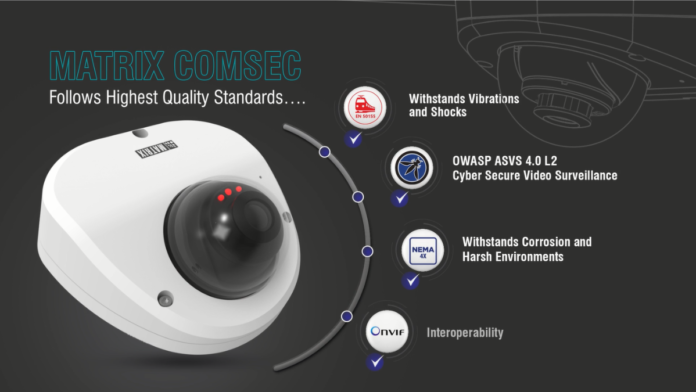
  • Select cameras that meet industry-specific standards like EN50155 and NEMA 4X for ruggedness and environmental durability.

What are the Advantages of Matrix Ruggedized IP Cameras for Trains?

Ruggedized IP cameras are essential for ensuring effective surveillance and security in the dynamic environment of train coaches. Here’s how they address the specific needs:

1. Camera Placement and Design

  • Ruggedized IP cameras boast a sleek, compact, and sturdy design distinct from traditional dome or bullet cameras. Their flat-faced structure allows seamless integration into tight spaces, making them ideal for installation within confined areas such as railway coaches.
  • With this streamlined design and a higher field of view, they ensure uninterrupted surveillance of crucial zones like seating sections, aisles, and doorways, where security risks are most prevalent.

2. Image Quality

  • They incorporate features such as image stabilization, that combats motion-induced blurring that captures clear and consistent video footage, even in dynamic environments.
  • With 120dB True WDR and SONY STARVIS sensor, they provide clear, superior image quality even in challenging lighting conditions.

3. Network and Power Requirements

  •  Ruggedized IP cameras are engineered to operate efficiently with minimal power consumption, ensuring compatibility with available power supply sources throughout the train journey.
  • They have 512GB SD card support that safeguards recording against network and power brownouts for uninterrupted monitoring.

4. Storage Data Considerations

  • Ruggedized IP Cameras feature advanced compression algorithms and adaptive streaming capabilities, optimizing network and bandwidth usage.
  • They have smart streaming capabilities, and technology like Region of Interest (ROI), that allow streaming and recording of critical areas at a higher bitrate from the entire image, optimizing bandwidth and storage requirements.

5. Regulatory Compliance Standards

  • Matrix Ruggedized IP Cameras are EN50155 certified,  a European standard specifically designed for electronic equipment used in the railway sector to ensure that the devices are safe, reliable, and able to operate in extreme conditions.
  • Other than that, these cameras are NEMA 4X, IK10, and IP67 compliant, which underscore their ability to withstand challenging environmental conditions.

6. Cyber-security Concerns

  • With IP surveillance cameras becoming interconnected and reliant on internet access, surveillance footage has become vulnerable to cyber-attacks.
  • Matrix Ruggedized IP Cameras comply with the OWASP ASVS 4.0 L2 norms and are certified by STQC, providing robust protection against cyber threats and safeguarding surveillance footage from unauthorized access or tampering.

To Sum Up

Ruggedized IP cameras are specifically designed to withstand the vibrations and movement associated with train operations, ensuring reliable performance. Their durability and flexibility make them crucial tools for comprehensive surveillance coverage. Integrating these cameras into existing transport infrastructure requires careful planning and ongoing support.

By leveraging the benefits of ruggedized IP cameras, transport networks can enhance safety for passengers and staff, creating a more secure journey for all.


Discover the endless possibilities of our city’s Metro at InnoMetro, our flagship Expo and Conference. Be an active participant in shaping its future towards a more sustainable tomorrow. Stay informed and join us to take a step towards a brighter future.
Advertisement1
InnoMetro_2026