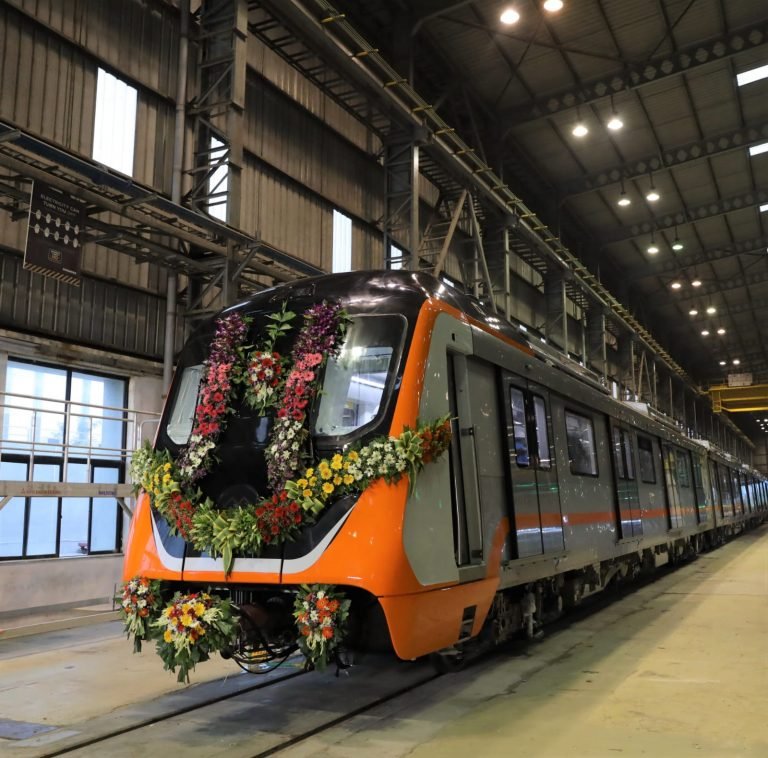
Chennai Metro: Buggie services will be available at four Metro stations

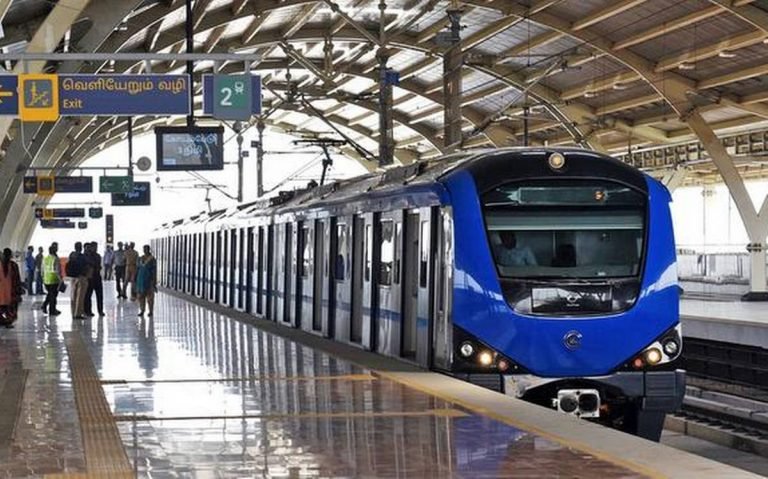
CHENNAI (Metro Rail News): Thousands of passengers at Wimco Nagar and Chennai Airport will benefit from the project. Hundreds of commuters use the Wimco Nagar suburban railway and Metro stations every day. On the other hand, passengers have always found it challenging to transition from one mode to another since they must walk or take an autorickshaw.

Similarly, numerous travellers and airport employees have requested a buggy service between the terminals and the station at Chennai Airport. According to authorities with the Chennai Metro Rail Limited (CMRL), each station will have two eight-seater vehicles that would run throughout the day.

“We will finalise the contractor shortly, and these vehicles will be available in six months,” an official said. In the increased parking area at Wimco Nagar, there will be a particular lane for these buggies to run between the stations. “Since these vehicles cannot be operated on the road, we will make a separate lane,” the official stated.

Thousands of people exit the station at Vadapalani and proceed to the nearby Forum Mall. They will benefit from this service.
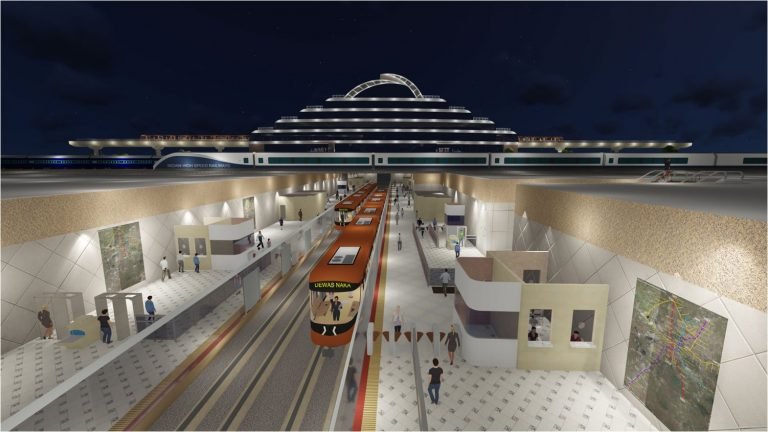
“The largest underground station in the world is the Chennai Central Metro, and many senior folks and others find it difficult to walk from the concourse to the lift point.” “These buggies will only run on the concourse level,” he explained.

Challaghatta Metro station in Bengaluru is expected to open in August 2022

BANGALORE (Metro Rail News): By August of this year, the Challaghatta Metro station, which is roughly 2 kilometres from the Kengeri Metro station, will be operational. The Challaghatta station was scheduled to open in March 2022 when the extended Purple Line between Mysuru Road and Kengeri was launched. Ninety per cent of the structural work on this elevated station has been completed, according to senior Bangalore Metro Rail Corporation Limited (BMRCL) officials.

“Along this route, a total of 70 spans have been built, and roof structure construction is currently underway. It will be finished by the end of March. Work on the finishing touches, such as placing stone on the floor, painting, and other outside work, will begin in the first week of February and be completed by July of this year,” a senior official stated.

The official stated that the welding work to join the rails has been completed and that plinths are being installed. “A total of 1,750 metres of rail must be installed, followed by the installation of fixtures around the rails. The power supply third rail will be completed later, “Added the official.

The Baiyappanahalli-Mysuru Road line was extended by 7.5 kilometres up to Kengeri on August 29 of last year. When asked why the delay occurred, an official responded, The most challenging aspect of the project was constructing a 56-meter span above NICE Road.

The second wave of the COVID pandemic, which resulted in a massive labour shortage, further slowed things down. The third wave also has an impact, as many workers are on leave or taking rest due to health concerns.

A small temple stood in the development, causing land acquisition complications. “To finish our work here, we had to finally dismantle it. While the physical work will be completed by July, the inspection and approval by the Commissioner of Metro Rail Safety may take longer. As a result, by the end of August, we’ll be able to run trains here, “added the official.

The Nadaprabhu Kempegowda Layout of the Bangalore Development Authority is also nearby. “An underpass has been suggested to provide communication between Challaghatta station to the layout. BMRCL and the National Highways Authority of India will work together on it. However, it appears improbable that it will be in place at the time of opening of the line.”

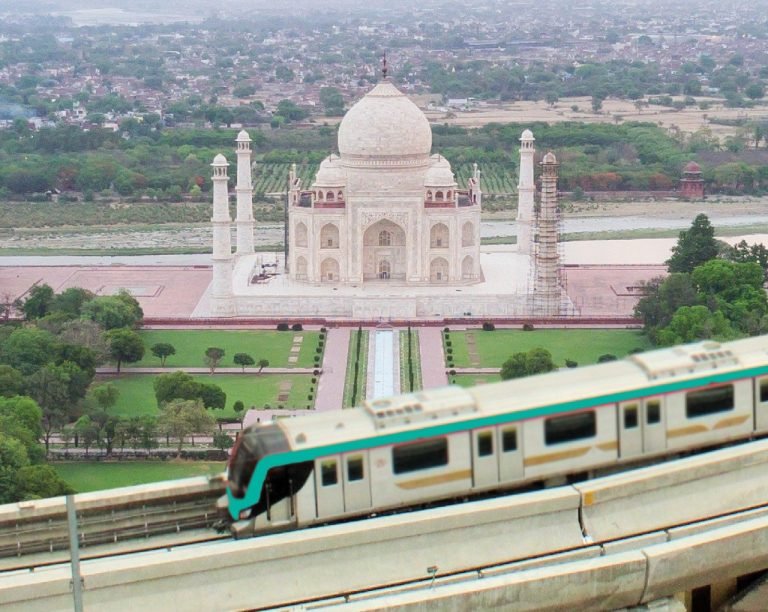
Agra Metro’s Piling & T-Girder Erection completed by Sam India Builtwell

AGRA (Metro Rail News): In the last week, Sam India Builtwell achieved two significant milestones on Fatehabad Road’s 4 km Taj East Gate – Taj Mahal Ramp elevated corridor for the Agra Metro Phase 1 project. The final 684 piles for pier foundation construction were installed last week. During a virtual ceremony held by Prime Minister Modi in December 2020, the first ceremonial pile for the 14.25 kilometre Line-1 was drilled.

Then, with the help of Appolo Cranes, Sam’s station team finished installing all 144 double T girders for the platform level of Taj East Gate Station, Basai Station, and Fatehabad Road Station on Sunday. On August 31, 2021, construction on the launch began. Uttar Pradesh Metro Rail Corporation (UPMRC) awarded Sam India Builtwell the Rs. 272.95 crore contract for the 7 km Priority Corridor’s 4 km Package AGCC-01 in October 2020.

Since November 2021, technical offers from seven contractors have been considered for the remaining 3 km underground portion (Package AGCC-02) of the Priority Corridor between Taj Mahal and Jama Masjid stations. However, due to bidding delays, the UPMRC will not be able to complete the 3 km underground section of the Priority Corridor before the 2024 Lok Sabha elections, as planned.

Bids Invited for Bangalore Metro Challaghatta Depot’s Work

BANGALORE (Metro Rail News): The Bangalore Metro Rail Corporation Ltd. (BMRCL) issued a tender notice for the civil construction of the Purple Line’s Challaghatta Depot and Workshop last week. This station will be built on a section of a 40-acre land tract abutting Mysore Road at the southern end of Reach 2B, which is now under construction by Soma Enterprise.

When the old Baiyappanahalli Depot is repurposed to serve the 57 km Blue Line connecting Silkboard – KR Puram – Kempegowda International Airport, Challaghatta Depot, together with the Kadugodi Depot, will become critical in conducting efficient Purple Line operations in the coming years.

Construction of Depot cum Workshop at Challaghatta in Reach-2 Extension of Bangalore Metro Rail Project, Phase-2 is the brief scope. The period estimated for the completion of the project is 2 years with an estimated cost of Rs. 517.44 Cr, and the final submission date would be February 25, 2022, at 3 PM.

STUP Consultants Pvt. Ltd. was granted an Rs. 4.47 crore Detailed Design Consultant (DDC) contract in January 2020. It was supposed to have an Inter Modal Integration Hub (IMIH) at the time, but that has since been dropped. In addition, the depot’s stabling lines were supposed to be on an elevated deck, but that plan was cancelled as well.

The final 1.314 kilometres section of Reach 2B connecting Kengeri Station and Challaghatta Station is expected to open in 2023. The primary priority for BMRCL and their system contractors is to commission the 15.257 km Purple Line Reach 1A & 1B extension to Whitefield, followed by the 3.031 km Green Line Reach 3C extension to Madavar (formerly BIEC). This is the 5th and final depot of the Phase 2 project to be tendered out.

Tender notices for remodelling Baiyappanahalli Depot and constructing Shettigere Depot by Kempegowda Airport are pending for Phases 2A and 2B. The Detailed Design Consultant contract for PADECO Co. Ltd. – Ardanuy India Pvt Ltd. JV was granted in mid-September 2021.

ContractorDepot
Under BiddingPurple Line’s Challaghatta Depot
Vascon Engineers Ltd.Purple Line’s Kadugodi Depot
BSR InfratechGreen Line’s Anjanapura Depot
Parnika Commercial & Estates Pvt. Ltd.Yellow Line’s Hebbagodi Depot
ISGEC Heavy Engineering Ltd.Pink Line’s Kothanur Depot

K-Rail survey facing fierce opposition in Kannur district, 30 houses to be demolished in Payyannur

PAYYANUR (Metro Rail News): In Kannur, a protest against the projected SilverLine Project is gaining traction. As surveyors arrive to undertake the social impact study, many people who will be impacted by the semi-high-speed rail route construction in Payyanur are voicing their opposition.
buy cialis daily online https://www.ecladent.co.uk/wp-content/themes/twentyseventeen/inc/en/cialis-daily.html no prescription

In numerous instances, protests by families who are about to lose their land and homes have hampered the house-by-house survey. As a result, thirty houses will have to be demolished in Payyannur alone. The survey will be conducted in 23 villages in the Kannur district as part of the social impact assessment. In the initial step, surveys would be conducted in 11 villages in the district, ranging from Chirakkal to Payyannur.

In the Kannur district alone, the state government has identified 106.2005 hectares of land for the project. Out of the 530 km rail line from Thiruvananthapuram in the south to Kasaragod in the north, the district would have a 61.7-kilometre segment. The railway line will run through the taluks of Kannur, Payyannur, and Thalassery in the Kannur district.

SilverLine is being hailed as the state’s largest infrastructure project. The journey time between Thiruvananthapuram and Kasaragod is projected to be reduced to roughly four hours. The builder is Kerala Rail Development Corporation Limited (K-Rail). The project is expected to cost more than Rs 63,000 crore.

The number of households to be rehabilitated, the size of the land covered by the project, as well as the number of houses, colonies, and other public areas in the vicinity are all included in the scope of the social impact analysis. The research will also determine whether the land to be purchased is necessary for the project. The cost of compensating for the potential social impact will be calculated during the research.

Over one lakh private vehicles will be replaced by RRTS, reducing CO2 emissions

DELHI (Metro Rail News): The 82-kilometre Rapid Rail Transit Corridor (RRTS) connecting Delhi and Meerut is now under construction, with the 17-kilometre priority section from Ghaziabad to Duhai expected to be completed by 2023. Officials predict that it will reduce CO2 emissions once fully operating by taking about 1.5 lakh private automobiles off the road.

A senior official added that It is anticipated that the corridor will lower total yearly greenhouse gas emissions by 2.5 lakh CO2e, making the city cleaner and a far more excellent place to live. It is also expected to raise the percentage of people who use public transit along the route from 37% to 63%. It will also remove around 1 lakh private automobiles from the road, helping to decongest the NCR, which lacks a public transportation system.

The corridor will run from Sarai Kale Khan in Delhi to Modipuram in Meerut, passing through Ghaziabad. The RRTS, which will be the first of its type in the country, will travel at a speed of 100 km per hour and take commuters to Meerut in 50-60 minutes. Separate business and general coaches will be available on the trains.

The RRTS runs through Delhi for about 14 kilometres, passing through Sarai Kale Khan, Jangpura, Anand Vihar, and New Ashok Nagar. These stations will serve as hubs for Metro stations, ISBTs, and other RRTS corridors.

Of the 14 km stretch, 9.2 km line would be elevated, while the Anand Vihar portion would be underground. “Between New Ashok Nagar and Kondli, foundation work, including piling and pile caps for the elevated section, is in full swing. “A 3-kilometre section is being worked on, with piers being put on portions where foundation work has been finished,” stated a senior NCRTC official.

Work on laying the foundation and pier construction for the Sarai Kale Khan station in Delhi has begun following significant utility shifting/modification. All three RRTS Phase-I corridors – Delhi-Meerut, Delhi-Alwar, and Delhi-SNB – will merge at this station, which will function as an interchange facility for the rapid rail, railway station, metro station, and ISBT.

To get to the railway station or bus stop, people must depart and walk almost a kilometre or take a rickshaw. They will be able to use the interchange facility without having to exit the premises once the RRTS is completed. A four-lane underpass has been built from Mathura Road to the RRTS station in Jangpura to make public access to the station more accessible. Work on the other Delhi stations is also moving very quickly.

The elevated New Ashok Nagar station will provide interchange services with the neighbouring Metro station. According to the official, preparations are underway at Anand Vihar to launch a tunnel boring machine to construct underground portions of the corridor.

In addition, the NCRTC is building a 1.35-kilometre bridge across the Yamuna in Delhi, which will run roughly parallel to the present DND flyway. This will link the RRTS stations of Sarai Kale Khan and New Ashok Nagar. The river bridge will be roughly 626 metres long, with the rest of it being over the khadar area on both sides. It will feature 32 piers with a 44-metre gap between them. The foundation for the bridge is now being laid.

The priority section starting from Sahibabad to Duhai Depot in Ghaziabad will have five stations and are nearing completion. An official exclaimed, “NCRTC has completed about 80% of the foundation work of the elevated section. More than 1,200 piers have been constructed on a 30-km stretch out of 82 km. In addition, about 16-km of the viaduct has been constructed, most of which is located on the priority section.”

Nokia and Alstom will collaborate to build a 4.9G/LTE private network in India for Delhi – Meerut RRTS

ESPO, Finland (Metro Rail News): Nokia stated this week that it would collaborate with Alstom to build a private wireless network for the Delhi to Meerut Regional Rapid Transit System (RRTS) of the National Capital Regional Transport Corporation (NCRTC). In addition, it will enable European Train Control System (ETCS) Level 2 Signaling to ensure commuter safety on the high-speed rail line, which is currently being built.

The Delhi-Meerut RRTS is the first phase of a phased development of a high-speed rail network aimed at enabling sustained economic and social development in Delhi and the neighbouring areas through improved connectivity. The low-emission RRTS, which is expected to be fully operational in 2025, will transport more people at average speeds of 100 kmph, reducing travel time and road congestion.

The fully redundant private network, which will span the 82 km rail route with 25 stations, will be built on Nokia’s Modular Private Wirelesssolution (MPW), which includes the latest AirScale radios, Air Frame-based evolved packet core capabilities, the 7250 IXR IP/MPLS backhaul routers, Group Communication platform for mission-critical push to talk/video (MCx/GC), and Network Services Platform (NSP) management.

The private network will feature ETCS Level 2 and 3 signalling and automated operation (ATO), allowing trains to use radio signals to continuously receive movement authorities and report their exact direction and position to ensure the safety of all passengers on board. For railway operators, introducing LTE/4.9G technology for ETCS is a significant benefit that will pave the way for a smooth transition to FRMCS (Future Railway Communication System).

Chennai Metro is working to minimise noise during metro train riding

CHENNAI (Metro Rail News): Many commuters may have experienced a screeching noise in metro trains, generated mainly by train-track friction, which frequently occurs on tight curves. The Chennai Metro Rail Limited (CMRL) will shortly commence track maintenance, including the use of rail grinding equipment to smooth out rails worn down by train operations, minimise noise, and increase the life of the rails.
buy super avana online https://pavg.net/wp-content/themes/twentytwentyone/inc/en/super-avana.html no prescription

According to a metro rail official, work would be completed in 90 days over the 54-kilometre line from Wimco Nagar to Airport and from Central Metro to St Thomas Mount. “We’ll probably start working in February.” According to the official, the work will be done between midnight and 4.30 a.m.

“The grinding will improve rail-wheel interaction in addition to lowering noise,” the official stated. According to officials, the rail grinding machine, which resembles a diesel locomotive, is expected to be rented from the Bangaluru metro and operated by a foreign specialist. CMRL has issued a tender for the machine’s transportation, loading, and unloading.

Due to friction produced by train movements and exposure to the environment, the ballastless rails experience corrugation and in some cases, corrosion. This frequently results in rail squeals, a screeching noise made by trains as they navigate sharp curves or straight stretches, as well as shocks and vibrations.

As a result, the rails must be ground regularly. Rail grinding began shortly after its establishment in 2015, and it will continue in 2019, 2020, and 2021. “The primary concern that occurs from failing to grind the rails is the harm that the undulation and pit marks on the train wheels may cause.”

“The rails are constructed of hard steel, while the train wheels are made of soft steel, both of which are imported from Europe and are costly to replace if they are broken,” one official explained. With the 118.9 km phase-2 taking shape, CMRL officials said a procurement process for rail grinding equipment has begun, which might cost roughly Rs 50 crore and take nearly 2.5 years to complete.

DMRC launches a special train to mark ‘Azadi Ka Amrit Mahotsav’ at Yamuna Bank

DELHI (Metro Rail News): The Delhi Metro Rail Corporation (DMRC) introduced a specially decorated metro at Yamuna Bank Metro Station on the Blue Line on Tuesday as part of the ongoing ‘Azadi Ka Amrit Mahotsav-celebrating 75 years of India’s Independence.’ Following its launch, the train was immediately put into passenger service.

https://twitter.com/OfficialDMRC/status/1485920915976486912

According to the DMRC, the exterior of this eight-coach special train has been wrapped and painted with a collage of images and slogans portraying the glorious history of its people, culture, and achievements over the last 75 years; evoking the spirit of ‘Aatmnirbhar Bharat.’

“The train was ceremoniously launched on Republic Day to promote the message of nationalism and solidarity to the general public. Furthermore, they informed in a press release that this particular train would stay in service during the ‘AzadiKaAmritMahotsav’ commemorative period “, they informed in a press release.

Since last year, the DMRC has been hosting various activities to honour the ‘AzadikaAmritMahotsav – 75 years of India’s Independence’ (AKAM) celebrations. The DMRC began its AKAM commemorative activities in July 2021 from the Lal Quila Metro station on the Violet Line in the form of an exhibition to highlight the historical significance of the historic venue from which the Prime Minister addresses the nation on every Independence Day, which is August 15th.

“In addition, event corners, display panels inside and outside of prominent Metro stations across the network, and digital screens at stations and within trains are all regularly used to communicate theme-based fascinating messages on ‘AKAM’ celebrations.”

This includes trivia about significant events in Indian independence, inspirational words from prominent Indian leaders, the journey of India’s evolving in various fields, cultural diaspora, and so on,” according to the DMRC.

The DMRC also stated that from time to time, online and on-ground activities such as Cyclothon, children’s workshops, quizzes, and drawing competitions are held by the DMRC to raise awareness about the use of public transportation, non-motorized transportation, environmental benefits, and to revisit the history of independent India.

Delhi Metro services to be ‘partially regulated’ on January 26, 2022

DELHI (Metro Rail News): The Delhi Metro Rail Corporation (DMRC) said on Monday that its services in the national capital would be disrupted on January 26 owing to Republic Day celebrations. According to a statement, all metro station parking lots will be blocked from 6 a.m. on January 25 to 2 p.m. on January 26.

It further stated that on January 26, “as part of the security precautions for the Republic Day festivities as per the directives of Delhi Police,” services on the yellow line, which runs from HUDA City Centre to Samaypur Badli, will be partially regulated.

“During this time, travellers can interchange from Line 2 to Line 6 (Kashmere Gate to Raja Nahar Singh) and vice versa at the Central Secretariat Metro station. At 6:30 p.m., regular service will be restored at these stations. “It was also added.

Intelligence reports suggested that a terror organisation would try to carry out attacks throughout the national capital in January; hence Delhi has been converted into a fortress ahead of the Republic Day celebrations. The Delhi Police has deployed over 27,000 officers to avoid any unforeseen situations.

According to news agency ANI, Delhi Police Commissioner Rakesh Asthana said, “Last year, preparations for Republic Day began just after the Independence Day celebrations. We must exercise additional vigilance in Delhi because it is always under threat of terrorism. We’re on high alert again this year. To keep track of all anti-terror efforts, security agencies are cooperating with Delhi Police.”

Vehicle inspections, checking of lodges, tenant, servant, and labourer verification have all been stepped up. “To safeguard airspace, counter-rogue drone technology is being deployed. Other agencies, in addition to the Delhi Police, are working together to secure the airspace. In and around Central Vista, all agencies are cooperating with Delhi Police,” he stated.

“We will finalise the contractor shortly, and these vehicles will be available in six months,” an official said. In the increased parking area at Wimco Nagar, there will be a particular lane for these buggies to run between the stations. “Since these vehicles cannot be operated on the road, we will make a separate lane,” the official stated.

Thousands of people exit the station at Vadapalani and proceed to the nearby Forum Mall. They will benefit from this service. “The largest underground station in the world is the Chennai Central Metro, and many senior folks and others find it difficult to walk from the concourse to the lift point.” “These buggies will only run on the concourse level,” he explained.

Kochi Metro served five crore passengers in four years

KOCHI (Metro Rail News): Since its inauguration in 2017, the Kochi Metro has served over five million passengers. According to a KMRL spokesman, the total number of passengers who have used the service has reached 5.12 crore. During these years, 40,000 to 50,000 passengers used the facilities on average.

Before the pandemic, it was over 65,000. Due to pandemic-induced lockdowns, the Kochi Metro was closed for more than 160 days in 2020 and more than 50 days in 2021. It never regained its previous footfall after the lockdown.

The average number of customers declined to 18,361 in 2020. However, after the second shutdown, it showed a minor recovery in 2021, with an average of 26,043 daily commuters. The Metro, which is infamous for losing money, has recently implemented a number of sops. 

Some passengers are requesting a rate reduction. According to the Metro’s annual report, it lost Rs 334.41 crores in 2020-21. In 2019-20, it was Rs 310.82 crores. The income of the metro train, on the other hand, is increasing. It made Rs 167.46 crores in 2020-21, compared to Rs 134.95 crores in 2019-20.

MMRCL completes 18% of track laying work

MUMBAI (Metro Rail News): The Mumbai Metro Rail Corporation Ltd (MMRCL), the project implementing authority for the underground Metro Line 3 (Colaba-Bandra—SEEPZ), stated that overall 18% of track laying work has been achieved far.  On the entire corridor, a total of 66.07 kilometres of the track will be laid.

The Head Hardened (HH) rails of a total of 10,740 tonnes manufactured by Japanese company M/s. Nippon will be utilised for Metro-3 track work.  Last year, M/s. Mitsui imported all of the rails from Japan in three lots. M/s Larsen & Toubro has been commissioned with the track installation and construction.

For the first time in India, Low Vibration Track (High Attenuation) technology is employed for track work. M/s Sonneville AG, a Swiss company, devised this device to reduce greater levels of noise and vibration in the range of 22VdB (vibration measurement) generated during train operations on this line.

Because Metro Line 3 will travel beneath different heritage and ancient residential structures once it is completed. This technology will improve passenger comfort while also protecting the existing heritage structures on the ground.

The sleepers for the tracks are made in a specialised sleeper casting plant at Wadala explicitly built for this purpose. According to the MMRC, 201,600 sleeper blocks will be required for the entire project.

While overall, work on Metro Line 3 has been 71 per cent so far. A total of 97 per cent of the tunnelling work has been finished. The construction of the station is in full swing, with 77 per cent of the work completed thus far. According to the MMRCl, 34% of system development has been performed.

Industry Leaders Expectations from Rail Budget 2022

The Rail Budget will be presented on February 1 alongside the General Budget, as has been the pattern since the Narendra Modi government took power, ahead of the Assembly elections scheduled to be held in the five states.

Nirmala Sitharaman, the finance minister, will announce her fourth budget on February 1, and reports say the Central government will increase the rail budget outlay by 15-20% this time. The Railways received Rs 1,10,055 crore from the government last year. An amount of roughly Rs 2.5 lakh crore is expected to be set aside this time.

In many railway-related areas, there is a buzz of excitement ahead of the budget. The central government may announce new passenger railway facilities. In the last fiscal year, the Railways have lost Rs 26,338 crore. Despite the losses sustained during the Covid-induced crisis, analysts feel that a train fare increase is unlikely. The Railways is also thought to be examining options other than raising fares to boost revenue.

During the Covid period, freight provided the majority of the Railways’ earnings. As a result, the railways will make an effort to prepare other freight lanes, which will relieve pressure on passenger trains. In the rail budget, about ten new light trains (aluminum-built) for long-distance travel could be unveiled.

Plans are in the works to improve rail connections in election-bound states and major cities. The government may enlist the help of commercial enterprises to do this. A bullet train connecting Delhi and Varanasi may also be announced. Indian Railways will develop the solar-power capacity to minimise their reliance on electricity and diesel and to reduce carbon emissions.

In addition, the National Rail Plan will state that by 2030, all trains will be fully electrified. Through the PPP model, redevelopment projects for the enhancement of the stations will be revealed. Twelve corridors have been identified for this purpose. It has piqued the curiosity of several companies.

The administration may also announce the formation of a Rail Development Authority this year, which will provide recommendations to the government on fare-related matters. More projects like Tejas are planned to be developed in the future to connect major tourist hotspots around the country.

In addition, the creation of specialised freight lines would be prioritised. The East-West Corridor from Bhusaval to Dankuni via Kharagpur has already been announced, as has the North-South Corridor from Itarsi to Vijayawada. The Finance Minister had also unveiled the National Rail Plan 2030 for railway development while declaring the previous railway budget.

It was announced that the railway facilities would be given a new makeover. The central government has already set aside Rs 1 lakh crore for investment. In addition, metro rail systems are being built in the outskirts of two Tier-2 and Tier-1 cities, with Indian Railways aiming to become “the world’s first 100 percent green train service” by 2030.

In addition, the federal government may declare the use of hyperloop technology in the upcoming rail budget. Passengers are transported in pods through tubes or tunnels. This mode of transport is more rapid than the bullet train.

The government could possibly make major infrastructure announcements in the budget. The government may announce the redevelopment of 500 railway stations in this budget, which will be named ‘Kayakalp.’

Alain SPOHR, Managing Director, Alstom India & South Asia
Mr. Alain SPOHR, MD, Alstom India & South Asia

Alain SPOHR, Managing Director, Alstom India & South Asia said

“Alstom believes that Railways can prove to be one of the champion sectors to provide fillip to Make in India, incentivise foreign investments and deliver a big boost to the economy. We are positive that this year’s budget will be as progressive as last year’s, where the Government allocated a record sum for capital expenditure.

Our expectations are in line with the priority accorded to infrastructure projects by the Government such as National Infrastructure Pipeline and PM Gati Shakti (National Master Plan for Multi-modal Connectivity). An enhanced capital outlay to encourage railway

modernization plans for creation of infrastructure as well as replacing railway passenger and freight fleets would be ideal. Special emphasis on multi-modal connectivity with enhanced opportunities under PPP mode is expected to boost activity in this sector.

We agree with the Finance Minister that connectivity is the essence of the economy and improving intercity connectivity is critical for the formation of smart cities and boosting the pace and volume of economy. We are expecting additional support for introduction of new technologies such as Metro Lite and Metro Neo for promoting mobility in Tier II & III cities.

We are hopeful that the government will further improve on the ease of doing business in India as there is a huge potential for growth. Introducing production linked incentives for railway manufacturers and exporters promoting Make-in-India would be encouraging while also fast-tracking the implementation of projects and supporting the manufacturing ecosystem. Certainty in policy and adequate government support for project execution can vastly improve private investment in the sector.

With the ambition to become the largest Green Railways in the world moving towards becoming a ‘net zero carbon emission’, we are hopeful that measures to promote energy efficient and carbon-friendly technologies, processes and practices will feature in the upcoming budget.

Promoting a level playing field for original domestic as well as foreign companies, which have invested substantially in India and contribute towards economic growth, will attract additional investments into the country. The Government must consider supporting companies that are significantly invested in India, conducting cutting- edge R&D and executing large railway development projects to come forward and make India an export hub. These measures will also help India become an Atmanirbhar Bharat and achieve its aspiration of a $5 trillion GDP”

DSC 3886 C min 2
Mr. Rohit Saboo, President & CEO, National Engineering Industries Ltd.

Rohit Saboo, President & CEO, National Engineering Industries Ltd Said

In the light of the continuing pandemic, the government is making an ongoing effort to achieve normalcy with regards to economic damages. Keeping in mind the future of the country, budget should be growth oriented and should focus on capital expenditure. It should continue providing financial support to SME/MSME sector, which is the future of our nation. Home grown brands should be given priority in all government tenders in line with Make in India initiative. There should be a mechanism for fast-track approval for products developed by local suppliers. The Government should focus on faster induction and implementation of Artificial Intelligence based technologies for safety and maintenance in the Railway system. Emphasis should also be given on logistics services. Further, digital integration of Railway system with industry systems can radically reduce the time and cost for domestic suppliers.”

NHSRCL and IRCON International sign a track package contract for Mumbai-Ahmedabad High-Speed Rail Project

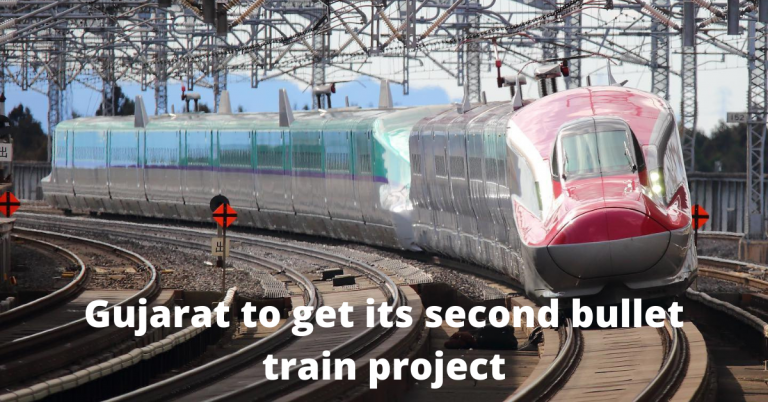
MUMBAI (Metro Rail News): The National High-Speed Rail Corporation Limited (NHRCL) has signed an agreement with IRCON International Limited for the design, supply, and construction of the track and track-related activities for the Mumbai-Ahmedabad High-Speed Rail corridor (MAHSR T-2 Package). It is 237 kilometres long and between Vadodara and Vapi in Gujarat.

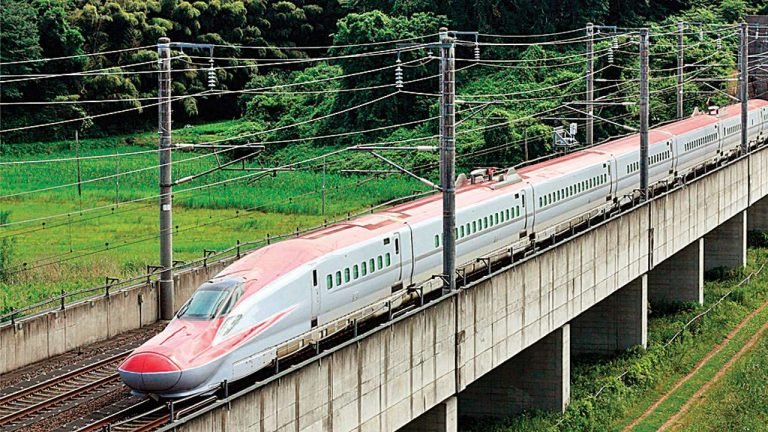
On India’s first Bullet Train or HSR project, the ballast-less slab Track system adopted in Japanese HSR (Shinkansen) will be deployed. For the contract, Japan Railway Track Consultant Co. Limited (JRTC) provided thorough design and drawings of major HSR track components such as RC Track bed, Track slab layout, and continuous welded rail (CWR) forces.

The contract, which was awarded to an Indian company, M/s IRCON International Limited, intends to strengthen the Make in India effort. “We have received support from JICA in a very effective manner,” stated Satish Agnihotri, Managing Director, NHSRCL, in response to the development. I am grateful for the technical assistance provided by JICC, JARTS, and JRTC for the MAHSR project.” He stated.

“Under this contract, Indian contractors will receive transfer of Japanese Shinkansen technology, which will offer a huge boost to the Make in India effort,” stated MIYAMOTO Shingo, Minister of Economic and Development, Embassy of Japan in India.