KEC International bags new orders worth Rs 945 crore

DELHI (Metro Rail News): KEC International, an RPG Group company, has secured new orders of Rs 945 crores across its various businesses:

The business has secured orders for Transmission & Distribution (T&D) and Cabling projects in India, SAARC, the Middle East, and America which includes a 765 kV GIS Substation order in India, from Power Grid Corporation of India Limited (PGCIL), under Tariff Based Competitive Bidding (TBCB) route and 100 kV Underground cabling project in India.

The business has won an order for setting up of a power supply system for railways, including receiving substation, high voltage cabling and associated civil works, from Delhi Metro Rail Corporation (DMRC). KEC has also secured orders for several types of cables in India and overseas.

Vimal Kejriwal, MD & CEO, KEC International, said, “We are delighted with our new order wins, especially the prestigious substation order in the Green Energy Corridor from PGCIL. We are witnessing a gradual revival in the domestic T&D market, which had been sluggish for past few quarters. Our Railway business continues to strengthen its presence in the technologically enabled areas of metros. With these orders, our total order inflow for FY22 stands at an all-time high of Rs 17,202 crores, a robust growth of ~45% in last year.”

UNEP launches new sustainable land use finance impact directory

GENEVA (Metro Rail News): Financial institutions around the world can now measure the positive impact of their investments into biodiversity conversation, adaptation, mitigation, forest protection and sustainable livelihoods with the help of a new indicator directory and resources platform, launched today.

The Land Use Finance Impact Hub and its Positive Impact Indicators Directory – launched on 6th April by UN Environment Programme (UNEP) Climate Finance Unit and the UNEP-World Conservation Monitoring Centre (UNEP-WCMC) – has been developed with and for impact funds and sustainably focused financial institutions, and aims to support the rollout of effective industry frameworks to track the environmental and social impacts of land-use investments.

To successfully tackle the triple planetary crisis of climate change, nature loss and pollution, leaders are calling for the world to become not only net-zero, but also nature positive, for the benefit of both people and planet. This represents a real paradigm shift with the economic imperative to not only minimize impact but also restore ecosystems. Banks and investors are waking up to this urgent need, and are looking for guidance and practical solutions to help drive nature positive land-use investments. The new tool will enable the implementation of the policy efforts across the finance industry and encourage capital flows into nature positive assets and activities.

Strong impact-measurement frameworks are key to driving public and private investor confidence, attracting diverse sources of concessional finance and mainstreaming private capital across biodiversity conservation, climate adaptation, climate mitigation, forest protection, and sustainable livelihoods. They align with a  global focus on nature-based solutions, based on the newly adopted resolution at the 5th UN Environment Assembly.

“Coming hot on the heels of the Task Force on Nature-related Financial Disclosures (TNFD) beta-framework release, the new Land Use Finance Impact Hub provides an important resource for financial institutions to ensure they are properly considering their environmental and social impacts. The Positive Impact Indicators Directory is a valuable and unique starting point for institutes to track their positive impacts – and aligns with the TNFD call for greater disclosure on nature-related opportunity identification and disclosure,” said Matt Jones, Head of Nature Economy at UNEP-WCMC.

The Positive Impact Indicators Directory is a harmonized shortlist of key performance indicators, designed to encompass fundamental aspects of sustainable land use investment such as the natural habitat area that is effectively protected through time. It aims to help end-users, including impact funds, asset managers and debt managers, to identify and measure how land use investments generate positive environmental and social impacts. UN Member States who are involved in blended concessional financing will also find this useful to ensure their impacts are properly tracked. The Directory also allows users to see how the proposed indicators link to global goals, including the UN Sustainable Development Goals, the Rio Conventions, and the UN Decade on Ecosystem Restoration, enabling financial institutions to track their positive environmental and social impacts at a time of increasing pressure on the financial sector to influence the change needed to address planetary crises.

“In the early days of sustainable land use finance, there was a tendency for each fund to develop their own set of project-specific Key Performance Indicators, making it difficult to aggregate impact results at the fund level and for financiers to identify where they could best invest their capital to achieve the desired impacts,” said Ivo Mulder, Head of UNEP’s Climate Finance Unit. “The Land Use Finance Positive Impact Indicators Directory is a first step to resolving this challenge by adopting a common and standardized approach. It brings increased efficiency for capital allocation in nature-positive assets, including in the context of sustainable land-use assets.”

The Directory, while providing a unique, targeted shortlist of indicators for positive environmental and social impacts, is only a small part of the Land Use Finance Impact Hub.

The Hub will host multiple expert discussions, information briefs that educate decision-makers about various environmental and social frameworks and relevant external resources. The team is also looking to expand the Positive Impact Indicators Directory to include indicators relevant to banks, in addition to the current set developed with and for impact funds.

UNEP’s Climate Finance Unit UNEP-WCMC aim to make the Impact Hub the go-to platform for guidance and tools needed by users to ensure funds are spent efficiently, potential risks are curtailed, and impacts are measured, monitored and reported against.


Rail Minister shares current status of Mumbai-Ahmedabad bullet train

DELHI (Metro Rail News): Union Rail Minister Ashwini Vaishnaw on Wednesday informed the Lok Sabha about the Mumbai–Ahmedabad high-speed rail corridor (MAHSR) project and said “The cost of MAHSR Project is Rs 1,08,000 crore as in 2015. Delay in land acquisition, especially in the State of Maharashtra and consequent delays in finalization of contracts as well as adverse impact of COVID-19 have delayed the execution of MAHSR Project.”

The rail minister also informed that about 1,248 hectares of land has been acquired out of total land requirement of 1,396 hectares so far, and said, “The anticipated increase in cost and time can be fully ascertained only after completion of land acquisition, finalisation of all contracts and associated timelines.”

Speaking about the current status of the high-speed rail project, he explained that all statutory clearances relating to wildlife, Coastal Regulation Zone (CRZ), as well as, forest clearance have been obtained.

The Centre had sanctioned the first Bullet Train project between Mumbai and Ahmedabad in December, 2015 with technical and financial assistance from Government of Japan.

He also said that according to the Memorandum of Understanding (MoU), the Government of Japan will provide a loan of 81 per cent at the maximum of the project cost. “Finalization of actual cost and the quantum of loan shall be amended accordingly if required,” he added.

The minister said that In Maharashtra, 68.65 per cent out of total 297.81 hectares needed for the project has been acquired whereas in Gujarat, 98.76 per cent out of 954.28 hectares needed for the project has been acquired.

NMRC to select company for new route’s overhead systems

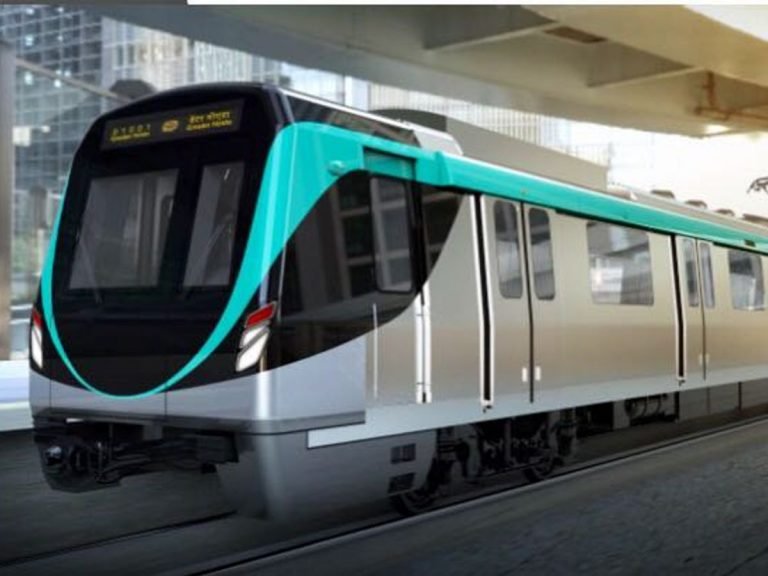
NOIDA (Metro Rail News): The Noida Metro Rail Corporation (NMRC) has issued a tender for hiring a consultancy firm for designing the overhead equipment system (OHE) and other technical capabilities for the extension corridor in Greater Noida West. This tender includes OHE transmits electric energy to run trains and power supply infrastructure.
buy kamagra soft online https://www.facebeautyscience.com/wp-content/themes/twentyseventeen/inc/en/kamagra-soft.html no prescription

Officials informed that the firm which will get selected will work for the 9.6km corridor that will have five stations from Sector 51 in Noida to Greater Noida’s Sector 2. The last date for application is May 3.

“The NMRC already issued a civil tender and selected a developer for the civil construction work in December 2021. The work has not been awarded to the developer as an in-principle approval from the Centre of the project is awaited. Now, we have issued a tender to hire a consultancy firm for overhead equipment system”, an NMRC official said.

GR Infra Projects Limited had bagged the tender for construction of the project in December 2021. The OHE design should focus on problems such as weather vulnerabilities, temperature, rainfall humidity, wind pressure, thunderstorm and disasters like earthquakes, officials said. The design should also follow the standards of DMRC and the Indian Railways, the officials added.

“The design requirements should also match the standard speed, frequency, comfort, and reliability and high levels of workmanship and quality. For design purpose, the maximum speed potential of the system shall be taken as 120 kmph,” the tender document, issued on Monday, stated. Once a design is approved, the NMRC will hire a developer for the OHE project.

Ritu Maheshwari, NMRC’s managing director and Noida Authority CEO, last week commented that work on the Greater Noida West corridor is expected to start in three months. The DPR for Metro in Greater Noida West has been sent to the central government for their approval.

The new corridor will be built in two phases. The first phase which will be a 9.6km stretch will have five stations-Noida Sectors 122 and 123. Greater Noida Sector 4. Ecotech 12 and Greater Noida Sector 2. In the second phase which is a stretch of over 5.8km, four stations that are Greater Noida Sectors 3.10 and 12 and Knowledge Park V will be constructed.

This time NMRC will build the extension for this network, unlike the existing 29.7km Aqua Line Noida Sector 51 – Greater Noida depot that was built by the DMRC.

L&T bags significant contracts from UPMRCL

UTTAR PRADESH (Metro Rail News): Larsen & Toubro (L&T) on Tuesday, 5th March has informed that its transportation infrastructure business and railways business unit has bagged several orders from prestigious clients which includes Uttar Pradesh Metro Rail Corporation (UPMRCL) Ltd. However, L&T has not disclosed the value of contracts but said that they fall under the significant category which ranges from Rs 1000cr to Rs 2500cr.

The railways business unit along with the substation business unit of the power transmission and distribution business has won an order from the UPMRCL.

“This EPC order involves design, supply, installation, testing and commissioning of a 750 volt DC third rail traction system, Receiving Substations including High Voltage Cabling from Grid Substations… of the Agra Metro Rail Project at Agra, Uttar Pradesh,” the L&T statement said.

The 36-month project will be funded by the European Investment Bank (EIB).

FOB to connect Noida Sector 52, 51 Metro stations soon

NOIDA (Metro Rail News): The Noida Authority board has finally approved the construction of a foot over bridge (FOB) to link Blue line’s Sector 52 Metro station with Aqua line’s Sector 51 Metro station which will provide a major relief to thousands of daily commuters. The officials said that the tenders have been floated and the construction work will start soon.

Presently, commuters have to get down from the metro station and walk on the road for nearly 300 meters to take an e-rickshaw to reach the other station, as it is the only link between the two metro stations. Officials have informed that the FOB will be a 400 meters and five meters wide L-shape structure which is going to benefit the daily office-goers and commuters.
buy zoloft online https://blackmenheal.org/wp-content/themes/twentytwentytwo/inc/patterns/en/zoloft.html no prescription
The total cost for the construction of FOB will be borne by Noida Authority, a senior Noida Authority official said.

DDA releases Rs 130 cr for DMRC phase-IV project

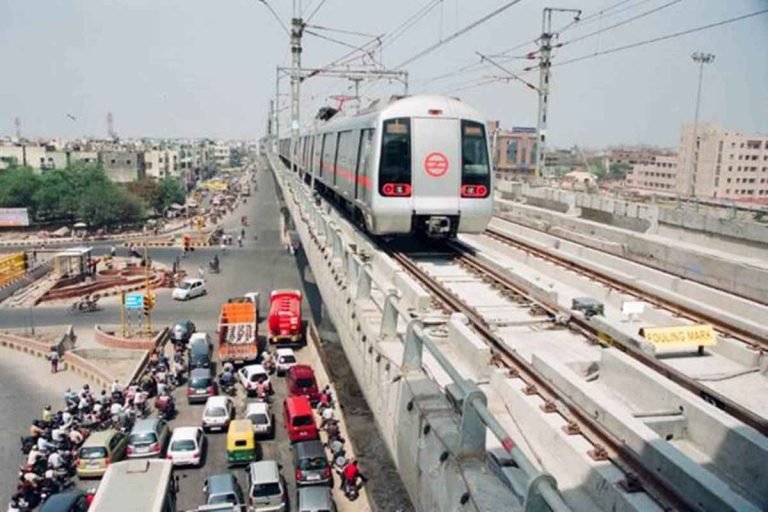
DELHI (Metro Rail News): The Delhi Development Authority (DDA) has released Rs 130 crore for the Delhi Metro Rail Corporation (DMRC) to facilitate the construction of the new metro line in Narela. DDA has taken this step because the area, where most of its new housing projects are concentrated, faces connectivity issues. The DMRC has planned a 23-km-long Metrolite corridor between Rithala and Narela as part of its Phase-IV project.

The DDA wants the project to be facilitated as Narela sub-city is one of the three sub-city projects of DDA and is being developed to provide for the housing requirement of the national capital which is increasing. The Metro corridor will pass through sectors 25, 26, 31, 32 and 36 in Rohini, Barwala, Pooth Kalan, Bawana industrial areas 1 and 2, and Narela.

“The DDA is actively working with the DMRC to bring metro connectivity to the far-flung areas of Northwest Delhi. A series of meetings were held by the DDA with DMRC and other stakeholders to finalise the Metro route alignment for Rithala-Bawana-Narela to serve the already constructed housing pockets in the Narela Sub-city Project,” said a senior official.
buy grifulvin online https://gilbertroaddental.com/wp-content/themes/twentyseventeen/inc/en/grifulvin.html no prescription

DDA housing schemes of Narela Sub-city were less preferred in comparison to other areas of Delhi because there is absence of a public Mass Rapid Transportation System. The proposed metro route would improve the accessibility and connectivity to the people of Narela, he added.

MTHL can’t bear the load of Metro: MMRDA

MUMBAI (Metro Rail News): The Mumbai Metropolitan Region Development Authority (MMRDA) had previously planned to revive the Metro corridor between Mumbai and Navi Mumbai on the Mumbai Trans Harbour Link (MTHL) which is under construction between Sewri and Navi Mumbai but now it seems impossible.

In January 2022, MMRDA had announced their plans to appoint a consultant who can study whether the sea bridge can take the load of a Metro corridor. The consultant submitted the draft report last month according to which the 22 km bridge cannot bear the load of the Metro. After the report, the MMRDA said the bridge will not be ruled out and that they will study if they can make it work by increasing the load capacity. MTHL will connect Sewri with Nhava Sheva which is expected to be complete by 2023 and 65 per cent of work for it has already been completed.

SVR Srinivas, the metropolitan commissioner of MMRDA, said, “The draft report pointed out that the bridge might not be capable of tackling the load of the Metro.
buy vibramycin online https://www.parkviewortho.com/wp-content/languages/new/prescription/vibramycin.html no prescription
However, we are exploring solutions like increasing the load capacity. We have not ruled out the project yet.”

MMRDA had prepared a detailed project report (DPR) in 2010 for the Mumbai Trans Harbour Metro Rail Link which is a 49 km corridor between Prabhadevi and Dushmi. The project’s aim was to encourage mass transport and cater to future travel demands while facilitating the decongestion of traffic but as MTHL was to be constructed under Public-Private Partnership (PPP) model, the firms who were interested, were not desirous on the Metro corridor because they thought that the citizens would prefer the Metro over using the MTHL and paying a toll. Later, the MMRDA decided to construct MTHL by taking a loan, but the Metro plan remained off the radar till last year.

Tamil Nadu government approves feasibility study for MRTS in Coimbatore

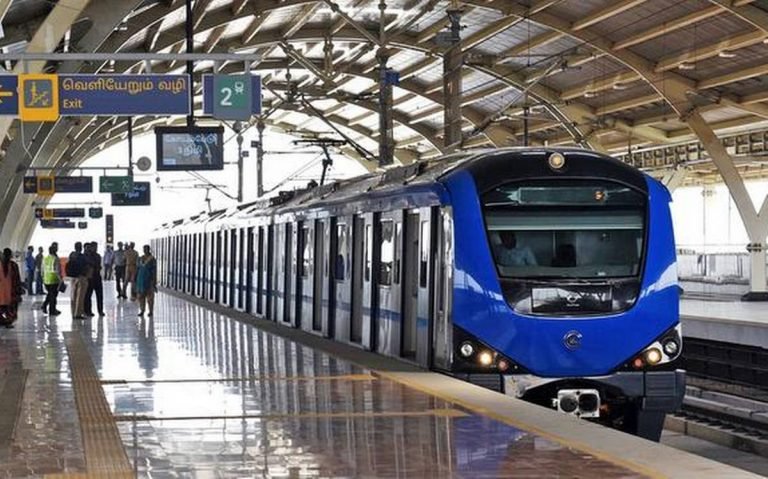
COIMBATORE (Metro Rail News): The Tamil Nadu government has approved the feasibility for starting a Mass Rapid Transit System (MRTS) in Coimbatore. The Detailed Project Report (DPR) for Phase 1 of the project is under finalization by Systra & Rites Ltd. 

As per the press release, stake holders of Coimbatore Metro Rail project held a meeting on 1 April. The meeting was chaired by Mr Pradeep Yadav, Md, Chennai Metro Rail Limited (CMRL) and Principal Secretary, Special Initiative Department, Government of Tamil Nadu. The consultant gave a presentation on the proposed routes in the meeting.

Coimbatore Metro Rail will cover 139 km and this project will be executed in three phases by CMRL. The first phase will be for 44 km on the Avinashi road until Karumathampatty and Sathyamangalam road until Valiampalayam Pirivu from Ukkadam, according to sources.

The second phase and third phase work will start after a detailed study and due approvals which will be done at the same time. A further extension from the existing plan of 139 km and suggestions to include new areas will be taken under study.

This metro will run parallel to the locations in which flyovers are being built and the required land for the same will be acquired. The estimated cost for this project will be Rs 6,800 crore, according to sources.

Patna Metro’s PMCH station to be built underground

PATNA (Metro Rail News): The Patna Medical College and Hospital (PMCH) station of Patna Metro which was previously proposed to build on an elevated corridor will now be built underground. The officials on Sunday also said that two gates for exit or entry would be located inside the campus of the institution which is undergoing a major infrastructure renovation.

The Patna Metro rail project is 31 km long stretch that includes the Danapur-Mithapur-Khemni Chak corridor (Line-1) and Patna Railway Station-Pataliputra Bus Terminal corridor (Line-2) and will benefit millions of passengers.
buy viagra generic mexicanpharmacyonlinerx.net over the counter
The Delhi Metro Rail Corporation (DMRC) is assisting the Patna Metro Rail Corporation (PMRC) in the construction of the metro lines in Patna.

This was much required as the metro station will provide seamless connectivity to people who would come to PMCH for their medical requirements. The PMCH Metro Station will be a part of the 14.45 km-long Patna Railway Station-Pataliputra Bus Terminal Corridor (Line-2) of the PMRC, the officials said.

“Originally proposed as an elevated station, the (PMCH) station was designed to pass through extremely congested residential as well as commercial areas. It was later realised that an elevated stretch will involve a large number of partial or complete demolition of nearby structures. Moreover, construction of an elevated viaduct on the busy road would lead to choking of road traffic, since the width of Ashok Rajpath, between Catholic Church and PMCH, is extremely narrow,” the statement said.

The DMRC on Sunday said, “In order to ensure optimised accommodation of the systems requirements as well as for the efficient provision of passenger amenities, the layouts and sizes for the systems rooms had to be designed specific to the PMCH station, which is distinct from other stations.”

The positions of the entrances, and the related vertical movement elements and passages had to be designed specifically to the available land at the surface and the road alignment at this particular location. The officials informed that it is an engineering challenge as this has resulted in “unique design of the station entrances, concourse layout as well as the ancillary areas,” officials informed

The PMCH Metro Station which is now constructed as an underground metro station will be having “four entry/exit gates in total, two inside the Patna Medical College and Hospital campus and the other two, towards the opposite side of the road on Ashok Rajpath,” the statement said.

A small subway of 30 metres will also be constructed to provide connectivity to the entry/exit gate on either side. The station will have two lifts and three escalators for the convenience of commuters, the DMRC said, and also shared the concept plan in graphic images.

The foundation stone of the Patna Metro was laid by Prime Minister Narendra Modi on February 17, 2019

Officials inspects the Delhi-Ghaziabad-Meerut RRTS Corridor

DELHI (Metro Rail News): Secretary, Ministry of Housing & Urban Affairs and Chairman NCRTC Mr Manoj Joshi along with Mr Vinay Kumar Singh, Managing Director, NCRTC, on Sunday, 3rd April, inspected the ongoing construction work of the Delhi-Ghaziabad-Meerut RRTS corridor.

The visit started from Sarai Kale Khan RRTS station which is being developed by NCRTC as a mega transport hub. Mr Joshi was apprised about the Multi-Modal-Integration scheme for seamless commuter movement at this RRTS station where all the three RRTS corridors of Phase 1 will converge and will also be interoperable. RRTS stations will be seamlessly integrated with other modes of transport such as Metro stations, Bus Terminals, and Indian Railway Stations, wherever possible, through Walkways, Lifts, Escalators and Underpasses etc.

Moving further, he overviewed the construction of RRTS bridge over the Yamuna River and Anand Vihar RRTS station site. MD NCRTC apprised Secretary about how Anand Vihar RRTS station is being uniquely designed for efficient multimodal integration. Secretary was also informed that four Tunnel Boring Machines (TBMs) will be working in Delhi. Two from Anand Vihar towards New Ashok Nagar and two from Anand Vihar to Sahibabad. The first TBM named Sudarshan has already been launched for its journey in the last month.

During his visit to one of the Casting yards for the project, it was explained that how the Precast technique is being extensively used in the implementation of RRTS to obtain high-quality concrete and optimization of construction period. It was a strategic decision to adopt pre-casting technique as the corridor is being constructed majorly at the centre or side of busy highways.

The Secretary also reviewed the Ghaziabad Receiving Sub Station (RSS), built for supplying power on the priority section of the RRTS corridor. He inspected the installation of state-of-the-art systems and sophisticated electrical equipment. Further, Shri Joshi visited the Ghaziabad RRTS station site, which will hold the distinction of being the highest and largest among the 25 stations on this corridor as the RRTS alignment crosses over the Delhi Metro viaduct and a flyover at this location. Proposed traffic integration plan at this highly busy zone and various initiatives being taken by NCRTC in this regard were explained to him.

Moving forward Secretary inspected the Guldhar RRTS station and the ongoing track laying work near it. Secretary appreciated the pace of construction progress particularly of the priority section, including the various safety and anti-dust measures being taken. Secretary was informed that the 23rd Launching Gantry for construction of super structures of viaduct has been installed recently for the 82 km long corridor. Such massive deployment of resources is first of its kind in the country for implementation of any urban transport system.

Secretary interacted with the on-ground engineers, understood their challenges in implementation of the 82 km long Delhi-Ghaziabad Meerut corridor. Secretary was also briefed about various measures being taken by NCRTC to ensure minimum inconvenience to local public during construction including construction being carried out within barricaded zones, deployment of traffic marshals to manage traffic etc.

The visit concluded at the RRTS Duhai Depot, wherein Secretary reviewed the construction progress, Admin building, ongoing electrical work, track laying activities and the prototype of RRTS train. MD, NCRTC, showcased the modern and commuter-centric interiors of India’s first Regional Rail to the Secretary. He appreciated the corporation’s approach to customise the train, giving due attention to commuters’ requirements during regional commute including luggage rack facility, Mobile/laptop charging facility at every seat, provision of wheelchair space for differently abled and stretcher space for emergency medical transit, dynamic route map display among others.

Secretary was contented to note the pace of the project is a as per the timelines. He acknowledged that the NCRTC team is working efficiently in collaboration with all stakeholders and is all set to commission India’s first RRTS corridor on time and transform the public transport landscape of NCR.

CM Uddhav Thackeray inaugurates Mumbai Metro lines 2A and 7 today

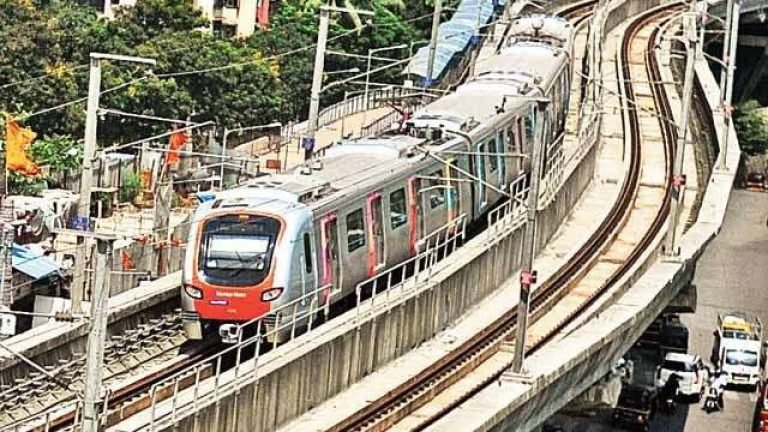
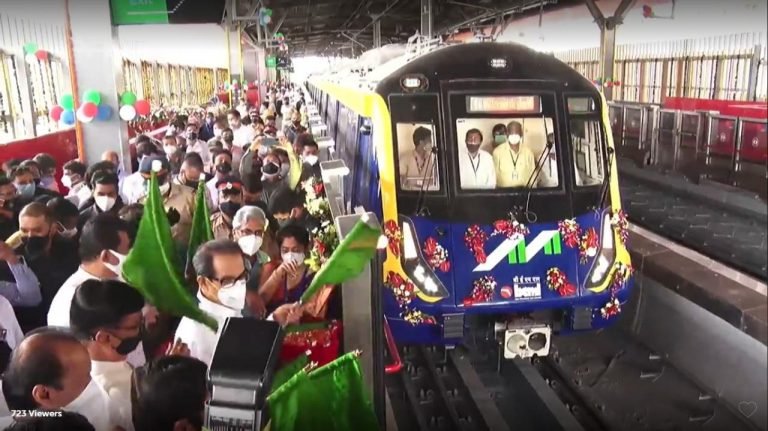
MUMBAI (Metro Rail News): CM Uddhav Thackeray has inaugurated services on Mumbai Metro lines 2A and 7 today on the occasion of Gudi Padwa. Both the lines are driverless train operations called BTC. Many citizens were present on the occasion of this event and witnessed the metro launch and then travelled by metro.

Both lines are fully elevated and Metro 2A, running from Dahisar west to D.N. Nagar (Andheri west), and Metro 7, from Dahisar east to Andheri east, will hugely benefit the people in the north-western suburbs.

The MMRDA has been granted the final nod of the Commissioner of Metro Rail Safety after following all the requirements for the project which has crossed several tentative deadlines since October 2021 for launching commercial operations. Metro 7 is 33.50 km long with 29 stations and Metro 2A will be 18 km long with 17 stations.

Running parallel to the Western Express Highway, the Western Railway suburban section, the S. V. Road and the Link Road, the aim of two new Metro Lines is to reduce road congestion and overcrowding in the local trains which will provide major relief to the commuters.

Chief Minister Uddhav Thackeray, Deputy Chief Minister Ajit Pawar and Revenue Minister Balasaheb Thorat had flagged off the trial runs of these two lines last May.

L&T Hyderabad metro rail gets CMRS nod for full speed potential of 80 KMPH

HYDERABAD (Metro Rail News): L&T Metro Rail (Hyderabad) Limited (L&TMRHL) has recently undertaken modifications to its signalling software with the objective to harness the full speed potential of its metro system. These software upgrades and system compliance were inspected by CMRS – Shri Janak Kumar Garg from 28th to 30th March. As part of safety checks, speed trials were conducted and on finding the systems to be compliant to safety regulations, the CMRS (Commissioner for Metro Rail Safety) has issued the authorisation to deploy this upgraded systems software.

With this authorisation, L&TMRHL will now be able to operate its trains to the full speed potential elevating from the current speed of 70 KPMH to 80 KMPH resulting in saving of significant time between corridor terminals. With this, it is expected that journey time would reduce by about 6 mins on Corridor 3 (Nagole to Raidurg); about 4 mins on Corridor 1 (Miyapur to LB Nagar), and about 1.15 min on Corridor 2 (MGBS to JBS). It is also expected that with this systems upgrade, there will be an improvement in the rail wheel interaction on sharp curves thereby reduction in screeching and vibrations.

Mr KVB Reddy, MD & CEO, L&TMRHL, said, “With the receipt of this authorisation from CMRS, we would now be ramping up the metro systems to full speed potential thus saving time between the terminal stations, leading to a better passenger experience.”

Mr. Sudhir Chiplunkar, Chief Operating Officer, L&TMRHL, said, “The signalling software upgrade would enable us to fully utilise the system’s potential leading to better operational efficiency and effectiveness.”

MahaMetro sets up Neo metro station and coach prototypes for Nashik project

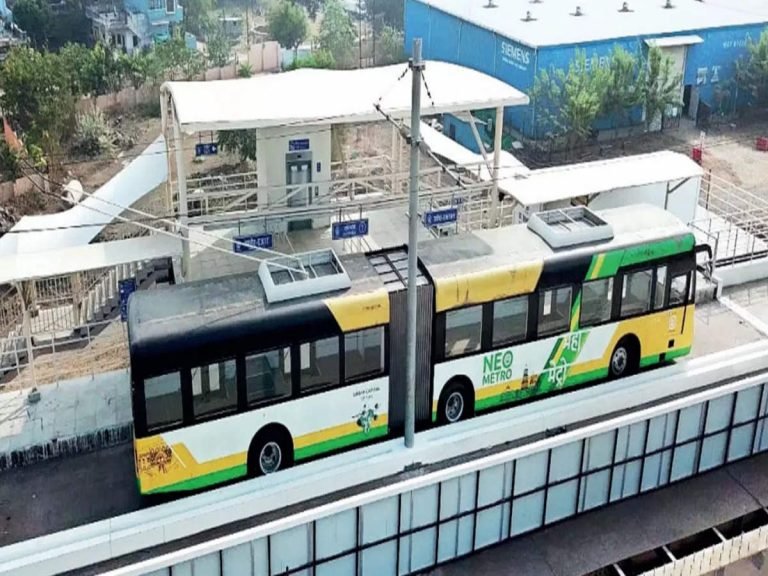
NASHIK (Metro Rail News): MahaMetro has set up prototypes for new metros that will come up in tier II and III cities. The Maharashtra Metro Rail Corporation Limited (MahaMetro) to build this prototype of the Metro Neo station and facilities on about 6,000 sqft at its Hingna depot (the headquarters of Maha Metro) in Nagpur has used two discarded buses which were converted into Metro Neo coaches, station with different entry and exit, information and signboards, and overhead wires to run the rubber-tyred coaches.

Maha Metro managing director Brijesh Dixit said that the project will be launched in Nashik city. “The prototypes of Metro Neo coaches and station are a part of the company’s preparation to implement the project seamlessly in Nashik and in other tier II and tier Ill cities where Maha Metro would be entrusted with such projects,” added Dixit, TOI reported.

Neo Metro

Maha Metro is the central agency to implement the Metro Neo project in Nashik city in two years with a cost of Rs 2,100 crore. This project will include two separate elevated corridors of 32km and 30 stations and similar projects are likely to come up in cities like Warangal, Dehradun, and Madurai.

Dixit said that, since the concept is new, it would help the Maha Metro team understand all technical aspects related to the Metro Neo project, and if there is any need for modifications before it is implemented.

“Moreover, various stakeholders who would be involved in the implementation of the project can have a view of the kind of infrastructure that needs to be constructed for this project. These stakeholders can also suggest modifications which can further bring down the project cost without compromising on the quality,” he added.
buy prelone online gaetzpharmacy.com/prelone.html no prescription

Maha Metro has turned two discarded buses into inter connected coaches which resemble the rubber-tyred trolley coaches that would run on an elevated corridor. All the parts used in this project are made in India and therefore is a part of the Make in India policy of the government.