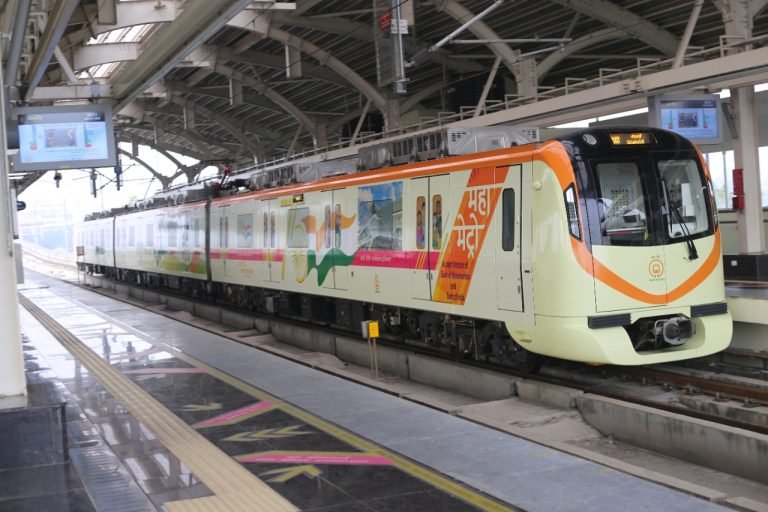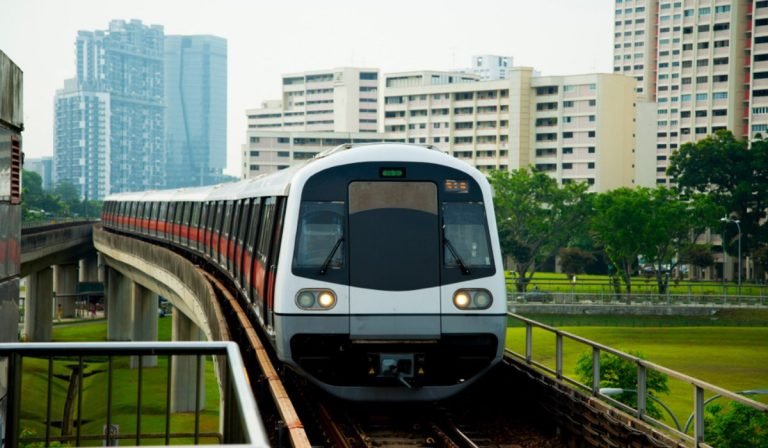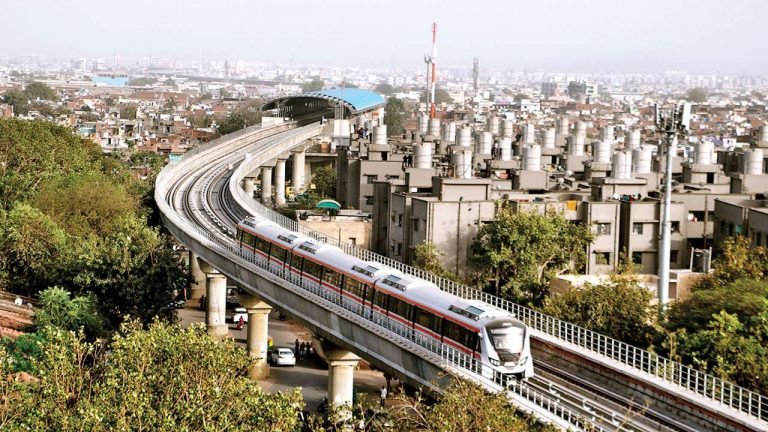
New Delhi: Prime Minister Narendra Modi has flagged-off the Delhi-Faridabad Metro Line that would allow hassle free travel for around two lakh daily commuters between the national capital and the industrial hub in Haryana.The extension of the Delhi Metro connects Badarpur to Escorts Mujesar in Faridabad.The total cost of the project from Badarpur to Escorts Mujesar is nearly Rs. 2,500 crore. Out of this, Rs. 1,557 crore was borne by the Haryana Government, the Centre contributed Rs. 537 crore, while the Delhi Metro provided Rs. 400 crore.The nine stations in this section include, Sarai, NHPC Chowk, Mewala Maharajpur, Sector 28, Badkal Mor, Old Faridabad, Neelam Chowk Ajronda, Bata Chowk and Escorts Mujesar. buy kamagra polo online https://lasernailtherapy.com/wp-content/themes/twentytwentytwo/inc/patterns/en/kamagra-polo.html no prescription
All these are elevated and located on either side of the Delhi-Mathura Road (NH-2).“The nine-station metro corridor which was 95 per cent indigenously built will provide people a safe, affordable, quick, comfortable, reliable, environment-friendly and sustainable transport facility,” a Haryana government spokesperson said.Haryana Chief Minister ML Khattar, addressing a press conference on Saturday, had thanked the Prime Minister for “gifting” the Metro service which would take the city to “another level of progress” with better connectivity with other NCR towns.He had also said that the Prime Minister would be announcing the go-ahead for connecting Gurgaon with Faridabad by Metro.
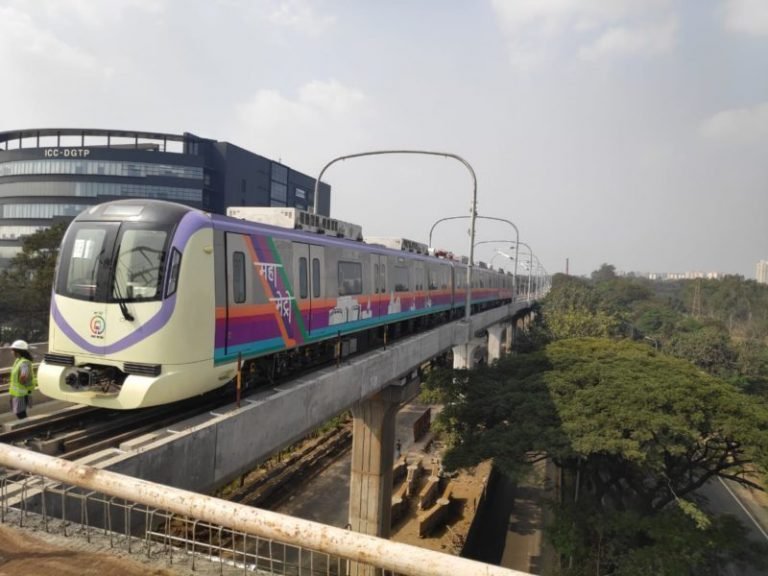
PUNE (Metro Rail News): The Pune district administration in month has acquired 100 acres of land via direct purchasing. The land acquisition has been done for Baramati-Phaltan-Lonand and Pune-Miraj railway lines.
The Baramati-Phaltan-Lonand railway track is a stretch of 63.65 kms, out of which 37.20 kms stretch passes through Baramati taluka. buy vidalista generic newonlineandblo.com/vidalista.html over the counter
To implement the railway track project private land acquisition is proposed in 12 villages of Baramati taluka which are Latte, Malwadi, Kurnewadi, Khamgalwadi, Barhanpur, Netpatwalan, Sonakaswadi, Dhakale, Thoptewadi, Karhavagaj, Sawantwadi and Tandulwadi.
The committee which works under the Collecter has fixed the rates of land in these villages, whereas the land of Maharashtra Industrial Development Corporation (MIDC) in Katphal will be transferred for this project.
The process for acquiring 87% of the private land for the second line of Pune-Miraj railway line has been completed.
NEW DELHI (Metro Rail News): The Aerocity Metro station is going to convert into a major interchange station after its expansion which will connect it to the Regional Rapid Transit System (RRTS) station, Airport Express Line and Tughlakabad-Aerocity Silver Line corridor. The Aerocity station will become Delhi Metro’s third major triple interchange station, after Kashmere Gate and Azadpur.
The Delhi Metro Rail Corporation (DMRC) has decided to expand the Aerocity Metro station under its phase-4 project which will connect tthe existing station to the under-construction Tughlakabad-Aerocity Silver Line corridor. This station will also have connectivity at the concourse level, between the Airport Express Line and the new Silver Line. National Capital Region Transport Corporation (NCRTC) will also have interconnecting facilities for its RRTS station at Aerocity for the proposed corridor to Alwar in the future.
According to a DMRC official, the upcoming Aerocity Metro station will cross diagonally to the proposed RRTS station. Commuters will not have to exit the Metro station and use a subway or foot overbridge to reach the RRTS station, as they can just go from the Metro concourse to the RRTS platform. buy vidalista online https://herbalshifa.co.uk/wp-content/themes/twentytwentytwo/inc/patterns/en/vidalista.html no prescription
The new interchange facility is going to boost connectivity for various areas of South Delhi.
The Aerocity station will become Delhi Metro’s third major triple interchange station, after Kashmere Gate and Azadpur.
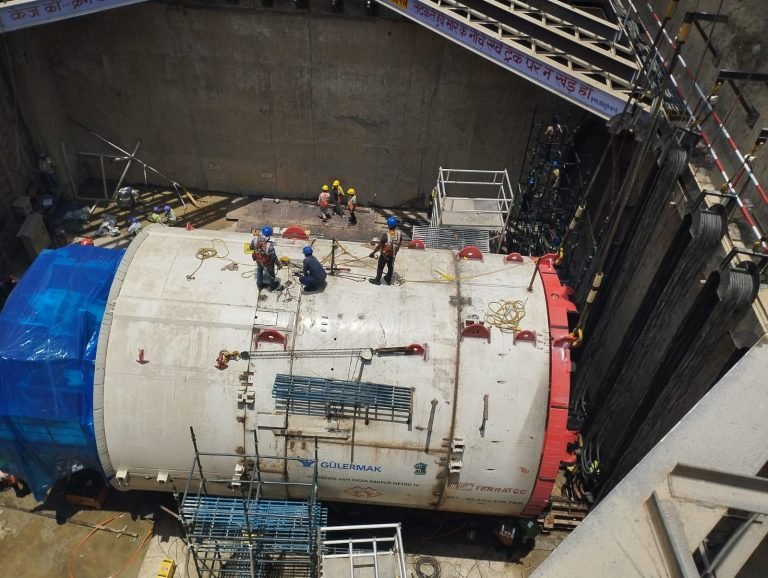
NEW DELHI (Metro Rail News): Terratec has announced the delivery of the first of five 6.61m diameter Earth Pressure Balance Tunnel Boring Machines (EPBMs) that will be used by Tata Projects Ltd. for its underground works contracts on Chennai Metro Rail Phase-II Corridors India, following successful factory testing of the S96 machine this month.
The new TBMs will be used by contractor Tata Projects Ltd. on Chennai Metro Rail tunnelling contract for Chennai Metro Rail Limited (CMRL) to build Phase 2 – Corridor 3, from Venugopal Nagar Station to Kellys Station. The work involves the construction of 18 kms of bored tunnels. TERRATEC will provide five of the seven TBMs required for the package.
TERRATEC Mixed Ground EPBMs have been chosen to tackle this project because of the variable geological conditions (boreholes indicate sand, silt, clay on the tunnel drives with some weathered rock). The expected “mixed ground” will be dealt with by the TBM’s mixed-face dome-style cutterheads designed to work effectively in the geology on these contracts at pressures of up to 4 bar. Other features include VFD electric cutterhead drives, tungsten carbide soft ground cutting tools that are interchangeable with 17’’ roller disc cutters, high torque screw conveyors, active articulation systems and state-of-the-art guidance and control systems. buy tadalafil online https://www.adentalcare.com/wp-content/themes/medicare/editor-buttons/images/en/tadalafil.html no prescription
As the TBMs progress, they will install 1,400mm wide by 275mm thick universal reinforced concrete lining rings consisting of five segments plus a key.
Chennai Metro is the fourth longest metro system in India. The network currently consists of two lines covering a length of 54.65 kilometres. The new Line 5 of Chennai metro will have 48 stations and connect from Madhavaram to Sholinganallur. The project is anticipated to be completed in about four years.
In recent years, Terratec has emerged as the leading TBM supplier in the Indian market, having supplied 40 TBMs in the last nine years (more than all other TBM manufacturers combined over the same period). Terratec’s continuing success on projects such as Phase III of the Delhi Metro, Lucknow Metro, the Ahmadabad Metro, Pune Metro and Mumbai Metro is a result of tailor-made robust TBM design, prompt onsite assistance, readily available stock of TBM spares and highly-skilled specialised TBM support throughout tunnelling operations.
TELANGANA (Metro Rail News): Stradler Rail has decided to set up a Rail Coach Manufacturing facility in Telangana and it will be a hoint venture between Medha Servo Drives Pvt Ltd and Swiss railway rolling stock manufacturer Stadler Rail. The project will cost around Rs 1,000 crore.
Stadler Rail Executive Vice President Ansgard Brockmeyer and the Principal Secretary for ITE&C, Government of Telangana, Jayesh Ranjan, signed a Memorandum of Understanding (MoU) in the presence of Minister KT Rama Rao in the Telangana Pavilion at the World Economic Forum in Davos.
According to the MoU the company is going to invest Rs 1,000 crore in the Rail Coach manufacturing facility which will create around 2,500 jobs for youngsters. people from across the state.
I welcome Stadler Rail to Telangana. It was great meeting EVP (Sales and Marketing) Mr. Ansgar Brockmeyer @WEF Davos. This investment further cements Telangana's position as a global investment destination#TelanganaAtDavos#InvestTelangana
Minister KT Rama Rao welcomed the Stadler Rail Company for coming forward to set up their railway coach production facility in the southern state of Telangana. KTR also said that the investment further cements Telangana’s position as a global investment destination.
Kolkata : An ancient City with historical Importance
The City of Kolkata made its debut in 1690 as an amalgamation of three humble villages – Sutanuti, Gobindapur and Kalikata. But, it has since grown into a sprawling Metropolis and the principal centre for trade and commerce in Eastern India over the last three centuries and it was also the Capital of the Country for a considerable period. In the course of its long existence, this premier ‘City’, often described as the cultural citadel of India, has witnessed many upheavals –Cultural, Social and Political. It has also been faced with innumerable problems, of which the transport problem, in particular, has been very acute. This has happened due to a continuous shift towards urbanization and the consequent increase in population – Resident as well as Migrant. Metro Railway, Kolkata feels honoured and pride of itself for becoming the ‘Life Line’ in the field of transport network of this great ‘City’.
A transport System evolved through times
Kolkata is the main business, commercial & financial hub of eastern India & the north eastern states. It is also a major commercial & military port, & the only city in eastern India to have an international airport. Once India’s prime city, the development of the city has lagged far behind the needs of its growing population. Kolkata is in dire need to provide to its citizens the best of amenities available in the country. The relative antiquity of Kolkata and unplanned growth has further exacerbated the problems of inadequate civic amenities in the city. Realizing the magnitude of this problem, the government arduously is trying to place modern infrastructure in the metropolitan city and a number of agencies are working towards that goal.
Only 6.2% of the area of Kolkata is comprised of roads compared to 20%+ for the other comparable metro cities in India. With a vehicle population estimated to be around 1.6 million and 23.50 million transit trips a day in 2011, the city is bursting at its seams. With very little scope to increase the road area in city and a projected vehicle population of 3 million and an estimated 32 million transit trips by 2025, the enormity of the problem could be easily imagined. It was realized early that only road transport would not be adequate to meet the growing transport needs of the population and a rail based system for mass rapid transport is the most viable option to address this need.
Therefore, the burgeoning transport problem drew the attention of the city planners, the State Government and also the Government of India. It was soon realised that something had to be done and done fast to cope up with the situation. It was Dr. B.C. Roy, the then Chief Minister of West Bengal, who for the first time conceived the idea of building an Underground Railway for Kolkata to solve the problems to some extent in 1949.
A survey was done by a team of French experts but nothing concrete came out. Efforts made to solve the problem by augmenting the existing fleet of public transport vehicles barely touched the fringe of the problem as the roads account for only 4.2% of the surface area in Calcutta as compared to 25% in Delhi and even 30% in other cities. With a view to finding out an alternative solution to alleviate the suffering of the Kolkatans, the Metropolitan Transport Project (Rlys) was set up in 1969. After detailed studies, the MTP (Rlys) came to the conclusion that there was no other alternative but to construct a Mass Rapid Transit System. The MTP (Rlys) prepared a Master Plan in 1971 envisaging construction of five rapid transit lines for the city of Kolkata, totalling to a route length of 97.5km. Of these, the highest priority was given to the busy North-South axis between Dum Dum and Tollygunge over a length of 16.45 km and the work on this project was sanctioned on June 1st 1972. The foundation stone of the project was laid by Smt. Indira Gandhi, the then Prime Minister of India, on December 29, 1972 and the construction work started in 1973-74.
Since the commencement of construction, the project had to contend with several problems such as non-availability of sufficient funds till 1977-78, shifting of underground utilities, court injunctions, irregular supply of vital materials and others. But overcoming innumerable hurdles and crossing all barriers of disbelief, Calcutta Metro, India’s first and Asia’s fifth, became a reality on October 24, 1984 with the commissioning of partial commercial service covering a distance of 3.40 km with five stations between Esplanade and Netaji Bhavan. This was quickly followed by commuter services on another 2.15 km stretch in the north between Dum Dum and Belgachia on Novermber 12, 1984. The commuter service was extended upto Maha Nayak Uttam Kumar on April 29, 1986 covering a further distance of 4.24 km making the service available over an overall distance of 9.79 km and covering 11 stations.
However, the services on the north section were suspended w.e.f. Oct, 92 as this isolated small section was not attractive to commuters. After a gap of over eight years, the 1.62 km Belgachia-Shyambazar section, along with Dum Dum -Belgachia stretch, was opened on August 13,1994. Another 0.71 km stretch from Esplanade to Chandni Chowk was commissioned shortly thereafter, on October 2, 1994. The Shyambazar-Shovabazar-Girish Park (1.93 km) and Chandni Chowk-Central (0.60 km) sections were opened on February 19, 1995. Services on the entire stretch of Metro were introduced from September 27, 1995 by bridging the vital gap of 1.80 km in the middle. A dream thus came true.
Phase II a length of 5.834 Kms from Maha Nayak Uttam Kumar to Kavi Nazrul station was completed in Aug’ 2009. Further it was extended upto Kavi Subhash a length of 2.851 kms in Oct, 2010 for commercial operation. It was further extended, Dum Dum to Noapara, a length 2.091 Kms, on 10th July 2013. The last leg was opened on 23rd February 2021 for commercial operation from Noapara to Dakshineswar (4.139 Kms).
First Metro System of the Country
The initiative had to wait for 2 decades when in 1969 the Metropolitan Transport Project was initiated. The master plan prepared by them in 1971 envisaged a network of 97.50 km consisting of three North-South corridors of which three were selected for detailed planning. These three lines were Dumdum – Tollygunge, Bidhannager – Ramrajatala and Dakshineswar – Thakurpukur. Based on traffic studies, the Dumdum – Tollygunge corridor was first selected for implementation and work started on 29th December, 1972. On 24th October 1984, the first stretch, a length of about 3.4 km between Esplanade and Bhowanipur was completed, the first metro line in India. Over the years, others stretches on the corridor were gradually completed and some extensions were also made. This corridor was extended to New Garia in 2010. Today it carries about 5 lakh passengers a day.
East-West Corridor
Kolkata Metro Line 2 or East-West Corridor is a rapid transit line of the Kolkata Metro in the Indian state of West Bengal. It currently consists of an operational section between Salt Lake and Phoolbagan, and will eventually connect Teghoria with Howrah by going underneath the Hooghly River. It would consist of 17 stations from Teghoria (Haldiram) in the east to Howrah Maidan in the west, of which 11 would be elevated and 6 would be underground, with a total distance of 22 km. It is expected to derive a very high ridership since it will connect India’s two largest commuter railway and long-distance railway terminals (Howrah and Sealdah) along with two of its largest business districts (BBD Bagh and Salt Lake Sector V). Line 2 has India’s first underwater metro tunnel along with the deepest metro shaft. The first phase between Salt Lake Sector V and Salt Lake Stadium was inaugurated by Union Railway Minister Piyush Goyal on 13 February 2020 and commercial services started from 14 February 2020.
The master plan had already identified the corridor way back in 1971. But the success of the Delhi Metro contributed to the sanction of the East–West Metro corridor, which will connect Howrah Railway Station with the Satellite City of Salt Lake. In January 2004, the Pacific Consultant International Group conducted a feasibility study for the line. The report proposed the route and tubular structures be under the Hooghly River.
A new organisation called the Kolkata Metro Rail Corporation Limited (KMRC) was formed, which executes the operations of this Line, commencing construction in 2009. Of KMRC’s eight directors, four each were from the state and central governments. The cost is being shared between the state government (30 per cent), the Union Urban Development Ministry (25 per cent), and the Japan Bank for International Cooperation (JBIC) (45 per cent). But as of 2011, after state government dis-invested from the project, most of the share of this project went to Indian Railways and with Japan Bank for International Cooperation (JBIC).
The project is estimated at a cost of 50 billion. The present cost however, has escalated to 80 billion. But due to major setbacks, such as land acquisition, slum relocation, and route alignment problems, the project got delayed. The East-West Corridor was originally slated to be operational by 2012, but was later pushed back to 2015. The project will now be implemented in four phases. The first phase, from Salt Lake Sector V to Salt Lake Stadium, became operational on 13 February 2020. The second phase, to Phoolbagan opened on 4 October 2020, operational from 5 October 2020. The third phase to Sealdah is now slated to be operational by 2022 and the final phase which includes the journey through the tubular tunnels under the Ganges will be operational by year 2023.
Country’s First Underwater Metro System
Kolkata will soon boast of having the first under river metro tunnel in the country. Both the tunnels are ready for tracks to be laid. The wait is now reduced to few months only. The Kolkata metro is ready to take a plunge. For the first time ever in India a metro train will run under a river. The city of joy is heading for a trip under the Hooghly.
Kolkata underwater metro is 33 mtrs under the normal level of earth. This also means that it is not only the deepest but also one of the biggest underwater metro system. One would have an experience of a lifetime of not just travelling via an underwater river tunnel in an A.C Rack of the metro but also ensure to land on one of the busiest platforms which can handle around forty thousand passengers in one hour on any given day.
The underwater stretch lies 30 m under the river and is part of the east-west metro project. The metro train would huddle down through 520m tunnel at a speed of 80 kms per hour. This is the first time in the transportation sector in the entire country that a magnificent civil structure of this magnitude is built under a river. Despite cutting through a river the tunnel is absolutely water proof. With the help of a tunnel boring machine this has been made possible in record time. All ventilation fans, the efforts for maintaining humidity and temperature level at top and bottom is being consistently tried.
Apart from this the Kolkata metro achieves many accolades from becoming India’s first underwater tunnel constructed below the sprawling howrah station heritage buildings with a first ever such project. Soon Kolkata would be the first Indian city to have the perfect harmony between a legendary ride on a tram and jet setting on futuristic trains.
Few other major details
With the inauguration of the North-South Metro route from Noapara to Dakshineswar in 2021, the upcoming metro corridors are also expected to improve connectivity, particularly in the highly congested areas of the city.
Most of the construction for Line 1 is based on the Cut and Cover construction method, a traditional tunnelling method. Further, the East-West Metro corridor project will have an underwater tunnel and the section will be equipped with all the necessary facilities and safety measures. There will be tunnels for the evacuation of passengers in case of any emergency. As per an official, 80% of the construction work is complete. The Kolkata Metro Rail Corporation Ltd (KMRCL), a government enterprise established in 2008, is undertaking the construction of the East-West corridor project of the Kolkata Metro. In July 2019, it handed over the operations of the Metro Line 2 to Metro Railway, Kolkata, which is the owner and operator of the Kolkata Metro, along with KMRCL. The Metro Railway, Kolkata, will also operate other metro lines after the completion of the construction work.
Metro Route
In March 2022, the Kolkata Metro Railway officially assigned colour codes to the different metro corridors and the new extended metro lines under various phases of implementation.
Kolkata Metro Line 1 (Blue Line)
Kolkata Metro Line 1 stations
Layout
Dakshineshwar
Elevated
Baranagar
Elevated
Noapara
Elevated
Dum Dum
Elevated
Belgachhia
Underground
Shyambazaar
Underfround
Shobhabazar Sutanuti
Underground
Girish Park
Underground
Mahatma Gandhi Road
Underground
Central
Underground
Chandni Chowk
Underground
Esplanade
Underground
Park Street
Underground
Maidan
Underground
Rabindra Sadan
Underground
Netaji Bhavan
Underground
Jatin Das Park
Underground
Kalighat
Underground
Rabindra Sarobar
Underground
Mahanayak Uttam Kumar
At-Grade
Netaji
Elevated
Masterda Surya Sen
Elevated
Gitanjali
Elevated
Kavi Nazrul
Elevated
Shahid Khudiram
Elevated
Kavi Subhash
At-Grade
The Line 1 of Kolkata Metro is the North-South Metro line. It is now referred to as the Blue Line. The route comprises 26 stations with 15 underground stations, two stations on the surface and 9 elevated stations. It covers about 32 kilometres of distance from Kavi Subhas to Dakshineswar.
The oldest metro line that was started in the city on October 24, 1984, was a small section of 3.4 kilometres, connecting Esplanade to Bhowanipore (now Netaji Bhavan). More sections were later opened, such as Tollygunge metro station to New Garia station along an elevated route. In 2013, the line was extended in the north with a new section connecting Dum Dum station to Noapara. In February 2021, a four-km section from Noapara to Dakshineswar became operational.
Kolkata Metro Line 2 (Green Line)
Kokata Metro Line 2 Stations
Layout
Teghoria/Haldiram
Elevated
Raghunathpur
Elevated
Baguiati
Elevated
Dum dum Park
Elevated
Kestopur
Elevated
Badhan Bank salt Lake Sector V
Elevated
Karunamoyee
Elevated
Central park
Elevated
LICI City Center
Elevated
Bengal Chemical
Elevated
IFA Salt Lake Stadium
Elevated
PhoolBagan
Underground
Sealdah
Underground
Esplanade
Underground
New Mahakaran
Underground
Howarah
Underground
Howrah Maidan
Underground
The Kolkata Metro Line 2 route includes a total of 17 stations with 11 elevated stations and six underground stations spanning a distance of 22 kms. On February 13, 2020, the first phase of the East West Metro corridor from Salt Lake Sector V to Salt Lake Stadium was inaugurated. The Phoolbagan Metro station was the first underground metro station in the East West Metro route to be opened.
Underwater tunnel
The 16.6-kilometre-long East-West Metro corridor includes 5.8 kms of the elevated route and 10.8 kms of an underground section. Of this 16.6-km stretch, 520 metres will be under the riverbed of the river Hooghly. The twin cities of Kolkata and Howrah will be connected by an underwater tunnel that will be developed 33 metres below the riverbed of the river Hooghly. The Green Line will finally connect Howrah with Teghoria.
Kolkata Metro Line 3 (Purple Line)
The Line 3 of the Kolkata Metro is under construction. The route will start from Joka Metro station in the south and connect Esplanade in the north, covering a distance of around 15 kms. The project will be developed by Rail Vikas Nigam Limited (RVNL) owned by the Indian Railways.
Kolkata Metro Line 4 (Yellow Line)
The Line 4 or the Yellow Line will connect Noapara and Barasat in North 24 Parganas. This Kolkata Metro route, which is under construction, will be around 16.8 kms.
Kolkata Metro Line 5 (Pink Line)
A 12.5-km metro stretch will be developed, connecting Baranagar to Barrackpore as part of the Kolkata Metro’s Pink Line route.
Kolkata Metro Line 6 (Orange Line)
This 29.8-km route of Kolkata Metro will link New Garia with Netaji Subhas Chandra Bose International Airport via the two satellite towns of Salt Lake and New Town. Once opened, metro Line 6 will provide easy access to the Kolkata Airport, especially for those living in the southern and the eastern parts of the city.
Timeline & Major Events
October 1984
The oldest metro line connecting Esplanade to Netaji Bhavan in Bhowanipore was started in Kolkata.
September 1995
The 16.45-km stretch from Dum Dum to Tollygunge Metro station became operational.
February 2009
The foundation stone for the underwater metro tunnel was laid.
March 2009
Construction work on the underwater metro tunnel was started.
October 2010
The final, 1.58-km stretch, from Kavi Nazrul to Kavi Subhash started functioning.
December 2010
Metro Railway was granted the status of a Zonal railway.
July 2013
A new section from Dum Dum to Noapara became operational.
July 2019
KMRC handed over the Line 2 Metro operations to Kolkata Metro Railway.
February 2020
Phase 1 of the East-West corridor from Salt Lake Sector V to Howrah Maidan became operational.
October 2020
The East-West Metro corridor was extended from Salt Lake Stadium metro station to Phoolbagan metro station.
February 2021
A section of around 4 kms from Noapara to Dakshineswar became operational.
Kolkata Metro latest updates
Kolkata Metro network plans to cover 100 kilometres by 2026. The Kolkata Metro network is likely to cover a length of about 100 kilometres in the next four years. This will include Phase 1 of Joka to Esplanade and New Garia to the Kolkata airport sections. Further, the Sealdah section will become operational in April 2022.
The first phase of the Kolkata East-West Metro corridor is connecting the Sector V of Salt Lake, the IT hub of the city, with the Salt Lake Stadium in the area, covering a 5.3km long stretch. The commercial services connecting six over ground stations – Sector V, Karunamoyee, Central Park, City Centre, Bengal Chemical and Salt Lake Stadium stations, have begun. For almost four decades, the sole corridor of Kolkata metro traversed through 24 stations, of which 15 are underground, covering a meagre distance of 27.3km from Noapara to Kavi Subhas.
The East-West corridor of the Kolkata Metro is India’s first-ever transportation project where metro trains will ply under river — Hooghly. The Metro project, scheduled to be completed by June 2021, had faced an unprecedented jolt last year, when a tunnel-boring machine hit an aquifer in Bowbazar area of the city, causing severe ground subsidence and damage to several buildings. The accident further delayed the completion of work by another year, with the authorities now eyeing a 2022 deadline.
Kolkata metro has five other ongoing railway projects, which have been allotted a budgetary grant of Rs 1,542 crore for fiscal 2020-21. The New Garia-NSCBI Airport link (Line-6), slated to be completed by June 2021, (new deadline July, 2022) has been allotted Rs 328 crore, while the Noapara-Barasat line has received a grant of Rs 200 crore. Another 16.6-km Joka-BBD Bag route, connecting the south-eastern suburbs of Behala with the heart of the city, has been granted Rs 99 crore, and the Barrackpore-Baranagar and Dakshineswar stretch, covering a distance of 14.5 km, allotted Rs 10 crore.
Conclusion
Kolkata formerly known as Calcutta is a city of many hues, recognized by many as the Cultural Capital of India, known to others as the City of Palaces and to yet others as the City of Joy; it is difficult to capture its diversity as well as uniqueness within the confines of a single phrase.
Located on the eastern bank of the river Hooghly, Calcutta was established by the British in an area where the villages Kalikata, Sutanuti and Govindapur existed. These villages were part of an estate which belonged to the Mughal emperor himself and whose jagirdari was held by the Sabarna Roy Choudhury family. The rights were transferred to the East India Company in 1698 and it became the capital of British Indian in 1772. The city grew under the British and saw the emergence of a new educated urbane Babu class in the 19th century. Calcutta becomes the pioneering center of socio-cultural revolution often referred to as the Bengal Renaissance. Calcutta also became the epicenter of the Indian independence movement, especially the revolutionary stream. In 1905 Bengal was partitioned on communal grounds which resulted in widespread public agitation and the boycott of British goods (Swadeshi movement).
The British moved the capital to New Delhi in 1911 in view of these developments and also the fact that Calcutta was located in the eastern fringes of India. Through Calcutta lost a part of its political significance due to this decision, it continued to remain a determinant in the political developments in the country in the run up to independence in 1947 and a torch-bearer of the early industrial progress. It continued to play a very influential role in the cultural & literacy landscape of the country. In the fields of education, film, theatre & science, Calcutta has continued to play a stellar role. In 2001, the name of the city was changed to Kolkata to go with the Bengali pronunciation of the name.
Today it is a thriving metropolis, home to 4.5 million residents in an area of 185 sq km under the jurisdiction of the Kolkata Municipal Corporation. The Kolkata Metropolitan Area spread over 1750 sq km comprising 157 postal areas in 2006 has a population of approximately 14.2 million making it the 13th most populous urban city in the world and the 18th largest urban agglomeration in the world. The urban agglomeration comprises 72 cities & 527 towns & villages. The suburban areas of Kolkata metropolitan district incorporate parts of the districts of North 24- Parganas, South 24- Parganas, Howrah, Hooghly & Nadia.
Indian Railways, keeping in view the ongoing COVID-19 pandemic, will adopt the facility of contactless ticketing similar to facilities at airports with QR code-enabled tickets. The QR code-enabled tickets will be scanned on handheld devices and mobile phones at railway stations and on trains. Last month, an automatic QR code-based ticket scanning system was introduced by Indian Railways at the Prayagraj junction railway station, in a first-of-its-kind initiative. The contactless ticketing system is believed to help passengers as well as railway staff to prevent the spread of novel coronavirus. The contactless QR code-based ticket scanning system will work:
CRIS has rolled out an application, for contactless ticket checking of reserved tickets, covering all the zones of Indian Railways to display PRS ticket details as QR Code.
Once the tickets are booked, an SMS will be sent to the mobile number of the passenger, containing the URL of the QR code.
During the station entry or during the checking of the train ticket, passengers will have to click on the QR code URL available on his or her SMS.
After doing this, the QR code of the reserved ticket will be displayed on the mobile browser of the passenger.
The TTE will scan the displayed QR code of the reserved ticket on the passenger’s mobile browser, through his or her mobile device having the capability of scanning the QR code. According to Indian Railways, any free QR code scanner mobile application available in iOS App Store or Google Play store such as QR and Barcode Scanner, QR Code reader, etc. can be used for this purpose.
Moreover, the HHT application is also capable of scanning this QR code and it will fill the PNR details in the application automatically for TTE for turn up action. Currently, the facility is live and SMS with links for generating QR code is being sent on the provided mobile number.
The ongoing COVID-19 pandemic has completely changed how we go about our lives nowadays. It has also altered how businesses operate, taking precautions to curb the spread and stick to delivering goods. The Indian Railways has gone back and forth in restarting travel over the past couple of months. And now, it is taking cues from the advanced air travel system to introduce a contactless ticketing system at railway stations.
The railways are planning to issue QR code-enabled tickets, which can easily be scanned at the station or on the train to verify your identity. The train conductor can either use a handheld device or rely on a mobile phone to scan these tickets, further simplifying the whole process. This also applies to platform tickets and not just train tickets.
QR Ticketing System
The QR Ticketing System for Transit Operators is an integrated system of using QR Codes as prepaid tickets to avail mainly transit services of all modern operators like Metro, Bus, Rental Cars, Rail, Flight, etc. This part – QR Ticketing System Implementation Guidelines provides some valuable tips and insights to implementing the QR Ticketing System and integrating it with AFC systems. An annexure, addressing some of the most ‘frequently asked questions’ is also provided here.
Basic Implementation
The basic implementation of a QR Ticketing system involves few important steps outlined as under :
Ticket Purchase Mobile and Webclient Application
Ticket Office Machine (TOM) Application
Ticket Validation in QR Ticketing System
Validating Terminal and AFC System Updates
Simple Customer Care Application Integrated with TG
Implementing Products and Passes in QR Ticketing System
Ticket Purchase Mobile and Webclient Application
This is the customer face of the QR Ticketing System. Customers must be able to use an App (like a Mobile or Webclient App) to buy Bus or Metro journey tickets. The Apps can also provide facility to buy tickets for Rail or Air journeys. Some of the salient features that every App must support are :
An UI that is integrated with the QR Ticket Generator (TG) which, in turn, is integrated with PTO’s AFC. The App Provider may be any third-party commercial application but integration with TG is mandatory. CDAC’s Travel Mozo App is one such example of a third-party system that is easily integrable with PTO’s AFC via CDAC TG Services.
The App must follow the QR Specifications to generate QR Tickets in the typical QR Ticketing System format.
Due to constraints of security and other services like ‘location’, App must ask for the user’s permission.
The minimum set of Access Permission can be detailed as per table below :
Service Parameter
Description
NFC (Near-field communication)
It totally depends on the PTO station center if they need it for communication with the device to scan a QR Ticket. NFC is available only on some high-end mobile devices.
Internet Connectivity (Mobile Data & WiFi )
Device must have internet connectivity for booking a ticket. Internet connectivity may be either mobile data or WiFi.
Bluetooth connectivity
It totally depends on the PTO station center if they need it for communication with the device to scan a QR Ticket. Application will ask for this.
Live Geo-Location
The QR Ticketing System can optionally maintain the actual physical latitude and longitude of the device at the time a ticket is being purchased. This is a precautionary measure that the PTO may enforce in order to prevent misuse or fraudulent tickets. Furthermore, in case of booking a cab or rickshaw or for tracking the device, the app needs the live location of device.
Contact number
For account security verification like OTP app needs phone number of user.
SMS and Phone call
In case of cab and rickshaw, app may need to call the driver for getting the information about booked rides. SMS may be required for OTP and other purposes.
Push Notification (Message Notification)
Device must allow this for getting the notifications like: The day of journey notification When user uses the QR Ticket, the real-time transit update should be sent via push notification and the App must update the information in the Ticket History accordinglyTo send QR Ticket validity (Expiry time of ticket) alert
Ticket Office Machine (TOM) Application
Issuance of Paper QR Tickets intended to replace the tokens used in Metro station. So all Metro operators must provide an Application in their Ticket Office premises that can facilitate such purchases. These applications may be attended or unattended (Ticket Vending Machines). TOM applications must also have the same integration with the PTO’s own AFC.
TOM – Workflow and Design:
There are mainly 4 components to the TOM Application.
Super Admin – This is only required for administration purposes. If the PTO requests the TOM APP Provider to check some problem, the App Providers DB and Application Administrator can intervene and look into the issue. The Super Admin console may also be used by the PTO to create and manage the Executive/Personnel handling the requests for ticket.
PTO-specific TOM application tailor made for PTO’s needs.
Ticket Issuing Person / Teller – Handles day to day ticket issuing work
Station / Depot specific TOM Application Engine
Ticket Generator (TG) – The interface with the TG is almost exactly the same as the Mobile APP except that there is no Payment Service Provider Interface required. The PTO collects the Ticket fare using its own mechanisms like Cash, Card, etc. The TG may be local to the PTO and also operated by the PTO itself. But it can also be provided by a third-party service provider. In that case the TG Provider should settle the service charges for all the Paper tickets issued through it.
Ticket Validation in QR Ticketing System
TRM or Transit Rules Management is normally PTO-specific that implements the PTO’s business rules pertaining to usage of tickets purchased by the customers. For QR Code Tickets, some common validations that shall be necessary to perform are as follows. Please note that these points are only a set of Recommended Rules.
The Ticket Serial Number is valid
Activation Date and Validity time of journey information is correct
Entry/Exit station information is correct.
Please note that some PTOs allow entry anywhere between the Source and Destination stations. Similarly, the commuter maybe allowed to deboard or exit at any station that falls before the actual Destination station specified on the QR Ticket.
Validating Terminal and AFC System Updates
After a QR Ticket is validated at a terminal the process of updating transit information in the AFC Systems – its protocol, communication mode, architecture, etc. – is actually not within the scope of the QR Ticketing System specifications. For the sake of illustrating a real situation, we shall assume that the target AFC System is an NCMC-compliant one.
Flow of transit information into NCMC-compliant AFC:
When QR is presented at the validation terminal, terminal performs required validation checks and generates QR transit file which is then sent to the AFC.
Any type of transit file generated at the terminal shall be divided into two blocks – Common Transit Data Block and Variable Transit Data Block. The Common block consists of elements which are common for all media types (viz. NCMC, Cash, Token and QR) while the Variable block consists of only media-specific information.
Each data block is further split into two sub-blocks. First sub-block consists of fixed set of data elements and second sub-block consists of operator defined data which may be decided by operator according to requirements.
The source of some data elements in the Variable Data Block is the QR Payload present in the ticket. Other elements are generated by the terminal itself.
Simple Customer Care Application Integrated with TG
Customer Care is a very important feature for all transit service providers. In order to provide customers top quality service and a value for their money PTOs usually employ many Customer Care personnel. To aid the Customer Care executives in their job, a good Customer Care application is a necessary requirement. In case of the QR Ticketing System the QR ticket that the customer presents at a validation gate or terminal may run into some problem. A ticket may fail validation for a variety of reasons – genuine or due to some glitch. In all such cases, the commuter can approach the Customer Care centre. The purpose of the Customer Care application is to provide the operator with enough information about the ticket based on which the operator can take the correct decision to alleviate the problem faced by the customer. A simple Customer Care application must support at least the following minimum requirements:
An Application that is integrated with a QR code scanning device. These devices are readily available and are usually referred to as HID – Human Interface Device. For simplicity, it is recommended to use a USB-based HID that works as a Keyboard Emulator. That way when the operator places the cursor on a Standard Input text field and scans the QR – emulated keystrokes – which is the actual QR payload – becomes available to the Customer Care application for further validation.
The QR payload can then validated and displayed on the Customer Care App Form.
Based on the validation, the Customer Care operator takes the decision. Decisions are entirely the PTOs own business rules and policies.
It is quite possible that the Customer Care App to have the option to print a duplicate QR ticket.
Interface of the customer care should obviously be directly interfaced to the correct Ticket Generator. Since one QR ticket can be issued by one and only one TG, the ticket validation of the issued ticket must land at the same TG.
Implementing Products and Passes in QR Ticketing System
Trip Passes are an integral part of any transit application. PTOs of all types – Bus or Metro operators – often issue many passes like – Senior Citizen Pass, Student Pass, Day Pass, Monthly Pass, etc. In the QR Ticketing System, the Product ID parameter is used to populate Passes. It is sent as a Policy Update Request.
Example of a QR Ticket using a QR Pass Ticket (Monthly Pass for Metro):
The ticket issuing Application must provide only one QR Ticket that should contain the information for a Pass. Essentially, the following criteria are of importance –
An App that must provide the option to User to buy Passes. Passes are PTO-specific and cannot be used for inter-operator journeys unless some operators decide to issue joint passes.
If a user has already bought a Pass and the validity of the pass has expired, then it is desirable for the App to disable the ticket on the Phone so that it cannot be presented. In order for the TG to determine the current status of passes, PTO’s AFC shall share relevant details like transaction amount (To update remaining balance in Pass), trip count (To update remaining trips in case of trip based Pass) etc. with TG.
A Global “All Access” Source and Destination ID in the Policy DB that would imply a ‘Pass’ QR Ticket. The Station Code for “All Access” can be fixed as 255 or ‘FF’ Hex.
Validity Period = 43200 minutes. One QR Pass Ticket is for a maximum validity of 45 days only.
The User must pay up at least the minimum amount specified by the PTO for the Pass. This is also a Policy DB parameter as shown in the figure above. The user cannot purchase a QR Pass Ticket without paying up this minimum amount.
For all types of Passes, the APP must provide a facility to query the ‘Query Balance’. Actually the TG must send the updated QR Payload reflecting the actual available balance on the Ticket_Fare field.
After the Ticket (or Pass) is purchased, like any other QR Ticket, the TG sends the ‘Purchase QR’ information to the AFC. The AFC must notify all the terminals as a Start of Day (SOD) object the Passes information. These SOD objects must contain the ‘Ticket Serial Number’ of the QR the ‘Available Balance Amount’ and the ‘Minimum Required Balance’.
When a Pass is presented on the terminal, the TRM Validation Rules must ensure that the Product ID is correct (= 5 in our example) and the ‘Balance Amount’ on the scanned QR (this is the same as the Ticket_Fare value) and the data available on terminal must match. Then the remainder amount must also be at least equal to the ‘Minimum Required Balance’. As a side note, the APP must also send notifications to user when the Minimum Balance Amount is about to exhaust so that the user can recharge the pass.
If the ‘Minimum Balance Amount’ is not enough, then – whether the commuter oversteps or not – all the Exit terminals should deny the commuter to pass through and direct him to go to Customer Care. Any additional due amount can be recovered there and then.
Since the ‘Entry-Exit’ pairs of a ‘Pass’ journey would always be available with the AFC, it must update the balance in that Pass accordingly. These updated balances (along with the Tkt_Sl_No) must be resent to the terminals again. The updated balance information must also be sent to the TG.
So the next time the user sends the ‘Query Balance’ request to the TG, the TG updates the Ticket_Fare with this balance to reflect the correct available balance. It must actually send the entirely new QR Payload as the Digital Signature would have to be updated. The APP must display the ‘Updated Balance’ to the user and also render the new QR.
This cycle can repeat from Step 6 until Step 9 is reached or the user actually recharges the Pass.
Example of a QR Ticket using a Senior Citizen / Student / Special Pass:
Senior Citizen, Student or Special (for differently-abled persons) products or passes are not as straightforward as the other passes. There is a mandatory requirement of Verification required before these can be used. The following steps provide a simple yet effective method to implement these type of Products in the QR Ticketing System.
In this method, the APP provides user to the option to buy a Senior Citizen or Student or Special Pass as any other Product or Pass.
The APP must mention that these Passes need ‘Verification’ and the process as described in these steps must be clearly mentioned.
For these type of Passes, it must be mandatory to fill the Personal Info, which is part of the Static Block of the QR Dataset. In the Personal Info all information in the Name, Age, Gender, ID No and ID Type must be filled out
The user must specify the date from which he wishes to make the Pass active. This should be filled in the Activation_Date field of the Ticket (or Pass in this case).
Once all the information is filled, the user must be asked to agree with these rules and can then proceed and buy the ticket. If the payment is successful, the APP must render a QR having only the Tkt_Sl_No.
On the TG, these serial numbered tickets must be marked as ‘Requires Verification’ or something in those lines.
On the APP, there must be a button like ‘Request Ticket’. Until the ticket is actually verified, till then clicking this button the TG should simply respond with ‘Ticket Not Validated’.
On the date of Activation, the user must proceed to Customer Care with his QR. Naturally, this QR will not work on any Validation terminal as it does not have any journey information.
The Customer Care executive shall scan the QR and fetch the Pass details from TG. He must then proceed to verify the actual Physical Identity of the user with the information fetched from the TG.
Once the Customer Care executive is satisfied that the information provided when purchasing the QR Ticket (or Pass) is consistent with the actual ID, he must send the request to the TG to mark the Pass as ‘Valid’. The TG must acknowledge the Customer Care application affirmatively. The Customer Care executive must then inform the user that he can now ‘Request Ticket’.
This time when the TG receives the request, it must then return the QR Payload.
The APP can then proceed to render the actual QR Pass on the user’s APP and the user can start using it just like any other QR Pass.
Futuristic Implementation
Some further advanced implementation features of the QR Ticketing System can be outlined stated as under:
Advanced Features in QR Ticketing System
These are desirable features that should be taken up to add value to both the customer and PTO.
Applying Machine Learning and Artificial Intelligence to the System that shall be useful not only to the public but particularly to the PTOs with valuable insights.
Different Media scanning not just optical or camera scanning but also Bluetooth, WiFi, NFC scanning
Designing and developing cost-efficient Android based Validation Terminals that can be quickly adopted by the transport industry and quite possibly by other industries as well for e.g. the tourist sites, parking areas etc.
This may involve below mentioned steps further :
Sending Real-Time Transit Notifications to Customer’s Mobile Route Request – Consumer Mobile Apps must be informative and user-friendly. Notifications like (a) Reminders on the date of journey, (b) Transit updates – journey completion, (c) real-time schedule changes, (d) Traffic conditions (e) Availability of tickets, etc. can be sent to the user’s mobile phone and shown in the App to give a clear picture to the customer. The general way to send all such updates to the user’s mobile is called ‘Push Notification’. Technology Service Providers like Google, Apple, Microsoft and Amazon provide Subscription-based Push Notification services that Application Providers can avail to send business updates to their customers in real-time. The concept of Push Notification Service is simple and can be described in a nutshell as follows:
Subscription to a cloud messaging service like Google Firebase Cloud Messaging (GCM – also called Firebase Cloud Messaging – FCM since 2019) or Apple Push Notification Service (APNS) – These are mobile notification services that enable third-party application developers to send notification data or information from developer-run servers to applications that either target the Google Android Phone or the Apple iOS Phones. The GCM and FCM may also be viewed as two separate entities operated by Google wherein the GCM does registration/authentication jobs and the FCM delivers the real-time messages to the user devices.
Cloud Messaging Services has the ability to send push notifications, deep-linking commands, and application data well up to 4 KB of payload data. Push Notification Services are usually a paid- service and so in order to take advantage of this technology the APP Provider must pay up and subscribe annually with a good Messaging Service Provider like GCM.
All App Providers must inform the user and seek permission to send ‘Push Notification’ to their personal mobile. This can be done during App set and installation as a onetime pre-requisite. Here we assume that the user gives consent to the App Provider to send Transit Updates to his/her phone.
Upon allowing the App permission to receive and display notifications, the client APP sends a registration API request to the Cloud Messaging Service, say GCM, interface to begin the registration process.
The GCM Service receives and acknowledges the request and responds by giving the device a GCM Registration ID – a unique identifier that is used later to send notification to the individual mobile device. The identifier is stored onto the device, and is typically sent to the developer’s Application Server (App Provider) to be stored. The Registration ID is a randomly-generated identifier that does not contain any personal or device information that could allow a developer to discover the personal identity of the user.
When the App Provider wishes to send a notification event to an individual device, the process begins with an API request to the GCM Authentication Service. The request must include the Registration ID among some other data like the content that is to be displayed on the device.
Upon successful verification of the Registration ID and other credentials, an authentication token is returned. Both these identifiers are then sent back to the GCM Service to be ‘Enqueued’ and delivered to the device
Upon receipt of the Push Notification Message, the App can then update the necessary tickets for journey updates or other such information.
Route-agnostic Intra-PTO QR Code Ticket – In ordinary day-to-day commuting in cities, it is commonplace for commuters to travel on more than one Line or Route to reach his/her destination. For example, if a person uses three different routes to reach his office or home, it essentially means that his source station (starting point) falls in the first route and his destination station (ending point) falls in the third route. But in order to complete the entire journey, he has to learn not only about all the available routes including the connecting intermediate routes, but also the stops where he needs to descend and then ascend again in order to continue towards his destination. This is applicable for both Buses and Metro transport. Although, most of the bus transport operators have implemented route based ticketing system currently, it is desirable that the QR Ticketing System should support a Route-agnostic QR Ticketing form of implementation when issuing tickets to customers. This essentially means that the customer should only mention his Starting and Destination stations and the system must be smart enough to determine and show all the possible combinations through which these two points can be connected. The customer can then make an informed decision of which combination he or she wants to avail.
Urban transport has advance by leaps and bounds in the last 10-15 years in our country. Not only Metro rails, but high-speed Rapid Bus Transit, Rapid Rail, Suburban Rail, Mono Rail, etc. have made their presence felt in our country providing commuters the comforts of fast travel within the city and even to long distance satellite towns and cities. In an effort to provide further convenience to commuters, different PTOs – operating different transit medium within a city or even between cities – are now collaborating with each other to issue combined single journey tickets from each other’s premises thereby sparing the customer from the burden to procuring multiple tickets when hopping from one mode of transport to another. This type of collaboration or interchange is called Paid-2-Paid interchange. One example of Paid-2-Paid interchange are Delhi Metro (operated by DMRC) and Airport Rapid Transit (operated by Reliance). In the city of Mumbai, 14 PTOs operating under MMRDA, running different modes of transport have already collaborated or are in the process of doing so to allow customers to inter-travel on any mode of transport with a single ticket. In general, the PTOs that support Paid-2-Paid travel have common interchange points using which the commuter can hop from the premises of one PTO and move to the premises of the other.
Acronyms and Abbreviations
AFC – Automatic Fare Collection System
CAFC – Centralized AFC system
ECC – Error Correction Code
GSM – Grams Per Square Meter
HID – Human Interface Device
PTO – Public Transport Operator
QR Code – Quick Response Code
RFU – Reserved for Future Use
Stn Code – Station Code
TOM – Ticket Office Machine
TRM – Transit Rules Management
TXN Ref. No. – Transaction Reference Number
Conclusion
Over the last 4-5 years, QR codes have become the most popular medium of choice for instant payments in our country and across the globe. With the ever-increasing demand for deployment of QR Codes as fare media, it is important that the Public Transport ecosystems provide a consistent and seamless experience to their customers. The system should enable people to remotely book tickets not just for urban transport operations like Metro and Buses, but also other varied services like hotel reservations, entertainment events, tourist spot reservations, etc. The popularity of QR codes also means that there is a good availability of online technical support. This allows service providers to quickly develop and implement solutions compatible with most existing payment gateway systems.
The specifications described in the preceding pages above are only a first step towards achieving a world-class QR Ticketing Ecosystem that strives to provide customers a hassle-free travel experience on one hand, and to service providers a fully automated state-of-the-art ticketing solution, on the other. However, this is only just the beginning. The road ahead is surely long and winding. In due course this ecosystem must evolve towards route and operator agnostic ticketing solutions and encompass other non-transit services under its umbrella. The not-so-distant future should also address some of the most pertinent needs of the modern world like vehicle capacity management, real-time traffic updates, attractive pricing, etc. through the use of Industry 4.0 technologies viz. artificial intelligence, machine learning, big data and IoT.
Indian railways are the fourth largest network in the World with a track length of over 70,000 km and a network of more than 20,000 passenger trains. Managing all aspects – operation, maintenance, scheduling, repair or monitoring has always been a tough task for the Indian railways. The task is difficult due to the problem of integration of various systems such as signalling, telecom, operation, rolling stock, electrical, information technology, traffic, infrastructure, etc. and the involvement of human factors.
One way of trying to meet the demand is to enhance railway infrastructure. The infrastructure has been the key feature of current projects such as the Konkan Railway double-track expansion and the introduction of bullet train along the Mumbai-Ahmedabad High-Speed Corridor. But the question is why to overlook the increase in throughput to meet the increasing demand by the incorporation of Artificial Intelligence, machine learning, and self-control systems.
These systems are designed to improve the reliability of existing infrastructure and make up for the one-time heavy investment. The heavy investment can eliminate the need for human interference and provide the required level of safety and speed up-gradation. It should be possible to do more with the hardware if we can make the ‘software’ more efficient. Having more efficient software includes greater information sharing, lower latency, and smart algorithms. This is why many OEMs and startups are now investigating the feasibility of services based on Artificial Intelligence worldwide.
Feasibility of Artificial Intelligence in Indian Railways
Operation – Artificial intelligence for any system requires a huge amount of linkable data. In Indian railways, the network already runs on the SCADA system, so a vast amount of operational data is available for modelling and training purposes.
Infrastructure – Digitised versions of railway infrastructure is also readily available. It is also available for rake information and crew rosters.
Tracks and Rolling stock – The data for predictive maintenance of the tracks or trains is in development phase in the country. However, with not much variation data from other countries can be used for training of these modules and sections.
Signal and Telecom – The history of events may be obtained from the data loggers of the interlocking system. This can help to schedule the movement of trains and also to manage machine-driven operations.
Although we have good availability of the data, the key challenge would be in developing a framework where researchers can start with several individual problems, and then integrate them effectively. Hierarchical or more generic architectures are effective in handling such intentions. These could be used from an algorithmic standpoint. The need is to make the various systems talk to each other effectively. This is where expertise in software/hardware architectures and system integration is required.
Applications of Artificial Intelligence in Indian Railways
There is a long-range service spectrum that AI can provide depending upon the level of efficiency and need. The feasibility of some of the primary requirements of Railways which Artificial Intelligence can provide is discussed below:
Train Scheduling
All signalling rules assume that tracks at stations are occupied by at most one train at a time. This can be ensured by algorithms, simulation models, graphs, heuristics and control systems with the required degree of Artificial Intelligence in Indian Railways.
The information which can be obtained from AI shall include:
Time duration from the first event to the last event,
The total or average running time of trains,
The priority-weighted running time of trains,
Robustness of the timetable to deviations, and combinations thereof.
This will make sure that
Either a track section between two stations is occupied by at most one train at a time (in absolute block signalling), or
Every piece of track between two signals is occupied by at most one train at a time (in automatic block signalling).
Currently, railway networks do not use automated algorithms for this function. They instead rely on the training and experience of controllers (dispatchers) to take decisions. They cannot process a large amount of contextual information, Neither they can meet the demand for small turnaround time for decision making.
But the above-mentioned approach will generate high-level timetables and schedules of train movement. They will specify tracks to be occupied, the time required for switching tracks, and signalling requirements. And the parameters of immediate conflict can be evaluated in real-time. Hence, instant scheduling decisions can be taken, generating microscopic schedules.
With AI, one can develop iterative optimization approaches or graph-based models to compute low-level timetables with real-time decision support using heuristics. Artificial Intelligence also offers a way of training algorithms to react to disturbances quickly and yet with near-optimal solutions.
Controlling the speed profiles of trains
An AI-based conflict resolution scheme shall not only achieve hard signalling (signal aspects) but more optimum approaches such as train speed management. Both the energy consumption of the train and total delay depend on the speed profile used between stations. Using Reinforcement Learning (RL) or dynamic programming, energy-efficient speed profiles for single trains can be computed at the initial level. However, for broader applications in the country, the future possibility is the development of AI techniques that can:
Interact with human train operators without increasing their load,
Be implemented by humans in the loop, and
Detect obstacles on the tracks.
Delay Prediction and Reduction
One major role of Artificial Intelligence in Indian Railways can be the prediction of train delays. This is an important consideration for the highly limited nature of railway networks. Currently, there is no mechanism in IR to take corrective actions for the delay in train timings. Such delays are caused due to train priorities, downstream conflicts with other trains, freight loads, and irregular stopping times. A human cannot process all of these factors simultaneously, or come up with an optimal solution for the network as a whole.
Accurate delay predictions due to the incorporation of Artificial Intelligence in Indian Railways would help dispatchers (controllers) in downstream portions of the network. It would also improve the passenger experience by providing early updates regarding their journeys. A system to predict delay time would learn from past train delay data, predict how long each delay will be, and use a cloud-based service to deliver updates.
An AI-driven approach is a ‘sense-analyze-respond’ system to predict and correct delays. The ‘sense’ part of the program gathers data about the status of trains in the network. The ‘analyze’ part calculates the implications of each possible option. And the ‘respond’ part allots the computed track resources to each train based on physical capabilities and safety standards.
The foolproof working of the signalling system is important for safe train operations. Railways completely depend on the health of its signalling assets along with real-time information. Most of the delays happen due to the failure of signals. So far, Indian systems follow a manual maintenance system and find-and-fix methods. But the adoption of Artificial Intelligence in Indian Railways can help predict failures by remote condition monitoring of the system well in advance.
This can be possible by embedding smart sensors on critical rail components and take necessary preventive actions. Inputs shall be collected on fixed intervals and sent to a central location (such as operations control center or OCC). As a result, any problems in the signalling system would be detected on a real-time basis.
Trains equipped with smart sensors and GPS transmit component-wise health status and location to the AIC (Asset Intelligence Center). The AIC which maintains the digital database of all railway assets also collects inputs from the safe distance warning (SDW) system embedded in the track-side cameras about the train/wagon defects and electronic damage notifications (also transmitted to the driver).
Once such information is gathered and integrated, data analytics in the form of RAM / LCC (Reliability, Availability, Maintainability and Lifecycle Cost) which calculates the cost overhead in maintaining the particular train component at a given time and conditions and also generates a digital Rulebook (say, Rulebook 4.0) which shall provide an easy access to the maintenance policies in the form of a structured data model for use by concerned operators and workshop staff in the future.
The AI-recommended decisions based on dynamic algorithms and policies as per the digital Rulebook are then encapsulated into a consolidated maintenance schedule inside the Digital Fleet Control Module and is compared against the workshop capabilities to generate demand for material and labor. This demand is eventually fetched to the workshop Digital Interface in the form of digital order.
Fleet control module of a railway system illustrating processes involved in digital decision making is stated as under:
Smart Locomotives – Equipped with sensors and GPS modules to send component based condition and location information continuously.
Electronic Damage Notification – Enables the train driver the digital recording and transmission of defect information of the locomotive.
Smart Wagons – Sending location data and specific status information such as shocks and loading status.
Safe Distance Warning (SDW) – Identifies wagon defects by camera systems placed e.g; at cameras across the rail tracks supported with image recognition technology.
Asset Intelligence Center – Integrates and provides all vehicle information consistently and standardized structure for live analytics.
RAM-LCC Reports – Deliver required information to identify cost potential continuously. An integrated tool provides LCC diagrams and supports fleet control and technical vehicle development.
Condition Based Maintenance – Optimizes and extends rules and knowledge to maintain all vehicles individually and condition based.
Rulebook 4.0 – Provides all maintenance policies by a modular structured data model. Gives digital access to task specific maintenance policies – also on tablets in the workshop.
Digital Fleet Control – Clustering of condition-based maintenance demand for vehicles and live matching with workshop capacities to control the workshop supply.
Workshop Management System – Digital order management of the workshop. Complete digital data collection and processing. Further services such as automated material ordering to be processed digitally.
Optimization and Automatization of Processes – Provision of dashboards and apps for end users as well as by direct integration of information in operational sales and production systems.
Conclusion
Figure 1Remove the text of the image
Indian Railways can have remarkable improvement in asset management and other technology based services using IoT for Rolling Stock like Coaches, Wagons and Locomotives. The optimal use of assets can be facilitated once their exact location is known in real time. Track maintenance can become better and manpower can be effectively utilized. The great pressure that railways is facing due to the whopping wage bill and its severe criticism by experts can be eased once the handheld devices can enable management to optimally deploy staff for maintenance works. The assets will have sensors depicting their health and with use of intelligent monitoring systems, they will reach the right location at the right time. IR today is dependent heavily on supply chain partners. Lot of time and effort is wasted in pursuing the supplies, gaining access to information of vendor. All this can be automated using IoT & AI. The role of purchase department can be limited just to give the purchase order, the balance work can be handled by intelligent systems when the network has information on consignments, stock position etc. IoT is the future, and it has already arrived.
Sustainable infrastructure involves developing roads, railroads, buildings, energy and water infrastructure with due consideration to economic, social and environmental implications. The International Institute for Sustainable Development (IISD) defines sustainable infrastructure assets as those which:
Lower carbon and environmental footprints
Protect natural ecosystems
Prove resilient to changing climates
Optimize the use of natural ecosystems and their “infrastructure services”
Move beyond compliance on core labour standards and human rights
Trigger technological and industrial innovation
Increase investment in education and research and development (R&D)
Increase employment
Demonstrate financial viability
Crowd-in domestic investors and businesses
Increase foreign direct investment
Bring value for money for taxpayers and investors
Indian Railways : A viable and sustainable transport system
India has the fourth largest railway network with over 22,593 operating trains (9141 freight and 13,452 passenger) with a daily passenger count of 24 million passengers and 203.88 million tonnes of freight. India’s railway network is recognised as one of the largest railway systems in the world under single management.
The railway network is also ideal for long-distance travel and movement of bulk commodities, apart from being an energy efficient and economic mode of conveyance and transport. Indian Railways is the preferred carrier of automobiles in the country. Government of India has focused on investing in railway infrastructure by making investor-friendly policies. It has moved quickly to enable Foreign Direct Investment (FDI) in railways to improve infrastructure for freight and high-speed trains. At present, several domestic and foreign companies are also looking to invest in Indian rail projects. Indian Railway network is growing at a healthy rate. In the next five years, Indian railway market will be the third largest, accounting for 10% of the global market. Indian Railways, which is one of the country’s biggest employers generates nearly one million jobs.
The government has announced two key initiatives for seeking private investments-running passenger trains by private operators across the railways network and redevelopment of railway stations across the country. According to Indian Railways, these projects have the potential of bringing an investment of over US$ 7.5 billion in the next five years. ‘Adarsh’ Station Scheme has been started since 2009-10 and presently, railway stations are upgraded/modernised based on identified need of providing better enhanced passenger amenities at stations. Under the scheme, 1253 stations have been identified for development, out of which 1201 stations so far have been developed. The remaining 52 stations are planned to be developed by 2021- 22. Indian Railways is also looking at other areas of revenue generation as under:
(a) Change in composition of coaches so that it can push the more profitable AC coach travel;
b) Additional revenue streams by monetising traffic on its digital booking IRCTC; and
The Indian Railway launched the National Rail Plan, Vision 2024, to accelerate implementation of critical projects, such as multitrack congested routes, achieve 100% electrification, upgrade the speed to 160 kmph on Delhi-Howrah and Delhi-Mumbai routes, upgrade the speed to 130 kmph on all other golden quadrilateral-golden diagonal (GQ/GD) routes and eliminate all level crossings on the GQ/GD route, by 2024.
Efforts for raising Revenue
Revenue growth has been strong over the years. Indian Railways’ revenue reached US$ 23.30 billion in FY22 (Until March 10, 2022). The gross revenue stood at US$ 16.89 billion in FY21 (until March 10, 2021). In case of freight earnings, it experienced a year on year growth of 21.81% It stood at US$ 17.68 billion in FY22 (until March 2022) as compared to FY21 which was at 16.04 billion. Passenger earnings for Indian Railways was at Rs. 50,669.09 crore (US$ 7.25 billion) in FY20. The total passenger revenue stood at US$ 4.66 billion until March 10, 2022 as compared to FY21 which was at US$ 2.03 billion. This was a 162.46% growth. The gross revenue stood at Rs. 85,588.96 crore (US$ 11.44 billion) in FY22 (until September 2021).
In FY22 (until September 2021), passenger earnings stood at Rs. 15,434.18 crore (US$ 2.05 billion) and freight earnings (until October 2021) stood at Rs. 78,921.86 crore (US$ 10.5 billion). Freight earnings stood at US$ 16.04 billion in FY21. In October 2021, freight earnings stood at Rs. 12,312.76 crore (US$ 1.63 billion) and freight loading reached 117.35 million tonnes. Freight remains the key revenue earning segment for the Indian Railways, accounting for 79.1% of the total revenue in FY22 (until August 2021), followed by the passenger segment.
Freight remains the major revenue earning segment for Railways, accounting for 65% of its total revenue in FY20, followed by the passenger segment. In FY20-21, Indian Railways recorded the highest loading in freight transportation. Freight traffic carried by Indian Railways stood at 1,232.64 million tonnes in FY21. With this, the freight revenue of Indian Railways also increased to Rs. 1,17,386 crore (approx.) (US$ 16.04 billion) for the year 2020-21, as against Rs. 113,488 crore (US$ 16.10 billion) during fiscal 2019-20.
During FY20, passenger traffic in the country reached 8,086 million and is estimated to reach 12 million by 2031. In FY22 (until March 2022), passenger traffic stood at 3.23 billion. In August 2021, freight earnings stood at US$ 1.43 billion and freight loading reached 110.43 million tonnes. Since August 2020, the Indian Railways has run 450 Kisan Rail services and was able to transport over 1.45 lakh tonnes of agricultural produce & perishables.
RailTel, a PSU under the Railway Ministry, which provides fast and free Wi-Fi across the Indian Railways network, announced its highest ever consolidated income of Rs. 11,660.05 million (US$ 158.48 million) for FY19-20. This income figure is a growth of 12.3% over the consolidated income of the financial year FY18-19.
In June 2021, freight earnings stood at US$ 1.50 billion, which is 26.0% higher than last year’s earnings of US$ 1.19 billion, and freight loading reached 112.65 million tonnes, which is 11.19% higher than last year’s loading of 101.31 million tonnes. In November 2020, India Railways announced that 40% of dedicated freight corridor (DFC) will be opened for traffic by end-FY21, while the entire 2,800 km route will be completed by June 2022.
India was among the top 20 exporters of railways globally as of 2017. India’s export of railways has grown at a CAGR of 31.51% during 2010-2018 to US$ 507.90 million. Exports of railways in 2019E stood at US$ 635 million. Indian Railways is developing and creating technology in areas such as signalling and telecommunication with 15,000 kms being converted into automatic signalling and 37,000 kms to be fitted with ‘KAVACH’, the domestically developed Train Collision Avoidance System.
Push in Investments: Infra Development, Sustainability
Foreign Direct Investment (FDI) Inflows in railway-related components stood at US$ 1.23 billion from April 2000- June 2021.
Following are some of the major investments and developments in India’s railways sector:
In November 2021, Indian Railways announced that ~102 semi-high-speed Vande Bharat Expresses are expected to commence operations by 2024, with at least 10 new trains scheduled to launch by August 2022 that will connect 40 cities. In October 2021, Indian Railways announced a plan to establish ~500 multi-modal cargo terminals under the ‘PM GatiShakti’ programme, with an estimated outlay of Rs. 50,000 crore (US$ 6.68 billion) in four-five years. Through this plan, the government plans to integrate various modes of transportation for seamless movement of parcel and bulk cargo (e.g., coal and steel).
In July 2021, the South Central Railway zone announced infrastructure development by doubling the maximum permissible speed to 100 km per hour on the Godavari Bridge. The initiative gave a major boost to the Indian Railways on infrastructure modernisation. In July 2021, Indian Railways executed remodeling of Gangapur City Yard to boost the speed of railways between Delhi and Mumbai route. Since the launch of first ‘Kisan Rail’ service on August 7, 2020, the Indian Railways have operated a total of 1,040 Kisan Rail services by transporting ~3.38 lakh tonnes of consignment across 72 routes in the country until July 30, 2021.
The Indian Railways is likely to deliver 58 super critical as well as 68 critical projects worth more than Rs.1,15,000 crore (US$ 15.44 billion) in the next few years. 27 super critical projects will be completed by December 2021, while two projects will be handed over by March 2022. 29 super critical projects—spanning 1,044 kms and costing Rs. 11,588 crore (US$ 1.5 billion)—have been commissioned. Four projects worth Rs. 1,408 crore (US$ 189.05 million) have been completed and the remaining projects are targeted for completion by March 2024.
In July 2021, the Ministry of Railways received bids from the private and public sectors to operate 29 pairs of trains with about 40 modern rakes, entailing an investment of ~Rs. 7,200 crore (US$ 966.74 million). On July 25, 2021, the Indian Railways Station Development Corporation (IRSDC), a nodal agency of the Ministry of Railways spearheading the re-development of railway stations across the country, claimed that the two railway stations will be redeveloped at an indicative cost of Rs. 1,285 crore (US$ 172.54 million) in four years.
The Indian Railways has decided to undertake electrification of Broad Gauge (BG) rail lines in a mission mode and is likely to complete the process by 2023-24. Of the 64,689 kms of broad gauge route, 45,881 kms has been electrified and the remaining 18,808 kms route is yet to be electrified. About Rs. 21,000 crore (US$ 2.8 billion) is estimated to be spent on electrification of the remaining BG routes.
As of May 2021, the Indian Railways loading stood at 73.45 million tonnes (MT) including 35.62 MT (coal), 9.77 MT (iron ore), 3.38 MT (food grains), 2.22 MT (fertilisers) and 3.15 MT (cement, excluding clinker). As of May 5, 2021, Indian Railways commissioned Wi-Fi at 6,000 railway stations. In May 2021, the Government of India and European Investment Bank (EIB) signed a finance contract for the second tranche of US$ 182.30 million for the Pune Metro Rail project.
In January 2021, Prime Minister Mr. Narendra Modi flagged off the world’s first double-stack, long-haul container train from New Ateli in Haryana to New Kishanganj in Rajasthan. In January 2021, Hyundai Motor India Ltd. (HMIL) has announced that it has exported 125 cars to Nepal via the Indian Railways. The export is claimed to be eco-friendly and the first-ever by the company. With this step, the company is aiming to reduce carbon footprint by 20,260 tonnes.
On November 26, 2020, National High-Speed Rail Corporation Limited (NHSRCL) signed an agreement with L&T to design and construct 47% alignment works for Mumbai-Ahmedabad bullet train project. The Indian Railways completed eight major capacity enhancement projects by taking advantage of the coronavirus lockdown. These projects included three super critical projects with a combined length of 68km, three critical projects with a combined length of 45km, upgradation of the entire 389km railway line from Jhajha in Bihar to Pandit Deen Dayal Upadhyaya Junction in Uttar Pradesh and a new 82km port connectivity line to Paradip.
As a part of the Railways’ plans to upgrade its network, the Ministry announced that all non-AC sleeper coaches will be replaced by AC coaches for trains running >130 kmph. This move has been taken as a technical necessity for high-speed trains with the bonus of improving passenger experience.
Few recent initiatives taken up by the Government are:
India is rolling out 400 Vande Bharat trains that is expected to bring Rs. 40,000 crore (US$ 5.24 billion) of business opportunity for the country. Under the Union Budget 2022-23, the government allocated Rs. 1,40,367.13 crore (US$ 18.40 billion) to the Ministry of Railways.
In October 2021, India and Nepal signed an MoU (Memorandum of Understanding), for a proposed US$ 3.15 billion railway line project, to connect Kathmandu and the Indian border town, Raxaul. In June 2021, the Central Government approved the implementation of a 235 km semi high-speed rail corridor between Pune and Nashik in Maharashtra. The cost of building this project will be Rs. 16,039 crore (US$ 2.20 billion). In June 2021, the Central Government approved a Rs. 25,000 crore (US$ 3.43 billion) five-year plan to use 4G technology to modernise communication networks in railway stations and improve the safety and security of train journeys.
Indian Railways has logged the highest ever electrification of sections covering 6,015 Route Kilometer (RKM) in a single year during 2020-21. More than 5 times electrification was achieved during (2014-21) last seven years as compared to during 2007-14.
In April 2021, Indian Railways completed the arch closure of the under-construction Chenab Bridge which is the world’s highest railway bridge. Chenab Bridge is 1315 m long and will be 35 meters higher than Eiffel Tower in Paris. The total cost of the bridge is estimated to be Rs. 1,486 crore (US$ 200.46 million) and the design life of the bridge is said to be 120 years.
In FY21-22, the Indian Railways announced to complete several projects. The Railway Ministry has identified 56 projects in various railway zones that is proposed to be completed by end of the fiscal year.
Under the Union Budget 2021-22, the government allocated Rs. 110,054.64 crore (US$ 15.19 billion) to the Ministry of Railways. In February 2021, Minister of Railways Mr. Piyush Goyal dedicated 88 Railway projects to the country worth Rs. 1000 crore (US$ 138.14 million) in the states of Kerala, Tamil Nadu, Madhya Pradesh, West Bengal and Karnataka.
In February 2021, Indian Railways called for ‘Request for Qualification (RFQ)’ for redeveloping New Delhi railway station under a public-private partnership, with an estimated project cost of Rs. 5,000 crore (US$ 690.75 million).
To boost rail infrastructure and make the Indian Railways network future ready, Indian Railways has identified 56 projects across the country in various zones to be completed by Feb-Mar 2021 and FY22.
In July 2020, the Ministry of Railways has invited Request for Qualifications (RFQ) for private participation in operating passenger train services across 109 Origin Destination (OD) routes. As part of the plan, the railways will introduce 12 trains in FY23, 45 in FY24, 50 in FY26 and 44 more in the next fiscal, taking the total number of trains to 151 by the FY27. The project would entail private sector investments of about Rs. 30,000 crore (US$ 4.09 billion).
The Government is going to come up with a ‘National Rail Plan’ to enable the country to integrate its rail network with other modes of transport and develop a multi-modal transportation network. A ‘New Online Vendor Registration System’ has been launched by Research Designs & Standards Organisation (RDSO), the research arm of Indian Railways, to have digital and transparent systems and procedures.
The Ministry of Railways plans to monetise assets including Eastern and Western Dedicated Freight Corridors after commissioning, induction of 150 modern rakes through PPP, station redevelopment through PPP, railway land parcels, multifunctional complexes (MFC), railway colonies, hill railways and stadiums.
Sustainable Development for the future
Indian Railways is one of the largest integrated railway networks in the world. With an enormous route length of more than 126,511km, operating many thousands of regular trains over 7,325 stations, with an employee strength of nearly 1.1 million, the operations of IR certainly are one of the bigger, more varied and highly complex of any across the world. Owning 76,608 passenger coaches, 2,93,077 freight wagons and more than 12,000 locomotives, as the eighth largest employer in the world, IR plays a very critical and significant role in the economic life and operations of India.
No wonder IR requires itself to remain vigilant to the evolving situation and requirements of its society, economy and nation. The coronavirus pandemic has affected our operations and activities too. However, we have come up with a long-term National Rail Plan (NRP) with the objective of developing infrastructure, and capacity, with a special emphasis on enhancing our share of freight logistics in the overall share of IR revenue.
A long-term vision for Indian rail
Unlike previous IR plans, the new vision plan has envisaged preparing India’s national transport for the coming decades of 2041 and 2051. Plans are afoot to study the physical, material and human resource limitations of the organisation, assessment of contemporary and future modal share of IR, future requirements of fixed and rolling stocks, funding and financing strategies.
One significant feature of the plan relates to preparing for capacity requirement, both in terms of passengers and freight, ahead of demand by targeting the peak and not merely the averages, as has been the case previously. Secondly, based on financing strategies, existing and future railways projects are to be identified based on options, evaluation and prioritisation.
Major Accomplishments
Between 2008-2014, eight studies were undertaken by IR including the Total Transport Study (RITES) and the India Transport Report, but, importantly, no comprehensive studies or work has been carried out, particularly in the last five years. Some of IR’s major, more recent, achievements can be summarised as follows:
Dedicated Freight Corridors (DFCs)
The story of Dedicated Freight Corridors (DFCs) has been a spectacular one. Two of them, the Eastern Dedicated Freight Corridor (EDFC) and the Western Dedicated Freight Corridor (WDFC), are already functional, while four more DFCs have been planned where freight trains will run at an average of 90-100km/hr, as against the existing 25-30km/hr.
Connectivity
IR has connected almost the whole of India through the railways. States like Manipur, Tripura, Arunachal Pradesh, Jammu and Kashmir have all have been connected for the first time in the country’s history, while more parts are being added to the IR network. Beyond the country’s frontiers, IR is also working on initiating and enhancing connectivity with Bhutan, Bangladesh, Nepal, Myanmar and Pakistan.
Carbon Neutral
Sustainable development is being achieved through the greater use of solar energy, biogas, bio-toilets in passenger trains, LED lights, rainwater harvesting, and reforestation. Substantial electrification is also being implemented to ensure IR becomes a carbon neutral transporter by 2030.
Stations
Passenger services and amenities have been improved substantially. Stations are much cleaner and, as part of a station redevelopment plan worth $13 billion, 400 stations have been taken up in a Public-Private Partnership (PPP) model.
Safety
To address safety aspects, long considered to be one of IR’s vulnerabilities, an Automated Fire Alarm System, an Automated Fog Assistance System, CCTV cameras for stations and trains, Wi-Fi enabled stations, complete elimination of unmanned railway crossings and faster modernisation and digitisation on doubling of railway tracks, as well as signalling systems, as part of the $13 billion National Rail Safety Fund, are being developed and/or implemented.
High-speed trains
High-speed trains and semi-high-speed trains that may have seemed impossible in Indian conditions, are already functioning with some about to start. Gatiman Express, Vande Bharat Express, Tejas Express, and vista dome coaches have all been introduced within a short time, while the metro rail network is already running in 11 Indian cities. The bullet train on Ahmedabad-Mumbai is also being advanced, while five more high-speed bullet train routes are being finalised.
Tourism
A very significant, though less talked about aspect of IR, is its huge tourism potential. It has recently introduced specialised tourist trains such as the Punj Takht, Mahapariniravan Express, Ayodhya Circuit which are certain to add value and revenue to the ambitious expansion plans of the Indian railways.
Eyeing future challenges
With plans to invest a massive $320 billion in enhancing connectivity and profitability, IR is currently standing at the threshold of a great future. With more functional autonomy, professional management and effective utilisation of scarce resources and strategies, what was widely perceived as a ‘white elephant’ in Indian bureaucratic circles until recently could well emerge as one of the major public corporates donning the global economic landscape in the not-so-distant future.
Going Digital
The focus on digitalisation has received a further boost in this year’s Union Budget. Investments in predictive maintenance through advanced digitalisation systems like Vehicle Equipment Monitoring Systems and modernisation of Rolling Stock depots are foreseen to reduce the lifecycle cost, yielding significant dividends. The faster, accurate and advanced digitalisation solutions will not only address conventional challenges, but also improve operational efficiency and enhance safety.
The digital solutions for rolling stock propulsion for locomotives, hotel load converters and signalling solutions will enable the railways to scale up capacity and improve throughput, in addition to bringing in green technology. Besides digitalisation and technology, there should also be increased investments for research, design and manufacturing, which would be key drivers in the transformation of the railways.
With the vision and investments firmly in place, the need of the hour is to double down on execution and implement the initiatives in a time-bound manner. For instance, carrying out accelerated implementation of end-of-train telemetry, automated signalling and various other measures will ensure timely modernisation of rail infrastructure. Indian Railways is already speaking a market savvy language. Also, the focus on safety is visible with emphasised action towards proliferating the Kavach technology for 2,000-km tracks. Various steps are also being taken to meet the railways’ plan to be net zero in emissions by 2030. The development of a modern railway system at the national as well as metropolitan level will not only yield notable economic dividends, but also contribute to India’s sustainability and climate-change goals.
Conclusion
With a network of around 68,000 route km, rail transport is the backbone of the Indian economy. Even as the process of electrification and signalling automation is underway on key railway corridors, the government has now given a green signal for digitisation initiatives to usher in a new era of safe and smooth transportation of people and goods. With the Centre aligning the injection of cutting-edge technologies in the railways with its flagship initiative of Make in India and Atmanirbhar Bharat, the measures will go a long way in accelerating asset addition, enhancing efficiency, building capacities, and creating new infrastructure.
The railway leadership has brought the medium-term objective of raising its modal share from 28% to 40% and increasing originating cargo from 1,400 MT to 2,000 MT by 2024 at the centre of all action. For this, it is adopting a progressive stance while earnestly addressing the needs of its customers as well as eliminating the obstacles faced by its suppliers and service agencies.
The railways have also taken up sizable measures to accelerate the pace of electrification. Its EPC model for awarding large-size contracts with balanced conditions not only lessens the burden on the contractor’s cash flow, but also ensures smooth execution of the work within a defined timeframe. On its part, the industry is ready with 100% localised products for execution of the automatic signalling mandate, with electronic interlocking and axle counters ready to be rolled out for automatic signalling throughout high density networks.
Indian Railways surely is working hard to be an all class future centric transport system with world-class facilities at an affordable cost. Days are not far when travel by IR would be synonymous to comfort and ease.
Exports are one of the engines of economic growth. In most cases, it has been observed that high and sustained economic growth is preceded by shifts from traditional import substitution to more export-oriented and outward-looking policies, resulting in export growth rates reaching 20 per cent per year (or more) over extended periods of time.
For instance, it was the Japanese economy that effectively followed the export-led strategy, – in the 1960s, their merchandise exports grew at an average annual rate of 16.9 per cent in the 1960s and in the 1970s, 21 per cent (World Bank estimates). A similar economic trajectory was adopted by the East Asian economies like South Korea and Singapore in the 1980s as well as the 1990s. These economies have, in fact, recorded the most impressive economic performances over the past few decades. The impressive economic performances of the East Asian countries led economists to emphasise on the vital role played by exports driving growth. The learning that emerged from the export-led hypothesis are:
Exporters must engage with competitive world markets so that they become more competitive and are able to innovate new technology more rapidly.
The export-led growth trajectory would also fuel domestic competition, in turn encouraging even non-exporters to try to become more competitive. They would be driven to adopt or innovate new technology more rapidly, leading to faster productivity gains throughout the economy and faster economic growth.
Market access to larger world markets would allow successful exporters to increase their output and employment more swiftly.
These parameters are pertinent, especially in the context of developing nations. This is because an export-led growth strategy, through various governmental and economic policies, aims to increase the capability of the producers who are then able to compete in the world market, utilise advanced technology, as well as provide foreign exchange needed to finance imports.
For instance, among developing nations, Vietnam has been able to successfully follow the export-led policy and attract foreign direct investment. This strategy allowed led to capital intensity, productivity growth, improved prosperity and dramatically reduced poverty levels in Vietnam.
However, the financial crisis of 1997 in the East Asian economies, and the recent global economic slowdown have led to some scepticism regarding exports playing a role in sustaining economic growth. Although the export oriented approach is vital in terms of achieving growth, but it is incomplete and does not necessarily provide with clear guidance to avoid policies that could be potentially harmful over time. This approach requires some necessary factors to enable any economy to be competitive. Some of these factors include a well-defined export policy, a conducive business environment etc.
Nonetheless, the relevance of export-led growth is far from over. Despite the scepticism, it has been found that export-led growth has provided countries with short term effectiveness and relative ease of export-oriented strategies. In fact, export-drives can push growth rates up, at least for a short while.
However, in consideration of the changing times, traditional export-led growth policy orientations need to move beyond and incorporate competitiveness within their strategies. Competitiveness, in this context, essentially implies productivity. Productivity, here, is viewed as the critical driver of long-term sustainable prosperity, which is the aim of any economic policy. Exports have a dual role in this context: acting as enablers of competitiveness. They also act as a signalling tool to represent the signs of underlying competitiveness.
Not only this, exports are also contributes to growing innovation. In a sense, the more a country exports, the more it is exposed to foreign competition and ideas which in turn will improve its capabilities to innovate further. Although import substitution provides a protectionist regime, export policies provide a potential of competition, innovation and future growth possibilities.
Indian Railways & Export Potential
Indian Railway has the 4th world’s largest rail network. The route length network of Indian Railway is spread over 115,000 kms with 12,617 passenger trains and 7,421 freight trains each day from 7,349 stations. This Railway Network is ideal for long distance travel and movement of bulk commodities, from being an energy efficient and economic mode of transport.
The Indian Railways is now focused on increasing its production and export to countries globally besides introducing new technology in the Indian market. The government of India has focused on investing in railway infrastructure by making investor friendly policies. It has enabled the Foreign Direct Investment (FDI) in railways and resolved to improve infrastructure for freight and high speed trains. Nowadays, several domestic and foreign companies are looking to invest in Indian Railways.
There exists a significant Indian opportunity for International companies in the Indian Railway growth story and also Global opportunity for Indian suppliers of railway equipment, rolling stock and services. Further, India is building the country’s first high speed rail corridor between Mumbai to Ahmedabad which is expected to be operational by 2024.
Various Initiatives and Achievements
Significant part of required technology is available indigenously & Exports will help to improve both top line and the bottom line of Indian Railways, as the fixed cost shall be appointed over larger volume and innovation can be made viable. Focusing on the world market will improve the quality of services & also allow Indian Railways to manage the large infrastructure and support systems in the country thereby delivering the products and services for sustaining operations.
The scale of manufacturing and services of Indian Railways can be leveraged to enable it to become a major role in global railway equipment, rolling stock, and services market.
One of the recent examples : Train 18 ,also known as Vande Bharat Express is India’s first semi high speed train indigenously developed in India . With the success of this train , the rolling stock market and the semi high speed railway market is looking at utilizing the opportunity to make an entry into unexplored market.
The train first trial run occurred on 29th October 2018 in Chennai where in Train 18 was inaugurated by Prime Minister Mr. Narendra Modi on 15th February 2019, with the commercial run started from 17th February 2019 onwards. It will be running on the route Delhi – Varanasi via Kanpur and Allahabad.
Further looking at other examples, Bombardier Transportation, the rail equipment division of Canada’s Bombardier group, will use its first Indian metro rail factory in Savli, Gujarat,as a hub for exporting to South-East Asia. The Savli plant is also looking at supply metro rail cars and other equipment to China, Singapore and other South-East Asian countries. The first order of Bombardier was delivered to Delhi Metro Rail Corporation of 424 metro cars. Bombardier Transportation is also planning to supply high-power locomotives to Indian Railways .
Similarly, Alstom – Chennai has a strong presence in India where the company is executing metro projects in some Indian cities such as Chennai, Kochi, Lucknow where the rolling stock is manufactured in the state of the art facility at Sri City in Andhra Pradesh. Alstom has further supplied rolling stock to the Sydney Metro , thereby underlining the potential of equipment suppliers in India for exporting globally .
Additionally Companies such as Titagarh, CAF, Talgo etc are also in various stages of development of their Indian story. Looking at Indian Govt. Factories , MCF in August 2014 rolled out the first coach and since then it has doubled production almost every year.. In December 2018 , PM Narendra Modi flagged off the 900th coach manufactured at the factory , the production capacity at MCF is expected to rise from 1000 to 3000 per year by 2020-2021. MCF has the least cost of production of all Units of Indian Railways for coaches produced. They are now capable to export these coaches and other equipment to neighboring countries
Growth opportunities & future trend
Railways in India have been a tool for development, equity and integration of all parts of the mainstream. Railway Help in transporting goods and raw materials from different industries. Therefore all industries would benefit from it. Advancement in technology and making India a Railway hub will also help in travelling amenities to passengers and further also develop the services as well as tourism. Export of India’s railways locomotives, rolling stock, equipment, has been extremely low. Export witnessed a sudden increase from US$ 56.8mn in 2010 to US$ 134.5 mn in 2011 and then it remained around the same level. While export in 2013 and since has increased slightly to touch US$ 192.4 mn, exports can further be escalated to increase the export economy.
The first set of Diesel Electric Multiple Units (DEMU) was exported by Indian Railways from Integral Coach Factory (ICF), from Chennai to Sri Lanka, each DEMU consisting of 13 coaches and totalling of 78 coaches.
All DEMU train sets are manufactured at ICF & these sets are of three phase AC propulsion system, superior suspension and superior interiors. The Indian Government has extended the line of credit (LOC) to many countries for funding Railway projects that have been utilized for export of rolling stock that manufactured by Indian Railways. It is expected that the cost of per coach will be 20% to 25% less than what is offered by other countries around the world.
Projects of Indian Railways with Neighboring Countries:India is expanding its railway network with neighboring countries such as:
Nepal : Jogbani – Biratnagar link : These are the two links between India and Nepal between Raxaul Junction, Bihar – Sirsyia, Pasra and Jayanagar, Bihar – Khajuri, Dhanusa.
Pakistan : Samjhauta Express – Pakistan and Thar Express were the only rail connection between India and Pakistan, the border crossing takes place is Wagah border in India.
Bangladesh : Maitri Express : This is an International border train that connects the Bangladesh capital – Dhaka to Kolkata in India. This is the only rail network link between India and Bangladesh that runs six days a week from each side.
Bhutan : Indian Railways has plans to build a rail system between Bhutan that connects to India.
Myanmar : The railway track between Manipur to Burma is under construction.
Vietnam : The central Government is considering a rail link from Manipur to Vietnam.
China : There is also a proposal to to start a high – speed rail link from New Delhi to Kunming in China which is far fetched at the moment.
Thailand : Rail link to Thailand is also in the list of international passenger train service in India.
Singapore train link, if Burma railways is rebuilt then Indian railways will also allow trains to Singapore.
IRCON International Limited, the Railway arm which is an engineering and construction, specializes in transport infrastructure. Its primary involved in construction of railway projects in India and abroad. The major projects of IRCON are :
Afghanistan – Iran : Chabahar – Zahedan Railways, in may 2016, Prime Minister Narendra Modi’s trip to Iran and the agreement was signed to develop two berths at Ports of Chabahar and to build new Chabahar – Zahedan Railways as a part of North – South Transport corridor by Indian Railways .
Malaysia : This project includes design and construction, completion, testing, commissioning and maintenance of the double track project between Seremban and Gemas, Malaysia. IRCON is helping Malaysia revive a multibillion – dollar rail project that had been shelved in 2003 due to its high cost.
Sri Lanka : After winning the project worth USD 1 Billion in Malaysia for doubling of the track the company was awarded the rehabilitation of Railway line projects of about 250 million US$ in Sri Lanka.
Conclusion
The Railway industry is growing now a days and becoming successful day by day. Further, the manufacturing companies in India are growing and doing great innovations is making the Railway’s ecosystem a fertile ground for new manufacturers, entrepreneurs, innovators and those looking to deploy and test technology at a large scale. A global rail market will allow India to become a Rail Hub in the future.
CHENNAI (Metro Rail News):Chennai Metro Rail Limited (CMRL) has awarded a contract to Larsen & Toubro’s construction arm for the Chennai Metro Rail Project. The value of this contract is worth Rs 1,000 crore- Rs 2,500 crore. The completion time for this elevated metro rail package is 35 months.
“L&T Construction awarded another significant contract for Chennai Metro Rail Project,” L&T informed in a statement.
The scope of the order involves the construction of an elevated viaduct of approximately 10 km, including an elevated ramp and 10 elevated metro stations at Nehru Nagar, Kandanchavadi, Perungudi, Thoraipakkam, Mettukuppam, PTC colony, Okkiyampet, Karapakkam, Okkiyam Thoraipakkam and Sholinganallur.
Presently L&T is working on four packages of CMRL Phase II, of which one is underground and the other three are elevated packages.
GHAZIABAD (Metro Rail News):National Capital Region Transport Corporation (NCRTC) officials on 28th May informed that the passengers who will travel by business on Delhi-Meerut RRTS are going to get access to “premium lounges” which will be built at RRTS stations and will only be reserved for the business class passengers.
According to the official, the entry for the premium lounge will also be kept separate from where the passengers can directly get into the coach.
“Every train will have one premium coach. buy elavil online salempregnancy.org/wp-content/languages/new/elavil.html no prescription
The fare of the business or premium class will be higher than that of the normal ticket. Premium lounge will be similar to lounges at airports and will have all business class facilities,” an NCRTC official said.
The premium lounge will include a luxurious ambience, comfortable couches, magazines, books, coffee and tea vending machines. The aim behind the idea of introducing premium coaches in RRTS is to provide luxurious facilities to those who are willing to spend more for their comfort.
Metro Rail News conducted an email interview with Mr. Jitendra Tyagi, MD, Uttarakhand Metro Rail Corporation Ltd. In the interview Mr. Tyagi talked about the complex mobility plan of the Uttarakhand Metro Rail Project.
Managing director (MD) of Uttarakhand Metro Rail (UKMRC), Mr. Jitendra Tyagi has over 35 years of experience in the railway and metro sector. He is a 1983 batch officer of the Indian Railways Services of Engineers. As MD of UKMRC, his responsibility is to lead and oversee the planning, construction and operations of the upcoming Dehradun, Haridwar and Rishikesh metro rail projects. Prior to UKMRC, Tyagi has held various positions at the Delhi Metro Rail Corporation (DMRC), where he had a 13-year stint. Thereafter, he took charge as director (works) in DMRC and was involved in the completion of several corridors of Phase III of the Delhi metro. Along with this, he also oversaw the implementation of the Jaipur and Kochi metro rail projects also, as director.
Here are the edited excerpts: –
In what ways Uttarakhand Metro Rail Project is different from other rail projects in the country. Can you brief upon the comprehensive mobility plan of UMRP?
Let me first give you a brief about the Comprehensive Mobility Plan. We got the CMP prepared in the year 2019. CMP is a vision document covering all futuristic needs of mobility in the area it is prepared for. Dehradun, Rishikesh, Haridwar and Roorkee are 4 main urban developments in the Western plain area of Uttarakhand. The entire region has tremendous scope of urbanisation as it provides great employment opportunities, education as well as health care to public of Uttarakhand. In view of this, entire region has been notified as the “Dehradun-Haridwar-Rishikesh Metropolitan area”. The CMP has addressed all mobility needs, including that of goods movement in the entire metropolitan area. As far as mobility of people is concerned, It has classified the mobility need of people in three categories mainly first order, second order and third order mobility corridors. First-order having the highest mobility requirement. It has identified following first order corridors in the metropolitan area:-
S.no.
Corridors
Route length(in kms.)
1
ISBT to Kandoli
11.389
2
FRI to Raipur
13.975
3
Haridwar to Rishikesh
34.151
4
Vidhan Sabha/Rispana to Nepali Farm
34.517
Total
94.032
In the first phase, we are taking up the two corridors in Dehradun having a total length of 23 kms. & 25 stations. Initially we planned Metrolite (LRT) on all the corridors but after Ministry of Housing & Urban Affairs, Govt. of India issued standard specifications for Metro Neo, we decided to implement this system on both the corridors of Dehradun. This decision to adopt Metro Neo is mainly based on economics, it being cheaper than Metrolite. Metro Neo is different than normal Metro system as it is a rubber tyre based system and can negotiate steeper gradients (upto 10-12%) which is suitable for this metropolitan area. Metro Neo system in Dehradun will run entirely on an elevated viaduct.
Besides being the ‘Land of Gods’ the Devbhumi, Uttarakhand also is a strategically important state sharing borders with Nepal & China. How are you planning to develop a modern, futuristic transport system for the state addressing a number of peculiarities Uttarakhand holds for itself?
From strategic point of view, two main transport systems are important. One good road network and second rail connectivity. UKMRC is mandated to develop mainly Urban transport system and therefore has no direct role in this aspect. However ‘All Weather Road’ project has served the strategic connectivity also besides connecting Char Dhams. Railway line between Rishikesh to Karnprayag is already under construction which will also help the better connectivity to various parts of Uttarakhand.
Uttarakhand is a fast-growing state in the country. The per capita income of the people of the state is also improving significantly. What in your opinion can be the best transport system for the state eyeing the immense tourism opportunities that can be developed on a circuit basis amidst tough terrains and a very diverse landscape?
For Uttarakhand, and infact for any state, one transport system alone cannot serve the purpose. You have to have a combination of various transport systems like Rail, Road, Metro, Ropeway etc. Uttarakhand has immense possibility of tourism. Many beautiful places can attract large number of tourist if these are well connected. As Uttarakhand is predominantly a hilly state, Ropeway can be one of the most suitable system to connect remote places having potential of tourism. Infact funicular system could also be a good choice for some of the places as this system itself is a tourist attraction. Infact UKMRC has also been given two Ropeway projects one between Har-ki-Pauri in Haridwar to Chandi devi temple and the other between Rishikesh to Neelkanth Mahadev temple. We are working on these projects.
Which other major cities UKMRC is planning to develop and connect through metro or light transit systems in the state other than Dehradun, Rishikesh and Haridwar in the first phase?
As already explained earlier UKMRC plans to take-up Haridwar-Rishikesh Metro Neo project in Phase-2 and connecting this system with Dehradun in Phase-3. Besides this, we are also planning to develop Personalized Rapid Transit System (PRT), commonly known as POD Taxi, in the city of Haridwar on second order transit corridors identified in CMP.
Char Dham yatra, strategic rail links, and all-weather connectivity to the state are some of the priority works of the present government at the centre for the state. To what extent different works have been accomplished. Are you meeting the deadline?
As ‘All Weather Road’ to connect Char Dhams and Railway project between Rishikesh to Karnprayag are being looked after by other agencies and not UKMRC, it will not be correct on my part to comment. All I can say is that all these projects in the State are progressing quite well.
What would be your message to our readers?
I would like to convey that entire world is going through many crises. Covid-19 pandemic has already seriously affected the world economy. Russia-Ukraine war is another crises, the world is facing and another one is climate change. Climate change has been an area of serious concern for many decades. Lot has been done but lot more is needed in order to save Earth and keep it habitable for our future generations. In this regard, environmental friendly Mass Rapid Transit system in various cities is the need of hour so that carbon footprint can be minimized. We have to understand that use of private vehicles can be reduced only when public transport system is at least equally comfortable as private vehicle, if not better. Last but not the least, we should not leave any stone unturned to achieve the objective of ‘Aatmnirbhar Bharat’ set by our honourable Prime Minister and also make all out efforts to make India a net zero country which is also the vision & goal set by honourable Prime Minister.
Metro Rail News conducted an email interview with Mr. Rohit Saboo, President & CEO, National Engineering Industries Ltd. In the interview, Mr. Saboo talked about NBC’s constant commitment to provide efficient solutions that have made them set benchmarks for themselves to keep growing over the last 7 decades.
Mr. Rohit Saboo began his journey as Executive Assistant to the Chairman of CK Birla Group. He has worked in manufacturing, R&D and is now President and CEO of National Engineering Industries. A business development professional, with expertise in strategy, business planning, operations management and operational excellence, at NEI, his purpose is to maintain the company’s legacy and fast-track its growth with increased sales, fostering a strong global presence.
Here are the edited excerpts: –
NBC is the first bearing manufacturing company in the world to get the prestigious Deming Grand Prize. How special is this accolade for the organisation which recognizes the highest standards in Total Quality Management?
We at NBC are extremely delighted to join the distinguished list of companies across the globe that have been conferred with the prestigious Deming Grand Prize. This award serves as an epitome of NBC’s growing manufacturing prowess and quality processes. Our constant commitment to provide efficient solutions have made us set benchmarks for ourselves to keep growing over the last 7 decades. With the support of our stakeholders and customers as well as the relentless efforts of our employees, our journey over the years has been rewarding and this award serves as a great inspiration for us to move on with the winning spirit to achieve newer heights.
Has the company been able to realise and achieve the objectives of a self-reliant India?
Founded by Mr. BM Birla, we are a 75-year-old legacy brand and have always supported India in its self-reliance vision.We are the first Indian company to manufacture bearings for the Indian industries in India. We have grown over the years and are now not only supplying to Indian automotive, railways, and industrial segment but are also exporting to over 30 countries globally
We have worked very closely with Indian Railways since 1952. Our focus has always been to provide domestically developed bearings for Railways by understanding their challenges. In line to attaining self-reliance, we plan to leverage the technology through local manufacturers. With the acquisition of Kinex, our European subsidiary, we are planning to grow in international markets equally. Our JV with Amsted Seals for manufacturing railway seals is already operational which will not only cater to domestic requirement but also to our international customers.
Given the current focus is on “Atmanirbhar Bharat”, we are also considering to widen our existing portfolio by getting into the other critical sectors like, aerospace and defence industries. We are in discussion with several aerospace businesses and have realised that we can explore these sectors and help in lowering import dependency.
Amidst global efforts and advocacy for reducing carbon footprints what is your strategy. Has there been any major development in this regard?
Environment, climate change, and sustainable development have been global concerns worldwide. Keeping to the spirit of our company purpose of ‘Enabling sustainability by making movement more efficient’, NBC has gone above and beyond boundaries to implement sustainability measures with a view to contribute in reducing carbon footprint. We remain committed to be carbon neutral by 2039. We are working with our suppliers and other stakeholders to develop processes and structure which will enable us to deliver on this commitment. The measures include energy management systems, renewal power generation, environment friendly products, waste management, returnable/reusable packaging and environment friendly buildings.
We have also been awarded with the Green Factory Platinum Certification for our 75-year-old manufacturing plant in Jaipur. Under this certification, our plant received the highest level of rating given by IGBC for the best-in-class sustainability practices. Our other plan near Vadodara is also IGBC Platinum certified.
Please tell us something about your partnering with Daimler group and your overseas operations.
Our relationship with Daimler is since the time their operations commenced in India. At the same time, supplies of our products started globally to Daimler and we have come a long way since then. This partnership has grown and strengthened over the years. Now, our manufactured bearings are supplied to Daimler in various countries including India, Germany, Brazil, USA and Japan.
We have provided Daimler with bespoke solutions using latest technology in processes and products. Some of the products have been specifically designed for them in our state-of-the-art R&D centre located in Jaipur. Our supplies to Daimler ranges from bearings for axles, wheel-end solutions and transmissions.
Over the last decade, we have been able to successfully develop an eco-system at global locations to support our international customers, including Daimler. This includes local key account management team, local engineering support and EDI enabled warehouses in USA and Germany.
Kindly throw some light on the CSR policy of the organisation.
The CK Birla group is deeply committed to creating a sustainable positive impact. As part of the group, NBC has been helping the local community through heritage preservation, education, maintaining green spaces and skill development. During the pandemic, NBC worked closely with the local authorities to provide food, masks, ventilators and face-shields to frontline workers. We also supported local hospitals with oxygen cylinders and oxygen concentrators besides donating beds to the community health centre. We also helped SMS hospital in Jaipur by setting up a PSA oxygen generation plant.
Your acquiring of Kinex bearings in Europe has also been a topic of greater interest and discussion. Please share some details about the acquisition.
Kinex bearings was acquired by NBC in 2020 through its wholly owned subsidiary in Europe. This was aligned to our strategy to enhance our product portfolio and expand our geographic footprint, as well as serve our existing customers better and acquire new customers. This acquisition includes two production plants in Slovakia, with the capability to manufacture bearings for various critical sectors such as railways, industrial segments and textile. It also manufactures bearings for aerospace and water pump bearings for the automotive sector. The product mix is complementary which will help both organisations increase their market share.
In an era of cutting-edge technology, OEMs and advanced automobiles how are you matching up industrial and R&D needs in specialized areas such as advanced materials and processes, product design, tribology and lubrication, virtual simulation, testing etc.?
Innovation is the key to be competitive in the global market. Our state-of-the-art R&D centre in Jaipur is equipped with the best-in-class infrastructure including designing, testing and in-house validation. It is critical for the R&D teams to be ready for numerous and concurrent changes, transforming the industry as a whole. We have a dedicated R&D team of over 130 qualified engineers, who conduct research in specialized areas such as advanced materials and processes, product design, tribology and lubrication, virtual simulation and testing. Constant push and focus on R&D has led to a substantial growth in patent filings for us.
This has resulted in NBC developing solutions for our customers such as power dense solution, low torque bearing, low noise bearing, better sealing technology and hybrid bearing.
High RPM and low noise bearings is a need of industry and market today for electric vehicles. What has been company’s strategy and development in this regard?
Anticipating the market demand, we calculated the moves and initiated the process of design, develop, testing infrastructure and validation of our indigenously developed bearings for electric vehicles (EVs), which is high rpm capable, reduced noise and friction, power dense and improved life. We have already launched these bearings and are supplying to few EV OEMs in the space of 2W, 3W and passenger cars and engaged with global OEMs in commercial vehicle space. Speaking of being future-ready, we are working closely with both the domestic and international OEMs to provide them optimized bearing solution for their upcoming vehicles.
What would be your message to our readers?
The future of the industry is inching faster towards electric and digital solutions. Digital transformation will play a key role in the sustainability of business and improve resilience to future crises. With this evolving landscape, we at NBC are working towards implementing technology in our everyday working to fast-track our growth and enhance quality as well as sustainability for our stakeholders.
NEW DELHI (Metro Rail News): India’s first and only private sector rail producer, Jindal Steel & Power (JSP) has taken a big leap in rail infrastructure manufacturing. The company will install India’s first Rail Wheelset manufacturing plant at its Raigarh facility in Chhattisgarh. JSP has collaborated with GIFLO Steel – Hungary for this ambitious project.
The MoU for technology collaboration has been signed between GIFLO Steel – Hungary & Jindal Steel at the “India Hungary Business Forum” organized by the Embassy of Hungary along with FICCI in the national capital on 27th May 2022. The plant will have an initial capacity of 25,000 Wheelsets per year. Jindal Steel will also install a Rail forging unit for asymmetric rails which are used in rail track switches, especially for high-speed train tracks.
“We at Jindal Steel are committed to AtmaNirbhar Bharat Abhiyan launched by Hon’ble Prime Minister. Rail wheelset manufacturing plant will help Indian Railways to speed up the modernization of its Rail infrastructure; by making available world-class rail wheels to realize the vision of “Gati Shakti” by the Government of India”, said Mr V R Sharma, Managing Director of Jindal Steel.
“Having its competence and understanding of the nuances of rail rolling, JSP is working to meet our country’s demand for various grades of Rails while maintaining international quality and safety standards. Our Rail mill in Raigarh has been supplying superior grades of rails to various Metro and Indian Railway projects under execution”, he added.
JSPL is the only producer of Head Hardened Rail grades 1080 HH & 1175HT for a heavy axle load of more than 25 Ton & high-speed application in the country. JSPL also produces Rails in grades R 260 and 880 for 60E1, ZU 1-60 & 60E1A1 profiles. JSPL has also supplied R350 HT Grade Rails for its overseas customers.