Wireless Communications in Smart Rail Transportation Systems

Abstract

Railway, subway, airplane, and other transportation systems have drawn an increasing interest on the use of wireless communications for critical and noncritical services to improve performance, reliability, and passengers experience. Smart transportation systems require the use of critical communications for operation and control, and wideband services can be provided using noncritical communications. High speed train (HST) is one of the best test cases for the analysis of communication links and specification of the general requirements for train control and supervision, passenger communications, and onboard and infrastructure wireless sensors. 

The article analyses in detail the critical and noncritical networks mainly using the HST as a test case. First, the different types of links for smart rail transportation are described, specifying the main requirements of the transportation systems, communications, and their applications for different services. Then, based on findings a network architecture and requirements of the communication technologies for critical and noncritical data has been proposed. Finally, an analysis is made for the future technologies, including the fifth-generation (5G) communications, millimeter wave (mmWave), terahertz (THz), and satellites for critical and high-capacity communications in transportation.

Introduction

Wireless technologies have been widely developed in the last years and now are ready to meet the increasing demands of communication services for control, operation, and maintenance of smart transportation systems. Existing radio technologies include Wi-Fi, WiMAX, Long Term Evolution (LTE), wireless sensor networks, wireless ad hoc networks, and particularly future fifth-generation (5G) technologies that will highly focus on the development of intelligent transportation systems of terrestrial and aerial vehicles. These emerging technologies can significantly improve the operation, efficiency, reliability, and passengers’ experiences, but each communication network must be designed and configured to meet the special requirements of each transportation system.

Nowadays, transportation systems have an important demand of communications with very strict requirements of quality, capacity, and reliability. One of the best ‘test cases’ for the analysis of communications in transportation systems is high speed train (HST). In a HST communication network, two types of communications: critical and noncritical communications can be propounded.

Critical communications between HST and infrastructure are used for the control signalling to increase speed, efficiency, safety, and reliability. These communications are critical because they are necessary for the high-performance operation of the transportation system so that it must have a very high reliability and availability (>99%). Nevertheless, it is important to remark that communications are not responsible for the security. Security depends on other systems installed onboard or in the infrastructure. For example, if a HST is considered, Global System for Mobile Railway (GSM-R) communications are used now to transmit telemetry (position) of the train and to send movement authorizations to it. This information is necessary to increase the speed of the train higher than 300 km/h and must be updated every 100 ms. If it is not updated during 1 second, there will be an emergency process reducing the speed of the train to a safe value. To guarantee this performance it is necessary to achieve very high quality communications systems with redundancy and improved reliability. GSM-R is widely used in HST, but, currently, railway operators want to improve the performance of the trains and move to automatic driving so that they need a new high-capacity wireless communication system able to include high quality video transmissions from train to control center.

Another example could be the use of Unmanned Aerial Vehicles (UAVs) to improve security and reliability of smart rail transportation. As proposed in, these platforms can be used to enable and improve the communications and operation of next generation of smart transportation systems. For these applications, UAVs need also a critical communication link and a payload link. Critical communication link is used to send position of the UAV from air to ground, and to send control commands or waypoints to the UAV. There will be also a noncritical communication link that can be used for several purposes like video transmission for railway incident or infrastructure monitoring, or as a moving relay for emergency communication.

Thus, in both cases, the use of critical communications is mandatory, and these communications must have high quality of service because although security does not depend on them, frequent fails on communications can reduce reliability. For these reasons, a critical communication system has very special requirements and must rely on a very well proved technology specially customized for the smart transportation system. For example, HSTs are still using GSM-R standard, and commercial UAV radios use mainly early frequency hopping technology.

Noncritical communications are used for payload, supplementary services, and passenger services. In this case, broadband communications for supplementary services like high-definition video and data services of the passengers is required. Some examples could be a video link transmitted by a UAV or a wideband Internet for the passengers of a high speed train. In both cases the principal requirement is capacity, so the design of these communications is completely different. Currently, these communications are on continuous development and are one of the principal challenges for the next years and for 5G technologies.

Finally, wireless sensors and ad hoc networks used for security and monitoring are now being used to provide supplementary services to vehicles, and the use of millimeter wave (mmWave), terahertz (THz), and satellites will be relevant in the future to provide vehicle-to-vehicle communications, radar sensors, and onboard communications for different vehicle applications.

5aaG4K5 ZpEQM9zoHjMuLzMuUrmxCiX OkraMA aBxIXV9jaJJCx j5sAxo vTBW aKMy Fvs600scEyLj

Communications for Smart Rail Transportation

As transportation systems become more automated, vehicles have an increasing demand on communications and are being equipped with more wireless communications services and sensors. However, the maximum data rate of commercial communication systems (e.g., 4G) is still limited to 100 Mb/s for high mobility, and, therefore, current technologies are not sufficient to handle the terabyte-per-hour data rates that can be generated in next generation vehicles. Likewise, railway communications are required to provide various high data rate applications for passengers and train service. These applications need to be implemented in five rail scenarios:

  1. Train-to-infrastructure (T2I) (HD video and other information in real time transmitting among various infrastructures)
  2. Interwagon (wireless network between wagons)
  3. Intrawagon (links between user equipment and access points of a wagon)
  4. Inside station (links between access points (APs) and user equipment (UEs) in train/metro stations)
  5. Infrastructure-to-infrastructure (I2I) (HD video and other information in real time transmitting among various infrastructures) (note that whether this I2I scenario belongs to railway communication depends on whether this link is managed by railway industry; in most countries, the I2I link is provided by communication network operator, but in some countries, like China, such link is owned and managed by railway corporations.)

For the scenarios ‘inside station’ and ‘infrastructure-to-infrastructure,’ the bandwidth requirements are from several hundred MHz to several GHz, depending on concrete conditions. For the scenarios ‘intrawagon’ and ‘interwagon,’ 1–10 GHz bandwidths will be required, respectively. As the main interface between the network on train and the fixed network, the scenario ‘train-to-infrastructure’ transmits an aggregated stream of the inter/intrawagon scenarios. Therefore, it requires the bandwidth of several GHz to accommodate over 100 Gbps data rates. Such high data rate and huge bandwidth requirements form a strong motivation of exploring the underutilized mmWave and even THz bands. From the wireless channels viewpoint, there are numerous open challenges and chances on researching and developing mmWave and THz terrestrial and satellite communications enabling smart rail transportation [9]. Among all the above five scenarios, the most challenging one is the T2I scenario. As the main interface between the network on train and the fixed network, the T2I channel suffers strong dynamics, Doppler spread, and shadowing. Thus, it has drawn great attention, and, therefore, we mainly discuss it in the rest of the paper, rather than briefly talking about all of the five scenarios with equal weight.

Critical Communications

In contrast to the rapid and innovative changes in commercial mobile communications, the development of critical communications in public transportation has been rather more measured, mainly because of the mission-critical requirements. Among all the critical communications in railway, the GSM-R is the most widely used standard, and its stability has been verified for more than 10 years. However, due to limited transmission capacity, GSM-R has been applied mainly to data communications for train control.

In order to provide new railway services such as video supervision and real-time monitoring, research efforts are now oriented towards LTE as the next generation technology. In particular, the capabilities of LTE in terms of future railway operational needs are currently being reviewed under the Future Railways Mobile Communications System (FRMCS) project, which was initiated in 2013. Recently, the authors in have proposed LTE Railway (LTE-R) as an integrated wireless railway communications system by validating a deployed testbed of LTE-R. Moreover, ‘signal quality on the top of and inside train,’ ‘chain type network deployment,’ and ‘guaranteeing quality of services (QoS) for safety services’ are the main critical issues that need further and deeper technical consideration:

  1. Signal quality on the top of and inside train: when using the direct access mode for both the onboard terminals (usually on the top of the train or car) and mobile terminals inside the train or car, the most critical issue during cell optimization is the achievement of a target level of received signal strength for both onboard and mobile terminals. This is mainly because the signal from the base station that penetrates directly into the car suffers the penetration loss up to 24 dB. Such difference of the two channels, on the one hand, poses much higher requirements for the transmission power of the base station and, on the other hand, requires careful design of the antenna parameters of the two types of receivers in order to ensure a certain level of signal quality simultaneously for both onboard and mobile terminals. When using the two-hop access mode—one T2I hop and one intrawagon hop—such challenge coming from the huge penetration loss of the train body can be avoided.
  2. Chain type network deployment: rather than the hexagonal type cell structure in commercial networks, railway (or vehicular) dedicated communication networks use a cell structure of a sequential chain type. Because of this uniqueness of a dedicated network, the communication scheme has the chance to be optimized further with low complexity and without loss of optimality.
  3. Guaranteeing QoS for ultrareliable low latency applications: safety-critical vehicular applications can be broadly classified as vehicle detection, road detection, lane detection, pedestrian detection, drowsiness detection, collision avoidance, and so forth. All these applications assist drivers and reduce potential accident risks and therefore require ultrareliability and low latency (e.g., the allowable latency for Traffic Signal Violation Warning (V2I) is 100 ms, while the allowable latency for vehicle collision warning (V2V) is 20 ms). For railway, typically all safety-based services need the highest safety level (SIL4), low bandwidth (less than 1 kb/s per train), significant delay constraints (less than 500–800 ms in the worst case, usually even less), and the traffic pattern is usually real-time variable bit rate (RT-VBR). Voice calls need higher data rates (i.e., 64 kb/s depending on the codec). A good reference for maximum jitter could be 30 ms. Therefore, in order to support these services, it is important to keep data connectivity at the highest priority level. To do so, the network design for critical communications in public transportation must make use of sophisticated network management schemes for handling exceptional situations such as traffic congestion.

Noncritical, Broadband Communications

High-capacity communications networks for payload services and passengers on transportation are beginning to develop nowadays. Passengers on HSTs, metros, airplanes, and boats demand the use of communications like the ones they have in their private vehicles or at their homes. Also, transportation system operators demand supplementary services like the following:

  1. Onboard and wayside high-definition (HD) video surveillance that is critical for safety and security concerns (e.g., cars stuck on railway crossings, terrorist attacks).
  2. Onboard real-time high data rate connectivity for web browsing, video conferencing, video broadcast, and so forth.
  3. Real-time train dispatching HD video between train and train control centers (TCCs) required for train dispatching and future driverless systems as well as journey information that are dynamically updated for all passengers.

However, the implementation of these communications in smart transportation systems has an important complexity because each transportation system has its own special characteristics: number of users, maximum speed, vehicle construction, vehicle infrastructure, and others. For these reasons, it is necessary to design and adapt the communication network for each specific transport system, and, therefore, public networks for critical communications can be used. 

According to the specifications of the transportation system, it is necessary to efficiently use the public terrestrial infrastructure combined with other technologies to increase capacity and performance. Therefore, the use of 4G LTE networks must be combined with moving relay solutions onboard trains and then combined with satellite networks and other 5G terrestrial networks to improve capacity and to reduce cost. It is, therefore, necessary to provide broadband services to users considering the characteristics of this means of transport and its peculiarities, which for HST are summarized in a data capacity close to 1–10 Gbps to provide broadband services up to 1500 users, who are going to maintain an intense connectivity. To this end, there is the problem of HST which makes it difficult to use terrestrial networks on desserts or inhabited areas that are frequently crossed by new HST. On the other hand, the frequent tunnels make it difficult to use the satellite, so a mixed solution must be used.

This network must be capable of providing broadband communications to train passengers; for this purpose it will have a redundant terrestrial link that connects to the first and last wagon of the train. This link will use a moving relay solution in order to achieve reliable communications and reduce fixed infrastructure requirements. This network allows users to access a high-capacity terrestrial communications network that it is distributed inside the train using a wireless network based on the new high-capacity 802.11 standards such as 802.11ac/ad. The satellite link is used as backup link for the terrestrial network. This link currently allows up to 100 Mbps using antennas with automatic azimuth control and low profile elevation that can be simply installed on top of the train, and in the future, the capacity will be increased to 1 Gbps.

The entire communication system requires the use of an IP network along the train with a minimum capacity of 10 Gbps. This will allow managing the traffic of different links: train-land, train-satellite, and intratrain. Interwagon communications can be also done using short distance 10 Gbps wireless links at mmWave or THz, to allow train assembly and to minimize wired connections on trains wagons.

Trains will have an internal 10 Gpbs network for multimedia applications of the passengers, with an external connection of 1 Gbps for Internet connections. Also, in the station, there will be a 100 Gbps network for all the train noncritical services. This station network can have many infrastructure-to-infrastructure communications for additional services as passengers transfer, video surveillance, advertising screens, digital TV, and other new services. As an example of terrestrial network, the current LTE network that can reach capacities of 100–300 Mbps using carrier aggregation on the 1–6 GHz band can be stated and described. This performance can be efficiently used on HST using a moving relay solution on board the train. These links allow reliable communications up to speeds of 350 km/h with the problem that throughput is reduced with velocity when the channel is degraded, as described in. To get higher throughputs, it is necessary to use lower frequency and higher frequency networks together. 

F5NLeNznXmkrF49OoBcfI x2JXi3a9NoBDLWQGGN6dhSrsH8bPLIwh0nM3zPE0SHhdueTKee3d KVQOIbVIObR7 VNFxBpgYzcenk FpSLRn9P QMfgcHih992gUPEvSMO qna M

Network Design for Critical and Non-Critical Communications

The design of critical and noncritical communications is completely different from conventional networks. In the first case, it is necessary to make a special design of the network focused on QoS and reliability. In the other case, noncritical communications are focused on capacity. In both cases, the model and design of the communication network are completely different, considering node architecture, handover schemas, relay configuration, Multiple-Input Multiple-Output (MIMO), antennas, and diversity. Then, it is necessary to accurately design the physical interface for each special environment, vehicle dynamic, and passengers or payload requirements. It includes propagation modeling, waveform selection, and antenna design for current communications bands (1–6 GHz), mainly for critical communications and for future mmWave bands (24–34 GHz) for passengers and payload.

High quality of service networks is based on the use of redundant communications to increase reliability and maintainability. For this purpose, railway critical communications use two equal terrestrial networks simultaneously. This solution guarantees an excellent radio coverage and reliability.

Noncritical communications can also use two or more networks at the same time, but, in this case, the design of the network is focused to increase capacity, so two or more networks work in parallel and at the same time guarantee a minimum coverage in complex areas. Usually, high-capacity terrestrial network can be complemented with a satellite link to provide radio coverage on remote areas and with other terrestrial networks to improve capacity on special parts of the track like stations or densely populated areas.

Conclusions

In the above discussion the state-of-the-art wireless communications in smart rail transportation systems have been surveyed and discussed comprehensively. To begin with, the communication requirements and scenarios/links of smart rail transportation are defined in terms of train-to-infrastructure, interwagon, intrawagon, inside station, and infrastructure-to-infrastructure scenarios. Then, regarding the critical communications, the situation of current GSM-R and the trend of future LTE-R are reviewed, and the main critical issues—signal quality on the top of and inside train, chain type network deployment, and guaranteeing QoS for safety services—are highlighted for further study. Moreover, multiple potential solutions of providing noncritical, broadband communications are analyzed. A complex project is highly required to install a network inside the train and several external networks combining terrestrial links in microwave and mmWave bands together with satellite links. For the network planning, usage of redundant communications is the key solution of guaranteeing an excellent radio coverage and reliability of critical communications, while deploying two or more different networks that can work in parallel is of importance of providing noncritical, broadband communications to the onboard users. Last but not least, some principal techniques are highlighted for network radio planning for smart rail transportation systems, including accurate link budget using high-performance ray-tracing methods, new handover scheme avoiding very fast adaptive beamforming and new telecommunication solutions based on multiple radio bearers using cellular and satellite public networks.

Exclusive Interview with Mr. KVB Reddy, MD & CEO, L&TMHRL

Metro Rail News conducted an email interview with Mr. KVB Reddy, MD & CEO, L&TMHRL. In the interview, Mr. Reddy talked about the cost vs benefit behind the adoption of software technologies and how Indian metro rail projects are in the very early stages of adoption of digital initiatives.

Mr KVB Reddy is Managing Director and Chief Executive Officer of L&T Metro Rail (Hyderabad) Limited. He has a bachelor’s degree in Mechanical Engineering from Regional Engineering College now known as NIT), Bhopal. He has also completed his Master’s in Business Administration from the Indira Gandhi National Open University. He started his career with NTPC Delhi, as an Engineering Executive Trainee in the year 1983 and rose to the position of Manager (Planning & Systems-NCR), in which position, he worked up to February 1995. Prior to joining L&T, he was the Executive Director of Essar Power Limited and was associated with Essar for the last 22 years. He has had a long career in the Power sector, both in Concessionaire and EPC side, and brings with him 34 years of rich experience. His areas of expertise include Procurement, Project coordination and development, Operations & Maintenance, Business Development, Project Execution, EPC, Project Financing, Commercial, and Business Strategy.

Here are the edited excerpts: –

What are some of the sustainable methods used for design and construction of the metro project to ensure energy and water conservation and the other efficient measures undertaken?

The fast-growing urban mass rapid transit sector in India is transforming the dynamics of how people used to travel. The conscious adoption of new sustainable technologies and eco-friendly design and construction of these projects offer great potential to reduce the impact of the construction and management of works from an environmental, economic, and social viewpoint. 

The metro by itself is an efficient transit system on account of steel-to-steel friction being low and due to the use of electricity as fuel. Taking the example of Hyderabad Metro Rail, we are putting the metro train itself to our advantage by adopting a state-of-the-art converter inverter-based propulsion system. This system has the capability of pumping back energy to the source, i.e., electric grid during braking mode. Moreover, our metro trains have a 25kV AC system which has greater receptibility for regenerated energy. With this system in place, we pump back over 35% of the energy received by way of regenerative braking. Additionally, when we constructed our metro stations with their alignment made in such a way that when a metro train enters the station it faces a rising gradient, and when it leaves, it is a falling gradient, thus giving a natural advantage for braking as well as acceleration. 

Apart from the energy regenerated, which is almost 25 million units per annum of regeneration, we have also opted for solar power and have started almost 8.3 Mwp of solar plant capacity in our depots as well as stations—which gives us about 10 million units per annum. This amounts to almost 15 percent of our total energy consumption. And there is still scope—we want to take it further up to 15 mw. 

This apart, every station and depot have water-harvesting pits. In depots, our train wash plant uses recycled water. In fact, 20 of our stations are LEED Platinum certified by IGBC. Our project planners have placed a lot of emphasis on sustainability, clean energy, and energy conservation, and this is certainly giving us good results.

How has the metro sector progressed in terms of accelerating the adoption of digitisation while paving the way for sustainable mobility?

There is a tremendous thrust on the adoption of new technologies in every aspect of the project, right from the concept stage to commissioning. In fact, our Indian metro system today is at par with any other metro system in the world. Whether it is the signalling system (CBTC System), modern lightweight aluminium built rolling stock, or the adaptation of BIM. Right from the project stage to asset management, Indian Metro rail is focused on digitisation. Digitised passenger information systems, fare collection systems including proximity smart card / QR based ticketing systems enhance the passenger convenience. 

Hyderabad Metro Rail has been the first metro in the country to have opted for most advanced Communication Based Train Control (CBTC) system. Here, the main advantage is that shorter headways can be achieved with the dynamically moving block section, and it also requires fewer components and less maintenance. We have introduced QR based ticket booking through our own mobile app ‘TSavaari’ along with the opportunity of Mobile QR Ticket booking through third party mobile apps.

The adoption of technology is a win-win for operators as well as users. By adopting digitalisation across its operations & maintenance, asset management, autonomous trains, automated maintenance, smart manufacturing, and services for mobility, Railways and Urban Mass Rapid Transit system are on the right track for future growth.

Talking about the cost vs benefit behind the adoption of software technologies, I believe Indian metro rail projects are in the very early stages of adoption of digital initiatives. The ambitious metro rail projects in India have opened vast opportunities for digital technology. Usage of combined tools in innovative ways with context-based solutions to accelerate digital adoption and also improve project performance would definitely lead to massive benefits, which would far outweigh the underlying cost. 

To what extent is the process of upgrading and building the metro network indigenous and to what degree do we have to depend on imported technologies?

Growth lies in agility and openness towards technology adoption. In today’s time when Metaverse is importing people to the next level of futuristic way of human experience, most certainly in the real world as well, there are a lot of opportunities to explore the various frontiers of technologies to make living better and that is what the entire metro network in India is doing by adopting cutting-edge technologies. In this reference, it is indeed commendable that the government is putting a lot of focus on indigenisation through Atma-Nirbhar Bharat, Make in India, and Vocal for Local to push the indigenous technologies and capabilities, which is surely going to usher the sustainable transport goals in a big way. 

Talking of manufacturing metro coaches, we have seen many companies like BEML, Alstom among others manufacturing metro coaches in India. There are several companies such as ABB, and Mitsubishi Electric, which are manufacturing various Metro components in India. Ample domestic capacity is also being developed for the construction of civil structures.

Last mile connectivity is pivotal towards sustainability, as it reduces the loop and make people interested to use mass rapid transit system. To what extent have metros helped cities and suburbs in achieving last mile connectivity?

Last mile connectivity indeed promotes sustainability. Statistics show that by 2025, India’s population is expected to grow to 1.4 billion and about 40 percent of whom are urban. The number of cities with populations exceeding 50 million is projected to double by 2025. This population growth will accentuate the existing pressures on India’s public transportation systems. In this scenario, metro rails have come as a big respite for city dwellers reducing urban transport-related issues, such as traffic congestion, air and noise pollution, and accidents. However, when it comes to first and last-mile connectivity, the journey is still long. 

In the past, city planning in India has often not accounted for the most vulnerable users of public transport systems. But now, urban planners have become responsive to the need to establish a city-wide integrated and multimodal transportation system to improve public transportation. With this, we are hoping for the best in upcoming times.

Talking of Hyderabad Metro Rail, we have promoted feeder services, to help commuters in reaching metro stations from their points of journey origin (shared autos, shuttle cabs, or app-based bikes and cars). These services got impacted due to COVID-19 pandemic, however, we are liaising with local govt and civic bodies to restore this very important connectivity for the benefit of commuters. We have also been collaborating with service partners to provide better options for our passengers for first and last-mile connectivity so that they can reduce their dependency on private vehicles and start using the metro more often. Recently, we further strengthened our first and last-mile connectivity by collaborating with MetroRide, the Artificial Intelligence-enabled ride-hailing mobility platform, which provides a fleet of electric auto service keeping sustainability mode of passenger mobility in the focus. 

Namma Metro: The Metro in IT Capital of India developing Fast

Information

Bangalore (Namma) Metro is an urban Mass Rapid Transit System (MRTS) with 2 lines and 51 stations serving Bengaluru, Karnataka’s capital and largest city.

Construction for Bangalore Metro Phase 1 with 42.30 km of routes started in April 2007. Its first section, connecting Baiyyappanahalli – MG Road on the Purple Line, opened up in 2011. The 6th (and final) section was inaugurated by India’s President on June 17 2017 and commercial operations started on the next day.

Construction work on the 73.921 km Bangalore Metro Phase 2‘s first new section (Mysore Road – Pattanagere, Reach-2A of Purple Line) started in September 2015. The project faced funding issues due to which a majority of civil construction contracts were awarded only in the first half of 2017. While the Green Line’s extension to Silk Institute became operational in January 2021, the entire phase, including a 13.9 km underground section of the Pink Line, is expected to be ready no sooner than 2024 after which the metro network will become 116.25 km long.

Bangalore Metro’s Phase 3 project with routes totalling 105.55 km is currently on the drawing board. From that, 18 km (Central Silk Board – KR Puram) and 38 km (KR Puram – KIAL Airport) of lines have been expedited and will be built in parallel with Phase 2 under Phase 2A and Phase 2B respectively.

Project Details

  • Top Speed : 80 kmph
  • Average Speed : 34 kmph
  • Track Gauge: Standard Gauge :1435 mm
  • Electrification : 750 V DC Third Rail
  • Signalling : Distance to Go (Purple & Green lines), CBTC (Yellow & Pink lines)
  • Operational : 55.6 km
  • Under Construction : 116.86 km
  • Approved : 0 km
  • Proposed : 105.55 km
  • Daily Ridership : 4.15 lakh/day (February 2020)
  • Rolling Stock : 342 coaches (57 train-sets x 6) supplied by BEML and 216 coaches (36 x 6) to be supplied by CRRC
XFe1IhsGg tI0EAqS Pgcp6 pfi0rypeAGQBCPzfRj4p7sRZ9U03y9jWzVteJuxvCJx yNqz3HJyomyp7zMeTJlFynzLoAbUR96j0Ov jssGeUFknEvUXX0 T9fgZF8uaGnrp32MKzkeFsH6vQ

Operational Lines (Phase 1, Phase 2)

  • Line-1 (Purple Line) : Baiyyappanahalli – Kengeri (25.60 km, 22 stations)
  • Line-2 (Green Line) : Nagasandra – Silk Institute (30 km, 29 stations)

Under Construction Lines (Phase 2, Phase 2A, Phase 2B)

  • Line-1 (Purple Line) : Kengeri – Challaghatta (1.314 km, 1 station)
  • Line-1 (Purple Line) : Baiyyappanahalli – Whitefield (15.257 km, 13 stations)
  • Line-2 (Green Line) : Silk Institute – Anjanapura Depot (0.50 km, 0 stations)
  • Line-2 (Green Line) : Hesaraghatta Cross (erst. Nagasandra) – Madavar (erst. BIEC) (3.031 km, 3 stations)
  • Line-3 (Yellow Line) : RV Road – Bommasandra (19.143 km, 16 stations)
  • Line-4 (Pink Line) : Gottigere (Kalena Agrahara) – Nagawara (21.386 km, 18 stations)
  • Line-5 (Blue Line) : Central  Silkboard – KR Puram (18.236 km, 13 stations, ‘ORR Line’)
  • Line-5 (Blue Line) : KR Puram – Hebbal – KIAL Terminals (37 km, 17 stations, ‘Airport Line’)

Proposed Lines Pending Approvals (Phase 3)

105.55 km of routes proposed in Phase 3 (not finalized & likely to change by the time approved)

History – Key Dates

Phase1

  • 20 Oct 2011 : Baiyyappanahalli – MG Road (Purple Line) – 6.7 km
  • 01 Mar 2014 : Sampige Road – Peenya Industry (Green Line) – 9.9 km
  • 01 May 2015 : Peenya Industry – Nagasandra (Green Line) – 2.5 km
  • 16 Nov 2015 : Mysore Road – Magadi Road (Purple Line) – 6.4 km
  • 30 Apr 2016 : MG Road – Magadi Road (Purple Line) – 4.8 km
  • 19 June 2017 : Sampige Road – Yelachenahalli (Green Line) – 12 km

Phase2

  • 15 Jan 2021 : Yelachenahalli – Silk Institute (Green Line) – 5.8 km
  • 30 Aug 2021 : Mysore Road – Kengeri (Purple Line) – 7.5 km

Details : Phase 1 

Construction work on Bangalore (Namma) Metro Phase 1 with routes totaling 42.30 km started in April 2007. Its first section, connecting Baiyyappanahalli – MG Road on the Purple Line, opened in 2011. The 6th and final section was inaugurated by the President on June 17, 2017 and commercial operations started on the next day.

Routes

This phase involved the construction of 2 new lines on standard gauge tracks:

Line-1 (Purple line) : Baiyyappanahalli – Mysore Road

  • Length : 18.10 km
  • Type : Elevated & Underground (4.8 km)
  • Depot : Baiyappanahalli
  • Number of Stations : 17
  • Station Names : Mysore Road, Deepanjali Nagar, Attiguppe, Vijayanagar, Hosahalli, Magadi Road, City Railway Station, Majestic, Sir M Vesveshwaraya, Vidhana Soudha, Cubbon Park, MG Road, Trinity, Halasuru, Indiranagar, Swami Vivekananda Road and Baiyappanahalli

Line-2 (Green line) : Nagasandra – Yelachenahalli

  • Length : 24.20 km
  • Type : Elevated & Underground (4 km)
  • Depot : Peenya
  • Number of Stations : 24
  • Stations Names : Nagasandra, Dasarahalli, Jalahalli, Peenya Industry, Peenya, Goraguntepalya, Yeshwanthpur, Sandal Soap Factory, Mahalaxmi, Rajajinagar, Kuvempu Road, Srirampura, Sampige Road, Majestic, Chickpet, KR Market, National College, Lalbagh, Southend Circle, Jayanagar, Yelachenahalli (formerly Puttenahalli)

History (Key Dates – Phase 1)

  • 20 Oct 2011: Baiyyappanahalli – MG Road (Purple Line) – 6.7 km
  • 01 Mar 2014: Sampige Road – Peenya Industry (Green Line) – 9.9 km
  • 01 May 2015: Peenya Industry – Nagasandra (Green Line) – 2.5 km
  • 16 Nov 2015: Mysore Road – Magadi Road (Purple Line) – 6.4 km
  • 29 Apr 2016: MG Road – Magadi Road (Purple Line) – 4.8 km
  • 19 June 2017: Sampige Road – Yelachenahalli (Green Line) – 12 km

Details : Phase 2 

Bangalore (Namma) Metro Phase 2 project with 73.921 km of new routes was approved by Karnataka’s state government’s in 2011 and by India’s Central Government in 2014. Construction work on Phase 2’s first new section (Mysore Road – Pattanagere, Reach-2A of Purple Line) commenced in September 2015. Out of the 73.921 km length of new track, 13.885 km will be underground while the rest will be built elevated.

The project faced funding issues due to which a majority of civil construction contracts were awarded only in the first half of 2017. While the Purple Line’s extension to Challeghata & Green Line’s extension to Anjanapura Township will be ready in 2020-21, the entire phase, including a 13.885 km underground section, is expected to be ready in sections, only in 2026. Once Phase 2 is operational, the network’s total length will become 116.19 km. Major lenders providing official development assistance (ODA) loans for this phase’s construction and procurement of systems are European Investment Bank (EIB), Asian Infrastructure Investment Bank (AIIB) and possibly Japan International Cooperation Agency (JICA).

This phase involves the construction of 2 new lines on standard gauge tracks & the extension of both lines built in Phase 1 in all 4 directions.

New Lines

Official line colours were announced in November 2019

Line-3 (Yellow Line) : RV Road – Bommasandra

  • Length : 19.143 km
  • Type : Elevated
  • Depot : Hebbagodi Depot (39.3 acres)
  • Number of Stations : 16
  • Station Names : Rashtreeya Vidyalaya Road (RV Road), Ragigudda, Jayadeva Hospital, BTM Layout, Central Silkboard, Bommanahalli (formerly HSR Layout), Hongasandra (formerly Oxford College), Kudlu Gate (formerly Muneshwara Nagar), Singasandra (formerly Chikkabegur), Hosa Road (formerly Basapura Road), Beratena Agrahara (formerly Hosa Road), Electronic City, Infosys Foundation Konappana Agrahara (formerly Electronic City – II), Huskur Road, Hebbagodi and Bommasandra

Line-4 (Pink Line) : Kalena Agaraha (formerly Gottigere) – Nagawara

  • Length : 21.386 km
  • Type : Elevated (7.501 km) and Underground (13.885 km)
  • Depot : Kothanur Depot (31.5 acres)
  • Number of Stations : 18
  • Station Names : Kalena Agrahara (formerly Gottigere), Hulimavu, IIM-Bangalore, JP Nagar 4th Phase, Jayadeva Hospital, Swagath Road Cross, Dairy Circle, Lakkasandra (foremerly Mico Industries), Langford Town, Rashtriya Military School (formerly Vellara Road), MG Road, Shivaji Nagar, Cantonment, Pottery Town, Tannery Road, Venkateshpura, Kadugundanahalli (formerly Arabic College) and Nagawara

Phase 2 (Line Extensions)

Line-1 (Purple Line) : Mysore Road – Challaghatta

  • Length : 8.814 km
  • Type : Elevated
  • New Depot : Challagatta Depot (38.9 acre; for entire line)
  • Number of Stations : 7
  • Station Names : Nayandahalli, Rajarajeshwari Nagar, Jnana Bharathi (formerly Bangalore University Cross), Pattanagere, Kengeri Bus Terminal (formerly Mailasandra), Kengeri and Challeghatta
  • Status : 7.5 km Mysore Road – Kengeri section inaugurated on August 30, 2021

Line-1 (Purple Line) : Baiyyappanahalli – Whitefield

Length : 15.257 km

Type : Elevated

New Depot : Kadugodi Depot in Whitefield (44.8 acres; for entire line)
Number of Stations : 13

Station Names : Benniganahalli (formerly Jyothipuram / Tin Factory), KR Puram, Saraswati Nagar (formerly Mahadevapura), Gurudacharpalya, Hoodi Junction (erst. Doddanekundi), Sitharama Palya (formerly Visvesvaraya Industrial Area), Kundalahalli, Nallurhalli (formerly Vydehi Hospital), Sadarmangla (formerly Satya Sai Hospital), Pattandur Agrahara (formerly. ITPL), Kadugodi, Channasandra (formerly Ujjval Vidyalaya) and Whitefield

Line-2 (Green Line) : Yelachenahalli (Puttenahalli) – Silk Institute (Anjanapura)

Length : 6.29 km

Type : Elevated

New Depot : Anjanapura Depot (8.9 acre; for entire line)

Number of Stations : 5

Station Names : Doddakallasandra (formerly Krishna Leela Park) , Konankunte Cross (formerly Anjanapura Cross Road) , Vajrahalli, Thalgattapura and Silk Institute (formerly Anjanapura Township & Anjanapura)

Status : Inaugurated on January 14, 2021

Line-2 (Green Line):  Hesaraghatta Cross (formerly Nagasandra) – Madavar (formerly BIEC)

Length : 3.031 km

Type : Elevated

Number of Stations : 3

Station Names : Manjunathanagar, Chikkabidarakallu (formerly Jindal) and Madavar (formerly BIEC)

79T5aE7LurRZYSQ5Dg7M9r58QuhEhVK2nJOvjdyt l2Br FyW6pbfQ exKDKaDyVA2ET7GpEbtna3WBAZBcIUQkK6lvdZO2S7kqfjzHcT9de3OBI20Ecy4o4pwdQO 1z2 lMMMMbxeYU5mN Q

Details : Phase 2A

Bangalore (Namma) Metro’s Phase 2A project with one new 18.236 km elevated line, connecting KR Puram with Central Silkboard along the Outer Ring Road (ORR), was first announced at the Invest Karnataka Summit in February 2016 and is planned to be constructed along with the 73.92 km Phase 2 project. Bangalore Metro Rail Corporation Ltd. invited bids for geotechnical investigation and DGPS, topographic, land & property surveys in June 2016. The line’s Detailed Project Report (DPR), prepared by BMRCL’s in-house team, was revealed in November 2016 and estimates the line’s construction & system procurement to cost Rs 4202 crores.

The Karnataka government’s cabinet approved the project’s DPR in March 2017. Back then, instead of relying on foreign lenders, the BMRCL had planned to fund this line through what it called an “innovative financing model” in which private entities would have been engaged to pitch in anywhere from 25% to 50% of the line’s construction cost (Rs. 1100-2100 crores) and in return be granted exclusive advertising and leasing rights within the stations to monetize on their investment. By February 2018, BMRCL had only signed only 2 MoUs worth approximately Rs 100 crore each.

In 2018-2019, the BMRCL invited bids for the line’s construction in 3 packages. During that time, BMRCL was unable to achieve financial closure and the lowest bidder for all 3 packages, IL&FS Engineering and Construction Company Limited, was hit by financial troubles. In December 2019, BMRCL re-invited tenders for its construction. Technical bids were opened in March 2020 to reveal 9 bidders, and financial bids were opened in October to reveal Afcons Infrastructure and Shankarnarayana Construction as the lowest bidders. Construction contracts were awarded in May 2021.

In April 2021, Phase 2A was approved by the Central Government’s cabinet. Phase 2A and Phase 2B (KR Puram – Yelahanka – Bangalore Airport) will be funded through a $500 million loan by the Asian Development Bank (ADB) which was approved by its board in December 2020. In addition, Japan International Cooperation Agency (JICA) will provide a $318 million loan as well. A formal agreement for it was signed in March 2021.

Funding (Phase 2a)

Estimated Cost : Rs. 5,227.35 crore

ADB : Rs. 1,479.46 crore

JICA : Rs. 893 crore (preliminary negotiation)

PPP Sources : Rs. 600 crore

State Govt : Rs. 1,690.46 crore

Central Govt : Rs. 734.22 crore

Route Information

Line-5 (Blue Line) : KR Puram – Central  Silkboard

  • Length : 18.236 km
  • Type : Elevated
  • Number of Stations : 13
  • Station Names : KR Puram (interchange with the under construction Purple Line), Mahadevpura, DRDO Sports Complex, Doddanakundi, ISRO, Marathahalli, Kodibisanahalli, Kadubeesanahalli, Bellandur, Ibbalur, Agara Lake, HSR Layout, Silk Board (interchange with the upcoming Yellow Line).
  • Depot : Trains on the ORR line will be stabled and & maintained at the existing Baiyappanahalli  Depot. Some of the Purple Line’s existing stabling lines will be re-purposed for this line and due to that, a new depot for the Purple Line will be built at Kadugodi near Hope Farm Junction (view suggested layout) where government land is available. At a later stage, the Baiyappanahalli Depot will exclusively be used by this new line’s trains while the Purple Line’s trains will be stabled & maintained at Kadugodi Depot and Challaghatta Depot.
  • Rolling Stock : BMRCL plans to initially procure 120 coaches (20 train-sets x 6 coaches), and operate them in a DMC-TC-MC+MC-TC-DMC formation from the get-go.
8zYLcjjpVbaprDkUVQCzWMcXqX wmm7ZXsxFLeTDPZQIsy9 266gJDd9k7aLnH5geayJ467wV68lLxFsuJnDnmm7GzdDViF4mcLGk1sp0kUR7lUYe

Details : Phase 2B 

37 km Bangalore (Namma) Metro Phase 2B project is an under construction “airport-link” section of Blue Line from Bengaluru city to Kempegowda International Airport (KIAL) in Devanahalli with 17 stations.

A metro line to the airport has been on the drawing board since 2005 when construction commenced on the city’s airport. It was first envisioned as a high-speed rail link connecting the city’s CBD (MG Road) to be executed by a special purpose vehicle independent of the Bangalore Metro Rail Corporation.

In October 2015, RITES suggested 2 routes to the Bangalore Metro Rail Corporation (BMRCL). In September 2016, BMRCL sought suggestions from the public on 9 routes; they went on to finalize 4 routes in late-April 2017. In May 2017, they picked the route extending Line-4 via Nagawara, RK Hegde Nagar, Jakkur & Yelahanka. In January 2019, the Karnataka Government announced the approval of the line’s 37 km route with 17 stations as an extension of Line-5 (ORR Line) via KR Puram, Nagawara, Hebbal & Yelahanka.

Phase 2A and Phase 2B (KR Puram – Yelahanka – Bangalore Airport) will be funded through a $500 million loan by the Asian Development Bank (ADB) which was approved by its board in December 2020. In addition, Japan International Cooperation Agency (JICA) will provide a $318 million loan as well. A formal agreement for it was signed in March 2021.

In April 2021, Phase 2B was approved by the Central Government’s cabinet. BMRCL has not published Phase 2B’s DPR (Detailed Project Report) online.

Funding (Phase 2B)

  • Estimated Cost : 9,616.51 crore
  • ADB : Rs. 2,410.79 crore
  • JICA : Rs. 1,310.74 crore
  • PPP Sources : Rs. 800 crore
  • State Govt : Rs. 4,074.34 crore
  • Central Govt : Rs. 1,260.54 crore

Bids for Phase 2B’s construction work, through 3 civil packages, were invited in July 2019. Construction work is expected to start in Q4 2021.

Route Information

Line-5 (Blue Line) : KR Puram – Hebbal – KIAL Terminals

  • Length : 37 km
  • Type : Elevated, At-Grade and Underground (within the airport)
  • Depot : Shettigere Depot (in addition to Phase 2A’s Baiyappanahalli Depot)
  • Number of Stations : 17
  • Station Names : Kasturinagara, Horamavu, HRBR Layout (erst. Babusaheb Palya), Kalyan Nagar, HBR layout, Nagawara, Veerannapalya, Kempapura, Hebbal, Kodigehalli, Jakkur Cross, Yelahanka (erst. Kogilu Cross), Bagalur Cross (erst. Bagalur/PRR Cross), Bettahalasuru, Doddajala (erst. Trumpet Junction), Airport City (erst. Sky Garden, to be built at-grade) and KIAL Terminals (erst. Airport Terminal, to be built partially underground)

Details : Phase 3 

Bangalore (Namma) Metro’s Phase 3 project is currently in the planning stage with routes totaling 105.55 km being explored since 2015. Pre-feasibility and techno-economic feasibility studies by RITES and BMRCL were prepared in 2016. Karnataka’s state government approved the preparation of the project’s detailed project report (DPR) in February 2018 and the work for it was assigned to RITES in July 2020. The first draft is expected to get ready by mid-2023. Construction on Phase 3 is expected to begin in 2025 and end in the mid 2030s. By the time construction begins, multiple changes in the project’s scope & alignment can be expected to take place.

Estimated Cost : N/A (Pending Route Finalization & Approval)

Phase 3 Deadline : Not Finalized (Pending Route Finalization & Approval)

New Lines

  • Carmelaram – Yelahanka (37 km, shown in Brown) – DPR bids invited April 2022
  • Marathahalli – Hosakerehalli (21 km, shown in Red)
  • Silkboard – KR Puram – Hebbal (29 km, shown in Blue)

The 18 km Silkboard – KR Puram section has been fast-tracked and allocated to Phase 2A. In March 2017, the Karnataka Government’s cabinet approved its DPR. Official line colors are yet to be announced.

Extensions of Existing Lines

  • Nagavara – Airport (23 km)

In May 2017, the airport line’s route was finalized via RK Hegde Nagar – Jakkur – Yelahanka. In 2018, it was decided to be developed under Phase 2B as an extension of the Silkboard – KR Puram line instead.

In addition, here are some other potential lines on the drawing board –

  • JP Nagar to K R Puram via Hebbal
  • Magadi Road Toll Gate to Kadabagere
  • Gottigere to Basavapura
  • RK Hegde Nagar to Aerospace Park
  • Kogilu Cross to Rajanukunte
  • Bommasandra to Attibele
  • Iblur to Carmelaram

In March 2020, Karnataka’s Chief Minister announced during the budget speech that 2 corridors will be developed as metrolite lines through the public private partnership (PPP) model and the Detailed Project Report (DPR) for both will be prepared. These 2 corridors are:

  • ORR West Line: Hebbal to Mysore Road Metro Station (30 km)
  • Magadi Road Toll Gate to Kadabagere (14 km)

Conclusions

Bangalore Metro Rail Corporation Limited (BMRCL), a joint venture of Government of India and Government of Karnataka, is a Special Purpose Vehicle entrusted with the responsibility of implementation and operation of Bangalore Metro Rail Project.

Bangalore Metro, christened as “Namma Metro”, not only adds to the beauty of Bangalore city skyline, but more importantly provides a safe, quick, reliable and comfortable public transport system. Besides this, Namma Metro is a major environment friendly addition to the Bangalore City as it significantly contributes to the reduction of carbon emissions.

Metro services have been in operation on 56 KM on East-West corridor – 25.6 km long, starting from Baiyappanahalli in the East and terminating at Kengeri Terminal in the West and on 30.4 km North-South corridor commencing at Nagasandra in the North and terminating at Silk Institute in the South. This is the First Metro rail project in India commissioned with 750V DC Third Rail Traction on Standard Gauge. Bangalore Metro is developing fast and expected to help in decongesting the city traffic significantly. The city is popularly called the IT capital of India and is amongst one of the fastest growing cities of the world.

A project to build the city’s own metro system: Thane Metro

Introduction

The Thane Metro is a Mass Rapid Transit system for the city of Thane, Maharashtra, India. It will feature 22 stations along a 29 kilometres route (26 km elevated and 3 km underground) and will be connected to lines 4 and 5 of the Mumbai Metro. It’ll be also integrated and connected to the proposed New Thane Railway Station and existing Thane Railway Station. The project will be implemented by the Thane Municipal Corporation (TMC) and the Maharashtra Metro Rail Corporation (Maha Metro).

The Maharashtra Government Cabinet Headed by Chief Minister Devendra Fadnavis approved Thane internal ring metro project on 6 March 2019. The Construction was expected to be completed in 4–5 years at a cost of Rs. 13,095 crore. The proposed cost of the tickets will vary from Rs.17 to Rs. 104. The roofs of the metro stations are planned to be fitted with solar panels, which will provide up to 65% of the electricity requirements for the system.

Project Details

Key Figures

Operational : 0 km

Under Construction : 0 km

Approved : 0 km

Proposed : 29 km

Total Estimated Cost :  Rs. 7165 crore

Metrolite System Specifications

Track Gauge : Standard Gauge – 1435 mm

Electrification : 25 kV, 50 Hz AC OHE

Signalling : Communications-based train control (CBTC)

Total Capacity : 300-425 passengers (3 coach train)

Route Information

Length : 29 km

Type : Elevated (primarily) and Underground (2-3 km)

Number of Stops/Stations : 22

Station Names : Raila Devi, Wagle Circle, Lokmanya Nagar Bus Depot, Shivaji Nagar, Neelkanth Terminal, Gandhi Nagar, Kolshet Industrial Area, Manpada, Dongripada, Vijaynagar, Waghbil, Waterfront, Patlipada, Azad Nagar Bus Stop, Manorma Nagar, Balkum Naka, Balkum Pada, Rabodi, Shivaji Chowk, Thane Junction (underground) and New Thane (underground).

Timeline (Key Dates)

December 2018 : DPR approved by Thane Municipal Corporation.

January 2019 :DPR submitted by Thane Municipal Corporation to Maharashtra Government 

March 2019 : DPR approved by Maharashtra cabinet.

December 2020 : Revised Metrolite DPR approved by Thane Municipal Corporation.

September 2021 : Metrolite plan scrapped and Revised regular Metro DPR approved by Thane Municipal Corporation.

Fares

Thane Metrolite’s fare structure, prices and rules have not been announced yet. That will be finalized closer to the start of commercial operations. Ticketing will likely be integrated with Mumbai’s Metro network.

Conclusion

Thane Metrolite project with 1 circular line and 22 stations is a 29 km light rail transit (LRT) system proposed to be built in Thane, Maharashtra by Maharashtra Metro Rail Corporation Limited (Maha Metro). Thane’s mass transit project was initially planned as a regular (heavy) metro line, had its foundation stone laid by the Prime Minister in December 2018, scrapped in 2019 due to cost concerns, and then resurrected as a metrolite or light rail transit (LRT) system in early 2020.

The system will be designed per the Government of India’s July 2019 metrolite specifications, and will be cheaper to construct (approx Rs. 100 crore/km) and maintain due to its smaller size with lesser capacity compared to regular heavy-rail metro systems. Metrolite trains will mostly run at-grade (road level) on dedicated / fenced-in corridors and act as an excellent feeder to the Mumbai Metro (Line-4 Green Line & Line-5 Orange Line) and local suburban train system.

Its standard gauge system will be designed with trains operating at a top speed of 60 km per hour. Out of 22 stations, 2 will be underground while the rest will be elevated. A train maintenance depot is planned to built at Wadavli. Thane Metrolite’s Detailed Project Report was approved by the Thane Municipal Corporation (TMC) in December 2020 and is currently awaiting the state government’s approval.

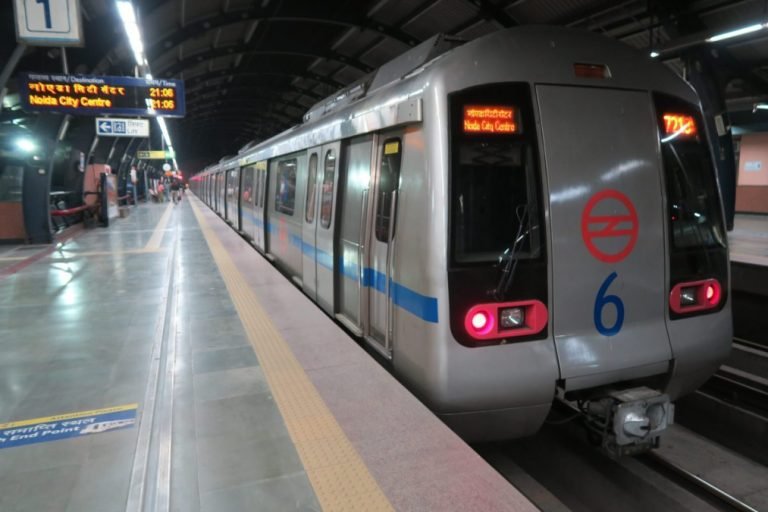
Noida Metro to connect to Jewar Airport in Phase – II

Introduction

The Uttar Pradesh government approved the construction of a 29.7 km metro line linking Noida with Greater Noida in October 2014. The government also appointed the Delhi Metro Rail Corporation (DMRC) as the turnkey consultant for the project.

The detailed project report (DPR) was prepared by the DMRC. A Special Purpose Vehicle (SPV) called the Noida Metro Rail Corporation (NMRC) was formed to implement the project. The Uttar Pradesh Cabinet approved the project and forwarded the DPR to Government of India in October 2013. The Government of India and UP will each bear 20% of the costs and loans from external agencies would be taken to fund the rest 60% of the project. Twenty percent funding from UP will be shared by Noida and Greater Noida Authorities, based on the length of track that passes through the two areas. 

The NMRC announced on 30 November 2016 that the first line of the metro would be called the Aqua Line. The project received safety clearance from the commissioner of metro rail safety on 21 December 2018. The Greater Noida Industrial Development Authority (GNIDA) approved an extension of the Aqua Line as part of Phase 2 of the metro project on 4 December 2018. The 15 km extension will link Noida Sector 71 to Knowledge Park 5 in Greater Noida. The extension will consist of nine stations and is expected to cost Rs. 2,602 crore. The new stations are Sector 122 and Sector 123 in Noida and Sector 4, Ecotech 12, Sectors 2, Sector 3, Sector 10, Sector 12 and Knowledge Park V in Greater Noida. 

Project Details 

The Noida Metro is a rapid transit system connecting the twin cities of Noida and Greater Noida in Gautam Buddh Nagar, Uttar Pradesh, India. The metro network consists of one line (called Aqua Line), with a total length of 29.7 kilometres serving 21 stations. A second line is planned. The system has all elevated stations using standard-gauge tracks. Initially, the trains are composed of four cars to be extended up to six in the future. Noida Metro is the 11th Metro system to be built in India and 2nd in Uttar Pradesh after Lucknow Metro. It is the sixth longest operational metro network in India after the Delhi Metro, Hyderabad Metro, Chennai Metro, Namma Metro and Kolkata Metro.

Noida Metro Rail Corporation (NMRC), a state-owned corporation, is building and owns the system. However, the operations and maintenance of Noida Metro lies with Delhi Metro Rail Corporation. The line is connected to Delhi Metro at Noida Sector 51 station by a footbridge. Foundation for the NMRC project was laid down in October 2014, with the construction being commenced by the end of December 2014 by then Chief Minister of Uttar Pradesh Akhilesh Yadav. Trial runs started in August 2018, and the metro was inaugurated on 25 January 2019 by Chief Minister of Uttar Pradesh, Yogi Adityanath. Noida metro is planned to be connected with blue line of DMRC and proposed Jewar Airport through Aqua line of NMRC. 

System Specifications

  • Top Speed : 95 kmph
  • Average Speed : 35 kmph
  • Track Gauge : Standard Gauge – 1435 mm
  • Electrification : 25 kV, 50 Hz AC OHE
  • Signalling : Communication-based Train Control (CBTC)

Key Figures

  • Operational : 29.7 km
  • Under Construction : 0 km
  • Approved : 14.95 km
  • Proposed : 70 km
  • Daily Ridership : 33,000/day (May 2022)
  • Rolling Stock : 76 coaches (19 train-sets x 4) supplied by CRRC

Operational Route

Line-1 (Aqua Line) Sector 51 – Greater Noida Depot

  • Length : 29.7 km
  • Estimated Cost : Rs. 5,503 crore
  • Type : Elevated
  • Depot : Greater Noida Sector 34
  • Number of Stations : 21

Stations Names: Noida Sector-51, Sector-50, Sector-76, Sector-101, Sector-81, NSEZ (erst. Dadri road), Sector-83, Sector-137, Sector-142, Sector-143, Sector-144, Sector-146, Sector-147, Sector-148 in Noida. Knowledge Park II, Pari Chowk, Alpha-1, Delta-1, GNIDA Office and Depot stations in Greater Noida.

Approved Routes

Line-1 (Aqua Line) Sector 51 – Knowledge Park V

  • Length : 14.95 km
  • Estimated Cost : Rs. 2,682 crore

(This extension of the Aqua Line was approved by Uttar Pradesh’s Cabinet in December 2019 and will be developed in 2 phases.)

  • Phase 1: Sector 51 to Greater Noida Sector-2 (9.605 km)
  • Phase 1 Stations (5): Noida Sector 122, Noida Sector 123, Greater Noida Sector 4, Ecotech 12 (Tech Zone) and Greater Noida Sector 2
  • Phase 2: Greater Noida Sector-2 to Knowledge Park V (5.8 km)
  • Phase 2 Stations (4): Greater Noida Sector 3, Sector 10, Sector 12 and Knowledge Park V

Proposed New Routes

Various new lines are currently on the drawing board. Some of them are:

Extension of Aqua Line: Depot Station to Chamrawali Bodaki (3.5 km)

(This eastward extension of Line-1 proposes to connect a residential township being developed for the Delhi – Mumbai Industrial Corridor (DMIC).

New Line  (Sector 142 – Botanical Garden)

  • Length : 11.504 km
  • Status : Proposed
  • Type : Elevated

(Alignment and line colour have not been finalized)

New Line (Greater Noida Knowledge Park II – Jewar Airport)

  • Length : 35.64 km
  • Status : Proposed (DPR being prepared by DMRC)
  • Type : Elevated (Express & Local services)
  • Number of Stations : 25
  • Station Names : Greater Noida’s Knowledge Park-II, Chi-I, Chi-II, Chi-III, Chi-IV, Gautam Budh University, Night Safari, Murshadpur, Yamuna Authority’s Sector 26A, Noida International University, Galgotia University, Sector 17A, Sports City, Sector 22A, Sector 22B, Sector 18A, Sector 22C, Sector 19, Sector 2, Sector 20, Sector 21, Sector 28, Sector 29, Nagla Hukum Singh and Jewar Airport
  • Contractors : Cengrs Geotechnica (Geotechnical work) and Centre for Environment Research and Development (EIA and SIA study) for preparation of DPR.

Major Timeline 

Phase 1 : Noida Sector 51 to Depot

  • Oct 2014 : UP Government approves the metro project.
  • Sep 2015 : Work in progress around Sec-71, Noida.
  • Nov 2015 : 700 piles (pillar foundation) out of total 5000 completed.
  • Feb 2016 : NMRC completes first phase of construction in eight months. 
  • Feb 2017 : 70% work completed.
  • Mar 2017 : Train trials expected by December 2017 and commercial operations by April 2018.
  • June 2017 : Commercial operations to start by April 2018.
  • July 2017 : 95% civil work of track and metro station completed, trials expected by year end.
  • Aug 2017 : Metro train trial to start by year end on 6-km track from Depot station to Knowledge Park station.
  • Sep 2017 : Commercial operations to start by April 2018.
  • Oct 2017 : 97% civil work done. All stations to be completed by October end.
  • Nov 2017 : Placing of the last girder, thus completing viaduct work for whole metro line.
  • Dec 2017 : Four Aqua Line coaches arrive from China, each costing INR 11 crores. Trial run to begin soon.
  • Jan 2018 : Limited trial run started on 1 km stretch.
  • Mar 2018 : Full-fledged trial run to start in April.
  • Jun 2018 : Trial runs on from Gr Noida Depot to Noida Sector-148 slowly planned to be extended to terminating station in Noida Sector-71. The line to become fully operational by Dec 2018.
  • Sep 2018 : Trials continued, extended till November 2018.
  • Nov 2018 : Extensive trials prior to final inspection by the commissioner of metro rail safety.
  • Dec 2018 : Safety trial successfully conducted and fares decided.
  • Jan 2019 : On 25 January, Aqua line was inaugurated by Uttar Pradesh Chief Minister Yogi Adityanath & cabinet minister for Housing and Urban Affairs Hardeep Singh Puri.

Phase 2

  • Dec 2018 : UP government approves the project on 04-Dec-2018.
  • Aug 2019 : Project gets delayed due to financial viability. Discussion on PPP mode.
  • Dec 2019 : Project approved in Uttar Pradesh cabinet meeting, project deadline set to 2022
  • Jun 2020 : Tenders invited and to be submitted by end of June-2020.
  • July 2020 : Tender for construction to be awarded by September.
  • Feb 2021 : The tender and bidding process for Noida Aqua-Line Extension Project conducted thrice between June 2020 and February 2021 but cancelled all three times due to relatively low response from the construction companies.
  • June 2021 : Tender for the Noida Metro Aqua Line Extension floated for the fourth time
  • July 2021 : NMRC received 3 bids from Sam India Builtwell, GR Infra Projects, and Ashoka Buildcon. After the technical evaluation of bids NMRC selects the contractor.

Network

  • Phase 1

The operated 29.7-kilometre Aqua Line has 21 stations. The line starts from Noida Sector 51 metro station and will run through sectors 50, 76, 101, 81, NSEZ, 83, 137, 142, 143, 144, 145, 146, 147 and 148; after this it will enter Greater Noida and will go through Knowledge Park-II, Pari Chowk, Alpha-1, Delta-1 and GNIDA Office before terminating in Depot Station. 

The entire route is on elevated track. All stations are equipped with platform screen doors. The corridor was completed at a cost of Rs. 5,503 crore, according to the NMRC. This line has an interchange station with the Delhi Metro at Noida Sector 52 metro station.

  • Phase 2

Noida Sector 51 to Knowledge Park V :The Greater Noida Industrial Development Authority (GNIDA) on 4 December 2018, approved the Noida Metro Phase 2 from Noida Sector 51 to Knowledge Park V in Greater Noida. The extension will cover up to 15  km and comprise 9 stations and cost Rs 2602 crore. 

According to the detailed project report (DPR), the new track would be completed in two phases and the entire project would connect Sector 51 in Noida and Knowledge Park V in Greater Noida. The first phase would be between Sector 51 and Greater Noida Sector 2, while the second phase would be between Greater Noida Sector 2 and Knowledge Park V stations, the DPR stated. There will be five stations in the first phase—Noida Sector 122, Sector 123, Greater Noida Sector 4, Eco Tech, and Greater Noida 2, while four stations in second phase—Greater Noida Sector 3, Sector 10, Sector 12 and Knowledge Park V. The construction cost of the first phase of the Noida Aqua Line Extension Project will be Rs 536.04 crore and the completion period of the project is 2 years. If all goes well, construction work is expected to start in 2021.

Knowledge Park II to Noida International Airport : DPR prepared for extension from Greater Noida to upcoming Noida International Airport at Jewar that will cover around 35.64  km and comprises 25 stations. The project cost is estimated to be Rs 5708 crore as per YEIDA officials.

Noida Sector 142 to Botanical Garden : DPR prepared for extension from Noida Sec 142 to Botanical Garden metro station that will cover around 11.5 km and comprises 11 stations. The project is expected to finish by 2023 and provide direct connectivity between expressway sectors and greater Noida to Delhi metro without having to leave the metro system. The DPR is being vetted by the board of the NMRC before being sent across for approvals.

Conclusion

The Noida Metro is a rapid transit system connecting the twin cities of Noida and Greater Noida in Gautam Buddh Nagar, Uttar Pradesh, India. Currently Noida Metro network consists of one line (called Aqua line). The metro was inaugurated on 25 January 2019 by Chief Minister of Uttar Pradesh, Yogi Adityanath. The services are available from 6:00am to 10:00pm from Monday to Saturday. On Sundays, trains are available between 8:00am and 10:00pm.

Noida Metro is the 11th Metro system to be built in India. It is the sixth longest operational metro network in India after the Delhi Metro, Hyderabad Metro, Chennai Metro,Namma Metro and Kolkata Metro. The line connects to Delhi Metro at Noida Sector 51 station. The 15 km extension will link Noida Sector 71 to Knowledge Park 5 in Greater Noida. The new stations are Sector 122 and Sector 123 in Noida and Sector 4, Ecotech 12, Sectors 2, Sector 3, Sector 10, Sector 12 and Knowledge Park V in Greater Noida. Each train has a seating capacity of 186 and a standing capacity of 848, with total capacity of 1,034 passengers. All 21 stations, the train depot, and the NMRC offices will be powered by solar energy. Trains will operate at an average speed of 35 km/h (22 mph) with a headway of ten minutes during non-peak hours and 7.30 minutes during peak hours from Monday to Friday, 15 minutes headway for Saturday and Sunday.

The Noida Metro Rail Corporation (NMRC) has started parking facilities at 15 Metro stations. Penalties starts from Rs. 50 to Rs.5000, varies as per the offences. NMRC envisages a unified, smart card based, multi-modal transport ticketing system for Noida City. Multi-model ticketing system would help NMRC to provide seamless commuting experience to commuters within city using a single common mobility card as fare media.

Present Network

Noida & Greater Noida are fastest growing towns in National Capital region. Noida & Greater Noida Authorities decided to have their own SPV in the name of Noida Metro Rail Corporation (NMRC) to facilitate mass transit & other urban transport in Noida & Greater Noida.

The principal objective of NMRC is to plan, design, develop, construct, maintain, operate and finance mass transit and other urban transport in Noida & Greater Noida region. Pursuant to this, NMRC is developing a metro rail system connecting twin cities Noida and Greater Noida. The NMRC has opened its corridor covering the length of 29.707KM between Noida & Greater Noida and operational since 26th January, 2019. The stretch consisting of 21 stations out of which 15 are in Noida and 6 in Greater Noida). NMRC has received ‘IGBC PLATINUM’ rating for all 21 elevated stations of NMRC from IGBC Green Rating System.

Cloud computing for maintaining railway signalling systems

Overview

Signalling systems in railway allow the control, supervision and protection of railway traffic. These systems play an important part in a railway’s capacity and availability. Thus, their reliability and maintenance are key concerns. A number of signalling systems are in market today; these work to guarantee safety while meeting the required capacity of the network. 

In order to keep the railway network in an optimal state, it is critical for the signalling systems to have tools that can make data mining and analysis easier and faster. The solution described herein allows data mining and posterior analysis without depending on the elements that provide the data. This is a key factor for signalling systems, due to their complexity and continuous development. For integration purposes, a data collection and distribution system based on the concept of cloud computing is proposed to collect data or information pertaining to the assets of the railway signalling systems. From a maintenance point of view, a benefit is that information or data may be collected pertaining to the health, variability, performance or utilization of an asset.

Signalling systems in railway allow the control, supervision and protection of the railway traffic. These systems play an important part in the railway’s capacity and availability. Their reliability and maintenance can affect both the infrastructure and the trains. In addition, safety is a key issue. Railway operators and managers are mining more and more data from trackside and handheld readers, onboard locomotive devices and integrated systems for an array of purposes. 

The challenge for users is to sort these data, interpreting them and using them to get improve the movement of freight. For technology providers, the challenge is to keep abreast of the needs of an increasingly diverse customer base. 

Linear assets, such as railroads, are integral infrastructures used to transport goods and people. The maintenance and improvement of these linear assets is critical to a country’s economy and security. Any improvement in the maintenance management of linear assets and the technology involved in maintenance tasks can have a substantial effect on the revenue, safety, and reliability of the linear asset. Today’s railways face increasing pressure from customers and owners to improve safety, capacity, and reliability – while controlling expenses and tightening the budget. Signalling systems play a key role in meeting these new expectations. 

With fewer resources and shrinking budgets, it is essential to have a proper maintenance management system in place to assist managers and engineers to get the most out of their existing infrastructure assets. For a linear asset, such as a railway, much information needs to be captured and analysed to assess the condition, maintenance, capital spending, and inspection of the railroad.

Signalling is an important part of the railway system. Train movement safety depends on it, as does the control and management of trains. Over the years, many signalling and train control systems have evolved, creating a highly technical and complex industry. Signalling is increasingly relevant for the operation and maintenance of trains. A good, safe, and secure operation is expected. In addition, the transport of goods or passengers must now be made through a number of countries without changing trains. Given the number of new demands, the development and implementation of signalling systems remains challenging; not all problems have been optimally solved. 

Railway signalling is a system used to control railway traffic safely, essentially to prevent trains from colliding. Being guided by fixed rails, trains are uniquely susceptible to collision; furthermore, trains cannot stop quickly, and frequently operate at speeds that do not enable them to stop within sight of the driver. Most forms of train control involve movement authority being passed from those responsible for each section of a rail network to the train crew. Not all methods require the use of physical signals, and some systems are specific to single track railways.

The signalling system is based on the ability to locate the trains operating in the network, applying restrictions on their operation to assure the safety of the network, and trying to optimize the line’s capacity. After the trains are located, the traffic can be controlled through signalling block systems and other devices.

Data mining on railway signalling systems 

Data mining can be defined as the exploration and analysis of large data sets to discover meaningful patterns and rules. Data are what we collect and store, while knowledge gleaned from those data helps us make informed decisions. The extraction of knowledge and information from data is called data mining. The ultimate goal of data mining is the prediction of future events. 

Considerations of railway systems should take both functional and structural perspectives into account. The former involves the mission of the system, while the latter focuses on its subsystems and their relations. In signalling systems, identifying this division is critical to understand the system and to maintain it. A particular characteristic of signalling systems is that the structural perspective is further divided into software and hardware. 

Since the elements that are part of the system are mostly electronic devices, the software is critical; it is essential to keep control of the configurations and changes in the software installed in the various system elements through the life cycle of the whole system. Signalling systems are meant to ensure safety on the railway network. Recently, complex systems integrate signalling control systems on the track and in the train (onboard). 

For the reasons mentioned above, the amount of information to manage during the service of a signalling system installed on a railway network is complex, with different equipment on the track and onboard the train. In addition, the system includes both hardware and software. Finally, the software comes in different formats and needs different tools to compile and analyse data. 

The management of railway signalling systems should consider information from both the onboard systems and the track. This paints a complete picture of the whole system, since both signalling systems are part of the control of the railway network. This requires a new vision of the railway; until now, independent management and maintenance systems for the track infrastructure and the train have been the norm. But sharing information means a better diagnosis of the system’s behaviour is possible.

Due to the rapid development of signalling systems, many different systems are available. All comprise a number of subsystems to ensure the required capacity of the network in a safe environment. The interactions between the systems and their subsystems depend on the individual railway network. The infrastructure manager must ensure that the entire network is in optimal condition; therefore, the manager must take into account all systems with their various subsystems. 

Also problematic is the fact that signalling systems have no standardized tools. Every manufacturer provides its customers (infrastructure or rolling stock managers) different solutions. Controlling a system requires both software and hardware; the same signalling equipment from different suppliers may produce similar (but not the same) data. Last but not least, in most cases, the data collected may not be used, or even properly stored for the following reasons: the maintenance managers may not have sufficient time to analyse the computerised data; the complexity of the data analysis process may be beyond the capabilities of the relatively simple maintenance systems commonly used; there is no well-defined automated mechanism to extract, pre-process and analyse the data and summarise the results so that site managers can use it. 

For all these reasons, in order to improve the process of keeping the railway network in an optimal state, particularly the signalling systems, it is critical to have tools that can make data mining and analysis easier and faster. Examples of information that can be collected include track availability, use of track time, track condition, performance history, and work performed. Measurements of the condition of a linear asset, such as the track, typically include continuous and spot measurements from automatic inspection vehicles, visual inspections from daily walking inspections, and records of in-services failures. The records of the train recording units can provide data from the routes, kilometres, speed curves, and driving modes of the train, among others

Signalling systems, like most electronic equipment, must have their hardware maintained; when parts are replaced, the software should be updated or not, depending on whether the new electronic device is configured by the factory or must be adapted to the particular specifications of its location and functions. Therefore, it is critical for the network to establish a good management process. Data mining can help, improving the management process and helping to diagnose any discrepancy. 

The developed mining system will provide and collect information through a distributed computer network; it may include new ways to diagnose failures or ways to improve the network, for example, increased line capacity. Data mining provides the possibility of analysing or even simulating possible changes in the configuration of the signalling system, making it possible to determine whether a change will be successful before implementing it. A central data store can integrate information on the linear asset. For railway signalling systems, the database can integrate railway information in the following areas: 

  • Layout-Configuration of rail line elements along a rail route, including such aspects as number of lines, location of bridges, tunnels, signals, balises, track circuits or axel counters, etc.
  • Inventory of the track and train signalling system component descriptions, including devices to locate the train, to perform protection and/or control, to determine location and installation date, to find software versions and codes of the various hardware, to find information pre-recorded on the balises, etc. 
  • Onboard information recorded, such as speed, drive modes used, train configuration, wheel profiling, information provided by the track, driver actions, etc.
  • Maintenance Input-Location and date of maintenance action taken, including spare parts or full equipment replaced or repaired, software updated on new devices or new software versions updated, etc. 
  • Traffic-Accounting of frequency of usage, maximum train speeds, and types of traffic.
  • Cost Information, such as train delays, maintenance, signalling system´s components. 

The central data store may be derived from a variety of data sources, such as the track side or the rolling stock, and may provide information to multiple system users, including track infrastructure managers, rolling stock providers, or maintenance railway companies.

Data Fusion : A need in maintenance of processes

A data collection and distribution system, known as asset cloud, is proposed to acquire data from the disparate sources of data provided by the different subsystems which form the signalling system. 

The different formats are converted to a common format or structure; the data, as needed, are run through any of a suite of applications run at a computer system or disbursed between workstations throughout the process control network.

This information may then be sent to different users to inform them of the present state of the signalling systems, equipment failure, or even future problems discovered thanks to the cloud’s correct diagnosis of the available information. 

The proposed application can fuse or integrate data from previously disparate and separate systems to provide better measurement, viewing, control and understanding of the entire signalling system.

Cloud Computing in Asset Management

The cloud is a set of hardware, networks, storage, services, and interfaces that enable the delivery of computing as a service. For the asset management of signalling systems, the cloud seems to be the solution, given the large amounts of dispersed data in different repositories. The end user (maintenance or operators) do not really have to know anything about the underlying technology. The data collection and distribution applications may be dispersed throughout the network and data may be collected at a number of locations. 

The cloud can maintain and store these data in the central working data store. At the same time, a user interface can provide a powerful analysis tool because of its ability to integrate layout, inventory, conditions, maintenance input, traffic, weather, and cost influences at any location along a linear asset. The ability to have this combined view is helpful to resolve track deterioration and choose corrective action.

The main goal is to provide a system and method to combine the data on a linear asset, with a view to extracting additional information from the data. Data must be analysed for different functions and from different points of view.

Asset Cloud in Railway Signalling Systems

Because of its complexity, cloud computing can solve most of the problems in the data mining procedure as it is applied to the railway, particularly signalling systems. 

Cloud computing can use the collected data to generate new information or data which can be distributed to one or more of the computer systems associated with the different functions of the railway signalling systems network; it can execute or oversee the execution of other applications that use the collected data to generate new types of data to be used within the process control.

The cloud should include or execute index generation software that collects or creates indices of devices. These indices help optimize the process control and provide business persons with more complete or understandable information about the operation. They allow easier control of the configuration of the signalling systems as well as the management processes of the different systems and subsystems that comprise the signalling system. 

A central office computer server (cloud) that is connected to the railway control centre will provide a repository for all data related to the linear asset. Data are collected from multiple sources. For example, in the context of a railway signalling system, data may be collected from including existing computer systems, train records (track, train and driver information), paper records (e.g., maps), experts (e.g., inspectors, supervisors, district engineer), and sensors (e.g., traffic and weather). Analysis of how these affect the signalling systems in terms of reliability and maintainability can be done to determine possible improvements in the capacity of the railway network. 

There are a number of be reduced with the access to the right information in a shorter time; improved software configuration and control management; improved failure diagnosis due to the established relations between data to perform quick root cause analysis; improved coordination between operation and maintenance; possible harmonization of maintenance procedures.

pS MVM9BW3da6HJgCSJ ZlCgOHc9YAqmb20 u ZZTibSFRgL7 jMJW z8663PtgPO4pW2Xu o0NVAoq 5LKqXhormplVP5Jsk4r 5SJ Dt3yclACBCbuOG PLp0WI7D eFamlzmF

Indian Rail Economy growing with Cloud hosting 

The ‘Digital India’ initiative has given wings to the government of India to innovate new methods to implement the technology and make lives more comfortable for the Indians. In the era where every little thing is being digitised, Cloud hosting has proved to be the stepping stone in making of Digital India. It has progressively transformed not only, the IT industries but also, gaming, media and all set to revamp the Indian Railways.

Indian railway is known to be the most extensive network in Asia and 2nd largest in the world. According to the reports, a total of 6853 railway stations are located in India and nearly, 13 million passengers travel every day. The Indian railway network is increasing day by day, and so, there have been frequent complaints regarding ticketing, security and many more. Thus, the Indian Railway Ministry has decided to revamp the railway network and make it digitised.

To provide a solution to the existing situation, the Indian Railway ministry launched RailCloud which is a strategic IT initiative. The estimated cost for implementing RailCloud is around 53 crore rupees aiming to build a single digital platform for Indian railways. Since Cloud Hosting has carried this digital era by storm, Indian railway ministry finds it to be the perfect match to improve passenger satisfaction, increase revenue and ensure safe operations. Cloud Hosting has given wings to digitise the railway network by enabling storage of large data within the same server space and enabling on-demand faster deployment of resources.

Massive efforts are being made to integrate the railway system with the digital platform. A technology expert predicted Cloud Hosting is likely to boost the Indian railway economy thus ensuring a high level of data security with the use of Private Cloud.  A survey says Cloud Hosting is all set to accelerate the railway network transformation not only in India but, across the globe. The coming years will see, Cloud Hosting firmly established as the strong pillars of Indian Railway digital platform.  The technical team is working hard to design innovations that will support the thought of making the railway system a digital platform with a goal to achieve customer satisfaction.

Common examples Indian Railway network leverages its Cloud Hosting technology:

Security:

In support of modernised digital India, Indian Railway ministry has left no stone unturned in moving the railway network towards digital platform also, ensuring a high level of security.  In this era where the internet has made things more accessible, the raised concerns are cybersecurity threats. The ministry considers it of utmost importance and thus planned to use Private cloud which has an inbuilt security system.  A report says the cloud is well equipped with the security features depending on the GOI guidelines. This ensures improved levels of security and reduced level of expenditure by 30%.

Ticketing System:

Indian Railways being the most extensive network of Asia sells nearly 1 Lakh tickets per day. E-ticketing system was implemented to make ticket booking easier for the passengers. This paved way to book tickets sitting at home and at any time. With the increasing amount of data, the primary concern raised was server concentration in a single region, and this could also lead to delays. So, the railway ministry decided to implement Cloud technology as an integral part of the Railway system as it is the key solution to these raised concerns. Cloud Computing infrastructure helps in balancing the servers in all the regions of India. In other words, passengers of a particular region can connect to the nearest server and reduce delays.

The 2nd benefit of cloud technology enjoyed by the Indian Railway network is load balancing. This means if Delhi server is overloaded with too many passenger data at the same time, then the transactions can be moved to the closest server to avoid delays and failures. Mechanism of Sharing load on multiple servers helps to balance the equal proportion of load at all the regions. Indian Railway ministry found it more convenient to deploy their cloud rather than renting it from an organisation and thus established RailCloud.

Conclusions

Data mining should not depend on the elements providing the data. This is a key factor for signalling systems, due to their complexity and ongoing development. 

In the past, the different functional areas, e.g., process monitoring, equipment monitoring and performance monitoring, were performed independently; each tried to ‘optimize’ its functional area without regard to the effect that its actions might have on other functional areas. As a result, a low-priority equipment problem may have caused a larger problem in achieving a desired or critical process control performance, but was not corrected because it was not considered important in the context of equipment maintenance. 

Data mining can be used in asset management. Knowing when a system or a component will break before it does so, in plenty of time for repairs to be conveniently and cost-effectively scheduled and executed, is an exciting application of this technology. Today’s maintenance managers are concerned with highlighting areas of existing or potential maintenance problems to improve the performance of assets, satisfy customers and minimise the operational cost of maintenance. 

Applying data mining techniques to signalling systems’ maintenance data can help isolate critical issues and derive solutions; this will significantly improve the management of the asset’s life cycle. It will also help managers discover weak points in the various procedures. Such discoveries can be used to modify maintenance and repair procedures, thereby reducing downtime, increasing uptime, and reducing the costs of maintenance and repair. 

The asset cloud is a feasible solution to the problem of limited or no access to data from various external sources; it collects data and converts that data if necessary into a common format or protocol that can be accessed and used by applications. Cloud computing can solve most of the problems involving data mining for railway signalling systems. 

Configuration and change control management processes are enhanced by data mining and cloud computing; the different information of the signalling systems is gathered, making it possible to easily and effectively control configurations and changes, and to improve the diagnosis of discrepancies.

The Railway network is the heart of India, and our economy is dependent on it. The Indians prefer to travel by trains as it the safest and cheapest means of travelling. But, with the modern age, the railway network needs to, and facilities need to be upgraded. So, Railway ministry decided to revolutionise the railway network using the Cloud Hosting Technology. They have implemented it in the ticketing system and data security. Cloud Hosting will surely be a boon to the digital railway network.

Delhi government to set up centre for sustainable mobility in partnership with IIIT Delhi

NEW DELHI (Metro Rail News): The Delhi government will be setting up a centre for sustainable mobility in partnership with IIIT Delhi.

Transport Commissioner, Delhi, Ashish Kundra informed that a memorandum of understanding (MoU) was signed for this partnership with Indraprastha Institute of Information Technology Delhi (IIIT Delhi) on July 12, 2022.

“Memorandum of understanding signed today with @IIITDelhi to establish a centre for sustainable mobility in partnership with @TransportDelhi @pravesh @kgahlot. Urban mobility problems to be addressed in partnership with academia,” he tweeted.

Transport minister Kailash Gahlot said that several breakthrough initiatives of Delhi government like open transit data, integrating bus data with Google maps and the One Delhi app were technically supported by an IIIT Delhi team.

“A lot of our breakthrough initiatives like Open Transit Data, integrating our bus data with Google maps & ONE DELHI App were technically supported by IIIT-D team. I’m confident that this official partnership will help Delhi achieve more milestones in smart & reliable transport,” he tweeted.

Metrolite system will not be sufficient for Rithala-Bawana-Narela corridor: DMRC

NEW DELHI (Metro Rail News): Metrolite system will not be sufficient for the Rithala-Bawana-Narela corridor therefore Delhi Metro has recommended a “three-coach” system with a provision for expansion proposed under Phase-4 because many infrastructure projects are upcoming in the area due to which large traffic is estimated.

DMRC Chief Vikas Kumar said that previously they planned to build a Metrolite network but a new recommendation has been sent to the Centre recently. The Union Cabinet in March 2019 had approved three out of the six corridors of the Delhi Metro’s phase 4 which will improve connectivity in Delhi.

“The original proposal was to build a regular metro network for the Rithala-Bawana-Narela corridor. The plan later was to have a Metrolite network which is for an area which has lighter commuter traffic,” Kumar said.

“But a major infrastructure project is planned there by the government under the TOD (transit-oriented development). And our assessment of the projected traffic volume in the area is much larger. So, we have recommended a three-coach metro system,” Kumar added.

“Also, the three-coach system shall have the provision for commensurate expansion in future, say to a six-coach system, so that platforms could be expanded too to accommodate the increased volume of traffic in future,” he added.

DDA officials had earlier said that several meetings had been held by authorities of DDA, DMRC and other stakeholders on the finalisation of the route alignment for the Rithala-Bawana-Narela corridor.

Smart Railway Automation System using various techniques

Transportation systems are complex with respect to technology and operations due to the involvement of a wide range of human actors, organisations and technical solutions. There is a need to apply intelligent computerised systems for the operation and control of such complex environments, such as computerised traffic control systems for coordinating advanced transportation.

Industry 4.0 is enabled by smart systems and Internet-based solutions. Maintenance is one of the application areas of self-learning, and smart systems can predict failure and trigger maintenance by making use of the Internet of things (IoT).

There is no established path for success of any emerging technology, but creating a roadmap can help the rail and aviation industries to bring a more digital and connected future. The need for these industries to be smart is there because Industry 4.0, or the fourth generation of industrial activity, ensures reliability and safety to these sectors. With automation of the manufacturing industry, these sectors will realise efficiency, capacity and cost benefits of Industry 4.0. Enhanced industry-wide condition monitoring will also help reduce unplanned maintenance. Both sectors are in constant search for improvements to deliver better and secure customer experience.

Digital Railway Solution

The digital railway programme is focussed mainly on digital signalling technology, which aims to enhance safety and speed up train movement in a congested network. If all data from signalling, rolling stock and passenger traffic control systems is brought together on a common platform, the entire network will be able to communicate seamlessly and instantaneously. The key to digitisation is the interoperability of systems while retaining a critical approach to data security.

Rail service information could even be integrated with other transport modes, such as bus and taxi services, to guide passengers through smooth door-to-door journeys. Holistic data management could lead to the transformational change in real-time intelligent traffic management and in-cab signalling. This could improve customer satisfaction, with station information systems and personalised messaging providing passengers with all the relevant information they need.

Digitisation of Railways Includes:

  • B-scan ultrasonic rail flaw detection (both non-stop and stop-and-verify systems) and track inspection with automated high-speed test trains.
  • Train control system levels 2 and 3 for high-density routes to increase network capacity and maintain the required safety standards.
  • Increased surveillance of personnel with both interior and exterior locomotive-mounted video surveillance to improve monitoring.
  • Track-laying machines for mechanisation of construction.
  • Electrification through machines such as self-propelled overhead electrification laying trains.
  • Complete train scanners for improved diagnostics and maintenance.
  • Use of distributed power to improve the efficiency of train operations with coordinated acceleration and deceleration.
  • Establishment of smart railway stations by implementing access control at entry points.
  • e-ticketing with services such as infotainment and app-based systems.
  • Use of training simulators and virtual reality (VR) training systems to improve personnel capabilities.

Digital Twin— Digital platform for railways and airways

A digital twin refers to a virtual replica of a physical asset, like an aircraft engine or a rail engine. It is a vital element of the digital rail solution that is continually updated as per the rail network. It enables engineers to test detailed what-if scenarios that could help in decision-making around the planning of enhancement and maintenance programmes. It could identify the most-valued solution that would have the greatest efficiencies and minimise disruptions.

Role of sensors in predictive maintenance

Sensors use a reaction-based approach to manage and maintain an asset and maximise its use potential. A wide range of sensors is available to collect huge amounts of data from all possible systems of a single train and then analyse it in real time to detect problems before these actually occur. Constant monitoring of equipment through the measuring of all relevant variables such as temperature, vibrations, oil levels and the like help anticipate the optimal timing for maintenance. 

It enables identification of faults proactively and elimination of necessary maintenance interventions. Predictive maintenance is a powerful tool that helps track asset health, reduce unplanned downtime of equipment and minimise the high cost of unscheduled maintenance. Optical and tactile sensors such as light curtains, camera systems and dynamic pressure-sensitive mats are suited to monitoring areas near rail vehicles. Good internal communication, fast reactions based on equipment geolocation data, high-quality maintenance planning and regular interventions are required to keep massive rail networks working.

Predictive maintenance and CMMS 

Modern, next-generation asset and maintenance management starts with the adoption of a smart computerised maintenance management system (CMMS). Reliable railway maintenance is required to improve critical issues like safety, delays and overall system capacity. It is expected to rely on smart transportation systems and interconnected solutions such as predictive maintenance. An interconnected CMMS can help maintain, manage and connect tracks, terminals, rolling stocks and communications infrastructure. It can identify maintenance issues before these impact safety, operations or revenue. It collects, stores and analyses data to prevent breakdowns and issue predictive maintenance algorithms to extend equipment life.

A reliable CMMS should be user-friendly, fast, reactive and flexible. It should also have a mobile application for anytime access, connectable to ERPs and IoT systems, geolocation tool, an analytical tool that supports unrestricted media upload and so on. Different departments such as accounting, operations, purchase and maintenance should also be connected to the entire communication platform. It can work as a network for manufacturers, technicians and suppliers to exchange expertise and speed up operations. Advanced CMMS analytic tools enable organisations to analyse data with great speed and accuracy, to optimise availability and increase the life of assets.

DDfxndarJgYIsx3VHWAOeeu5PPXoBPKk0S8CVm0wfT2TLxaAAgcpwsSGD2FQkTju5lCbxseLVDvzjSTfxb lhdDrsfNG8 bfk4JPmHYrZZIP0A1NeCg1YKDy1 ZTebBjBN5IJLWd

The IoT-connected trains

The IoT can interconnect all objects and devices that were previously not part of a network for predictive analytics. Its application increases safety, efficiency and ease of use with train management systems. Control and surveillance systems reduce the risk of collisions and regulate speed. Advanced consumer technologies help maximise connectivity and allow passengers to continue their activities on smart devices while travelling. Train-to-train communication through the cloud enables operators to transmit data about equipment, tracks and stations among themselves.

The IoT enables monitoring of areas on railway crossings remotely, such as barrier operations and end positions, switch end positions, space between barriers, system operations, connections and signals. This allows users to accelerate their projects, from engineering and runtime to maintenance with fast detection and localisation of errors and faults.

Here are some potential use cases presented by rail operators for using IoT to create a connected railway.

  • A journey planner application could recommend the fastest or most comfortable current trip allowing for road conditions to the station, live train times, available car parking capacities, passenger loading, etc., allowing passengers to make informed choices about what option will provide them with the best experience according to their personal circumstances, for example whether it is more important to have the shortest journey time, or to be guaranteed a seat. Allowing the inclusion of historic data will enable evaluation not only for a current trip, but also in a predictive way for a trip planned at a future date, based upon what is normal for the planned day and time of travel.
  • Combining passenger loading information from trains with social networking apps will help spread demand peaks. The same base information shared at a terminus can help in selecting the destination platform offering the most efficient passenger egress considering the loadings of other inbound trains, whilst sharing the same information on the train can produce a more even distribution of passengers within the carriages, potentially allowing standing passengers to find a seat.
  • Combining status information from diverse on-board public-facing assets such as toilets, food car chillers and ovens, and presenting it to service organizations with current positional information can improve the customer experience and reduce the penalty costs associated with having these assets out of service.
  • Intelligent closed-circuit TV cameras not only provide a record of events in case of an incident, they actively provide real-time alarms of the occurrence of potential problems, allowing more timely intervention responses and potentially reducing service outages.
  • Information concerning categorization of faults can be analyzed across multiple assets, even multiple operators, to spot trends and identify areas for preventative maintenance.
  • The automation of toilets can significantly reduce the cost incurred by the train operator and, at the same time, provide a better service to passengers who will less likely find a toilet out of order. Currently, most train operators are unable to determine the status of the on-board toilets in real time and a significant amount of manual checking is required.
  • Management of the video recordings on board. Many rail operators have to send personnel on board their trains to manually pick up the hard drive when video recordings are requested by a law enforcement agency for investigation of an incident.
  • Food and drinks can be easily refilled at the upcoming station if data is available in real time regarding the items sold.
  • Temperature can be remotely controlled to avoid issues with refrigerators that might not be working at all times but whose temperature is critical to preserve the food quality over time.
  • Predictive and preventive maintenance can dramatically increase the percentage of times a train is in use rather than sitting in a maintenance or repair shop, and also improve the passenger experience and safety.

Big Data analytics for smart railways

The complete Big Data architecture includes the IoT and cloud computing devices. These work together to create smart railways that have self-learning capabilities to predict failure, make diagnoses and trigger maintenance actions. The architecture utilises multiple data sources to extract relevant information. It helps users to know what happened when, so they can go back and do the root cause analysis from the data, and take appropriate corrective action. Big Data analytics in railways lead to predictive analytics and make decisions based on huge amounts of data. These involve data collection, analysis, visualisation and decision-making for assets.

Estimation of the remaining useful life of an asset to ascertain the probability of its mission accomplishment is key to the success for any organisation. The railway domain can achieve data interconnection via the train bus where most railway sub-systems and their respective sensors are accessible for global optimisation.

With the increase in demand for more passenger rail services and greater volumes of cargo trains, use of data and its analysis will become a primary asset for the railway sector. Millions of data points captured from sensors on critical train components will help detect impending part defects, ensuring maintenance before a defect occurs. This will improve reliability of the system infrastructure for many years by remote monitoring of location and condition of all vehicles.

Safety is a key area of concentration

Safety is, of course, a primary element of IoT applications and solutions when it comes to train management. One safety use case is on-board train location and detection systems that enable trains to be aware of the positions of other trains. This reduces the risk of collisions while allowing trains to operate safely in close proximity to one another.

Speed monitoring and control is another important safety application. Systems have been developed that can display train velocity for drivers and report speeds back to central control systems. On-board monitoring systems are interconnected with outdoor signalling systems that can regulate train speeds or even remotely command trains to stop based on track conditions, the positions of switches, the presence of other trains on the track and other factors.

There are three major systems within railroads that automation and the IoT can bring significant benefits: signalling, interlocking and level crossings control.

  1. Signalling systems control the movement of a train by remotely adjusting train speed and braking. More traditional signalling systems are based on radio-frequency identification along the train track, but wireless train to ground signalling is getting more and more common in both railroad and metro systems.
  2. Interlocking avoids conflicting movements on the tracks at junctions and crossings by using red and green light signals. The interlocking system works in conjunction with the signalling system to prevent a train from getting a signal to proceed if the route is proven to be unsafe. The IoT can further improve the system’s level of automation and its integration with the signalling system.
  3. Level crossings control is the third system that impacts safety on railroads. Accidents related to level crossings represent 30% of all railway fatalities in the EU. IoT can help decrease those statistics by deploying cameras and sensors for increased safety.

IR & OMRS: New Age Technology for Predictive Maintenance

Indian Railways (IR) is moving towards the adoption of automation and instrumentation in its maintenance practices for detecting defects/deficiencies in rolling assets. The objective is to achieve machine-assisted automatic identification of defects in the Rolling Stock. This will lead to a paradigm shift in maintenance practices of Rolling Stock of Indian Railways from ‘Time Based Maintenance’ to ‘Condition Based Predictive Maintenance’ with a view to enhance reliability and availability along with improved safety of Rolling Stock during run.

For this, On-line Monitoring of Rolling Stock System (OMRS) is being adopted in Indian Railways. OMRS is a way-side inspection system consisting of Acoustic Bearing Detector (ABD) or Rail Bearing Acoustic Monitor (RailBAM) and Wheel Impact Load Detector (WILD)/Wheel Condition Monitor (WCM) to detect the faults in the bearings and wheels of rolling asset. This is an automated system for detecting defective wheels and bearings, and catching the same before it fails, thus resulting in efficient utilization of the coaches, wagons & locomotives. OMRS monitors the health of each Rolling Stock of the train in order to identify defective bearings & wheels. Defect report generation and alert communications takes place in real time for taking corrective action, accordingly.

The current practice of inspection of Rolling stock over Indian Railways is largely based on manual inspection, which is either track side Rolling-in-Examination or pit examination of Rolling Stock in stationary or slow moving condition. The visual inspections are done by trained manpower either in a pit or track side location but this relies on the individual judgment.  Therefore, an automated defect detection system viz. OMRS is being adopted by Indian Railways which consists of following sub-systems:

  • Acoustic Bearing Detector (ABD)/ Bearing Acoustic Monitor (RailBAM) gives an early warning on possible defects in the bearing box, before reaching the stage of hot box.
  • Wheel Impact Load Detector (WILD)/Wheel Condition Monitor (WCM) system measures the wheel impacts on tracks to identify the flat surface on wheels in Rolling Stock. This system is based on Accelerometer device to measure the wheel impacts.
  • PhotoTAG system is used for vehicle identification using Visual (photographic) identification technique.

Encouraged by the results of deployment of OMRS, including some critical detection which could have potentially been cause of an accident, not otherwise detectable by normal maintenance procedure, Indian Railways is now going ahead with greater adoption of track side based maintenance systems with an aim towards predictive maintenance. Further, moving towards predictive maintenance practices in yards, Indian Railways is envisaging to convert its ‘freight examination yards’ into technology driven ‘Smart Yards’ for automatic detection of faults/defects/deficiencies in freight wagons. These Smart Yards will predict anomalies like Hot Wheel Hot Axle, defective bearings, defective wheels, hanging/loose/missing parts etc. long before any failure actually happens. Smart Yards will be equipped with various automated technology driven systems including OMRS, Hot Box Detector, Wheel Profile Recorder and Machine Vision Equipments etc.

The concept of smart yard is to use modern repair facilities, infrastructure, tools, automatic defect detection equipments and digital technology to enhance safety, reliability and productivity in freight trains operation. The automatic defect detection equipments of Smart Yard shall provide advance data about hot axles and wheels, wheel flats, wheel profile & diameter, load imbalance, spring breakage, loose and hanging parts, wear condition of brake blocks etc. even before the rake arrives at the maintenance yard. It will then use this information for objective fault assessment and proactive staffing, thereby, reducing turn-around time while boosting safety and improving productivity.

Status of implementation of Smart Yard:

  • Initially in 1st phase, 40 identified yards will be converted into Smart Yards.
  • COFMOW (a unit of Indian Railways) has been nominated for carrying out the overall work of Smart Yards.

The implementation of aforementioned technology driven automatic predictive maintenance practices for up-keep of Rolling Stock not only will benefit Indian Railways on account of efficient/safe operation of trains but will also benefit on economic ground.

Conclusion

The railway industry is on its way to integrate predictive maintenance and Big Data. Recent advancements in sensors and condition monitoring technologies have led to continuous data collection and evaluation, significantly minimising the number and cost of unscheduled maintenance.

Most significant improvements have been evidenced by more informative and user-friendly websites, mobile applications for real-time information about vehicles in motion, and e-ticket purchases and timetable information implemented at stations and stops. With the rise of Industry 4.0, railway companies can now ensure that they are prepared to avoid the surprise of equipment downtime.

More technologies to meet needs of the railways

Researchers have developed a technique known as frequency-selective coating of window panes to solve the problem of low mobile Internet signals. These panes are provided with a transparent electrically-conductive layer consisting of metals or metal oxides. Metallic coating of the windows is vaporised along lines in a special structure by a laser to pass certain frequency ranges unobstructed.

The VR lab at GE Transportation’s John F. Welch Technology Centre, Bengaluru, have facilitated a 3D VR environment for inspection. It tracks the motion of inspectors through specially-designed wearable goggles and infrared (IR) cameras placed in the room. The VR controller allows users to interact with individual components. The environment helps teams at different locations collaborate and review products that are under development. The lab can also be used as a training ground for service engineers who work on products in the field.

Locotrol distributed power system is a control and communication system that enables coordinated braking and traction power distribution between lead and remote engines for faster stopping times and shorter stopping distances. Locovision system through superior image quality cameras and real-time data processing monitors wayside assets, measures track gauges and detects intruders. It stores all information in a hardware infrastructure to help avoid major asset repairs and fines. The rail integrity monitor employs innovative technology with mounted sensors under the locomotive, continuously testing rail integrity in real time.

Automatic train control systems continuously monitor all train movements to provide fail-safe signalling. Operation of railways is centrally-monitored and controlled through operations control systems. Supervision systems, such as CCTVs or emergency telephones, also contribute to safety and enhanced comfort.

Signalling systems and railway automation solutions are crucial to detect and signal whether line sections are clear or occupied. There are three grades of automation and train control systems, namely, partially automated (supervised by a driver), highly automated (reduced driver supervision) and fully automated (the system is responsible).

DMRC to roll out e-autos as feeder buses less viable

NEW DELHI (Metro Rail News): Delhi Metro Rail Corporation (DMRC) is going to introduce its first e-auto service with a batch of 50 autos which are to be launched from Dwarka Sector-9 station to provide last-mile connectivity to the passengers. DMRC took this decision considering the factor that its feeder buses are “less viable” due to “under-utilisation”.

“The e-auto service would be launched soon, first for Dwarka sub-city. The first batch of 50 e-autos will be launched from Dwarka Sector-9 station, and a total of 136 such autos will serve the sub-city. This is a step to boost last-mile connectivity for metro commuters,” DMRC chief Vikas Kumar said.

According to a senior official, after 136 e-autos planned for the Dwarka sub-city, another 663 e-autos would be soon rolled out in different areas. The first batch of 50 e-autos is likely to be launched from Dwarka Sector-9 station in the first week of August, he added.

Dwarka sub-city has 13 stations, including Dwarka Mor, Dwarka, Dwarka Sector-14 and Dwarka Sector-21 on the Blue Line. According to the DMRC website, there are four routes for Delhi Metro feeder buses — Kashmere Gate Metro Station to Harsh Vihar; Shastri Park Metro Station to Mayur Vihar Phase-III; Mayur Vihar Phase-III to Harsh Vihar and Vishwa Vidyalaya Metro Station to Shankarpura Burari.

Future Mobility Ecosystem

Showing new mobility solutions

Mobility is undergoing one of the most transformational shifts of a generation, with far-reaching implications for the way people live. The future of mobility being fuelled by three key technology-driven disruptive trends: electrification of vehicles, connected & autonomous vehicles and Mobility-as-a-Service. This raises an obvious question that in what ways consumers and business seize the benefits of this mobility revolution.

Transforming the Mobility Landscape: Mobility 2030

The automotive, transport and wider mobility market is undergoing a transformational social, technological and economic shift, fundamentally changing the way people and products move. Many sectors, beyond automotive and transport, are being disrupted, with new markets emerging, existing ones converging, and others declining and possibly vanishing. New entrants and start-ups are challenging incumbents, who in turn look to leverage their experience and resources to build sustainable market positions. Amidst continued population growth, urbanisation and environmental concerns, new forms of mobility are critical to support tomorrow’s population hubs and economic activity. Today’s mobility systems suffer from congestion, inefficiency, accidents and high prices. But the future promises convenient, safe and economic mobility, with less impact to health and the environment.

Mobility transformation is fuelled by three key technology-driven disruptive trends: electrification of vehicles (EVs) and alternative powertrains, connected and autonomous vehicles (CAVs) and Mobility-as-a-Service (MaaS). Taken independently, each would significantly disrupt the ecosystem; but in combination, they should drive unprecedented change. These advances are set to replace our current vehicle-centric system with a radically more efficient, data-enabled and driverless ecosystem – with consumers at its heart. Users would be able to seamlessly transition between public, private, on-demand and scheduled modes of transport, with dynamic travel information enabling mid-journey changes.

As the mobility ecosystem evolves, its global value is forecast to grow to more than $1 trillion by 2030. At the same time, one can expect to see different business models emerging amidst an expected shifting of the value. For example, with OEMs two dominant archetypes can be observed: ‘Metalsmiths’ manufacturing ever more sophisticated hardware (i.e. vehicles), alongside a new archetype, the ‘Gridmaster’. The latter would manufacture vehicles, but also provide a platform for a variety of value-adding customer services. 

However, the roll-out could vary significantly at both a country and city level depending on degree of urbanisation, household choice, existing options, infrastructure, and of course, local policies. Government support significantly influences all three disruptive trends. It also impacts the shape and pace of development of the new ecosystem. From a private sector perspective, it is believes that change would not be driven by any one company or sector. Instead it would require unprecedented collaboration, to develop the right mobility solutions. A fast-shifting ecosystem calls for swift decisions on changes to business and operating models, partnerships and acquisitions.

Considering each of the three technology-driven disruptive trends in terms of timing, impact and implications for market participants, the evolving mobility landscape is stated as under: 

  1. The rise of on-demand mobility and MaaS : From vehicle ownership to Mobility as a Service
  2. The Revolution of connected and autonomous vehicles : Building momentum
  3. Emerging Mobility Ecosystem

Future Mobility Ecosystem in Railways : Data Driven Decision Making & Automation

Data Driven Decision making and automation in Railways is significantly gaining importance across all metro and rail systems. The most current examples of digitalisation in rail transport can be summarized as under:

  1. Connected Commuter: Digital Services for Passengers – In the last five years, Railways across the globe have made significant improvements in modelling a transparent communication with the passengers, evidenced by:
  • more informative and user-friendly websites
  • mobile applications offering real-time information about vehicles in motion and allowing for ticket purchase and issue and other functionalities
  • onboard infotainment services
  • dynamic passenger and timetable information implemented at stations and stops.

In Germany, passengers can access the internet at over 135 stations, in DB Lounges and on board ICE trains. The entire ICE fleet of DB Long Distance is equipped with fast, multi-provider WiFi technology. Passengers can use WiFi free of charge in both first-class and second-class coaches. It is also available on all ICE international trains to France, within the Netherlands and to Austria. The free ICE Portal offers an overview of up-to-date information on journey and connecting trains, as well as a wide variety of audio books and games, books, films, the news section, daily newspapers, travel & discover, and Kids’ World section. No-limit free internet access is provided in first class and a basic internet service in second class that allows passengers to network and communicate, send and receive e-mails, and stay up to date with social media. 

In Russia, business and first class passengers onboard high-speed Sapsan train service can access the internet and a portal with films, music, audio books and magazines. Additionally, the portal offers information about cultural events in both cities, a virtual tour of the train, a range of online courses and information about railways.

In India, most of the metro and railways stations have started offering free WiFi services to its passengers. Other facilities includes modern features like CCTVs with facial recognition, an emergency talk-back system, WiFi enabled infotainment system, automatic plug-door, step control etc.

In Turkey, passengers onboard the high-speed Velaro D trains can access an internet, passenger assistance and entertainment services, called AlwaysConnected. In all of the mentioned cases, infotainment services (paid or free) were first offered to passengers in higher classes, followed by economy class.

There are a number of challenges to connectivity whilst on a train: the metal body of the train weakens the signal, multiple users on the same train reduce the capacity of the network, phone towers flash past and tunnels block the signals. Researchers now have succeeded in solving the problem of low mobile internet signal by means of a technique known as frequency-selective coating of window panes. These panes are provided with an electrically conductive, transparent layer consisting of metals or metal oxides. The metallic coating of the window is vaporized along lines in a special structure by a laser. This enables radio signals in certain frequency ranges to pass through unobstructed, while radio signals at a different frequency are attenuated. 

  1. MaaS: Towards Intermodal Urban Mobility

As a result of the process of digitalisation of the economy and society it is becoming necessary to manage one’s own time effectively, living in two worlds, the real one and the virtual one, simultaneously. This is made possible by such modern mobile devices as netbooks, tablets, smartphones, voice and video devices for communication between humans and digital systems (Amazon Echo, Amazon Echo Look), that have created virtual mobility. A new personality type has been named homo mobilis; it typically features a new understanding of the idea of freedom and the comfort of living, cybermentality, the need to be online continually, the need to have continuous internet access and to communicate with others using social media as well as the need for new, personalised products and services, fully tailored to one’s values, life style, emotions and personal pursuits. 

The terms nanosecond culture as well as always-on mobile have been used to describe the expectation to be able to access products and services immediately and on demand. Future concepts of mobility, such as: Mobility on Demand, Any Time Mobility, Networked Mobility, are expected to address these needs. Meanwhile, concepts of the evolution of urban mobility that have emerged in the last five years are linked to the evolution of the concept of Smart City. The so-called Smart Mobility is marked by the orientation to optimal use of the resources across different modes of transport, ensuring inter-modality. In Mobility On-Demand users are only charged for the functionality that they actually use (pay-as-you-use, pay-as-you-go). From the user’s perspective, these services mean an improvement of the flexibility and the use of resources according to the actual requirements regardless of the user’s location.

The Evolution Concept of Urban Mobility in 21st Century can be illustrated as under:

The period (2000-2050) on a time scale for every decade depicts following –

1st Decade (2000-10) – Low emission Mobility

2nd Decade (2010-20) – Sustainable mobility (Mobility 1.0)

3rd Decade (2020-30) – Smart Mobility (Mobility 2.0)

4th Decade (2030-40) – Mobility On-Demand (Mobility 3.0)

5th Decade (2040-50)- Mobility as a Service (MaaS)

Its worth mentioning that each of the new mobility models is connected, meaning that is provides instant access to the internet and ICT systems that offer real-time journey information, to plan onward journey, make reservations and purchase tickets. Such solutions, based on electronic platforms and applications, are called Mobility as a service (MAAS). It analyses a number of possible journey scenarios, using different modes and means of transport: public and private, it offers booking and ticketing services and it provides for access to locations on route that are important for the traveller, at the same time monitoring the traffic, road works, incidents and accidents on line. This application is available online through mobile devices and it allows for the selection of the mode of transport, also available in real time, following the traveller’s preferences, such as: the cost, the time, or carbon footprint left. 

  1. PMAAS: Digital services for rolling stock predictive maintenance

The use of digital data processing is revolutionizing maintenance of infrastructure and rolling stock. Based on millions of data points captured from sensors on critical train components, analytics can detect impending part defects, ensuring maintenance is only done when required, but before a defect occurs. Reliable knowledge of which parts are likely to fail in the near future allows for close to 100% availability, as faults are fixed when units are not currently in service, avoiding breakdowns. This improves the reliability of the system as the typical operational fleet reserves of 5-15% kept as back-up in the event of faults can now be reduced, thus increasing the effective capacity.

By consolidating volumes of maintenance data with business processes and IT systems and using cloud computing, manufacturers of rolling stock are now able to offer a number of new digital services, such as:

  • Fault Detection as a Service
  • Predictive Maintenance as a Service (PMaaS)
  • Simulation as a Service.

Similarly, recent developments in the field of predictive maintenance of rolling stock & infrastructure can be stated as under :

  • Remote monitoring of location and condition of all vehicles in real time
  • Remote Diagnostics
  • Root cause investigation of faults
  • Automatic data visualization
  • Algorithm for preventive fault analysis
  1. GOA4: Automation and Integration of Train Control Systems

In rail transport, the development of autonomous systems has been spectacular mainly in the area of in public transport services, such as: driverless metro lines, light rail transit (LRT), people movers, and automated guided transit (AGT). In these systems, automation refers to the process by which responsibility for operation management of trains is transferred from the driver to the train control system. Following The International Electrotechnical Commission (IEC) standard 62290-1, there are four Grades of Automation (GoA). The highest, GoA 4 describes a system upgrade in which vehicles are run fully automatically without any operating staff onboard.

Grades of Automation and Train Control Systems –

  • Partially automated – Supervised by Driver
  • Highly Automated – Reduced Driver Supervision
  • Fully Automated – System is responsible
lzYU27wl7wTqWaj173nQ0zuYoD PNBGIoZs UydK6fvu74S7Q 3z Bjm6XwXXyi iM9n

Types of Train Operation

  • Automatic Train Protection (ATP)
  • Driver Advisory Systems (DAS)
  • Automatic Train Operation (ATO)
  • Driverless and Unattended Train Operation (DTO/UTO)

In the over 30 years since the launch of the first automated metro lines, the growth rate for driverless metro has doubled in each decade – an exponential growth that is bound to quadruple in the coming decade. Current forecasts, based on projects approved for implementation, indicate that by 2025 there will be over 2,300 km of fully automated metro lines in operation.

Apart from implementing autonomous train service on metro lines, i.e. in closed systems with short intervals between services and high frequencies, another challenge will be the introduction of Automated Train Operations (ATO) in urbanised areas for regional and cross-country trains. A combination ETCS with ATO is a promising solution for future fully-automated operation for mainline services. ETCS monitors the train’s movement to ensure it adheres to the local speed limit and its own permitted top speed. The system can be scaled up to different levels. For example, at Level 2, the required GSM-Railway radio channel enables both the train-track communication for the ETCS itself and the communication between the trackside Automatic Train Supervision (ATS) and ATO.

Technically, this means that ETCS is a train control and protection system that acts as an intermediary between the vehicle and the track to ensure railway safety and that conveys driving instructions from the track to the vehicle. The so-called balises installed on the track serve to retrieve this information along with precise positional data. ATS system coordinates train movements. ATO, on the other hand, is a control system which, like a train driver, controls acceleration and braking along with such functions as door movements, and translates the calculated energy-optimized trip profile into precise control commands to the train’s drive and braking systems. It does all this within the secure framework defined by the ETCS, which is why the system is referred to as ATO over ETCS.

The advantages when ETCS is combined with ATO are particularly through improved energy efficiency and greater line capacity. ATO shortens headways through time-optimized driving, plus it enables for precise stopping at defined positions, automatic door opening, definition of exact stopping times for the driver, and precise travel along ETCS braking curves. Aided by ATO, the train uses line data, schedule data and real-time information from the infrastructure to drive at an optimized speed profile, thus making additional energy savings.

Below mentioned are few innovation capabilities which can enable railway sector to produce value-adding products and services, and increase network capacity:

  1. Automated Train Operation
  2. Mobility as a Service
  3. Logistics on Demand
  4. More value from data
  5. Optimum energy use
  6. Service timed to the second
  7. Low cost railway
  8. Guaranteed asset health and availability
  9. Intelligent Trains
  10. Stations and smart city mobility
  11. Environmental and social sustainability
  12. Rapid and reliable R&D delivery

Data Driven Decision making or Digitalisation in Railways, as key to businesses, is now demonstrating how its use will help meet customers’ expectations, drastically improving manufacturing, operations and maintenance performance across metro and rail systems globally. Optimised rail solutions mean smart use of existing networks, i.e. maximised use and rightsizing of capacity based on demand, and of assets, i.e. maximum availability, but also return on investment, i.e. low life cycle costs. 

QOxs7g3fOQ TUPyBgneaQouXpYTmFtH1kpYTrEdeGoS7FDHXsHX7JoD4cFUobNeQ2o8HS8EZsCfW0QBhV1tZYYyqy1ZH1IJtg6lmAm8j HvhdkSy55g1gD2n4Df7hSzICnrDh3N8
  1. Internet of trains: Creating value for multiple stakeholders

An example of how the concept of the Internet of Things is implemented in rail transport is the internet of trains, or The Connected Train, whereby the train’s smart sub-systems communicate data via cloud computing to the central data platform. To be able to utilise the functionality of the Internet of Trains, reliable and uninterrupted communication is necessary between three different networks: one providing the connection between the train components and the on-board controls, one used by the crew on-board (for example, VLAN-based) and one broadband mobile internet connection service offered to passengers. A prerequisite for the implementation of IoT is an operation of the GSM-R standard, a mobile internet system dedicated for rail transport and one of the two key components of the European Rail Traffic Management System (ERTMS). It is expected that progress in this area will follow especially in the case of those solutions offered to rail operators and passengers that are not required to be homologated. 

Conclusion

Digital transformation fares beyond the digitations of data and processes. Instead, it involves an ongoing adaptation to changes in a turbulent environment. This creates both opportunities and threats for any industry, not less the rail industry. The challenge to be addressed in the coming years is not only a switch from electromechanical to electronic devices followed by a switch to digital components, the implementation of fully automated systems based on standard interfaces and safety certification, but first and foremost, a general change of the mindset to one allowing for sharing of resources, consolidation of business solutions and the creation of new value of rail services both within and outside rail ecosystems.

The digital challenge for railway sector is how to connect the customers, the operators, the trains and the infrastructure and transform to network effects. It is more specifically focused towards developing and upgrading data driven decision making system for railways ensuring a speedy, safe and convenient passenger and freight transport system.

In this context Indian Railways is making significant strides towards developing railway mobility as a service through its enhance network of metro, urban, semi urban, regional rapid and mass rapid transit systems. The government and railways in India is also making significant strides towards upgrading its entire rail network, operations and system using Big Data, IoT and AI. Train scheduling, controlling the speed profiles of trains, delay prediction & reduction, asset management are some of the major areas which Indian Railways is trying to automate through data driven decision making using artificial intelligence. Similarly, using complex applications with elements such as predictive models, statistical algorithms and what-if analysis powered by high-performance analytics system towards customer experience and management of applications like train scheduling, timetabling, improving security at railway stations, automatic charting, network optimization, crew management, inventory management, IRCTC ticket, catering and accommodation management through big data analytics is also a major component of Indian Railways today exemplifying strenuous efforts towards digitalization and automation of rail and urban transport system in the country involving RRTS, MRTS etc.

The world is preparing itself for a robust urban transport system amidst rapid urbanisation of cities in most of the countries exerting pressure on its public and existing transport system.  The arising problem to much extent can be solved through   development of a modern, technology enabled, automated transport system.

Pune Metro Line 3 achieves completion of 1000th piling work at Balewadi

PUNE (Metro Rail News): The work of Pune Metro Line 3 aka Puneri Metro on the Hinjewadi to Shivajinagar route has now gained rapid momentum. The construction of the 23-km-long project, jointly launched by Pune IT City Metro Rail Limited (PICTMRL), a Tata group’s special purpose vehicle company, and the Pune Metropolitan Region Development Authority (PMRDA), has reached the stage of successfully completing one thousand (1000) pilings on Tuesday 12th July.

“The 1000th piling work was completed today at the proposed station No. 10 of Pune Metro Line 3 near Balewadi Stadium. Along with this, a barricading work of 12 thousand 147 RMT on the Hinjewadi to Shivajinagar metro line has been completed till date. A total of 22 piers have been completed. The total number of pile caps for piers including the pile caps to be made for the station has now reached 86. We are working towards increasing this number even faster in the upcoming days and are truly grateful to the citizens of Pune for their ongoing support of this project,” Mr. Alok Kapoor, Chief Executive Officer of Pune IT City Metro Rail Limited said.

Piling work is mainly the construction process used to lay the foundation. The pile cap on which the station is to be erected is the foundation connecting the pier and the piling dug for it. Before placing this pile cap, pits of uniform size are made according to the total pressure on the pole in the ground, which is called ‘pile’. One station pile cap stands on six such pilings. This process is completed in about 14 days. The total time required for this work is 14 days for actual construction followed by a waiting period of 21 days. A pier can be erected on this pile cap in about a month. Meanwhile, important stages like load test and quality check are fulfilled.

The Pune Metro Line 3 is a 23 Km elevated Metro rail project connecting the IT hub of Hinjawadi to the Central business district of Shivajinagar. It is a Public-Private Partnership (PPP) project awarded by the Pune Metropolitan Region Development Authority (PMRDA) to a consortium consisting of Tata Group’s TRIL Urban Transport Private Limited (TUTPL) and Siemens Project Ventures GmbH. The Project would be developed & operated on Design, build, finance, operate & transfer (DBFOT) basis by a special purpose vehicle (SPV), Pune IT City Metro Rail Limited or PITCMRL for a Concession Period of 35 years including the construction period.

Maharashtra govt appoints IAS Officer Ashwini Bhide as MD of Mumbai Metro

MUMBAI (Metro Rail News): The Maharashtra government has appointed IAS officer Ashwini Bhide as managing director of the Mumbai Metro Rail Corporation (MMRC). The decision of appointment has been taken by Deputy Chief Minister Devendra Fadnavis so that the Metro 3 project, connecting Navy Nagar and SEEPZ, can be implemented immediately.

Bhide is an IAS officer of 1995 batch and holds the rank of principal secretary. The previous Uddhav Thackeray government had appointed Bhide as additional commissioner in Brihanmumbai Municipal Corporation (BMC). At present, Bhide looks after the work of the eastern suburbs in BMC and the post of managing director of MMRC will be her additional charge.

Gov order

The Metro 3 project is handled by MMRC and the post of MD was vacant after Ranjit Deol was transferred earlier this year. The additional charge of MMRC was given to Mumbai Metropolitan Region Development Corporation commissioner S V R Srinivas. The government Tuesday gave the additional charge to Bhide.

NHSRCL requests Maharashtra govt to resolve pending issues for Ahmedabad-Mumbai Bullet train project

MAHARASHTRA (Metro Rail News): National High-Speed Rail Corporation Limited (NHSRCL) has written to Maharashtra’s chief secretary, requesting him to intervene to resolve long-pending issues that are delaying the bullet train project. This move has come after a change in the government of Maharashtra. The letter was written on July 7 by former NHSRCL chief Satish Agnihotri, the day he was sacked by the Railway Board.

In the letter, Agnihotri said that one of the most important long-pending issues, which will affect the commencement of the work in Maharashtra, is the clearance under the Forest (Conservation) Act, 1980.

The application for the clearance, after compliance with the conditions and the payment of the mandatory charges, was submitted in March 2021, the issue is still pending with the Maharashtra forest department, he added.

“Your kind intervention is requested in resolving aforesaid issues for providing encumbrance-free land at the earliest and expedite the acquisition of remaining land in Thane and Palghar districts,” Agnihotri stated in the letter.

According to Agnihotri, the Japanese have been requesting for the likely dates for the commencement of the civil work in Maharashtra as the tenders for underground stations at the Bandra Kurla Complex (BKC) and an undersea tunnel were cancelled after repeated postponement over the last couple of years.

The letter also includes a list of 16 important locations where the project is facing delays from the Maharashtra government due to issues related to land acquisition. The progress of land acquisition in Maharashtra for the bullet train project is moving very slowly with 72 per cent (313 hectares out of a total requirement of 434 hectares) of the land needed for the project acquired. Whereas physical possession has only been for 39 per cent of the land, which is 168 hectares.