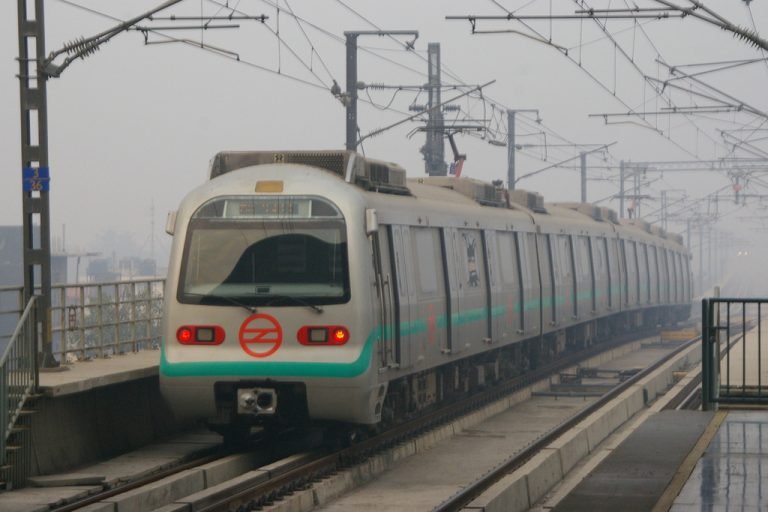
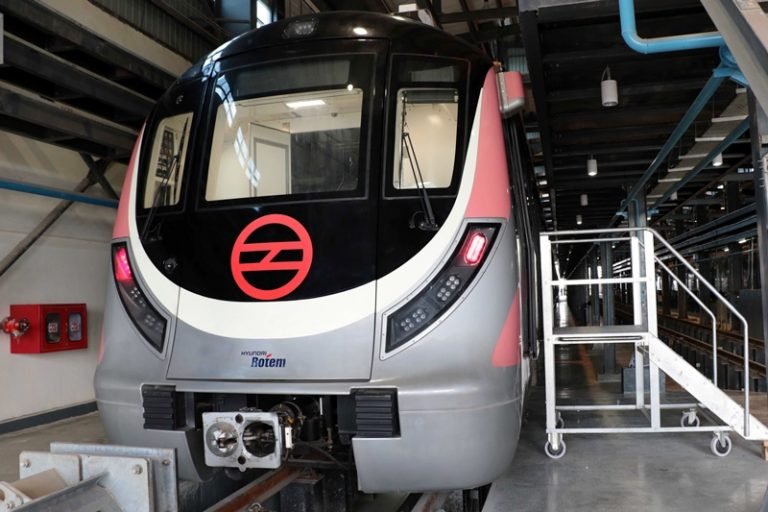
New Delhi: Prime Minister Narendra Modi has flagged-off the Delhi-Faridabad Metro Line that would allow hassle free travel for around two lakh daily commuters between the national capital and the industrial hub in Haryana.
The extension of the Delhi Metro connects Badarpur to Escorts Mujesar in Faridabad.
The total cost of the project from Badarpur to Escorts Mujesar is nearly Rs. 2,500 crore. Out of this, Rs. 1,557 crore was borne by the Haryana Government, the Centre contributed Rs. 537 crore, while the Delhi Metro provided Rs. 400 crore.
All these are elevated and located on either side of the Delhi-Mathura Road (NH-2).
“The nine-station metro corridor which was 95 per cent indigenously built will provide people a safe, affordable, quick, comfortable, reliable, environment-friendly and sustainable transport facility,” a Haryana government spokesperson said.
Haryana Chief Minister ML Khattar, addressing a press conference on Saturday, had thanked the Prime Minister for “gifting” the Metro service which would take the city to “another level of progress” with better connectivity with other NCR towns.
He had also said that the Prime Minister would be announcing the go-ahead for connecting Gurgaon with Faridabad by Metro.
New Delhi: The Delhi Metro Rail Corporation (DMRC) planning to close all token counters at metro stations in the coming time. DMRC has started to install tokens vending machine (TVM) at all the metro stations. DMRC has decided to make all metro stations counterless. DMRC will soon complete this project.
According to the reports, the work of converting existing token counters to 519 TVMs at 118 stations of Delhi Metro has already been completed. At present, the token counter will be available only at the stations where the railway station and bus terminals are interlinked.
DMRC Spokesperson informed about the creation of counter equipment to the stations that the Delhi Metro currently has 183 metro stations and the number of stations will be 227 along with the construction of Phase-3. The task of making all these counters is underway.
According to DMRC MD Mangu Singh, he wants to increase the use of Metro smart card among the passengers. There are a total of 183 stations in the metro, which will be 227 after completion of phase 3 project. More than 80 percent of the passengers currently use Smart Cards during a visit to the Metro.
Another DMRC official said that Delhi Metro has tokens counter at some stations, but they will also be removed in the coming time. He said that Delhi Metro is now turning to countless stations so that those resources can be used somewhere else.
Kolkata: On Tuesday morning, there was a big accident at Damdam station, nine metro passengers got injured. According to the information, at 10.45 in the morning when some people were aboard the escalator located at Damdam station, the accelerator started running in reverse direction. Because of this, people aboard the escalator fell down with shock. In the incident, Tuhu Bhattacharya (24), resident of Jagdal area of North 24 Parganas district, fell down due to which he got crushed.
During this incident, many people suffered with injuries on their feet and hands. After the incident, there was a stir in other passengers present at the station. The security personnel and other officers present at the station reached. On the other hand, the injured person was taken to the station manager’s cabin and left after he was stripped. As soon as the incident happened, General Manager of Metro Railway Ajay Vijayvargiya ordered the high-level probe into the incident.
New Delhi: After a young couple was harassed in the Kolkata Metro for “standing too close”, the police has registered a suo motu FIR to probe the incident following mass protests and a petition that were triggered by the incident.
Photos of the moral policing incident in Kolkata metro went viral, triggering protests
The couple was pushed off the metro train they were in and then thrashed by a mob on Monday night after an argument with a senior citizen who bumped into them while boarding the train. Other passengers also joined the fight and started to heckle the crowd and the couple was told to “get a room” and “go to a club”. The male was kicked and punched, and according to a passenger who clicked photographs of the incident on his mobile phone, the woman was also not spared.
This phenomenon is also raising the question whether Delhi Metro may be in the same place, because in large numbers of young couples also travels in the metro and it is common for them to hug each other at the stations or in metro trains. In such a situation, it is also important to worry about their safety.
However, officials related to the security of the Delhi Metro say that the possibility of such an incident in Delhi is very rare. Raghubir Lal, inspector of CISF, who took charge of the Metro safety, said that the first thing is that the local police have the responsibility of security in the Kolkata Metro, while the security in Delhi Metro is under the responsibility of CISF, which has made all arrangements for the safety of women and other metro passengers. Delhi’s atmosphere is quite different and the thinking of the people here is not conservative. Also, passenger traveling in the Delhi Metro are also very disciplined.
DCP Deepak Gauri of Delhi Metro Rail Police, also terming the Kolkata incident as a shocking event, said that such incidents in Delhi are not expected. Here is a strict security arrangement inside the Metro system. buy soft pack online https://nouvita.co.uk/wp-content/themes/twentynineteen/fonts/en/soft-pack.html no prescription
Here, large number of young students travel in the metro. If there is an incident such as tinkering or beatings take palace, then police takes strict action in all such cases. In the context of the incident in Kolkata metro, he said that law enforcement agencies should take strict action in such incidents. DMRC spokesperson also says that there are many security arrangements in the Delhi metro. Security of passengers is priority of DMRC, CISF and Metro Police. No compromise can be made with safety of metro commuters.
New Delhi: Those who are eagerly waiting to reach the Bahadurgarh by metro train will have to take some more patience now. Most of the sections of this route have been completed, and trial run is going on since December last year, but due to lack of a 300 meters of land in Haryana, the Metro is not able to reach Bahadurgarh. DMRC officials say that this land is necessary for the regular operation of the Metro trains. Talking to the Haryana Government on this issue, DMRC have made it clear that till the matter is resolved, it will be difficult to start the Metro services to Bahadurgarh.
Many old lines are being extended along with two new lines in Phase-III of Delhi Metro project. Under the same, the green line of Delhi Metro between Kirti Nagar and Inderlok to Mundka is to be extended from Mundka to Bahadurgarh in Haryana. For this, DMRC has created an 11.182 km elevated section, on which 7 new stations have been constructed ahead of Mundka. Out of these, 4 stations (Mundka Industrial Area, Ghavera Mandi, Tikri Kalan and Tikri Border) in Delhi, while three stations (Mohan Industrial Estate, Bus Stand and City Park) have been constructed in Haryana.
DMRC officials say that a portion of 300 meters of land near Mohan Industrial Estate station has not been handover to Delhi Metro yet and due to which the work is stuck, while the rest of the work is almost completed. DMRC says that it is extremely important to get this land to start the operation of Metro train on this section of the Green line (Line-5), because here a new depot of the Delhi Metro has been built and depot is made functional only after getting the identified land for the purpose.
Metro officials say that if this land is not made available, then the operation of the Metro will not be able to start functioning of this depot. In this case, all burden will come to Mundka depot, from where some trains can be operated, but it will not be possible to run trains on this full line with full frequency between Kirti Nagar and Indrlok to City Park, unless this land is not available to prepare the route for the new depot made in Haryana. That is the reason why even after all preparations have been completed, DMRC has not yet written a letter to Commissioner of Metro Rail Safety (CMRS) for safety inspection.
Lucknow: The Lucknow Metro Rail Corporation (LMRC) is installing Mass Spring System (MSS) to reduce the vibrations generated during train movement inside tunnel between the 3.67 km long underground corridor between Charbagh and KD Singh Stadium Metro Station. Shri Kumar Keshav Managing Director, LMRC today inspected this system while reviewing the work progress of this underground metro section which would be made operational for public from April, 2019. Here are some photographs-
LMRC installs Mass Spring System in Tunneling
1 of 5
Lucknow Metro Site Visits by MD Kumar Keshav with team
Managing Director reviewed the construction work of Hazaratganj, Sachivalaya and Hussainganj Metro Station where he reviewed the construction work for Auxiliary Building which will provide cooling facilities to these metro stations. He also reviewed the concourse area where the construction of stairs and track bed is completed. This Track Bed is now connected to the tunnel of each Metro Stations.
Lucknow Metro on one side has finished the installation of Over Head Electrification (OHE) work from Hazaratganj Metro Station to Hussainganj whereas the track work from Hazaratganj to Sachivalya Metro station is completed. These Underground Metro Station will have eight Emergency Gates which can be used by the time of emergency.
This has increased the hope of opening the line soon. If everything is okay, then this entire line will be open to the public by the end of this month or even before.
CMRC schedules visit of DMRC’s Magenta Line (Source: DMRC)
DMRC Executive Director Anuj Dayal said that CMRS will inspect the safety of the 25.6 km new metro section between Kalakaji temple and Janakpuri West to May 8 to 10. There are 16 new Metro stations in this section, two stations, Hauz Khas and Janakpuri West will provide interchange facility to the passengers.
On this line, the Metro service has already started between the Kalkaji temple and Botanical Gardens. The rest section is also based on the same technique, it is being thought that this time the green signal will be received by CMRS, and if this happens, then by the middle of this month or by the end of the month This section will also open for passenger service.
After the opening of this section, the 38.235-km new magenta line will be fully opened in the Botanical Gardens from Janakpuri West and it will also become the first such line of phase-3, on which the Passenger Service started with full capacity. Can go. The 12.64 km long line of this line between the Botanical Gardens from Kalkaji Temple was opened on December 25 last year for passenger only. Since then, people were waiting for the rest of the remaining portion of the line from Janakpuri West to Kalkaji Mandir.
New Delhi: The Delhi Metro Rail Corporation (DMRC) today celebrated its 24th Foundation day at Metro Bhawan, New Delhi. The Former President of India, Sh. Pranab Mukherjee was Chief Guest of this celebration. The Additional Secretary of the Union Ministry of Housing and Urban Affairs, Manoj Kumar and Chief Secretary of Delhi, Anshu Prakash were also graced the event.
Former President of India Sh. Pranab Mukherjee graced the 24th Foundation Day Celebration of Delhi Metro Rail Corporation. buy viagra capsules online no prescription
Addressing the metro officials and other delegates, Pranab Mukherjee said, “Everyone who is a Delhitee, lives in Delhi, feels proud of an organisation, that is, DMRC. and the same has been possible due to the complete dedication of the employees, working in different sections of the organisation.”
“Individual excellence, we find many a times. But that excellence to be converted and combined into collective excellence is not easy. The secret of successful corporation management is to build up this team work. I am happy that DMRC, from the very beginning, has built up this team work and this team spirit is the root of the success of the Delhi Metro,” the former President said.
“We have witnessed phenomenal growth from Phase 1 which was about 65 kilometres to over 252 kilometres now. In the next one year, we will add another 100 kilometres. This is indeed remarkable and makes DMRC one of the largest Metro networks in the world”, Chief Secretary of Delhi, Anshu Prakash said.
“Delhi Metro has indeed played a stellar role in the growth of Metro rail network in Delhi and NCR and its massive expansion and popularity in less than two decades of operations tells a great story of people centric policies, timely implementation, hard work and an unending drive to address the transportation issues of the vast agglomeration, that is Delhi,” the Additional Secretary of the Union Ministry of Housing and Urban Affairs, Manoj Kumar.
DMRC’s Managing Director, Mangu Singh, in his welcome address, informed that in the last one year, Delhi Metro had opened about 40 kilometres of new lines across three different corridors and another 35 kilometres of new sections were now ready for operations.
On this occasion, the annual Managing Director’s Awards were also given away to the deserving winners by the former President, Sh. Mukherjee. The Kashmere Gate Metro station was adjudged the ‘Best Metro Station’ and Sh. Pawan Kumar, Senior Station Controller was honoured with the ‘Metro Person of the Year’ award. Smt. Renu Sharma, Assistant Section Engineer/ Rolling Stock received the “Metro Woman of the Year” award. Besides them another 43 employees of DMRC and one employee of the Delhi Police received the Managing Director’s Award for meritorious performance.
The Annual Managing Director’s Award Winners of Delhi Metro Rail Corporation. (Photo: DMRC)
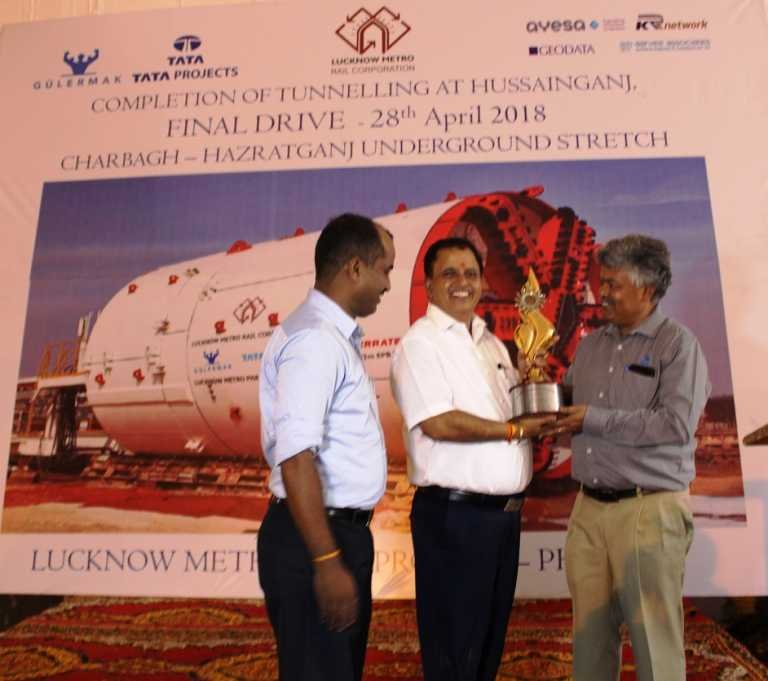
Lucknow: The Lucknow Metro Rail Corporation (LMRC), today, achieved a historic milestone as the Tunnel Boring Machines (TBMs) – ‘GANGA’ and ‘GOMTI’ simultaneously broke through the ground face to reach the Hussainganj underground Metro Station after completing their third and final drive between the Charbagh and the Hussainganj underground Metro stretch. Earlier also, these two TBMs had completed the tunneling drives between the Sachivalaya – Hazratganj and the Sachivalaya- Hussainganj Metro stretch in record time.
TBM Ganga and Gomti broke through the ground face to reach the Hussainganj underground Metro Station after completing their third and final drive between the Charbagh and the Hussainganj underground Metro stretch (Photo: LMRC)
This now marks the completion of tunneling works for the 3.67 km long Charbagh-Hazratganj underground Metro stretch of the Lucknow Metro Rail Project Phase I-A in a record time of approximately 15 months – two months ahead of schedule. LMRC had started its first tunneling drive from the Sachivaalaya Metro station on 18th January, 2017 and tunneling for the whole section was scheduled to be completed by June, 2018 but it has been completed two months ahead of the schedule.
The fact that the tunnelling work was completed two months ahead of schedule inspite of enormous technical and logistical challenges made the moment even sweeter for engineers of LMRC and the Gulermak-TPL JV (the contractor). buy doxycycline online https://myhst.com/wp-content/themes/twentytwentytwo/inc/patterns/en/doxycycline.html no prescription
It is indeed a moment of triumph and pride for the entire team of engineers and officials associated with the tunneling work who could successfully construct the 3.67 km twin tunnels in just about fifteen months in one of the most challenging and demanding urban conditions.
Tunnelling through the heart of the Lucknow city posed an enormous engineering challenge as the route passed beneath highly congested areas and basements of commercial establishments. Realizing the enormity of the technical challenge, engineers working on the project carefully planned each and every step involved in tunneling operation .The final drive from Charbagh to Hussainganj was the most challenging wherein TBMs had to pass just 1m below the bed of Haider Canal in the vicinity of highly populated area with dilapidated hutments on weak foundations.
Another major technical challenge during the final drive was the encounter of very hard strata which significantly reduced the TBMs advancement rate and also posed a critical challenge towards the safety of TBMs itself
The state of the art onboard computerized tunnel guidance system provided in TBMs ensured that the tunneling was done as per the designed alignment to the highest level of accuracy. Extensive instrumentation was done throughout the underground stretch and continuous online and real time monitoring was done by a team of dedicated experts to ensure safety during TBM operations.
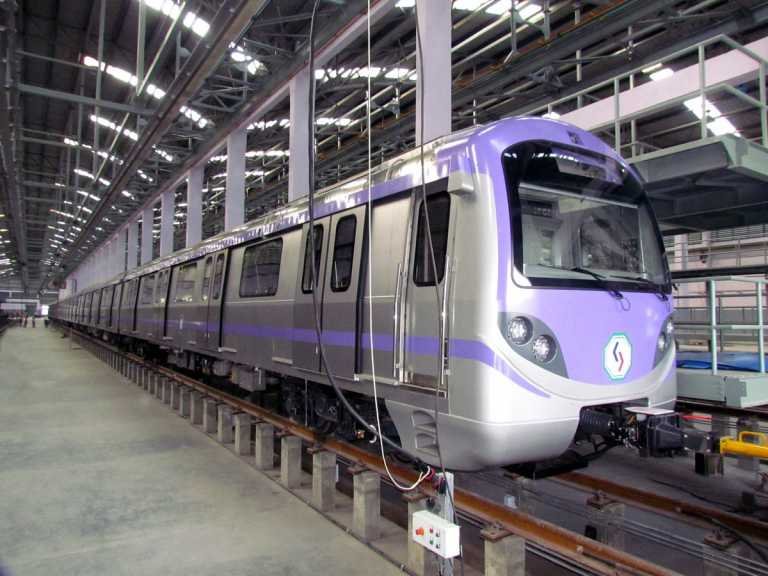
Kolkata: The Kolkata Metro Rail Corporation has unveiled new metro train received from BEML Bangalore on Wednesday which arrived reached in Salt Lake metro depot from Bangalore early on Saturday.
The six coaches train had come on trailers, covering a distance of more than 2,000km, were unloaded with the help of 300 kg Heavy Duty Crane at at the Salk Lake Metro depot of Kolkata Metro Rail Corporation (KMRC). The coaches were then assembled and shunted via rail-track by a Rail-cum-Road Mover (RRM). Here are some shining photographs of new metro train:-
BEML make Kolkata Metro Train in Salk Lake depot
1 of 6
New six coach metro train in Salt Lake depot of Kolkata Metro (Photo: KMRC)
Kolkata Metro (Photo: KMRC)
Kolkata Metro Finishes Chingrighata Work Early, Orange Line Construction Picks Up Pace
New six coach metro train in Salt Lake depot of Kolkata Metro (Photo: KMRC)
Interior of new BEML made Kolkata East West Metro Train (Photo: KMRC)
Interior of new BEML made Kolkata East West Metro Train (Photo: KMRC)
Operators Cabin design of new BEML made Kolkata East West Metro Train (Photo: KMRC)
The latest metro train has six coaches, two less than the ones on the north-south route. The train body, made of stainless steel, can carry 2,068 people in its six coaches, compared with 3,200 an eight-coach AC rake on the north-south route can ferry. Each coach has two pairs of CCTV cameras, a public address system and a radio for communication between the driver and passengers. A LED display board flashes the name of the next station and the terminal station. Each coach has eight doors, four on either side, and two roof-mounted AC units.
Interior of new BEML made Kolkata East West Metro Train (Photo: KMRC)
Once the driver pushes the start button, an automated management system will take over and run the train. From air-conditioning to opening and closing of doors, everything will be controlled by the communication-based control system.
Operators Cabin design of new BEML made Kolkata East West Metro Train (Photo: KMRC)
The driver’s cabin will have an integrated CCTV screen. The trains will have a maximum speed of 90kmph and an operational speed of 80kmph, said Prosenjit Chakraborty, chief engineer (electrical), KMRC. The north-south trains run at an average speed of 55kmph.
Interior of new BEML made Kolkata East West Metro Train (Photo: KMRC)
Each train will have two wheelchairs. The platforms will have screen doors aligned with the train doors, opening and closing together. The platform will be at the same level as the train doors, making it easier for a wheelchair to enter or leave the coaches.
Another metro train from BEML is expected to reach Salk Lake depot within a week. Once it comes, a trial will begin to synchronise the trains with the system. A team of 40 engineers from BEML will assist KMRC officials in conducting the trial runs.
The first phase of East-West Metro, between Salt Lake Sector V and the stadium, is expected to be operational by October of this year.
New Delhi: The Delhi Metro Rail Corporation (DMRC) has announced an increase in vehicle parking rates from Rs 2 to Rs 20. Increased rates will be applicable from 1 May 2018. Earlier, where four-wheeler used to cost 20 rupees for 6 hours of parking, it will now cost 30 rupees from 1st May. Similarly, parking of two-wheeler (for the first 6 hours) has been increased to 10 rupees, which has increased to 15 rupees. For the first six hours, the rate of cycling was 3 rupees, which has now increased to 5 rupees.
Revised Parking Rates of Delhi Metro Rail Corporation (DMRC) w.e.f. 1 May 2018
The current rates for Delhi Metro Parking are effective from March 1, 2013, whereas new rates will be effective from May 1, 2018. For up to 12 hours, the parking rate of four-wheeler vehicles would be 30 rupees, which would increase to 50 rupees. Similarly, for 12 hours two-wheeler used to cost 15 rupees, which will now cost Rs 25. Four-wheeler used to cost 40 rupees for parking more than 12 hours but from 1st May to 60 rupees. Likewise, two-wheeler vehicles cost more than 12 hours, which will increase from May 1 to 30 rupees.
Monthly charge has also increased. So far, the monthly charge for parking of four-wheeler vehicle was Rs 1,000, which would increase from 1 May to Rs 1,200. The monthly parking fee for two-wheeler is Rs 475, which will increase from May 1 to Rs 600.
First fare hike and now parking charges hike. These steps will completely kill Delhi Metro n increase congestion n pollution on roads. Sad https://t.co/f1PWBcduKA
Delhi chief minister Arvind Kejriwal tweeted, “First fare hike and now parking charges hike. These steps will completely kill Delhi Metro n increase congestion n pollution on roads. Sad.”
Metro increased parking charges by 50%. Earler increased fares by 100%. God knows who is advising Delhi Metro.
Health minister Satyendar Jain also attacked the hike. “Metro increased parking charges by 50%. Earlier increased fares by 100%. God knows who is advising Delhi Metro.