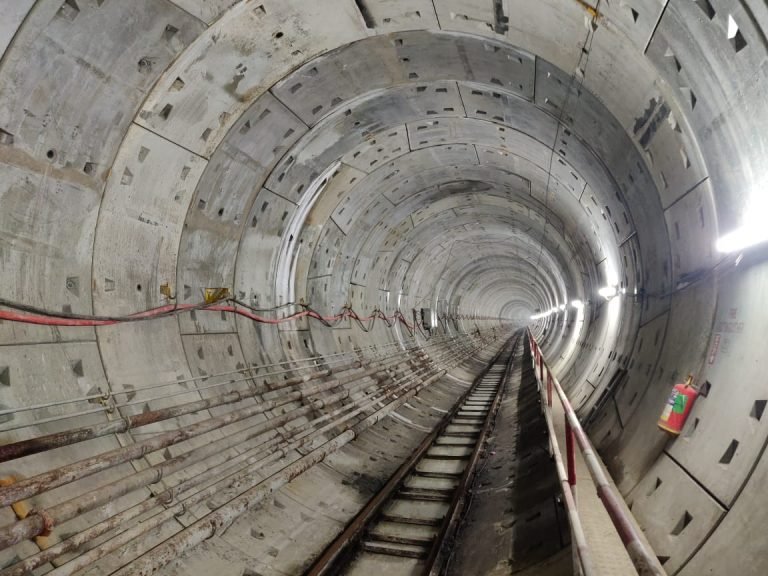
New Delhi: Prime Minister Narendra Modi has flagged-off the Delhi-Faridabad Metro Line that would allow hassle free travel for around two lakh daily commuters between the national capital and the industrial hub in Haryana.
The extension of the Delhi Metro connects Badarpur to Escorts Mujesar in Faridabad.
The total cost of the project from Badarpur to Escorts Mujesar is nearly Rs. 2,500 crore. Out of this, Rs. 1,557 crore was borne by the Haryana Government, the Centre contributed Rs. 537 crore, while the Delhi Metro provided Rs. 400 crore.
All these are elevated and located on either side of the Delhi-Mathura Road (NH-2).
“The nine-station metro corridor which was 95 per cent indigenously built will provide people a safe, affordable, quick, comfortable, reliable, environment-friendly and sustainable transport facility,” a Haryana government spokesperson said.
Haryana Chief Minister ML Khattar, addressing a press conference on Saturday, had thanked the Prime Minister for “gifting” the Metro service which would take the city to “another level of progress” with better connectivity with other NCR towns.
He had also said that the Prime Minister would be announcing the go-ahead for connecting Gurgaon with Faridabad by Metro.
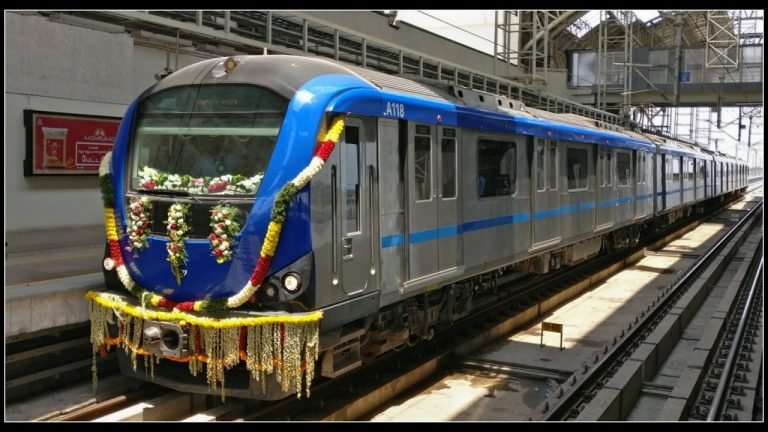
CHENNAI (Metro Rail News): Chennai Metro Rail Limited (CMRL) has begun scouting for a general consultant with the required expertise and oversee the construction of another portion of the corridors. Even as construction is set to commence on a part of the ambitious 118.9km phase-2 metro rail in June 2020. CMRL has called for expression of interest from firms to work as a general consultant for corridor-4 of phase-2.
The corridor will be from Lighthouse to Poonamallee bypass covering 26.1km. Officials said tenders for the construction of the corridor are likely to be floated in two months. “CMRL will require more than 30,000 people to execute such a massive project.
According to an official, a general consultant will bring in the experts required from across the world during various stages of construction since CMRL being a government agency won’t be able to do it on its own.
This comes after China-based Asian Infrastructure Investment Bank agreed to fund the construction of a part of corridor-4 between Meenakshi College and Poonamallee bypass. Officials said construction of the rest of the corridor from Lighthouse to Meenakshi College will be funded by Asian Development Bank. buy viagra online no prescription
While construction will begin initially on the 52km line between Madhavaram and Sholinganallur and from Madhavaram to CMBT, which are part of corridors 3 and 5, in June 2020, construction for corridor-4 is likely to begin a few months later.
“If work progresses without delays the phase may be ready for operations by 2026,” Said an official. The corridor, which cuts across the heart of the city, links many-core localities like Mylapore, Nandanam, T Nagar, Kodambakkam and Vadapalani with suburban areas like Porur, Kattupakkam, Kumanan Chavadi, Karayanchavadi and Poonamallee, which have relatively poor public transport connectivity. The corridor is also called ‘orbital corridor’ as it links the rest of the corridors in phase-1 and 2.
“Our detailed design consultant is on the job. Soil test has been done. Construction tenders are likely to be floated in two or three months,” an official said on the work on the line between Meenakshi College and Poonamallee bypass.
General consultants will assist in reviewing the detailed designs submitted by contractors, monitoring construction through all stages – from foundation laying to the installation of signalling and electrical systems as well as suppliers and manufacturers, quality control and safety, contract management for the project, planning operation and maintenance and training personnel.
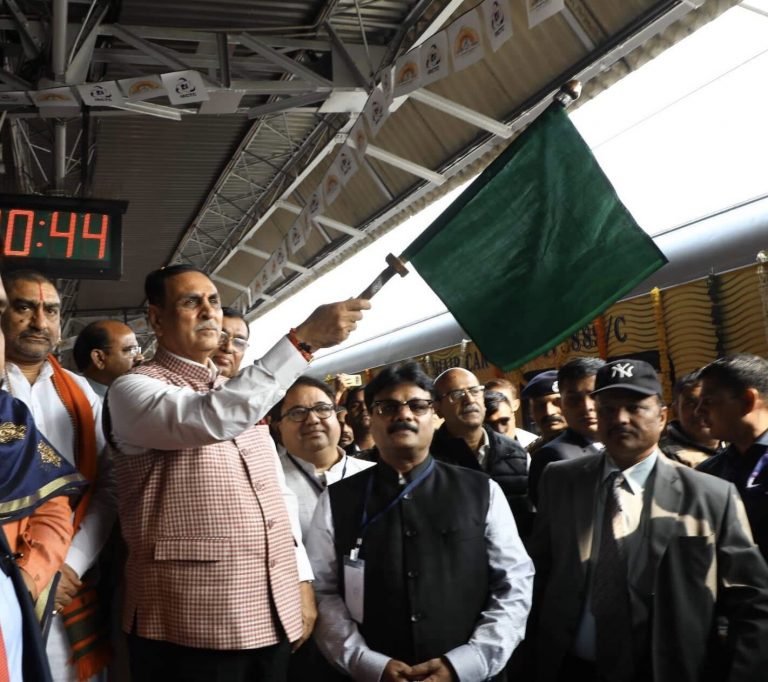
AHMEDABAD (Metro Rail News): India’s second Ahmedabad-Mumbai Tejas Express flagged off from Ahmedabad by Gujarat Chief Minister Vijay Rupani on Friday morning. Ahmedabad-Mumbai Tejas Express will run between Ahmedabad to Mumbai route six days a week except for Thursday. The commercial run of the newly launched Mumbai-Ahmedabad Tejas Express will start from 19 January 2020.
“It is a matter of pride that this semi high-speed, second Tejas Express train has been flagged off between Ahmedabad and Mumbai. This will benefit both states” Said Mr Rupani.
“The work on the bullet train is also going on the Mumbai-Ahmedabad route. Equipped with modern facilities, the train left from Ahmedabad at 10:43 am and reached Mumbai in about 6 hours 30 minutes, covering a distance of nearly 500 km. For the return journey, the train will leave Mumbai Central at 3:40 pm and reach Ahmedabad at 9:55 pm. The train will halt at Nadiad, Vadodara, Bharuch, Surat, Vapi and Borivali stations in both directions. The first Tejas Express between Delhi and Lucknow was flagged off last year.
The booking for Indian Railway Catering and Tourism Corporation (IRCTC) run Mumbai-Ahmedabad Tejas Express has started. Passengers can book their tickets exclusively on IRCTC website www.irctc.co.in and its mobile app ‘Irctc Rail Connect’. There will be no booking at railway reservation counters, said IRCTC in a press release.
Timings: the new Mumbai-Ahmedabad Tejas Express has two AC executive class chair cars and eight AC chair car with a capacity of carrying more than 700 passengers,
Fare: IRCTC will follow dynamic fare scheme for Ahmedabad-Mumbai Tejas Express There will be a different series of fares for lean, busy and festive seasons. There will be an advance reservation period of 60 days. If passenger cancels tickets, automatic full refund on confirmed or waitlisted e-tickets will be made.
Food: High quality food and beverages will be served on-board service staff in Ahmedabad-Mumbai Central Tejas Express. Passengers will be served morning welcome tea, breakfast and combo lunch/snacks in Ahmedabad –Mumbai Tejas Express. Tea and coffee vending machines will be available in the train. In addition to packaged drinking water, each coach will have a RO water filter machine.
Payment on delay: In a first, IRCTC decided to pay the travellers Mumbai-Ahmedabad Tejas Express is delayed. If the Mumbai-Ahmedabad Tejas Express delays for over an hour, passengers will get a compensation of ₹100. For delay of two hours and more, the passengers will receive ₹250, IRCTC said. There will be no facility of ‘tatkal’ ticket in the Tejas Express.
Free insurance: For the first time, IRCTC is offering a free insurance of ₹25 lakh to all the passengers travelling in Mumbai-Ahmedabad Tejas Express. The insurance cover includes ₹1 lakh insurance against theft or robbery during the travel.
Features of Ahmedabad-Mumbai Tejas Express
Ahmedabad-Mumbai Tejas express has state-of-the-art interiors, infotainment, personalised reading lights, mobile charging points, CCTV cameras, bio-toilets, LED TV sets and automatic doors and dustbins.
The passengers travelling on Tejas Express will get free insurance of Rs 25 lakh.
Some of the other facilities of Tejas Express include and compensation on delays. It will provide Rs 100 to each passenger in case delay is more than one hour and Rs 250 if delay exceeds two hours.
Tejas Express also boasts of high quality food service – on-board meals and snacks. Tea and coffee vending machines will be available inside the train.
Another feature of the Tejas Express is that you cancel a ticket, you will get automatic full refund on confirmed and waitlisted e-tickets in your accounts.
“With state-of-the-art facilities along with the crew’s traditional attire, the new Tejas Express is a symbol of Indian culture blended with modernisation for enhanced passenger comfort,” Rail Minister Piyush Goyal wrote on Twitter.
The Tejas Express train numbers 82902 and 82901 will operate on the Ahmedabad-Mumbai route six days a week with Thursday kept as off-day for maintenance activity.
The fully air-conditioned train has two executive class chair cars, having 56 seats each, and eight chair cars, having capacity of 78 seats each.
The total carrying capacity of the train is 736 passengers. The train halts at Nadiad, Vadodara, Bharuch, Surat, Vapi and Borivali stations.
The commercial run of Tejas Express will take place on January 19. You can book your train tickets on irctc.co.in
AHMEDABAD (Metro Rail News): The Gujarat Metro Rail Corporation Limited (GMRC) invited bids from the eligible and experienced bidders for the construction of viaducts and stations of Ahmedabad Metro Phase II projects.
Ahmedabad Metro Phase II Contract Package 1
Tender No.: GMRC/CONS/VDCT+STNS/PKG-C1/PH-2/2020 Issue Date: 10th January 2020
Scope of Work
Package – C1: Construction of i) 8.124 km elevated viaducts and 8 stations from Ch. 17343.443m to 25467.443m, ii) 5.420 km elevated viaducts and 3 stations from GNLU to GIFT City and iii) 0.815 km elevated viaducts and additional platform at Koteshwar Road station from Motera to Mahatma Mandir and GNLU to GIFT City (excl. E&M, Architectural, finishing and roofing) under Ahmedabad Metro Phase II project.
Approximate cost of work: Rs 1017.563 Crore
Tender Security Amount (EMD): Rs 20.35 Crore
The completion period of Work: 30 months (2 years 6 months)
Tender Document Cost: Rs 50,000 (Fifty Thousand)
Tender documents on sale: 20.01.2020 to 24.03.2020
Pre-bid Meeting: 01.02.2020 at 1100 hours
Last date and time of submission Tender: 24.03.2020 at 1500 hrs
Opening Date of Technical Bid: 24.03.2020 at 1530 hrs
Click here to know the eligibility criteria and bidding procedure, please read and download the complete tender notice
Ahmedabad Metro Phase II Contract Package 2
Tender No.: GMRC/CONS/VDCT+STNS/PKG-C2/PH-2/2020 Issue Date: 10th January 2020
Scope of Work
Package – C2: Construction of 6.478km elevated viaducts and 5 stations from CH. 25467.443m to 31945.443m and 0.679 km elevated viaducts and ramp for depot entry from Motera Stadium to Mahatma Mandir (excl. E&M, architectural finishing, and roofing) under Ahmedabad Metro Phase II project.
Approximate cost of work: Rs 470.064 Crore
Tender Security Amount (EMD): Rs 9.40 Crore
The completion period of Work: 27 months (2 years 3 months)
Tender Document Cost: Rs 50,000 (Fifty Thousand)
Tender documents on sale: 20.01.2020 to 26.03.2020
Pre-bid Meeting: 03.02.2020 at 1100 hours
Last date and time of submission Tender: 26.03.2020 at 1500 hrs
Opening Date of Technical Bid: 26.03.2020 at 1530 hrs
Click here to know the eligibility criteria and bidding procedure, please read and download the complete tender notice
Contact Point and Pre-bid Meeting Venue
Senior Deputy General Manager (Civil & Procurement) Gujarat Metro Rail Corporation Limited Block No.1, First Floor, Karmayogi Bhavan, Behind Nirman Bhavan, Sector 10/A, Gandhinagar-382010, Gujarat, India
Kindly Visit the Ahmedabad Metro section of the website to read more about the project.
NEW DELHI (Metro Rail News): The Delhi High Court has upheld the Election Commission’s (EC) decision not to allow the display of any political advertisement inside DMRC premises and on metro trains during the model code of conduct (MCC), saying the restriction was reasonable and in interest fair polls.
Justice Sanjeev Sachdeva termed as “laudable” the EC”s rationale to ensure the public does not get an impression that the government was endorsing or supporting a political party by permitting its advertisements on properties owned by the state or Public Sector Undertakings.
Keeping in view of the purpose for which the directions have been issued i.e., holding of free, fair and transparent elections, I am of the view that the restrictions, as imposed by the respondent 1 (EC), are reasonable and do not violate any provision of the Constitution of India.
The order of the court came while dismissing an outdoor advertising agency’s plea challenging the EC’s June 2019 direction to Delhi Metro Rail Corporation (DMRC) to incorporate a clause in its contracts with ad agencies prohibiting the display of political ads on space provided on commercial lease during the MCC.
The proposed clause also said that any political advertisement displayed in such spaces shall be removed immediately on enforcement of the MCC.
DMRC in turn in August 2019 wrote to the ad agency regarding the incorporation of the clause in the contract between them.
Challenging decisions of both EC and DMRC, the agency contended there was already a clause in the contract prohibiting the display of any advertisement which violated the MCC. However, the earlier clause did not prohibit all political ads during the poll period.
Rejecting the agency’s contention that its freedom to carry out trade was being restricted, the court said the clause proposed by EC would remain in effect for only one month when the MCC was in operation, and during the said period other non-political advertisements can be displayed.
“There are no absolute restrictions on the petitioners in carrying on any business or trade. There is only a restriction which is imposed on the petitioners on displaying a particular type of advertisement and restriction is to remain enforced only for a limited period.
“The restriction is not unreasonable keeping in view the object sought to be achieved by the impugned directions i.e. of free, fair and transparent election,” the court said.
It further said, “In any event, the interest of the petitioner (ad agency) is purely commercial. If one were to balance equities, on the one side there is the pure commercial interest of private individuals and on the other side is the general public interest of holding free, fair and transparent elections. The balance clearly tilts in favour of the general public interest.”
The court also directed that all political advertisements that are in breach of the directions of EC be removed as the MCC in connection with elections in Delhi were already in force.
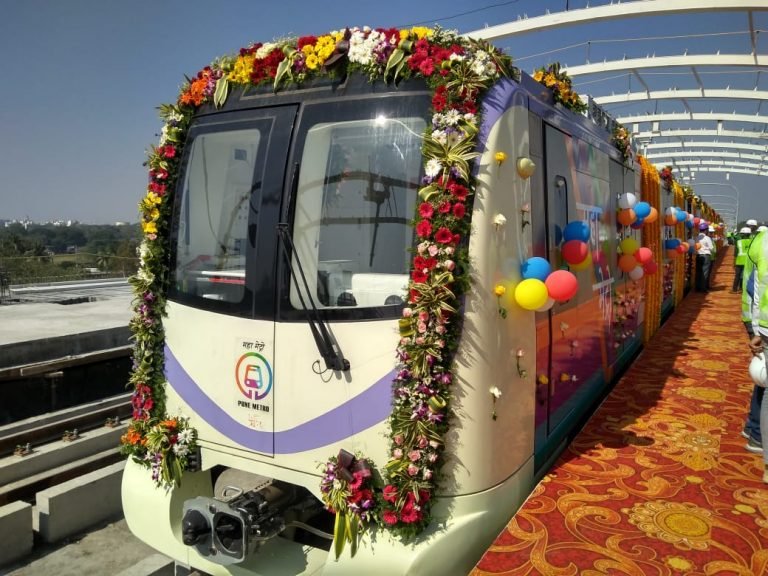
PUNE (Metro Rail News): Pune Metro’s Stretch Between Ideal colony Anandnagar and Garware of is likely to start by June 2020 said mayor Murlidhar Mohol, who took an update about the ongoing projects in the city.
The trial run from the Ideal Colony to Garware College is likely to start by January along with the PCMC priority route. The Pune Municipal Corporation (PMC) priority stretch will start for public use by June 2020 he further added.
Brijesh Dixit, managing director, Maharashtra Metro Rail Corporation Limited (Maha-Metro), said, “The trial run from the ideal Colony to Garware College is likely to start by January 2019.”
A senior civic official on condition of anonymity said that issues related to slum dwellers at Paud road is yet to be resolved and authorities are taking steps to ensure that the project meets its deadline.
Mohol said, “Swargate to Katraj development project report (DPR) for the underground metro and the development plan report (DRP) for Vanaz to Shivvrushti and Hadapsar to Swargate will be made for which Rs 32 lakh will be paid.”
‘Take final decision on 24X7 water supply’
Mohol said that he has directed the administration to take a final decision on 24X7 water supply project as the play has been delayed. “If the contractor is unable to complete the project then fresh tenders should be invited,” he said.
The water supply project is delayed for a while, but as of now, only preliminary work has been completed. The project aims to cater to the future needs of the city and to prevent a potential water scarcity situation in the city. The project aims for safe and equitable distribution of water, round the clock water service, to prevent leakages and detect non-revenue water and technological, economic and environmental water supply service. The estimated cost of the project is Rs 2,545 crore. buy levitra online https://www.ecladent.co.uk/wp-content/themes/twentyseventeen/inc/en/levitra.html no prescription
It gives me immense pleasure to announce that the Metro Rail News published its January 2020 – ELECRAMA 2020 Special issue Today.
Our January issue focuses on interesting topics such as OHE, Transmission Line, Transformers, Electrical Utilities, Energy Meters and Lighting. It also provides a cover story on Metrolite/Light Rail Transit and Metro Neo. Jaipur Metro is chosen as our project of the month and exclusive Interviews of Mr. Rajesh Agrawal, Member (Rolling Stock), Railway Board and L&T Metro Rail Hyderabad MD K.V.B. Reddy, along with other regular columns such as new development in metro project, pre/post-event coverage, technology updates, News analysis, Article, opinions, Awards, appointments, Product Watch, live tenders, Industrycontract, upcoming events, case study and current job openings.
We are thankful for our supporter and contributors who help us to publish a unique and informative magazine every month for our readers.
We Cordially Invite You Visit Metro Rail News at Hall 4, Stand No. H4E20 in ELECRAMA 2020 at India Expo Mart, Greater Noida, NCR, India on 18-22 January 2020.
Learn more about the Latest Innovation Strategy of Metro Rail News to increase your sales, branding, market share in Metro & Railway Industry of India.
Siemens India will showcase state-of-the-art technologies and solutions at ELECRAMA 2020, scheduled from 18-22 January 2020 at the India Expo Mart, Greater Noida, Hall no.1, Stall H1A2. Siemens will demonstrate an integrated approach through innovative solutions and products from its Digital Enterprise, Smart Infrastructure, Gas and Power portfolios, aimed at digital transformation for scalable industry, infrastructure and energy value chain.
Siemens will also be showcasing sector-specific applications like the Industrial Automation, Machine Safety, Energy Automation & Smart Grids, Omnivise digital services etc. In addition, numerous innovations, customer reference projects, product displays such as automated guided vehicles, drives and motors and a virtual reality tour of a power plant will be part of the Siemens Stall. Through these live demonstrations and interactions at the booth, customers from varied business verticals can witness how Siemens incorporates digitalization with future-ready and efficient solutions.
Siemens technologies and solutions showcase at Elecrama 2020
Digital Industries: Driving the digital transformation by integrating automation, software, and cutting-edge technologies.
1. Industrial Automation 2. Machine Safety 3. Low Voltage Drives 4. Low Voltage Motors
5. Industrial Networks and Communication 6. Digital Service 7. Industrial Training
Smart Infrastructure: Smart Infrastructure intelligently connects energy systems, buildings and industries to adapt and evolve the way we live and work.
1. Low-voltage power distribution & control products 2. Medium-voltage power distribution systems
3. Energy automation and smart grids 4. Infra 4.0: Smart Campus
Gas & Power: From state-of-the-art compressors, turbines and generators to virtual power plants, intelligent grid management and innovative storage solutions.
Population growth in India has led to cities that are buckling under the weight of demand for services. To avoid the overpopulation, many families are moving outside of the cities, but from there, another problem arises: how do they then move around? Shri. Vinay Kumar Singh, Managing Director of NCRTC, explains how this rapid urbanisation has forced India to rejuvenate its public transport offering to ensure that these people are just as provided for as those within the cities’ central business districts.
Delhi-NCR
Urbanisation is a global phenomenon and India is no exception to this population shift, primarily due to the evident disparity in rural-urban opportunities. The growing aspirations of the country’s citizens force around 25-30 people to migrate every minute from rural areas to cities in search of better opportunities. The national census in 2011 counted 139 million people as domestic migrants in the country between 2001 and 2011. The future is no less challenging for India, with the national economic survey of 2017-18 predicting that about 40 per cent of India’s population will be living in cities by 2030. This is further acknowledged by the United Nations in its World Cities report, which has estimated that urbanisation levels in India are expected to gradually increase from the current 32 per cent to 50 per cent in 2050.
This influx of domestic migrants is predominantly to Indian megacities like New Delhi, Mumbai, Bengaluru and Hyderabad, primarily because they are the sectoral hubs driving the economy’s meteoric growth. This trend of domestic migration, particularly in New Delhi, has led to uncontrolled urban sprawl, posing serious challenges for infrastructure, environment and citizens’ quality of life, constraining economic growth.
Planned growth of existing economic hubs and the development of new economic epicentres will be critical to sustainable polycentric urban development for realising the prime minister’s vision to make India a $5 trillion economy by 2025.
National Capital Region (NCR)
The National Capital Region (NCR) of India encompasses several districts adjoining New Delhi in the States of Haryana, Uttar Pradesh and Rajasthan, with New Delhi at its centre. NCR is one of the largest urban agglomerations in the world, formed in 1985 in line with the internationally adopted approach of regional planning to decongest New Delhi by enabling holistic development of the region.
Until now, the NCR has undergone lopsided development with a few satellite cities of New Delhi emerging as business hubs, while other sub-regions continue to struggle. This unicentric development has prevented the region from realising its true economic potential. A report by Oxford Economics has projected NCR’s GDP to hit $1 trillion by 2030.
This trend of domestic migration, particularly in New Delhi, has led to uncontrolled urban sprawl, posing serious challenges for infrastructure, environment and citizens’ quality of life, constraining economic growth
With an average 33 per cent decadal growth, the population of NCR is expected to reach approximately 64 million by the year 2021, while New Delhi is set to overtake Tokyo to become the world’s most populous city by 2028. The lack of planning and uncontrolled urbanisation in NCR in general, and Delhi in particular, has resulted in serious issues of over-stressed civic amenities, severe congestion, a high number of road accidents and hazardous pollution levels.
Regional mobility in NCR
Despite the augmentation of new roads, flyovers and expressways, traffic congestion has continued to plague the NCR unabated. Plans for transport arteries that create enhanced regional mobility serving the aspirations of NCR have become critically important for sustainable development.
Worldwide in extended urban agglomerations around cities like Seoul, Paris and Tokyo, besides the dense public transit (e.g. BRT, metros and buses) network within urban boundaries, the importance of regional transit planning was realised early on. Accordingly, regional rails have been planned to serve as the main transport backbone of the region with urban public transit modes serving as feeders. To address existing issues and meet organically growing demand, as well as the mobility requirements of the future to unlock the NCR’s economic development potential, the need to develop the Regional Rapid Transit System (RRTS) was identified.
The National Capital Region Planning Board, a statutory body under the Government of India, in its Functional Plan on Transport for NCR-2032, identified eight corridors for constructing high-speed RRTS in the NCR by 2032. Out of these, three corridors were strategically prioritised for implementation in Phase 1.
The responsibility of designing, developing, implementing, financing, operating and maintaining RRTS has been assigned to the National Capital Region Transport Corporation (NCRTC), a joint venture with the Indian government and the state governments of Delhi, Haryana, Rajasthan and Uttar Pradesh.
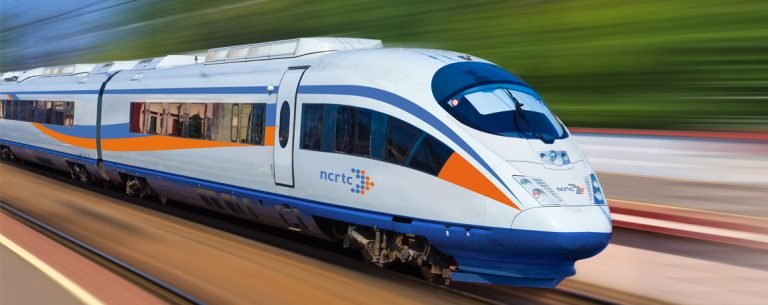
The RRTS will connect cities, towns and urban centres across the region, largely serving the needs of daily commuters travelling within the larger urban agglomeration. RRTS is a high-speed, high-frequency, rail-based system with a design speed of 180km/h and an average speed of 100km/h. Once operational, the RRTS will be the NCR’s fastest, most comfortable, most reliable and safest mode of transport. Efficient and sustainable mobility will enable polycentric development in the NCR.
The RRTS will connect cities, towns and urban centres across the region, largely serving the needs of daily commuters travelling within the larger urban agglomeration
RRTS is a first-of-its-kind project in India. The priority corridors of Delhi-Ghaziabad-Meerut, Delhi-Panipat and Delhi-Gurugram-SNB-Alwar will not only converge at Delhi’s Sarai Kale Khan, but will also be interoperable. Multimodal integration with other modes of transport is central to the project, with the intent of reducing travel bottlenecks for commuters adopting public transport. Integrated modes include airports, urban metro stations, Indian national railway stations and inter-state bus terminus.
Equipped with state-of the art technology, best-in-class command and control systems, level two ETCS signalling, and ballastless tracks, the RRTS will not only revolutionise public transport in the region but will set a benchmark for similar future projects in India.
The journey so far
The Delhi-Ghaziabad-Meerut corridor is the first RRTS corridor to be implemented by the NCRTC. The prime minister of India laid the foundation stone of the corridor on 8 March 2019. Civil construction work on the first 17km of the corridor is already in progress, slated to be commissioned by March 2023. Tenders for the rest of the packages for civil construction will be called shortly and the full corridor is set to be operational by 2025. The Asian Development Bank (ADB) is funding around 60 per cent of the cost of the corridor.
RRTS will not only revolutionise public transport in the region but will set a benchmark for similar future projects in India
The other two priority corridors are in the advanced stages of government approval. Pre-construction activities like geotechnical investigations, detailed designing and surveys are in progress on the Delhi-Gurugram-SNB-Alwar corridor. Multilateral lending agencies like the Asian Infrastructure Investment Bank (AIIB), Japan International Cooperation Agency (JICA) and World Bank, including ADB, have shown keen interest in funding these RRTS corridors.
With a team of its own experts, NCRTC has collaborated with several leading global organisations – such as M/s Ayesalngenieria, M/s ADIF and M/s INECO of Spain, M/s ITALFERR of Italy, and M/s Systra and M/s Egis Rail of France – in various technical areas related to conceptualisation, design, planning and integration for efficient implementation of the project.
Benefits of RRTS
The prime minister’s vision of ‘New India’ envisages an equitable and prosperous nation supported by a friendly ecosystem for economic growth. In New India, a sound mobility infrastructure network will define the transformation of cities in a more planned, equitable and sustainable manner.
RRTS, with the capacity to move 70,000-80,000 passengers per hour per direction, with minimal footprint on the land, will act as the transport backbone of the NCR. This next-generation infrastructure will not only be effective in curbing ills like urban sprawl, air pollution, road congestion and accidents, but will also be able to cater to the growing mobility demands of New India for the next 50-60 years. RRTS will be immensely advantageous in controlling the urban sprawl of New Delhi as well as in decongesting the city. Along with a fast, reliable and safe transit system, the regional rapid rail will also offer a range of other socio-economic benefits to the NCR.
The RRTS will result in substantial time savings by cutting the current travel time for a 100km journey of around three to four hours by about a third on its routes. Around two million daily commuters are likely to benefit from the operations of Phase 1 corridors. The Delhi-Ghaziabad-Meerut corridor alone is expected to remove around 100,000 vehicles from the roads, resulting in less pollution, relief in road congestion and a significant reduction in road accident cases.
This next-generation infrastructure will not only be effective in curbing ills like urban sprawl, air pollution, road congestion and accidents, but will also be able to cater to the growing mobility demands of New India for the next 50-60 years
The RRTS will also enable industries and businesses to have better access to a workforce with varied skillsets. The high-speed regional rapid transit system will bring people closer to opportunities; construction of the Phase 1 corridors alone is expected to create around 21,000 direct jobs8. The adoption of the government’s ‘Make in India’ policy will also help in generating direct and indirect employment.
An easy, safe and faster commute by RRTS would improve access to healthcare, education and economic opportunities, leading to improved quality of life and delivering progress through speed.
MUMBAI (Metro Rail News): The Mumbai Metro Rail Corporation Limited (MMRCL) has completed 100 per cent excavation work on 13 out of 26 underground stations on the Colaba-Bandra-SEEPZ, Metro-3 corridor. The 13 stations are Cuffe Parade, Vidhan Bhavan, Churchgate, Hutatma Chowk, CSMT, Science Museum, Siddhi Vinayak, MIDC, Marol Naka, Sahar Road, CSMIA Domestic, CSMIA International airport and SEEPZ.
SK Gupta, Project Director, MMRCL Said that Now further activities like construction of the station boxes, which is already underway, will take shape. “The excavation for the remaining 13 stations will be completed in the next three to four months. Overall 87 per cent of the excavation has been completed.
“28 lakh cum material (out of total 51 lakh cum) excavated fr these 13 stations for 100% achievement. At 9 stations, more than 70% excavation (13 lakh cum) is done. Only 5 stations are at less than 50% where work started late due to land acquisition & major utility issues. But we’ll catch up”, twitted Ashwini Bhide, Managing Director, MMRCL.
The progress status of the remaining 13
The progress status of the remaining 13 stations are
Kalbadevi (26%)
Girgaon (14%)
Grant Road (56%)
Mumbai Central (73%)
Mahalaxmi (75%)
Aacharya Atre Chowk (39%)
Worli (82%), Dadar (88%)
Shitladevi (71%), Dharavi (81%)
BKC (83%)
Vidyanagari (87%)
Santacruz (93%).
The MMRC has achieved 24th tunnel breakthrough out of 32 and 40-km tunneling out of 55 km. A total of 17 TBMs have been deployed for the execution of underground tunneling work under Mumbai Metro Line-3 till December 2019,
MMRCL Goals for 2020
MMRCL sets the goal for the completion of overall tunneling work by September. The first trainset is likely to be delivered by the end of this year. The MMRCL will invite bids for Operation & Maintenance work in the next month. The track laying work for the mainline will be commenced soon. The MMRC set a goal to achieve nearly 70% of civil work in this year.
The Japan International Cooperation Agency (JICA) may release the 3rd trench loan to MMRC by the end of this financial year i.e. March 2020.
Designs for all the major systems contracts will be completed and venders/OEMs for their various sub-systems will be finanlised. The MEP works which include the lighting of tunnel, station, fire fighting etc. will be executed along with civil works.
Recent development
The Tunnel Boring Machine (TBM) Surya-2 commenced its 3rd drive today at Churchgate Station shaft. The TBM will be tunneling 650 meters downline up to Hutatma Chowk under UGC-01.
MUMBAI (Metro Rail News): Maharashtra CM Uddhav Balasaheb Thackeray launched the first Girder of the Mumbai Trans-Harbour Link (MTHL) project at Sewri in Mumbai on Jan 15, 2019.
The 22 km long and 6 lanes wide road is going to connect Mumbai to Navi Mumbai which will further connect to JNPT and the Mumbai-Pune Expressway.
The first girder was launched in the presence of Minister, Urban Development & Chairman, MMRDA Eknath Shinde, Metropolitan Commissioner, MMRDA, R. A. Rajeev and other project officials.
“This project is going to be a boon for the city as it will save fuel & car operating cost, increase ease of transport & connectivity, decongest roads, save travel time & decrease air pollution. Once completed, MTHL will be the longest sea bridge in India”, twitted Maharashtra Chief Minister Uddhav Thackeray after launching the first Girdar of MTHL project.
The Mumbai Trans-Harbour Link project was envisaged about 35 years back. The project aims to connect the City of Mumbai with Navi Mumbai. Once completed, MTHL will be the longest sea bridge in India covering a total length of 21.8 kilometres.
The foundation stone for the project was laid down by Prime Minister Narendra Modi on 24 December 2016.
On 9 November 2017, After evaluation of bids received from the 17 out of 29 shortlisted contractors, the Mumbai Metropolitan Region Development Authority (MMRDA) had awarded contracts to a consortium of Larsen and Toubro Limited (L&T) and Japan’s IHI Corporation, a consortium of Daewoo and Tata Projects Limited (TPL), and Larsen and Toubro Limited (L&T) to construct the Sewri side of sea bridge, the Navi Mumbai side of sea bridge, and the bridge portion on land towards Chirle respectively.
The contracts between the MMRDA and the L&T-IHI Corporation consortium were officially signed on 27 December 2017. The Larsen and Toubro Limited (L&T) was awarded two contracts – Rs 7,637.3 crores for the 10.38 km package-1 and Rs 1,013.79 crores for the 3.61 km package 3. The contract for the 7.807 km package 2 was signed with Daewoo and Tata Projects Limited at cost of Rs 5,612.61 crores.
The construction of the project was commenced on 24th April 2018. The estimated cost of the project is Rs 14,262 crores. The MTHL sea link will contain a 6 lane highway, which will be 27 meters in width, in addition to two emergency exit lanes, edge strip and crash barrier.