Home Blog Page 500

Canadian firm bids for a Chennai Metro rail contract

1
Chennai Metro/ Representational image

CHENNAI (Metro Rail News):A Canadian company has bid for the general consultancy work for the Chennai Metro’s new 26.09-km line-4 which will connect Light House with Poonamallee Bypass through 30 stations. Kshitish Nadgauda, senior vice-president and managing director – Asia of Louis Berger, a part of Canadian firm Williams Sale Partnership Limited, told TNIE that the company has already bid for pre-qualification in July. The bids are likely to be announced by mid-October, he said.


In July, bids were invited for construction of elevated metro stations at Power House, Vadapalani, Saligramam, Avichi School, Alwartiru Nagar, Valasaravakkam, Karambakkam, Alapakkam Junction and Porur Junction for phase-2 of the project.
buy aygestin generic andnewonlineblo.com/aygestin.html over the counter
This section of the line-4 is being partly financed by the Asian Infrastructure Investment Bank (AIIB) through a $356.65-million (approximately Rs 2,700 crore) loan.

Besides a viaduct, this section consists of 9 stations and a depot-line to train maintenance depot at Poonamallee and is the second elevated package of line-4 on the upcoming 118.9-km Chennai Metro phase-2 project. Back in July, the CMRL invited bids for a 7.955-km elevated section for line-4, integrated with line-5 for roughly 4.2 km, between Power House and Porur Junction on Arcot Road. Nadgauda told TNIE that the Canadian firm wants to set its base in Chennai and is also vying for the Chennai Peripheral Road project.

Bids for construction of phase 2In July, bids were invited for construction of elevated metro stations at Power House, Vadapalani, Saligramam, Avichi School, Alwartiru Nagar, Valasaravakkam, Alapakkam Junction for phase-2 of the project.

Advertisement1
InnoMetro_2026

Mitsubishi Electric Bags Propulsion Equipment contract from Delhi Metro

0
Delhi Metro
Photo Copyright: DMRC

TOKYO (Metro Rail News): Mitsubishi Electric Corporation (TOKYO: 6503) said recently in a statement that it has been awarded a contract from Indian train builder BEML Limited to supply propulsion equipment for 80 new cars of Delhi Metro. With the order, Mitsubishi Electric has now sold propulsion equipment for more than 3,000 railcars in India’s metro markets. Mitsubishi Electric began its history of supplying India’s metro markets when it delivered propulsion equipment for the Delhi Metro Phase I Project in 2001.

“The energy-saving performance and high quality and reliability of Mitsubishi Electric equipment have led to continuous orders from major metro systems in India for the past 19 years. Since 2015, the Bidadi Factory of Mitsubishi Electric India Pvt. Ltd. (MEI) in Bengaluru, Karnataka, a subsidiary of Mitsubishi Electric, has been producing propulsion equipment, such as traction motors and inverters, for supply to the local market. Local production operations have enabled Mitsubishi Electric to support the Indian government’s “Make In India” policy for local production”, it said in a statement.


“Package delivery helps to optimize energy consumption and enhance energy-saving effects. – Traction inverters, traction motors and Train Control Management Systems (TCMS) provided in package help to optimize energy consumption control. – Energy-saving trains contribute to India’s Smart Cities Mission for reduced greenhouse-gas emissions. High reliability under severe conditions contributes to safe and stable transportation. – Delivered equipment is capable of enduring severe conditions, such as high temperatures, high humidity and thick dust. – With 19 years of experience in the Indian market, Mitsubishi Electric has earned praise from customers as a highly trustworthy company that contributes to transportation safety and stability”, it said.

Bidadi Factory contributes to indigenization – MEI Bidadi Factory was established in 2015 to locally manufacture and deliver equipment in support of the government’s “Make In India” initiative for local production. Metro networks expanding in India The economy of India is pushing forward with a plan to improve and expand metro networks in major cities such as Delhi, Bengaluru, Mumbai, Hyderabad, Ahmedabad, Kolkata and Pune—cities with populations of at least four million—as well as cities with populations from two million to less than four million, such as Nagpur, Jaipur, Lucknow and Kochi. In the future, some 20 cities plan to expand their metro markets.

“In response, Mitsubishi Electric aims to strengthen its transportation-systems business in India to help to ensure safe and stable operation of the nation’s metro railways”, it added.

Advertisement1
InnoMetro_2026

Lucknow Metro starts cleanliness drive ahead of Gandhi Jayanti

0

LUCKNOW (Metro Rail News): The Lucknow Metro has recently launched a cleanliness drive ahead of Gandhi Jayanti. “Considering the vision of Swachch Bharat Mission, Lucknow Metro has given another gift to its people by cleaning every nook and corner of the metro stations. Right from cleaning the Via-Duct to Pillars to washing the medians situated between the road corridors; people have been noticing a welcoming change ahead of 151 birth anniversary of Gandhi ji. Shining floors, well-cleansed handrails and stairs, deftly installed standees and video walls, deeply washed concourse and metro platforms are catching eyeballs of every commuter”, it said.

Uttar Pradesh Metro Rail Corporation (UPMRC) has geared up & spearheading the rigorous deep cleaning activities along with thorough washing of Metro premises from CCS Airport to Munshipulia Metro station. This exercise which began earlier this week will be conducted in different phases beginning with CCS Airport to Charbagh which was completed today morning under the supervision of Metro maintenance staff.

“UPMRC has undertaken this initiative in line with the Bapu’s vision of Swachch Bharat to ensure cleanliness of our environment & surroundings. During this deep cleaning drive, the Metro station premises right from the entrance & outside to the concourse & platform area will be cleaned using hose reel with a pressurized supply of water to ensure every nook & cranny is covered. Various arrangements have also been made for road level rooftop cleaning & washing of mainline viaduct stations of North-South corridor, it further added.

Mr Kumar Keshav, MD, UPMRC, said,” We have dedicated housekeeping staff & other workforce for round the clock cleaning & upkeep of Metro premises & trains. We are committed to meet the expectations of the public in providing the best passenger services along with a safe, smooth, seamless, reliable, affordable, convenient & eco-friendly travelling experience to the people in the ongoing Covid-19 pandemic. On the occasion of 151st birth anniversary of Mahatma Gandhi, we will be observing ‘Swachta Week’ and striving hard to follow his ideals of ‘Swachta Hi Sewa’ mission to maintain the cleanliness of our surroundings’.

Advertisement1
InnoMetro_2026

UPMRC’s MD Kumar Keshav addresses ‘Rail & Metro Technology’ Conclave,2020

0
Kumar Keshav.

LUCKNOW (Metro Rail News): Mr Kumar Keshav, MD, UPMRC today addressed a special session via virtual conference at UPMRC headquarters, Lucknow conducted by Rail Analysis magazine on ‘Transformation of Metro Rail Systems & Logistics in India & Role of Digitization’. 

“Mr Keshav was the keynote speaker of the session attended by group panelists comprising Shri Jitendra Tyagi, MD, Uttarakhand Metro Rail Corporation, Shri M.P Naidu, Director (Projects), L&T Metro Rail Hyderabad Ltd., Shri Ramnath Subramanyam, Director (Strategic Planning), Maha Metro, Shri S.M Sharma, Group General Manager, DFCCIL, Shri Mahendra Pal Singh, Chief of Development Operations, JICA India & Shri Parveen Sharma, CEO(India), The BIM Engineers”, said the UPMRC in a press note.

During the interactive panel discussion, he highlighted the various arrangements made by Lucknow Metro for sanitization, social distancing within premises and operational preparedness for successfully running metro services post covid-19. He also emphasized the importance of a comprehensive Business Continuity Plan prepared by UPMRC elaborating the guidelines, instructions & safety measures for the metro commuters.

While sharing his views on innovative technology being used in Kanpur & Agra Metro projects, he introduced the concept of Building Information Modeling (BIM) which will be implemented in forthcoming projects of UPMRC. BIM is an intelligent 3-D model-based construction of stations integrating new designs & technique. BIM design & its implementation will prove vital for ensuring cost-effectiveness & timely completion of the work. 

During the session, the last mile connectivity issue was put across to which MD, UPMRC said, “All the local bodies & other agencies have to come forward with an integrated policy at the state level to enable a right strategy to align all other modes of mass transportation. The ridership has definitely been impacted since the outbreak of this pandemic but the dedicated & committed UPMRC team has resumed operations in post COVID era albeit with all necessary safety measures & precautions. The ridership has revived since restarting operations on 7th September 2020 with around 15% of the pre COVID levels and it is expected to rise further in upcoming weeks.

”Sharing his opinion on the induction of new technology & digitization in the Metro sector he further added, “Digitization is the future and will have an immense impact on the implementation of Metro Rail Systems pan India. The latest technology has been adopted to ensure Agra & Kanpur Metro projects are built according to the world-class standards.  Lucknow Metro has also launched ‘GoSmart Card’ which will be used for multiple public transport systems & also for shopping by people in future”, he added.

Advertisement1
InnoMetro_2026

Local trains cancelled in Mumbai due to heavy rainfall

0
Suburban Rail Services, Mumbai
Image for representation.

MUMBAI (Metro Rail News): Local passenger train services in Mumbai on Wednesday were affected due to heavy rains. Parts of Mumbai received heavy rainfall on Tuesday night leading to disruption in local train services and waterlogging in certain areas.
Local train services are also affected due to the rains which began from Tuesday afternoon.

Central Railways services between Chhatrapati Shivaji Maharaj Terminus(CSMT) and Thane railway station have been suspended. The harbour railway line between CSMT and Vashi has also been affected by the rainfall.
Western Railways also said that they are suspending the local train services due to waterlogging. Train services between Churchgate and Andheri railway stations are suspended.

Train services between Andheri and Virar railway stations remain operational. Passengers at the Kurla railway station and Chuna Bhatti railway station faced difficulties due to waterlogging. Streets in Goregaon also witnessed waterlogging due to the rains.

Advertisement1
InnoMetro_2026

Kochi Metro’s Kochi1 Anthem wins best-branded content award

0
Kochi Metro
Kochi Metro

KOCHI (Metro Rail News): The Kochi1 Anthem, a video released jointly by Kochi Metro and Axis Bank to promote the Kochi1 card has won the Best Branded Content Award by Brand Wagon. The Brand Wagon awards, by Financial Express, selected Kochi1 Anthem for the best-branded content. 
“Kochi Metro and Axis Bank developed the video to promote Kochi 1 card, a one of its kind banking card. There are 85,000 Kochi1 cardholders who use Kochi Metro. The cardholders can use it while shopping and dining also. The video was shot inside Kochi Metro’s stations, trains and premises and Kochi”, a statement said.
buy viagra super fluox force online no prescription

The video created for the people of Kochi was released last year. “We are happy that a video created to celebrate life in Kochi has won accolades.” said Additional Chief Secretary Alkesh Kumar Sharma who is serving as the Managing  Director of KMRL.
The video depicts the life of various people residing in Kochi. The vibrancy, colour, culture of Kochi is portrayed in the city. 

Advertisement1
InnoMetro_2026

Jaipur Metro back on track with CM inaugurating the extended stretch

0
Jaipur Metro
Jaipur Metro

JAIPUR (Metro Rail News): Jaipur metro resumed operations today after a gap of around six months due to the nationwide lockdown imposed due to the ongoing COVID pandemic. Rajasthan’s chief minister Ashok Gehlot inaugurated a small underground stretch of the existing line to a new destination in the walled city area.
buy tadasiva online https://gilbertroaddental.com/wp-content/themes/twentyseventeen/inc/en/tadasiva.html no prescription
Chief Minister Gehlot digitally inaugurated the extended underground stretch of the existing Mansarovar- Chandpole metro line with which the network is now extended to Chandpole in Jaipur’s old city areas.

“The Jaipur Metro laid down its underground 2.12-km track and built the sole underground station at Chandpole under its phase 1-B plans. The new line would now cater to the people also in the old city area enabling them to reach Mansarovar 12 km away in around 26 minutes, a release said. The metro project saw a lot of challenges like saving of archaeological structures and environment and not hurting religious sentiments of people, the release said. People of the city supported us and this project is a result of support, dedication and zeal to develop Jaipur as a smart city”, the CM said according to a statement.

The chief minister also congratulated the team of engineers and officers of Jaipur Metro and talked to a woman operator named Shaifali too through video conference. The Jaipur metro was conceptualised a decade ago during the previous tenure of the Ashok Gehlot government. The route from Mansarovar to Badi Chaupar was decided as phase 1 which was divided in phase 1-A from Mansarovar to Chandpole on elevated tracks and underground between Chandpole and Badi Chaupar under Phase 1-B. The foundation stone for phase 1-A (Mansarover to Chandpole) was laid in February 2011 and trial runs were started in 2013 and the train started commercial services in 2015. For phase 1-B (Chandpole to Badi Chaupar), the foundation stone was laid in September 2013 and the project was scheduled to be completed in two and a half years but this phase took longer in the completion.

“In the phase 1-B, the major key challenges were about keeping heritage structures falling in its vicinity unharmed and developing the project in the most populated area of the city, an official said. The Jaipur Metro services were closed after the lockdown was announced in March this year because of coronavirus spread. Now the metro will function normally”, a statement released by Jaipur Metro said.

Advertisement1
InnoMetro_2026

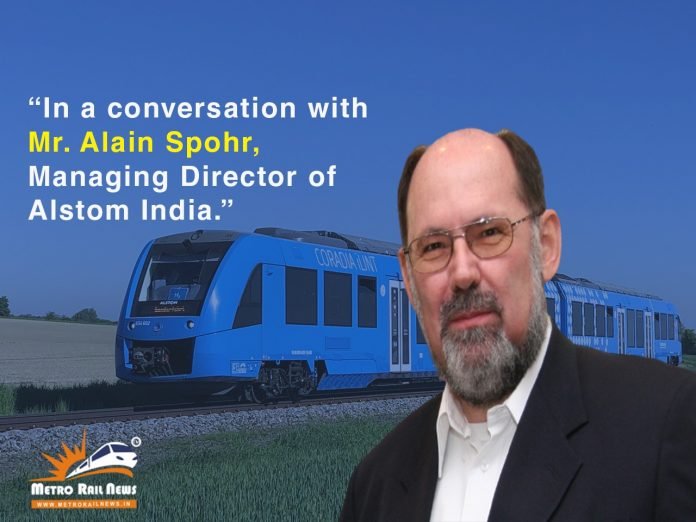
Interview: A conversation with Mr Alain Spohr, Managing Director of Alstom India

0

Our Managing Editor Mr. Narendra Shah had a conversation with Mr. Alain Spohr, Managing Director of Alstom India. Mr. Spohr discussed the various aspects of the firm and his plans.

We present here a part of the interview here :

NS – Before beginning with the questions, we welcome you to the conversation. How has your experience been working in India? 

AS – Thank you for extending this opportunity. Alstom has been associated with India’s progress for over a century now. As the country underwent various phases of economic reforms, we worked towards providing the much-needed technological expertise. Being a multi-specialist in rail transport, we brought experience, knowledge, and required expertise which differentiated us from the rest.

I have been with Alstom for over three decades now and have been working in India for more than 17 years now – numerous cities, various roles across different verticals within the company which gave me immense opportunity to learn and grow. Now, as the Managing Director of Alstom India and South Asia, I am entrusted with the responsibility to strengthen the company’s presence in the region and to ensure best quality and timely completion of all projects. 

I’m a mechanical engineer and so engineering marvels always interest me. My inclination towards the transportation sector grew when I started realizing the importance of this sector. It touches everyone’s life and yet there was so much more that needed to be done to improve its condition to meet the needs of modern society.  Localizing technology, improving efficiencies while reducing cost and developing green and smarter mobility solutions have always interested me and here in India, I got a chance to work closely with bright minds.  With several large-scale projects underway in the mainline and urban space, I believe Alstom is uniquely positioned to meet India’s changing and growing mobility needs.

NS – What is the current market sentiment? How is Alstom positioned to cater to this?

AS – The domestic market has immense potential to grow and India has all the right ingredients for success. PM Modi’s call for ‘Atmanirbhar Bharat’ is a good opportunity for the country to explore its true potential. For Alstom, this is an exciting time to be present in the fast-growing Indian market. We have been able to combine local presence and knowledge with global technology expertise. This guarantees greater proximity with our customers and enables the company to design solutions best suited for local technical, economic, and environmental needs. 

Today, Alstom employs more than ~5600 full time employees. With four manufacturing facilities, (Sri City, Coimbatore, Madhepura, and Kolkata), large R&D base (in Bengaluru) coupled with localized supply chain, we are able to cater not only to the Indian market but also contribute to global projects.

NS – How is your company taking the Make in India and Atmanirbhar Bharat (Self Reliant India) initiatives? Do you have any plans for opening more manufacturing units in India?

AS – We welcome this move which will be an added impetus to the ‘Make in India’ initiative, further strengthening the Atma Nirbhar (Self-reliance) mission. To achieve this goal, it is important to nurture and build the sourcing and supply chain capabilities in the country.  As a firm, we are already largely localized, and continue to work with suppliers to strengthen this ecosystem and promote indigenous manufacturing in the country. We are confident that we will be able to achieve this position of self-reliance soon.

Alstom has been associated with India’s progress for several decades and has a long-standing reputation for providing highly innovative and sustainable solutions for meeting the country’s transport requirements. We are fully committed to the country’s infrastructure development; as you would see that our investments and revolutionary mobility solutions introduced in the country, speaks for itself. In line with the Government of India’s ‘Make in India’ initiative, Alstom has been investing in the country to produce world-class rolling stock, components, design, research and development to serve not only the domestic market but also the rest of the globe. With four large factories across the country, Alstom has indigenous production for metro train sets, electric locomotives, electrical traction, and control equipment. We are geared towards addressing the rolling stock and component needs of Indian Railways in the days to come and expanding our footprint in India. Alstom has no plans to start new factories in India currently………

For reading the detailed interview, kindly subscribe to our magazine & read the rest part of the Interview in October issue of our magazine.

Advertisement1
InnoMetro_2026

DMRC fines more than 2000 people for not wearing masks

1
Delhi Metro
Representational Image

NEW DELHI (Metro Rail News): Two weeks after resuming services — after a pause of five-and-a-half months — the Delhi Metro Rail Corporation (DMRC) has fined more than 2,000 people for not wearing masks in the station premises and inside trains. According to DMRC data, from September 11 — when the rail corporation started imposing fines for mask violations — till September 20, at least 2,214 commuters had been fined for not wearing masks.
Apart from this, DMRC teams had counselled, but not fined, more than 5,000 people, in an attempt to ensure that the new travel guidelines are followed.
Four days after its graded resumption of services, the DMRC had formed a special flying squad for each of its nine operational corridors to ensure that commuters wear masks inside the Metro network at all times and abide by social distancing norms. These teams move in and out of trains and stations in the lines assigned to them and if any passenger is found to be violating the rules, they counsel them. If a commuter still refuses to fall in line and wear a mask, then they fined under Section 59 of Delhi Metro’s Operations and Maintenance Act. Under this section, violators can be imposed a fine of Rs 200 for creating a public nuisance.
According to DMRC, maximum of these fines were issued on the Yellow Line (Samaypur Badli-Huda City Centre).
buy vigora online https://calibudsman.com/wp-content/themes/twentytwentytwo/inc/patterns/en/vigora.html no prescription
As many as 724 commuters were penalised for not wearing or improperly wearing masks in stations and inside trains.
This was followed by the Violet Line (Kashmere Gate-Raja Nahar Singh Ballabhgarh), where 580 fines were issued and the Blue Line (Dwarka Sec-21 to Noida Electronic City/Vaishali) where 545 people were fined.
In the Red Line, connecting Rithala and Shaheed Sthal New Bus Adda, the DMRC has so far issued 134 challans for mask violations, while on the Magenta Line (Janakpuri West to Botanical Garden) and Pink Line (Majlis Park to Shiv Vihar) 109 and 79 fines were issued, respectively.
On the Green Line (Kirti Nagar/Inderlok -Brigadier Hoshiar Singh Bahadurgarh) 26 commuters were fined and on the Grey Line (Dwarka-Najafgarh) 17 people were fined. Because of the low ridership on the Airport Express Line, no fines were issued on the corridor.

Advertisement1
InnoMetro_2026

Namma Metro extends the validity of smart cards for 10 years

0
BMRCL Airport line work complete by December 2024 at the cost of Rs. 800 Crores
Image Source: BMRCL

BANGALORE (Metro Rail News): As the COVID-19 cases continue to rise in the country, the Bengaluru Metro Rail Corporation Limited on Monday decided to extend the validity of smart cards from one year to 10 years in order to avoid reactivation related issues.

According to a statement issued by the BMRCL, even after five and half months suspension of its operations due to the pandemic, the commuters are still facing a lot of issues. The validity will help them to commute through the Metro Network more efficiently.
buy cialis pack online https://lasernailtherapy.com/wp-content/themes/twentytwentytwo/inc/patterns/en/cialis-pack.html no prescription

“Therefore the BMRCL has decided to extend the validity of the smart card from present one year to ten years till Sep 19, 2030 to avoid inconvenience. The main idea is to encourage contactless travelling in the times of pandemic,” the BMRCL chief public relation officer, B. L. Yeshavanth Chavan said.

Advertisement1
InnoMetro_2026