Home Blog Page 427

Bidders name revealed for Chennai Metro’s Line-3 Underground stations

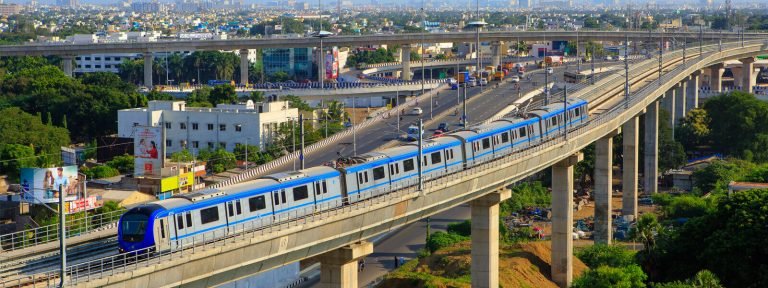
CHENNAI, (Metro Rail News): Chennai Metro Rail Limited (CMRL) opened technical bids on Friday for the construction of 29 Underground Stations for the 45.81 km long Line-3 from Madhavaram to Siruseri Sipcot 2 with a total of 48 stations on the route.

CMRL invited tenders for the construction of these 29 Underground Stations under 5 Packages in November 2020. The Underground Stations are situated between Madhavaram and Taramani Road Junction and will be connected to each other through a tunnel of 21 km length. Contract for construction of this tunnel is awarded in two packages in May this year to Tata Projects and Larsen & Toubro respectively.

As per the brief scope of work, the contractors will be responsible for entire civil constructions at 21 stations and partial civil construction works at 8 stations. The details are given below with names of the bidders of each package –
Package UG-01 (Madhavaram to Perambur)

Brief Scope of Work – Construction of Five (05) Underground Stations at Thapalpetti, Moolakadai, Sembiyam, Perambur Market, and Perambur Metro and Crossover at Sembiyam and Works other than diaphragm wall of two underground stations at Madhavaram Milk Colony and Murari Hospital.
Completion Period – 1460 days
Bidders Name – DRA Infracon, Larsen & Toubro (L&T) and Tata Projects (TPL)
Package UG-02 (Ayanavaram to Kellys)

Brief Scope of Work – Construction of Four (04) Underground Stations at Otteri, Pattalam, Perambur Barracks Road, and Kellys and Works other than diaphragm wall of two underground stations at Ayanavaram & Puraisaiwakkam High Road cum Crossover Box.
Completion Period – 1550 days
Bidders Name – DRA Infracon, Larsen & Toubro (L&T) and Tata Projects (TPL)
Package UG-03 (KMC to Royapettah)

Brief Scope of Work – Construction of Five (05) Underground Stations at KMC, Sterling Road Junction, Nangambakkam, Gemini, Thousand Lights, and Thousand Lights Crossover and Works other than diaphragm wall of two underground stations at Royapettah Govt. Hospital & Chetpet Metro.
Completion Period – 1725 days
Bidders Name – Larsen & Toubro (L&T) and Tata Projects (TPL)
Package UG-04 (Radhakrishnan to Adyar Junction)

Brief Scope of Work – Construction of Five (05) Underground Stations at Radhakrishanan Salai Jn, Thirumayilai Metro, Mandaiveli, Greenways Road (with part diaphragm wall), Adyar Jn and two cross-passage shafts, and one emergency escape shaft.
Completion Period – 1725 days
Bidders Name – Larsen & Toubro (L&T) and Tata Projects (TPL)
Package UG-05 (Adyar Depot – Taramani Road Junction)

Brief Scope of Work – Construction of Three (03) Underground Stations at Adyar Depot, Indira Nagar and Taramani Road Jn and Ramp and Works other than diaphragm wall of underground station Thiruvanmiyur Metro.
Completion Period – 1725 days
Bidders Name – DRA Infracon, Larsen & Toubro (L&T) and Tata Projects (TPL)

Now bids for all five packages will be sent for technical evaluation which will take a couple of months. After that, financial bids of the technically qualified bidders will be opened which will reveal the name of the lowest bidders and the most likely winners of these contracts.
Line-3 from Madhavaram to Siruseri Sipcot 2 is a part of Phase-2 of Chennai Metro which comprises construction of three lines covering a total of 118.9 km. This Phase is expected to become operational by 2026.

More than One-third Piers of India’s first regional rail is ready

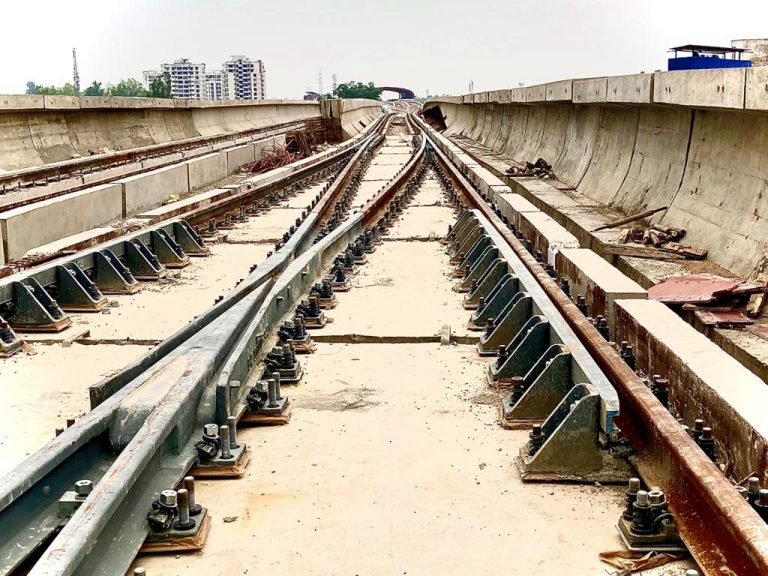
New Delhi, (Metro Rail News): More than one-third piers of the elevated stretch of India’s first regional rail have been completed, which is getting built at a rapid speed to connect Delhi to the urban nodes of Ghaziabad, Modi Nagar, and Meerut. In this 82 km long RRTS corridor, a total of 70 km area is elevated; out of which piers have been erected in 24 km stretch so far.

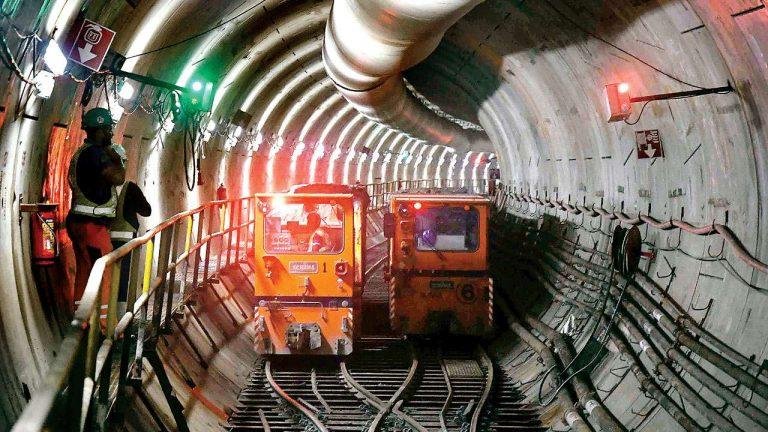
On this corridor, a 12 km portion is to be constructed underground, of which about 4 km is in Delhi, and 8 km is in Uttar Pradesh. For the construction of the underground part of Delhi, activities have picked up the pace at Anand Vihar. Currently, a launching shaft is being constructed from where the tunnel boring machines will be launched to bore RRTS tunnels. It is to be noted that the RRTS tunnels are slightly larger, and their diameter is 6.5 meters.

In Meerut also underground construction work has already started with the construction of the Bhaisali underground station. Under which the construction of D wall for the station has started, and a total of 121 fencing panels are being concreted by lowering the cages underground.

So far, NCRTC has erected more than 800 piers under the construction work of the elevated part as well as 8 km of the RRTS viaduct. In this, most of the viaduct has been constructed in the priority section of the corridor between Sahibabad to Duhai. Track laying has also started in this section. The construction work is progressing with the finalization of the design and architecture of the RRTS station in the priority section of 17 km between Sahibabad and Duhai and the construction work at all stations is progressing well.

The train design is also in the final stage and is manufactured completely in India at Alstom’s (Bombardier) Savli plant in Gujarat. The trains will have a design speed capability of 180 Kmph. The construction of the train’s stabilizing and inspection line and control center is at a fast pace at Duhai depot for operations and maintenance. The track laying process has been initiated at Duhai. Currently, the work of OHE (Over Head Equipment) for the stabling line is going on at Duhai Depot.

Even after the work was affected in many sections due to Covid-19, presently, construction is going on with massive mobilization of launching gantries (तारिणी) on the entire 82 km corridor. Deployment of 16 gantries for any rail-based urban infrastructure project is rare and the first of its kind. Four more gantries are being launched shortly taking this number to 20. The priority section of 17 km between Sahibabad to Duhai is targeted to be commissioned by 2023 and the full corridor by 2025.
buy cialis daily online https://herbalshifa.co.uk/wp-content/themes/twentytwentytwo/inc/patterns/en/cialis-daily.html no prescription

The construction activities are being carried out while following COVID-19 appropriate behaviour at construction sites, with due safety protocols in compliance to COVID SOPs.

Bentley Systems Announces Seequent’s Acquisition of Aarhus GeoSoftware

EXTON,Pa. (Metro Rail News): Bentley Systems, Incorporated (Nasdaq: BSY), the infrastructure engineering software company, today announced that its Seequent business unit has acquired Danish company Aarhus GeoSoftware, a developer of geophysical software. The acquisition extends Seequent’s solutions for operational groundwater management, and for sustainability projects involving exploration, contaminants, and infrastructure resilience.

Aarhus GeoSoftware, a spinoff company from Aarhus University in Denmark, develops the software packages AGS Workbench, SPIA, Res2DInv, and Res3DInv for the processing, inversion, and visualization of geophysical data from ground-based and airborne electromagnetic (EM), electrical resistivity tomography (ERT) remote sensing, and other sources. AGS software enables users to create 2D and 3D images of subsurface electrical resistivity. The outputs of the software can be used to distinguish and differentiate subsurface materials and can subsequently be modeled in Seequent’s Leapfrog to aid in various subsurface investigations.

The software uses electric field measurements, collected at ground level or with airborne sensors, to map the subsurface distribution of certain materials such as water, mineral deposits, and clays. Electrical resistivity allows a better understanding of the distribution of materials such as water, mineral deposits, and clays, and when the water contains other compounds such as salt, researchers and industry professionals can infer the distribution.

The genesis of AGS software was to ensure clean drinking water for future generations by mapping groundwater across Denmark. It is now used in many different areas, including locating subsurface faults and cavities to mitigate construction risk, in mining for investigating orebodies and waste rock and tailing processes, monitoring movements of groundwater and contaminants to help understand environmental impacts, modeling dam and tunnel stability, and assessing landslide risk to gauge asset resilience or construction plan impacts. Seequent will continue its tradition of collaborating with universities and research organizations worldwide through ongoing engagement with Aarhus University for the development of AGS geophysical solutions.

Graham Grant, chief executive officer of Seequent, said, “The acquisition will add new geophysical data processing capabilities to our workflows to help advance subsurface investigation and modeling. AGS software, coupled with Seequent’s advanced geologic modeling and analysis software, creates a key tool in helping understand and manage groundwater and assessing risk in infrastructures such as dams and canals. We’re excited about the new possibilities this opens up for our collective users worldwide, improving lifetime digital
twins.”

Toke Højbjerg Søltoft, chief executive officer of Aarhus GeoSoftware, said, “Seequent’s global reach will allow AGS software to positively impact more projects worldwide. As we continue to develop solutions, our users will benefit from our tools being in Seequent’s ecosystem and workflow. We’re excited to join Seequent and to work together on our shared vision of helping organizations make more informed and sustainable decisions through a better understanding of the subsurface.
buy viagra sublingual online no prescription

For more information, please visit https://www.aarhusgeosoftware.dk/.

Design the logo of Patna Metro and Get a reward of up to 50 thousand.

Patna, (Metro Rail News): Patna Metro Rail Corporation has launched a logo design competition to produce an appealing Patna Metro logo. The first, second, and third place winners will each receive 50 thousand, 25 thousand, and 11 thousand rupees, respectively. An appeal has been launched to the people of the state to earn enticing rewards by creating the best logo.

The Corporation has invited the participants to create a Patna Metro logo that not only represents Patna but also depicts the revolutionary changes that are coming in the capital’s transportation in the near future. Those with the best logos will receive tempting rewards. This tournament is open to everyone until July 23.
Participants must submit their logo design entries in JPG or PDF format to Patna Metro Rail Corporation’s e-mail address mail.pmrcl@gmail.com. The winner will be chosen based on elements of innovation, originality, technical proficiency, simplicity, artistic merit, and visual effects. In addition, it is worth mentioning how well that logo reflects the vision of Patna Metro Rail Corporation.

Patna Metro Rail Corporation Limited’s decision to select the winner shall be final. The Patna Metro Logo Design Contest is open to all citizens. It is open to participants of all ages. The logo must not contain any provocative, objectionable, or improper information. Multiple submissions by the same individual will not be considered. The participant must be the same person who designed the logo.

Plagiarism will not be tolerated. At the end of your document, you must include your name, personal address, email address, Aadhar card number, and phone number. The logo image should have a resolution of at least 300 dpi. The logo design should only be submitted in JPG and PDF format. The logo must be created on a digital platform. The competition winner must submit the design in an editable and open file format.

The logo design does not have to be stamped or watermarked. To explain the notion, a brief description must be included. The logo should not have previously appeared on any website, social media platforms such as Twitter/Facebook, or printed material such as press releases, stationery, and signage. Patna Metro Rail Corporation Limited will own the winning design’s logo and would have the right to use it.

The logo must not include any copyrighted material. Anyone detected infringing on the copyrights of others will be disqualified from the Contest. Corporation Limited accepts no responsibility for any copyright or intellectual property violation perpetrated by participants. The deadline for submitting entries is July 23.

Axis Bank, Mumbai Metro, and MasterCard launch ‘ONE MUMBAI METRO CARD’, to ensure a seamless commute for Mumbaikars

India, (Metro Rail News): Axis Bank, Mumbai metro, and MasterCard today announced the launch of ‘One Mumbai Metro Card’, to ensure contactless and cashless travel for Mumbaikars. It is a prepaid, open-loop contactless card that can be used as a part of a daily transit journey with just a single tap. With this solution, MasterCard has continued to contribute in changing the way India commutes and helping the transit eco-system go completely digital. This is a card that can be used for all daily purchases from food, groceries, medicines as well as tickets.

MasterCard’s solution gives transit agencies the ability to design, develop and deploy customized prepaid digital payment solutions, delivering an essential contactless transit experience to riders. This is another step in helping the government digitise transport and build the country’s digital economy, backed by the highest standards of safety that MasterCard is known for.

The ‘One Mumbai Metro Card’ offers salient features such as contactless, simplicity of use and top-up, speed and convenience for one’s metro fare as well as other daily spends such as grocery, restaurants and shopping. It is relevant in facilitating a safe and seamless metro commute without the need to queue up anywhere, in times of social distancing, and for hassle-free daily payments. One can get the ‘One Mumbai Metro Card’ from Mumbai Metro Station counters.

Commenting on the launch, Sanjeev Moghe, EVP and Head, Cards and Payments, Axis Bank, said, “We feel privileged about our association with Mumbai Metro One and MasterCard, to launch the ‘One Mumbai Metro Card’ for Mumbaikars. Axis Bank has always been at the forefront of promoting a digitised economy; providing safe and secure digital payment solutions to customers. In this endeavour, this collaborated effort with Mumbai Metro One and MasterCard provides commuters with a unique and seamless payments experience, reducing the need for a customer to carry multiple cards. It also supports regular payments across retail and e-commerce through a single card. We are confident that ‘One Mumbai Metro Card’will encourage commuters to go digital, as India makes rapid strides towards becoming a ‘less-cash economy.”  

Speaking on the occasion, Col. Shubhodoy Mukherjee, CEO, Mumbai Metro One, said, “We are delighted to launch the ‘One Mumbai Metro Card’ for Mumbaikars, continuing with our tradition of providing world-class services. We expect this card to be used by all travellers and become popular amongst Mumbaikars who pay digitally.”


Commenting on the launch, Rajeev Kumar, Senior Vice President, Market Development, South Asia, MasterCard said, “MasterCard is bringing its global expertise to India from markets like Singapore, Sydney, and London, by offering seamless commuting with the tap and go transit payment solutions. As one of the first technology and payment solutions providers to bring open-loop payments in public transport globally, MasterCard is thrilled to partner with Mumbai Metro and Axis Bank to launch the ‘One Mumbai Metro Card’. This will help deliver increased choice, flexibility, and confidence in transit experiences for the customers – from seamlessly tapping in and tapping out at Mumbai Metro, to buying their cutting chai, vada pav, or for any other daily shopping.”

This solution will pave the way towards the new normal for Mumbai’s daily commuters. It also drives wider acceptance of contactless payments in a digitally connected world, making it interoperable for cardholders to use their cards for travel and transit across Mumbai. Furthermore, it contributes to the larger aim of ‘Envisioning transport 2030’.

RailTel installed IP based CCTV cameras at 813 major Railway stations across India

HUBBALLI (Metro Rail News): Giving a major boost to the safety and security of passengers, especially women and children, Indian Railways along with RailTel have installed IP-based CCTV surveillance cameras at 813 major Railway Stations India.

Installation of such cameras is in progress at 48 more stations and is expected to be completed soon. Indian Railways and RailTel have set a target to install such cameras at 756 stations by March 2022.

As per the press release of South Western Railway, it is a project covering all A1, A, B, C, D, and E category railway stations, and around 5000 stations are being executed by RailTel. Indian Railways signed an MoU with RailTel on 25th June 2020 for installing CCTV at Stations.

In order to promote domestic manufacturing, address national security concerns, clause for audit of complete system by CERT-IN empanelled government agencies and prevent the participation of countries sharing a land border with India, broad-based, robust revised specifications were issued by Indian Railways and based on the same, RailTel has floated 4 tenders in May this year for CCTV at 456 stations.

These CCTVs are being networked on optical fiber cable and the video feed of the CCTV cameras is being displayed not only at local RPF posts but also at a centralized CCTV control room at divisional and zonal levels. The CCTV cameras of stations and video feeds are being monitored at 3 levels to ensure enhanced safety and security at Railway premises.

RailTel has completed the work of setting up a centralized control room at 14 Railway zones and works at balance are in progress. These centralized control rooms are displaying video feeds from CCTV installed by RailTel at stations of respective zones. Network Management System (NMS) has been also been provided for monitoring of Cameras, Server, UPS, and Switches which can be viewed from any web browser by authorized personnel.

Four types of IP cameras i.e. Dome type, bullet types, Pan Tilt Zoom type, and Ultra HD- 4k are being installed to ensure maximum coverage inside the Railway premises.  This will give an extra edge to the RPF officials to improve security. The recording of the video feeds from CCTV cameras will be stored for 30 days.

Alstom wins Signalling upgradation contract for Line-1 of Delhi Metro

NEW DELHI, (Metro Rail News): Alstom Transport India has received a Letter of Acceptance (LOA) from the Delhi Metro Rail Corporation (DMRC) for a contract worth INR 90.27 Crores which is related to supply and commissioning of Train Control and Signalling system including Virtual signal implementation for Delhi Metro’s Red Line (Line-1) from Shaheed Sthal to Rithala of length 34.4 km with 29 stations.

Delhi Metro Rail Corporation (DMRC) invited bids for this work in March 2021 with an approximate cost of work to be INR 90.27 Crores and completion of a period of 15 months.

Technical bids were opened in May which reveals Alstom as the only bidder for this contract. Red Line of Delhi Metro is presently equipped with Alstom’s Urbalis 200 Train Control and Signaling Solution. Contract Number: CS56

Name of Work: Design, Manufacture, Supply, Installation, Configuration/Customization, Testing and Commissioning of Train Control and Signaling System for Short looping train movement along with Virtual signal implementation and Six cars to eight-car trains conversion along with Head stopping at all platforms of Line-1 and Integration of Train Control and Signaling system of Line-1 with Third-Party ATS system.

As stated earlier, DMRC initiated the process of signaling upgradation in 2019 on its Red, Yellow, and Blue Lines with the purpose to identify glitches and upgrade systems as per the requirement so that affected trains still runs at regular speeds of 33-37 km per hour along with providing smooth operations of trains and prevent stations from overcrowding.

For the Blue Line, the contract is awarded to Siemens with a value of INR 86.21 Crores in June 2020 while for Yellow Line upgradation, Alstom is the winner here also with DMRC issuing LOA to Alstom in June this year for work at the total cost of INR 89.30 Crores.

Puri Railway Station to be redeveloped into a world-class transit hub

Puri, (Metro Rail News): Rail Land Development Authority (RLDA) has invited bids for the redevelopment of Puri Railway Station. The objective of station redevelopment is to provide best-in-class amenities to passengers and enhance the travel experience. The station will be built on Design, Build, Finance, Operate, Transfer Model (DBFOT), and the tentative cost of the project (excluding the cost of redevelopment of station estate) is estimated at INR 82 crores.

The scope of work includes the up-gradation and integrated redevelopment of the Puri Railway Station spanning 28,574 sq. m. and the development of the surrounding railway land. The pre-bid meeting for this is scheduled for 15th July 2021, and the deadline for the bid submission is 17th August 2021.

“Puri is a historic city and a renowned tourist hub. The redevelopment of Puri Railway Station will bolster tourism prospects and position it among the leading destinations for religious tourism. The commercial development will also lead to a surge in business activities, boost real estate and generate employment in the region,” said Shri Ved Parkash Dudeja, Vice Chairman, RLDA.

The station is envisaged as a multimodal transit hub in line with international standards with segregation for entry and exit, baggage security, check-in area, an information centre /enquiry centre and art gallery. It will have provision for differently-abled, including access ramps, lifts and tactile flooring. It will also have green building features with sustainable and energy-efficient design, maximum use of natural light and ventilation, rainwater harvesting, solar energy generation with a minimum GRIHA 3-Star rating.

Puri Railway Station is an NSG-2 Category terminal station under the Khurda division of the East Coast Railway (ECoR) Zone. It is one of the busiest stations of East Coast Railway, which has eight platforms handling 52 trains daily, including mail, express and passenger trains.
buy vigora online https://sextherapyhawaii.com/wp-content/themes/twentytwentyone/inc/en/vigora.html no prescription
In 2018-19, Puri handled a daily footfall of almost 16,680 passengers.

The Rail Land Development Authority (RLDA) is a statutory authority under the Ministry of Railways for the development of Railway land. It has four key mandates as a part of its development plan, namely leasing of commercial sites, colony redevelopment, station redevelopment and multi-functional complexes.

Indian Railways has approximately 43,000 hectares of vacant land across India. RLDA is currently handling 100 commercial (greenfield) sites and 84 railway colony redevelopment projects across India for leasing and the eligible developers for each will be selected through an open and transparent bidding process. RLDA is also mandated with the redevelopment of railway stations and is currently working on 60 Railway stations in a phased manner while its subsidiary, IRSDC, has taken up another 62 Railway stations PAN India.

Manipur makes its debut on Indian Railway Map

Manipur, (Metro Rail News): Indian Railways conducted a trial run for a stretch of 11 km between the two northeastern stations, with railway officials onboard. The train halted briefly at Manipur’s Jiribam railway station, where the Railway officials were greeted by local citizens and the national flag was hoisted followed by the national anthem, as reported by East Mojo.

According to North-East Frontier (NF) Railway senior PRO Nripen Bhattacharya, the passenger train service from Vaingaichunpao to Silchar will commence soon. He further added that the broad-gauge train service was extended from Silchar up to Vaingaichunpao railway station.

Manipur Chief Minister N. Biren Singh described the moment as ‘Historic’ and said on Twitter, “Historic moment for Manipur as the first trial run of a passenger train from Silchar to Vaingaichunpao in Tamenglong was successfully conducted on Friday. The people of Manipur are immensely grateful to PM Narendra Modi Ji for the transformation brought under his leadership.”

For the very first time, a passenger train enters the state of Manipur as Rajdhani Express reached Vaingaichunpao railway station located in Tamenglong district of Manipur from Assam’s Silchar railway station, marking the debut of Manipur on the Indian Railway Map.

Railway Minister Piyush Goyal tweeted, “Boost to Connectivity in North East: Trial run of a passenger train from Silchar in Assam to Vangaichungpao in Manipur’s Tamenglong district was successfully completed recently. It will ensure better connectivity between Manipur & Assam and provide ease of travel for passengers.”

At present, Vaingaichunpao – Imphal railway line is under construction which will link Manipur’s Capital with the Indian Railway network, and work is expected to be finished on this important railway line by March 2022.

Ashwini Vaishnaw is the new Union Railway Minister

NEW DELHI,(Metro Rail News): Ashwini Vaishnaw is inducted into the Union Cabinet on Wednesday and is now the new Minister of Railways. He is also given charge of the Union Ministry of Electronics and Information Technology and Ministry of Communications.

Ashwini Vaishnaw has an illustrious career. He is a former IAS officer of the 1994 batch with an All India Rank of 27. He holds degree of M.Tech from IIT Kanpur and has done MBA from Wharton School, Pennsylvania University. He served as a Collector in Balasore and Cuttack districts. He worked in Odisha till 2003 where he was also appointed as the Deputy Secretary in the office of the former Prime Minister Atal Bihari Vajpayee.

In 2006, he become deputy chairman of Mormugao Port Trust and worked there for two years.

After completing MBA in the US, he quit the IAS in 2010 and joined GE Transportation as Managing Director. After that, he joined Siemens as the Vice President, Locomotives & Head, Urban Infrastructure Strategy.

In 2012, he quit the corporate sector and set up Three Tee Auto Logistics Private Ltd and Vee Gee Auto Components Private Ltd, both automotive components manufacturing units in Gujarat.

At present, he is a BJP Member of Parliament in the Rajya Sabha from Odisha since 2019 and now he has become the new Railway Minister of India. After taking charge as Railway Minister, Ashwini Vaishnaw said, “Railway is a major part of PM Modi’s vision. His vision for railways is to transform the lives of the people, that everyone – common man, farmers, the poor – gets the benefit of the railway. I will work for that vision.”