Home Blog Page 353

Patna Metro’s PMCH station to be built underground

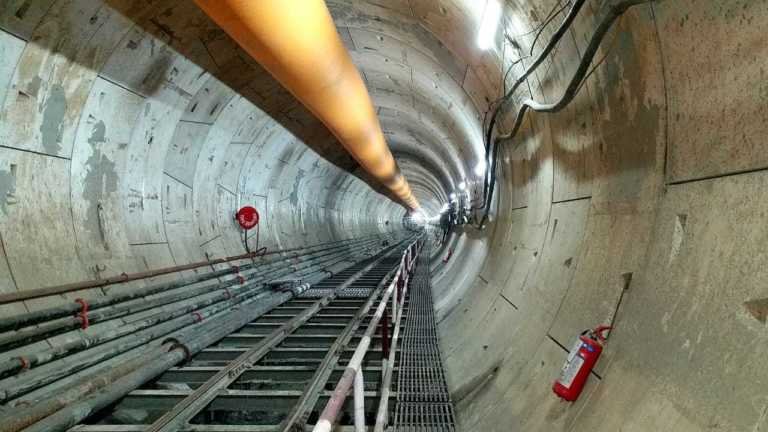
PATNA (Metro Rail News): The Patna Medical College and Hospital (PMCH) station of Patna Metro which was previously proposed to build on an elevated corridor will now be built underground. The officials on Sunday also said that two gates for exit or entry would be located inside the campus of the institution which is undergoing a major infrastructure renovation.

The Patna Metro rail project is 31 km long stretch that includes the Danapur-Mithapur-Khemni Chak corridor (Line-1) and Patna Railway Station-Pataliputra Bus Terminal corridor (Line-2) and will benefit millions of passengers.
buy viagra generic mexicanpharmacyonlinerx.net over the counter
The Delhi Metro Rail Corporation (DMRC) is assisting the Patna Metro Rail Corporation (PMRC) in the construction of the metro lines in Patna.

This was much required as the metro station will provide seamless connectivity to people who would come to PMCH for their medical requirements. The PMCH Metro Station will be a part of the 14.45 km-long Patna Railway Station-Pataliputra Bus Terminal Corridor (Line-2) of the PMRC, the officials said.

“Originally proposed as an elevated station, the (PMCH) station was designed to pass through extremely congested residential as well as commercial areas. It was later realised that an elevated stretch will involve a large number of partial or complete demolition of nearby structures. Moreover, construction of an elevated viaduct on the busy road would lead to choking of road traffic, since the width of Ashok Rajpath, between Catholic Church and PMCH, is extremely narrow,” the statement said.

The DMRC on Sunday said, “In order to ensure optimised accommodation of the systems requirements as well as for the efficient provision of passenger amenities, the layouts and sizes for the systems rooms had to be designed specific to the PMCH station, which is distinct from other stations.”

The positions of the entrances, and the related vertical movement elements and passages had to be designed specifically to the available land at the surface and the road alignment at this particular location. The officials informed that it is an engineering challenge as this has resulted in “unique design of the station entrances, concourse layout as well as the ancillary areas,” officials informed

The PMCH Metro Station which is now constructed as an underground metro station will be having “four entry/exit gates in total, two inside the Patna Medical College and Hospital campus and the other two, towards the opposite side of the road on Ashok Rajpath,” the statement said.

A small subway of 30 metres will also be constructed to provide connectivity to the entry/exit gate on either side. The station will have two lifts and three escalators for the convenience of commuters, the DMRC said, and also shared the concept plan in graphic images.

The foundation stone of the Patna Metro was laid by Prime Minister Narendra Modi on February 17, 2019
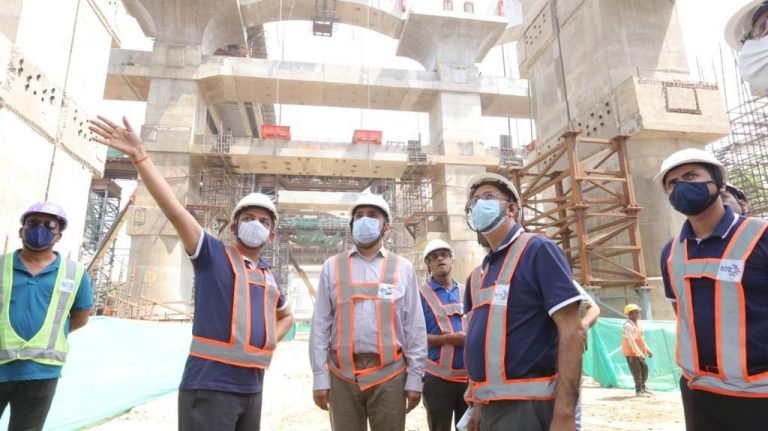
Officials inspects the Delhi-Ghaziabad-Meerut RRTS Corridor

DELHI (Metro Rail News): Secretary, Ministry of Housing & Urban Affairs and Chairman NCRTC Mr Manoj Joshi along with Mr Vinay Kumar Singh, Managing Director, NCRTC, on Sunday, 3rd April, inspected the ongoing construction work of the Delhi-Ghaziabad-Meerut RRTS corridor.

The visit started from Sarai Kale Khan RRTS station which is being developed by NCRTC as a mega transport hub. Mr Joshi was apprised about the Multi-Modal-Integration scheme for seamless commuter movement at this RRTS station where all the three RRTS corridors of Phase 1 will converge and will also be interoperable. RRTS stations will be seamlessly integrated with other modes of transport such as Metro stations, Bus Terminals, and Indian Railway Stations, wherever possible, through Walkways, Lifts, Escalators and Underpasses etc.

Moving further, he overviewed the construction of RRTS bridge over the Yamuna River and Anand Vihar RRTS station site. MD NCRTC apprised Secretary about how Anand Vihar RRTS station is being uniquely designed for efficient multimodal integration. Secretary was also informed that four Tunnel Boring Machines (TBMs) will be working in Delhi. Two from Anand Vihar towards New Ashok Nagar and two from Anand Vihar to Sahibabad. The first TBM named Sudarshan has already been launched for its journey in the last month.

During his visit to one of the Casting yards for the project, it was explained that how the Precast technique is being extensively used in the implementation of RRTS to obtain high-quality concrete and optimization of construction period. It was a strategic decision to adopt pre-casting technique as the corridor is being constructed majorly at the centre or side of busy highways.

The Secretary also reviewed the Ghaziabad Receiving Sub Station (RSS), built for supplying power on the priority section of the RRTS corridor. He inspected the installation of state-of-the-art systems and sophisticated electrical equipment. Further, Shri Joshi visited the Ghaziabad RRTS station site, which will hold the distinction of being the highest and largest among the 25 stations on this corridor as the RRTS alignment crosses over the Delhi Metro viaduct and a flyover at this location. Proposed traffic integration plan at this highly busy zone and various initiatives being taken by NCRTC in this regard were explained to him.

Moving forward Secretary inspected the Guldhar RRTS station and the ongoing track laying work near it. Secretary appreciated the pace of construction progress particularly of the priority section, including the various safety and anti-dust measures being taken. Secretary was informed that the 23rd Launching Gantry for construction of super structures of viaduct has been installed recently for the 82 km long corridor. Such massive deployment of resources is first of its kind in the country for implementation of any urban transport system.

Secretary interacted with the on-ground engineers, understood their challenges in implementation of the 82 km long Delhi-Ghaziabad Meerut corridor. Secretary was also briefed about various measures being taken by NCRTC to ensure minimum inconvenience to local public during construction including construction being carried out within barricaded zones, deployment of traffic marshals to manage traffic etc.

The visit concluded at the RRTS Duhai Depot, wherein Secretary reviewed the construction progress, Admin building, ongoing electrical work, track laying activities and the prototype of RRTS train. MD, NCRTC, showcased the modern and commuter-centric interiors of India’s first Regional Rail to the Secretary. He appreciated the corporation’s approach to customise the train, giving due attention to commuters’ requirements during regional commute including luggage rack facility, Mobile/laptop charging facility at every seat, provision of wheelchair space for differently abled and stretcher space for emergency medical transit, dynamic route map display among others.

Secretary was contented to note the pace of the project is a as per the timelines. He acknowledged that the NCRTC team is working efficiently in collaboration with all stakeholders and is all set to commission India’s first RRTS corridor on time and transform the public transport landscape of NCR.

CM Uddhav Thackeray inaugurates Mumbai Metro lines 2A and 7 today

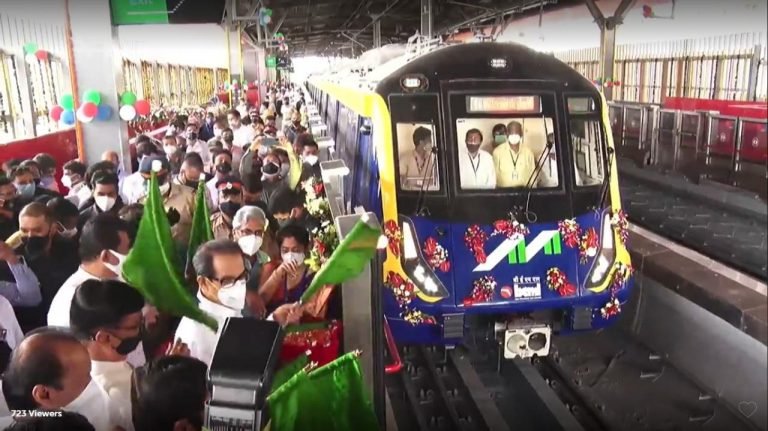
MUMBAI (Metro Rail News): CM Uddhav Thackeray has inaugurated services on Mumbai Metro lines 2A and 7 today on the occasion of Gudi Padwa. Both the lines are driverless train operations called BTC. Many citizens were present on the occasion of this event and witnessed the metro launch and then travelled by metro.

Both lines are fully elevated and Metro 2A, running from Dahisar west to D.N. Nagar (Andheri west), and Metro 7, from Dahisar east to Andheri east, will hugely benefit the people in the north-western suburbs.

The MMRDA has been granted the final nod of the Commissioner of Metro Rail Safety after following all the requirements for the project which has crossed several tentative deadlines since October 2021 for launching commercial operations. Metro 7 is 33.50 km long with 29 stations and Metro 2A will be 18 km long with 17 stations.

Running parallel to the Western Express Highway, the Western Railway suburban section, the S. V. Road and the Link Road, the aim of two new Metro Lines is to reduce road congestion and overcrowding in the local trains which will provide major relief to the commuters.

Chief Minister Uddhav Thackeray, Deputy Chief Minister Ajit Pawar and Revenue Minister Balasaheb Thorat had flagged off the trial runs of these two lines last May.

L&T Hyderabad metro rail gets CMRS nod for full speed potential of 80 KMPH

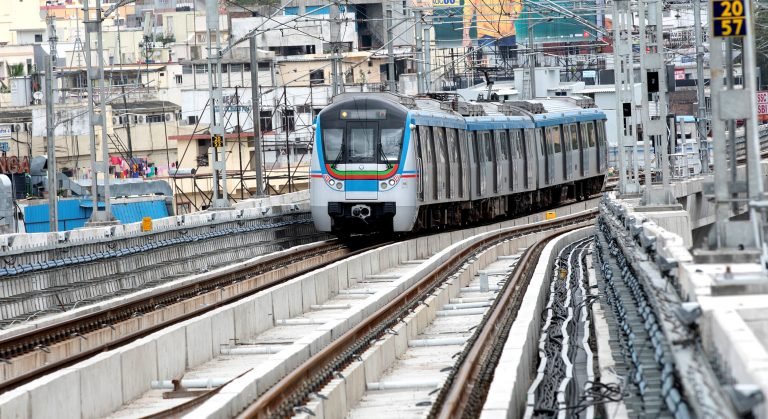
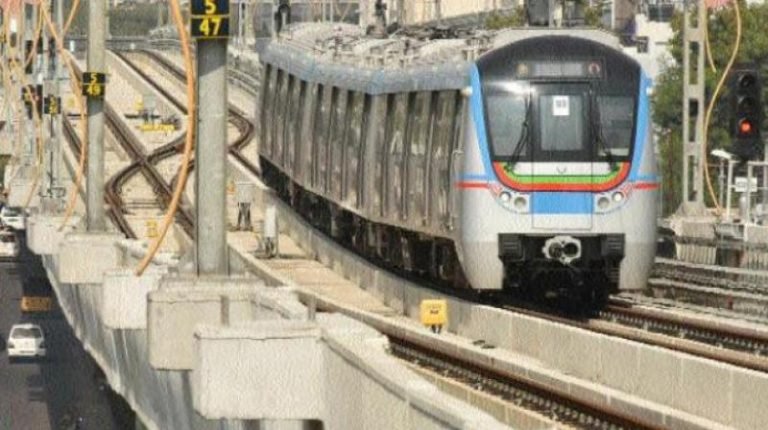
HYDERABAD (Metro Rail News): L&T Metro Rail (Hyderabad) Limited (L&TMRHL) has recently undertaken modifications to its signalling software with the objective to harness the full speed potential of its metro system. These software upgrades and system compliance were inspected by CMRS – Shri Janak Kumar Garg from 28th to 30th March. As part of safety checks, speed trials were conducted and on finding the systems to be compliant to safety regulations, the CMRS (Commissioner for Metro Rail Safety) has issued the authorisation to deploy this upgraded systems software.

With this authorisation, L&TMRHL will now be able to operate its trains to the full speed potential elevating from the current speed of 70 KPMH to 80 KMPH resulting in saving of significant time between corridor terminals. With this, it is expected that journey time would reduce by about 6 mins on Corridor 3 (Nagole to Raidurg); about 4 mins on Corridor 1 (Miyapur to LB Nagar), and about 1.15 min on Corridor 2 (MGBS to JBS). It is also expected that with this systems upgrade, there will be an improvement in the rail wheel interaction on sharp curves thereby reduction in screeching and vibrations.

Mr KVB Reddy, MD & CEO, L&TMRHL, said, “With the receipt of this authorisation from CMRS, we would now be ramping up the metro systems to full speed potential thus saving time between the terminal stations, leading to a better passenger experience.”

Mr. Sudhir Chiplunkar, Chief Operating Officer, L&TMRHL, said, “The signalling software upgrade would enable us to fully utilise the system’s potential leading to better operational efficiency and effectiveness.”

MahaMetro sets up Neo metro station and coach prototypes for Nashik project

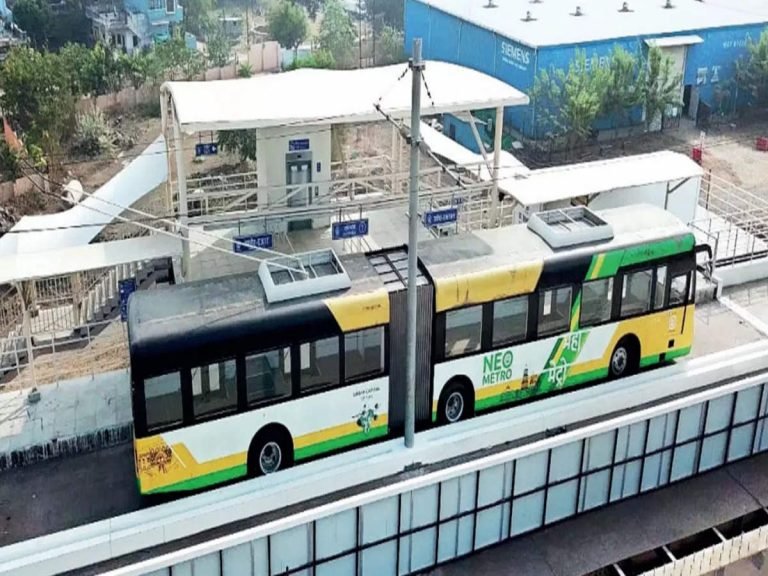
NASHIK (Metro Rail News): MahaMetro has set up prototypes for new metros that will come up in tier II and III cities. The Maharashtra Metro Rail Corporation Limited (MahaMetro) to build this prototype of the Metro Neo station and facilities on about 6,000 sqft at its Hingna depot (the headquarters of Maha Metro) in Nagpur has used two discarded buses which were converted into Metro Neo coaches, station with different entry and exit, information and signboards, and overhead wires to run the rubber-tyred coaches.

Maha Metro managing director Brijesh Dixit said that the project will be launched in Nashik city. “The prototypes of Metro Neo coaches and station are a part of the company’s preparation to implement the project seamlessly in Nashik and in other tier II and tier Ill cities where Maha Metro would be entrusted with such projects,” added Dixit, TOI reported.

Neo Metro

Maha Metro is the central agency to implement the Metro Neo project in Nashik city in two years with a cost of Rs 2,100 crore. This project will include two separate elevated corridors of 32km and 30 stations and similar projects are likely to come up in cities like Warangal, Dehradun, and Madurai.

Dixit said that, since the concept is new, it would help the Maha Metro team understand all technical aspects related to the Metro Neo project, and if there is any need for modifications before it is implemented.

“Moreover, various stakeholders who would be involved in the implementation of the project can have a view of the kind of infrastructure that needs to be constructed for this project. These stakeholders can also suggest modifications which can further bring down the project cost without compromising on the quality,” he added.
buy prelone online gaetzpharmacy.com/prelone.html no prescription

Maha Metro has turned two discarded buses into inter connected coaches which resemble the rubber-tyred trolley coaches that would run on an elevated corridor. All the parts used in this project are made in India and therefore is a part of the Make in India policy of the government.

Kochi Metro gets ready to launch 200 e-autos in phases

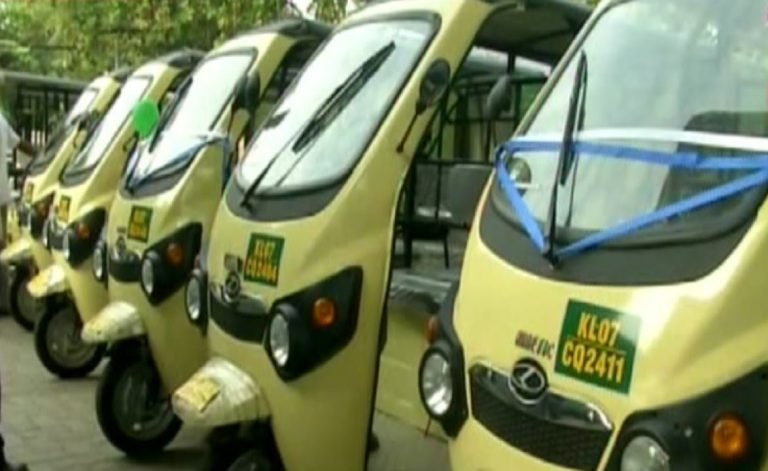
KOCHI (Metro Rail News): Kochi will be getting its first fleet of e-autos soon as Ernakulam Jilla Autorickshaw Drivers Cooperative Society (EJADCS) are set to launch 80 e-autos while Kochi Metro Rail Limited (KMRL) readying to launch another 200 in coming months.

The first 80 e-autos will have swappable batteries and these will operate in the city and in West Kochi, whereas the 200 e-autos that KMRL will roll out will provide first-and last-mile connectivity from metro stations and make the journeys of passengers more comfortable.

A metro official has said that the process for procurement of 200 autos has begun. “KMRL will purchase them, while EJADCS will operate them. Many rounds of discussions were held with them (driver’s society), and the terms and conditions, including revenue sharing, are being finalised. We have recommended that a group of 100 women drivers be trained and deployed to operate half the fleet of 200 autos as part of efforts to bring about gender parity,” he added.

These new autos will have company-fitted batteries, and recharging stations will be built in the coming months. KMRL and EJADS had agreed on a pact in September 2021 according to which they decided to operate 100 e-autos from metro stations on the 25-km Aluva-Pettah metro stretch, from November 1 which is celebrated as Kerala Day but the work was not concluded due to the pandemic situation.
buy viagra super active generic over the counter

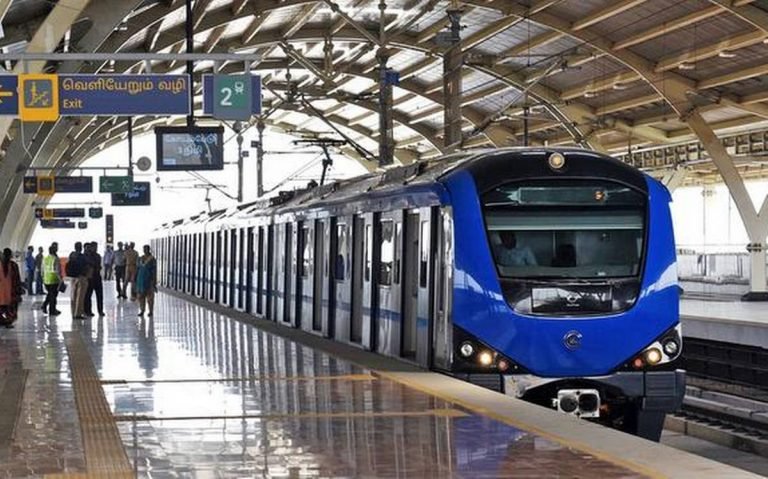
CM Stalin inaugurates CMRL’s Central Square

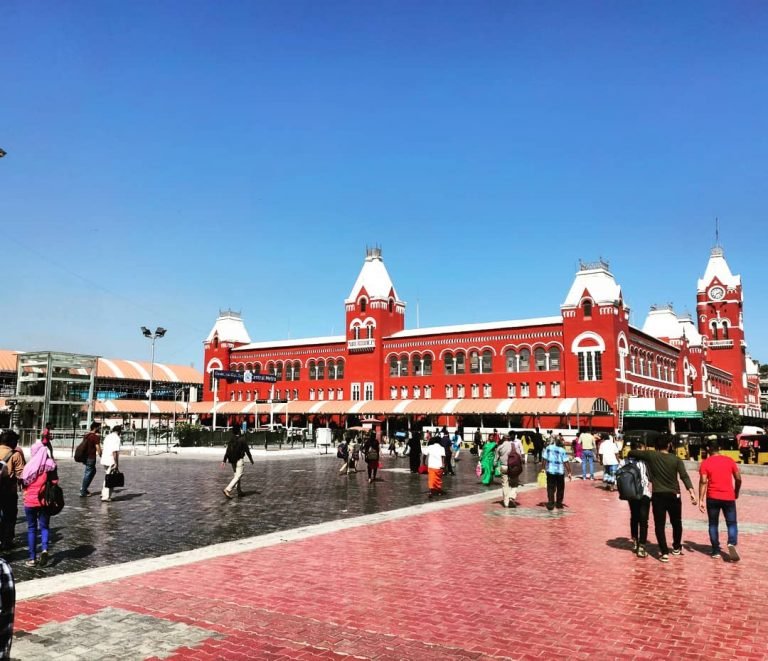
CHENNAI (Metro Rail News): Chief Minister M. K. Stalin on Wednesday, 30th March, inaugurated the Central Square which is built at a cost of ₹400 crore. The facility is close to Puratchi Thalaivar Dr. M.G. Ramachandran Central Railway Station and its aim is to connect important buildings located in this area.

According to officials of Chennai Metro Rail Limited (CMRL), one of the important aspects of this square is the new subways equipped with escalators. “Thousands of people enter and exit this area everyday and our aim is to make walking and travel for passengers seamless. Many who were earlier using the pedestrian crossing will now switch to the subways,” an official said. 

Many transport options such as suburban trains, MRTS services, Metro trains and buses are available for the commuters who land at the railway station. These transport hubs are now interconnected. Important buildings such as Rajiv Gandhi Government General Hospital, Victoria Hall and Ripon Buildings are now linked as well with these subways. 

Some of the features of this square include pathways for easy walking, a pedestrian plaza with seating arrangements for commuters to rest and relax in between their journey, landscaping with greenery and fountains, revamped bus bays and subways.

An underground multi-level car parking is also coming up as part of this facility which would be able to hold about 2,000 vehicles and this is located opposite the Central Metro station. CMRL is also planning to use a building here as a museum to show commuters how this mass rapid transit took shape and display pictures and miniature machines. 

Mumbai Metro Rail-3 underground project could take two more years to complete

MUMBAI (Metro Rail News): In a press conference on Thursday, MMRDA’s metropolitan commissioner SVR Srinivas said, “Mumbai metro line 3 will take at least another two to two-and-a-half years to complete as a lot of works remain other than the depot.”

“Another 1.5 km-long tunnel boring work on the 33.5 km line is pending, apart from construction of the stations and other works like signalling, telecommunications, overhead wires, and control center, among other things,” he added.
buy cialis pack online https://pridedentaloffice.com/wp-content/themes/twentytwentyone/inc/en/cialis-pack.html no prescription

Mumbai’s Colaba-SEEPZ Metro rail line-3 could take upto two more years to complete as several tasks including some part of the tunnel boring work as well construction of stations, are still pending, a senior official of the Mumbai Metropolitan Region Development Authority (MMRDA) has said.

Once completed, this first underground metro line of the city will provide connectivity to the city airport from south Mumbai and western suburbs, and reduce the burden on the locals living in nearby areas.

Srinivas informed that the MMRDA is conducting a study to extend the Chembur -Wadala -Jacob Circle monorail corridor by another 200-250 meters for connecting it with Mumbai metro line 3. ‘We will take decision about it within a month,’ he said.

JICA to provide ₹4,710 cr. to CMRL for phase II project.

CHENNAI (Metro Rail News): Japan International Cooperation Agency (JICA) has signed a loan agreement with the Government of India to provide Japanese Official Development Assistance (ODA) loan amounting to ₹4,710 crores for the construction of the Chennai Metro Rail Phase II project.

Rajat Kumar Mishra, Additional Secretary, Department of Economic Affairs, Union Ministry of Finance and Saito Mitsunori, Chief Representative, JICA India, signed the agreement.

The aim of this project is to interconnect existing metro networks to provide a seamless ride to commuters and also to solve increased traffic congestion and road accidents in the city. Moreover, regional economic development will be promoted by expanding the mass rapid transportation system in the Chennai region.

This project is predicted to develop an additional Metro Rail System network of approximately 51 km, which includes Corridor 3 from Madhavaram Milk Colony to Sholinganallur and Corridor 5 from Madhavaram Milk Colony to CMBT which would help in cutting down the increasing road traffic, leading to a shift in the public transportation system. This will reduce traffic-related pollution.

Mr. Mitsunori, Chief Representative, JICA India office, said, “Upon completion of the project, the Chennai Metro would ensure comfortable, reliable and greener transport for the citizens. JICA is proud of its partnership with CMRL. As traffic congestion in Chennai is increasing, Chennai Metro will play a pivotal role in addressing vehicular pollution and traffic accidents by further promoting the modal shift from road traffic to public transportation. We strongly hope that the new loan supports CMRL in strengthening its operational structure, providing a convenient mode of transportation to the citizens.”

HUMTA invites proposals for the pre-feasibility study

HYDERABAD (Metro Rail News): The Hyderabad Unified Metropolitan Transport Authority (HUMTA) has invited proposals from experienced firms to carry out a ‘pre-feasibility study’ for the proposed semi-high speed rail connectivity between Hyderabad to Warangal and Hyderabad to Vijayawada.

This project is a part of the Regional Rapid Transit System (RRTS) which is proposed by the State government. It is different from the ordinary railways and the Hyderabad Metro Rail Limited services. RRTS aims at exact regional travel at higher speeds. “The project will offer a safe and hassle-free commute,” a Hyderabad Metropolitan Development Authority (HMDA) official commented.

Plans are afoot to visit Delhi as a similar RRTS project that connects Delhi, Ghaziabad and Meerut have been proposed there, said a HMDA official. As National Capital Region (NCR) region covers Delhi and some districts of Haryana, Uttar Pradesh and Rajasthan a similar project was proposed.
buy cialis daily online https://calibudsman.com/wp-content/themes/twentytwentytwo/inc/patterns/en/cialis-daily.html no prescription

“Like Delhi is the epicentre in the projects connecting multiple States in the North, in this project proposed by the Telangana government, we want Hyderabad to be the epicentre,” said a HMDA official.
Officials from HMDA also said that as the number of commuters on this proposed route is high that is why the semi-high speed rail was proposed in these corridors. HUMTA was formed with the purpose to deal with issues related to traffic and transportation in HMDA jurisdiction.