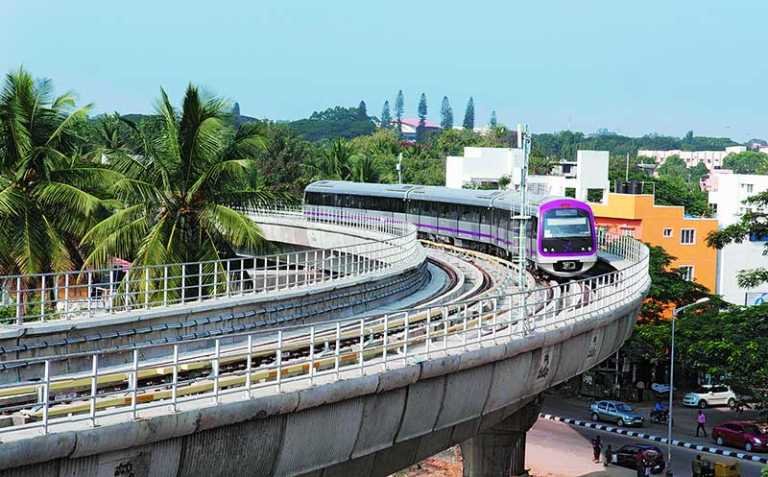
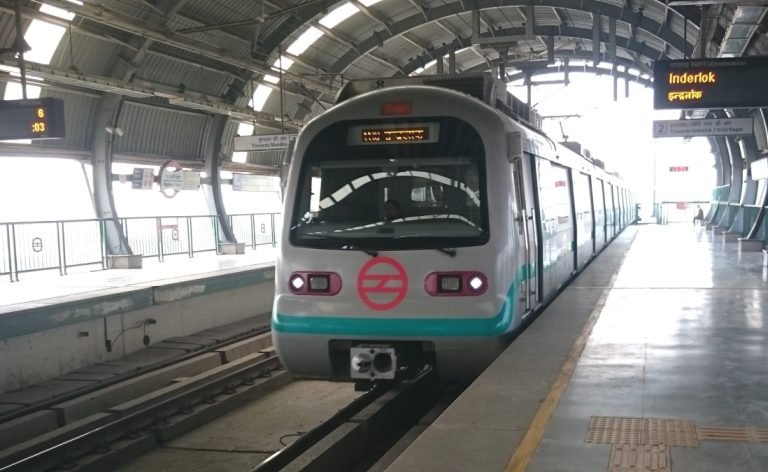
New Delhi: Prime Minister Narendra Modi has flagged-off the Delhi-Faridabad Metro Line that would allow hassle free travel for around two lakh daily commuters between the national capital and the industrial hub in Haryana.
The extension of the Delhi Metro connects Badarpur to Escorts Mujesar in Faridabad.
The total cost of the project from Badarpur to Escorts Mujesar is nearly Rs. 2,500 crore. Out of this, Rs. 1,557 crore was borne by the Haryana Government, the Centre contributed Rs. 537 crore, while the Delhi Metro provided Rs. 400 crore.
All these are elevated and located on either side of the Delhi-Mathura Road (NH-2).
“The nine-station metro corridor which was 95 per cent indigenously built will provide people a safe, affordable, quick, comfortable, reliable, environment-friendly and sustainable transport facility,” a Haryana government spokesperson said.
Haryana Chief Minister ML Khattar, addressing a press conference on Saturday, had thanked the Prime Minister for “gifting” the Metro service which would take the city to “another level of progress” with better connectivity with other NCR towns.
He had also said that the Prime Minister would be announcing the go-ahead for connecting Gurgaon with Faridabad by Metro.
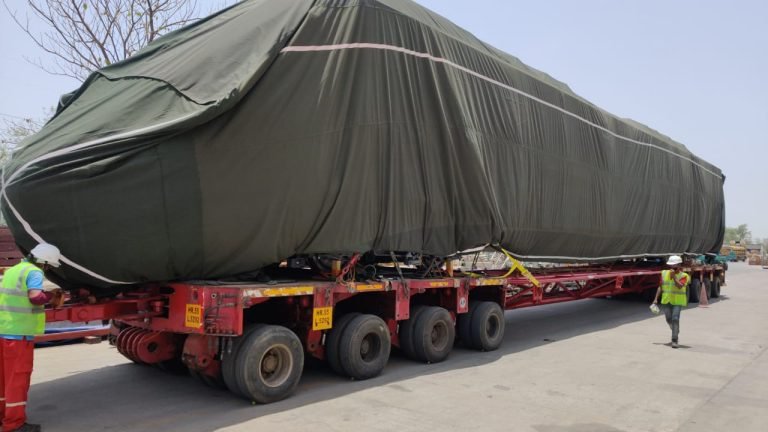
GHAZIABAD (Metro Rail News): The first Trainset of India’s first RRTS has been dispatched from Savli, Gujarat and it is going to arrive soon at Duhai Depot. The delivery of this trainset started from Savli, Gujarat. The trainset was loaded on a trailer at the manufacturing factory of Alstom in Gujarat and will be brought to the Duhai Depot, Ghaziabad via road.
The first trainset of RRTS was handed over to NCRTC on 7th May, 2022 at an event organised at the manufacturing unit in the presence Manoj Joshi, Secretary MoHUA and Chairman NCRTC along with Vinay Kumar Singh, MD, NCRTC, and other dignitaries of NCRTC and Alstom.
The Duhai Depot, Ghaziabad is gearing up for its arrival. The tracks have been laid out, shades prepared for the workshop and preparations are being made for the testing of the train at the Depot. For the operation of the RRTS trains, an administrative building has also been constructed in the Depot.
For the testing and the maintenance of the RRTS trains, 11 stabling lines, 2 workshop lines, 3 Internal-Bay Lines (IBL) and one Heavy Internal Cleaning (HEC) line are being constructed. The construction of one workshop and one IBL line is in the final stage, while the construction of the rest of the lines has been completed.
Alstom has been awarded the contract of manufacturing the RRTS trains under Make In India initiative, as per which they would be delivering 40 trainsets, including 10 three-car trainsets for Meerut Metro, bundled with rolling stock maintenance for 15 years. The contract also includes designing, supplying, installing, testing, and commissioning Signalling and Train Control, Supervision, Platform Screen Doors, and Telecommunication Systems for the entire Delhi-Ghaziabad-Meerut corridor.
The features of this RRTS train are listed below.
The trainsets, with their sleek and modern design, will be lightweight equipped with a regenerative braking system and compatible with Automatic Train Protection (ATP), Automatic Train Control (ATC), and Automatic Train Operations (ATO). The regenerative braking system is an important feature of these trains, which generates electricity when the brakes are applied and the power goes back to the electric grid through the overhead traction of the train system.
RRTS is the first-of-its-kind system in which trains, with a design speed of 180 kmph, will be available every 5 – 10 minutes and cover the distance between Delhi and Meerut in 55 minutes. NCRTC has taken the initiative of building a huge network of networks by seamlessly connecting the various public transit systems in NCR. With Multi-Modal-Integration, RRTS stations will have seamless integration with Metro stations, railway stations, and bus depots, wherever possible.
NCRTC is planning to commence trial runs on the Priority Section of the Delhi-Ghaziabad-Meerut RRTS corridor by the end of this year.
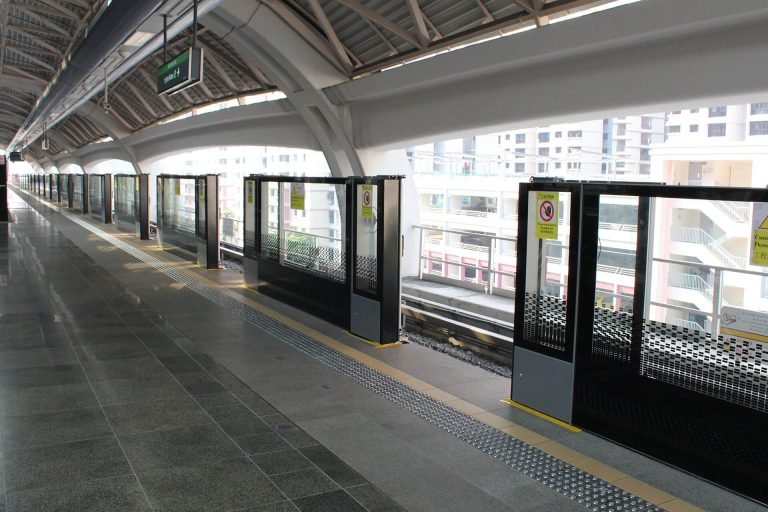
CHENNAI (Metro Rail News): For the safety of the passengers now platform screen doors will be installed on all the elevated stations in the 118.9 km phase-2 network. Recently Chennai Metro Rail Limited (CMRL) announced its decision on the bid to design, manufacture, install as well as commission doors for the 27 stations in the 26.1 km corridor-4 from Lighthouse to Poonamallee bypass recently.
18 stations in corridor-4 will have half-height platform screen doors on 36 platforms, and nine stations will have full-height platform screen doors on 18 platforms. Platform screen doors for three-car trains will be planned and installed. These doors are mainly used for passenger protection as they prevent falling from the platform as well as intentionally jumping from the platform.
The trains in phase-2 will be driverless which makes the platform screen doors more important as all operations will be automatic. Phase-2 features 48 underground and 80 elevated stations. Officials said platform screen doors also prevent accidents when service trains pass through stations at high speed, and they reduce the force of gravity on passengers, which can result in a fall over the tracks in few situations.
As the doors reduce vibration from the tunnels and trains, they also improve the sound quality of platform announcements. These are closely related to the signalling system since it automatically opens when it joins the doors of a train that stops at a platform. The Platform screen doors will include manual secondary doors for an emergency evacuation of passengers from the train away from the station, emergency escape doors that do not open automatically, and fixed screens, which will keep passengers from falling off the tracks.
BENGALURU (Metro Rail News): Of the 142 Metro stations of Namma Metro‘s Phase-I and II, Infosys Konappana Agrahara is going to be the first station on 18-km RV Road-Bommasandra Line which is going to get certification from the Indian Green Building Council (IGBC), India’s premier body for energy efficiency assessment. As per the information provided by a senior metro official, the registration forms have been submitted by the Infosys Foundation whereas the documents will be submitted soon.
for the construction of this station, the Infosys Foundation is spending around Rs 100 crore. The work began in September 2017, but the pandemic delayed it like other Metro projects. Col Vinod said, “The roofing will have a layer of Rock Wool under it, and another roofing below it. This is to ensure commuters feel cool inside the station. buy doxycycline online https://lasernailtherapy.com/wp-content/themes/twentytwentytwo/inc/patterns/en/doxycycline.html no prescription
This system known as Kalzip Roofing is found in airports,” he added, TNIE reported.
Manoj Hegde, Regional Manager, Infosys Foundation, said, “The facade is aesthetically pleasing and it is a completely closed station. Nearly 30,000 sqft has been earmarked for BMRCL for commercial ventures which is huge, while the Infosys Foundation will have 3,000 sqft for itself. A 350-metre walkway will be built by Infosys Ltd that will take employees directly to the campus from the Metro station.”
BMRCL MD Anjum Parwez said that one portion of this Reach 5 line from Central Silk Board to Bommasandra would be ready by June 2023 for opening whereas the rest of the line could be opened by the end of 2023.
PUNE (Metro Rail News): The Pune district administration in month has acquired 100 acres of land via direct purchasing. The land acquisition has been done for Baramati-Phaltan-Lonand and Pune-Miraj railway lines.
The Baramati-Phaltan-Lonand railway track is a stretch of 63.65 kms, out of which 37.20 kms stretch passes through Baramati taluka. buy vidalista generic newonlineandblo.com/vidalista.html over the counter
To implement the railway track project private land acquisition is proposed in 12 villages of Baramati taluka which are Latte, Malwadi, Kurnewadi, Khamgalwadi, Barhanpur, Netpatwalan, Sonakaswadi, Dhakale, Thoptewadi, Karhavagaj, Sawantwadi and Tandulwadi.
The committee which works under the Collecter has fixed the rates of land in these villages, whereas the land of Maharashtra Industrial Development Corporation (MIDC) in Katphal will be transferred for this project.
The process for acquiring 87% of the private land for the second line of Pune-Miraj railway line has been completed.
NEW DELHI (Metro Rail News): The Aerocity Metro station is going to convert into a major interchange station after its expansion which will connect it to the Regional Rapid Transit System (RRTS) station, Airport Express Line and Tughlakabad-Aerocity Silver Line corridor. The Aerocity station will become Delhi Metro’s third major triple interchange station, after Kashmere Gate and Azadpur.
The Delhi Metro Rail Corporation (DMRC) has decided to expand the Aerocity Metro station under its phase-4 project which will connect tthe existing station to the under-construction Tughlakabad-Aerocity Silver Line corridor. This station will also have connectivity at the concourse level, between the Airport Express Line and the new Silver Line. National Capital Region Transport Corporation (NCRTC) will also have interconnecting facilities for its RRTS station at Aerocity for the proposed corridor to Alwar in the future.
According to a DMRC official, the upcoming Aerocity Metro station will cross diagonally to the proposed RRTS station. Commuters will not have to exit the Metro station and use a subway or foot overbridge to reach the RRTS station, as they can just go from the Metro concourse to the RRTS platform. buy vidalista online https://herbalshifa.co.uk/wp-content/themes/twentytwentytwo/inc/patterns/en/vidalista.html no prescription
The new interchange facility is going to boost connectivity for various areas of South Delhi.
The Aerocity station will become Delhi Metro’s third major triple interchange station, after Kashmere Gate and Azadpur.
NEW DELHI (Metro Rail News): Terratec has announced the delivery of the first of five 6.61m diameter Earth Pressure Balance Tunnel Boring Machines (EPBMs) that will be used by Tata Projects Ltd. for its underground works contracts on Chennai Metro Rail Phase-II Corridors India, following successful factory testing of the S96 machine this month.
The new TBMs will be used by contractor Tata Projects Ltd. on Chennai Metro Rail tunnelling contract for Chennai Metro Rail Limited (CMRL) to build Phase 2 – Corridor 3, from Venugopal Nagar Station to Kellys Station. The work involves the construction of 18 kms of bored tunnels. TERRATEC will provide five of the seven TBMs required for the package.
TERRATEC Mixed Ground EPBMs have been chosen to tackle this project because of the variable geological conditions (boreholes indicate sand, silt, clay on the tunnel drives with some weathered rock). The expected “mixed ground” will be dealt with by the TBM’s mixed-face dome-style cutterheads designed to work effectively in the geology on these contracts at pressures of up to 4 bar. Other features include VFD electric cutterhead drives, tungsten carbide soft ground cutting tools that are interchangeable with 17’’ roller disc cutters, high torque screw conveyors, active articulation systems and state-of-the-art guidance and control systems. buy tadalafil online https://www.adentalcare.com/wp-content/themes/medicare/editor-buttons/images/en/tadalafil.html no prescription
As the TBMs progress, they will install 1,400mm wide by 275mm thick universal reinforced concrete lining rings consisting of five segments plus a key.
Chennai Metro is the fourth longest metro system in India. The network currently consists of two lines covering a length of 54.65 kilometres. The new Line 5 of Chennai metro will have 48 stations and connect from Madhavaram to Sholinganallur. The project is anticipated to be completed in about four years.
In recent years, Terratec has emerged as the leading TBM supplier in the Indian market, having supplied 40 TBMs in the last nine years (more than all other TBM manufacturers combined over the same period). Terratec’s continuing success on projects such as Phase III of the Delhi Metro, Lucknow Metro, the Ahmadabad Metro, Pune Metro and Mumbai Metro is a result of tailor-made robust TBM design, prompt onsite assistance, readily available stock of TBM spares and highly-skilled specialised TBM support throughout tunnelling operations.
TELANGANA (Metro Rail News): Stradler Rail has decided to set up a Rail Coach Manufacturing facility in Telangana and it will be a hoint venture between Medha Servo Drives Pvt Ltd and Swiss railway rolling stock manufacturer Stadler Rail. The project will cost around Rs 1,000 crore.
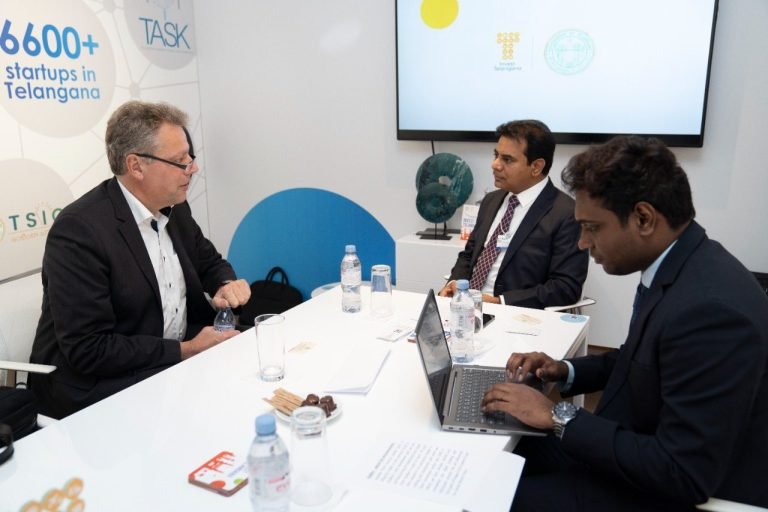
Stadler Rail Executive Vice President Ansgard Brockmeyer and the Principal Secretary for ITE&C, Government of Telangana, Jayesh Ranjan, signed a Memorandum of Understanding (MoU) in the presence of Minister KT Rama Rao in the Telangana Pavilion at the World Economic Forum in Davos.
According to the MoU the company is going to invest Rs 1,000 crore in the Rail Coach manufacturing facility which will create around 2,500 jobs for youngsters. people from across the state.
I welcome Stadler Rail to Telangana. It was great meeting EVP (Sales and Marketing) Mr. Ansgar Brockmeyer @WEF Davos. This investment further cements Telangana's position as a global investment destination#TelanganaAtDavos#InvestTelangana
Minister KT Rama Rao welcomed the Stadler Rail Company for coming forward to set up their railway coach production facility in the southern state of Telangana. KTR also said that the investment further cements Telangana’s position as a global investment destination.
Kolkata : An ancient City with historical Importance
The City of Kolkata made its debut in 1690 as an amalgamation of three humble villages – Sutanuti, Gobindapur and Kalikata. But, it has since grown into a sprawling Metropolis and the principal centre for trade and commerce in Eastern India over the last three centuries and it was also the Capital of the Country for a considerable period. In the course of its long existence, this premier ‘City’, often described as the cultural citadel of India, has witnessed many upheavals –Cultural, Social and Political. It has also been faced with innumerable problems, of which the transport problem, in particular, has been very acute. This has happened due to a continuous shift towards urbanization and the consequent increase in population – Resident as well as Migrant. Metro Railway, Kolkata feels honoured and pride of itself for becoming the ‘Life Line’ in the field of transport network of this great ‘City’.
A transport System evolved through times
Kolkata is the main business, commercial & financial hub of eastern India & the north eastern states. It is also a major commercial & military port, & the only city in eastern India to have an international airport. Once India’s prime city, the development of the city has lagged far behind the needs of its growing population. Kolkata is in dire need to provide to its citizens the best of amenities available in the country. The relative antiquity of Kolkata and unplanned growth has further exacerbated the problems of inadequate civic amenities in the city. Realizing the magnitude of this problem, the government arduously is trying to place modern infrastructure in the metropolitan city and a number of agencies are working towards that goal.
Only 6.2% of the area of Kolkata is comprised of roads compared to 20%+ for the other comparable metro cities in India. With a vehicle population estimated to be around 1.6 million and 23.50 million transit trips a day in 2011, the city is bursting at its seams. With very little scope to increase the road area in city and a projected vehicle population of 3 million and an estimated 32 million transit trips by 2025, the enormity of the problem could be easily imagined. It was realized early that only road transport would not be adequate to meet the growing transport needs of the population and a rail based system for mass rapid transport is the most viable option to address this need.
Therefore, the burgeoning transport problem drew the attention of the city planners, the State Government and also the Government of India. It was soon realised that something had to be done and done fast to cope up with the situation. It was Dr. B.C. Roy, the then Chief Minister of West Bengal, who for the first time conceived the idea of building an Underground Railway for Kolkata to solve the problems to some extent in 1949.
A survey was done by a team of French experts but nothing concrete came out. Efforts made to solve the problem by augmenting the existing fleet of public transport vehicles barely touched the fringe of the problem as the roads account for only 4.2% of the surface area in Calcutta as compared to 25% in Delhi and even 30% in other cities. With a view to finding out an alternative solution to alleviate the suffering of the Kolkatans, the Metropolitan Transport Project (Rlys) was set up in 1969. After detailed studies, the MTP (Rlys) came to the conclusion that there was no other alternative but to construct a Mass Rapid Transit System. The MTP (Rlys) prepared a Master Plan in 1971 envisaging construction of five rapid transit lines for the city of Kolkata, totalling to a route length of 97.5km. Of these, the highest priority was given to the busy North-South axis between Dum Dum and Tollygunge over a length of 16.45 km and the work on this project was sanctioned on June 1st 1972. The foundation stone of the project was laid by Smt. Indira Gandhi, the then Prime Minister of India, on December 29, 1972 and the construction work started in 1973-74.
Since the commencement of construction, the project had to contend with several problems such as non-availability of sufficient funds till 1977-78, shifting of underground utilities, court injunctions, irregular supply of vital materials and others. But overcoming innumerable hurdles and crossing all barriers of disbelief, Calcutta Metro, India’s first and Asia’s fifth, became a reality on October 24, 1984 with the commissioning of partial commercial service covering a distance of 3.40 km with five stations between Esplanade and Netaji Bhavan. This was quickly followed by commuter services on another 2.15 km stretch in the north between Dum Dum and Belgachia on Novermber 12, 1984. The commuter service was extended upto Maha Nayak Uttam Kumar on April 29, 1986 covering a further distance of 4.24 km making the service available over an overall distance of 9.79 km and covering 11 stations.
However, the services on the north section were suspended w.e.f. Oct, 92 as this isolated small section was not attractive to commuters. After a gap of over eight years, the 1.62 km Belgachia-Shyambazar section, along with Dum Dum -Belgachia stretch, was opened on August 13,1994. Another 0.71 km stretch from Esplanade to Chandni Chowk was commissioned shortly thereafter, on October 2, 1994. The Shyambazar-Shovabazar-Girish Park (1.93 km) and Chandni Chowk-Central (0.60 km) sections were opened on February 19, 1995. Services on the entire stretch of Metro were introduced from September 27, 1995 by bridging the vital gap of 1.80 km in the middle. A dream thus came true.
Phase II a length of 5.834 Kms from Maha Nayak Uttam Kumar to Kavi Nazrul station was completed in Aug’ 2009. Further it was extended upto Kavi Subhash a length of 2.851 kms in Oct, 2010 for commercial operation. It was further extended, Dum Dum to Noapara, a length 2.091 Kms, on 10th July 2013. The last leg was opened on 23rd February 2021 for commercial operation from Noapara to Dakshineswar (4.139 Kms).
First Metro System of the Country
The initiative had to wait for 2 decades when in 1969 the Metropolitan Transport Project was initiated. The master plan prepared by them in 1971 envisaged a network of 97.50 km consisting of three North-South corridors of which three were selected for detailed planning. These three lines were Dumdum – Tollygunge, Bidhannager – Ramrajatala and Dakshineswar – Thakurpukur. Based on traffic studies, the Dumdum – Tollygunge corridor was first selected for implementation and work started on 29th December, 1972. On 24th October 1984, the first stretch, a length of about 3.4 km between Esplanade and Bhowanipur was completed, the first metro line in India. Over the years, others stretches on the corridor were gradually completed and some extensions were also made. This corridor was extended to New Garia in 2010. Today it carries about 5 lakh passengers a day.
East-West Corridor
Kolkata Metro Line 2 or East-West Corridor is a rapid transit line of the Kolkata Metro in the Indian state of West Bengal. It currently consists of an operational section between Salt Lake and Phoolbagan, and will eventually connect Teghoria with Howrah by going underneath the Hooghly River. It would consist of 17 stations from Teghoria (Haldiram) in the east to Howrah Maidan in the west, of which 11 would be elevated and 6 would be underground, with a total distance of 22 km. It is expected to derive a very high ridership since it will connect India’s two largest commuter railway and long-distance railway terminals (Howrah and Sealdah) along with two of its largest business districts (BBD Bagh and Salt Lake Sector V). Line 2 has India’s first underwater metro tunnel along with the deepest metro shaft. The first phase between Salt Lake Sector V and Salt Lake Stadium was inaugurated by Union Railway Minister Piyush Goyal on 13 February 2020 and commercial services started from 14 February 2020.
The master plan had already identified the corridor way back in 1971. But the success of the Delhi Metro contributed to the sanction of the East–West Metro corridor, which will connect Howrah Railway Station with the Satellite City of Salt Lake. In January 2004, the Pacific Consultant International Group conducted a feasibility study for the line. The report proposed the route and tubular structures be under the Hooghly River.
A new organisation called the Kolkata Metro Rail Corporation Limited (KMRC) was formed, which executes the operations of this Line, commencing construction in 2009. Of KMRC’s eight directors, four each were from the state and central governments. The cost is being shared between the state government (30 per cent), the Union Urban Development Ministry (25 per cent), and the Japan Bank for International Cooperation (JBIC) (45 per cent). But as of 2011, after state government dis-invested from the project, most of the share of this project went to Indian Railways and with Japan Bank for International Cooperation (JBIC).
The project is estimated at a cost of 50 billion. The present cost however, has escalated to 80 billion. But due to major setbacks, such as land acquisition, slum relocation, and route alignment problems, the project got delayed. The East-West Corridor was originally slated to be operational by 2012, but was later pushed back to 2015. The project will now be implemented in four phases. The first phase, from Salt Lake Sector V to Salt Lake Stadium, became operational on 13 February 2020. The second phase, to Phoolbagan opened on 4 October 2020, operational from 5 October 2020. The third phase to Sealdah is now slated to be operational by 2022 and the final phase which includes the journey through the tubular tunnels under the Ganges will be operational by year 2023.
Country’s First Underwater Metro System
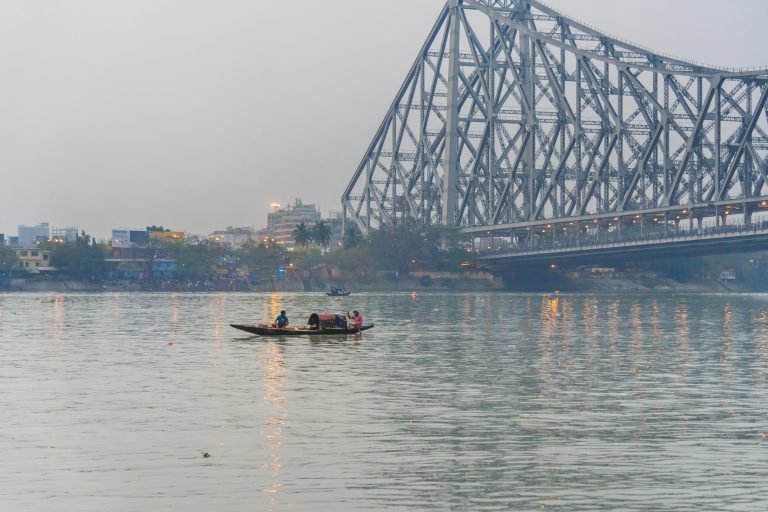
Kolkata will soon boast of having the first under river metro tunnel in the country. Both the tunnels are ready for tracks to be laid. The wait is now reduced to few months only. The Kolkata metro is ready to take a plunge. For the first time ever in India a metro train will run under a river. The city of joy is heading for a trip under the Hooghly.
Kolkata underwater metro is 33 mtrs under the normal level of earth. This also means that it is not only the deepest but also one of the biggest underwater metro system. One would have an experience of a lifetime of not just travelling via an underwater river tunnel in an A.C Rack of the metro but also ensure to land on one of the busiest platforms which can handle around forty thousand passengers in one hour on any given day.
The underwater stretch lies 30 m under the river and is part of the east-west metro project. The metro train would huddle down through 520m tunnel at a speed of 80 kms per hour. This is the first time in the transportation sector in the entire country that a magnificent civil structure of this magnitude is built under a river. Despite cutting through a river the tunnel is absolutely water proof. With the help of a tunnel boring machine this has been made possible in record time. All ventilation fans, the efforts for maintaining humidity and temperature level at top and bottom is being consistently tried.
Apart from this the Kolkata metro achieves many accolades from becoming India’s first underwater tunnel constructed below the sprawling howrah station heritage buildings with a first ever such project. Soon Kolkata would be the first Indian city to have the perfect harmony between a legendary ride on a tram and jet setting on futuristic trains.
Few other major details
With the inauguration of the North-South Metro route from Noapara to Dakshineswar in 2021, the upcoming metro corridors are also expected to improve connectivity, particularly in the highly congested areas of the city.
Most of the construction for Line 1 is based on the Cut and Cover construction method, a traditional tunnelling method. Further, the East-West Metro corridor project will have an underwater tunnel and the section will be equipped with all the necessary facilities and safety measures. There will be tunnels for the evacuation of passengers in case of any emergency. As per an official, 80% of the construction work is complete. The Kolkata Metro Rail Corporation Ltd (KMRCL), a government enterprise established in 2008, is undertaking the construction of the East-West corridor project of the Kolkata Metro. In July 2019, it handed over the operations of the Metro Line 2 to Metro Railway, Kolkata, which is the owner and operator of the Kolkata Metro, along with KMRCL. The Metro Railway, Kolkata, will also operate other metro lines after the completion of the construction work.
Metro Route
In March 2022, the Kolkata Metro Railway officially assigned colour codes to the different metro corridors and the new extended metro lines under various phases of implementation.
Kolkata Metro Line 1 (Blue Line)
Kolkata Metro Line 1 stations
Layout
Dakshineshwar
Elevated
Baranagar
Elevated
Noapara
Elevated
Dum Dum
Elevated
Belgachhia
Underground
Shyambazaar
Underfround
Shobhabazar Sutanuti
Underground
Girish Park
Underground
Mahatma Gandhi Road
Underground
Central
Underground
Chandni Chowk
Underground
Esplanade
Underground
Park Street
Underground
Maidan
Underground
Rabindra Sadan
Underground
Netaji Bhavan
Underground
Jatin Das Park
Underground
Kalighat
Underground
Rabindra Sarobar
Underground
Mahanayak Uttam Kumar
At-Grade
Netaji
Elevated
Masterda Surya Sen
Elevated
Gitanjali
Elevated
Kavi Nazrul
Elevated
Shahid Khudiram
Elevated
Kavi Subhash
At-Grade
The Line 1 of Kolkata Metro is the North-South Metro line. It is now referred to as the Blue Line. The route comprises 26 stations with 15 underground stations, two stations on the surface and 9 elevated stations. It covers about 32 kilometres of distance from Kavi Subhas to Dakshineswar.
The oldest metro line that was started in the city on October 24, 1984, was a small section of 3.4 kilometres, connecting Esplanade to Bhowanipore (now Netaji Bhavan). More sections were later opened, such as Tollygunge metro station to New Garia station along an elevated route. In 2013, the line was extended in the north with a new section connecting Dum Dum station to Noapara. In February 2021, a four-km section from Noapara to Dakshineswar became operational.
Kolkata Metro Line 2 (Green Line)
Kokata Metro Line 2 Stations
Layout
Teghoria/Haldiram
Elevated
Raghunathpur
Elevated
Baguiati
Elevated
Dum dum Park
Elevated
Kestopur
Elevated
Badhan Bank salt Lake Sector V
Elevated
Karunamoyee
Elevated
Central park
Elevated
LICI City Center
Elevated
Bengal Chemical
Elevated
IFA Salt Lake Stadium
Elevated
PhoolBagan
Underground
Sealdah
Underground
Esplanade
Underground
New Mahakaran
Underground
Howarah
Underground
Howrah Maidan
Underground
The Kolkata Metro Line 2 route includes a total of 17 stations with 11 elevated stations and six underground stations spanning a distance of 22 kms. On February 13, 2020, the first phase of the East West Metro corridor from Salt Lake Sector V to Salt Lake Stadium was inaugurated. The Phoolbagan Metro station was the first underground metro station in the East West Metro route to be opened.
Underwater tunnel
The 16.6-kilometre-long East-West Metro corridor includes 5.8 kms of the elevated route and 10.8 kms of an underground section. Of this 16.6-km stretch, 520 metres will be under the riverbed of the river Hooghly. The twin cities of Kolkata and Howrah will be connected by an underwater tunnel that will be developed 33 metres below the riverbed of the river Hooghly. The Green Line will finally connect Howrah with Teghoria.
Kolkata Metro Line 3 (Purple Line)
The Line 3 of the Kolkata Metro is under construction. The route will start from Joka Metro station in the south and connect Esplanade in the north, covering a distance of around 15 kms. The project will be developed by Rail Vikas Nigam Limited (RVNL) owned by the Indian Railways.
Kolkata Metro Line 4 (Yellow Line)
The Line 4 or the Yellow Line will connect Noapara and Barasat in North 24 Parganas. This Kolkata Metro route, which is under construction, will be around 16.8 kms.
Kolkata Metro Line 5 (Pink Line)
A 12.5-km metro stretch will be developed, connecting Baranagar to Barrackpore as part of the Kolkata Metro’s Pink Line route.
Kolkata Metro Line 6 (Orange Line)
This 29.8-km route of Kolkata Metro will link New Garia with Netaji Subhas Chandra Bose International Airport via the two satellite towns of Salt Lake and New Town. Once opened, metro Line 6 will provide easy access to the Kolkata Airport, especially for those living in the southern and the eastern parts of the city.
Timeline & Major Events
October 1984
The oldest metro line connecting Esplanade to Netaji Bhavan in Bhowanipore was started in Kolkata.
September 1995
The 16.45-km stretch from Dum Dum to Tollygunge Metro station became operational.
February 2009
The foundation stone for the underwater metro tunnel was laid.
March 2009
Construction work on the underwater metro tunnel was started.
October 2010
The final, 1.58-km stretch, from Kavi Nazrul to Kavi Subhash started functioning.
December 2010
Metro Railway was granted the status of a Zonal railway.
July 2013
A new section from Dum Dum to Noapara became operational.
July 2019
KMRC handed over the Line 2 Metro operations to Kolkata Metro Railway.
February 2020
Phase 1 of the East-West corridor from Salt Lake Sector V to Howrah Maidan became operational.
October 2020
The East-West Metro corridor was extended from Salt Lake Stadium metro station to Phoolbagan metro station.
February 2021
A section of around 4 kms from Noapara to Dakshineswar became operational.
Kolkata Metro latest updates
Kolkata Metro network plans to cover 100 kilometres by 2026. The Kolkata Metro network is likely to cover a length of about 100 kilometres in the next four years. This will include Phase 1 of Joka to Esplanade and New Garia to the Kolkata airport sections. Further, the Sealdah section will become operational in April 2022.
The first phase of the Kolkata East-West Metro corridor is connecting the Sector V of Salt Lake, the IT hub of the city, with the Salt Lake Stadium in the area, covering a 5.3km long stretch. The commercial services connecting six over ground stations – Sector V, Karunamoyee, Central Park, City Centre, Bengal Chemical and Salt Lake Stadium stations, have begun. For almost four decades, the sole corridor of Kolkata metro traversed through 24 stations, of which 15 are underground, covering a meagre distance of 27.3km from Noapara to Kavi Subhas.
The East-West corridor of the Kolkata Metro is India’s first-ever transportation project where metro trains will ply under river — Hooghly. The Metro project, scheduled to be completed by June 2021, had faced an unprecedented jolt last year, when a tunnel-boring machine hit an aquifer in Bowbazar area of the city, causing severe ground subsidence and damage to several buildings. The accident further delayed the completion of work by another year, with the authorities now eyeing a 2022 deadline.
Kolkata metro has five other ongoing railway projects, which have been allotted a budgetary grant of Rs 1,542 crore for fiscal 2020-21. The New Garia-NSCBI Airport link (Line-6), slated to be completed by June 2021, (new deadline July, 2022) has been allotted Rs 328 crore, while the Noapara-Barasat line has received a grant of Rs 200 crore. Another 16.6-km Joka-BBD Bag route, connecting the south-eastern suburbs of Behala with the heart of the city, has been granted Rs 99 crore, and the Barrackpore-Baranagar and Dakshineswar stretch, covering a distance of 14.5 km, allotted Rs 10 crore.
Conclusion
Kolkata formerly known as Calcutta is a city of many hues, recognized by many as the Cultural Capital of India, known to others as the City of Palaces and to yet others as the City of Joy; it is difficult to capture its diversity as well as uniqueness within the confines of a single phrase.
Located on the eastern bank of the river Hooghly, Calcutta was established by the British in an area where the villages Kalikata, Sutanuti and Govindapur existed. These villages were part of an estate which belonged to the Mughal emperor himself and whose jagirdari was held by the Sabarna Roy Choudhury family. The rights were transferred to the East India Company in 1698 and it became the capital of British Indian in 1772. The city grew under the British and saw the emergence of a new educated urbane Babu class in the 19th century. Calcutta becomes the pioneering center of socio-cultural revolution often referred to as the Bengal Renaissance. Calcutta also became the epicenter of the Indian independence movement, especially the revolutionary stream. In 1905 Bengal was partitioned on communal grounds which resulted in widespread public agitation and the boycott of British goods (Swadeshi movement).
The British moved the capital to New Delhi in 1911 in view of these developments and also the fact that Calcutta was located in the eastern fringes of India. Through Calcutta lost a part of its political significance due to this decision, it continued to remain a determinant in the political developments in the country in the run up to independence in 1947 and a torch-bearer of the early industrial progress. It continued to play a very influential role in the cultural & literacy landscape of the country. In the fields of education, film, theatre & science, Calcutta has continued to play a stellar role. In 2001, the name of the city was changed to Kolkata to go with the Bengali pronunciation of the name.
Today it is a thriving metropolis, home to 4.5 million residents in an area of 185 sq km under the jurisdiction of the Kolkata Municipal Corporation. The Kolkata Metropolitan Area spread over 1750 sq km comprising 157 postal areas in 2006 has a population of approximately 14.2 million making it the 13th most populous urban city in the world and the 18th largest urban agglomeration in the world. The urban agglomeration comprises 72 cities & 527 towns & villages. The suburban areas of Kolkata metropolitan district incorporate parts of the districts of North 24- Parganas, South 24- Parganas, Howrah, Hooghly & Nadia.
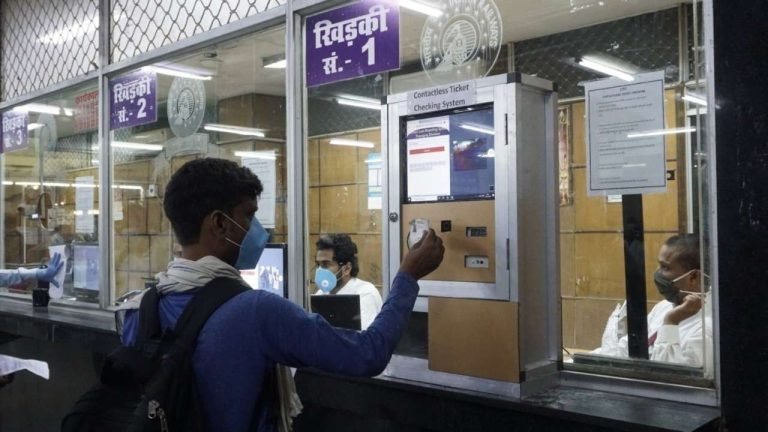
Indian Railways, keeping in view the ongoing COVID-19 pandemic, will adopt the facility of contactless ticketing similar to facilities at airports with QR code-enabled tickets. The QR code-enabled tickets will be scanned on handheld devices and mobile phones at railway stations and on trains. Last month, an automatic QR code-based ticket scanning system was introduced by Indian Railways at the Prayagraj junction railway station, in a first-of-its-kind initiative. The contactless ticketing system is believed to help passengers as well as railway staff to prevent the spread of novel coronavirus. The contactless QR code-based ticket scanning system will work:
CRIS has rolled out an application, for contactless ticket checking of reserved tickets, covering all the zones of Indian Railways to display PRS ticket details as QR Code.
Once the tickets are booked, an SMS will be sent to the mobile number of the passenger, containing the URL of the QR code.
During the station entry or during the checking of the train ticket, passengers will have to click on the QR code URL available on his or her SMS.
After doing this, the QR code of the reserved ticket will be displayed on the mobile browser of the passenger.
The TTE will scan the displayed QR code of the reserved ticket on the passenger’s mobile browser, through his or her mobile device having the capability of scanning the QR code. According to Indian Railways, any free QR code scanner mobile application available in iOS App Store or Google Play store such as QR and Barcode Scanner, QR Code reader, etc. can be used for this purpose.
Moreover, the HHT application is also capable of scanning this QR code and it will fill the PNR details in the application automatically for TTE for turn up action. Currently, the facility is live and SMS with links for generating QR code is being sent on the provided mobile number.
The ongoing COVID-19 pandemic has completely changed how we go about our lives nowadays. It has also altered how businesses operate, taking precautions to curb the spread and stick to delivering goods. The Indian Railways has gone back and forth in restarting travel over the past couple of months. And now, it is taking cues from the advanced air travel system to introduce a contactless ticketing system at railway stations.
The railways are planning to issue QR code-enabled tickets, which can easily be scanned at the station or on the train to verify your identity. The train conductor can either use a handheld device or rely on a mobile phone to scan these tickets, further simplifying the whole process. This also applies to platform tickets and not just train tickets.
QR Ticketing System
The QR Ticketing System for Transit Operators is an integrated system of using QR Codes as prepaid tickets to avail mainly transit services of all modern operators like Metro, Bus, Rental Cars, Rail, Flight, etc. This part – QR Ticketing System Implementation Guidelines provides some valuable tips and insights to implementing the QR Ticketing System and integrating it with AFC systems. An annexure, addressing some of the most ‘frequently asked questions’ is also provided here.
Basic Implementation
The basic implementation of a QR Ticketing system involves few important steps outlined as under :
Ticket Purchase Mobile and Webclient Application
Ticket Office Machine (TOM) Application
Ticket Validation in QR Ticketing System
Validating Terminal and AFC System Updates
Simple Customer Care Application Integrated with TG
Implementing Products and Passes in QR Ticketing System
Ticket Purchase Mobile and Webclient Application
This is the customer face of the QR Ticketing System. Customers must be able to use an App (like a Mobile or Webclient App) to buy Bus or Metro journey tickets. The Apps can also provide facility to buy tickets for Rail or Air journeys. Some of the salient features that every App must support are :
An UI that is integrated with the QR Ticket Generator (TG) which, in turn, is integrated with PTO’s AFC. The App Provider may be any third-party commercial application but integration with TG is mandatory. CDAC’s Travel Mozo App is one such example of a third-party system that is easily integrable with PTO’s AFC via CDAC TG Services.
The App must follow the QR Specifications to generate QR Tickets in the typical QR Ticketing System format.
Due to constraints of security and other services like ‘location’, App must ask for the user’s permission.
The minimum set of Access Permission can be detailed as per table below :
Service Parameter
Description
NFC (Near-field communication)
It totally depends on the PTO station center if they need it for communication with the device to scan a QR Ticket. NFC is available only on some high-end mobile devices.
Internet Connectivity (Mobile Data & WiFi )
Device must have internet connectivity for booking a ticket. Internet connectivity may be either mobile data or WiFi.
Bluetooth connectivity
It totally depends on the PTO station center if they need it for communication with the device to scan a QR Ticket. Application will ask for this.
Live Geo-Location
The QR Ticketing System can optionally maintain the actual physical latitude and longitude of the device at the time a ticket is being purchased. This is a precautionary measure that the PTO may enforce in order to prevent misuse or fraudulent tickets. Furthermore, in case of booking a cab or rickshaw or for tracking the device, the app needs the live location of device.
Contact number
For account security verification like OTP app needs phone number of user.
SMS and Phone call
In case of cab and rickshaw, app may need to call the driver for getting the information about booked rides. SMS may be required for OTP and other purposes.
Push Notification (Message Notification)
Device must allow this for getting the notifications like: The day of journey notification When user uses the QR Ticket, the real-time transit update should be sent via push notification and the App must update the information in the Ticket History accordinglyTo send QR Ticket validity (Expiry time of ticket) alert
Ticket Office Machine (TOM) Application
Issuance of Paper QR Tickets intended to replace the tokens used in Metro station. So all Metro operators must provide an Application in their Ticket Office premises that can facilitate such purchases. These applications may be attended or unattended (Ticket Vending Machines). TOM applications must also have the same integration with the PTO’s own AFC.
TOM – Workflow and Design:
There are mainly 4 components to the TOM Application.
Super Admin – This is only required for administration purposes. If the PTO requests the TOM APP Provider to check some problem, the App Providers DB and Application Administrator can intervene and look into the issue. The Super Admin console may also be used by the PTO to create and manage the Executive/Personnel handling the requests for ticket.
PTO-specific TOM application tailor made for PTO’s needs.
Ticket Issuing Person / Teller – Handles day to day ticket issuing work
Station / Depot specific TOM Application Engine
Ticket Generator (TG) – The interface with the TG is almost exactly the same as the Mobile APP except that there is no Payment Service Provider Interface required. The PTO collects the Ticket fare using its own mechanisms like Cash, Card, etc. The TG may be local to the PTO and also operated by the PTO itself. But it can also be provided by a third-party service provider. In that case the TG Provider should settle the service charges for all the Paper tickets issued through it.
Ticket Validation in QR Ticketing System
TRM or Transit Rules Management is normally PTO-specific that implements the PTO’s business rules pertaining to usage of tickets purchased by the customers. For QR Code Tickets, some common validations that shall be necessary to perform are as follows. Please note that these points are only a set of Recommended Rules.
The Ticket Serial Number is valid
Activation Date and Validity time of journey information is correct
Entry/Exit station information is correct.
Please note that some PTOs allow entry anywhere between the Source and Destination stations. Similarly, the commuter maybe allowed to deboard or exit at any station that falls before the actual Destination station specified on the QR Ticket.
Validating Terminal and AFC System Updates
After a QR Ticket is validated at a terminal the process of updating transit information in the AFC Systems – its protocol, communication mode, architecture, etc. – is actually not within the scope of the QR Ticketing System specifications. For the sake of illustrating a real situation, we shall assume that the target AFC System is an NCMC-compliant one.
Flow of transit information into NCMC-compliant AFC:
When QR is presented at the validation terminal, terminal performs required validation checks and generates QR transit file which is then sent to the AFC.
Any type of transit file generated at the terminal shall be divided into two blocks – Common Transit Data Block and Variable Transit Data Block. The Common block consists of elements which are common for all media types (viz. NCMC, Cash, Token and QR) while the Variable block consists of only media-specific information.
Each data block is further split into two sub-blocks. First sub-block consists of fixed set of data elements and second sub-block consists of operator defined data which may be decided by operator according to requirements.
The source of some data elements in the Variable Data Block is the QR Payload present in the ticket. Other elements are generated by the terminal itself.
Simple Customer Care Application Integrated with TG
Customer Care is a very important feature for all transit service providers. In order to provide customers top quality service and a value for their money PTOs usually employ many Customer Care personnel. To aid the Customer Care executives in their job, a good Customer Care application is a necessary requirement. In case of the QR Ticketing System the QR ticket that the customer presents at a validation gate or terminal may run into some problem. A ticket may fail validation for a variety of reasons – genuine or due to some glitch. In all such cases, the commuter can approach the Customer Care centre. The purpose of the Customer Care application is to provide the operator with enough information about the ticket based on which the operator can take the correct decision to alleviate the problem faced by the customer. A simple Customer Care application must support at least the following minimum requirements:
An Application that is integrated with a QR code scanning device. These devices are readily available and are usually referred to as HID – Human Interface Device. For simplicity, it is recommended to use a USB-based HID that works as a Keyboard Emulator. That way when the operator places the cursor on a Standard Input text field and scans the QR – emulated keystrokes – which is the actual QR payload – becomes available to the Customer Care application for further validation.
The QR payload can then validated and displayed on the Customer Care App Form.
Based on the validation, the Customer Care operator takes the decision. Decisions are entirely the PTOs own business rules and policies.
It is quite possible that the Customer Care App to have the option to print a duplicate QR ticket.
Interface of the customer care should obviously be directly interfaced to the correct Ticket Generator. Since one QR ticket can be issued by one and only one TG, the ticket validation of the issued ticket must land at the same TG.
Implementing Products and Passes in QR Ticketing System
Trip Passes are an integral part of any transit application. PTOs of all types – Bus or Metro operators – often issue many passes like – Senior Citizen Pass, Student Pass, Day Pass, Monthly Pass, etc. In the QR Ticketing System, the Product ID parameter is used to populate Passes. It is sent as a Policy Update Request.
Example of a QR Ticket using a QR Pass Ticket (Monthly Pass for Metro):
The ticket issuing Application must provide only one QR Ticket that should contain the information for a Pass. Essentially, the following criteria are of importance –
An App that must provide the option to User to buy Passes. Passes are PTO-specific and cannot be used for inter-operator journeys unless some operators decide to issue joint passes.
If a user has already bought a Pass and the validity of the pass has expired, then it is desirable for the App to disable the ticket on the Phone so that it cannot be presented. In order for the TG to determine the current status of passes, PTO’s AFC shall share relevant details like transaction amount (To update remaining balance in Pass), trip count (To update remaining trips in case of trip based Pass) etc. with TG.
A Global “All Access” Source and Destination ID in the Policy DB that would imply a ‘Pass’ QR Ticket. The Station Code for “All Access” can be fixed as 255 or ‘FF’ Hex.
Validity Period = 43200 minutes. One QR Pass Ticket is for a maximum validity of 45 days only.
The User must pay up at least the minimum amount specified by the PTO for the Pass. This is also a Policy DB parameter as shown in the figure above. The user cannot purchase a QR Pass Ticket without paying up this minimum amount.
For all types of Passes, the APP must provide a facility to query the ‘Query Balance’. Actually the TG must send the updated QR Payload reflecting the actual available balance on the Ticket_Fare field.
After the Ticket (or Pass) is purchased, like any other QR Ticket, the TG sends the ‘Purchase QR’ information to the AFC. The AFC must notify all the terminals as a Start of Day (SOD) object the Passes information. These SOD objects must contain the ‘Ticket Serial Number’ of the QR the ‘Available Balance Amount’ and the ‘Minimum Required Balance’.
When a Pass is presented on the terminal, the TRM Validation Rules must ensure that the Product ID is correct (= 5 in our example) and the ‘Balance Amount’ on the scanned QR (this is the same as the Ticket_Fare value) and the data available on terminal must match. Then the remainder amount must also be at least equal to the ‘Minimum Required Balance’. As a side note, the APP must also send notifications to user when the Minimum Balance Amount is about to exhaust so that the user can recharge the pass.
If the ‘Minimum Balance Amount’ is not enough, then – whether the commuter oversteps or not – all the Exit terminals should deny the commuter to pass through and direct him to go to Customer Care. Any additional due amount can be recovered there and then.
Since the ‘Entry-Exit’ pairs of a ‘Pass’ journey would always be available with the AFC, it must update the balance in that Pass accordingly. These updated balances (along with the Tkt_Sl_No) must be resent to the terminals again. The updated balance information must also be sent to the TG.
So the next time the user sends the ‘Query Balance’ request to the TG, the TG updates the Ticket_Fare with this balance to reflect the correct available balance. It must actually send the entirely new QR Payload as the Digital Signature would have to be updated. The APP must display the ‘Updated Balance’ to the user and also render the new QR.
This cycle can repeat from Step 6 until Step 9 is reached or the user actually recharges the Pass.
Example of a QR Ticket using a Senior Citizen / Student / Special Pass:
Senior Citizen, Student or Special (for differently-abled persons) products or passes are not as straightforward as the other passes. There is a mandatory requirement of Verification required before these can be used. The following steps provide a simple yet effective method to implement these type of Products in the QR Ticketing System.
In this method, the APP provides user to the option to buy a Senior Citizen or Student or Special Pass as any other Product or Pass.
The APP must mention that these Passes need ‘Verification’ and the process as described in these steps must be clearly mentioned.
For these type of Passes, it must be mandatory to fill the Personal Info, which is part of the Static Block of the QR Dataset. In the Personal Info all information in the Name, Age, Gender, ID No and ID Type must be filled out
The user must specify the date from which he wishes to make the Pass active. This should be filled in the Activation_Date field of the Ticket (or Pass in this case).
Once all the information is filled, the user must be asked to agree with these rules and can then proceed and buy the ticket. If the payment is successful, the APP must render a QR having only the Tkt_Sl_No.
On the TG, these serial numbered tickets must be marked as ‘Requires Verification’ or something in those lines.
On the APP, there must be a button like ‘Request Ticket’. Until the ticket is actually verified, till then clicking this button the TG should simply respond with ‘Ticket Not Validated’.
On the date of Activation, the user must proceed to Customer Care with his QR. Naturally, this QR will not work on any Validation terminal as it does not have any journey information.
The Customer Care executive shall scan the QR and fetch the Pass details from TG. He must then proceed to verify the actual Physical Identity of the user with the information fetched from the TG.
Once the Customer Care executive is satisfied that the information provided when purchasing the QR Ticket (or Pass) is consistent with the actual ID, he must send the request to the TG to mark the Pass as ‘Valid’. The TG must acknowledge the Customer Care application affirmatively. The Customer Care executive must then inform the user that he can now ‘Request Ticket’.
This time when the TG receives the request, it must then return the QR Payload.
The APP can then proceed to render the actual QR Pass on the user’s APP and the user can start using it just like any other QR Pass.
Futuristic Implementation
Some further advanced implementation features of the QR Ticketing System can be outlined stated as under:
Advanced Features in QR Ticketing System
These are desirable features that should be taken up to add value to both the customer and PTO.
Applying Machine Learning and Artificial Intelligence to the System that shall be useful not only to the public but particularly to the PTOs with valuable insights.
Different Media scanning not just optical or camera scanning but also Bluetooth, WiFi, NFC scanning
Designing and developing cost-efficient Android based Validation Terminals that can be quickly adopted by the transport industry and quite possibly by other industries as well for e.g. the tourist sites, parking areas etc.
This may involve below mentioned steps further :
Sending Real-Time Transit Notifications to Customer’s Mobile Route Request – Consumer Mobile Apps must be informative and user-friendly. Notifications like (a) Reminders on the date of journey, (b) Transit updates – journey completion, (c) real-time schedule changes, (d) Traffic conditions (e) Availability of tickets, etc. can be sent to the user’s mobile phone and shown in the App to give a clear picture to the customer. The general way to send all such updates to the user’s mobile is called ‘Push Notification’. Technology Service Providers like Google, Apple, Microsoft and Amazon provide Subscription-based Push Notification services that Application Providers can avail to send business updates to their customers in real-time. The concept of Push Notification Service is simple and can be described in a nutshell as follows:
Subscription to a cloud messaging service like Google Firebase Cloud Messaging (GCM – also called Firebase Cloud Messaging – FCM since 2019) or Apple Push Notification Service (APNS) – These are mobile notification services that enable third-party application developers to send notification data or information from developer-run servers to applications that either target the Google Android Phone or the Apple iOS Phones. The GCM and FCM may also be viewed as two separate entities operated by Google wherein the GCM does registration/authentication jobs and the FCM delivers the real-time messages to the user devices.
Cloud Messaging Services has the ability to send push notifications, deep-linking commands, and application data well up to 4 KB of payload data. Push Notification Services are usually a paid- service and so in order to take advantage of this technology the APP Provider must pay up and subscribe annually with a good Messaging Service Provider like GCM.
All App Providers must inform the user and seek permission to send ‘Push Notification’ to their personal mobile. This can be done during App set and installation as a onetime pre-requisite. Here we assume that the user gives consent to the App Provider to send Transit Updates to his/her phone.
Upon allowing the App permission to receive and display notifications, the client APP sends a registration API request to the Cloud Messaging Service, say GCM, interface to begin the registration process.
The GCM Service receives and acknowledges the request and responds by giving the device a GCM Registration ID – a unique identifier that is used later to send notification to the individual mobile device. The identifier is stored onto the device, and is typically sent to the developer’s Application Server (App Provider) to be stored. The Registration ID is a randomly-generated identifier that does not contain any personal or device information that could allow a developer to discover the personal identity of the user.
When the App Provider wishes to send a notification event to an individual device, the process begins with an API request to the GCM Authentication Service. The request must include the Registration ID among some other data like the content that is to be displayed on the device.
Upon successful verification of the Registration ID and other credentials, an authentication token is returned. Both these identifiers are then sent back to the GCM Service to be ‘Enqueued’ and delivered to the device
Upon receipt of the Push Notification Message, the App can then update the necessary tickets for journey updates or other such information.
Route-agnostic Intra-PTO QR Code Ticket – In ordinary day-to-day commuting in cities, it is commonplace for commuters to travel on more than one Line or Route to reach his/her destination. For example, if a person uses three different routes to reach his office or home, it essentially means that his source station (starting point) falls in the first route and his destination station (ending point) falls in the third route. But in order to complete the entire journey, he has to learn not only about all the available routes including the connecting intermediate routes, but also the stops where he needs to descend and then ascend again in order to continue towards his destination. This is applicable for both Buses and Metro transport. Although, most of the bus transport operators have implemented route based ticketing system currently, it is desirable that the QR Ticketing System should support a Route-agnostic QR Ticketing form of implementation when issuing tickets to customers. This essentially means that the customer should only mention his Starting and Destination stations and the system must be smart enough to determine and show all the possible combinations through which these two points can be connected. The customer can then make an informed decision of which combination he or she wants to avail.
Urban transport has advance by leaps and bounds in the last 10-15 years in our country. Not only Metro rails, but high-speed Rapid Bus Transit, Rapid Rail, Suburban Rail, Mono Rail, etc. have made their presence felt in our country providing commuters the comforts of fast travel within the city and even to long distance satellite towns and cities. In an effort to provide further convenience to commuters, different PTOs – operating different transit medium within a city or even between cities – are now collaborating with each other to issue combined single journey tickets from each other’s premises thereby sparing the customer from the burden to procuring multiple tickets when hopping from one mode of transport to another. This type of collaboration or interchange is called Paid-2-Paid interchange. One example of Paid-2-Paid interchange are Delhi Metro (operated by DMRC) and Airport Rapid Transit (operated by Reliance). In the city of Mumbai, 14 PTOs operating under MMRDA, running different modes of transport have already collaborated or are in the process of doing so to allow customers to inter-travel on any mode of transport with a single ticket. In general, the PTOs that support Paid-2-Paid travel have common interchange points using which the commuter can hop from the premises of one PTO and move to the premises of the other.
Acronyms and Abbreviations
AFC – Automatic Fare Collection System
CAFC – Centralized AFC system
ECC – Error Correction Code
GSM – Grams Per Square Meter
HID – Human Interface Device
PTO – Public Transport Operator
QR Code – Quick Response Code
RFU – Reserved for Future Use
Stn Code – Station Code
TOM – Ticket Office Machine
TRM – Transit Rules Management
TXN Ref. No. – Transaction Reference Number
Conclusion
Over the last 4-5 years, QR codes have become the most popular medium of choice for instant payments in our country and across the globe. With the ever-increasing demand for deployment of QR Codes as fare media, it is important that the Public Transport ecosystems provide a consistent and seamless experience to their customers. The system should enable people to remotely book tickets not just for urban transport operations like Metro and Buses, but also other varied services like hotel reservations, entertainment events, tourist spot reservations, etc. The popularity of QR codes also means that there is a good availability of online technical support. This allows service providers to quickly develop and implement solutions compatible with most existing payment gateway systems.
The specifications described in the preceding pages above are only a first step towards achieving a world-class QR Ticketing Ecosystem that strives to provide customers a hassle-free travel experience on one hand, and to service providers a fully automated state-of-the-art ticketing solution, on the other. However, this is only just the beginning. The road ahead is surely long and winding. In due course this ecosystem must evolve towards route and operator agnostic ticketing solutions and encompass other non-transit services under its umbrella. The not-so-distant future should also address some of the most pertinent needs of the modern world like vehicle capacity management, real-time traffic updates, attractive pricing, etc. through the use of Industry 4.0 technologies viz. artificial intelligence, machine learning, big data and IoT.
Indian railways are the fourth largest network in the World with a track length of over 70,000 km and a network of more than 20,000 passenger trains. Managing all aspects – operation, maintenance, scheduling, repair or monitoring has always been a tough task for the Indian railways. The task is difficult due to the problem of integration of various systems such as signalling, telecom, operation, rolling stock, electrical, information technology, traffic, infrastructure, etc. and the involvement of human factors.
One way of trying to meet the demand is to enhance railway infrastructure. The infrastructure has been the key feature of current projects such as the Konkan Railway double-track expansion and the introduction of bullet train along the Mumbai-Ahmedabad High-Speed Corridor. But the question is why to overlook the increase in throughput to meet the increasing demand by the incorporation of Artificial Intelligence, machine learning, and self-control systems.
These systems are designed to improve the reliability of existing infrastructure and make up for the one-time heavy investment. The heavy investment can eliminate the need for human interference and provide the required level of safety and speed up-gradation. It should be possible to do more with the hardware if we can make the ‘software’ more efficient. Having more efficient software includes greater information sharing, lower latency, and smart algorithms. This is why many OEMs and startups are now investigating the feasibility of services based on Artificial Intelligence worldwide.
Feasibility of Artificial Intelligence in Indian Railways
Operation – Artificial intelligence for any system requires a huge amount of linkable data. In Indian railways, the network already runs on the SCADA system, so a vast amount of operational data is available for modelling and training purposes.
Infrastructure – Digitised versions of railway infrastructure is also readily available. It is also available for rake information and crew rosters.
Tracks and Rolling stock – The data for predictive maintenance of the tracks or trains is in development phase in the country. However, with not much variation data from other countries can be used for training of these modules and sections.
Signal and Telecom – The history of events may be obtained from the data loggers of the interlocking system. This can help to schedule the movement of trains and also to manage machine-driven operations.
Although we have good availability of the data, the key challenge would be in developing a framework where researchers can start with several individual problems, and then integrate them effectively. Hierarchical or more generic architectures are effective in handling such intentions. These could be used from an algorithmic standpoint. The need is to make the various systems talk to each other effectively. This is where expertise in software/hardware architectures and system integration is required.
Applications of Artificial Intelligence in Indian Railways
There is a long-range service spectrum that AI can provide depending upon the level of efficiency and need. The feasibility of some of the primary requirements of Railways which Artificial Intelligence can provide is discussed below:
Train Scheduling
All signalling rules assume that tracks at stations are occupied by at most one train at a time. This can be ensured by algorithms, simulation models, graphs, heuristics and control systems with the required degree of Artificial Intelligence in Indian Railways.
The information which can be obtained from AI shall include:
Time duration from the first event to the last event,
The total or average running time of trains,
The priority-weighted running time of trains,
Robustness of the timetable to deviations, and combinations thereof.
This will make sure that
Either a track section between two stations is occupied by at most one train at a time (in absolute block signalling), or
Every piece of track between two signals is occupied by at most one train at a time (in automatic block signalling).
Currently, railway networks do not use automated algorithms for this function. They instead rely on the training and experience of controllers (dispatchers) to take decisions. They cannot process a large amount of contextual information, Neither they can meet the demand for small turnaround time for decision making.
But the above-mentioned approach will generate high-level timetables and schedules of train movement. They will specify tracks to be occupied, the time required for switching tracks, and signalling requirements. And the parameters of immediate conflict can be evaluated in real-time. Hence, instant scheduling decisions can be taken, generating microscopic schedules.
With AI, one can develop iterative optimization approaches or graph-based models to compute low-level timetables with real-time decision support using heuristics. Artificial Intelligence also offers a way of training algorithms to react to disturbances quickly and yet with near-optimal solutions.
Controlling the speed profiles of trains
An AI-based conflict resolution scheme shall not only achieve hard signalling (signal aspects) but more optimum approaches such as train speed management. Both the energy consumption of the train and total delay depend on the speed profile used between stations. Using Reinforcement Learning (RL) or dynamic programming, energy-efficient speed profiles for single trains can be computed at the initial level. However, for broader applications in the country, the future possibility is the development of AI techniques that can:
Interact with human train operators without increasing their load,
Be implemented by humans in the loop, and
Detect obstacles on the tracks.
Delay Prediction and Reduction
One major role of Artificial Intelligence in Indian Railways can be the prediction of train delays. This is an important consideration for the highly limited nature of railway networks. Currently, there is no mechanism in IR to take corrective actions for the delay in train timings. Such delays are caused due to train priorities, downstream conflicts with other trains, freight loads, and irregular stopping times. A human cannot process all of these factors simultaneously, or come up with an optimal solution for the network as a whole.
Accurate delay predictions due to the incorporation of Artificial Intelligence in Indian Railways would help dispatchers (controllers) in downstream portions of the network. It would also improve the passenger experience by providing early updates regarding their journeys. A system to predict delay time would learn from past train delay data, predict how long each delay will be, and use a cloud-based service to deliver updates.
An AI-driven approach is a ‘sense-analyze-respond’ system to predict and correct delays. The ‘sense’ part of the program gathers data about the status of trains in the network. The ‘analyze’ part calculates the implications of each possible option. And the ‘respond’ part allots the computed track resources to each train based on physical capabilities and safety standards.
The foolproof working of the signalling system is important for safe train operations. Railways completely depend on the health of its signalling assets along with real-time information. Most of the delays happen due to the failure of signals. So far, Indian systems follow a manual maintenance system and find-and-fix methods. But the adoption of Artificial Intelligence in Indian Railways can help predict failures by remote condition monitoring of the system well in advance.
This can be possible by embedding smart sensors on critical rail components and take necessary preventive actions. Inputs shall be collected on fixed intervals and sent to a central location (such as operations control center or OCC). As a result, any problems in the signalling system would be detected on a real-time basis.
Trains equipped with smart sensors and GPS transmit component-wise health status and location to the AIC (Asset Intelligence Center). The AIC which maintains the digital database of all railway assets also collects inputs from the safe distance warning (SDW) system embedded in the track-side cameras about the train/wagon defects and electronic damage notifications (also transmitted to the driver).
Once such information is gathered and integrated, data analytics in the form of RAM / LCC (Reliability, Availability, Maintainability and Lifecycle Cost) which calculates the cost overhead in maintaining the particular train component at a given time and conditions and also generates a digital Rulebook (say, Rulebook 4.0) which shall provide an easy access to the maintenance policies in the form of a structured data model for use by concerned operators and workshop staff in the future.
The AI-recommended decisions based on dynamic algorithms and policies as per the digital Rulebook are then encapsulated into a consolidated maintenance schedule inside the Digital Fleet Control Module and is compared against the workshop capabilities to generate demand for material and labor. This demand is eventually fetched to the workshop Digital Interface in the form of digital order.
Fleet control module of a railway system illustrating processes involved in digital decision making is stated as under:
Smart Locomotives – Equipped with sensors and GPS modules to send component based condition and location information continuously.
Electronic Damage Notification – Enables the train driver the digital recording and transmission of defect information of the locomotive.
Smart Wagons – Sending location data and specific status information such as shocks and loading status.
Safe Distance Warning (SDW) – Identifies wagon defects by camera systems placed e.g; at cameras across the rail tracks supported with image recognition technology.
Asset Intelligence Center – Integrates and provides all vehicle information consistently and standardized structure for live analytics.
RAM-LCC Reports – Deliver required information to identify cost potential continuously. An integrated tool provides LCC diagrams and supports fleet control and technical vehicle development.
Condition Based Maintenance – Optimizes and extends rules and knowledge to maintain all vehicles individually and condition based.
Rulebook 4.0 – Provides all maintenance policies by a modular structured data model. Gives digital access to task specific maintenance policies – also on tablets in the workshop.
Digital Fleet Control – Clustering of condition-based maintenance demand for vehicles and live matching with workshop capacities to control the workshop supply.
Workshop Management System – Digital order management of the workshop. Complete digital data collection and processing. Further services such as automated material ordering to be processed digitally.
Optimization and Automatization of Processes – Provision of dashboards and apps for end users as well as by direct integration of information in operational sales and production systems.
Conclusion
Figure 1Remove the text of the image
Indian Railways can have remarkable improvement in asset management and other technology based services using IoT for Rolling Stock like Coaches, Wagons and Locomotives. The optimal use of assets can be facilitated once their exact location is known in real time. Track maintenance can become better and manpower can be effectively utilized. The great pressure that railways is facing due to the whopping wage bill and its severe criticism by experts can be eased once the handheld devices can enable management to optimally deploy staff for maintenance works. The assets will have sensors depicting their health and with use of intelligent monitoring systems, they will reach the right location at the right time. IR today is dependent heavily on supply chain partners. Lot of time and effort is wasted in pursuing the supplies, gaining access to information of vendor. All this can be automated using IoT & AI. The role of purchase department can be limited just to give the purchase order, the balance work can be handled by intelligent systems when the network has information on consignments, stock position etc. IoT is the future, and it has already arrived.