Home Blog Page 332

Moovit unveils a smarter, more personalized journey than ever before in 112 countries

NEW DELHI (Metro Rail News): Moovit, an Intel company and creator of the popular urban mobility app, is announcing the launch of several new features that offer a smart, tailor-made mobility experience. Moovit, which has guided more than 1.4 billion users globally since its inception, now displays dynamic and personalized predictions about what travel information and route is most vital to a user at any given time, as soon as they open the app.

Each person has their own travel needs, preferences, and habits, which is also dependent on the city they are travelling in. That’s why, starting today, Moovit is beginning to roll out new features in 3,500 cities across 112 countries, that will make it easier for each user to get where they want, how they want, when they want — with just a tap. 

Moovit’s latest features includes:

  • Smart Cards: Instant travel suggestions, presented on the Home screen as soon as users open the app. These are predictions based on historical app activity, current location, time of day, day of the week, and ‘Favorited’ items. 
  • Smart Trips: Suggested trip options based on pre-set preferred modes of transportation.
  • Smart Returns: Reminders that it is time to head back to where a user last departed from, and the suggested routes available.

“Moovit’s new Smart Cards are dynamic and are prioritized based on location, previous app activity, time of day and day of the week,” said Yovav Meydad, Moovit’s Chief Growth and Marketing Officer. “That, coupled with pre-set preferred modes of transit and reminders to head back, allow Moovit to provide users with an even more simplified and intuitive interface to improve the way they travel.”

Smart Cards:

Displayed on the home screen, under the search bar, Smart Cards are instant travel suggestions that can be scrolled through horizontally. Essentially, they are predictions of a users’ travel needs, displayed as soon as the app is opened. A simple tap on each card takes the user to the relevant Moovit screen. For example, a suggested trip card will pull up an itinerary, and if a user is nearby a station, tapping that card will take users to the station details. These suggestions are based on previous app behaviour, current location, time of day, any day of the week. 

They include the following types of suggestions:

  • Best Way Home: Once a user sets their home address as a Favorite location, and they are away from the location, Moovit will automatically suggest a trip home and display the best ways to get there
  • Best Way to Work: Once a user sets their workplace address as a Favorite location, every weekday morning during commute hours, Moovit will automatically suggest a trip plan to work and display the best ways to get there
  • Recent Trips: Suggests routes to a location previously searched by the user within the last 30 days, on the same day of the week and at approximately the same time
  • Last Route: Allows users to quickly return to the most recent itinerary that they viewed, regardless of their current location
  • Favourite Stop: If a user has previously selected a Favorite stop and is standing in close proximity to it, this Smart Card will automatically appear and display the departure information for upcoming lines at that stop
  • Nearest Station: If a user is standing in proximity to a stop, this Smart Card will allow them to view all line departure information of the stop closest to them

Smart Cards are presented according to priority and based on data availability. 

Smart Trips: 

Moovit also offers a personalized trip planning experience, from day one of using the app. New Moovit users can select their preferred modes of transportation during the app onboarding process. These Smart Trip planning filters take into account how users like to ride, enabling Moovit to suggest customized routes with the preferred modes selected.

Existing users also have the ability to change their preferred means of transit via the “Preferences” control on the “Suggested Routes” screen or via “Settings” under the “More” menu. 

Smart Returns:

Moovit can now remind users when to head back to the last location they departed from. Users can set up return trip reminders, specifying the time they would like to head bac, through the Itinerary screen when planning a trip.

A tap on the notification window will instantly lead users to all suggested routes to get back. Reminders can only be set for the current day and at least one hour from the current time.

Moovit can be downloaded on Google Play and the App Store.
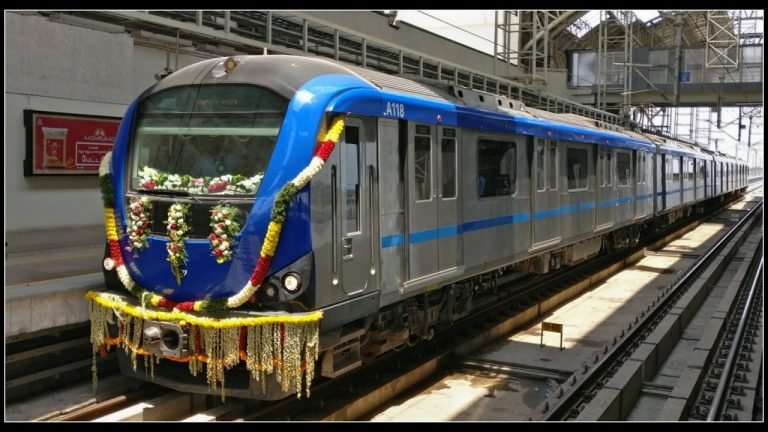
CMRL to install floodproof doors at 5 more metro stations

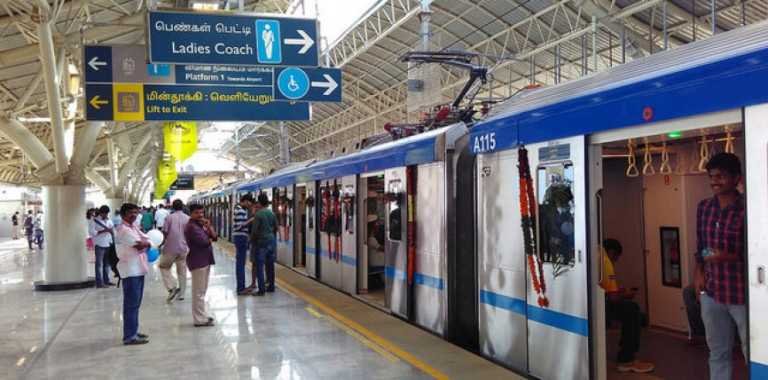
CHENNAI (Metro Rail News): Chennai Metro Rail Limited (CMRL) has decided to install flood-proof doors in underground stations in the phase I and phase I extension projects to brace from monsoons. This decision is a welcome step as seven years since the Metro began operations, its stations have suffered from leakages and flooding during heavy showers. These flood-proof doors would be integrated into the entry/exit points to enable quick installation and removal, officials said.

According to CMRL officials, the bids were floated to install flood-proof doors in five underground stations which are Saidapet, Anna Nagar East, Thousand Lights, Tondiarpet and Sir Theagaraya College. In 2021, CMRL installed the 1-1.2-m-tall doors on a pilot basis in a few stations which include Government Estate and AG-DMS.

According to the official, there were some issues related to the entry of water into stations each year which was even worse last year. It is the reason why we wanted this facility to be in place at five more stations, where this issue is recurring, before the monsoon this year.

In 2015, the tunnels of the under-construction Saidapet station which is closely located to Adyar river carried flood water to many parts and created several issues. After that, rainwater has entered a few underground stations, including Government Estate, Anna Nagar East and AG-DMS many times.

Metros in the country facing low ridership, trouble in generating revenues

New Delhi (Metro Rail News): A Parliamentary Standing Committee has observed that most of the metro in the country which are operating are not able to generate revenues due to the low ridership. the committee has come to the conclusion that it is due to faulty DPRs, lack of proper planning to provide first and last mile connectivity and a few other reasons.

Other than Delhi and Mumbai Line 1, most of the operational metros in the country including Bengaluru, Hyderabad, Lucknow, Chennai, Kolkata and Kochi have lower ridership.

Bengaluru Metro had Actual Average Daily Ridership (AADR) of 1.48, 3.40, 4.52, 4.89 and 0.96 lakhs only in 2016-17, 2017-18, 2018-19, 2019-20 and 2020-21, respectively, against Average Daily Ridership required for breakeven of 7.65, 10.09, 12.32, 13.19 and 18.54 lakhs, respectively, in the same years. The Bengaluru metro has been constantly witnessing low ridership than it is required for breakeven.

Lucknow Metro also had AADR of 0.537 and 0.258 lakhs only in 2019-20 and 76 2020-21, respectively, against the ADR required for Breakeven of 0.943 lakhs for all these years. Thus, Lucknow metro also does not have sufficient ridership for breakeven.

According to the report, the Committee thinks that if metro rail projects are to be made as mass transportation medium in true sense and operate on sustainable basis so that the commuters will travel by metro for which proper facilities should be made available to them in terms of comfort, convenience, quality, affordability and reliability, etc.

The Committee has recommended taking concrete steps to increase ridership of all metro projects. It has also asked to ensure that ridership estimation which forms the basis for the selection of type of metro (conventional or metrolite or metroneo) must be accurate and realistic.

81% electrification of country’s broad-gauge railway network complete: Ashwini Vaishnaw

NEW DELHI (Metro Rail News): Minister of Railways, Ashwini Vaishnaw on July 18 informed that the Indian Railways whose aim is to electrify the entire network by 2023-24 has now successfully completed the electrification of 81% of its railway tracks. The broad gauge network will reduce the dependence and usage of fossil fuels ultimately saving millions of dollars annually.

The electrification works which were completed recently include the electrification of Konkan Railway’s entire 741-km route between Thokur and Rora in Karnataka. Whereas South Central Railway recently announced the complete electrification of various railway lines in Andhra Pradesh. South Central Railway recently also announced that it would be launching an electric rail route between Washim and Hingoli city.

The Indian Railways has successfully completed the electrification of 6,015 km of railway track in 2020-21 even after the challenges that surfaced after the pandemic.

To make the railway network fully equipped with modern technology, the Indian Railways recently decided to only use 2 KV traction systems for the electrification of the entire network which is commonly used in countries like China, France, and Japan to operate high-speed trains.

Pune Metro completes viaducts work on Vanaz Metro Station to Civil Court Metro Station route

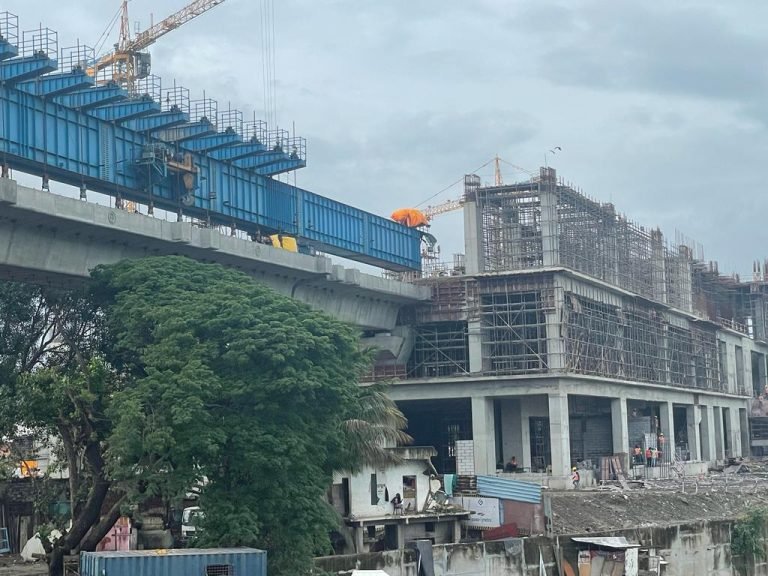
PUNE (Metro Rail News): The work of Maha Metro’s Pune Metro project is going in full swing. Pune Metro has completed an important landmark today, July 18. Viaduct work on the Reach 2 route of Pune Metro has been completed. Pune Metro has a total length of 33.2 km and has 30 stations. It has 5 underground stations and 25 elevated stations. To speed up the project, Pune Metro has divided the routes into various parts such as – Reach 1 (Pimpri Chinchwad Metro Station to Civil Court Metro Station), Reach 2 (Vanaz Metro Station to Civil Court Metro Station), Reach 3 (Ramwadi Metro Station to Civil Court Metro Station), Underground Route 1 (Swargate Station to Civil Court Station) and Underground Route 2 (Range Hill Station to Civil Court Station). Pune Metro has appointed various contractors to complete works on time and as scheduled.

pic 3

Pune Metro has completed the launching of all 2631 Pre-stressed concrete box segments, 41 Pre-stressed Concrete I girders, and one 48m steel girder span in Reach-2 i.e., a total of 296 viaduct spans and 12 depot line spans of the East-West Corridor of Pune Metro Rail Project from Vanaz to Civil Court which is of 7.505 km length metro viaduct including depot line at Vanaz. This year on said line commercial operation from Vanaz Metro Station to Garware College Metro Station has already begun, and with the completion of the viaduct till the Civil court metro station, it is safe to say that Pune Metro will be able to operate the metro up to civil court metro station in a short time.

The elevated line from Vanaz station to Civil Court station will be completed shorty and very soon the metro will run on this line. It will take some time to complete the work of Deccan Station, Chhatrapati Sambhaji Station, Pune Municipal Corporation Station, and Civil Court Station on this route. The work of the Pune Metro is going at a fast pace and the citizens of Pune are eagerly waiting for the completion of this work.

On this occasion, the Managing Director of Mahametro Dr. Brijesh Dixit congratulated the entire Metro officials and employees. On this occasion, he has said that this work has been made possible due to the active support and cooperation of the Central Government, State Government, Pune Municipal Corporation, and all other government institutions. In the next few months, the Metro will start service for passengers up to the Civil Court station.

NMRC to lease out commercial spaces at four metro stations

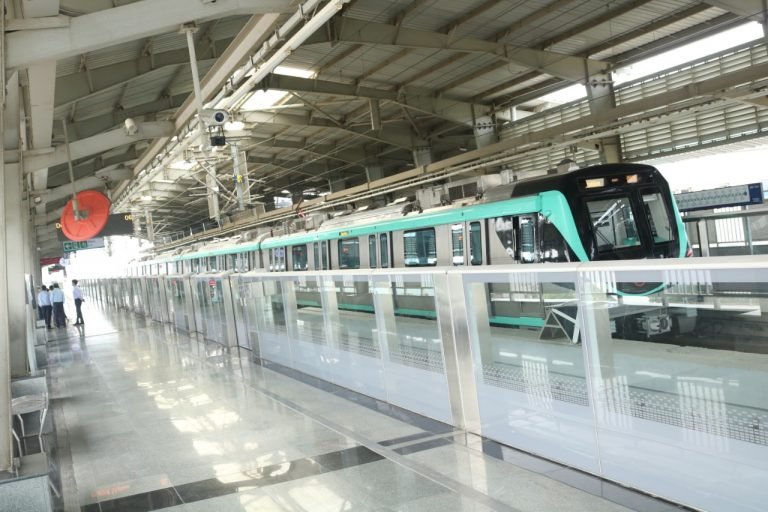
NOIDA (Metro Rail News): The Noida Metro Rail Corporation (NMRC) has decided to give commercial spaces at the stations in sectors 101, 81, 142 and the Depot. NMRC has taken this decision with the aim to make use of real estate value to get additional revenue other than the existing earnings through Metro fares.

The commercial space will be given out to the selected bidder for a licence period of 15 years. “It can be extended for a suitable time period with mutual consent of both the parties,” the RFP document by NMRC stated. “The licensee’s responsibility will be to develop the entire offered area with prior approval by NMRC,” it added.

According to officials, 198sqm and 597sqm of space will be available on two floors of the Sector 101 station. At the Sector 81 metro station, 198 sqm and 545 sqm of space will be available whereas 104 sqm at the Sector 142 station and 105 sqm at the Depot station will be available.

The bidders who are interested can submit their applications to the NMRC by August 2. The Aqua Line connects Noida Sector 51 station to the Depot station in Greater Noida. It has 21 stations on the route and ridership of around 30,000 commuters per day.

The decision to hand over MRTS to Chennai Metro under discussion

CHENNAI (Metro Rail News): Southern Railway general manager B C Mallya who was present at the inauguration of a photo exhibition on poet Subramania Bharathi at Tiruvallikeni MRTS stations has informed that the handing over of the MRTS section to Chennai Metro Rail (CMRL) is currently under discussion.

Mallya also informed that there is a possibility that the MRTS trains will be operated by either railway staff or the staff hired by metro rail. “it’s the same track and signalling system for railways and metro rail. Our signalling system is also good. Sometimes we may be asked to run the trains or they may have to hire staff to operate the trains” he added.

Mallya also said that railways was planning to initiate a talk with the state government to keep the Buckingham canal near the MRTS stations clean.

The Chennai Mass Rapid Transit System, a state-owned subsidiary of Indian Railways, is a metropolitan elevated railway line in Chennai. It is operated by the Southern Railways and is the first elevated railway line in India and also the country’s longest elevated corridor spanning 17 km.

Maharashtra Govt gives clean chit, MMRDA to raise Rs 60,000 cr loan for infra projects

MUMBAI (Metro Rail News): Mumbai Metropolitan Region Development Authority (MMRDA) has received permission from the Maharashtra government to raise a Rs 60,000 crore loan for infrastructure projects.

According to officials, the Maharashtra government has decided to stand as a guarantor for the loans and stamp duty on the government guarantee has been waived off for an amount of Rs 12,000 crore to be raised in the first phase.

Infrastructure projects which includes metro rail works, Thane-Borivali underground route, Thane coastal road, and Sewri-Worli Connector, worth Rs 1,74,940 crore are underway in the Mumbai Metropolitan Region.

This decision has come after a cabinet meeting which was held recently.

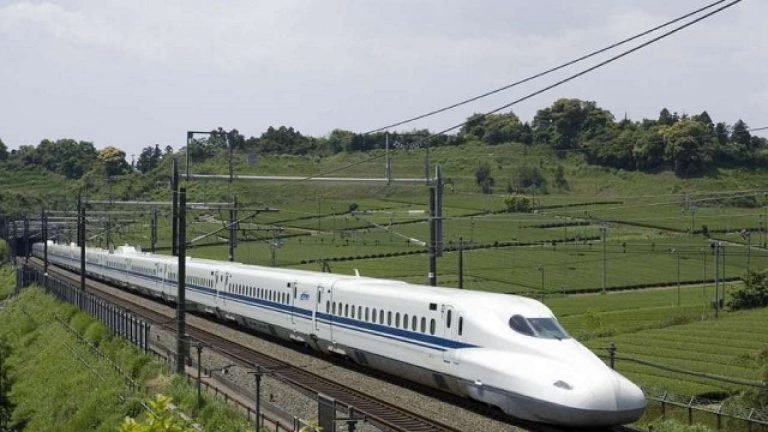
NHSRCL awards contract worth Rs 201 crore for MAHSR to Mitsubishi Precision

MUMBAI (Metro Rail News): The National High Speed Rail Corporation Limited (NHSRCL), the body that is undertaking the construction of the Mumbai-Ahmedabad Bullet train project, has planned to get simulators.

NHSRCL has awarded a contract worth Rs 201 crore to Mitsubishi Precision for the manufacturing, supply and commissioning of training simulators for the bullet train. The completion period of supplying the simulators is 28 months.

These simulators will be used to train The drivers and staff who will be responsible to operate the high-speed trains between Mumbai and Ahmedabad will be trained using these simulators. Training of drivers, conductors and dispatchers will be undertaken on the simulators.

The simulators will be set up in Vadodara in Gujarat. The simulators will have two types from which the first type will be for training the crew that will be on board the high-speed train whereas the second one will have driver consoles that will allow 10 trainee pilots of the bullet train to have a hands-on experience of operating the train.

NHSRCL has also set up a sample track for training purposes.

First 2 cars of prototype train for Mumbai Metro Line-3 to reach Mumbai soon

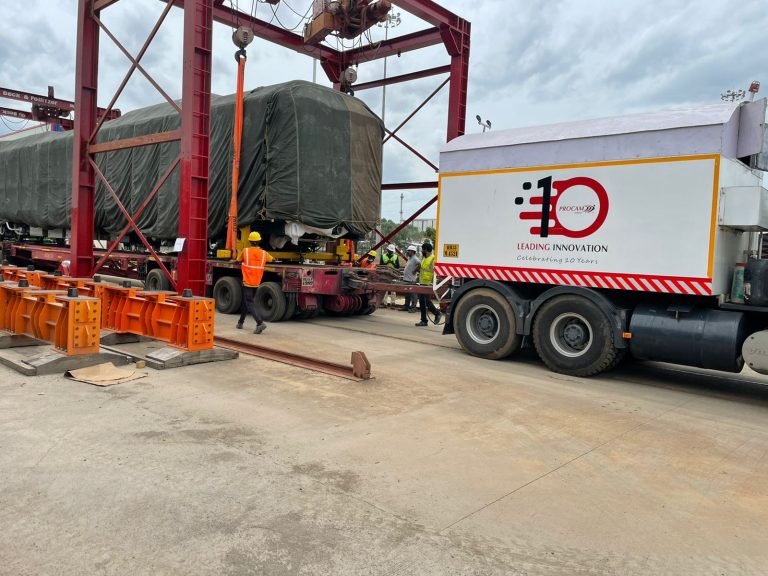
MUMBAI (Metro Rail News): The first two cars of a prototype train which will be used for trial runs of Mumbai Metro line-3 are ready to be dispatched from the Alstom trains manufacturing plant located in Sri City, Andhra Pradesh.

These cars of the Metro prototype trains could not be dispatched to Mumbai even after they were ready because the Metro car shed was not avvailable due to the protest of environmentalists. After the protest, the MVA government decided to shift the shed from Aarey to Kanjurmarg which is now again being shifted to Aarey after the change in the government. The first two cars will reach Mumbai within the next 8-12 days.

According to the Mumbai Metro Rail Corporation Ltd (MMRCL), the two cars that are part of a prototype Metro train, having a total of 8 Metro cars, were loaded in the trailers on Sunday from Alstom’s manufacturing facility and will be dispatched to Mumbai any moment.

According to an official, the trailer will take around 8-12 days to reach Mumbai after which they will be assembled at the temporary facility centre (temporary Metro car shed) at Aarey. Once assembled, the trial run of the Metro can be started between Marol and Maroshi as planned. All the eight cars of the prototype trains are likely to reach Mumbai around August 15 after which the testing of the Metro can be started.

The official added that the train will be tested on various parameters, including speed, oscillation and emergency break distance during the 10,000-km test runs. The trial could go on for three-six months.