Home Blog Page 297

Pune metro installs CBTC for safety of passengers and trains

0
pune metro
Pune Metro/ Representational

PUNE (Metro Rail News): The Pune Metro has installed a Communication Based Train Control (CBTC) signaling system for the safety of both passengers and trains. It will be feasible to run a train every two minutes with this technology while keeping a safe distance between each train.

Information regarding the precise location of the train will be transmitted to all Zonal Control Centres and TCMS systems of all trains through the radio unit located on the side of the tracks.

Maharashtra Metro Rail Corporation Managing Director, Brijesh Dixit said, “In CBTC system, the position, speed, location, timing and other important information of the train will be continuously communicated and updated by the on-board computer on the train, Train Control and Management System (TCMS) with other trains running on the tracks and Zonal Control Centre through radio communication.”

A Metro official said, “The information of a train will be continuously received by the train running ahead and the train running behind it. As a result of such features two trains can never approach or hit each other. If for some reason a train stops, the train behind it will automatically stop at a safe distance.”

The official added, “The signaling and train control system in Pune Metro will be software-based. For its testing calibration and validity, the work of low-speed and high-speed train trials and multiple train trials are being done in Vanaz and Nal stop sections. In the trial, three trains run simultaneously.”

Dixit added, “CBTC’s high-speed train trial is an important step towards the completion of Pune Metro. In a few months, Pune Metro will be operational from Garware College and Phugewadi to Civil Court. The safety and security of the commuters are of utmost importance and therefore CBTC and Automatic Train Operation (ATO) systems have been chosen for Pune Metro”.

The trial’s objective is to determine whether a train’s information is correctly communicated to and received by the trains moving in front and behind it. The trials that have been run thus far have been satisfactory.
 

Advertisement1
InnoMetro_2026

L&TMRH records loss of 1,745.85 crore in FY 21–22

0
Hyderabad Metro Rail

HYDERABAD (Metro Rail News): In the fiscal year 2021–2022, L&T Metro Rail Hyderabad (L&TMRH) the private concessionaire that developed and runs the Hyderabad Metro Rail (HMR) services recorded a loss of 1,745.85 crore which is just slightly less than the loss of 1,766.75 crores the previous year.

Fare and non-fare revenue, operating revenue and other income for the fiscal year 2021–22 under consideration were 357.15 crores as compared to 227.95 crores the previous financial year. A total of 1,746.21 crores was lost before taxes.

According to the company’s annual report, revenue from the metro rail system and other sources was 319.62 crores for the fiscal year ending on March 31, 2022 including construction revenue of 118.23 crores and 155.76 crores respectively.

According to the report, the government-imposed restrictions because of the COVID-19 epidemic had an influence on all areas of the company’s activities. Due to the impact on metro train ridership and the low footfalls in the company’s retail malls, the company was forced to support shops by switching to a revenue-sharing model of lease rentals in place of fixed rentals.

In addition to making sure that it provides safe and punctual travel along with affordable last-mile connectivity, contactless travel aimed at reducing commuters’ pain points and pandemic-related apprehensions, it would continue to target higher ridership, according to the 12th annual general body meeting of L&TMRH held last month.

“All efforts are being put in to make Hyderabad Metro the safest and cleanest transportation mode keeping in view the current pandemic situation,” said the report. It was pointed out that the CMRS – Commissioner of Metro Rail Safety, had cleared the way for increasing the maximum speeds of the trains to be increased from 70 kmph to 80 kmph on all three corridors to reduce the travel time in March with software updates.

The company also disclosed that it had successfully refinanced all of the term loans it had obtained from banks raising 12,975 crores through non-convertible debentures (NCDs) and commercial papers (CPs) lowering the interest rate on these loans by more than 2.5% annually.

Net fixed assets which are made up of property, plant and equipment investment property and intangible assets were valued at 17,043.29 crores and the net fixed assets comprising of property, plant and equipment, investment property and intangible assets stood at 17,882.95 crores, respectively. A total of Rs435.95 crore was added to property, plant, equipment, investment property and intangible assets during the year.

Four malls and an office building totaling 1.28 million square feet each were completed as part of transit-oriented development (TOD) projects in Punjagutta, Errum Manzil, Hitec City and Moosarambagh while work on an office building in Raidurg with a 0.5 million square foot footprint is anticipated to be finished this year.

Advertisement1
InnoMetro_2026

Pune soon to get Neo Metro services

0
Neo Metro
Neo Metro

PUNE (Metro Rail News): Pune locals will soon have access to the ultra-modern, high-speed Neo Metro service throughout the city. The Pune Municipal Corporation has received a Detailed Project Report (DPR) of the Neo metro from the Maharashtra Metro Rail Corporation Limited (Maha Metro).

Neo-Metro is a mass rapid transit system that offers affordable, environment-friendly and energy-efficient urban transportation solutions for Tier 2 and Tier 3 cities. It will travel at a speed of 90 km/h and have a carrying capacity that is three to five times greater than that of public buses.

On an elevated platform, Pune’s Neo Metro will travel a 43.84 km span of the city on an elevated platform. There will be 45 stations. The project is expected to get underway by December of this year and will be finished by 2028-2029, as stated by the officials. The project’s anticipated cost is set at Rs. 4940 crores. The civic organization contacted Maha Metro about transforming the proposed High Capacity Mass Transit Route (HCMTR) into a Metro Neo project as stated by MD Brijesh Dixit.
Ambedkar Chowk, Savitribai Phule Pune University, Senapati Bapat Road, Kelewadi, Paudphata, Alankar Police Thane, Siddhi Garden, Senadat Police Chowki, Sanas Playground, Laxmi Narayan Chowk, City Pride Station, Market Yard, Gangadham Chowk. , Bibvewadi, Lullanagar, Jambhulkar Chowk, Fatimanagar, Ghorpadi, Pingale Vasti, Vadgaon Sherry, Vimannagar, Airport, Vishrantwadi, Deccan College, Khadki Methodist Church and Bopodi are the stations that are proposed for the Neo Metro in Pune.

According to reports, the Pune project may get momentum only after the Nashik plan starts. The Union cabinet has already given its approval for the 32-km Nashik neo metro project. It will be the nation’s first project of its kind if it is implemented quickly.

The Nashik metro project is expected to cost around Rs 2100 crore. If it was a rail-based metro it would have caused more than Rs 8000 crore.

Advertisement1
InnoMetro_2026

MP Aparajita Sarangi writes letter to Odisha CM for metro

0
MP Aparajita Sarangi writes letter to Odisha CM for metro

BHUBANESHWAR (Metro Rail News): MP Aparajita Sarangi has written a letter to Odisha Chief Minister Naveen Patnaik imploring him to submit a proposal to the Central government for an integrated metro rail system between Bhubaneswar and Cuttack. The parliamentarian has also spoken with Urban Affairs Ministry representatives about the Metro Rail Policy.

Therefore, the State Government should plan an integrated Metro Rail system for both cities to make fitness of things. The project can be carried out in stages, beginning in the city of Bhubaneswar and then moving on to the city of Cuttack. According to the 2017 Metro Policy, a 50:50 equity partnership between the Central and State Governments can be used to plan a metro system. The development of the Metro system will not only improve mobility but, it will also enhance the commercial activities in both the twin cities,” the MP said.

“The combined population of Bhubaneswar and Cuttack will be around 22 lakhs. However, the rapid expansion of habitations and commercial complexes between both the twin cities have expanded at a rapid pace and if one includes the areas which do not come within the Municipal Corporations of Bhubaneswar and Cuttack, then the estimated population would be close to 30 lakhs. I would like to mention that both Bhubaneswar and Cuttack, though important cities of Odisha, do not have Mass Rapid Transit System (MRTS),” Sarangi mentioned in the letter to the CM.

“As per Metro Rail Policy, 2017, the cities having more than 20 lakhs population should plan for Metro Rail system. In this regard, I would like to mention that the population of Bhubaneswar is likely to exceed 20 lakhs within 4 to 5 years. Further, as mentioned above, the current combined population of twin cities Bhubaneswar and Cuttack is already exceeding 20 lakhs,” she said in the letter.

“For going ahead with the Metro rail system, a feasibility-cum-Detailed Project Report (DPR) needs to be prepared. The Ministry of Housing and Urban Affairs (MoHUA) under Urban Transport Planning and Capacity Building Scheme, provides financial assistance up to 50% for conducting feasibility studies and for preparing DPR for formulating such a proposal,” she wrote.


Advertisement1
InnoMetro_2026

PM Modi to inaugurate slew of projects in Gujarat

0
ahmedabad-metro
ahmedabad-metro/ Representational Image

GUJARAT (Metro Rail News): Prime Minister Narendra Modi will lay the foundation stone and inaugurate a number of projects including the eagerly waited metro rail project in Ahmedabad and the world’s first CNG terminal at Bhavnagar during his two-day visit to poll-bound Gujarat on September 29 and 30.

According to a state government official, the Prime Minister will lay the foundation stone for the CNG terminal at Bhavnagar on September 29. During the 2019 Vibrant Gujarat Global Business Summit, the UK-based Foresight Group and the Gujarat Maritime Board (GMB) inked a Memorandum of Understanding (MoU) for the construction of a CNG terminal in Gujarat.

The port would be built at a cost of 4,024 crore and in addition to the CNG terminal it shall meet future demands of the Bhavnagar district for projects like container manufacturing, vehicle scrapping and other mega projects specifically, the Dholera Special Investment Region.

The port will also have an ultra-modern container terminal, multi-purpose terminal and liquid terminal with direct doorstep connectivity to the existing roadway and railway network connecting to the largest industrial zones, the Dedicated Freight Corridor and the Northern hinterland of the country.

“Moreover, the CNG Import Terminal will provide an additional alternate source of energy to meet the growing demands of clean energy. The promoters have already signed an agreement for the supply of CNG and the development of CNG Export Terminal with RAK Gas, Ras Al Khaimah, UAE. The supply mechanism of CNG once operational will be revolutionary enabling India to tap small scale and stranded gas volumes which are yet to be utilized,” as stated in a government press statement.

The Regional Science Centre in Bhavnagar which covers 20 acres and costs Rs 100 crore to build will also be inaugurated by the prime minister. The Das Nala, Nari Gam, Ahmedabad highway and Bhavnagar are close to the Regional Science Center (RSC) in Bhavnagar.

On September 30, 2022, the Prime Minister will flag off Phase-I of the Ahmedabad Metro train project. It will stretch 21 kilometers between Thaltej Apparel Park. Phase-I of this massive project developed at a total cost of Rs. 12,925 crores, consists of a 40-km stretch with 32 corridors.

There are 17 stations along the Thaltej-Vastral route in the East-West corridor. A 6.6 km underground segment of this line contains four stations. There are 15 stations along the 19-kilometer North-South corridor that runs from APMC to Motera Stadium. This metro corridor will contain 126 entry/exit points, 96 coaches, 129 elevators and 161 escalators.

The APPL Container (AAWADKRUPA PLASTOMECH PVT. LTD) project will also be inaugurated by the prime minister in Bhavnagar. After the Prime Minister’s “Make In India” initiative was revealed, the Indian government set up a container manufacturing hub in Bhavnagar. In 2019, the first container prototype was manufactured.

Advertisement1
InnoMetro_2026

RRTS section to be operational for trial runs by March 2023

0
high-speed-rail-transit
high-speed-rail/ Representational Image

GHAZIABAD (Metro Rail News): The work to energize the electrical overhead equipment (OHE) for rapid train operation on the priority section of the Regional Rapid Transit System (RRTS) corridor will be finished by mid-October and will clear the way for trial runs that are anticipated to begin in November of this year.

The National Capital Region Transport Corporation (NCRTC) has taken the RRTS project comprising 25 stations and three depots on which high-speed trains will transport passengers between the three cities of Delhi, Ghaziabad and Meerut and 82-kilometer-long RRTS corridor by 2025. The project’s estimated cost is Rs 30,274 crore. In Ghaziabad, a 17-km priority section is being built and when it is operational in March 2023, it will be the nation’s first RRTS section.

The entire 17-km priority stretch in Ghaziabad, which runs from Sahibabad to Duhai and has five RRTS stations and one depot is being developed on an elevated corridor. Five receiver sub stations (RSS) which are being built at Sarai Kale Khan in Delhi, Ghaziabad city, Muradnagar (Ghaziabad) and at Modipuram and Shatabdi Nagar in Meerut, will supply electricity to the entire 82-km RRTS corridor, according to NCRTC officials.

The high-speed ultra-modern RRTS trains have a design speed of 180 kilometers per hour (kmph) while the operational speed will be around 100kmph. The NCRTC has also planned a number of initiatives to reduce energy use and produce roughly 10 million units of electricity annually by the time the RRTS project is completely operational in 2025.

The rolling stock (RRTS trains) feature a built-in concept of “regenerative braking” that will cut power consumption while braking and send the power saved back to the grid, as stated by an official. The NCRTC is constructing all of its electricity sub-stations in compliance with the Indian Green Building Council’s (IGBC) requirements which include using LED lighting, air ventilation, sewage treatment facilities and green spaces.

“The installation of OHE is taken up at a fast pace and energising the OHE lines for running of trains are likely to be completed by the mid of October. It will help in conducting the trial runs of the RRTS trains. For energising the 17-km priority section in Ghaziabad, we have come up with a receiver substation (RSS) near river Hindon. It will receive electricity from the grid and supply power for the operation of the rapid trains, stations and depots,” said Puneet Vats, NCRTC chief public relations officer.

“By way of regenerative braking, we are expecting to save about 30% electricity during train operations. Further, in order to save electricity, we have planned the installation of solar rooftop panels on stations, depots and administrative buildings. With this, we will be generating about 11 megawatts (MW) of solar power on the entire 82-km corridor and this will help reduce consumption of regular electricity,” Vats added.

Advertisement1
InnoMetro_2026

HMR Creates Green Channel to transport beating heart at post mid night

0
HMR Creates Green Channel to transport beating heart at post mid night

HYDERABAD (Metro Rail News): L&T Hyderabad Metro Rail redemonstrates its ability to rise to the occasion to help the citizens of Hyderabad in the quickest possible time. Like the last time in Feb 2021, L&TMRHL received an SOS call from the Apollo Hospital, Jubilee Hills for transport of a harvested heart to save a life. HMR activated a Green Channel in the wee hours of the morning today on 26 September and facilitated a special train to transport the beating heart from Nagole to Jubilee Hills Check Post Metro Station.WhatsApp Image 2022 09 26 at 4.54.20 PM

This activity coincided with the handling of special metro train services beyond the business hours of 25 Sep for the return journey of about 20k spectators who travelled to watch the T20 cricket match at the Rajiv Gandhi International Cricket Stadium, Uppal, from the Stadium and the adjoining two metro stations.

A panel of doctors and other medicos headed by Dr. Gokhale from the Apollo Hospitals, Jubilee Hills brought the harvested heart from the Kamineni Hospital at the Nagole Metro Station at around 1 am.

The live heart was then immediately rushed inside the waiting metro train. In a span of about 25 minutes, the special train reached the Jubilee Hills Check Post where the ambulance of Apollo Jubilee Hills was waiting to receive the live organ and the medical team. The entire activity was seamlessly handled by the metro and security officials on Line 3.

WhatsApp Image 2022 09 26 at 4.54.20 PM 1Speaking on this occasion, Mr. KVB Reddy, MD & CEO, L&TMRHL, said, “The Hyderabad Metro Rail is committed to serving its passengers and is always ready to go the extra mile if help is needed. It is ingrained in our values and beliefs to rise to the occasion for those who need us the most. This time again, we have activated a Green Channel in the quickest possible time to transport a harvested heart to save a precious life. My sincere gratitude goes out to every doctor and member of the HMR staff who ensured this safe and seamless transport of the live organ.”.

Advertisement1
InnoMetro_2026

Symbroj Media to organize International Conference on Digital Transformation of Indian Railways

0
Symbroj Media to organize International Seminar on 9th December, 2022

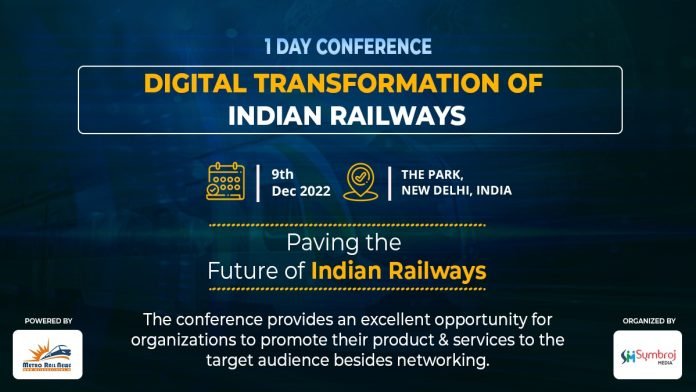
NEW DELHI (Metro Rail News): The International Conference on Digital Transformation of Indian Railways will be organized at the Park Hotel, New Delhi on 9th December 2022 as per the information shared by Symbroj Media, a well-known media and event management company in Delhi/NCR. Metro Rail News, the noted publication of the group on metro & railways shall exclusively cover the event apart from various other participating media houses, channel partners, event management groups & stakeholders.

It may be noted that Indian Railways after US, Russia, and China is the fourth-largest railway system in the world. It has a total route network of 68,103 km, 9,141 freight trains and 13,452 passenger trains. Indian Railway today has quickly become the largest potential market in the world for the introduction of innovative technologies and solutions for effectively utilizing existing resources and introducing new technology.

The Railways in India has a vast talent pool and resources which help them to both adopt and implement innovative technological solutions from around the world as well as to create indigenous solutions. High-speed trains, safety, track modernization, locomotives, signaling systems and the creation of a heavy-haul system where axle weights and train lengths could be continuously raised in accordance with needs are important areas where technological advancements are required. The IR is anticipated to build a future-ready railway infrastructure by 2030 to reduce logistical costs and guarantee complete electrification of broad rail routes by December 2023.

With a number of new innovations, IR is spearheading at all fronts. The conference will be a platform to discuss all in detail. It shall also cover the various advantages and disadvantages of implementing futuristic technologies for Indian Railways and bring together all interested groups on a single platform to encourage the development of technological solutions for the railways as well as to share beneficial knowledge gained from an international perspective among stakeholders for in-depth understanding of sector-related problems.

Additionally, the other objectives of the conference would be to create brand awareness, product showcase, reach specific target audiences, product demonstrations, introduction of new products, gather intelligence, develop relations with prospects, business development and improve corporate image.

Industry experts and speakers from various departments & sectors such as  Ministry of Indian Railways, Indian Railway Zones, Rail Associations & Experts, Relevant Ministries, Government Agencies & Policy Makers, PSU Heads & Private Companies Speakers, DFCCIL / NHSRCL / IRSDC/ IRCTC / RLDA/ CONCOR/ CWC /CRWC, RDSO/ COFMOW/ RITES/ RVNL/ RAILTEL / CRIS/ IRFC,  Railway production Unit, Rail PSU’s / SVP’s, Technology Solution Providers, Rolling Stock Manufactures, Construction and Engineering Firms, EPC, Industry Analysts/Consultants,  Land Use and Management Planning Experts,  Security, Surveillance, Access Control System Providers,  Signaling and Telecommunication Solutions providers shall greatly contribute in the rendezvous on the ongoing technologies.

As stated by Narendra Shah, founder & CEO of Symbroj Media, “The conference shall provide an excellent opportunity for organizations to promote their product and services to the target audience besides networking during panel discussions and cozy interactions.” “The sponsors would get an opportunity to meet noted personalities of railways and metro sector, Industrialists, tech stalwarts, leaders from various departments, ministries and experts in a must participate event of the year,” he added.


Advertisement1
InnoMetro_2026

MMRDA to procure 10 Rakes for the 20 Km Monorail Project

0
Mumbai monorail project becomes a white elephant for govt
Mumbai monorail project/ Representational Image

MUMBAI (Metro Rail News): The Mumbai Metropolitan Region Development Authority (MMRDA) is planning to procure 10 extra rakes for the 20 km monorail project between Chembur and Jacob Circle. Hyderabad-based Medha Servo Drives Ltd. will deliver the first of ten monorail rakes in February 2023. The Mumbai Monorail will run more frequently now—every 10 minutes instead of every 20–25 minutes with the the new rakes.

“We have decided to appoint an independent agency to ensure that the rakes are world-class,” a senior official said. Trials will be conducted after the arrival of the first rake and after that three rakes will arrive once every three months.

The new rakes would have greater safety features and be more roomy, according to MMRDA. The monorail is currently being run by seven rakes with two remaining on standby. An Indian company would deliver 10 rakes with four cars each for this corridor, according to the MMRDA announcement.

The rakes must be designed by Medha Servo Drives Ltd before being delivered to MMRDA. Modern technology, improved strength and excellent fire resistance will all be features of the new rakes.

According to MMRDA, the maintenance costs will be lower than they were for earlier trains in Make in India initiative. Each coach currently weighs 13.5 tonnes. The load on the guideways and piers will be lessened by the new rakes’ several tonnes less weight.

An official has stated that spare maintenance parts will be easily accessible. The new bogies will also be made of stainless steel much like the metro. The capacity of the new coaches would be at least 10 percent greater than that of the existing ones which can accommodate approximately 568 passengers per train.

In order to serve busy and congested areas, the MMRDA chose to launch the 20 Km-long monorail route Chembur-Wadala-Sant Gadge Maharaj Chowk as a feeder service to other transport systems. Monorail can carry 7,500 commuters per hour in each direction and has a daily capacity of 1.5 to 2 lakh people.

Several parts of the city that are not serviced by the Metro Rail or the Suburban Rail System would be connected by the Monorail. Wadala, Curry Road, and Chembur will further act as the Monorail’s linkages to the Suburban Rail Network.

Advertisement1
InnoMetro_2026

PM to inaugurate Ahmedabad Phase-I Corridor, flag off Train-18 third rake

0
Representational Image

AHMEDABAD (MetroRail News): The Ahmedabad Metro Rail project‘s remaining Phase 1 corridor sections are fully ready to open for the public. Last Saturday, September 17, 2022, the Gujarat Metro Rail Corporation Limited (GMRCL) gained safety approvals from the Commissioner of Metro Railway Safety (CMRS). On September 30, 2022, Prime Minister Narendra Modi is most likely to inaugurate the completed metro services.

Prime Minister Modi will also flag off the Vande Bharat train‘s third rake that would leave from Gandhinagar on September 30. “We have received CMRS clearance. It means we can begin commercial operations and carry passengers. This will perhaps be the longest stretch of 33-odd kilometers to receive clearance,” said a senior GMRC official. The preparation for the inauguration ceremony which will take place at Helmet Circle has been started by GMRCL, the Ahmedabad Municipal Corporation and the Police Department . The PM is also planned to address public on Doordarshan.

The 32.5 Km North-South Metro Corridor and 32.5 Km East-West Metro Corridor were officially approved for opening by the CMRS. Since 2019, the 6.5 km stretch between Vastral and Apparel Park has been accessible to the general public. Phase II will extend Phase-I connections to Mahatma Mandir and GIFT City from Motera.

Only 29 of the 32 stations are expected to be functional at this time; the remaining stations will open up soon after, according to the plan. Vastral’s first underground station would be accessible to the general public later.
Vastral Gam and Thaltej Gam will be connected by the 20.737 Km-long North-South Metro Corridor (Line 1) which will have 18 stations along the way at Thaltej Gam, Thaltej, Doordarshan Kendra, Gujarat University, Commerce Six Roads, Stadium, Old High Court Interchange, Shahpur, Gheekanta, Kalupur Railway Station, Kankaria East, Apparel Park (Depot), Amraiwadi, Rabari Colony and Vastral Gam.

With 15 stations at Motera Stadium, Sabarmati, AEC, Sabarmati Railway Station, Ranip, Vadaj, Vijay Nagar, Usmanpura, Old High Court Interchange, Gandhigram, Paldi, Shreyas, Rajiv Nagar, Jivraj Park, and APMC, the 18.522 km East-West Corridor (Line 2) would link Motera to APMC.

Advertisement1
InnoMetro_2026