

Home Blog Page 248

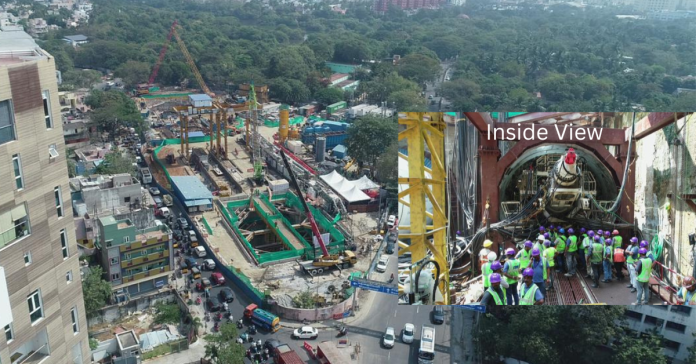
Tunneling work starts at Greenways Road Station of Chennai Metro Rail on Corridor 3

0
Tunneling work starts at Greenways Road Station of Chennai Metro Rail on Corridor 3

CHENNAI ( Metro Rail News ): The contractor for the Chennai Metro Rail Project‘s contract TU02 (Kellys to Taramani), Larsen & Toubro, has started the Tunnel Boring Machine (TBM) at the Greenways Road Station in Corridor 3.

The TU02 contract for the Chennai Metro Rail Project’s Kellys to Taramani stretch will utilize eight Tunnel Boring Machines (TBMs), including the Herrenknecht TBM (S 1027) named Kaveri, after the river Kaveri. Following Kaveri, the next TBM to be deployed from Greenways Road Station will be named Adyar.

According to the project timeline, the Kaveri TBM is expected to reach Adyar Junction Station in August 2023 after tunneling through DB Road and crossing the Adyar River near Thiru Vi. Ka. Bridge. This development is a crucial step forward in the Chennai Metro Rail Project, which aims to improve connectivity and reduce traffic congestion in the city.

Chennai Metro Rail Ltd has begun the expansion of Chennai’s metro rail network under Phase 2, after the completion of Phase 1 and Phase 1 Extension Corridors in stages since June 2015, and due to the increasing ridership in Corridors 1 & 2. The project’s second phase comprises three corridors with a total length of 118.9 km.

To build the extensive network of underground tunnels of Phase 2, a total of 23 Tunnel Boring Machines (TBMs) will be deployed in Chennai. These TBMs include new machines imported for the works, as well as TBMs remanufactured in India. According to the release, the TBMs will be launched and retrieved multiple times until completion from various shaft locations.

Advertisement1
InnoMetro_2026

Patna Metro Construction Goes Green with Top Soil Conservation Efforts

0
Soil and tree preservation, Patna Metro

PATNA ( Metro Rail News ): The construction of the city’s new metro system is taking place with a focus on topsoil conservation. Delhi Metro Rail Corporation Ltd. (DMRC)understands the importance of preserving the fertile top layer of soil, which is essential for growing crops, plants, and trees. It is also a finite resource that can take hundreds of years to form but can be easily lost or damaged due to construction and development activities.

DMRC is taking a responsible and sustainable approach to the construction process by
implementing measures to minimize the impact on topsoil and promote its conservation. The topsoil is being carefully removed and stored for future use in parks, green spaces, and other landscaping projects within the city. Fertile topsoil is stripped to a depth of 20cm from the areas to be used for construction, and it is then stockpiled to a maximum height of 40cm in designated areas, covered or stabilized with temporary seeding for erosion prevention and then maybe reapplied to the site during the plantation of the proposed vegetation. It is also in line with the objectives of the Soil Conservation Act, which aims to promote sustainable land use practices and prevent soil degradation.

Saving trees during metro construction is another key aspect of DMRC’s commitment to
environmental responsibility and sustainability. During construction, it is important to
minimize the impact on existing trees and to replant new trees where possible. To achieve this, DMRC has implemented several measures, such as conducting a tree survey to identify and map the location of all the trees on the construction site, protecting them by installing barriers and providing appropriate care or translocating them someplace safe on need basis.

The DMRC is committed to ensuring that Patna Metro Project does not cause undue harm to the city’s tree population and is taking steps to ensure that the new metro facility enhances the city’s natural beauty and greenery.

Advertisement1
InnoMetro_2026

Delhi Metro employs mist spray technology to tackle dust pollution during Patna Metro construction

0
Innovative Dust Suppression Technology Employed for Patna Metro Construction

PATNA (Metro Rail News): The Delhi Metro Rail Corporation Ltd. (DMRC) has implemented advanced mist spray dust suppression technology to minimize the impact of dust pollution during the construction of the new metro line in Patna. This technology involves the use of specialized equipment to produce fine particles of water that bind with the dust particles, preventing them from becoming airborne. By strategically placing the mist spray equipment on-site, the entire construction area is covered, making it an effective and eco-friendly solution for controlling dust pollution.

Patna’s air quality has been a growing concern in recent years, with the Air Quality Index (AQI) frequently exceeding safe limits set by the World Health Organization. However, the use of mist spray dust suppression technology during the construction of the Patna Metro has the potential to significantly control the AQI in the city. It is an ideal solution for cities like Patna where air pollution is a serious concern and will solve the concerns of local residents regarding dust pollution around construction sites.

The effectiveness of mist spray technology in controlling dust pollution, even in the harshest conditions, has been proven. It not only keeps the surrounding area clean but also reduces the risk of respiratory problems for workers and nearby residents. DMRC ensures the implementation of environmental best practices for controlling emissions or minimizing the impact of construction activities on the environment, as required by the Air (Prevention and Control of Pollution) Act, 1981.

The construction of the Patna Metro is expected to be completed by 2026 and will provide much-needed transportation options for residents in the area. With the use of mist spray dust suppression technology, residents can be assured that the project will be carried out with utmost care for the environment and their health.

Advertisement1
InnoMetro_2026

JSP wins INR 110.32 Cr Contract to Supply Head-Hardened Rails for Mumbai Metro Line-4

0
Mumbai-Metro/Representational Image

MUMBAI (Metro Rail News): On February 1st, Jindal Steel and Power Ltd. (JSP) became the lowest bidder to supply 9800 MT of head-hardened rails for Mumbai Metro’s Line-4, which spans 32.32 km, and Line-4A (Green Line), The 2.88 km long route connect Wadala, Kasarvadavali, and Gaimukh through 34 raised stations.

To provide additional strength, lower residual stress, elongate track life, and minimize maintenance, Jindal Steel and Power Ltd. (JSP) will manufacture 9800 MT of head-hardened rails for Package CA-150 of Mumbai Metro’s Line-4 and Line-4A. These special tracks will be 60E1-1080 grade in accordance with Indian Railway Specification T-12-2009 and produced using a specialized heat treatment process.

Jindal Steel and Power Ltd. (JSP) submitted a financial bid of Rs. 110,32,06,580.00 for the Mumbai Metro’s Line-4 and Line-4A head-hardened rails contract, which was originally estimated to cost Rs. 80.46 crores and have a 15-month delivery deadline.

Originally, Mumbai Metropolitan Region Development Authority (MMRDA) invited bids for this contract in November 2020, with an estimated Rs. 80.46 crores and a 15-month delivery deadline. Bids were re-invited in November 2022, with an unknown estimate and a 550-day (1.5-year) delivery deadline. During the technical bid evaluation in November, Mitsui & Co. Ltd. of Japan was found non-compliant with the bidding conditions and was disqualified, leaving JSP as the only bidder. As a result, JSP has declared the lowest bidder before opening its financial bid.

Advertisement1
InnoMetro_2026

RRTS to reduce travel time from Delhi to Neighboring States

0
RRTS-trainsets
Representational image only

DELHI (Metro Rail News): The forthcoming Regional Rapid Transit system (RRTS) corridor in Delhi is likely to reduce the travel time from different locations in the NCR and other adjacent places like Haryana and Rajasthan to National Capital. Passengers will be able to travel from Ghaziabad to Haryana in just 45-50 minutes through Delhi-Panipat Corridor, and Delhi-Gurgaon- Alwar RRTS corridor will help travellers to commute from Delhi to Neemaran in around 70-75 minutes.

The Central government had approved the Delhi-Panipat RRTS corridor. However, early this month, the government said to Rajya Sabha that the Delhi government did not approve financial aid for the Delhi SNB and Delhi-Panipat corridors. However, they have got the approval of the Haryana and Rajasthan governments.

The Delhi-Panipat corridor, which is 103 km long, will connect Delhi with Sonipat and Panipat in Haryana. It will also link Murthal, Ganaur, Samalkha, and Panipat to Delhi with high-speed rails. There will be 17 stations on this line. Delhi will have six stations ( Sarai Kale Khan, Indraprastha, Kashmiri Gate, Burari, Alipur and Mukarba Chawk ). With the help of this project, people will be able to reach Murthal in about 40-50 minutes and to reach Panipat from Delhi, it will take around 65 minutes.

The Delhi-Gurgaon-Alwar Corridor will be developed in three phases. In phase one, the 107-km-long SNB Urban Complex (Shahjahanpur-Neemarana-Behror) will be constructed, which will link Gurgaon, Manesar, Panchgaon, and Rewari. Commuters will be able to travel to Neemarana from Delhi in just 70-75 minutes.
In the second phase, the SNB- Sonatala line will be extended to Shahjahanpur, Neemrana and Behror. SNB Alwar will be constructed in the third phase. The Delhi-Gurgaon-SNB-Alwar RRTS will also go through Manesar, Bawal and Neemrana, which are industrial areas that would ease the journey and increase the productivity of the people travelling.

Advertisement1
InnoMetro_2026

Pune Metro Line 3 Completes Erection of 300 Piers, Accelerating Project Work

0
Pune Metro line 3 piers

PUNE (Metro Rail News): The Pune Metro Line 3 project, connecting the IT hub of Hinjewadi to the central business district of Shivajinagar, has made significant progress across several sections. Construction of the piers, which form a crucial part of the project, has seen a recent acceleration, with the erection of 100 piers completed in just 60 days. This brings the total number of piers erected to 300, a major milestone in the project’s development.

The joint venture between Tata Group and the Pune Metropolitan Region Development Authority (PMRDA) is overseeing the construction of the metro rail system on a public-private partnership basis. Tata Group has established the Pune IT City Metro Rail Limited as a special purpose vehicle (SPV) for the project’s implementation.

The piers, which are being constructed according to strict design and safety standards set by the Bureau of Indian Standards (BIS), are a special circular shape with a diameter of 2000mm, fully compliant with the design parameters of the metro rail system. The project developers are committed to following all construction safety parameters and quality control measures to ensure the project is completed on time.

The Pune Metro Line 3 will provide easy, convenient, and affordable public transport options between Hinjewadi and Shivajinagar, benefiting the citizens of Pune. The project will be developed and operated on a design, build, finance, operate, and transfer (DBFOT) basis by the SPV, Pune IT City Metro Rail Limited (PITCMRL), for a concession period of 35 years, including the construction period.

About Pune Metro Line 3:

Pune Metro Line 3 is a 23 km elevated metro rail project connecting Hinjawadi to the central business district of Shivajinagar. It is a public-private partnership project awarded by the Pune Metropolitan Region Development Authority (PMRDA) to a consortium consisting of Tata Group’s TRIL Urban Transport Private Limited (TUTPL) and Siemens Project Ventures GmbH.

Advertisement1
InnoMetro_2026

MMRDA plans to combine flyover and Metro line expansion for better connectivity

0
(Representational Image)

MUMBAI (Metro Rail News): MMRDA (Mumbai Metropolitan Region Development Authority) is likely to build a combined 2.58 Km road flyover below Metro line 6 ( Swami Samarth Nagar-Vikhroli) to provide additional transport facilities.

The elevated Mumbai Metro 6 runs through Jogeshwari, WEH, and Powai, comprising a 15.31 km elevated corridor which will form a vast metro network connecting four other metro corridors – Metro line 2A, Metro 3 Cola Bandra SEEPZ, Metro 4, and Metro 7.

As per MMRD, Metro 6 will have 13 stations, and 66 % work has been completed. In addition, the civil work on metro stations on line 6 is 51.50 per cent complete.

According to SVR Srinivas, MMRDA Commissioner, the Mumbai Metro Network is being constructed by the authority to provide rapid transportation services to people within a short travel distance. Metro line 6 will offer rail-based connectivity between Western and Eastern suburbs and play an essential role in an integrated public transport network for people.

Advertisement1
InnoMetro_2026

CMRL to conduct second survey to improve Chennai Metro patronage

0
Chennai Metro
Representational image only

CHENNAI (Metro Rail News): Chennai Metro Rail Limited (CMRL) is planning a second survey to improve patronage by understanding commuter needs. Over a period of nearly a month, questionnaires will be distributed to passengers throughout the 54-km network and 41 stations, with an aim to cover at least 20,000-25,000 persons.

The survey will ask questions about passengers’ profiles, reasons for using the Metro, travel to and from the station, and general suggestions to improve commuter amenities. Officials hope to enhance the current weekday ridership of 2.5 lakh passengers.

This is the second survey, with the first one leading to the introduction of improved signage, last-mile connectivity, and rectifying issues in the parking system, resulting in a gradual increase in ridership.

“Signage was improved at stations, last-mile connectivity was added in areas like Manapakkam and Taramani, issues in the parking system were also rectified. It helped us understand the commuters’ needs. Importantly, after implementing their suggestions, we saw a gradual increase in ridership. Hence, we are doing the survey again to improve the services,” the official added.

Advertisement1
InnoMetro_2026

Chennai Metro to operate driverless metro on Poonamalle – Powerhouse line

0
Chennai Metro
Representational image only

CHENNAI (Metro Rail News): By August 2024, Chennai Metro rail is planning to bring the first set of three-coach driverless trains to the city.
Covering 118.9 km of the city, these trains will be first operated at the Ponamalla-Powerhouse stretch in 2026 as part of the forthcoming phase 2 Chennai Metro Rail System.
At present, there are four-coach trains running on line 1; further, line 2 will have – three and, post that, six-coach trains.

According to an official, “once the coaches arrive individually, it will be connected to the train. Post that, the train would undergo some series of static and dynamic tests, which includes traction testing, train control, management system, passenger information systems, brake system, etc. These tests will be conducted first within the tracks at Poonamalle depot. Followed by the delivery of signaling systems, systems will be integrated, and trains will be further inspected in order to figure out any glitches and failures. The exact process would go for a minimum of 10-12 months.

”CMRL has ordered 26 driverless trains to run the stretch as the Poonamallee-Power house stretches a larger section of the corridor for 26.1 km.
Due to differences in design, control, and signalling systems, phase 1 trains can’t run on phase 2. Also, for phase 2, the model and colour of driverless trains have not been confirmed yet.
In October and November, a few more sets were expected to arrive. However, the first set is already scheduled to be delivered by August. RDSO (Research Designs and Standards Organization) will certify the trains before it is officially into operation.

Advertisement1
InnoMetro_2026

Union Budget Allocates Record 164.77% Increase in Funds for Kolkata Metro Projects

0
Kolkata Metro
Kolkata Metro

KOLKATA (Metro Rail News): In this year’s Union Budget tabled in the Parliament, Kolkata Metro has been allotted Rs. 3220.25 Crores for different o­n-going Metro projects. This is a massive 164.77% higher than the 2022-2023 budget proposal of Rs. 1216.25 Crores.

The total Plan Outlay for Metro Railway has increased by an unprecedented 153.36% and is fixed at Rs. 3496.54 Crores.

As adequate funds are available, Metro Railway plans to open new Metro routes and extend existing routes in the year 2023. The New Garia to Hemanta Mukherjee stretch of New Garia to the Airport via the Rajarhat Metro Project (Orange Line) has already been inspected by the Commissioner of Railway Safety, N.F. It is expected that his mandatory approval to start the commercial services o­n this stretch will be received very soon.

After that nod, commercial services o­n this 5.4-km-long stretch will likely start in February 2023.

This stretch will be further extended to Salt Lake Sec-V (a length of 9.82- km) in October 2023. In addition, the Noapara to Bimanbandar stretch (7.04 km) of the Noapara-Bimanbandar- Barasat Metro Project (Yellow Line) will be inaugurated in the same month.

Commercial services o­n the Purple Line from Joka to Taratala have already started. This service will be further extended from Taratala to Majherhat (1.24 km) by October 2023.

Target has also been fixed to extend much-awaited Metro services from Sealdah to Howrah Maidan (7.25 km) by December this year. Once achieved, Metro will run for the first time under a mighty river like Hooghly in this country. As a result, commuters coming from the suburbs can reach places like Esplanade, Sealdah or Salt Lake quickly and smoothly without facing any traffic snarls.

Metro is planning to extend its wings very fast this year, and a total of 30.75 kms will be added to the Kolkata Metro network with the existing 47.93 kms.

Shri Arun Arora, General Manager, Metro Railway, has said, “These extensions and opening of new routes will be this year’s Puja Gift to the people of Kolkata.”

Advertisement1
InnoMetro_2026