Home Blog Page 243

Mobility as a Service (MaaS): Revolutionizing Transportation

0

Mobility as a Service (MaaS) is an innovative concept that has the potential to transform the way people move around cities and regions. MaaS is a system that provides users with access to various transportation modes, such as public transit, bike-sharing, ride-hailing, car-sharing, and more, through a single digital platform. The goal of MaaS is to provide seamless, sustainable, and affordable mobility options to individuals and businesses, while reducing traffic congestion, air pollution, and carbon emissions. In this article, we will explore what MaaS is, its key components, benefits, challenges, and the future of this emerging technology.

What is Mobility as a Service (MaaS)?

1 ThAr nO5ATtPOqOkNI2UMw

Mobility as a Service (MaaS) can be defined as a concept that integrates different modes of transportation into a single platform, allowing users to plan, book, and pay for their trips with ease. MaaS is a response to the growing need for more sustainable and efficient transportation solutions, particularly in urban areas where traffic congestion and air pollution are major problems. MaaS systems can be operated by public transit agencies, private companies, or a combination of both, and can be accessed through mobile apps, websites, or physical kiosks.

Key Components of Mobility as a Service (MaaS)

The key components of Mobility as a Service (MaaS) include:

  1. Trip Planning: MaaS systems provide users with real-time information about different transportation options, such as schedules, fares, and routes, enabling them to plan their trips in advance.
  2. Booking: MaaS systems allow users to book and pay for transportation services through a single digital platform, making the process more convenient and seamless.
  3. Payment: MaaS systems support various payment methods, such as credit cards, digital wallets, or mobile payments, depending on the user’s preference and the service provider’s policy.
  4. Customer Support: MaaS systems offer customer support services, such as feedback, complaints, and assistance, to ensure a high level of user satisfaction.

Benefits of Mobility as a Service (MaaS)

Mobility as a Service (MaaS) has several benefits, such as:

  1. Convenience: MaaS systems provide users with a one-stop shop for all their transportation needs, making it easier and more efficient to plan and book trips.
  2. Affordability: MaaS systems offer competitive pricing and flexible payment options, enabling users to save money and choose the transportation mode that best suits their budget.
  3. Sustainability: MaaS systems promote more sustainable and eco-friendly transportation modes, such as public transit, bike-sharing, and car-sharing, reducing the reliance on personal cars and the associated emissions.
  4.  Reduced Congestion: MaaS systems can help reduce traffic congestion by encouraging more efficient use of transportation modes, such as carpooling or public transit.

Untitled design 78

Challenges of Mobility as a Service (MaaS)

Mobility as a Service (MaaS) also faces several challenges, such as:

  1. Data Management: MaaS systems rely on vast amounts of data from various sources, such as transportation providers, users, and third-party platforms, which can be difficult to manage and protect.
  2. Regulation: MaaS systems operate in a complex regulatory environment, where different transportation modes and providers are subject to different laws and standards, making it challenging to ensure a level playing field for all.
  3. Infrastructure: MaaS systems require adequate physical and digital infrastructure, such as reliable public transit networks, bike lanes, charging stations, and mobile networks, which may not be available in all areas.
  4. Consumer Behavior: MaaS systems may face resistance from consumers who are used to traditional modes of transportation and may not be willing to switch to new and unfamiliar services. Additionally, consumer preferences and behaviours can be difficult to predict and can change rapidly over time, making it challenging for MaaS providers to anticipate and meet their needs.
  5. Integration: MaaS Systems rely on integrating different modes of transportation, such as buses, trains, bikes, and ride-sharing services, into a seamless and interconnected network. This requires coordination and collaboration between different transportation providers and stakeholders, which can be difficult to achieve due to competing interests and priorities.
  6. Affordability: MaaS systems aim to provide convenient and cost-effective transportation options to users. However, the affordability of MaaS services can be a barrier for many people, especially those with low income or n rural areas where transportation options may be limited.

Overall, the challenges facing Mobility as a Service (MaaS) are complex and multifaceted, requiring innovative solutions and collaborative efforts from stakeholders across the transportation industry to overcome.

Here are some of the latest developments and updates on Mobility as a Service (MaaS):

  1. Expansion of MaaS platforms: The MaaS market is expanding rapidly, with several new players entering the market and existing platforms expanding their services. For example, the MaaS platform Moovit has recently expanded its services in India, Brazil, and the US, while Whim, a MaaS operator in Europe, has partnered with Hyundai to offer new services in Asia.
  2. Integration with autonomous vehicles: MaaS systems are likely to integrate with autonomous vehicles in the future, offering users more flexible and efficient transportation options. For example, the MaaS operator Uber has recently partnered with the self-driving car company Aurora to develop autonomous ride-hailing services.
  3. Shift to subscription-based models: MaaS providers are increasingly adopting subscription-based models, where users pay a monthly fee for access to a range of transportation options. For example, the MaaS platform Splyt has recently launched a subscription service in London, offering users unlimited access to ride-hailing services and other transportation modes.
  4. Growing demand for micro-mobility: Micro-mobility options such as e-scooters and e-bikes are becoming increasingly popular, and MaaS platforms are incorporating these modes into their offerings. For example, the MaaS operator Whim has recently partnered with the e-scooter company Tier to offer users more transportation options in Germany and Finland.
  5. Role in sustainable transportation: MaaS is seen as a key tool for promoting sustainable transportation and reducing carbon emissions. Several MaaS providers are partnering with cities and governments to develop more sustainable transportation options, such as electric buses and bike-sharing programs.

Overall, the MaaS market is evolving rapidly, with new technologies, services, and partnerships emerging all the time. As more cities and regions seek to promote sustainable and efficient transportation options, MaaS is likely to play an increasingly important role in shaping the future of mobility.

Sustainable Modes of Transport: Key to a Greener Future

DMRC and SUN Mobility flag off a fleet of electric autos at Delhi scaled 1

India is a rapidly urbanizing country, and as its cities continue to grow, there is an urgent need to develop sustainable and efficient transportation systems. With the rise in pollution levels and traffic congestion, sustainable modes of transport are becoming increasingly important. In this article, we’ll explore some of the sustainable modes of transport that can help make India’s cities greener and more livable.

Cycling

Cycling is one of the most sustainable modes of transport, and it has numerous benefits. It is a low-cost and environmentally friendly way to get around, and it also has health benefits. Cycling can help reduce air pollution, traffic congestion, and carbon emissions. In addition, it is a great way to stay fit and active.

However, cycling infrastructure in India is still underdeveloped, and there are several challenges that need to be addressed. These include a lack of dedicated cycling lanes, poor road conditions, and safety concerns. To promote cycling as a sustainable mode of transport, cities need to invest in cycling infrastructure, including dedicated lanes, bike parking, and safety measures.

Public Transit

Public transit is another sustainable mode of transport that can help reduce traffic congestion and air pollution. In India, public transit includes buses, trains, and metros. Public transit is a more affordable and environmentally friendly way to get around compared to private vehicles. It can also help improve accessibility for people who cannot afford private vehicles.

However, public transit in India is often overcrowded and unreliable, which can discourage people from using it. To promote public transit as a sustainable mode of transport, cities need to invest in improving the quality and reliability of services. This could include increasing the frequency of buses and trains, improving passenger comfort, and introducing new technologies, such as smart cards and real-time passenger information.

Electric Vehicles

Electric vehicles (EVs) are a sustainable mode of transport that can help reduce air pollution and carbon emissions. They are also more energy-efficient compared to conventional petrol and diesel vehicles. In India, the government has set ambitious targets for EV adoption, and several cities have already started to promote the use of EVs.

However, there are several challenges that need to be addressed to promote EVs as a sustainable mode of transport. These include a lack of charging infrastructure, high upfront costs, and limited vehicle range. To promote EVs, the government needs to provide incentives, such as tax breaks and subsidies, to encourage people to switch to EVs. Additionally, cities need to invest in developing charging infrastructure, including public charging stations.

Walking

Walking is a sustainable mode of transport that is often overlooked. It is a low-cost and environmentally friendly way to get around, and it also has health benefits. Walking can help reduce air pollution and traffic congestion, and it can also help improve accessibility for people who cannot afford private vehicles.

However, walking infrastructure in India is often inadequate, with poorly maintained sidewalks and road crossings. To promote walking as a sustainable mode of transport, cities need to invest in developing pedestrian infrastructure, including well-maintained sidewalks, pedestrian crossings, and street lighting.

Conclusion

Sustainable modes of transport are key to a greener and more livable future in India. Cycling, public transit, electric vehicles, and walking are all sustainable modes of transport that can help reduce air pollution, traffic congestion, and carbon emissions. However, to promote these modes of transport, cities need to invest in developing the necessary infrastructure and services. By doing so, we can create a more sustainable and efficient transportation system that benefits everyone.
Advertisement1
InnoMetro_2026

Phase IV Metro Stations in Delhi to Get Solar Plants

0
Solar Panels at Metro/Representational Image
Representational Image

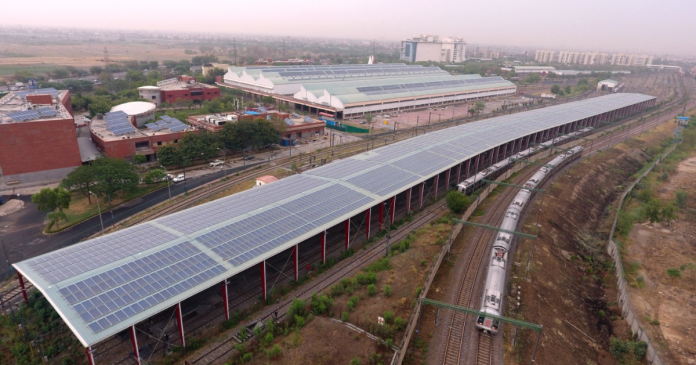
DELHI (Metro Rail News): The Phase IV elevated metro stations are being prepared for the installation of solar plants. Space will be reserved for inverters, panels and necessary equipment. The Delhi Metro Rail Corporation (DMRC) officials stated that the solar plants will be installed on the rooftops of the stations based on their alignment and exposure to sunlight.

The intention is to establish solar plants with a capacity of 10 MW at the Phase IV Metro stations, which could generate approximately 1 crore units of solar energy per year. The annual requirement of additional electricity for Phase IV is estimated to be around
21.8 crore units.

Phase IV has three priority corridors – Janakpuri West-RK Ashram (Magenta Line), Majlis Park-Maujpur (Pink Line), and Aerocity-Tughlaqabad (Silver Line). Currently, 35% of the total energy supplied to Delhi Metro is from renewable sources. The DMRC officials aim to increase this to 50% by 2031. Of the 35% renewable energy used by Delhi Metro, the majority (30%) is from offsite share generated by the Rewa Solar Plant in Madhya Pradesh, while 4% is from rooftop solar plants, and 1% is produced by the waste-to-energy plant in Ghazipur. DMRC’s operational cost for electricity demand accounts for 30% of the total power demand of 270 MW.

Advertisement1
InnoMetro_2026

Metro Rail Maintenance System: A Comprehensive Guide

0

Metro rail systems have revolutionized urban transportation in many parts of the world, providing a safe, efficient, and sustainable mode of transportation to millions of people every day. However, regular maintenance and upkeep are critical to ensure that the metro rail systems operate smoothly and provide a comfortable and safe travel experience. This article will explore the various aspects of metro rail maintenance, including its importance, types, best practices, challenges, and future trends.

Importance of Metro Rail Maintenance

Maintenance is an essential component of any metro rail system. Proper maintenance helps to ensure the safety and comfort of passengers, minimize the risk of breakdowns and accidents, and extend the system’s service life. The cost of maintenance is also much lower than the cost of replacing equipment or infrastructure that has failed. Therefore, a well-planned and executed maintenance program can help to reduce downtime, increase reliability, and minimize the overall life cycle cost of the system.

Types of Metro Rail Maintenance

Metro rail maintenance can be broadly classified into four categories:

  1. Preventive maintenance

Preventive maintenance involves routine inspection, cleaning, lubrication, and adjustment of equipment and infrastructure to ensure that they operate at their optimum level. Preventive maintenance is typically performed on a schedule, and it helps to identify potential problems before they become serious and require costly repairs.

Untitled design 79

2. Corrective maintenance

Corrective maintenance involves repairing or replacing equipment or infrastructure that has failed or malfunctioned. Corrective maintenance is usually performed in response to a failure or defect that has been identified during the preventive maintenance process or through other means, such as passenger feedback or system monitoring.

3. Predictive maintenance

Predictive maintenance involves the use of advanced technologies, such as sensors and data analytics, to identify potential problems before they occur. Predictive maintenance is typically performed in real-time or near real-time, and it helps to reduce downtime, extend the service life of equipment, and increase system reliability.

4. Condition-based maintenance

Condition-based maintenance involves the use of sensors and other technologies to monitor the condition of equipment and infrastructure continuously. Condition-based maintenance helps to identify potential problems early and allows maintenance activities to be scheduled based on the actual condition of the equipment rather than on a predetermined schedule.

Best Practices for Metro Rail Maintenance

shutterstock 1286076259 scaled 1 1

To ensure that a metro rail system operates smoothly and efficiently, several best practices can be adopted, including:

  1. Developing a comprehensive maintenance plan

A comprehensive maintenance plan should be developed that outlines the maintenance activities required to keep the system in good working condition. The plan should include a schedule for preventive, corrective, and predictive maintenance, as well as the resources required to execute the plan.

2. Adopting a data-driven approach

Metro rail systems should adopt a data-driven approach to maintenance, using advanced technologies such as sensors, data analytics, and machine learning to identify potential problems and optimize maintenance activities.

3. Regular inspection and testing

Regular inspection and testing of equipment and infrastructure are essential to identify potential problems and ensure that the system operates safely and efficiently. Regular inspections should be conducted on a schedule, and any defects or issues identified should be addressed promptly.

4. Training and development of maintenance staff

Maintenance staff should be trained regularly to ensure that they are up to date with the latest technologies and best practices in maintenance. Regular training and development can help to improve the quality and efficiency of maintenance activities.

Challenges in Metro Rail Maintenance

Metro rail maintenance is not without its challenges. While proper maintenance is critical to ensuring the safe and efficient operation of metro rail systems, maintenance activities can cause downtime and disruptions to the system, leading to inconvenience for passengers and potential loss of revenue for the system operator. In this section, we will explore some of the key challenges that metro rail systems face in maintenance.

  1. Downtime and Disruptions

One of the most significant challenges in metro rail maintenance is downtime and disruptions. Regular maintenance activities, including preventive, corrective, and predictive maintenance, require that portions of the system be taken offline. This can lead to inconvenience for passengers and result in potential loss of revenue for the system operator. Therefore, it is critical that maintenance activities be scheduled and executed efficiently to minimize downtime and disruptions.

2. High Costs

Metro rail maintenance can be expensive, particularly in systems that have been in operation for many years. Over time, equipment and infrastructure may become worn, requiring more extensive repairs or replacement. Additionally, some maintenance activities, such as inspections and testing, require specialized equipment and personnel, which can add to the cost of maintenance. Therefore, metro rail systems must balance the cost of maintenance with the benefits of providing safe, efficient, and reliable transportation to their passengers.

Alstom India Chennai Metro

3. Ageing Infrastructure

Many metro rail systems in India have been in operation for decades, and their infrastructure is ageing. This can lead to more frequent breakdowns and failures, requiring more extensive repairs and replacement of equipment. The cost of maintaining ageing infrastructure can be high, and replacement of entire systems may be necessary in some cases. Therefore, metro rail systems must invest in regular maintenance and upgrade programs to ensure that their infrastructure remains safe and reliable.

als089 pe 060

4. Skilled Workforce Shortage

Another challenge in metro rail maintenance is a shortage of skilled maintenance personnel. Metro rail systems require a highly skilled workforce to maintain their equipment and infrastructure, including technicians, engineers, and other specialized personnel. However, there is a shortage of skilled workers in the maintenance field in India, which can make it difficult for metro rail systems to recruit and retain qualified staff. Therefore, metro rail systems must invest in training and development programs to build a skilled maintenance workforce.

5. Regulatory Compliance

Metro rail systems must comply with a range of regulatory requirements, including safety standards, quality standards, and environmental regulations. Compliance with these regulations can be time-consuming and costly, particularly when new regulations are introduced or when systems are required to be retrofitted to comply with new requirements. Therefore, metro rail systems must invest in monitoring and compliance programs to ensure that they meet all relevant regulatory requirements.

Conclusion

Metro rail maintenance is essential to ensuring the safe and efficient operation of urban transportation systems. However, maintenance activities can be costly, time-consuming, and disruptive to passengers. To address these challenges, metro rail systems must adopt best practices for maintenance, invest in regular maintenance and upgrade programs, and build a skilled maintenance workforce. By doing so, metro rail systems can provide safe, efficient, and reliable transportation to their passengers and contribute to the sustainable development of their cities.

Advertisement1
InnoMetro_2026

Andhra Pradesh Plans Semi-High Speed Circular Suburban Rail Services to Improve Connectivity and Traffic Facilities in the V-G-T Area

0

The Andhra Pradesh government plans to enhance connectivity and traffic facilities in the V-G-T area by establishing Semi High-Speed Circular Suburban Rail Services. The proposed rail service will connect important locations in the area, including Vijayawada, Namburu, Amaravati, Guntur, Tenali, and Vijayawada.

The Andhra Pradesh Metro Rail Corporation Limited (APMRC) has appointed the Urban Mass Transit Company Limited (UMTC) to conduct a feasibility study and prepare a detailed project report for the suburban rail service in the V-G-T area.

Vijayawada and Guntur are major cities located within the Amaravati Metropolitan Regional Development Area (AMRDA), as well as several surrounding growth centers, including Krishna Canal, Duggirala, Tenali, Vejendla, Mangalagiri, Sathenapalli, Nuzividu, Gudivada, and Gannavaram.

The current rail system in the area is insufficient, with passenger and express trains taking over an hour to travel just 32.17 km from Guntur to Vijayawada. The Indian Railways’ Howrah-Chennai East Coast Corridor is already fully utilized, and branch lines have few trains and are slow in mixed traffic movement. As a result, faster passenger trains cannot be operated for the regional commuters in the area. The development of a Semi High-Speed Suburban Rail System will provide faster commuting for the development of this regional hub.

metro map

The Government of India’s Ministry of Railways has given in-principle approval to the project, which is planned to be taken up under a joint venture between the Government of India and the Government of Andhra Pradesh, following the Suburban Rail Policy of 2017. A detailed project report is currently under preparation, and further details will be provided once it is finalized.


Advertisement1
InnoMetro_2026

Patna Metro’s Sustainable Solution: Solar Power Panels to Bridge Power Gap at Metro Stations

0
Representational Image

PATNA (Metro Rail News): As part of its commitment to sustainable and renewable energy sources, one of the primary goals of the Patna Metro project is to bridge the power gap in the city and reduce the carbon footprint of the transportation system. To achieve this goal, the Patna Metro system is expected to be equipped with solar power panels, similar to the Delhi Metro model.

The decision comes as a result of DMRC’s commitment to Patna Metro Project in reducing carbon footprint and to assist in uninterrupted power supply to its stations in the future. Considering the futuristic technology and potential for solar power generation, it will implement rooftop grid connected solar power panels at selected locations of elevated stations and maintenance depots. The solar panels installed on the rooftops of the metro stations will generate clean and green energy, which will aid constant power supply at Patna Metro stations.

The solar panels will generate approximately 6.5 megawatts of electricity per day. Different sheds and buildings of the establishment are proposed to be used for Solar Photovoltaic (SPV) installation to optimize the solar energy potential. The requirement of power at each elevated station is expected to be 200kW-300kW and 1500kW-2000kW for each underground station. The generated solar power can be used for auxiliary services at the stations like lift operation, lighting, signalling and telecommunication, firefighting system, fare collection system etc.

This initiative for Patna Metro will not only reduce the reliance on non-renewable sources of energy, but it is also in line with the Indian Government’s target of achieving 50 percent cumulative electric power from renewable resources by 2030 and achieve net-zero carbon emissions by 2070. This initiative is also in line with the measures suggested by Bihar Renewable Energy Development Agency (BREDA) towards adopting sustainable construction practices.

Patna Metro is committed to providing clean and green transportation solutions to the citizens of Patna. By adopting solar energy, it is not only reducing carbon footprint but also contributing to the development of a sustainable future. With this initiative, it will set an example for other transport systems to follow.


Advertisement1
InnoMetro_2026

MP’s State Budget Allocates Rs 710 Crore for Bhopal and Indore Metro Rail Projects

0
MP metro project
Representative Image/copyright MPRCL

BHOPAL (Metro Rai News): The state budget of Madhya Pradesh has designated a sum of Rs 710 crore for the metro rail projects in Bhopal and Indore. The cities have a priority corridor that is currently under construction. Despite the availability of external funding for both projects, it has not been utilized yet. The state government aims to commence the priority corridor of these ambitious metro projects by September 2023, which it has set as the deadline.

During a recent statement, Finance Minister Jagdish Devda stated that the operation of the Metro Rail between Indore and Bhopal would be initiated soon. He expressed his hope that the primary corridor will be completed by the year 2023-24.

In October of last year, an official from the Madhya Pradesh Metro Rail Corporation Limited (MPMRCL) announced that the first installment of a $250 million loan (out of a total of $400 million) from the European Investment Bank (EIB) is anticipated to be released in the first quarter of 2023. This announcement came after a visit from the EIB team to Bhopal.It is anticipated that the initial phase of the Bhopal Metro project will consist of 2 lines and 28 stations, and the project will be divided into three main packages. The project equity is divided among various entities, with the MP government and the Union government holding 20% each, while the remaining 60% will be financed through a soft loan from the EIB.

Advertisement1
InnoMetro_2026

Russia’s TMH and India’s RVNL Consortium Emerges as Lowest Bidder for Manufacturing 200 Vande Bharat Trains

0
Vande Bharat Express trains
Vande Bharat Express/Representational image

DELHI (Metro Rail News): Russia’s CJSC Transmashholding (TMH) and Rail Vikas Nigam Limited (RVNL) consortium has emerged as the lowest bidder in the tender to manufacture and maintain 200 Vande Bharat Express trains.

BHEL-Titagarh has emerged as the second lowest bidder. The Indian Railways is planning to produce 200 Vande Bharat Express Trains, which are more premium than the Rajdhani Express trains. The new manufacturer will use the present technology used to manufacture Vande Bharat trains.

The sleeper version of the Vande Bharat train is being designed, and this contract will help in scaling up their production. The new manufacturer has estimated a cost of Rs 120 crore per train set for manufacturing, which is less than Rs 128 crore per Vande Bharat train set as manufactured by ICF.

S. No.Bidder NameBid Amount (Rs. Crore) / Train
1TMH and RVNL120
2BHEL-Titagarh139
3BEML-Siemens145
4Alstom164.5
5Stadler-Medha165

Indian Railways had qualified the technical bids of five players for the Rs 58,000 crore project; BEML-Siemens, BHEL-Titagarh, Alstom, Stadler-Medha, and Russian TMH with RVNL. The lowest bidder will manufacture and maintain 120 Vande Bharat sleeper trains, while the second lowest bidder will manufacture and maintain 80 train sets.

The new Vande Bharat sleeper trains will be manufactured for a life of 35 years and are expected to be used for medium to long-distance travel. The new trains are capable of running at speeds of 160 kmph. Semi-high-speed trains like Vande Bharat sleeper can help bring down travel time between major cities to under 12 hours. Meanwhile, Indian Railways has floated a separate tender for manufacturing 100 aluminum Vande Bharat trains in India, which will be a first for railways. The technical bids for the tender were recently submitted.

The Vande Bharat Express trains are self-propelled and designed to run at speeds of up to 200 kmph, reducing travel time between cities by a significant margin. The trains have several advanced features such as automatic doors, GPS-based passenger information systems, and CCTV cameras for security.

The consortium is expected to set up a manufacturing plant in India to produce the trains, which will be made of aluminum and have a stainless steel body. The production is expected to take around five years, and the trains will initially be used on the Delhi-Varanasi and Delhi-Katra routes.

The Vande Bharat Express project is part of the Indian government’s plan to modernize and upgrade the country’s railway infrastructure. The government has been investing heavily in upgrading railway tracks, signaling systems, and rolling stock to improve safety and efficiency.

The TMH-RVNL consortium’s bid is a significant win for both countries, as it is expected to create employment opportunities in India and enhance India-Russia relations. India has been a key market for Russian defense and manufacturing companies, and the Vande Bharat project is expected to further cement ties between the two countries.

The development comes amid the ongoing tensions between India and China, with the Indian government encouraging domestic companies to reduce their dependence on Chinese imports and increase self-reliance through the ‘Atmanirbhar Bharat’ initiative. The Vande Bharat project is seen as a significant step in this direction, as it aims to create a domestic manufacturing ecosystem for high-speed trains in India.

Overall, the emergence of the TMH-RVNL consortium as the lowest bidder for the Vande Bharat project is being hailed as a significant milestone in India’s efforts to modernize and upgrade its railway infrastructure and promote domestic manufacturing.

Advertisement1
InnoMetro_2026

Keith Bentley, Founder of Bentley Systems, Retires; Julien Moutte Promoted to Chief Technology Officer

0
Bentley office
Image for representation/ Copyright respective authority

NEW DELHI (Metro Rail News): On Mar. 01, 2023 – Bentley Systems, Incorporated (Nasdaq: BSY) (“Bentley Systems” or the “Company”), the infrastructure engineering software company, today announced forthcoming retirements:

  • As of April 2023 founder Keith Bentley will step down as Chief Technology Officer to assume the role of Technology Advisor through his anticipated retirement later in the year, and will continue thereafter his service on Bentley Systems’ Board of Directors. His successor as Chief Technology Officer will be Julien Moutte, currently Vice President of Technology; and
  • David Hollister, currently Chief Investment Officer, will retire as of March 31, 2023. He was succeeded as Chief Financial Officer by Werner Andre at the beginning of 2022.

CEO Greg Bentley said, “It is practically unique for any mature software company to have had, for its lifetime, a chief inventor who has also been its chief evangelist, both for the work of its engineer users and developers. Bentley Systems was founded in 1984 to commercialize Keith Bentley’s software for infrastructure engineering, and Keith’s contributions to the substance and articulation of our work have never slowed down, culminating in our market-leading iTwin Platform for infrastructure digital twins. Keith has been working closely and continuously with Julien Moutte over the past two years. Together they are committed to assuring that iTwin benefits will extend to every one of our application and cloud services users.”

Soon-to-be CTO Julien Moutte joined Bentley Systems as Vice President of Technology in January 2021 from SAP, where he was head of technology for SAP Marketing Cloud. Julien’s technical expertise ranges from cloud operations and high availability platforms to multimedia and mobile. He is an IT entrepreneur and investor and during the past 15 years has launched more than 10 companies in Europe and the United States. Based in Barcelona, Julien is fluent in Spanish, English, and French, and in 1998 graduated in computer science at Université Claude Bernard in Lyon, France. Julien worked in startup ventures, and at SAP, with Bentley Systems’ Chief Operating Officer Nicholas Cumins, to whom he reports.

David Hollister served as Bentley Systems’ CFO between 2007 and 2022. Greg Bentley said, “David Hollister has zealously and adroitly stewarded our financial, portfolio development, and investment activities, and our IPO in 2020 would not have been possible without his drive and orchestration. I am further grateful to David for having nurtured such a capable CFO successor, Werner Andre, who has performed admirably over the past year. It is difficult to imagine David ever ‘taking it easy,’ but along with all his colleagues and Bentley Systems’ external constituencies, I thank and congratulate him upon his retirement!”

Keith Bentley and David Hollister will participate in Bentley Systems’ quarterly operating results presentation on February 28, 2023. To join the live Zoom video webinar of the event, please register through this direct link. Alternatively, the event can be accessed from the Events & Presentations page on Bentley Systems’ Investor Relations website at https://investors.bentley.com. A replay and transcript will be available after the conclusion of the live event on Bentley Systems’ Investor Relations website.


Image 1 bentley
Keith Bentley, Founder and Chief Technology Officer, Bentley Systems. Image courtesy of Bentley Systems.
David Hollister, Chief Investment Officer, Bentley Systems. Image courtesy of Bentley Systems.
Julien Moutte, Vice President of Technology, Bentley Systems. Image courtesy of Bentley Systems.

About Bentley Systems

Bentley Systems (Nasdaq: BSY) is the infrastructure engineering software company. We provide innovative software to advance the world’s infrastructure – sustaining both the global economy and environment. Our industry-leading software solutions are used by professionals, and organizations of every size, for the design, construction, and operations of roads and bridges, rail and transit, water and wastewater, public works and utilities, buildings and campuses, mining, and industrial facilities. Our offerings, powered by the iTwin Platform for infrastructure digital twins, include MicroStation and Bentley Open applications for modeling and simulation, Seequent’s software for geoprofessionals, and Bentley Infrastructure Cloud encompassing ProjectWise for project delivery, SYNCHRO for construction management, and AssetWise for asset operations. Bentley Systems’ 5,000 colleagues generate annual revenues of more than $1 billion in 194 countries.

Advertisement1
InnoMetro_2026

An advanced Metro System needed for the Metropolitan City : Mumbai Metro

0
Mumbai Metro Line 6
Representational Image

The idea to build the Mumbai Metro, with the purpose of providing alternate transport facility to Mumbaikars, started taking reality in 2006, when the foundation stone for phase-I, according to the Mumbai Metro map was set. However, operational and policy bottlenecks caused the Mumbai metro routes to be delayed. There are now only three Mumbai Metro routes in operation. Two of them are new metro lines in Mumbai.

On January 19, 2023, Prime Minister Narendra Modi dedicated the Mumbai Metro lines 2A and 7 to the nation. Modi rode the metro from Gundivali train station to Mogra and back. In 2015, the Prime Minister laid the groundwork for these two lines.

Mumbai Metro will also be compatible with the National Common Mobility Card, which conforms to the One Nation, One Card approach. From October 2022, the Mumbai Metropolitan Region Development Authority (MMRDA) has begun trial runs for these two metro lines. When both sections of the Mumbai Metro lines – Line 2A and Line 7 – are fully operational, they shall carry close to 3 lakh passengers.

The projected cost of the Line 2A Mumbai metro project is Rs 6,410 crore. Lines 2 A and 7 in Mumbai will feature two interchanges, one at Dahisar and the other at DN Nagar metro station, with the existing Mumbai Metro Line 1. (Ghatkopar and Versova). The Mumbai 1 mobile app introduced will have all Mumbai metro related information and also help in buying tickets online by payment using UPI. 

The first phase of the Mumbai metro routes ‘Metro 2A’ (Dahisar to DN Nagar) and ‘Metro 7’ (Dahisar East to Andheri East), was made operational for passengers on April 2, 2022. Every day, more than 3 lakh commuters are projected to use the new metro lines. The first section of the new Mumbai Metro 2A route is from Dahisar to Dahanykarwadi, and the first phase of the new Mumbai Metro 7 route is from Dahisar to Aarey colony.

There would be 11 trains of six coaches operating for both Mumbai metro corridors, with 8 or 9 of them operational and the others on standby. The Mumbai metro trains will run every 10 minutes and will be operational for about 19 hours a day.

On February 22, 2022, approximately 50% of the statutory inspection of the delayed Phase 1 of Mumbai metro corridors 2A and 7 between Dahanukarwadi and Aarey was completed by the Commissioner of Metro Rail Safety (CMRS). The inspection includes a look at the railway assets, including signalling, OHE, civil works, stations, and platforms. On March 25, 2022, the Mumbai Metro received its safety certificate.

Metro Routes

Line 1

This operating route connects Versova to Ghatkopar through Andheri and is also known as the Blue Line on the Mumbai metro map. The Mumbai metro route connects significant locations in the western suburbs with the central suburbs, making it one of the city’s most popular modes of transportation. This 11.4-kilometre-long Mumbai metro track is entirely elevated.

Line 2

This 42-kilometre-long Mumbai metro route, often known as the Yellow Line, is divided into two sections: Mumbai Metro line 2A and Mumbai Metro line 2B.

The Mumbai Metro line 2A segment will be an 18-kilometre corridor connecting Dahisar-Charkop-DN Nagar with 17 Mumbai metro stations. Because of community requests for location-specific metro stations, the MMRDA renamed 15 of the 17 stations. According to the MMRDA list, two stations whose names have not been altered are Dahisar East Metro station and Eksar Metro station.

The 2B section will be 23.5 kilometres long and will connect DN Nagar, BKC, and Mankhurd. This project is expected to cost roughly Rs 17,000 crores. The first leg of the 2A Mumbai metro route of 9.5 km began operations on April 2, 2022, and connects Dahisar, Anand Nagar, Kandarpada, IC Colony, Eksar, Borivali West, Pahadi Eksar, Kandivali West, and Dhanukarwadi with 9 stations.

Line 3

Line 3 of the Mumbai Metro, also known as the Aqua Line, is 33.5 kilometres long and totally underground, connecting Cuffe Parade in south Mumbai to SEEPZ and Aarey in north Mumbai. It includes 26 underground Mumbai metro stations and one at-grade station. This Mumbai metro route will also travel through the Mumbai Airport, enhancing regional connectivity.

The overall cost of constructing this route was formerly estimated to be Rs 23,136 crores. The Maharashtra cabinet approved additional funding of Rs 10,269 crore for the Mumbai Metro Line 3 project on August 10, 2022, citing cost inflation, bringing the total cost to Rs 33,405 crore.

Japan International Cooperation Agency(JICA) is funding Metro Line 3 with new costs, JICA’s contribution will rise from Rs 13,235 crore to Rs 19,924 crore. By 2031, 17 lakh passengers are expected to travel daily on Metro Line 3. The tunnel work has been finished to 98.6 percent, while station work has been completed to 82.6 percent. A total of 73.14 hectares of government property and 2.56 hectares of private land have been acquired.

The Aqua Line, also known as the Mumbai Metro Line 3, was inaugurated at Sariput Nagar in Aarey Colony by Maharashtra chief minister Eknath Shinde and deputy chief minister Devendra Fadnavis. Construction work has begun to connect Chhatrapati Shivaji Maharaj Terminal’ (CSMT) ancient subway to Mumbai Metro Aqua Line 3. MMRCL has already erected barricades in front of the subway at the entry site near Canon.

Aqua Line will connect at eight public transportation hubs, increasing connectivity. Mumbai CSMT and Churchgate termini, Grant Road and Mumbai Central railway stations, Dadar MSRTC bus depot, Mahalakshmi monorail, and Mumbai Metro Lines 1 and 2B are among them. Furthermore, the dynamic and static testing of the initial design proving train trial runs for Mumbai Metro Line 3 has been completed.

Line 4

Mumbai Metro Line 4, also known as the Green Line, would connect Kasarvadavali in Thane to Wadala in south-central Mumbai. This Mumbai metro route would improve connectivity between Mumbai and Thane while also relieving pressure on the local rail network. This project is projected to cost Rs 15,000 crores. The project is under construction.

Line 5

This 24-kilometre-long Thane-Bhiwandi-Kalyan Metro-5 line, popularly known as the Orange Line, would be totally elevated and will include 17 Mumbai metro stations. It will cost Rs 8,416 crore to build. The Metro-5 route will eventually connect with the Metro-4 Wadala-Thane-Kasarwadavli line and the Metro-11 Taloja-Kalyan corridor.

Line 6

This Mumbai metro route, also known as the Pink Line, would connect the western and eastern suburbs and will be the second west-east metro corridor after the already functioning Versova-Andheri-Ghatkopar portion. The 14.5-kilometre route will have 13 Mumbai metro stations.

Akurli Metro Station Line 7 scaled

Line 7

Mumbai Metro Line-7, also known as the Red Line, is a 33.5-kilometre-long Mumbai metro route that will connect Dahisar to Andheri and then to the Mumbai International Airport. The line would include 29 Mumbai metro stations, 14 of which will be elevated and the rest subterranean. The Mumbai metro route was scheduled to begin operations in 2020. The Covid-19 pandemic, however, slowed down the civil construction works. The second phase of Metro Line 7 construction is 98% complete. 

The Phase 1 of Mumbai Metro Line 7 began operations on April 2, 2022, trials for phase 2 are planned to begin in October 2022, with commercial operations proposed to begin by the end of December 2022.

In addition, the MMRDA will construct a footbridge connecting the Goregaon station on Metro Line 7 to the Goregaon western railway station. MMRDA plans to open the Line 7 Mumbai metro project, which is expected to cost roughly Rs 6,208 crore, in January 2023.

Line 8

Line 8, also called the Gold Line, is a proposed Mumbai metro route connecting Mumbai Airport and Navi Mumbai Airport. The approved length of this Mumbai metro route is 32 kilometres, and the project will cost Rs 15,000 crores to build. On this route, eight metro stations have been proposed.

Line 9

Line 9 of the Mumbai Metro is an extension of Line 7 and Metro-2A. (Dahisar to DN Road). This corridor, which will connect Gaimukh and Shivaji Chowk (Mira Road or Metro-10 ), will cost Rs 3,600 crores. The Mumbai metro route was supposed to open in 2019; however, due to procedural issues, the date has been extended to October 2024.

Line 10, 11

Lines 10 and 11 of the Mumbai Metro are expansions of Line 4, often called as the Green Line. These lines will link Gaimukh and Shivaji Chowk (Mira Road), as well as Wadala to CSMT. PM Narendra Modi laid the foundation stone of the project in 2017. Work on these lines has begun.

Line 12

This Mumbai metro route is intended to be a continuation of Mumbai Metro Line 5. It will connect Kalyan and Taloja and improve connectivity throughout the Mumbai Metropolitan Area.

Line 13

This is a proposed Mumbai metro project that will link Mira Road and Virar. The cost of this 23-kilometre-long Mumbai metro route is anticipated to be over Rs. 6,900 crores. The comprehensive project report for this route is currently being developed. The project is scheduled to be completed by 2026. This will be referred to as the Purple Line. 

Line 14

The Magenta Line is a Mumbai metro route that will connect Vikhroli with Kanjurmarg and thereafter to Ambernath-Badlapur. It shall have an interchange with Line 6, called the Pink Line. This project, which is also in the DPR state, will cost approximately Rs 13,500 crores. This Mumbai metro line is scheduled to open by 2026.

Conclusion

The Mumbai Metropolitan Region Development Authority (MMRDA) is implementing the Mumbai Metro route network, which is being expanded beyond the Mumbai region.

At the moment, only one Mumbai metro route is completely operational, while two more are being phased in. In Mumbai, eight are under construction, and five metro lines have been approved. The first line opened in June 2014, the other two additional new metro lines began operations in April 2022. Mumbai has 14 metro lines, with two additional lines on the extension. Metro Line 2B (D N Nagar to Mandale), Metro Line 4 & 4A (Wadala-Kasarvadavali-Gaimukh), Metro Line 5 (Thane to Kalyan), Metro Line 6 (Swami Samarth Nagar to Vikhroli), and Metro Line 9 are all under development in Mumbai (Andheri to CSIA and Dahisar to Mira Bhayander). All of these Mumbai metro routes, according to MMRDA, have already initiated civil works and are projected to be completed by 2022-2024.


Advertisement1
InnoMetro_2026

Navi Mumbai Metro: Connecting the Fast-Growing Satellite City

5
Navi Mumbai Metro Line 1

Navi Mumbai Metro: An Introduction

Navi Mumbai, created as a satellite city for Mumbai, has grown rapidly in the recent decade. Today, every node, both old and new, that is opening up in Navi Mumbai is being developed carefully with the goal of providing people with cutting-edge social and physical infrastructure. Seawoods Darave, for example, is India’s first and largest transit-oriented development (TOD) situated in Navi Mumbai. The operation of the Navi Mumbai Metro (NMM), which offers good connection to its various nodes, is the next milestone for this satellite city.

Mumbai (Navi Mumbai) Metro Line-1 phase-2 trial run from Central Park (station 7) to Utsav Chowk (station 4) in Kharghar has been completed successfully. With the completion of this successful test, construction on the NMM Line Phase-2 has gained momentum. On November 25, 2022, CIDCO entered into an agreement with ICICI Bank for a Rs 500 crore Line of credit, completing the financial completion process for the Metro Line No. 1 project. With Rs 500 Crore line of credit facility from ICICI Bank, work on Line No. 1 will be hastened, and passengers will be able to ride on this line as soon as the construction is completed on time. The approved line of credit has, in some ways, stamped the trustworthiness of CIDCO’s undertakings.

The Belapur-Pendhar line viaduct has been finished, and 5 of the 11 stations are ready for commissioning. This Line has received all necessary certifications, including CMRS. The last six stations are now under construction, and the entire route is projected to be operational very soon. The cost of Metro line-1 is anticipated to be around Rs 3,400 crore, of which Rs 2,600 crore has already been invested by CIDCO, Rs 500 crore is from a bank line of credit, and the remainder would be CIDCO internal accruals.

The Navi Mumbai Metro is expected to serve one lakh passengers per day by 2027. After receiving the RDSO certificate and the ‘Dynamic Clearance Certificate,’ the next step for the Navi Mumbai Metro was to obtain the Commissioner of Metro Railway Safety (CMRS) certificate. On February 11, 2022, the Railway Board of the Government of India approved the rolling stock (coaches, electricity, etc.) of CIDCO’s Navi Mumbai metro. The Navi Mumbai Metro is now undergoing civil work inspection. Following the successful completion of the civil work inspection, the CMRS and the Railway Board will issue a green signal to begin direct transport.

Metro Rail Network

The Maharashtra government has designated the City and Industrial Development Corporation of Maharashtra Ltd (CIDCO) as the implementing agency for the building, maintenance, and operation of the Navi Mumbai Metro Corridor-1, which will be built in three stages. On May 1, 2011, the foundation stone for the Navi Mumbai metro train project was laid. Corridor-1 connects Belapur, Kharghar, Pendhar, Kalamboli, and Khandeshwar, with plans to expand it to Navi Mumbai International Airport (NMIA). Corridor-1 is based on a detailed project report prepared for the Navi Mumbai Metro Rail Project by the Delhi Metro Rail Corporation (DMRC).

Metro Line 1

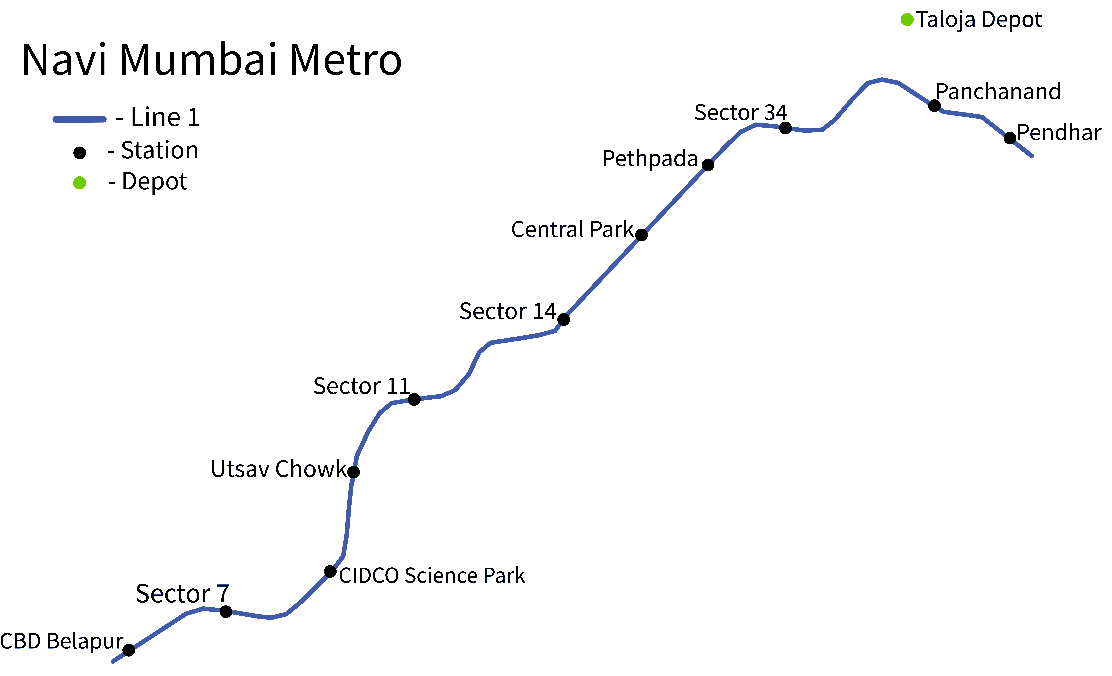
Line-1 will be 23.4 kilometres long and will have 20 metro stations. The Navi Mumbai Metro Line 1 line will begin in Belapur and end at the Navi Mumbai International Airport (NMIA). Line-1 would be built in four phases, with the first covering a distance of 11.10 kilometres and include 11 elevated stations with a terminus at Belapur and a depot-cum-workshop at Taloja metro station.

Metro Line 2 

The Navi Mumbai Metro Phase 2 route from MIDC Taloja metro station to Khandeshwar will stretch 10.30 kilometres and feature eight stops. The Navi Mumbai Municipal Corporation (NMMC) and the Mumbai Metropolitan Region Development Authority (MMRDA) will fund Navi Mumbai Metro Lines 2 and 3, respectively.

Navi Mumbai Metro Map

A two-kilometre-long interlink between Pendhar and MIDC will be developed as part of Phase 3 of the Navi Mumbai Metro line. Ultimately, Phase 4 of the Navi Mumbai Metro will run from Khandeshwar to the Navi Mumbai International Airport (NMIA).

Metro link to suburban railway stations

Belapur suburban railway station would be connected to Metro station 1, while Kharghar suburban railway station would be connected to Metro station 3. Furthermore, the Taloja metro station could provide as a link to the Konkan Railway. The Navi Mumbai Metro would be a three-car train that could be expanded to a six-car train if demand grows and related infrastructure becomes available.

Dynamic Clearance Certificate

Mumbai (Navi Mumbai) The central Ministry of Telecommunications granted the ‘Dynamic Clearance Certificate’ to Metro Phase 1 from Belapur to Pendhar metro station.

RDSO Certified

The interim speed certificate for CIDCO’s Navi Mumbai Metro’s Metro Line-1, Phase 1, from Belapur to Pendhar metro station has been given by the Research Design and Standards Organisation (RDSO) in Lucknow. The RDSO certificate for the Navi Mumbai Metro route between stations 7 and 11 was issued on October 20, 2021. Navi Mumbai Metro received the certificate following successful trials and reviews of test certifications, as well as a vast quantity of documentation demonstrating adherence to the RDSO safety rules.

Conclusion

The Navi Mumbai Metro is a mass rapid transit system built by CIDCO, with line 1 set to open in early 2023. To relieve the strain on the railway network and the increasing traffic on the roads, a new method of public transportation was needed to connect all Navi Mumbai residential nodes. As a result, the Navi Mumbai metro was constructed with five lines that span 106.4 kilometres. The Navi Mumbai Metro will not only meet a critical transit necessity for the smart city, but it will also help the city’s economic growth.

Advertisement1
InnoMetro_2026