Home Blog Page 239

New Garia-Airport Metro Ramp Construction Resumes After Three-Year Logjam

0
KOLKATA METRO
Representational image

KOLKATA (Metro Rail News): Kolkata’s New Garia-Airport Metro ramp construction, which had been stalled for three years due to a logjam on VIP Road, is now set to proceed. To enable traffic diversion and the construction of the ramp leading to the underground station, the Kolkata airport’s land is being handed over by the Airports Authority of India (AAI). Metro Railway has agreed to pay Rs 64 crore to the airport authorities and has already released half of the sum. Once completed, the Public Works Department (PWD) will let Rail Vikas Nigam Ltd (RVNL) to barricade the Kolkata-bound flank near Kaikhali crossing and initiate construction work. RVNL estimates it will take two months to build the road for traffic diversion.

The New Garia line, which terminates at the airport along with the Noapara-Airport and Barasat-Airport links, is a crucial part of Kolkata’s upcoming Metro network. The New Garia-Airport Metro route will mainly comprise a viaduct over EM Bypass and New Town, but will also include an 800m underground section on VIP Road to link the overhead tracks with the Airport Metro station. The diaphragm walls for tunnelling through the cut-and-cover method to link the 32km New Garia-Airport corridor with the terminal Airport Metro station have already begun. The Metro tracks will go underground on VIP Road to connect the Airport Metro station. The Metro viaduct has been built until the Kaikhali crossing, but further progress was halted due to the land logjam. Despite the fact that the construction of the New Garia-Airport line has been ongoing for years, the 5.4km section from New Garia to Ruby is now prepared for launching.

Advertisement1
InnoMetro_2026

Alstom Starts Production of Metro Trainsets for Indore and Bhopal Metro

0
Commencement ceremony for manufacturing of Bhopal-Indore Metro trainset/Photo by Bhopal Metro Rail

SAVLI, GUJARAT (Metro Rail News): Alstom Transport India has initiated the production of metro trains for Indore and Bhopal Metro at its Savli manufacturing plant in Gujarat. Bhupendra Singh, the Urban Development Minister in the state, virtually inaugurated the launch of the rolling stock production. In July 2022, Alstom was contracted by Madhya Pradesh Metro Rail Corporation Limited (MPMRCL) to create, design and deliver 52 standard gauge Movia metro trainsets with three-car configurations each for both metro projects in Bhopal and Indore. Alstom is to supply 27 trainsets for Bhopal metro and 25 for Indore.

Honorable Urban Development and Housing Minister, Mr. Bhupendra Singh attending the ceremony virtually/Photo via Twitter

As part of the €387 (around 32,00 crore ) million contract, the installation of the latest Communications Based Train Control (CBTC) signalling system, train control and telecommunication systems, with seven years of comprehensive maintenance, is included.

Operating at a maximum speed of 80 kmph, the Movia metro family consists of lightweight, air-conditioned stainless steel carriages powered by modern energy-efficient propulsion systems with regenerative braking. The French major also received another combined order for the Agra-Kanpur metro project, marking the company’s second such combined order in India.

Alstom, a French mobility company, has a strong order portfolio in India. It has received its second combined order in India after the Agra-Kanpur metro projects. The company has been tasked with delivering 201 standard gauge metro cars for the Agra and Kanpur Metro Project, with an option to supply an additional 51 metro cars. Additionally, Alstom is currently involved in manufacturing metro trains for Mumbai Metro Line 3, as well as modern trainsets for India’s first semi-high-speed Delhi-Meerut RRTS project.

Advertisement1
InnoMetro_2026

Chennai Metro Rail Plans to Establish Operations Control Centre in Madhavaram

0
Chennai Metro
Representational image

CHENNAI (Metro Rail News): Chennai Metro Rail Limited is planning to establish an operations control centre (OCC) in Madhavaram to monitor and control the metro trains of phase-1 and driverless trains of phase-2. The OCC will have additional space and facilities for future expansion, and another OCC will be set up at CMRL’s headquarters in Nandanam as a backup.

According to an official, the existing OCC in Koyambedu will be dismantled and used for property development once the new OCC in Madhavaram is established. The tender for the project has been floated, and it will take about a year to set up once the tender is awarded.

The OCC will be responsible for monitoring the movement of trains on the mainline and taking control of train operations during emergencies. The entire operation of the driverless trains, including the opening and closing of doors at stations, will be controlled from the OCC, with cameras installed inside and outside the trains to monitor the trains remotely. In phase-1, CMRL currently has a fleet of 52 trains, and they intend to operate almost 110 trains in phase-2. To ensure backup in case of an emergency, a backup OCC (BOCC) will be built far away from the main OCC. This backup will be used if there is an emergency, like a fire accident in the main OCC, according to R Ramanathan, former CMRL director.

Advertisement1
InnoMetro_2026

RVNL Starts Work on Underground Tunnel for Kolkata’s New Garia line

0
Kolkata Metro
Representational Image

KOLKATA (Metro Rail News): Rail Vikas Nigam Ltd (RVNL), the implementing agency for the New Garia-Airport Metro corridor in Kolkata, has begun work on constructing an underground tunnel to connect the airport Metro terminal to the line. The tunnelling is expected to be completed by the end of this year, while the 3.5km section from City Centre II to the airport is set to be completed by the end of 2024.

Although the Metro project connecting New Garia with Netaji Subhas Chandra Bose International Airport still has several gaps, a 5.4km section is set to be launched commercially this month. The construction of the diaphragms on both sides of the 800m underground section through Airports Authority of India (AAI) land is also being carried out by Afcons Infrastructure.

An official has announced that the New Garia-Airport Metro stretch will include a total of 24 elevated stations, with Phase 1 covering five stations, including the terminal Kavi Subhas station and the Hemanta Mukherjee station at Ruby crossing. RVNL is currently fast-tracking the remaining stations. The airport station will act as the northern terminal of the Metro corridor and will also serve as a stop for the 6.8km Noapara to airport line, which is set to be extended to New Barrackpore.

Afcons’ scope of work includes the 800m tunnel, for which trenching work began near the end of February. The 3.5km mostly elevated segment with two new stations at Chinar Park and VIP Road (Haldiram’s) will connect City Centre II and airport Metro stations. In January 2021, Afcons was awarded the Rs 532 crore civil construction contract with a 36-month deadline.

Advertisement1
InnoMetro_2026

NCRTC Expects to Complete 17-km Priority Section of RRTS Corridor March-end

0
RRTS-trainsets
Representational image only

GHAZIABAD (Metro Rail News): The NCR transport corporation (NCRTC) is making significant progress with the construction of the 17-km priority section of the RRTS corridor, with trial runs already underway. The corporation expects to complete the project by the end of March, which is three months ahead of the official deadline set for June. The 17-km priority section extends from Sahibabad to Duhai and forms part of the 82-km RRTS network, connecting Delhi, Ghaziabad and Meerut, with a total cost of Rs 30,274 crore.

The six trainsets stationed at the Duhai depot are being tested, with advanced-stage signal testing being conducted manually. The corporation is set to announce the fare module for the RRTS, which is expected to be higher than the estimated Rs 2 per kilometre as per the detailed project report (DPR). The NCRTC is implementing a cutting-edge automatic fare collection (AFC) system for RRTS, including the introduction of the National Common Mobility Card (NCMC) for ticketing options.

Advertisement1
InnoMetro_2026

Tata Steel to Manufacture 22 Vande Bharat Express Trains for Indian Railways

0
Vande Bharat Express trains
Vande Bharat Express/Representational image

NEW DELHI (Metro Rail News): Tata Steel, India’s leading steel manufacturer, has signed an agreement with the Indian Railways to manufacture at least 22 Vande Bharat Express trains, India’s fastest and most feature-rich trains, in the coming year. The Ministry of Railways aims to manufacture a total of 200 Vande Bharat trains over the next two years and launch the first sleeper version by the first quarter of 2024.

To expedite production, Indian Railways has signed an agreement with Tata Steel on various schemes. As part of the agreement, Tata Steel will manufacture seats for the Vande Bharat Express, from first AC to three-tier coaches. The company has also been contracted to make Linke Hofmann Busch (LHB) coaches for the train, which includes structures of panels, windows, and railways of the trains.

The multinational steel company has been awarded a tender worth approximately Rs 145 crore for manufacturing the train’s parts. The manufacturing process is expected to take 12 months.

The composites division of Tata Steel has already started working on the seating system for Vande Bharat Express, which includes 22 train sets with 16 coaches
each. According to Debashish Bhattacharya, the Vice President of Tata Steel’s Technology and New Materials Business, the seats have been specially designed to rotate up to 180 degrees and include passenger amenities resembling those found on aeroplanes, marking the first time such features have been incorporated into trains in India.

Advertisement1
InnoMetro_2026

Maharashtra government proposes ₹40,000 crore for Metro projects, Mumbai to get new lines

0
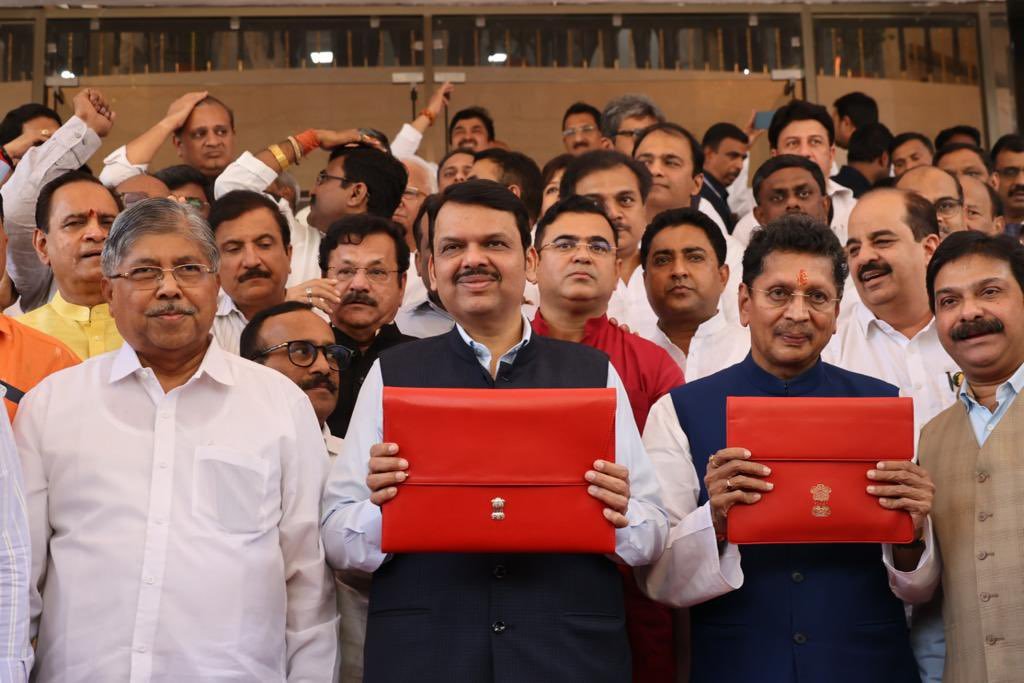
Presentation of Maharashtra Budget 2023

MUMBAI (Metro Rail News): The Maharashtra government has proposed a budget of ₹40,000 crore for Metro projects in various parts of the state, with new lines to be added in Mumbai, Thane, Nashik and Pimpri-Chinchwad. Deputy Chief Minister Devendra Fadnavis made the announcement during his speech in the Assembly. The state has sent proposals for new Metro projects in Thane, Nashik, Pimpri-Chinchwad, and the Nigdi corridor of Pune Metro and Swargate to Katraj Metro project are awaiting approval from the central government. Fadnavis stated that the convenience of passengers in Mumbai, MMR and Thane areas is the top priority. A total of 337 km long Metro network is being developed, out of which 46 km stretch has already been opened for traffic, and an additional 50 km stretch is expected to be operational by 2023-24.

Maharashtra Budget in state assembly
Maharashtra Budget in the state assembly

Mumbai will see the addition of three new Metro lines: line 10 from Gaimukh to Shivaji Chowk in Mira Road, with a length of 9.2 km and estimated cost of ₹4,476 crore; line 11 from Wadala to Chhatrapati Shivaji Maharaj Terminus, with a length of 12.77 km and estimated cost of ₹8,739 crore; and line 12 from Kalyan to Taloja, with a length of 20.75 km and estimated cost of ₹5,865 crore.

In Nagpur, the second phase of expansion of the Metro network has been approved by the central government, with work on a 43.80 km stretch to be undertaken in 2023-24 at the cost of ₹6,708 crore. Work is also in progress for the Hinjewadi to Shivanagar Metro Rail project in Pune, with an estimated budget of ₹8,313 crore for the 23.3 km length.

Advertisement1
InnoMetro_2026

State Bank of India Becomes Sole Bidder for Agra Metro’s Automatic Fare Collection Contract

1
AFC system
AFC system/Representational image, Photo by: Rohit Padole

AGRA (Metro Rail News): The State Bank of India (SBI) has become the sole bidder for Package AGAFC-01, the Automatic Fare Collection (AFC) contract for the Agra Metro Phase 1 project. The Uttar Pradesh Metro Rail Corporation (UPMRC) will be using a public-private partnership (PPP) model for this systems contract, with the selected contractor being responsible for designing, manufacturing, supplying, installing, testing, and commissioning an end-to-end Open Loop EMV (RuPay/Master/Visa) NCMC card-based AFC system, along with QR code-based ticketing.

All devices will be connected to a central back-office AFC system. This is a retender, with the initial bidding process in July 2022 receiving zero bids by December of the same year. The work period for this retender is set at 1050 days. The scope of the project includes the design, manufacture, supply, installation, testing, and commissioning of the open-loop EMV NCMC card and QR code-based AFC system on a PPP basis for the Agra Metro Project. In case UPMRC is not content with SBI’s offer, the package will undergo a retender. On the other hand, if UPMRC is satisfied with SBI’s bid, it will proceed to a technical evaluation that could take up to a month to complete.

Advertisement1
InnoMetro_2026

Rail Vikas Nigam Limited invites bids for Rayagada Yard Phase-II works in Odisha

0
Indian Railways/Representational Image
Representational Image

NEW DELHI (Metro Rail News): Rail Vikas Nigam Limited (RVNL) is seeking bids for Rayagada Yard Phase-II works and other related works in Package-4 of Sambalpur/Waltair Divisions of East Coast Railway in Odisha, India. The works include balance construction of roadbed works, bridges, installation of track (excluding supply of rails and B.G main line sleepers), construction of platforms, platform shelters, and soft development of Rayagada Circulating Area, among others.

The approximate estimated cost for the project is INR 35,61,40,481 Crore and the period of work is 18 months. The tendered work is part of the project for the 3rd line of the existing railway line between Titlagarh-Vizianagaram of East Coast Railway, and the works are located in between Bissamcuttack-Ladda station yard limits and in connection with the 3rd line track between Titlagarh-Vizianagaram Section.

The scope of work includes Bridge works, Protection works, Formation works, P.way track linking, laying of points and crossings, slewing of track, miscellaneous works, Passenger Amenities at Stations, supply of cement and provision of site facility and related works. The section of Bissamcuttack-Ladda Stations is a part of the 3rd line between Titlagarh-Vizianagaram.

Advertisement1
InnoMetro_2026

CMRL Removes Six Stations from Phase-2, Saving 1,200 Crore

0
Chennai Metro
Representational image

CHENNAI (Metro Rail News): Chennai Metro Rail Limited (CMRL) has removed six metro stations from phase-2 of its project, which is expected to save nearly 1,200 crore. The stations, including Doveton Junction, Foreshore Estate, Natesan Park, Meenakshi College, and Thapal Petti, were all either underground or elevated and situated less than 750m from the next stop. One of the reasons for removing the stations, as stated by CMRL spokesperson L Girirajan, was their close proximity to the nearest stations. Another reason was that the proposed station at Thapal Petti would have had a sharp curve that could be challenging to maintain.

The proposed phase-2 of Chennai Metro Rail is 118.9km long with 128 stations, including 48 underground stations, and is expected to be completed by 2026. Metro stations are generally planned every 1km for easy access and emergency evacuation. The stations that have been removed are on the 45.8km Madhavaram Milk Colony-Siruseri Sipcot corridor-3 and the 26.1km Lighthouse-Poonamallee Bypass corridor-4.

Changes were made by CMRL to decrease the project cost from 89,000 crore to 61,843 crore, which included the substitution of the maintenance depot originally proposed for Siruseri SIPCOT with stabling lines for train parking. Additionally, it has converted some stations from being underground to elevated and decreased the size of the stations by 25% in comparison to phase-1 stations. Sources say that similar emergency structures to the shaft built inside May Day Park at Chintadripet may be built in place of the removed stations.

Advertisement1
InnoMetro_2026