Introduction
Wi-Fi is fairly common all around the world. It enables us to wirelessly link our smart devices to the internet. It employs electromagnetic radio waves at various frequencies, namely 2.4 GHz, 5 GHz, and 6 GHz, depending on the supporting WLAN chips. Various WLAN standards have been developed to provide higher data speeds and better coverage. The WLAN adheres to IEEE standards such as 802.11b, 11a, 11g, 11n, 11ac, 11ax, and 802.11be. Wi-Fi networks are generally used for larger data rates with restricted coverage and have been developed to support devices inside buildings, offices, railway stations, airports, and trains, among other places.
WLAN (Wireless Local Area Network) standards were created to accommodate smart devices with limited mobility initially. The IEEE 802.11ax version allows for greater mobility, allowing internet connection in automobile-confined devices via Wi-Fi hotspots. Cellular technologies adhere to 3GPP or ETSI standards and are primarily intended for usage in outside areas for fast-moving vehicles. Cellular standards include 2G (GSM), 3G (UMTS or CDMA), 4G (WiMAX, LTE), and 5G NR (New Radio). Wi-Fi service is offered by installing a Wi-Fi Router, which is an 802.11 AP (Access Point). Cellular service is delivered by erecting a cell tower and supporting equipments for PSTN/PSDN interface. Satellite networks provide connection in remote areas where cellular towers are either unavailable or impractical to deploy in rural and steep terrain. Due to placement in higher altitudes and at a greater height above the Earth, satellites provide a much broader coverage of the Earth.
Specific cellular standards for railways have been developed, including GSM-R and LTE-R, with the following specifications. The chart below summarises the key aspects of Wi-Fi and cellular standards (GSM-R, LTE-R, and 5G NR).
| Feature | WiFi-6/6E (IEEE 802.11ax) | Cellular (GSM-R) | Cellular (LTE-R) | Cellular (5G NR) |
| Frequency | 2.4 GHz, 5 GHz, 6GHz | 876 to 880 MHz, 912 to 925 MHz | 450, 800, 1400 MHz | 3.5, 28, 34, 66 GHz |
| Channel Bandwidth | 20 to 160 MHz | 0.2 MHz | 1.4 to 20 MHz | 1.25 to 400 MHz |
| Data rate i.e. throughput | 600 Mbps (80 MHz, 1 Spatial Stream-SS), 9.6 Gbps (160 MHz, 8 SS) | 172 Kbps per channel | 50/10 Mbps | 4 Gbps per channel |
| Mobility | 300 Km/Hr | 350 Km/Hr | 500 Km/Hr | 500 Km/Hr |
(Comparison of Wi-Fi and Cellular Technologies)
L band (1-2 GHz), C band (3700-4200 MHz in downlink and 5925-6425 MHz in uplink), extended-C band, Ku band (11.7-12.7 GHz in downlink, 14-14.7 GHz in uplink), and Ka band (18.8-19.3 GHz in downlink, 28.6-29.10 GHz in uplink) are the bands used in satellite communication networks. The most common bandwidths for satellite transponders are 36 MHz and 72 MHz. Ground station users employ these whole bandwidths for a number of voice/data calls depending on various multiple access mechanisms.
Wi-Fi network architecture: Homes

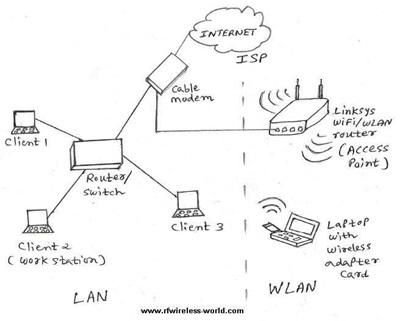
The basic Wi-Fi system consists of a single Wi-Fi router at home that is linked to an ISP (Internet Service Provider) on one side and Wi-Fi Clients (i.e. Stations) on the other. To interface with a Wi-Fi router, a cable modem or a compatible modem is usually required, depending on the technologies used by the ISP. ISPs have been using a variety of technologies to deliver internet access to users over the years, including dial-up internet, ADSL/SDSL, cable internet, ISDN, Ethernet, fibre optic, satellite, Wi-Fi, and cellular broadband.
Wi-Fi Network Architecture at Home
A Wi-Fi router enables several wifi-enabled smart devices to share a single internet connection. As a result, a number of individuals can use a single high-speed internet connection comfortably and economically. Connections to ethernet or ethernet ports are available on the Wi-Fi router. With the help of these, desktop PCs or laptops equipped with 10/100/1000 Mbps LAN devices can be readily connected to these ports using ethernet cables. Wi-Fi hotspots are deployed in shopping malls, airports, railway stations, and at business enterprises to provide internet access to customers or passengers using Wi-Fi routers. These Wi-Fi routers are linked to an ISP.
Wi-Fi network for moving trains: The Working

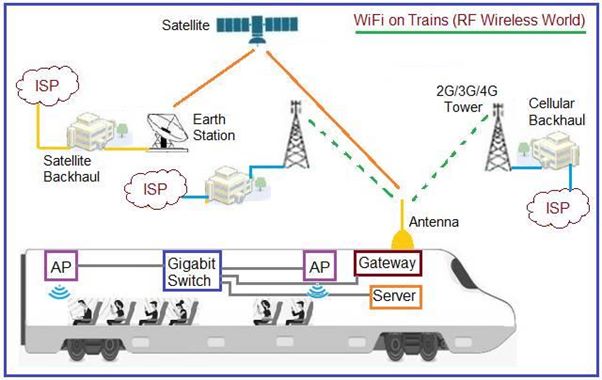
Internet access requires a connection to an ISP via various wired or wireless technologies. Wired technologies are generally ineffective and cannot be used when the train is moving at high or low speeds. As a result, cellular or satellite technologies are required to give internet connectivity to train passengers via EM (Electro-Magnetic) waves.
Wi-Fi architecture for onboard trains
Each train compartment has one or more Wi-Fi routers or access points (APs). Using Ethernet cables, all of these APs are linked to a multi-port gigabit switch. The Multimedia Server is linked to a gigabit switch through an Ethernet wire to aid in the configuration and monitoring of all APs and gateways. The WAN gateway is the equipment that connects APs inside the train to the outside network (cellular or satellite). Gateways accomplish this through the use of specifically designed rail antennas mounted on the train’s roof. Multiple WAN gateways are deployed in the trains based on user requirements.
Wi-Fi/Cellular architecture: Covered metro stations and rail tunnels
It is difficult to provide internet connectivity on trains when they are in underground stations, covered metro stations, or tunnels. There are numerous approaches that can be used in such situations. Repeater-based applications and solutions were used in tunnels initially. In the method, a series or ordered set of repeaters are placed between APs located on opposite ends of the rail tunnel. These WLAN APs are linked to a cellular tower on the track side.
Wi-Fi/Cellular architecture for covered metro stations and rail tunnels

A different approach is being developed, which shall make use of the most recent 5G NR cellular infrastructure. 5G NR RRUs and BBUs are linked together in this system via Optical Fibre Cables (OFCs) and Optical to-RF and RF to Optical converters. In hyperloop technology, a number of WLAN APs are also installed inside the rail tunnels or capsules. OFC is used to connect these several WLAN APs.
Advantages of Wi-Fi on board trains
Railway operators are in a better position than other modes of transportation to provide a more comfortable and convenient passenger experience. The provision of on-board high-speed broadband connection is an important service available to the pasengers. While private passengers shall have the facility of fast internet access, video streaming, and online gaming, business travellers would be benefitted by the ability to work while travelling. Simultaneously, the availability of broadband on trains shall enable rail operators to roll out applications such as video monitoring for greater security, enhanced ticketing and seat reservation services, and other technologies that can access data online to help optimise procedures and decrease operational costs. Onboard broadband connectivity enhances the passenger experience while also contributing to increased railway operating efficiency.
On-board Wi-Fi facilities are helping rail operators, personnel and passengers in the following ways:
(i) Connected passenger
- Information and entertainment
- Internet access
(ii) Connected staff
- Handheld PC for ticketing
- Passenger counting system
- Train monitoring
(iii) Connected fleet
- Train monitoring
- Surveillance cameras
- Driver decision support
The generic benefits or advantages of Wi-Fi on board trains can be stated as under:
- The Wi-Fi service allows travellers to stay in touch with friends and family while travelling.
- Business people can continue working while riding the trains.
- Since the service being nearly free, passengers may spend their time by watching films or listening to their preferred music.
- Train accidents or minor issues in trains can be easily reported from remote hilly regions to their controlling stations located kilometres away.
- The system enables train control in real-time.
- It facilitates the deployment of safety-related applications such as CCTV streaming, door clearance, mission essential voice, and passenger information systems.
Disadvantages
Installing complete solutions on all trains is prohibitively expensive. The system’s benefits and downsides are largely determined by the precise technologies used to provide internet connection in the train. The same can be inferred based on various railway-bound technologies such as ethernet, Wi-Fi, cellphone, satellite, and so on.
RailTel
RailTel, a Central Public Sector Enterprise, a ‘Mini Ratna (Category-I)’ company, is an ICT provider as well as one of the country’s largest neutral telecom infrastructure providers, with ownership of a Pan-India optic fibre network availability. The OFC network covers country’s major towns and cities, as well as some rural areas. RailTel was founded on September 26, 2000, with the goal of modernising the existing telecom system for train control, operation, and safety, as well as generating additional revenue by establishing a nationwide broadband and multimedia network and laying optical fibre cable along railway tracks using the right of way.
RailTel’s optic fibre network currently spans over 61000 route kilometres and 6108 railway stations across India. Its city-to-city access spans over 21000 kilometres across the country.
RailTel’s various operations have been certified for Tier-III (Design & Facility), ISO 27001:2013 Certified for Information Security Management System, ISO 20000:2018 Certified for Service Management System, ISO 9001:2015 Certified for Quality Management System, ISO 27017:2015 Certified for Cloud Security, ISO 27018:2019 Certified for Data Privacy in Cloud Service, ISO 27033 Certified for Network Security, and CMMI Maturity Level-4 Certified for Process Improvement.
RailTel has a strategic relationship with the Indian Railways and works on a wide range of projects, including providing mission critical connectivity services such as IP-based video surveillance systems at stations, ‘e-Office’ services, and implementing short-haul connectivity between stations as well as long haul connectivity to support various organisations within the Indian Railways. RailTel additionally provides a number of passenger services, such as content on demand and Wi-Fi, across important railway terminals in the country.
RailTel believes that their experience and expertise in handling and undertaking telecom and ICT projects, has led themselves to be opted for implementation of various mission-mode projects for the Government of India, including rolling out the National Knowledge Network, Bharat Net (formerly, the National Optical Fiber Network) and USOF funded optical fiber based connectivity project in North East India.
RailWire
RailWire is a community-based broadband internet service provided by RailTel in collaboration with over 8000 communities in India. RailWire broadband, launched in 2008, is provided across India using a 61,000+ kilometre optic fibre network that runs through exclusive right of way along the train tracks.
RailWire Wi-Fi Experience
RailTel has supplied state-of-the-art public Wi-Fi under the brand name Railwire with the objective of transforming railway stations into platforms for digital inclusion. RailTel’s RailWire Wi-Fi is currently available at 6108+ stations. This is one of the world’s largest and fastest public Wi-Fi networks. RailTel wishes to provide Wi-Fi at all railway stations (excluding halts), and only just a few hundred stations remain to be covered and reach the milestone of all station coverage. Passengers can use this service to stream High Definition (HD) videos, download movies, songs and games, and carry out office work online within the station boundaries.
Every day, the first 30 minutes of Wi-Fi access at 1 Mbps speed is free. To use the Wi-Fi facility at a greater speed, the user must select a plan with a higher speed and pay a little cost. Excluding GST, the plans ranges from Rs. 10/day (for 5 GB at 34 MBPS) to Rs. 75/30 day (for 60 GB at 34 MBPS). To acquire a plan online, customers can use a variety of payment methods such as net banking, wallets, and credit cards. Advertisement-based monetisation has been planned to further monetise the infrastructure developed.
Using Wi-Fi at Stations :
- Switch on the Wi-Fi mode on the smartphone
- Select the RailWire Wi-Fi network
- Enter Mobile and get one-time password (OTP) through SMS
- Enter OTP and start accessing High-speed Wi-Fi
Railway Signalling
Safety, in addition to efficiency, is an important objective for Indian Railways. RailTel has been tasked with the project of replacing the existing mechanical signalling system with a modern electronic interlocking signalling system at 26 Northern Railway stations. Work at ten stations has been completed, and work on the remaining stations is underway and is in progress. This replacement shall improve the operational efficiency and safety.
The new Electronic Interlocking signalling system shall allow for signal lowering and track switching with the click of a mouse. Previously, mechanical interlocking systems used standard 1 interlocking system with a maximum speed of 50 kmph. With a modern, sophisticated electronic interlocking system, the standard of interlocking has been updated to Std-II with a maximum speed of 110 kmph. Thus, the new electronic systems are not only improving the safety and efficiency of railway traffic, but also increasing its speed.
Summary & Conclusion
By making Internet access more widely available, cellular networks enable new services. Their rising coverage, dependability, and speed enable enterprises and end users alike to take advantage of new opportunities, while also increasing reliance on Internet availability for daily activities. Certain places, however, do not have consistent cellphone coverage. A common example is railway networks, which might span extensive runs along desolate areas where deploying a cellular network would be prohibitively expensive. Even in regions where coverage exists, passengers’ access to cellular networks is hampered by signal attenuation caused by the train’s own body. Some travellers may also encounter significant roaming fees when using the Internet. In addition to passengers, M2M units and train crews could benefit substantially from network connectivity, but they confront the same difficulties.
In order to access the Internet aboard a moving train, different approaches can be followed.
- The first alternative is for the cellular network operator is to install more cellular capacity along the railway tracks. This technique is rarely cost-effective, and in any case, signal reception is still hindered by the train’s coachwork. Additionally, passengers must have a cellular contract with the particular operator in order to gain network connectivity.
- Another possibility is to utilise signal repeaters (which may even be installed on the train). This is only possible in locations where there is some signal to begin with, and network capacity is severely impacted.
- Establishing an independent network aboard the train is a preferable solution. M2M systems can be linked via Ethernet wiring, and Wi-Fi can be provided to reach every corner. An onboard router manages upstream connections and can integrate various network access technologies (such as cellular with external high-gain antennas, satellite, and Wi-Fi along the tracks) to provide failsafe and high-speed connectivity. Additional routers may also be placed to ensure greater redundancy.
Having a comprehensive network with high-speed Internet connectivity aboard the train offers up many new options for streamlining rail operations while also creating customer loyalty by providing an incentive to go by train rather than driving or travelling by air. Among the many new services that can be provided, some connected to train operation can be mentioned, such as:
- For security purposes, real-time central access to on-board cameras.
- Management and Remote monitoring of on-board systems. However, passenger-oriented services must not be overlooked.
- Free or low cost internet access.
- Maps, train schedules, and adverts displayed on inside screens.
- Access to on-board restaurant or cafeteria for orders.
When implementing many services, the train’s routers must ensure that they all work independently and do not interfere with one another. The routers must also ensure that when there is minimal bandwidth available, the most vital services are prioritised. Further, it is also crucial to protect sensitive data using powerful encryption techniques, as well as facilitate flexible management and failsafe operations. Train operators must streamline their operations and develop new ways to secure consumer loyalty in order to remain competitive in an increasingly complex industry. Having full Internet connectivity on the trains is a low-cost solution to quickly improve both of these areas.