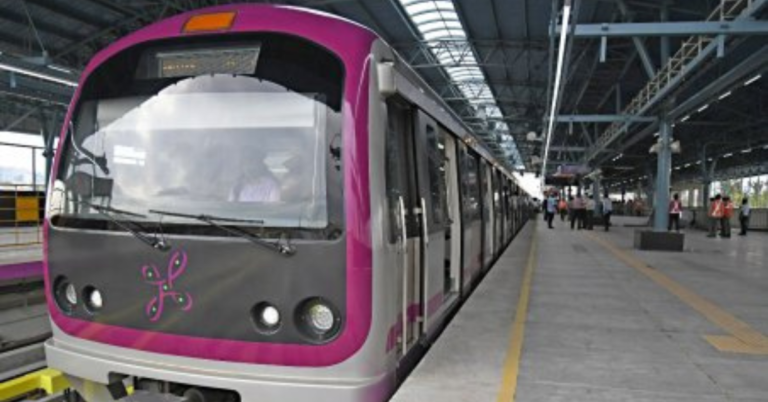
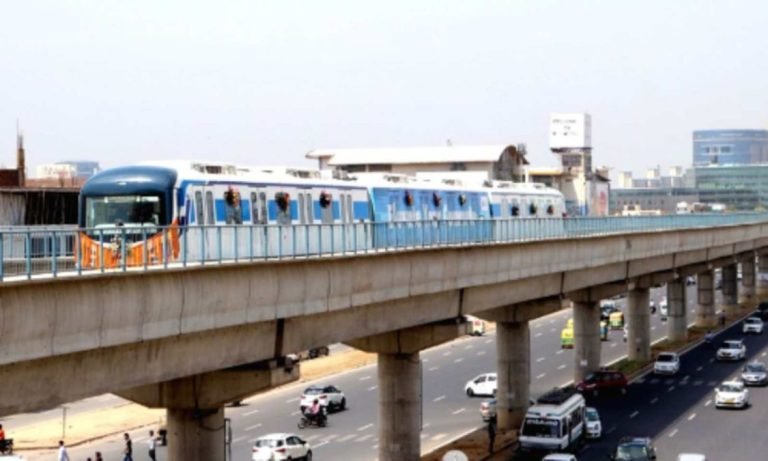
New Delhi: Prime Minister Narendra Modi has flagged-off the Delhi-Faridabad Metro Line that would allow hassle free travel for around two lakh daily commuters between the national capital and the industrial hub in Haryana.
The extension of the Delhi Metro connects Badarpur to Escorts Mujesar in Faridabad.
The total cost of the project from Badarpur to Escorts Mujesar is nearly Rs. 2,500 crore. Out of this, Rs. 1,557 crore was borne by the Haryana Government, the Centre contributed Rs. 537 crore, while the Delhi Metro provided Rs. 400 crore.
All these are elevated and located on either side of the Delhi-Mathura Road (NH-2).
“The nine-station metro corridor which was 95 per cent indigenously built will provide people a safe, affordable, quick, comfortable, reliable, environment-friendly and sustainable transport facility,” a Haryana government spokesperson said.
Haryana Chief Minister ML Khattar, addressing a press conference on Saturday, had thanked the Prime Minister for “gifting” the Metro service which would take the city to “another level of progress” with better connectivity with other NCR towns.
He had also said that the Prime Minister would be announcing the go-ahead for connecting Gurgaon with Faridabad by Metro.
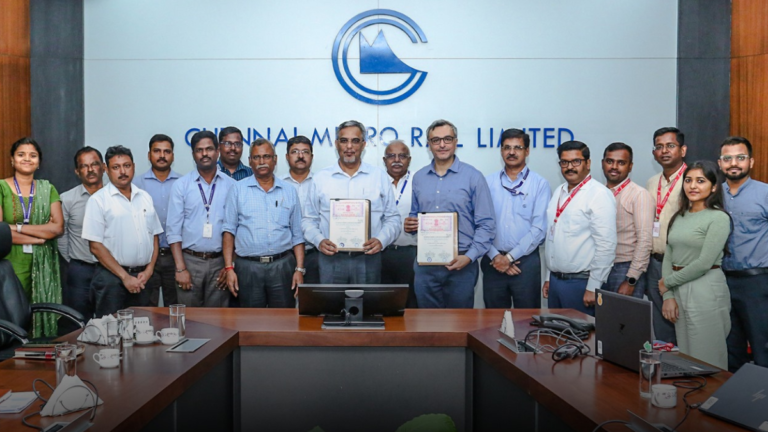
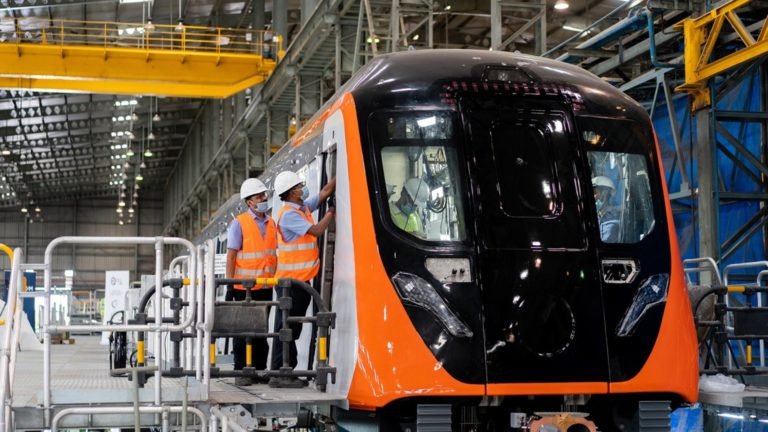
CHENNAI (Metro Rail News):Chennai Metro Rail Limited (CMRL) has signed a supplementary contract agreement with M/s. Alstom Transport India Limited on 27th November 2023 for the supply of ten additional train sets.
Value of the Contract
The total value of this supplementary contract is INR 269 Crore, inclusive of taxes and duties.
The agreement was signed by Thiru. Rajesh Chaturvedi, Director (Systems and Operations), CMRL and Thiru. Rajeev Joisar is the commercial director of India & South Asia, Alstom Transport India Limited. Thiru. A.R. Rajendran, CGM (RS), Senior Officials and Staff of CMRL and Alstom Transport India Ltd were present during the occasion.
Specifications of the Agreement
This agreement is executed under the provisions of the ARE-03A contract, which was awarded to M/s. Alstom Transport India Limited on 17th November 2022. ARE-03A contract entails the supply of 26 numbers of Driverless (UTO – Unattended Train Operation) train sets, each consisting of a 3-car formation (totalling 78 cars).
Total Order Quantity
With the signing of the supplementary agreement, the number of trains ordered with M/s. Alstom Transport India Limited will have 36 trains of 3-car formations (totalling 108 cars).
Scope of Contract
The contract includes the supply of driverless trains, including the design, manufacture, testing, commissioning of standard gauge metro rolling stock, training of personnel, supply of spare parts and defect liability.
Deadline
The total completion time is around 28 months. The trains will be maintained and operated from the maintenance depot constructed in Poonamallee of Metro Corridor-4.
Chennai Metro Phase: 02
Phase 2 of the Chennai Metro Project pitches for a 118.9 km Network consisting of 3 corridors, namely:
Corridor 3: Madhavaram to SIPCOT (45.8 Km)
Corridor 4: Lighthouse to Poonamalle Bypass (26.1 Km)
Corridor 5: Madhavaram to Sholinganallur (47 Km)
Currently, 36 out of the 61 packages, encompassing Civil, Track, and System components for Corridor 3, Corridor 4, and Corridor 5, have been granted, and construction is underway. The project is scheduled for completion by the conclusion of 2026.
It is being constructed at an estimated cost of Rs 69,180 Crore. It is expected to open in phases from 2026 onwards. With its completion, CMRL’s total coverage goes to 173 Km long.
Discover the endless possibilities of our city’s Metro at InnoMetro, our flagship Expo and Conference. Be an active participant in shaping its future towards a more sustainable tomorrow. Stay informed and join us to take a step towards a brighter future.
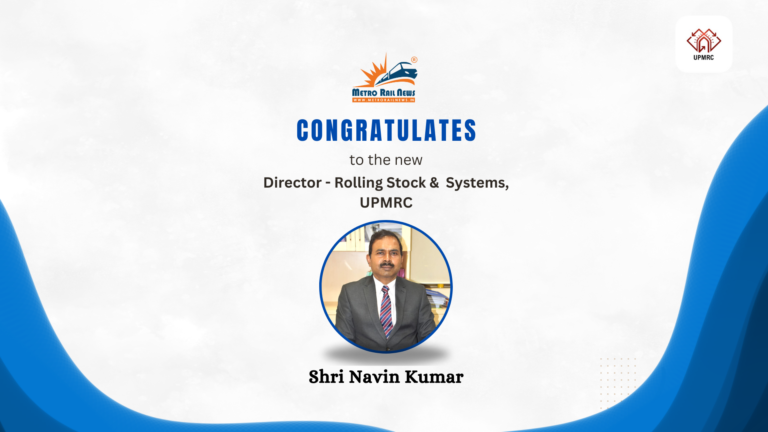
LUCKNOW (Metro Rail News): Shri Navin Kumar has joined as Director Rolling Stock & Systems, Uttar Pradesh Metro Rail Corporation Limited. Shri Kumar worked as the Establishment Officer in the Ministry of Railways before joining UPMRC.
An Electrical Engineer by Profession, he has over 30 years of experience in the Railways. He has held important positions in the Railway Board Zonal Railways, including Joint Secretary and Executive Director- Establishment (Gazetted Cadre).
During his tenure at Banaras Locomotive Works, he was instrumental in the Design, Erection and Commissioning of India’s first IEEE-387 compliant 2.4 MW DG Set for Kaiga and Rawatbhata Atomic Power Plants.
As DRS, Shri Navin Kumar will look after the Rolling Stock and Systems of the Lucknow, Kanpur and Agra Metro projects.
Managing Director, UPMRC Shri Sushil Kumar congratulated Shri Navin Kumar on taking over as Director (Rolling Stock & Systems), UPMRC. He said his expertise and experience will be an asset to UPMRC.
Discover the endless possibilities of our city’s Metro at InnoMetro, our flagship Expo and Conference. Be an active participant in shaping its future towards a more sustainable tomorrow. Stay informed and join us to take a step towards a brighter future
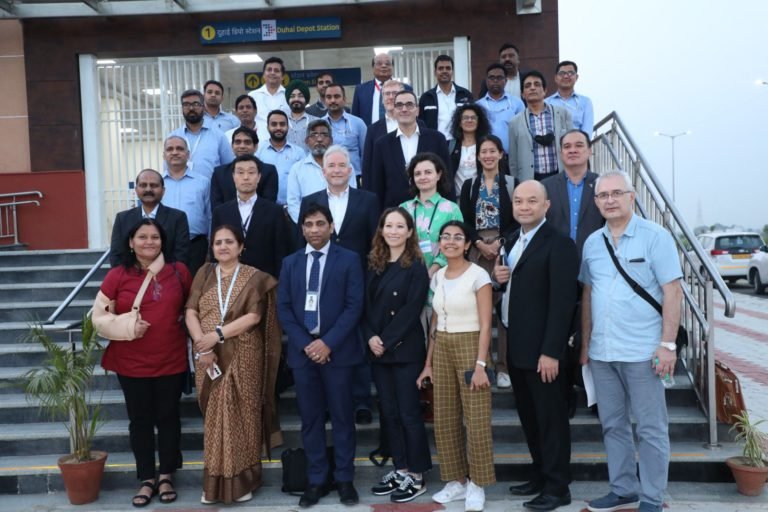
NEW DELHI (Metro Rail News): A delegation of the Asian Development Bank (ADB) and Donors from the Foreign, Commonwealth and Development Office (FCDO), Sweden and Spain visited the newly inaugurated stretch of RRTS Corridor.
The Delegation
The delegation had Mr Bertrand Furno, Executive Director, ADB; Mr Llewellyn Roberts, Alternate Executive Director, ADB; and Mr Norio Saito, Senior Director, ADB.
The Visit
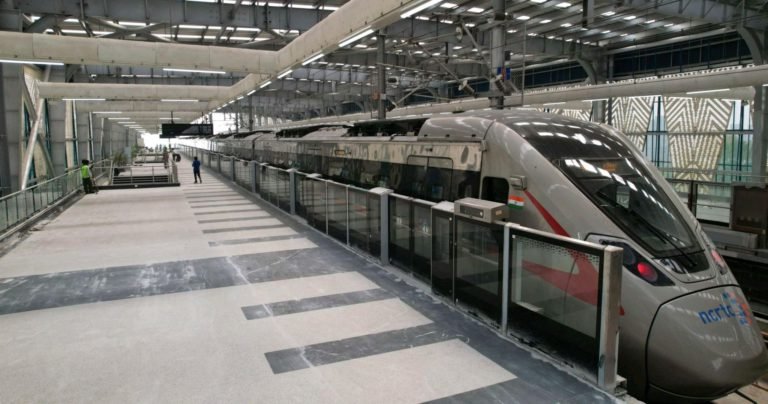
It began with a detailed presentation on the RRTS project by the NCRCTC team in their corporate office at GatiShkati Bhawan. The delegation rode the Namo Bharat trains from Sahibabad to Duhai Depot RRTS station.
It witnessed several new-age technologies, augmented reality, virtual reality, building information modelling, and solar daylighting systems at ‘Aparimit’, the innovation centre at Duhai Depot.
Decarbonisation
The delegation was also made aware of the decarbonisation efforts being undertaken by the NCRTC. NCRTC is to improve the energy mix in favour of renewable sources. The Delegation appreciated the efforts being undertaken by the organisation in the field of carbon emission and net zero pollution.
Social Welfare Programs
The delegation was also informed about the gender sensitisation initiative being undertaken by the NCRTc for the O&M staff and the operators of first & last mile connectivity services. The innovative programs introduced by NCRTC aim to instil people with the best etiquette to offer commuters the best possible service.
RRTS
The Rapid Rail Transit System (RRTS) is a mass rapid transit network stretching 82.15 kilometres, connecting Delhi’s Sarai Kale Khan with Ghaziabad and Meerut. The construction of the Delhi-Ghaziabad-Meerut corridor, with a total cost of Rs 30,000 crore, is underway. The inaugural phase of the priority corridor, spanning 17 kilometres, was inaugurated by Prime Minister Modi. This segment includes five stations: Sahibabad, Ghaziabad, Guildhar, Duhai, and Duhai Depot.
On October 20th, Prime Minister Narendra Modi officially launched India’s inaugural RAPIDX train, Namo Bharat, departing from Sahibabad Station. These trains are designed to operate at a top speed of 180 kmph, with ticket prices ranging from Rs 20 to Rs 50 for standard coaches and Rs 50 to Rs 100 for premium coaches.
The RRTS project entails semi-high-speed rail corridors connecting Delhi to Meerut in Uttar Pradesh, Alwar in Rajasthan, and Panipat in Haryana.
Discover the endless possibilities of our city’s Metro at InnoMetro, our flagship Expo and Conference. Be an active participant in shaping its future towards a more sustainable tomorrow. Stay informed and join us to take a step towards a brighter future
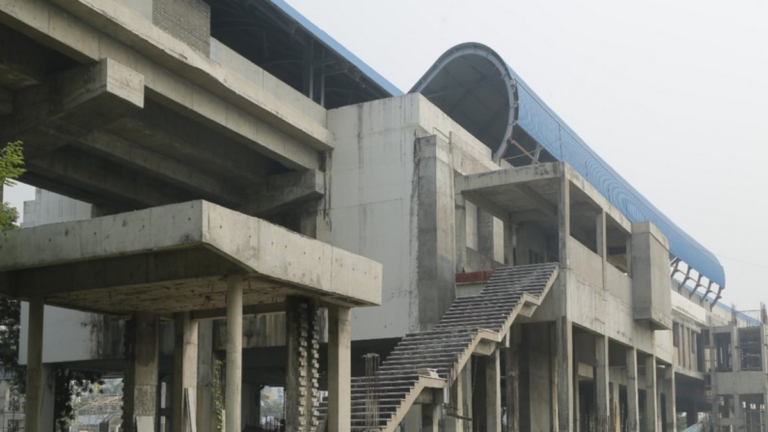
KOLKATA (Metro Rail News): The construction work of Nazrul Tirtha Metro station on Kavi Subhash- Jai Hind(Airport) Corridor of Orange Line is in full swing. This station will be built in the Nazrul Tirtha area of New Town. once commissioned, this station will cater to thousands of passengers and office goers in the coming days.
The concreting work of this station is almost complete. The covering of the station roof is almost complete. The floors have been covered with granite. State-of-the-art passenger amenities are going to be provided at Nazrul Tirtha Metro station. There will be 08 escalators and 04 lifts provided at this station. Apart from these, 08 staircases will also be available here.
There will be two spacious platforms 180 metres in length at Nazrul Tirtha station, along with ticket counters and Automatic Smart Card Recharge Machines (ASCRM) for self-ticketing facilities. Apart from these, one toilet for ladies, one for gents and one for divyangjan will be available for the convenience of the passengers. A public Address System, digital display boards, an emergency lighting facility for the convenience of the passengers, and tactile floor indicators for the blind will be some other added amenities here.
Discover the endless possibilities of our city’s Metro at InnoMetro, our flagship Expo and Conference. Be an active participant in shaping its future towards a more sustainable tomorrow. Stay informed and join us to take a step towards a brighter future.
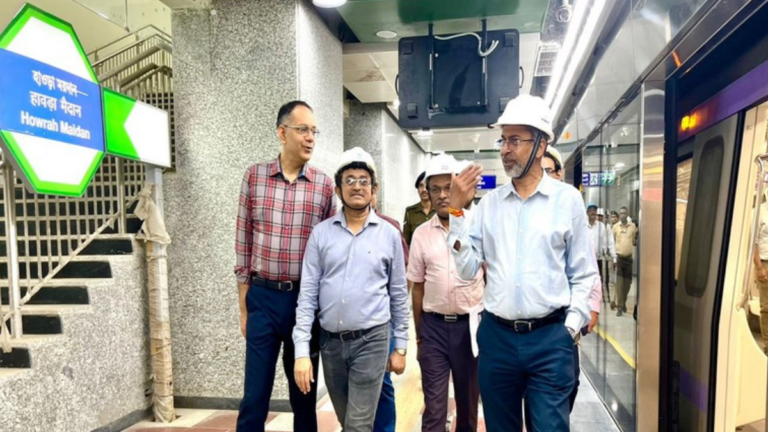
KOLKATA (Metro Rail News): Shri P. Uday Kumar Reddy, General Manager, inspected Howrah Maidan to Esplanade stretch of East-West Metro Corridor (Green Line) yesterday, i.e. on 27.11.2023. During this inspection, Senior KMRCL officials and other senior officials of Metro Railway accompanied him.
Shri Reddy started today’s inspection from Howrah Maidan Metro station this afternoon. He travelled up to Esplanade Metro station under the river Hooghly in a Metro. On his way to Esplanade, Shri Reddy stopped at each station and inspected all passenger amenities and work progress as these stations were almost ready for commissioning. While evaluating the work progress on all the underground stations from Howrah Maidan to Esplanade on-the-spot, he also inspected these stations’ ventilation and air-conditioning systems.
Shri Reddy expressed his satisfaction after seeing the work progress and advised everyone to complete all the pending jobs within the deadline.
Discover the endless possibilities of our city’s Metro at InnoMetro, our flagship Expo and Conference. Be an active participant in shaping its future towards a more sustainable tomorrow. Stay informed and join us to take a step towards a brighter future.
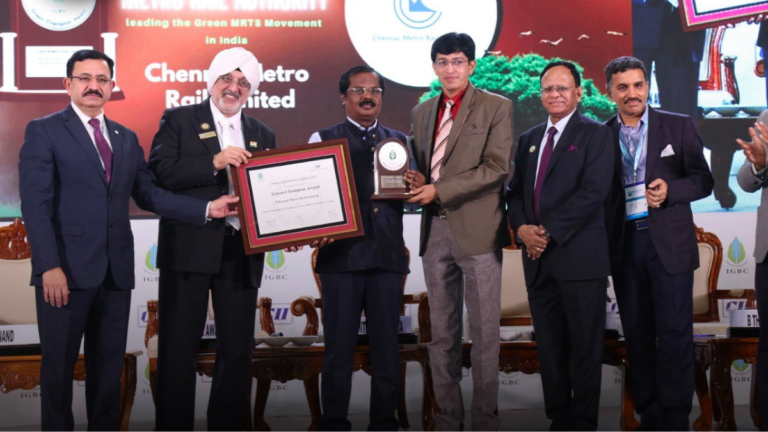
CHENNAI (Metro Rail News): CMRL has been conferred the Green Champion Award, one of the highest honours bestowed by the Indian Green Building Council (IGBC) for leading the green MRTS movement in India. The award ceremony occurred on 24th November 2023 as part of the “Green Building Congress,” IGBC’s flagship conference and expo on the Green Built Environment, held at the Chennai Trade Centre. Thiru. T. Archunan, Director (Projects), CMRL, received the prestigious award on behalf of the organisation.
It may be recalled that CMRL has recently been given international recognition for its continued and committed pro-environment initiatives in all its activities. The Green Apple Award 2023 – Gold was conferred by The Green Organization, London, United Kingdom, last week on 20th November 2023 in an award ceremony held in London. Earlier this year, in an award ceremony held in April 2023 in Miami, the USA, CMRL received the Green Champion Award 2023 – Silver for the Environmental Best Practice “Carbon Reduction” category.
These awards underline CMRL’s position as a leader in promoting and implementing environmentally conscious practices in creating world-class transportation infrastructure for the people of Chennai and encourage team CMRL and associated stakeholders, including its contractors, to continue striving for excellence in quality and sustainable development.
Discover the endless possibilities of our city’s Metro at InnoMetro, our flagship Expo and Conference. Be an active participant in shaping its future towards a more sustainable tomorrow. Stay informed and join us to take a step towards a brighter future.
NEW DELHI (Metro Rail News): Knorr-Bremse, on behalf of Alstom India, is fitting braking and climate control systems to 52 Movia metros ordered by Madhya Pradesh Metro Rail Corporation Limited.
The trains will serve on metro lines currently under construction in Bhopal and Indore
Knorr-Bremse systems are in high demand for major projects in the emerging Indian rail market
For Knorr-Bremse, the order value is in the lower double-digit million-euro range
Knorr-Bremse is to equip more metro trains destined for major cities in India in partnership with Alstom. The equipment includes braking and climate control systems for 52 Alstom Movia trains, with 156 railcars ordered by Madhya Pradesh Metro Rail Corporation Limited (MPMRCL) for Bhopal and Indore. Knorr-Bremse will also provide comprehensive services for these technologies over 15 years. With this order, Knorr-Bremse benefits from the dynamic development of India’s transportation sector while contributing to safe, reliable, eco-friendly mobility in the country’s mass transit segment.
Dr Nicolas Lange, Member of the Executive Board of Knorr-Bremse AG and responsible for the Rail Vehicle Systems division: “We’ve been working closely with local markets and customers in India for the last 30 years. The understanding and expertise we’ve acquired are paying off in the form of long-term customer relationships. For example, our high-quality systems solutions have proved their worth in many other Indian metro fleets in cities like Delhi and Mumbai. And now we’re bringing our high standards of dependability and market-leading quality to this new Alstom project in Madhya Pradesh.”
Olivier Loison, Managing Director, Alstom India, said, “Our integrated rolling stock and signalling project with MPMRCL for the Bhopal and Indore metro is a strong step forward in the infrastructure modernization in both the cities. Our global partnership with Knorr-Bremse allows us to provide the best-in-class solutions to our customers transforming the passenger experience. We look forward to our continued engagement and success in India.”
Safe and reliable rail mobility for significant cities
To serve Bhopal and Indore, MPMRCL has ordered 52 metro trains from Alstom, totalling 156 railcars. Starting in 2024, they will go into service on overground and underground lines in both cities, travelling at speeds of up to 80 km/h. Of the metro trains, 27 are destined for Bhopal (31 km, 30 stations) and 25 for Indore, some 200 kilometres away (first construction phase: 33 km, 29 stations). The trains will play a vital role in India’s mass rapid-transit systems (MRTS), intended to provide reliable connections for commuters in the country’s rapidly growing cities. India has recently implemented several innovative, large-scale projects involving metro transit systems in various parts of the country.
Quick deliveries, long-term service
Knorr-Bremse was able to impress Alstom with three benefits in particular: punctual deliveries of high-quality products, dedicated technical support at all stages of the project, plus the two companies’ shared experience of India’s most recent major metro project, Agra-Kanpur, for which Knorr-Bremse is also providing equipment. Generally, Knorr-Bremse is a crucial partner for several customers in the ongoing development of the Indian transportation sector.
The brake control unit at the heart of Knorr-Bremse’s braking systems is based on market-leading software expertise from the company’s Technology Center in Pune, India (TCI). At TCI, Knorr-Bremse employs more than 800 people and recently expanded the facility to host 1,300 specialists and engineers.
The energy-efficient and highly reliable climate control systems supplied by the Group’s Merak brand are already installed in several Indian metro systems, working to ensure onboard passenger comfort. The systems have an energy-saving free cooling function, feature CO₂ sensors and an intelligent, fresh air control mode for optimised in-train airflow. Knorr-Bremse will start to supply Alstom with the technologies for Bhopal and Indore in the immediate future; deliveries are expected to continue through mid-2025. At the same time, Knorr-Bremse will take responsibility for the long-term servicing of the brake and climate control systems, thus contributing to the high availability and reliability of metro services.
Discover the endless possibilities of our city’s Metro at InnoMetro, our flagship Expo and Conference. Be an active participant in shaping its future towards a more sustainable tomorrow. Stay informed and join us to take a step towards a brighter future.
NEW DELHI (Metro Rail News): NCRTC aims to roll out the co-branding rights process for the 5 RRTS stations very soon. This would help NCRTC to explore non-fare box revenue options.
Why?
NCRTC aims to explore the non-fare box revenue to generate handsome revenue into the system and bring financial stability & sustainability.
Rights Include
The Co-branding rights include
Add prefixes or suffixes with the name of the station.
Brand Colors on the stations
Advertisements at Entry/Exit points.
Comprehensive Coverage of Civil Structures
Audio Announcements of the Co-branded names
The bidding process for these is underway.
Non-Fare Box Revenue
Money from any source other than fares or freight revenue falls in the category of Non-fare box revenue. This allows the organisations to explore their facilities for advertisements of brands to increase their revenue and, in turn, stabilise their income & financial standing.
Big Opportunity
This presents a big opportunity for the brands as RRTS covers many commuters commuting to and from Delhi. This will expose the brands to many consumers, increasing its footprint across the cities covered by RRTS.
Further Development
NCRTC will also facilitate privileges and perks like media rights, F&B, retail spaces, telecom access rights, virtual stores, etc. It will also significantly impact the Delhi and NCR region’s economic paradigm.
RRTS
The Rapid Rail Transit System (RRTS) is a mass rapid transit network stretching 82.15 kilometres, connecting Delhi’s Sarai Kale Khan with Ghaziabad and Meerut. The construction of the Delhi-Ghaziabad-Meerut corridor, with a total cost of Rs 30,000 crore, is underway. The inaugural phase of the priority corridor, spanning 17 kilometres, was inaugurated by Prime Minister Modi. This segment includes five stations: Sahibabad, Ghaziabad, Guildhar, Duhai, and Duhai Depot.
On October 20th, Prime Minister Narendra Modi officially launched India’s inaugural RAPIDX train, Namo Bharat, departing from Sahibabad Station. These trains are designed to operate at a top speed of 180 kmph, with ticket prices ranging from Rs 20 to Rs 50 for standard coaches and Rs 50 to Rs 100 for premium coaches.
The RRTS project entails semi-high-speed rail corridors connecting Delhi to Meerut in Uttar Pradesh, Alwar in Rajasthan, and Panipat in Haryana.
Discover the endless possibilities of our city’s Metro at InnoMetro, our flagship Expo and Conference. Be an active participant in shaping its future towards a more sustainable tomorrow. Stay informed and join us to take a step towards a brighter future.
BANGALORE (Metro Rail News): Bangalore Metro Rail Corporation (BMRC) plans to begin the land acquisition for Bangalore Metro Phase 3 very soon once it receives the nod from the state finance department.
Preliminary Stage
In the preliminary stage, BMRCL will acquire 100 acres of land to construct depots and viaducts on some of the stretches of the Bangalore metro. Firstly, the survey process will be undertaken only to begin the work of land acquisition.
Metro Depot
Among the 100 acres of land to be acquired, 75 acres will be utilised for constructing a metro depot near Byadarahalli Police Station on Magadi Road. It will serve both the lines of Phase 03. It will be the city’s second-largest metro depot after the Peenya depot.
Further Plans
BMRCL has been asked to submit the land acquisition requirement for every 10-kilometre stretch of the proposed lines. The lines have been aligned to run on the viaducts in the middle of the roads. The stations are to be constructed based on various considerations.
DPR Deadlock
The DPR for the Bangalore Metro Phase 3 still lies with the central government. Approval still needs to be obtained from the central government. Following the directives from MoHUA, BMRCL has also adjusted the procurement of Rolling Stock for the Magadi Road line.
Kanpur Metro, Phase 3
Phase 3 of the Kanpur Metro entails two metro lines:
Kempapura- J P Nagar (32.1 Km)
Hosahalli- Kadabagere ( 12.5 Km)
The estimated cost of the project is estimated to be Rs 15,600 Crores.
Intrigued by the future of Metro and its impact on our city? Join us at our upcoming Inno Metro event to delve deeper into this vital issue. Stay informed, get involved, and let’s ride the Metro towards a brighter, more sustainable future together.
Gurgaon (Gurugram) Metro, also commonly referred to as Rapid Metro, is a single metro line with 11 stations built and developed by Rapid MetroRail Gurgaon (RMRG), a subsidiary of Infrastructure Leasing & Financial Services Limited (IL&FS). A 5.1 km route was developed in Phase 1 of the project to connect the Delhi Metro’s Sikanderpur Station (Yellow line) with the DLF Cybercity commercial and business districts. On November 14, 2013, this line became commercially operational. On March 31, 2017, a 7-kilometer extension of the line opened to connect Sikanderpur Station with Sector 55-56 via new and additional stations on Golf Course Road. The entire line is served by twelve 3-coach trains supplied by CSR Zhuzhou Electric Locomotive Works under a Siemens subcontract.
The Delhi Metro Rail Corporation (DMRC) has assumed control of the line’s operations. On October 22 2019, after its original operator (RMRG) expressed its inability to continue operations amidst low and sluggish footfall of passengers and overpowering operational expenditures. The corridors have been proposed to connect Gurgaon with numerous new metro lines to its surrounding communities and region, including old Gurgaon, Dwarka, Bawal, Manesar, Faridabad, and Sohna, to be approved by the Haryana Government. The Haryana Mass Rapid Transport Corporation (HMRTC) is the primary body and nodal agency with the charge and responsibility of carrying out and executing these lines.
New Line: HUDA City Centre – Palam Vihar – Moulsari Avenue
Length: 28.8 km
(This line, known as the New Gurgaon-Old Gurgaon link, has been designed to form a ring line. A consortium of RITES and the School of Planning and Architecture – SPA developed its DPR. The HMRTC board approved its directors in December 2019 and the Haryana state government’s Cabinet in August 2020).
Stations: Sector 45, Cyber Park, District Shopping Centre, Sector 47, Subhash Chowk, Sector 48, Sector 72 A, Hero Honda Chowk, Udyog Vihar Phase 6, Sector 10, Sector 37, Basai village, Sector 9, Sector 7, Sector 4, Sector 5, Ashok Vihar, Sector 3, Bajghera Road, Palam Vihar Extension, Palam Vihar, Sector 23 A, Sector 22, Udyog Vihar Phase 4, Udyog Vihar Phase 5, Moulsari Avenue (DLF Cyber City) Total 27
Gurgaon Metro Proposed New Routes
New Line: Gurgaon – Manesar – MBIR (82 km)
Length: 82 km
Phase 1: Gurugram Railway Station to Panchgaon in Manesar (35 km)
Phase 2: Panchgaon (Manesar) to Dharuhera (22 km)
Phase 3: Dharuhera – Manesar Bawal Investment Region (MBIR) (25 km)
(As part of the Delhi – Mumbai Industrial Corridor (DMIC), an 82-kilometer-long line with 39 stations has been proposed to connect Gurgaon with the Manesar Bawal Investment Region (MBIR). Its DPR was prepared and developed by AECOM and presented to the Haryana government by DMICDC in 2016. In addition, two spurs have been planned in Phase-1A (12 km from Global City to Sector-112) and Phase-1B (12 km from MBIR to Rewari), bringing the overall route of the line to 108 Km).
New Line: Gurgaon – Faridabad
Length: 31 km
(This route seeks to connect Sector 45 in Gurgaon (south of Huda City Centre) with Bata Chowk in Faridabad. To establish and develop an interchange, the Yellow Line needs to be extended by 1 km).
New Line: Sector 21 Dwarka – IFFCO Chowk Gurgaon
Length: 12.225 km
(In 2015, the Delhi Metro Rail Corporation Ltd. (DMRC) prepared the Detailed Project Report (DPR) for this line, recommending an extension of Line-3 (Blue Line) for Rs 5150 crore.). A revised and updated DPR proposes three alternatives:
Option 1: Extending the current Airport Express service to IFFCO Chowk
Option 2: Expansion of Line 3 from Sector 21 Dwarka to IFFCO Chowk.
Option 3: Independent express line from Sector 21 Dwarka to IFFCO Chowk with an independent depot
New Line: HUDA City Centre – Gurugram Railway Station
Length: 11.15 km
(This route includes Subhash Chowk, Rajiv Chowk, and New Colony Mor.)
New Line: HUDA City Centre – Dwarka
Length: 27.48 km
(This route is proposed to run through Subhash Chowk on Sohna Road, Hero Honda Chowk, Sector 33, 34, 37, Sector 10 A, 10, 9, 9 A, ESI Hospital, Sector 4, Sector 5, Railway Station, Sector 23, and Dwarka).
Extn of Line-1: Sector 55/56 – Vatika Chowk (6.34 km)
Length: 6.34 km
(This line is proposed to run from Sector 55/56 to Vatika Chowk along the Southern Peripheral Road (SPR), with five new metro stations at Sector 56, Sushant Lok, Sushant Lok Phase-3, Rosewood City, and Vatika Chowk. In September 2019, the DMRC completed the Techno-Feasibility Report for this line).
Latest Update on New Gurgaon Metro Line
The Haryana Mass Transport Corporation Ltd. (HMRTC) recently released a request for bids to begin constructing the new Gurgaon Metro line after the Cabinet approves of the process. Following the invitation for bids, three firms bid to work on constructing the projected metro line.
Conclusion
The recently approved Gurgaon Metro shall run through Old Gurgaon and connect Huda City Centre to Gurgaon Cyber City. After years of deliberation, the central government has finally approved the proposal. When completed, the project will connect the two sides of Gurgaon. The Metro’s total length is approximately 28.5 kilometres. The main line will be approximately 26.65 kilometres long, with the remaining 1.85 km constructed as a spur from Basai village to the Dwarka expressway. Over 2.5 million people are expected to benefit from the Huda City Centre to Cyber City metro line.
The metro line’s construction will also promote the area’s economic development. According to the officials, the line’s estimated ridership in 2026 will be around 5.4 lakh individuals, growing to 7.26 lakh by 2031. The Haryana Mass Transport Corporation Ltd (HMRTC) is developing a well-defined project safety plan. The project is being designed as a special-purpose vehicle (SPV). The SPV is supported both by the GoI and the Government of Haryana. The initial proposal was presented years ago. However, delay has been observed due to several revisions in the project plans. Below are some of the critical components of the recently approved Gurgaon Metro.
Key Features of the New Gurgaon Metro Line
Gurgaon Metro Line beginning station
HUDA City Center, Gurugram
Gurgaon Metro Line ending station
Gurgaon Cyber City
Number of stations on the line
27 (including one depot)
Total length of the Gurgaon metro line
28.5 kms
Current status
Approved by Cabinet, work to commence soon
Expected completion date
2027
Estimated cost of construction
Rs 6,800 Crores
Metro line and station type
Elevated
Owner
Haryana Mass Transport Corporation Ltd (HMRTC)
The new Gurgaon metro line, which connects Huda City Centre to Gurgaon Cyber City, will have 27 stations. These are the Gurgaon Metro stations:
List of Approved Gurgaon Metro Stations
HUDA City Center
Sector 45, Gurugram
Cyber Park
Sector 47, Gurugram
Subhash Chowk
Sector 48, Gurugram
Sector 72A, Gurugram
Hero Honda Chowk
Udyog Vihar Phase 6
Sector 10, Gurugram
Sector 37, Gurugram
Basai Village
Sector 9, Gurugram
Sector 7, Gurugram
Sector 4, Gurugram
Sector 5, Gurugram
Ashok Vihar
Sector 3, Gurugram
Bajghera Road
Palam Vihar Extension
Palam Vihar
Sector 23A, Gurugram
Sector 22, Gurugram
Udyog Vihar Phase 4
Udyog Vihar Phase 5
Cyber City
Dwarka Expressway (Sector 101)
Connectivity of Gurgaon Metro Stations
The newly approved Gurgaon Metro line’s main feature is connecting the New Gurgaon district to Old Gurgaon. The improved connectivity will aid in the development of the old Gurgaon area. The development in the old Gurgaon area has been somewhat slow. No metro line currently connects Old Gurugram to the rest of the city. Udyog Vihar Phase 6, Sector 10, Sector 37, Basai Village, Sector 9, Sector 7, Sector 4, Sector 5, Ashok Vihar, Sector 3, Bajghera Road, Palam Vihar Extension, Palam Vihar, Sector 23A, Sector 22, Sector 24, Udyog Vihar Phase 4, and Udyog Vihar Phase 5. Huda City Centre, Sector 45, Cyber Park, Sector 47, Subhash Chowk, Sector 48, Sector 72A, and Hero Honda Chowk are Gurgaon Metro Stations in the New Gurugram region.
Cost of Construction
The overall construction cost is projected to be around Rs 6,800 crores. The investment expected by different parties and stakeholders includes:
The Government of India’s shareholding will be about Rs 896.19 crore.
Haryana’s government shall contribute approximately Rs 1432.49 crore.
Haryana Urban Development Body will invest approximately Rs 300 crores.
PPP investment (lifts and elevators) is estimated to be around Rs 135.47 crores.
The Pass-through aid loan component will be worth approximately Rs 2688.57 crores.
The construction of the Gurgaon metro will significantly boost economic growth in the Gurgaon area, particularly the sectors in the old Gurgaon area. The following are some of the areas that are predicted to flourish and develop along the planned metro line:
Sector 4, Gurugram: It is a growing and upcoming community close to significant economic and employment centres. The area includes a combination of builder floors and single-family homes. The surrounding places and areas in proximity are rich in social infrastructure and civic amenities and infrastructure. Sector 4 is easily accessible through different kinds of transportation options. It is located along the old railway route near the railway station.
Palam Vihar: One of the earlier regions and localities of the area. It is well connected to both the Delhi and Gurugram regions. The location is very near to NH 48. The surrounding area offers excellent social infrastructure, including educational institutions, hospitals, and leisure centres. Palam Vihar is close to the Delhi International Airport and other nearby areas. The area features a substantial number of independent residences and builder floors.
Sector 9, Gurugram: Sector 9, Gurugram, is a reasonably priced residential sector. The locality is near several other residential colonies and is only a few minutes from Basai Road.
Ashok Vihar: It is one of Gurugram’s most affordable residential zones. The community is located near Old Railway Road and Sheetla Mata Mandir. The area primarily comprises builder floors, detached houses, and low-rise flats. The region is also close to numerous business and employment hubs and excellent schools, hospitals, and shopping places.
Summing It Up on Gurgaon Metro
The Union Cabinet has approved metro connectivity from HUDA City Centre to Cyber City in Gurugram, with a spur line to Dwarka expressway, significantly boosting Gurugram’s metro network. The project’s estimated cost is Rs 5,452 crore. The 28.5-kilometre metro route from Huda City Centre to Old Gurgaon and, after that, to Cyber City will be elevated. The project is expected to be completed in four years. The main corridor from Huda City Centre to Cyber City would be 26.65 kilometres long, while the Basai Village to Dwarka expressway – spur will be 1.85 kilometres long.
There will be up to 27 stations along the line, including one interchange station. According to the Gurugram Metro DPR (detailed project report), the metro route will include the following stations: HUDA City Centre, Sector 45, Cyber Park, District Shopping Centre, Sector 47, Subhash Chowk, Sector 48, Sector 72A, Hero Honda Chowk, Udyog Vihar Phase 6, Sector 10, Sector 37, Basai Village, Sector 9, Sector 7, Sector 4, Sector 5, Ashok Vihar, Sector 3, Bajghera Road, Palam Vihar Extension, Gurugram currently has only 17 km of metro line – the 5.3 km Yellow Line of the Delhi Metro and the 11.7 km Rapid Metro. Since 2017, when the second stretch of the Rapid Metro on Golf Course Road (6.8km) opened to commuters, no metro service has been expanded here. Rapid Metro was built privately and is presently operated by the government under DMRC. The previous corridor to be built was the Delhi Metro’s Yellow Line up to Huda City Centre in 2010.
Haryana Chief Minister Manohar Lal Khattar had stated that work on three additional Metro lines in Gurugram could begin this fiscal year. The entire Gurugram metro line would be elevated, stretching 28.5 km from Huda City Centre to Old Gurgaon and Cyber City. The construction of the new Gurgaon metro line is expected to be helpful in the resolution of connectivity concerns within the city. Gurgaon currently has few inter-city commute options and possibilities. It is also expected to contribute to Old Gurugram’s general economic development. Finally, it is predicted to positively impact the area’s socioeconomic development, particularly in the ancient Gurugram community.
Intrigued by the future of Metro and its impact on our city? Join us at our upcoming Inno Metro event to delve deeper into this vital issue. Stay informed, get involved, and let’s ride the Metro towards a brighter, more sustainable future together.