Home Blog Page 110

Kanpur Metro Streamlining the Connectivity

1
Kanpur Metro

Exploring Kanpur

Known as the financial capital of Uttar Pradesh, Kanpur is a large industrial city located in the central-western part of Uttar Pradesh. Founded in 1207 A.D., Kanpur is situated on the south bank of the river Ganga and is home to historical monuments such as the Jamuna Ghat, Bhitargaon Temple, Nanarao Park, and European Cemetery. 

Kanpur is known for attractions such as Green Park, Allen Forest Zoo, JK Temple, and Jagannath Mandir, the city attracts many tourists. The city is also famous for its street foods such as Sultani Daal, Shami Kebabs, and Basket Chaat. 

Known as India’s 12th most populous city, the 2011 census revealed Kanpur’s population to be 45,81,000 and the projected population as of 2024 is 32,86,000. The city is known for its well-established educational institutions such as IIT Kanpur. These institutions attract more students in the city and provide job opportunities to many people. 

KM 04

The Need for Metro in Kanpur

As of June 2017, Kanpur had the highest number of vehicles. It had 1.6 million vehicles registered under the Regional Transport Office (RTO). The concerns were on the rise for the exponential increase in the registered number of vehicles but the stagnant growth in the road network and transport facilities. 

Due to the rising population and an urgent need for a safe and convenient public transportation facility in Kanpur, the Uttar Pradesh government initiated the Kanpur Metro project. The project began to make travelling around the city easy for the people.

Kanpur Metro Overview

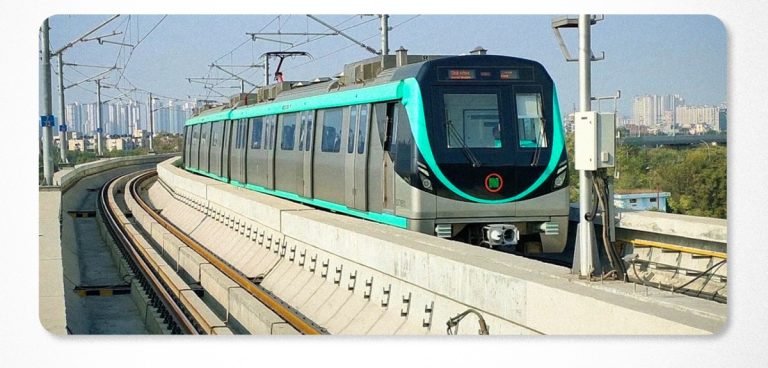
Kanpur Metro is an under-construction urban Mass Rapid Transit System (MRTS) with 2 lines and 30 stations by Uttar Pradesh Metro Rail Corporation Limited (UPMRCL).

KM02 2

Approval

RITES prepared the Detailed Project Report (DPR) of 32.385 km route of Kanpur Metro. In March 2016, the DPR got approval from the state cabinet and by the central government on February 28, 2019. 

The estimated cost for the project is Rs. 11,076.48 crores and 5 years were given for the completion of the project.

Funding: Phase 1 of Kanpur Metro is financed by the Government of India and the Government of Uttar Pradesh on a 50:50 basis. Also, India has taken a loan of EUR 650 million from the European Investment Bank which covers rolling stock and construction of Line 1 and Line 2 of the Kanpur metro. The loan was approved on July 15, 2020.

Opening of Priority Corridor

On November 15, 2019, the construction of the Kanpur Metro began. In December 2021, commercial operations began on 8.98 km long priority section which runs from IIT Kanpur to Motijheel. This section is a part of Orange Line. 

KM 05

Key Specification Of Kanpur Metro

Speed and TrackMaximum Speed: 80 km/h
Average Speed: 34 km/h
Track Gauge: Standard Gauge Track measuring 1435 mm
Safety and ElectrificationElectrification: The metro is powered by a 750V DC Third Rail.
Signalling: The metro system will use communication-based train control (CBTC).
Rolling StockAlstom Transport will supply 39 trains. The trains will have CO2 sensor-based air conditioning system to ensure energy savings during the train operations.
Daily RidershipAs of 2024, the daily ridership of Kanpur metro is around 8000-10,000 passengers.
Estimated CostRs. 11,076.48 crore
Train Length3 coaches

Lines of Kanpur Metro

Operational: 8.728 km | Under Construction: 19.357 km | Approved: 4.08 km
  1. Line 1 (Orange Line): IIT Kanpur – Naubasta
  • Distance: 23.8 km
  • Type: Elevated (15.164 km) & Underground (8.621 km)
  • Depot: Polytechnic College
  • Stations (22): IIT Kanpur, Kalyanpur Railway Station, SPM Hospital, CSJM Kanpur University, Gurudev Chauraha, Geeta Nagar, Rawatpur Railway Station, Lala Lajpat Rai Hospital, Moti Jheel, Chunniganj, Naveen Market, Bada Chauraha, Nayaganj, Kanpur Central, Jhakarkatti, Transport Nagar, Baradevi, Kidwai Nagar, Vasant Vihar, Baudh Nagar and Naubasta
Operational (8.7 km)Under construction (15.057 km)
IIT Kanpur, Kalyanpur Railway Station, SPM Hospital, CSJM Kanpur University, Gurudev Chauraha, Geeta Nagar, Rawatpur Railway Station, Lala Lajpat Rai Hospital, Moti JheelChunniganj, Naveen Market, Bada Chauraha, Nayaganj, Kanpur Central, Jhakarkatti, Transport Nagar, Baradevi, Kidwai Nagar, Vasant Vihar, Baudh Nagar, Naubasta
On July 10, the third rail system installation on the Up-line of the Chunniganj – Nayaganj section was completed. This advancement highlights the readiness of a approximately 14 km route on the up-line extending from IIT Kanpur to Naubasta.
On July 12, 2024, UPMRC began a trial run of the Kanpur Metro from Moti Jheel to Nayaganj. The trial run was conducted at a low speed to test the interaction between the trains and the tracks. 
  1. Line 2 (Blue Line): Agriculture University – Barra-8
  • Distance: 8.38 km
  • Type: Underground and Elevated
  • Depot: Agriculture Depot
  • Stations (8): Agriculture University, Rawatpur Railway Station, Kakadeo, Double Pullia, Vijay Nagar Chauraha, Shastri Chowk Station, Barra-7, and Barra-8
  • Estimated Cost: Rs. 1,025 crore
  • Status: Expected to be completed by December 2025
Elevated (5)Underground (3)
Agriculture College Station, Vijay Nagar Chauraha, Shastri Chowk Station, Barra-7, Barra-8Rawatpur, Kakadeo, Double Pullia
Updates-
The project will be financed through a loan taken from the European Investment Bank.Tunnelling works are expected to begin in mid-2025.Piling work of the section started on July 2, 2024.

Kanpur Metro Project’s Timeline

YearDetails
2015RITES prepared a detailed project report (DPR) for Kanpur Metro after conducting the feasibility study of the project.
2016The state cabinet approved the DPR.
The central government approved the DPR.
2017The Central government proposed a few changes in Line 1.
2018The Uttar Pradesh cabinet approved the central inputs.
The finance ministry approved the Kanpur metro project.
2019The Uttar Pradesh government allotted Rs. 175 crore to reinforce the preliminary work of Line 1. 
Prime Minister Narendra Modi laid the foundation stone of the Kanpur Metro.
Afcons Infra was finalised to construct 9 stations of the Kanpur metro.
Yogi Adityanath, the Chief Minister of Uttar Pradesh, laid the foundation of the civil work for the Kanpur metro.
2020The Chief Minister of Uttar Pradesh allocated Rs. 358 crore for the establishment of Kanpur Metro’s Line 1.
2021Finance Minister Suresh Khanna made a provision of Rs. 597 crore for the Kanpur Metro.
Prime Minister Narendra Modi inaugurated the 8.7 km priority corridor of Kanpur Metro. The corridor is from IIT Kanpur to Moti Jheel.
2024The rest of the corridor of Line 1 is expected to be completed by November.

Contractor’s List

Contractor NameContract Details
TYPSA-Italferr JVGeneral Consultant
SYSTRA – SYSTRA MVA Consulting (India) Pvt. Ltd. JVDetailed Design Consultant (Line 1)
SYSTRA – SYSTRA MVA Consulting (India) Pvt. Ltd. JVDetailed Design Consultant (Line 2)
Afcons Infrastructure Ltd.KNPCC-02(R1): Construction of IIT Kanpur – Moti Jheel
Sam (India) Builtwell Pvt. Ltd.KNPCC-04: Architectural finishing at 9 stations between IIT Kanpur – Moti Jheel
Gulermak – Sam India JV KNPCC-05: Construction of 3.9 km tunnels and 4 stations at Chunniganj, Naveen Market, Bada Chauraha and Nayaganj (Line 1)
Afcons – SAM India JVKNPCC-06: Construction of 4.6 km tunnels and 3 stations at Kanpur Central, Jhakarkatti and Transport Nagar (Line 1)
Kalpataru Projects International Ltd (KPIL) (formerly JMC Projects)KNPCC-07: Construction of 5.4 km elevated viaduct and 5 stations at Baradevi, Kidwai Nagar, Vasant Vihar, Baudh Nagar & Naubasta (Line 1)
KPIL – Gulermak JVKNPCC-11: Construction of 3.2 km tunnels and 3 stations at Rawatpur, Kakadeo and Double Pullia (Line 2)
Ceigall India Ltd. (CIL)KNPCC-12: Construction of 4.3 km viaduct 5 stations at Agriculture College, Vijay Nagar Chauraha, Shastri Chowk, Barra-7 Station and Barra-8 (Line 2)
KSM Bashir Mohammad & SonsKNPCC-14: Construction of Agriculture Depot (Line 2)
Sterling Wilson – GSC JVKNPE-1&2: 750 Volts DC Third Rail Rail Traction System, 33kV Cable Network, ASS, TSS & SCADA System
Larsen & ToubroKNPAGT-3: Supply of ballastless track for Kanpur Metro
HFCL Ltd.KNPAGS-1: Telecommunications (Telecom)
State Bank of India (Aurionpro)KNPAFC-01: Automated Fare Collection (AFC) System on PPP

Recent Updates

Kanpur Metro saved approximately Rs. 12 lakh in July by implementing an innovative cost-reduction model. The model involves booking slots on the Indian Energy Exchange to secure electricity at fixed lower rates with a powered source from the National Grid based on availability. 

Introduction of GoSmart Card

State Bank of India and UPMRC have introduced the GoSmart Card to allow hassle-free travel to passengers. The EVM chip-based card can be recharged with a minimum amount of Rs. 100. The passengers using the card will get the benefit of a 10% discount on every ride.

Challenges Faced by Kanpur Metro

1.Low Revenue Generation

The Kanpur Metro estimated daily ridership to be around 6 lakhs around 2023-24. However, the daily ridership of Kanpur metro is 8000-10,000 passengers. This impacts the revenue of the metro and leads to losses.

2.Traffic Rerouting

Due to the construction of various metro lines, especially the elevated lines, there is a need to reroute the traffic to facilitate construction activities and avoid any accidents. 

3.Increasing Demand for Line 2

Currently, the Kanpur Metro operates between IIT Kanpur and Motijheel. However, there is public demand for extending access to Line 2 (Agriculture University to Barra 8), which is still under construction. Also, Line 1 already had a well-established public transportation system and constructing a metro on that route on a priority basis did not prove to be a good move.

Benefits of Kanpur Metro

Impact on Real Estate Prices

Kanpur is one of the largest cities in India with various industrialists and businessmen. Due to the high population and private vehicles on the roads, the city experiences road congestion regularly. The Kanpur metro has helped to reduce road congestion and the real estate business to grow. The prices of properties near the stations have gone up by 8-10%. 

Impact on Real Estate Prices

The Kanpur metro aims to enhance the mobility within the city. People can reach their destination on time while avoiding the traffic congestion. The metro will boost public transportation, majorly in Corridor 2 of the Kanpur metro.

Conclusion

The Kanpur Metro is a significant step towards the urban infrastructure of Uttar Pradesh’s largest and most vibrant city, Kanpur. With its intricate network of elevated and underground lines, the metro system is set to reduce the traffic congestion on the Kanpur roads. Though the project has faced challenges such as lower-than-expected ridership and traffic disruptions during construction, its potential benefits are substantial.

By enhancing mobility and reducing travel times, the Kanpur Metro aims to improve the daily lives of residents and boost economic activities. The project is also expected to have a positive impact on real estate values and contribute to a more sustainable urban environment. As the metro system continues to expand, it will play a crucial role in shaping the future of Kanpur, making it a more connected, efficient, and dynamic city.

Advertisement1
InnoMetro_2026

YFC Launched 1st U-Girder For DMRC’s Golden Line 

0
YFC has launched U-girders on golden line ,Delhi metro

Delhi ( Metro rail news ): In August, YFC launched the first U-Girder for the 23.63 km long Golden line of Delhi metro phase 4 under package DC-04. 

In August 2020, YFC started casting U-girders package DC-04 in their yard at Pushp Vihar. The length of the U-girder is 28m long. 

Package DC-04 (DMRC) 

Package DC-04 is 4.28 km long and connects Saket G Block to Sangam Vihar. The U-Girder has been installed at the ramp area of Saket city’s Forest. This ramp will connect the 6.51 km underground package DC-09 under the contract of Larsen and Toubro.

Package DC-04 is the only elevated package on the Golden Line of the Delhi Metro, including a 2.4 km double-decker for vehicles and a metro on Mehrauli Badarpur Road between Sangam Vihar and Ambedkar Nagar metro station. 

In December 2019, Delhi Metro Rail Corporation (DMRC) awarded Package-04 to the YFC with an estimated cost of Rs. 726.08 crore with a deadline of 3 years. 

Work description 

YFC’s work scope includes building an underpass at Saket G-Block,  2 lane underpass from Mehrauli-Badarpur Road to Lal Bahadur Shastri Marg, emergency siding lines and 4 elevated stations at Sangam Vihar, Khanpur, Ambedkar Nagar and Saket G Block.

Moreover, the Golden Line (Line 10) of the Delhi Metro connects Aerocity to Tughalakbad, featuring 15 stations ( 4 elevated and 11 underground)  and connecting to other lines of Delhi Metro.

The Golden Line is under construction and witnessing many developments so far. 

Advertisement1
InnoMetro_2026

STUP Becomes Lowest Bidder For Thane Metro’s DDC-01 Contract

0

Thane( Metro Rail News): On 5 September 2024, STUP Consultants Pvt. Ltd grabbed the Design Consultant (DDC) contract for the 29 km Thane Metro project by Maharashtra Metro Rail Corporation Ltd. (MMRCL).

Scope Of Activity 

The scope of work under this contract includes the detailed design consultancy services for Thane Metro’s 6 elevated stations: 

  • Dr. Kashinath Ghanekar Natyagraha
  • Manpada
  • Dongripada
  • Vijay Nagari
  • Waghbil 
  • Waterfront

Maha-Metro invited bids for the DDC-01 contract in August with an estimated budget of Rs. 3.82 crore and a deadline of 36 months. In August, Technical bids were opened, revealing 5 bidders who submitted proposals for the contract. 

Financial Bids Received 

The financial bids received for the tenders are: 

              Company Bids Received 
STUP Consultants         1.35 Cr 
LKT Engineering Consultants        2.11Cr
Enia Design – Mahendra Raj Consultants        3.51Cr
SYSTRA MVA Consulting (India)        3.75 Cr
RITES        3.85 Cr

Thane Metro

Thane Metro, also referred to as Thane Integral Ring Metro Project, was approved for construction in August by the Central Government’s Cabinet with an estimated budget of Rs. 12,200 crore with a 2029 deadline. 

Thane metro project consists of single corridor spanning for 29 km with 20 elevated stations and 2 underground station 

Advertisement1
InnoMetro_2026

NCRTC MD Unveils Meerut Metro’s Commuter-Centric Features

0
Meerut Metro

Shri Shalabh Goel, Managing Director, NCRTC, unveiled the modern, commuter-centric features of Meerut Metro, today, at RRTS Depot, Duhai, Ghaziabad. Meerut Metro, a pioneering urban Mass Rapid Transit System (MRTS), aims to provide a safe, fast, and modern mobility solution for the residents of Meerut, Uttar Pradesh.

DSC09699 1
NCRTC MD Shalabh Goel

On this occasion, Shri Shalabh Goel said, “Meerut Metro will revolutionize the city’s transportation, enhancing connectivity, productivity, and overall quality of life. By providing a modern, reliable, and fast transit system, it will reduce travel time, alleviate traffic congestion, and foster economic growth. NCRTC has focused on understanding the commuter needs in detail and customized the features of this new-age transit mode, to ensure utmost comfort and efficient journeys for the people.”

Under the Make in India guidelines, 100% of the trainsets for Meerut Metro are being manufactured in India. M/s Alstom (formerly M/s Bombardier) was awarded the manufacturing contract, under which they will deliver the three-car trainsets for the Meerut Metro, bundled with rolling stock maintenance for 15 years. These world-class trainsets are being manufactured in Savli, Gujarat. To date, five Meerut Metro trainsets have been handed over to NCRTC

Key Specifications of Meerut Metro

DSC09623 1

The Meerut Metro train will have a design speed of 135 kmph and a maximum operational speed of 120 kmph. The trainsets, with their sleek and state-of-the-art modern light weight design, built with stainless steel, are energy efficient and equipped with a regenerative braking system. They are also compatible with Automatic Train Protection (ATP) and Automatic Train Operations (ATO)

Commuter-Centric Features of Meerut Metro Trainsets

Meerut Metro’s design embodies a modern aesthetic, prioritizing passenger comfort, safety, and security. The coaches are air-conditioned, having luggage racks, grab handles, CCTV cameras, USB mobile charging facilities, dynamic route maps, and many other modern conveniences.

Meerut Metro are three-car trainsets with ergonomically designed 2×2 transverse and longitudinal seating arrangements with comfortable cushioned seats. More than 700 passengers can travel in a train, with a seating capacity of 173.

Prioritizing safety, Platform Screen Doors (PSDs) will be installed at all stations synchronized with metro operations and also help in ensuring crowd management. Selective door opening via push buttons reduces energy consumption.

Safety measures like passenger emergency communication system, fire extinguishers, alarms, and talk-back systems are integrated.

There will be a specific reserved seating arrangement in each coach of the metro train for women passengers and senior citizens. 

Both stations and trains are universally accessible, with dedicated space for medical stretchers/ wheelchairs in emergencies. The metro stations also have spacious lifts to accommodate medical stretchers and wheelchairs.

The exterior of Meerut Metro trainsets sports an attractive and modern color combination of fluorescent green, blue, and orange that conveys technological advancement and the aspirations of the people of a ‘New India.’

In an innovative approach, the Meerut Metro will operate on the same RRTS infrastructure from Meerut South to Modipuram. This integration is vital for providing a holistic and seamless new-age public transit mode for the people of western Uttar Pradesh. At four of these stations, commuters will be able to switch to Namo Bharat train services and vice versa. These stations will be Meerut South, Shatabdi Nagar, Begumpul, and Modipuram. This innovative approach has led to significant savings in terms of construction cost of infrastructure viz OHE, viaduct, track, signalling etc.

The Meerut Metro corridor spans 23 km with 13 stations, including 18 km of elevated and 5 km of underground sections. Nine stations are elevated, three are underground, and one station (depot station) will be at grade. This 23 km distance will be covered by these modern trainsets within 30 minutes. The stations are Meerut South (elevated), Partapur (elevated), Rithani (elevated), Shatabdi Nagar (elevated), Brahampuri (elevated), Meerut Central (underground), Bhaisali (underground), Begumpul (underground), MES Colony (elevated), Daurli (elevated), Meerut North (elevated), Modipuram (elevated), and Modipuram Depot (at grade). 

DSC09777 1

Speaking on the occasion, Shri Shalabh Goel added, “The RRTS and Meerut Metro project is progressing at a rapid pace, and we are confident of delivering the project for the people of the region as per schedule. We are thankful to the Government of India and Government of Uttar Pradesh for their continuous support for the project and also creating an encouraging development-focused ecosystem.”

Construction of the Meerut Metro corridor is progressing rapidly, and all the stations have started taking shape. Underground tunnel construction has been completed, and finishing works are being done at all the underground stations. Track laying activities are currently in progress on already completed tunnels and viaducts. Out of the 18 km long elevated section, viaduct construction is almost completed till Modipuram station.

On October 20, 2023, the Hon’ble Prime Minister inaugurated India’s first Regional Rapid Transit System and flagged off the first Namo Bharat train. With this, the 17-kilometer-long Priority Section between Sahibabad and Duhai Depot was operationalized for the public. Currently, about a 42 km long section between Sahibabad and Meerut South is operational for commuters, with 9 RRTS stations. The entire RRTS corridor along with Meerut Metro is expected to be operational by 2025.

Source: NCRTC Press Release

Advertisement1
InnoMetro_2026

Jindal Stainless Supplies Stainless Steel For Vande Bharat Sleeper Coaches 

0

Jindal Stainless, India’s leading stainless steel manufacturer, has delivered stainless steel for the Vande Bharat sleeper coaches, the prototype of which was unveiled by the Minister of Railways, Shri Ashwini Vaishnaw, in Bengaluru recently. Jindal Stainless has supplied high-strength tempered 301L grade austenitic stainless steel for this prestigious government project. The coaches are manufactured by Integral Coach Factory (ICF) and Bharat Earth Movers Limited (BEML). The Vande Bharat sleeper train is designed for overnight journeys covering 800 km to 1,200 km.

Apart from providing better performance and durability, the tempered 301L austenitic stainless steel used to manufacture these coaches ensures lower life-cycle costs due to its corrosion resistance characteristics, resulting in long-term reliability. It also enhances passenger safety with its superior crash and fire resistance properties, maintaining the safety standards in railway transport.

vandebharatsleeper3 1

In a Press Release,, Managing Director, Jindal Stainless, Mr Abhyuday Jindal, said “The Vande Bharat sleeper train is set to mark a new era of innovation in Indian Railways, and we are proud to play a pivotal role in this transformative project that will revolutionise long-distance travel in India. The use of tempered 301L austenitic stainless steel will lead to reduction in the weight of each coach by approximately 2 tonnes. This weight reduction will lead to improved energy efficiency and a lower carbon footprint, aligning with the sustainability goals of modern rail transport. The enhanced safety and aesthetic appeal of this new train symbolises innovation and engineering excellence of the Indian Railways.”

With the capability to achieve speeds of up to 160 km/h, these coaches will provide an unparalleled combination of mobility, comfort, and contemporary amenities. The first batch of coaches is scheduled for dispatch from BEML’s Bengaluru plant on September 20, 2024, with an official launch anticipated by December 2024.

vandebharatsleeper1 1

Jindal Stainless is one of the leading global companies capable of manufacturing and supplying the highly-coveted 2J, No. 4, and DLT-DF special-finish stainless steel, required for metro and railway coach production. The company has delivered stainless steel for some of the most prestigious Indian railway projects, including Vande Metro, Kolkata’s underwater metro, the first train set of India’s first Regional Rapid Transit System (RRTS), and Mumbai metro, among others. The company has been supplying stainless steel to the Indian Railways since 1998 for wagons, coaches, infrastructure, etc.

About Jindal Stainless

India’s leading stainless steel manufacturer, Jindal Stainless, had a consolidated annual turnover of INR 38,562 crore (USD 4.7 billion) in FY24 and is ramping up its facilities to reach 4.2 million tonnes of annual melt capacity by 2026. It has 16 stainless steel manufacturing and processing facilities in India and abroad, including in Spain and Indonesia, and a worldwide network in 12 countries, as of March 2024. In India, there are ten sales offices and six service centres, as of March 2024. The company’s product range includes stainless steel slabs, blooms, coils, plates, sheets, precision strips, wire rods, rebars, blade steel, and coin blanks.

Jindal Stainless relies on its integrated operations to enhance its cost competitiveness and operational efficiency. Founded in 1970, Jindal Stainless continues to be inspired by a vision for innovation and enriching lives and is committed to social responsibility.

Jindal Stainless remains focused on a greener, sustainable future, fuelled by environmental responsibility. The company manufactures stainless steel using scrap in an electric arc furnace, which involves lower greenhouse gas emissions and enables recyclability with no reduction in quality.

Advertisement1
InnoMetro_2026

MMRDA to Construct Automated Rapid Transit System (Pod Taxi) in BKC

0
MMRDA to Deploy Pod Taxi in BKC
Representational Image

Mumbai (Metro Rail News): To streamline the connectivity in the Bandra-Kurla Complex (BKC) region and address the needs of the 4 to 6 lakh commuters who travel daily to and from the business district, Mumbai Metropolitan Region Development Authority (MMRDA) is planning to launch an Automated Rapid Transit System (Pod Taxi).

1725560247783
Representational Image

Sai Green Mobility Pvt Ltd, with M/s. Ultra PRT, as the technology partner, is likely to execute this project on a public-private partnership basis, with MMRDA providing the right way and the concessionaire bringing in the entire project funding. This initiative branches from a comprehensive Techno-Economic Feasibility Study (TEFS) commissioned by MMRDA, which studied several technologies operational across the globe. 

Significance of Project

The study, which was peer-reviewed by Tata Consulting Engineers, strongly recommended implementing the Pod Taxi system for the Bandra Kurla Complex (BKC). This recommendation was based on a detailed analysis of the region’s topography, which is well-suited for such a system, as well as projections of traffic growth in the area. The Pod Taxi system was identified as an ideal solution to efficiently manage the anticipated increase in transportation demand while integrating with the existing infrastructure.

Fares for Pod Taxi System

Fares for the Pod Taxi system have been decided based on surveys that MMRDA conducted among current auto and bus passengers. Currently, commuters pay Rs. 15.33 per km for metered autos and Rs. 30 to 40 for shared auto rides per person to reach BKC from Bandra or Kurla. Taxi users are charged Rs. 18.67 per km, while Ola and Uber drivers frequently impose dynamic rates ranging from Rs. 80 to 100 for short 2-3 km journeys from the stations to BKC.

The surveys indicated that approximately 70% of auto users and 36% of bus passengers are ready to pay Rs. 21 per km for the Pod Taxi service. Consequently, the TEFS study suggested setting the fare at Rs. 21 per km, with a 4% annual increase to cover inflation and operational costs.

Approval From MMRDA

On March 6, 2024, MMRDA approved this project with an estimated cost of Rs. 1016.34 crore on a Public-Private Partnership (PPP) basis.

TEFS consultant developed the financial model for this project, which was further reviewed by M/s. TCE. The model anticipates a three-year construction period and a 30-year concession period, including provisions for a fixed concession fee and a percentage of revenue sharing with MMRDA.

Advertisement1
InnoMetro_2026

Bhopal Metro’s Rail Over Bridge Launched At Habibganj Naka Station 

0
Rail Over Bridge For Bhopal Metro

Bhopal ( Metro Rail News): On 5 September 2024, Bhopal Metro advanced as a 400-ton, 65-metre-long Rail Over Bridge (RoB) was finally launched at Habibganj Naka Station.

GWjeWMKXgAMySYm

Due to the commendable coordination between Madhya Pradesh Metro Rail Corporation (MPMRCL) and Indian Railways, the installation of RoB was completed in just 3 hours, enhancing the development of Bhopal Metro’s priority corridor.

1725369228745

Bhopal Metro Phase 1

Bhopal Metro, also known as the Bhoj Metro, is an under-construction mass rapid transit system (MRTS) project with an estimated cost of Rs. 6941.40 crore. 

Bhopal Metro priority corridors consist of 2 Lines spanning 27.90 km with 28 stations in total.

Corridors

Line 2Orange Line Karond Circle station – AIIMS Station 14.99 kmNo. of Stations: 16
Line 5Blue Line Bhadbhada Square station – Ratnagiri Tiraha station 12.91 kmNo.of Stations: 14
Advertisement1
InnoMetro_2026

Bangalore Metro’s TBM Tunga Completes Its Final Drive For Pink Line

0
Bangalore metro, TBM Tunga Breakthrough

Bangalore (Metro Rail News):On 4 September, ITD Cementation India’s TBM Tunga (S-839B) achieved its 4th and final breakthrough at Nagawara Station of the 21.386 km long Pink Line of Bangalore Metro Phase 2 project.

In the first week of February,  ITD Cementation deployed TBM S-839B, nicknamed Tunga, from Kadugondanahalli (K.G. Halli) station for its final assignment. After constructing 938 meters TBM achieved breakthrough at Nagawara station’s South Cut and Cover Shaft.

According to BMRCL officials “With this breakthrough, out of the total 20,992 meters of tunneling, 20,582.7 meters (98%) is completed,”

With this milestone, eight of the nine Tunnel Boring Machines (TBMs): Urja, Varada, Avni, Lavi, Vindhya, Vamika, Rudra, and Tunga—have completed their tasks.

Shiva Shankar 3
Image credit: Shiva Shankar

TBM Tunga’s Assignment on Bangalore Metro’s Pink Line

Shiva Shankar
Image Credit:Shiva Shankar
Venkateshpura – Tannery Road  822mJune 2021 – June 2022
Tannery Road to Shadi Mahal TBM  Retrieval Shaft  209mJune 2022 – August 2022
Venkateshpura to Kadugondanahalli1184mOctober 2022 – December 2023
Kadugondanahalli to Nagawara South Shaft938 mFebruary 2024 – September 2024
Shiva Shankar 2 1
Image Credit: Shiva Shankar

Package RT-04

In November, ITD Cementation grabbed  Package RT-04  at a cost of Rs. 1771.25, which spans  4.591 km connecting Tannery Road to North Ramp with a 42-month deadline. 

The scope of work under this package incorporates the construction of twin tunnels from Tannery Road to North Ramp,  Ramp at Nagawara and four stations at;

  • Tannery Road 
  • Venkateshpura
  •  Kadugundanahalli 
  • Nagawara.

Upcoming Development 

Till date, 25 breakthroughs have been achieved out of 26 breakthroughs planned for the Bangalore Metro Phase 2 project. 

Now, only one breakthrough is left by the ninth TBM, Bhadra, which is currently constructing an approx 939-meter downline tunnel between K. G. Halli and Nagawara for the Bangalore Metro Phase 2 project. 

Advertisement1
InnoMetro_2026

Railway Minister Reveals New Vande Bharat Sleeper Train

0
vande bharat sleeper train
Vande Bharat Sleeper Train

Bangalore ( Metro Rail News ): The newly launched  Vande Bharat sleeper train manufactured at Bengaluru by Bharat Earth Movers Limited (BEML) will be dispatched this month; with no more delay, the Vande Bharat sleeper coaches will be inaugurated by December 2024.

Vande bharat Sleeper Coaches Concept Image 01

On 1 September, Railway Minister ‘Ashwini Vaishnaw’ introduced the Vande Bharat Sleeper coaches as the “Best in the world”.

He also mentioned, “These trains are being manufactured with a lot of care and vision. They are designed in a way that the passengers go through ultra comfort during the journey. Not just the passengers but even the service staff will have access to these comforts as a special cell is designed for them to take rest”.

Railway Minister Shares the Pictures of Vande Bharat Sleeper Coaches.

The Union Minister talked about the fiscal benefit of the sleeper coaches providing luxurious facilities and comfort on an affordable budget. The middle-class or service staff can also easily acquire the advantages.

Specification of Vande Bharat Sleeper Trains

The new Vande Bharat Sleeper train consists of 16 coaches and is designed for overnight trips ranging from 800 km to 1200 km.

Integration of Modern Technologies

These advanced Vande Bharat trains integrate modern technologies like the Kavach system that has also been installed to streamline the safety of passengers, and this system will alert the loco pilot about any danger. This will add to the safety of the sleeper coaches.

Vande bharat Sleeper Coaches Concept Image 04

This advancement outlines the effective implementation of the ‘Make In India’ initiative. This  Indigenous version of the Vande Bharat Sleeper train aims to provide passengers with a new experience for their long-distance travel.

Additionally, on 31st August, PM Modi flagged off the new 3 Vande Bharat Express via video conferencing, connecting UP, Tamil Nadu and Karnataka.

Advertisement1
InnoMetro_2026

Kinet commences operations at Marathwada Rail Coach Factory in Latur

0
Kinet

Maharashtra (Metro Rail News): Kinet has announced the commissioning of the Marathwada Rail Coach Factory (MRCF) at Latur. This ceremony marks the beginning of active preparations for the production capabilities of the facility, leading to the commencement of serial assembly of Vande Bharat Sleeper Coaches. 

About Kinet

Kinet, a leading manufacturer of electric passenger trains in India, has won an international contract to manufacture 1,920 sleeper coaches and maintain them for 35 years. 

22a3a8d6 2149 4fff 847e 340b9740ed88

The project involves upgrading existing government manufacturing facilities and depots to meet global production and maintenance standards. The commissioning of the MRCF marks a significant milestone in the ongoing modernisation of India’s railway network. 

The event was attended by Mr. NSR Prasad, CAO, ICF; Mr. Neeraj Kumar Dohare, DRM-Solapur; Mr. SC Sagar, CWE, Central Railway; Mr. Anshumali Kumar, ADRM-Solapur; Mr. Pradeep Gaur, CMD, RVNL; along with the dignitaries from the Kinet team including Ms. Alexandra Meluzova, CEO, Kinet; Mr. Sathyamurthy K, Managing Director-Latur, Kinet. 

Located in Latur, Maharashtra, the Marathwada Rail Coach Factory is spread over 351 acres. The facility will be equipped with 11 advanced assembly stations and will have various specialised workshops including a car body shop, warehouse, assembly, testing, bogie and paint shops. The internal tracks will be 8.6 km long. It is equipped with a solar power plant and a wastewater treatment plant, helping to reduce its carbon footprint and support India’s renewable energy targets.

23fdc29b 41a5 47b1 ba21 8684f26fd778

In addition, more than 1,000 trees will be planted on the site by the end of next year. Sathyamurthy K, Managing Director – Latur, Kinet, said: “This plant is more than just a manufacturing facility. It is a catalyst for socio-economic development in the region. More than 10,000 people will be involved in the entire production chain. By creating employment, supporting ancillary industries, and promoting skill development, we are contributing to the broader vision of ‘Viksit Bharat @2047’ – a developed India by the centenary of our Independence”.

Advertisement1
InnoMetro_2026