


New Delhi: The Delhi Metro has a network of cross passages in their underground sections which connect the two parallel underground tunnels. Two Metro tunnels are generally built parallel to each other for up and down movement of trains and these cross passages allow people to move from one tunnel to the other on foot in case of any emergency like fire or any other unusual occurrence in either of the tunnels. These walkways can be used for carrying out maintenance work also.The Delhi Metro Rail Corporation (DMRC) is constructing over 100 such cross passages between tunnels in the underground sections of the upcoming Phase 3. A cross passage is generally a small path between two tunnels connected through a walkway varying between 6- 10 mtrs.There will be a cross passage after approximately every 240 mtrs inside every underground tunnel. Cross-passages (CP) are built with reinforced concrete. They are provided to serve two primary purposes: emergency escape and maintenance work.In the existing network of the Delhi Metro, there are already a total of 108 cross passages These cross passages are protected with fire door assemblies and have a fire protection rating of 1-1/2 hours with a self-closing fire door. They have a minimum of 1120 mm (4 feet) clear width and 2100 mm (7 feet) height to enable the commuters to escape easily in case of any eventuality.These cross passages are built as per the NFPA (National Fire Precaution Association, USA) 130, 2014 guidelines.
buy elavil online https://healthcoachmichelle.com/wp-content/themes/twentytwentyone/inc/en/elavil.html no prescription
The construction of cross-passages is very challenging as workers have to do a lot of manual work in confined spaces and diligence is required by the supporting engineering staff to monitor the excavation and movement of ground. Over 50 kms of Phase III construction of the Delhi Metro involves underground tunneling.(Source: DMRC/Press Release)
Mobile App | Metro Rail News launches its Mobile App for Android users


New Delhi: Metro Rail News prides in itself in being proactive in embracing digital technologies and delivering content in newer formats for the new age audiences.
In keeping with the trend, Metro Rail News has recently launched Metro Rail News Mobile App for Android mobile devices on the Google Play Store. Metro Rail News team invites its readers to try it out first hand on mobile devices by downloading it here – Metro Rail News Mobile App
To reach out to the widest possible audience on the Android platform, the App has been built to be compatible on devices running latest Android versions. The Android platform is of considerable interest because it the fastest growing mobile operating platform in the world. Also, Android dominates emerging markets like like India, where it is available on the entry-level smartphones.
Metro Rail News has made the App highly customisable so that the reader can fill in the home screen with preferred news settings – it could be city news, sport news or even the opinion pages.
The statistics of mobile readership has been very encouraging and has registered a 150 per cent increase in unique visitors to the website from mobile devices year-on-year. The Android platform has seen the better growth rate – a 250 per cent increase year on year in terms of unique users.
Do send us your feedback on the Android App. We are keen to know how you find it, and it would help us make appropriate changes.
Lucknow Metro | Consortium of Datamatics & Mikroelektronika wins AFC contract for LMRC Project 1A
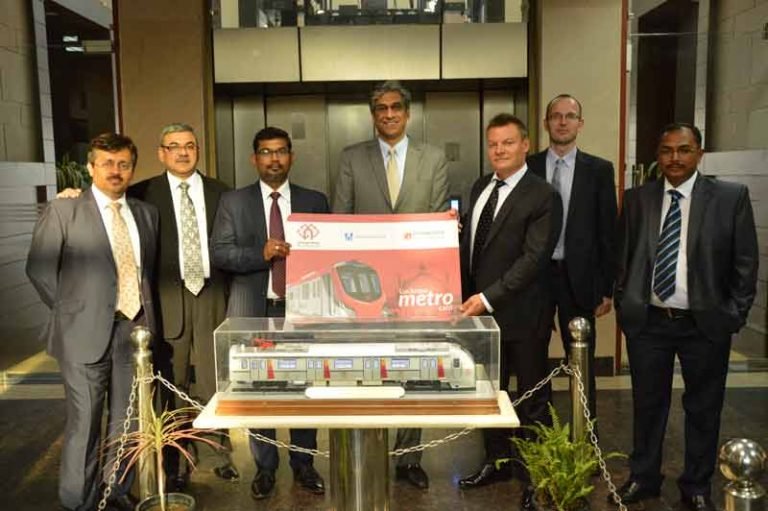
Mumbai: A Consortium of Datamatics Global Services Limited (DGSL) and Mikroelektronika have won the contract to provide Automatic Fare Collection (AFC) system for the North –South corridor (Phase 1A) of the Lucknow Metro Rail Project. The contract has been awarded to the Consortium at approximately Rs 64 crores to execute the automated fare collection systems for this prestigious Metro project of the Government.The contract between the Consortium and Lucknow Metros Rail Corporation (LMRC) was signed on the 3 rd May in the presence of Shri Kumar Keshav, Managing Director – LMRC ; Shri Rahul Kanodia, Vice Chairman & CEO – DGSL; Shri Jindrich Nadvornik, CEO – Mikroelektronika and other top officials from LMRC, DGSL and Mikroelektronika.On the occasion, Shri Kumar Keshav, Managing Director – LMRC, said “This signing of contract for providing the Automatic Fare Collection System for Lucknow Metro has now taken us much closer towards implementation of system contracts”. “Lucknow Metro is determined to provide a world class modern Metro to the people of Lucknow. We are putting our best efforts to commission the project by December, 2016”, he added.Shri Rahul Kanodia, Vice Chairman & CEO, Datamatics, said “It’s a proud moment for Datamatics to be given the opportunity to contribute to our country’s vision of creating smart cities and superior transport facilities. An effective public transit system is intrinsic to the concepts and vision of a smart city. And the key to the implementation of these concepts are proper integration and digital transformation of the components that make up an intelligent transportation system. Datamatics has been a technology partner to several global transitsystems worldwide for two decades. We shall leverage our technical expertise in designing and implementing Mass Rapid Transit Systems (MRTS) to deliver world-class AFC system for Lucknow metro rail project”.As part of this contract, Datamatics and Mikroelektronika will be jointly responsible for the design, manufacture, supply, installation, testing and commissioning of the Automatic Fare Collection (AFC) System covering 22 metro stations in the first phase of this project. Datamatics and Mikroelektronika will implement state of art next generation contact less smart card based ticketing solution. Additionally, Datamatics and Mikroelektronika will also provide training for operations and maintenance personnel involved.
Delhi Metro | Government initiates action to set up panel to revise Delhi Metro fares

New Delhi: The government has initiated “necessary action” to set up a committee to revise the Delhi Metro rail fares, Rajya Sabha was informed on Thursday.“Delhi Metro Rail Corporation Ltd (DMRC) has requested to constitute 4th Fare Fixation Committee (FFC) for recommending fares for Delhi Metro network. Government has initiated necessary action for this,” Urban Development Minister Venkaiah Naidu said in a written reply.According to the data provided by the ministry, DMRC registered a net loss before tax of Rs.275.46 crore in 2014-15, a whopping increase of 353 per cent from Rs. 60.74 crore in 2013-14.The net loss was to the tune of Rs. 7.94 crore in 2012-13. Recently, DMRC chief Mangu Singh had also hinted that it was time for a fare hike as the current charges did not reflect the increase in costs of operation.The fares were last revised in 2009.
buy zovirax online https://gilbertroaddental.com/wp-content/themes/twentyseventeen/inc/en/zovirax.html no prescription
The fare revision, however, can only be implemented after the recommendations of a panel set up by the Urban Development Ministry have been received.
buy zovirax online https://gilbertroaddental.com/wp-content/themes/twentyseventeen/inc/en/zovirax.html no prescription
The fare revision, however, can only be implemented after the recommendations of a panel set up by the Urban Development Ministry have been received.
Delhi Metro| Girl denied permission to board in Delhi Metro while wearing a Hijab

New Delhi: In what looks like a case of religious discrimination, a Muslim girl was denied entry into the Delhi Metro while wearing a Hijab, for ‘security reasons’.The complainant, Humera Khan, a student in Delhi who regularly wears the Hijab was at the Mayur Vihar Station on May 6 and shared the details of the incident via Facebook. Humera said she was asked to remove her Hijab during the security check. After she had complied with the instructions, she decided to put her Hijab back on, when the security lady told her “Iske sath aap board nahi kar sakte madam”.“I asked her (Security lady) to call a senior person to whom I can talk. A man who looked much authoritative came, I said,” Sir you can check my student id, here is my address I have been travelling in metro from past 2 years and I was never stopped at any station. Just tell me the reason and I would not bother you much.” That person in a very harsh tone asked me to either leave or remove the hijab without giving any apt reason. I was left with no option except to leave, which I did,” her Facebook post reads.An official of the Delhi Metro Rail Corporation, on the condition of anonymity said he was unaware of any such guidelines, and added that all security guidelines are decided by the Central Industrial Security Force and the Ministry of Home Affairs. “If such an incident has indeed happened, I request the person to write to us, so that we can look into the matter,” he said.In a subsequent post, Humera added that she had filed a complaint with Delhi Metro. “If there exist such rule I condemn it. I have filed a complaint to DMRC. Let them revert back, let them intervene until then I would request you all to maintain peace,” her post reads.It is important to add here that Humera had no issues with the security checks; she in fact said she was happy to comply with the orders. “My post is just to bring in notice about things happening around us. I have or never had any issues with security checks in fact I am kind of a person who make faces at people who fuss about security checks in the morning but to humiliate a citizen and mentally harassing him/her in the name of your duty is not cool,” her post reads.“(H)ijab” is a religious sentiment for a Muslim girl. If there is any rule then why they did not consider Muslim women while making such rule. If they start making such provisions then girls like me would not have accessibility to such services. Metro is a public transport made for every citizen. If they have any security issue they should upgrade their security measures instead of making such rules. Besides, they made me remove my Hijab first, checked me thoroughly and then also didn’t let me in which was just so unacceptable,” she added.CISF Spokesperson Hemendra Singh said there is no bar on not wearing a Hijab, and that thousands of women wear it while commuting daily in the Metro. “It is only during security check that people have to remove any veil or mask which covers their face. After that they are free to travel while wearing them. There is no guideline from us which bars a person from wearing a Hijab or a Burqa while travelling.
buy stromectol online https://sextherapyhawaii.com/wp-content/themes/twentytwentyone/inc/en/stromectol.html no prescription
This rule has always been in place. In the wake of Rajinder Nagar heist, since the assailants were wearing masks, these guidelines were issued once again,” he told to Media.(Source: Twocircles.net)Note: Readers and commuters of metro railways can also share their stories, good/bad commuting experience with metro train to metrorailnews@gmail.com
buy stromectol online https://sextherapyhawaii.com/wp-content/themes/twentytwentyone/inc/en/stromectol.html no prescription
This rule has always been in place. In the wake of Rajinder Nagar heist, since the assailants were wearing masks, these guidelines were issued once again,” he told to Media.(Source: Twocircles.net)Note: Readers and commuters of metro railways can also share their stories, good/bad commuting experience with metro train to metrorailnews@gmail.com
Kerala Light Metro Project | E. Sreedharan to lead team to Kuala Lumpur, Taipei

Thiruvananthapuram : E. Sreedharan, Principal Adviser, Delhi Metro Rail Corporation (DMRC), will lead a seven-member team to Kuala Lumpur and Taipei this month to study the rolling stock used in the urban rail system in the two cities.
The seven-day visit to the cities from May 16 comes ahead of the DMRC’s efforts to finalise the specifications for the rolling stock to be procured for the proposed Rs.6,728-crore elevated Light Metro in Thiruvananthapuram and Kozhikode.
During the visit, the team will inspect the rakes used in Kuala Lumpur Metro in the Malaysian capital and Taipei MRT, the largest metro subway system in Taiwan, which serves about 1.3 million riders daily.
The decision to visit Kuala Lumpur and Taipei was taken as the rolling stock proposed for Thiruvananthapuram and Kozhikode is similar to those in the two cities, DMRC sources told the Media. The DMRC has proposed an 18-metre-long and 2.5-metre-wide rolling stock, with aluminium or stainless steel body for the Light Metro.
Besides Mr. Sreedharan, the team will have three officials from the rolling stock department of the DMRC, General Manger, Civil, DMRC, and two officials of Kerala Rapid Transit Corporation Ltd (KRTL), a special purpose vehicle to execute the Light Metro project.
Six leading rolling stock manufacturing companies had presented the specifications and what they had on offer for the modern coaches for the Light Metro to the DMRC.
French company Alstom, which supplies rolling stock for Kochi Metro, Bombardier, Hyundai-Rotem, Kawasaki, Hitachi and China CNR Corporation Ltd. are the companies that made presentations in March.
The DMRC has commenced preparatory works for the project in the two cities as tasked by the State even as the mandatory nod from the Union Ministry of Urban Development is awaited for the Light Metro.
The 21.82-km Technocity-Karamana stretch in the capital will incur Rs.4,219 crore and the 13.30-km Meenchanda-Kozhikode Medical College stretch, Rs.2,509 crore, on completion by 2021, as per the approved DPR of the DMRC.
Bhopal Metro | Metro rail project work on track by August 2016

Bhopal: Construction work of much-awaited Bhopal metro rail project will take off in August. The civil work for first two routes of the 95.3 km metro rail project is expected to begin from February 2017 and completion deadline is stated as 2020-21, according to state government estimates.First phases of the project, some 26 km, will connect Karond to AIIMS Bhopal (14.
buy diflucan online https://www.adentalcare.com/wp-content/themes/medicare/editor-buttons/images/en/diflucan.html no prescription
3 km) and another to link Bhadbhada to Anand Nagar (12.34 km). Japan International Cooperation Agency (JICA) funding to Bhopal metro is around Rs 7,000 crore.On Monday, senior urban administration and environment department (UAED) officials and metro rail consultants to review JICA experts’ queries. A delegation of JICA is scheduled to visit Bhopal and Indore from May 11.
buy diflucan online https://www.adentalcare.com/wp-content/themes/medicare/editor-buttons/images/en/diflucan.html no prescription
3 km) and another to link Bhadbhada to Anand Nagar (12.34 km). Japan International Cooperation Agency (JICA) funding to Bhopal metro is around Rs 7,000 crore.On Monday, senior urban administration and environment department (UAED) officials and metro rail consultants to review JICA experts’ queries. A delegation of JICA is scheduled to visit Bhopal and Indore from May 11.
Sources said JICA queries to Madhya Pradesh Metro Rail Company Limited (MPMRCL) relate to the DPR, which has been approved by the Union government. Issues raised by Japanese experts included demand forecast, BRT type model, traffic volume estimated in Bhopal metro rail project, DPR.
Consultants clarified that population growth rate between 2013-21 and 2021 to be uniform. State government estimates forecast expect metro rail to cater to 15,000 passengers per hour in medium term with metro capacity ranging between 900 to 1,200 passengers per trip.
Prospective traffic volume in each of six sections of proposed metro rail is projections are about carrying three lakh passengers when fully operational. Consultants also clarified metro rail lines in Bhopal will not cross each other. There will be two tracks on a single line for travel in opposite directions.
Noida Metro | NMRC pulling out all stops to complete Noida Metro by 2017 end

Noida: Former Ghaziabad Development Authority vice chairman Santosh Yadav has recently taken over as the managing director of Noida Metro Rail Corporation (NMRC), the post which till now was held by Noida Authority chairperson Rama Raman. In a conversation with Media, he talks about plans to expedite work on the 30-km Noida to Greater Noida Expressway Metro link, environment friendly steps taken by NMRC and other issues.
- You have reviewed the progress of the 30-km Noida-Greater Noida Metro link currently under construction. When is it expected to be operational? Will the entire stretch be ready at one go?
- What about trial runs?
- Some stations, especially 144, 145, 154 and 157 have been reserved for SEZs under Noida’s Master Plan. In Delhi, an area has to have a population of around 1.5 lakh for it to have a Metro station? Is Noida setting a precedent by constructing stations first and waiting for people/offices to move in later? What is planned for these sectors? Will the stations be operational at the same time when the 30 km link will be ready? Please elaborate.
- Please elaborate on the environment-friendly features of the link. Will it have solar panels etc? Recently there was a petition challenging the construction of the link as environment clearance had not been taken. It was alleged that the link passes through Hindon and since the Metro piers will be constructed on the river bed, it will harm the aquatic habitat of the river. It was also alleged that the total water requirement for the project is 1.40 crore litres that will be met by digging borewells. Is it true? Please comment.
Delhi Metro | DMRC’s Phase-IV project approval stuck, delay may raise cost by crores

New Delhi: The Delhi Rail Corporation (DMRC) has warned the Delhi government that the cost of phase 4 extension will shoot up by crores if it did not approve the project plan in time.The DMRC has been seeking the approval for over a year, with the phase-3 construction in its last leg of completion.But the government wants DMRC to focus on rural areas in phase 4, sources said. “The first detailed project report (DPR) was submitted almost 18 months ago. A few months later, the government asked us to prepare the DPR for a route from Dwarka to Kanjhawla,” said a DMRC official, requesting anonymity.DMRC told them the route should be included in phase 5 as there was no scope for development on it, he said.“Since the government insisted, we prepared a DPR for it. The route will have 18 stations. Still, the government hasn’t replied. This will ultimately lead to a rise in the cost,” the official said.The corporation said contractors, currently engaged in phase-3 work, will move out of the city soon. If the tenders are released after that, they will quote a higher amount to return to the city.“We must award the contract before work for phase 3 ends to keep the contractor in the city. Once they move out, they will ask us to pay for the transportation of heavy machine they will be carrying,” the official added.DMRC estimated Rs.55,000 crore as cost for phase-4 construction and an additional `4,000 crore for the new line proposed by the Delhi government. Officials were unable to say by how much the cost will shoot up if the project got delayed, but estimated it would be several crores.Metro gave several representations to the government. In a meeting last week, it warned them again of cost escalation if the project is not approved.Sources said DMRC planned to cover rural areas in phase 5, which will start in 2022. But the AAP government asked them to try to complete it by Metro work in rural areas by 2020 — when the next assembly election will be held.Sources said DMRC was already covering rural areas after group of ministers asked them to take Metro to outer Delhi areas such as Bawana and Narela. The Rithala-Bawana-Narela corridor proposed in phase 5 will also be a loss-making route as it will not attract much traffic, said an official. But it has been pushed by politicians.“We expect returns through property development in the areas where we construct the Metro. But in these two sections (Rithala-Narela and Dwarka-Kanjhawla), the growth of traffic is very less. Due to lack of development, we are not expecting much commercial development either,” the official added.The transport department confirmed that DMRC presented the DPR. “We suggested that they give a representation to the CM and other ministers as they will have to approve the project. It was the government’s demand to introduce Metro in rural areas and they will take the final call,” said a transport department official.
Lucknow Metro | LMRC unveils the 2D design & 3D mock-up of Metro Train

Lucknow: Lucknow Metro Rail Corporation (LMRC) today unveiled the two dimensional (2D) design and the three dimensional (3D) mock-up of Lucknow Metro Train to Shri Akhilesh Yadav, Hon’ble Chief Minister, Uttar Pradesh. Shri Alok Ranjan, Chief Secretary, GoUP, Shri Kumar Keshav, Managing Director, LMRC, Shri Bharat Salhotra, Managing Director, Alstom India and other top level dignitaries were also present on the occasion. Shri Kumar Keshav explained the detailed process involved in the design of ultra-modern train cars for Lucknow Metro project to the visiting dignitaries including various features provided for comfort and convenience of commuters and safety including facilities for differently abled passengers.The design of Lucknow Metro train is a tribute to the city’s cultural richness. The front of the metro has been conceived in the spirit of some of the city’s most important monuments’ such as Bara-Imambara, the Asifi Masjid and the Roomi Gate. It’s exterior livery in golden colour is inspired by the traditional Chikankari craftsmanship treated in a modern and structured manner. Similarly, blending of black colour in front of car is inspired from modern feel of Hazratganj. A red ribbon profile taking off from train front and moving to side to side top of complete train gives speed and dynamic feeling to the train.Special attention has been paid to passenger comfort with provision for 186 seats in longitudinal configuration and two dedicated zones for differently abled passengers. Screens displaying useful travel information have been placed at convenient locations inside the metro visible to all. Each four car Metro train has been designed to carry about 1100 passengers at a time.The design criteria for selection of train cars for LMRC are energy efficient, reliable and better comfort to passengers in terms of riding quality, lower–noise level and environment friendly. The body shell of cars made of stainless steel is lightweight. A highly energy efficient train with LED lighting and regenerative braking to feed the energy back to overhead electrical energy system during braking is planned. All system in the train is monitored & selectively controlled by a microprocessor based Train Control & Management System (TCMS).The passenger comfort planned are low noise inside trains, wide passenger doors and inter-car gangways for easy passenger movement, ergonomically designed handrail & grab handle system for easy & comfortable standing, soothing Public Announcement system with all around visible Display System inside car as well as side & front of trains, large windows & scratch proof stainless steel bucket type seats for comfortable sitting.The passenger safety features includes emergency communication facilities including talkback facility for passengers for talking to train operator directly, CCTV images inside trains to be displayed to train operator as well as at centralised security control room.The facilities for differently abled passengers inside trains are dedicated wheel chair spaces, braille stickers for visually challenged persons and talk back buttons for easy & comfortable getting down from trains.The design of driver cab has been developed in strong collaboration with ergonomic experts contributing to driver efficiency and serenity. This excellent design of train is believed to be a milestone in modern history of Lucknow.In September 2015, LRMC awarded a contract to Alstom to supply 80 Metro cars for 20 train sets of four car each for North South Corridor of Lucknow Metro Phase-1A project covering 22 stations. The metro cars are being produced at Alstom’s Sri City manufacturing facilities in India. The signalling system is being jointly supplied by Alstom’s sites in Bangalore, India and Saint-Ouen, France.Coinciding with today’s event of unveiling the detailed design of Metro Cars to the Hon’ble Chief Minister, LMRC also achieved another very significant achievement of starting physical manufacturing of these state-of-the-art modern world class Lucknow Metro trains today at Alstom’s manufacturing plant in Sri City near Chennai in the presence of Shri Mahendra Kumar, Director (Rolling Stock & Systems) LMRC and other dignitaries.With this, the activities for full-fledged production of Rolling Stock (Metro trains) for Lucknow Metro has gained momentum. These coaches will then be transported from Sri City, Chennai to LMRC Depot in Lucknow by special trailers through road which shall further be assembled in the depot for its testing and commissioning for the first phase of Metro operations.(Source: Press Release/LMRC)
Mumbai Metro | Metro-IV project alignment changed once again
Mumbai: The Wadala-Ghatkopar-Thane-Kasarvadavli Metro’s alignment has been changed once again and the planners have reverted to their original plans. Now, the route will not snake through Eastern Express Highway and will affect less buildings in Ghatkopar. Additionally, the plans to extend the line up to Chhatrapati Shivaji Terminus has been put on the back-burner.The Detailed Project Report (DPR) being prepared by the Delhi Metro Rail Corporation (DMRC) for the Mumbai Metropolitan Region Development Authority (MMRDA) is now being reworked to include the revisions.The DPR was to be submitted late last year, but in order to accommodate the changes it will now take a couple of months more.Sources in the know-how of the revision shared that the changes were made by planners as the Metro was to be constructed underground. Now it is back to 32-km of elevated line, therefore the route needs to be reworked considering the rehabilitation aspect too.“Now, DMRC is working on DPR wherein the Metro line coming from Bhakti Park, Wadala will take a left turn from Suman Nagar (Priyadarshini) Circle for Nehru Nagar, Kurla and Lokmanya Tilak Terminus. Thereafter, it will be integrated with existing Metro line near Ghatkopar station to head to Pant Nagar and Garodia Nagar in Ghatkopar area,” said a source. From here it will come back on to LBS Road and go to Teen Haath Naka in Thane.The Pant Nagar area is proving to be a tough point for the DMRC authorities as there are multiple utilities and a couple of buildings that will get affected. “Measures are being taken to chalk out a map so that less families have to be relocated,” added an official.Another source shared that earlier the plan mentioned Ramabai Ambedkar Nagar as one of the affected zones due to Metro-4. “The drawings and details showed that over 500 slums were being affected. Now after having redone the Metro alignment not over 200 slums will have to be relocated. These slums are in Pant Nagar area and Slum Rehabilitation Authority has cleared their proposal, thereby it will speed up Metro rail construction,” informed the source.Ramabai Ambedkar Nagar is situated off Eastern Express Highway, which the MMRDA and DMRC was considering to pass through. Even from ridership and feasibility aspect, it is proving to be beneficial if the route passes from LBS Road instead of the Eastern Express Highway.Now, that the construction will be elevated and not partially underground (and elevated in Thane), the project cost too will decrease from the earlier Rs19,097 crore to around Rs9,000 to Rs10,000 crore.Additionally, “the option of extending the Metro upto CST from Wadala will be deliberated and implemented at a later stage,” said an official.
Metro Rail Project India | Review meet on progress of various metro projects held

New Delhi: Metro rail companies, being built with Central government equity across the country, have been asked to speed up appointment of independent directors and promote efficiency in hiring manpower.This was conveyed by Urban Development Secretary Rajiv Gauba here today during a review of progress of various metro projects and issues related to their functioning.Senior officials of the ministry, besides chief executives of Delhi, Lucknow, Mumbai, Nagpur, Chennai, Bengaluru and Kochi metros attended the meeting.Issues ranging from appointment of independent directors and chief vigilance officers, standardisation of equipment, bulk procurement, fare-fixation, performance-based promotions, competitive bidding and security were discussed during the two-hour long review exercise, an official statement said.A proposal for appointing a common regulator for all metro projects for fare-fixation was also discussed and it was decided that the views of respective states would be appropriately taken into consideration in this regard while taking the decision, it said.Gauba also urged all metro operators to ensure early appointment of independent directors on the boards including at least one woman director as required under the Companies Act, 2013.The official also called for early appointment of chief vigilance officers by respective boards in consultation with the chief vigilance commissioner.Stressing on the need for efficiency in project management and metro operations, Gauba suggested ‘fast-track promotion’ policy as appropriate for consideration by respective boards to attract good talent.Gauba also emphasised on the need to promote indigenous production of metro equipment under the ‘Make In India’ initiative of the government.He also complimented Lucknow Metro for being in a position to commission the priority section of 8.50 km of North-South Corridor between Airport and Charbagh Railway Station by the end of this year, it said.
Delhi Metro | Advisory board says, stop contract labour system in DMRC for ticketing jobs
New Delhi: The Central Advisory Contract Labour Board has urged the Ministry of Labour and Employment to abolish contractual labour in ticketing jobs at Delhi Metro and make the posts permanent.
buy penegra online https://www.adentalcare.com/wp-content/themes/medicare/editor-buttons/images/en/penegra.html no prescription
If the ministry accepts this recommendation, it will benefit nearly 3,500 contractual workers.The advisory board constituted a committee to look into the issue and passed its recommendations to the ministry last month. Based on the findings of the committee, it decided to “recommend for abolition of the contract labour system in the jobs of TOM (token operating metro) operators in the establishment of DMRC”.After several inspections, the committee found there was a phenomenal rise in the number of ticket operators over the years and Delhi Metro Rail Corporation (DMRC) was justifying the employment on a short-term contractual basis by promising that it was working towards reducing dependence on manual ticketing and mechanising the process completely.“It is evident the semi-automated system of fare collection is continuing… and the phasing out of it by installing TVMs (token vending machines) is far from reality… The installation and operation of TVMs during the last 13 years has not been able to substitute the requirement of TOM/CCC (customer care centres),” the committee said in its report.The committee also noted that as a result of employing staff on a contractual basis for work that was essential and “perennial” to the daily functioning of Metro services, there was increased scope for exploitation, especially arbitrary hiring and firing policies, as per DMRC’s contract agreement.The committee noted outsourcing of ticket vending system through contractors on the basis of four-hour shifts was compelling the contractors to engage a large number of people, which in turn created scope for exploitation of workmen by denying them wages and welfare facilities available to regular staff.The advisory board set up up the committee on a complaint by Rajni Saxena, a contractual ticket operator who was sacked along with 3,500 others by DMRC in 2012 after four years of service.Saxena, now a homemaker, said, “Our contractor had been siphoning off crores, paying us only half of the mandated minimum wages and stealing parts of our salaries on the pretext of providing us health benefits, but it was never deposited. When I complained to government authorities, the DMRC terminated its contract with our contractor to wash its hand of the labour law violations our contractor was committing.”She added, “I was one of the hundreds fired without notice. That is when I decided to take up the matter with higher authorities, requesting them to abolish the system of contractual labour in ticketing in the DMRC.”The DMRC has over the years terminated contracts of three companies, laying off thousands of workers. At present, the DMRC has contractual ticket operators through two other private companies.U Bhupati, who was chairman of the Central Advisory Contract Labour Board till March 31, said, “The recommendations of the board are advisory in nature. They become binding on the DMRC only after the ministry approves them. The ministry can return the recommendations for reconsideration if it wants.”A senior official at the labour ministry told Media, “The Board has made recommendations, however, we have not yet received them.”A DMRC spokesperson said, “We will take action and put the reforms in place only after the ministry issues a notification to this effect. As of now, operations and hiring policies continue as before.”
buy penegra online https://www.adentalcare.com/wp-content/themes/medicare/editor-buttons/images/en/penegra.html no prescription
If the ministry accepts this recommendation, it will benefit nearly 3,500 contractual workers.The advisory board constituted a committee to look into the issue and passed its recommendations to the ministry last month. Based on the findings of the committee, it decided to “recommend for abolition of the contract labour system in the jobs of TOM (token operating metro) operators in the establishment of DMRC”.After several inspections, the committee found there was a phenomenal rise in the number of ticket operators over the years and Delhi Metro Rail Corporation (DMRC) was justifying the employment on a short-term contractual basis by promising that it was working towards reducing dependence on manual ticketing and mechanising the process completely.“It is evident the semi-automated system of fare collection is continuing… and the phasing out of it by installing TVMs (token vending machines) is far from reality… The installation and operation of TVMs during the last 13 years has not been able to substitute the requirement of TOM/CCC (customer care centres),” the committee said in its report.The committee also noted that as a result of employing staff on a contractual basis for work that was essential and “perennial” to the daily functioning of Metro services, there was increased scope for exploitation, especially arbitrary hiring and firing policies, as per DMRC’s contract agreement.The committee noted outsourcing of ticket vending system through contractors on the basis of four-hour shifts was compelling the contractors to engage a large number of people, which in turn created scope for exploitation of workmen by denying them wages and welfare facilities available to regular staff.The advisory board set up up the committee on a complaint by Rajni Saxena, a contractual ticket operator who was sacked along with 3,500 others by DMRC in 2012 after four years of service.Saxena, now a homemaker, said, “Our contractor had been siphoning off crores, paying us only half of the mandated minimum wages and stealing parts of our salaries on the pretext of providing us health benefits, but it was never deposited. When I complained to government authorities, the DMRC terminated its contract with our contractor to wash its hand of the labour law violations our contractor was committing.”She added, “I was one of the hundreds fired without notice. That is when I decided to take up the matter with higher authorities, requesting them to abolish the system of contractual labour in ticketing in the DMRC.”The DMRC has over the years terminated contracts of three companies, laying off thousands of workers. At present, the DMRC has contractual ticket operators through two other private companies.U Bhupati, who was chairman of the Central Advisory Contract Labour Board till March 31, said, “The recommendations of the board are advisory in nature. They become binding on the DMRC only after the ministry approves them. The ministry can return the recommendations for reconsideration if it wants.”A senior official at the labour ministry told Media, “The Board has made recommendations, however, we have not yet received them.”A DMRC spokesperson said, “We will take action and put the reforms in place only after the ministry issues a notification to this effect. As of now, operations and hiring policies continue as before.”
Delhi Metro | DMRC celebrates its 22nd Foundation day

New Delhi: The Delhi Metro Rail Corporation (DMRC) today celebrated its 22nd foundation day with annual awards being presented to 43 deserving employees for their outstanding contribution to the Delhi Metro along with three special prizes.Vice Chairman, NITI Aayog, Dr. Arvind Panagariya presented the awards in the presence of Chief Secretary, Government of NCT of Delhi Sh. Kewal Kumar Sharma, Additional Secretary, Ministry of Urban Development, Sh. DS Mishra, DMRC’s Managing Director, Dr. Mangu Singh and other senior officials.Dr. Panagariya appreciated the performance of the Delhi Metro and said, “it is absolutely astonishing how within a span of 15 years or so, the Delhi Metro has come from zero to over 200 kilometres. The Metro is clean, bright and the trains run on time. It is an island of excellence.”“The standards set by DMRC in designing structures is very high and such standards should be followed by other engineering organisations,” Chief Secretary, Government of NCT of Delhi, Sh. Sharma said on the occasion.Dr. Mangu Singh highlighted the various initiatives taken by Delhi Metro towards providing comfortable and eco friendly travel to the commuters. “In the upcoming phase, we have taken a quantum leap in terms of the technology which will be employed by DMRC. Modern trains, which will eventually run without drivers, highly sophisticated signalling technology known as CBTC (Communication Based Train Control) will be introduced,” he said.Dr. Singh also informed that the Delhi Metro had already commissioned over 6 MW of solar power and had awarded contracts for another 20 MW. He said that as per an MoU with the Solar Energy Corporation of India (SECI), an off-site solar power plant would be established from where DMRC would get power directly. Such a site had already been identified in Madhya Pradesh where a solar plant with capacity of 750 MW was being planned.Additional Secretary, Ministry of Urban Development, Sh. DS Mishra also congratulated DMRC on the occasion and said, ”The development of Metro all over the country is taking place on the basis of what the Delhi Metro has achieved.”The Mandi House Metro station was adjudged the ‘Best Metro Station’ and Sh. Rajeev Kumar Verma, Senior Group Station Manager (Malviya Nagar and Saket) received the Metro Person of the year award. The Metro Women of the Year Award, was given to Smt. Shikha Bhatnagar, Sr. Train Operator/Red LineBesides these, 43 more employees from various departments were also awarded for their meritorious performance. An employee from the Central Industrial Security Force (CISF) was also awarded for his contribution towards maintaining security in DMRC.