New Delhi: Prime Minister Narendra Modi has flagged-off the Delhi-Faridabad Metro Line that would allow hassle free travel for around two lakh daily commuters between the national capital and the industrial hub in Haryana.The extension of the Delhi Metro connects Badarpur to Escorts Mujesar in Faridabad.The total cost of the project from Badarpur to Escorts Mujesar is nearly Rs. 2,500 crore. Out of this, Rs. 1,557 crore was borne by the Haryana Government, the Centre contributed Rs. 537 crore, while the Delhi Metro provided Rs. 400 crore.The nine stations in this section include, Sarai, NHPC Chowk, Mewala Maharajpur, Sector 28, Badkal Mor, Old Faridabad, Neelam Chowk Ajronda, Bata Chowk and Escorts Mujesar. buy kamagra polo online https://lasernailtherapy.com/wp-content/themes/twentytwentytwo/inc/patterns/en/kamagra-polo.html no prescription
All these are elevated and located on either side of the Delhi-Mathura Road (NH-2).“The nine-station metro corridor which was 95 per cent indigenously built will provide people a safe, affordable, quick, comfortable, reliable, environment-friendly and sustainable transport facility,” a Haryana government spokesperson said.Haryana Chief Minister ML Khattar, addressing a press conference on Saturday, had thanked the Prime Minister for “gifting” the Metro service which would take the city to “another level of progress” with better connectivity with other NCR towns.He had also said that the Prime Minister would be announcing the go-ahead for connecting Gurgaon with Faridabad by Metro.
New Delhi: Delhi Metro ridership breached the 33 lakh mark on the eve of Raksha Bandhan, reaching an all time high, while during the ongoing month of August itself, nine out of the ten daily riderships records of the mass rapid transit have been logged.As many as 33,61,911 commuters availed the metro on August 17. The Airport Express line had surpassed the daily ridership mark of 50,000 for the first time last Friday.Providing the breakup, Delhi Metro Rail Corporation (DMRC) said the ever busy Blue Line, that connects Dwaraka Sector-21 to Noida City Centre/Vaishali, recorded the highest ridership with 12,03,915 passengers.
Yellow line, another busy corridor, which stretches from North Delhi’s Samaypur Badali to Gurgaon’s HUDA City Centre recorded the second highest number of commuters at 11,68,410 while 4,56,427 people took the Red Line that connects Dilshad Garden to Rithala.The previous year’s record of 3,204,756, recorded on August 28, was broken on August 8 this month when 3,269,413 commuters availed the metro services, fast expanding and emerging as the national capital’s lifeline in the absence of a robust public transport system.DMRC’s network currently spans around 213 km. It ran 106 extra trips on Wednesday in anticipation of this expected increase in number of users due to the Raksha Bandhan festival, said an official statement.
It is already running extra trips on Saturdays and Sundays during the month to account for the annual trend of an extra rush around this period, due to festivities, commencement of colleges and the monsoons, metro official said.
Lucknow: Lucknow Metro’s contractors for package LKCC-01 between Amausi & Charbagh completed pushing a 60m long steel truss bridge over the Avadh intersection for the 22.878 km north-south metro line! Pushing work Pushing work teamWeighing 460 MT, the bridge was recently assembled just south of the Avadh rotary, and pushing work for it began on the night of August 8 by a team of Larsen & Toubro (L&T) and HMM Infra. This challenging task took 4 days to complete and was achieved by applying the push-launching method using multiple rollers and hydraulic jacks. Prior to being assembled on-site, the bridge was fabricated at HMM Infra’s facility in Ambala where their engineers also performed a trial assembly.The launching activity of this 470 ton steel span over metro viaduct was a daunting task in itself as this activity was performed during night hours at a height of approximately 13 meters above the road level. Lucknow metro had applied the ‘Push Launching Technology’ mechanism to achieve this engineering feat. ‘Push Launching Technology’ is a proven mechanism to do such type of launching activity where rolling of segments is concerned for erection of spans in metro construction As per a LMRC officialWith the bridge now successfully placed, L&T will now start concreting work at its deck after which track-laying work will commence. The 255m cantilever bridge is now the last major section pending on the entire 8.48 km priority corridor. Elsewhere, less than 35 U-girders are left to be placed in the run-up to the LMRC’s aggressive target of commencing trial runs by the end of the year.
Nagpur: According to NCC Ltd. successfully launched the first ever pre-cast segment for building Nagpur’s 19.658 km north-south Metro line! This particular segment was cast in May and if you notice closely, it was integrated & cast along with a parapet wall (unique in Indian metros) which has helped to reduce the cost of purchasing separate casting molds, transport individual parapet segments on-site and cut down overall construction time.Nagpur Metro Project updateAs per the Nagpur Metro Rail Corporation, the segment has a length of 3m with a top width of 8.5m and a bottom width of 3.5m. It’s 2m high and weighs approximately 37 MT.
DMRC parking lots remained closed on Independence dayNew Delhi: Parking facilities will not be available at the Delhi Metro stations from 6:00 AM on Sunday i.e, 14th August, 2016 till 2:00 PM on Monday i.e, 15th August, 2016 in view of the security measures adopted on the occasion of Independence Day.The Delhi Metro has instructed all the parking contractors to use this opportunity for cleaning all the parking lots thoroughly in the spirit of ‘Swachh Bharat Abhiyan’ and will also depute its officials to inspect the parking sites for strict compliance.
New Delhi: Trial runs began from 10th July 2016 on the 5.17 kilometre long ITO – Kashmere Gate section of Delhi Metro’s violet line. This stretch will be an extension of the presently operational Escorts Mujesar (Faridabad) – ITO corridor.
This entirely underground section will comprise of four stations – Delhi Gate, Jama Masjid, Lal Quila and Kashmere Gate. The Kashmere Gate station will become the first ever interchange facility of the Delhi Metro system to provide interconnectivity between three corridors of the network (violet line with red and yellow lines).
During the trial runs, the interaction of the Metro train with physical infringements (civil structure) will be checked to ensure that there is no physical blockage during the movement of the train on the track. The entire signaling system will also undergo rigorous testing.
In addition, the response of the train at different speeds, braking of the train and the interconnection with the Operations Control Centre (OCC) will also be monitored during the trials. The behavior of the track system and the Over Head Electrification (OHE) will be checked repeatedly during all the trials.
This section, also called the heritage line passes through various historical landmarks of the Old Delhi such as Delhi Gate, Jama Masjid and Red Fort. After the commissioning of this section, residents of Faridabad and various south Delhi areas such as Govindpuri, Kalkaji, Nehru Place, East of Kailash etc will be able to travel directly to Old Delhi and vice versa.
Commuters travelling on the yellow line between Central Secretariat and Kashmere Gate will also have another alternative of using the violet line for reaching the same destinations which, in turn, will decongest the system.
After the commissioning of this section, the entire 9.37 kilometre long Central Secretariat – Kashmere Gate section will be operational and become a part of the 43.40 kilometre long Escorts Mujesar – Kashmere Gate violet line corridor. This corridor is also being currently extended to Ballabhgarh from Escorts Mujesar (3.2 kilometres).
Since the corridor passes through areas of great historical importance, the stations have been decorated with panels and artworks depicting the glory of the bygone era. DMRC had tied up with the art and culture body INTACH for artworks at the stations. During construction also, adequate care was taken to ensure that the monuments nearby were not harmed in any way by Metro construction. The Heritage Line was given clearance by NMA (National Monuments Authority) on 13th February 2013.
New Delhi: The Delhi Metro Rail Corporation (DMRC) extended its trial runs on the upcoming Janakpuri West – Botanical Garden corridor from Okhla Vihar till Kalkaji Mandir in southern Delhi.
With the beginning of trial runs on this section, now trials are in progress on a 9. buy viagra black online no prescription
5 kilometre stretch from Kalindi Kunj till Kalkaji Mandir. Earlier in June, initial trial runs had started between Kalindi Kunj and Okhla Vihar stations of this corridor.
DMRC extends trial runs of driverless metro
Delhi Metro’s new UTO (Unattended Train Operations) enabled trains will operate on this corridor. The new trains, with extremely high levels of automation, will now undergo rigorous trials between these stations to ensure that they are ready for smooth operations after the commissioning of the corridor. Initially, train operators will run the trains, but gradually, driverless operations (on the UTO mode) will be possible.
During these trials, the interface of the Metro train will be checked to ensure that there is no physical infringement with civil infrastructure during the movement of the train on the track and also testing of various subsystems of coaches shall be done.
Later on, in stages, the new signaling technology to be implemented on this corridor and Communication Based Train Control (CBTC) will also undergo rigorous testing. The response of the train at different speeds, braking of the train and the interconnection with the Operations Control Centre (OCC) will also be monitored during the trials. The behavior of the track system and the Over Head Electrification (OHE) will be checked repeatedly.
This particular section from Kalindi Kunj till Kalkaji Mandir consists of seven elevated stations – Kalindi Kunj, Jasola Vihar Shaheen Bagh, Okhla Vihar, Jamia Milia Islamia, Sukhdev Vihar, Okhla NSIC and Kalkaji Mandir. Civil work on all stations is complete and finishing activities are in progress. Gradually, the trial runs will be expanded to the other parts of the entire corridor.
The depot has been built at Kalindi Kunj which will cater to the Janakpuri West – Botanical Garden corridor. This depot is also unique from the point of view of engineering since its stabling sheds will be elevated on a separate deck, which in turn will be covered by solar panels.
Mumbai: The Comptroller and Auditor General of India (CAG) has come down on the Mumbai Metropolitan Development Authority (MMRDA) for spending Rs. 5 crore unnecessarily crore in the construction of the Metro-II corridor in Mumbai. The CAG report has said the MMRDA appointed an independent engineer without resolving environmental issues related to the Metro-II corridor, which resulted in an ‘infructuous’ expenditure of Rs. 4.71 crore.
The CAG pointed out that the Mumbai Metro Rail Corporation Limited (MMRCL), a fully-owned company of MMRDA, entered in January, 2011, into an agreement with a consortium of three private parties for rendering consultancy services.
The scope of the consultancy’s work was to review and finalise the standard gauge rail system, conceptual designs, quality assurance programme, safety and operation plan etc.
The total consultancy fee was Rs. 20.31 crore, of which five per cent was payable as an advance. The government also entered into a concession agreement (CA) with the concessionaire. Mumbai Metro Transport Private Limited (MMPTL), a consortium of Reliance Infrastructure Limited (RIL), was appointed as a concessionaire to construct and operate the Metro on the Charkop-Bandra-Mankhurd route.
But before entering into the CA, RIL had in 2010 written to MMRDA that in both Charkop and Mankhurd depots, substantial area was falling under the Coastal Regulation Zone and this was not made known to them at the bidding stage. It was also stated that this was an impediment to the implementation of the project.
“Therefore, instead of taking steps for resolution of the environmental clearance issue, MMRCL went ahead with the appointment of the independent engineer and also released payment to them,” the CAG said.
Since the environmental clearances were not received and the project had become a not-starter, the GOM decided to terminate the contract at no cost to either party. “Consequently the entire payment made to the engineer became infructuous. The work done by him was not even verifiable.” The CAG also rejected the explanation submitted by MMRCL, stating the latter was well aware of the fact that the environmental clearances were required.
“They knew this project would be a non-starter. The role of the engineer whose services were engaged for work relating to implementation of the project were rendered futile,” it said.
MMRDA not for Metro line on MTHL
On one hand, the Mumbai Metropolitan Region Development Authority (MMRDA) says that public transport is the solution to Mumbai’s commuting woes, on the other hand, it is still not in favour of a Metro rail on the Sewri-Nhava Mumbai Trans-Harbour Link (MTHL).“Once the Dahisar (E)-Andheri (E) Metro is ready, it will have a capacity to carry motorists equivalent of using 50 car lanes of a highway,” said Pravin Darade, additional metropolitan commissioner, MMRDA. As per the projections, by 2021, 5.29 lakh passengers are expected to take a ride on the Metro, as compared to 6.67 lakh in 2031.In 2011, the MMRDA had proposed a Metro line parallel to the road sea bridge. The idea was to connect Mumbai’s Metro rail network with that of Navi Mumbai, and eventually with the planned Navi Mumbai International Airport.But as the MMRDA initiated the tendering procedure, it dropped the Metro rail plan, citing implementation “at a later stage”.When a senior MMRDA official was asked about the issue, he replied, “It (Metro line) was never planned on MTHL. It was just an idea.”
Bangalore: The Indian Institute of Management Bangalore (IIMB), the consultant appointed to prepare a fare structure for Kochi metro, has suggested Rs.15 as the minimum fare for 2 km distance and Rs.65 for the 25-km-long Aluva-Pettah corridor, during peak hours.
The IIMB has also recommended variable fare during off-peak hours, capping the upper fare at Rs.50. The final fares will be fixed most likely at the next director board meeting of KMRL, after being vetted by the fare-fixation committee which would have representatives of the State government and the Union Urban Development Ministry, Kochi metro sources said.
The minimum fare suggested is higher than that for other metros in the country. The maximum fare for a 10-km-long journey in Mumbai metro is Rs.100, while Chennai metro charges Rs.40 for the same distance. The fare suggested for the same distance in Kochi metro is Rs.30.
The IIM team has submitted a report on fare projection till 2025. It has suggested a new fare stage for 2, 5, 10, 15 and 20 km.
Reacting to possible criticism of the suggested fare structure, vis a vis the fares of Delhi metro, KMRL sources said that the capital city charges a minimum fare of Rs. buy avana online https://healthcoachmichelle.com/wp-content/themes/twentytwentyone/inc/en/avana.html no prescription
8 and Rs.16 for 10 km (Rs.1.50 per km) as compared to Rs.2.50 per km for travelling the full distance in the Kochi metro corridor.
The fares for Delhi metro’s first phase has not been revised so far, though a revision was expected in 2011.
Focus on TOD
Reacting to the suggested fare structure, D. Dhanuraj, chairman of city-based Centre for Public Policy Research (CPPR), warned that high fares might result in low patronage for the metro. “The focus must be on transit-oriented development (TOD) along the Aluva-Pettah metro corridor. Hong Kong is an apt example of a metro system which has optimally tapped the TOD concept,” he said.
In Kochi, government land in possession of the Kochi Corporation, Revenue Department etc. on the metro corridor can be better utilised, raking in revenue for the metro. Only then can the metro be operated in a feasible way, Mr. Dhanuraj said.
Delhi Metro allows only 21 of its trains to be used for ad wraps; it earns Rs. 32 crore a year
New Delhi: The concept of ‘Metro wrap’ ads, where the entire Metro train is covered with ads, is becoming so popular that demand for them has surpassed the total number of trains available for the purpose.
Since its launch in October 2014, the Delhi Metro has had at least 30 companies that have opted for this form of advertising and a dozen others are in queue.
The demand and supply gap arises because the Delhi Metro Rail Corporation (DMRC) allows only 10 per cent of its coaches per corridor to be wrapped with ads. Hence, only 21 trains of the total 208 trains can be wrapped with ads.
But, the DMRC and the ad agency, Eg.Communications Private Limited, which has been given the responsibility for the ad wraps, aren’t complaining.
The ad agency earns about Rs. 25 lakh from advertisers to wrap coaches of the Metro for a month, it pays the DMRC Rs. 32 crore per annum for the space.
“This concept has been a success due to the sheer magnanimity of the space available for advertising and of course, the huge ridership of the Delhi Metro. Each six-coach Metro train body provides 7,000 square feet of space for ads. Moreover, these ad-wrapped trains grab five million eyeballs on a daily basis. So for an advertiser, his job is done in a matter of seconds when a commuter or a person travelling in car sees the Metro passing by,” said Manish Sethi, director of Eg.Communications Private Limited.
At present, 12 trains are ad wrapped and order for four others are pending, Mr. Sethi said.
These trains run on all lines of the Metro network except the Red Line (Rithala-Dilshad Garden).
The Delhi Metro has a daily ridership of 26 lakh and about 70 per cent of commuters spend at least 30 minutes in the Metro network daily.
The first ad wrapped train was from Morpheus Group. It was rolled out in October 2014. The second was by Indiamart. Amazon.in, Renault, Snapdeal, Mother Dairy, ONGC, Bank of Baroda, PNB Housing, Micromax, Oppo, Fortune, Myntra, Dhara, Gulf and Hike have advertised on train bodies.
“Wraps are put only on six-coach trains as the fabrication cost is very high. buy Lopressor generic bloonlineandnew.com over the counter
Around Rs. 8 lakh per train goes in making, pasting and removing these ads,” said Mr Sethi.
The agency maintains that increasing the number of trains under this ad category is not necessary as fewer trains help in building high brand recall among people.
For advertise in Delhi metro Click here to contact us [psfb id=”2136″ title=”Contact Form”]
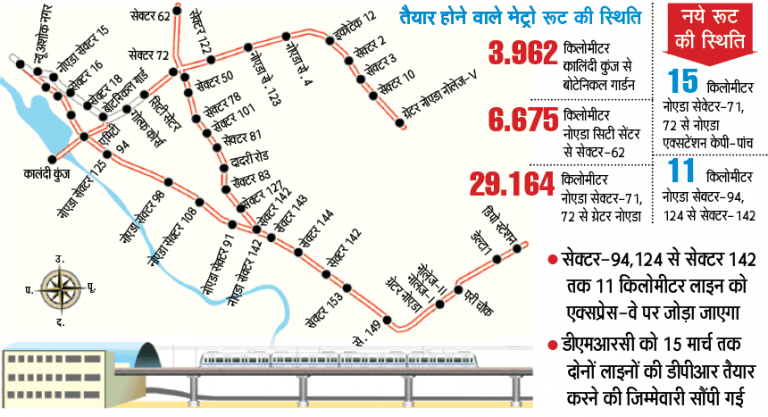
Noida: The Delhi Metro Rail Corporation will assist Noida Metro Rail Corporation (NMRC) in operating and maintaining the 29.7-km-long Noida-Greater Noida Metro corridor. A memorandum of understanding (MoU) to this effect was signed between the two entities on Friday. The construction work of Noida-Greater Noida corridor is already being executed by the DMRC.The DMRC will be providing assistance to the NMRC until the later develops the expertise to operate and maintain the corridor itself. “The assistance would be rendered during the pre-commercial operation period and three years post-commercial operation period of the NMRC. The agreement may be extended with mutual consent,” a statement from the DMRC said. The construction work of the 30-km-long corridor is already being executed by DMRC on behalf of NMRC. The structural work on the corridor, that will have 21 stations, is expected to be completed by March 2017. The DMRC has been involved in planning or construction of almost all Metro rail projects across the country.
Hyderabad: A total of 1,200 properties are still at different stages of acquisition for the Hyderabad Metro Rail. About 850 properties in Sultan Bazaar and 45 each in the three other corridors at Ameerpet, Jubilee Hills and Secunderabad.A senior government official said a GHMC committee was looking into the property acquisition. He said while those losing properties earlier wanted alternative sites, they were preferring money now. “Some of them have gone to court and the proceedings are at various stages.”A senior officer said that the claims for final settlements were not being cleared. “After notice is served on the owners, compensation must be given to them but that is taking time,” he said.In Secunderabad, the Padma Hamsa Apartments case is before the Hyderabad collector after the court cleared its acquisition. The collector has to decide how much money each apartment owner has to be paid.
A total of 1,131.89 square yards of the apartments will be taken over, an officer said. “Hyderabad Metro Rail will pay Rs 7.97 crore but this money has to be divided between each owner. This has to be decided by the collector. Till the collector sits with all of them and decides, the building cannot be taken over,” he said.L&T told to clear major roads soon
L&T Hyderabad Metro Rail has been asked to clear major traffic areas at Begumpet, Greenlands junction and Ameerpet stadium quickly to free up the roads for commuters.At the Begumpet Rasoopura stretch, traffic is completely stopped at night to allow construction. Despite this, a senior state government officer said, work was not happening at the required speed.Chief secretary Rajiv Sharma had pointed out that the works had to be completed quickly so that commuters are not troubled.A senior traffic police officer explained, “We deploy traffic personnel on the Begumpet stretch for long hours, yet it is difficult to manage as the road space has been reduced to a large extent.Squatter take Space between metro pillars
Open areas below the Metro Rail viaducts and stations are being occupied by miscreants, beggars and footpath dwellers. Many of them had been using the space near the Begumpet railway station, which is now occupied by construction activity.Complaints regarding this have been sent to the traffic police office at Rasoolpura. Mr P. Satish of the Begumpet traffic police said cops were evicting the illegal occupants but they were returning due to the continuous rains. “While some of them sleep at night and are not seen during the day, beggars and drug addicts are seen in the afternoon,” he said.Metro Rail staff working at night have been shooing them away. A senior official said that once construction work is complete, Metro Rail would beautify the stretch and barricade it.
TNERC has turned down a petition from the Chennai Metro
Chennai: The Tamil Nadu Electricity Regulatory Commission (TNERC) has turned down a petition from the Chennai Metro Rail Ltd (CMRL) to provide concessional power tariff retrospectively.
However, considering that CMRL is a provider of public transport services in Chennai, the Commission observed that “ends of justice will be met only if CMRL is classified under HT Tariff I (B) for all the connected load of CMRL.” “Other loads like ATM, kiosks, stalls, hotels, etc., shall be separately metered and charged under miscellaneous category and it shall be deducted from the main energy consumption metered at the CMRL’s point of supply,” the order said.
CMRL had approached the Commission seeking railway traction tariff for July 2013-June 2015 pointing out that the Metro Rail was an essential public utility and social sector green field project. CMRL claimed that the Delhi Metro Rail Corporation (DMRC) and Bengaluru Metro Rail Corporation Ltd (BMRCL) were being charged lower tariff of Rs. 6.10 per unit with fixed demand charges of Rs. 150 per kVA, and Rs. 5.20 per unit with fixed demand charges of Rs. 180 per KVA per month respectively under a special category, CMRL said.
It argued that its operational cost will be impacted if tariff was not fixed on par with DMRC or BMRCL. But TANGEDCO said, between July 2013 and June 2015 the power supply was used for trial operations and hence the agency was billed. buy sildalis online https://www.ecladent.co.uk/wp-content/themes/twentyseventeen/inc/en/sildalis.html no prescription
New Delhi: The Smart Cities Mission is an innovative and new initiative by the Government of India to drive economic growth and improve the quality of life of people by enabling local development and harnessing technology as a means to create smart outcomes for citizens. The Mission will cover 100 cities and its duration will be five years (FY2015-16 to FY2019-20). The objective is to promote cities that provide core infrastructure and give a decent quality of life to its citizens, a clean and sustainable environment and application of ‘Smart’ Solutions. Acknowledging the great importance of the ‘Smart Cities’ initiative by the Indian Government, Bharat Exhibitions is pleased to presents the 2nd edition of their industry flagship event – National Summit on 100 Smart Cities India 2016 scheduled to take place on 9th September 2016 at Le Meridien, New Delhi, INDIA. With the theme – “BUILDING TODAY – THE CITIES OF TOMORROW” this forum will trace the importance of various aspects of infrastructure that needs to be planned, designed, built and operated in order to provide the ‘Smart’ attribute to a city development. Take advantage of sponsorship and branding opportunities available to heighten your company’s presence at this exclusive conference. Choose from our wide range of advertising and sponsorship avenues to elevate your company’s profile and branding to a targeted audience. For details about the event kindly visit http://www.bharatexhibitions.com/en/100SCI2016/
New Delhi: The Delhi Metro Rail Corporation (DMRC) is going to install a 3 MWp solar power plant on top of the elevated Metro stabling lines of the Kalindi Kunj depot which will cater to trains operating on the Janakpuri West – Botanical Garden corridor.DMRC to Install 3mw Solar Plant-Kalindi Kunj DepotIn view of the constraints in availability of adequate land for the Kalindi Kunj depot, Delhi Metro engineers decided to construct an elevated stabling shed to accommodate Metro trains for maintenance purposes. This in itself was a major engineering achievement since, for the first ever time anywhere in Delhi Metro, an elevated shed was being constructed to counter the paucity of space and taking this innovative approach further, DMRC has decided to utilise the available space of the roof area of the stabling shed for generation of solar power.As per the plan, the solar plant will be set up on the frames of the stabling lines and will also serve the dual purpose of being the roof of the facility. A specialized agency was roped in to assess the feasibility of installing such a solar plant since Delhi Metro had not undertaken such a project before. Based on their report, a decision has been taken to install a 3 MWp plant there. The cost of installing this solar plant will be borne by the developer, as is the case with all DMRC plants, and Delhi Metro shall pay for the energy charges @ Rs. 5.4945 per unit, as levellised tariff for 25 years.The work on the stabling shed will be completed in about six months and then the solar plant will be installed atop the shed. Delhi Metro has so far installed solar power facilities at three of its depots (Yamuna Bank, Ajronda and Mukundpur) and work is in progress towards installing more such plants in the other depots. Installation of solar plant of 880KWp at Kalindi Kunj depot has been completed and commissioning work is in progress. Presently, the largest solar power plant on an individual roof is the stabling shed of Yamuna Bank Depot with a capacity of 624 KWp.Delhi Metro has so far commissioned 6.3 MWp of solar power plants across 21 locations in the Delhi Metro network. By March, 2017 DMRC will have commissioned solar power plants with capacity of about 20 MWp and by March, 2018, Delhi Metro will generate 31 MWp of solar power. As per its solar policy, DMRC plans to generate 50 MWp of solar power by the year 2021.





 The DMRC will be providing assistance to the NMRC until the later develops the expertise to operate and maintain the corridor itself. “The assistance would be rendered during the pre-commercial operation period and three years post-commercial operation period of the NMRC. The agreement may be extended with mutual consent,” a statement from the DMRC said. The construction work of the 30-km-long corridor is already being executed by DMRC on behalf of NMRC. The structural work on the corridor, that will have 21 stations, is expected to be completed by March 2017. The DMRC has been involved in planning or construction of almost all Metro rail projects across the country.
 A senior government official said a GHMC committee was looking into the property acquisition. He said while those losing properties earlier wanted alternative sites, they were preferring money now. “Some of them have gone to court and the proceedings are at various stages.”A senior officer said that the claims for final settlements were not being cleared. “After notice is served on the owners, compensation must be given to them but that is taking time,” he said.In Secunderabad, the Padma Hamsa Apartments case is before the Hyderabad collector after the court cleared its acquisition. The collector has to decide how much money each apartment owner has to be paid.
A total of 1,131.89 square yards of the apartments will be taken over, an officer said. “Hyderabad Metro Rail will pay Rs 7.97 crore but this money has to be divided between each owner. This has to be decided by the collector. Till the collector sits with all of them and decides, the building cannot be taken over,” he said.L&T told to clear major roads soon
L&T Hyderabad Metro Rail has been asked to clear major traffic areas at Begumpet, Greenlands junction and Ameerpet stadium quickly to free up the roads for commuters.At the Begumpet Rasoopura stretch, traffic is completely stopped at night to allow construction. Despite this, a senior state government officer said, work was not happening at the required speed.Chief secretary Rajiv Sharma had pointed out that the works had to be completed quickly so that commuters are not troubled.A senior traffic police officer explained, “We deploy traffic personnel on the Begumpet stretch for long hours, yet it is difficult to manage as the road space has been reduced to a large extent.Squatter take Space between metro pillars
Open areas below the Metro Rail viaducts and stations are being occupied by miscreants, beggars and footpath dwellers. Many of them had been using the space near the Begumpet railway station, which is now occupied by construction activity.Complaints regarding this have been sent to the traffic police office at Rasoolpura. Mr P. Satish of the Begumpet traffic police said cops were evicting the illegal occupants but they were returning due to the continuous rains. “While some of them sleep at night and are not seen during the day, beggars and drug addicts are seen in the afternoon,” he said.Metro Rail staff working at night have been shooing them away. A senior official said that once construction work is complete, Metro Rail would beautify the stretch and barricade it.
A senior government official said a GHMC committee was looking into the property acquisition. He said while those losing properties earlier wanted alternative sites, they were preferring money now. “Some of them have gone to court and the proceedings are at various stages.”A senior officer said that the claims for final settlements were not being cleared. “After notice is served on the owners, compensation must be given to them but that is taking time,” he said.In Secunderabad, the Padma Hamsa Apartments case is before the Hyderabad collector after the court cleared its acquisition. The collector has to decide how much money each apartment owner has to be paid.
A total of 1,131.89 square yards of the apartments will be taken over, an officer said. “Hyderabad Metro Rail will pay Rs 7.97 crore but this money has to be divided between each owner. This has to be decided by the collector. Till the collector sits with all of them and decides, the building cannot be taken over,” he said.L&T told to clear major roads soon
L&T Hyderabad Metro Rail has been asked to clear major traffic areas at Begumpet, Greenlands junction and Ameerpet stadium quickly to free up the roads for commuters.At the Begumpet Rasoopura stretch, traffic is completely stopped at night to allow construction. Despite this, a senior state government officer said, work was not happening at the required speed.Chief secretary Rajiv Sharma had pointed out that the works had to be completed quickly so that commuters are not troubled.A senior traffic police officer explained, “We deploy traffic personnel on the Begumpet stretch for long hours, yet it is difficult to manage as the road space has been reduced to a large extent.Squatter take Space between metro pillars
Open areas below the Metro Rail viaducts and stations are being occupied by miscreants, beggars and footpath dwellers. Many of them had been using the space near the Begumpet railway station, which is now occupied by construction activity.Complaints regarding this have been sent to the traffic police office at Rasoolpura. Mr P. Satish of the Begumpet traffic police said cops were evicting the illegal occupants but they were returning due to the continuous rains. “While some of them sleep at night and are not seen during the day, beggars and drug addicts are seen in the afternoon,” he said.Metro Rail staff working at night have been shooing them away. A senior official said that once construction work is complete, Metro Rail would beautify the stretch and barricade it.


