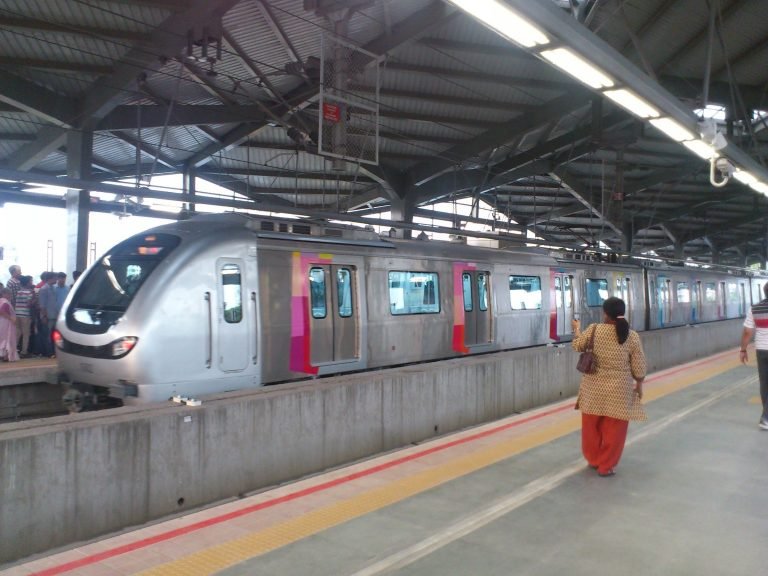
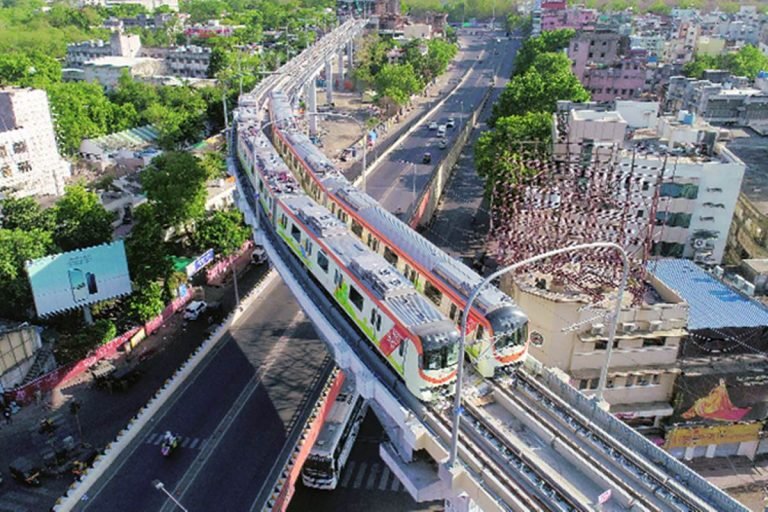
MUMBAI (Metro Rail News): The Maharashtra Metro Rail Corporation (Maha-Metro) has proposed the names ‘Aqua line’ for the Vanaz-Ramwadi metro corridor and ‘Purple line’ for the Pimpri-Chincwad to Swargate corridor.
Brijesh Dixit, managing director, Maha-Metro, said, “We have proposed these two names for the metro corridors. As Vanaz to Ramwadi metro corridor is passing through the Mula-Mutha riverbed, we have suggested the name ‘aqua line’. Purple color represents happiness. So considering this, the name ‘Purple line’ has been proposed for Pimpri-Chincwad to Swargate corridor.
“It is a norm that various metro lines have to be given names on the basis of color. This will help the commuters identify their metro trains. We hope to complete the work of the priority sections by December,” added Dixit.
MUMBAI (Metro Rail News): Voltas has received an order for tunnel ventilation systems for the Mumbai Metro 3 project post winning the bid.
HVAC solutions include tunnel ventilation for metros and underground stations. Under this business segment, the company has received Letter of Award (LOA) from Mumbai Metro Rail Corporation Limited (MMRCL) for Environmental Control System (ECS) and Tunnel Ventilation System (TVS) works for Phase 2, Lot 2 Package of 8 out of total 27 stations, i.e. from Cuffe Parade to Grant Road station and tunnel up to Mumbai Central station.
The total value of the packages being over Rs. 800 crores are divided into 3 packages and Voltas has received LOA for 1 package with an approximate value of Rs. 233 crore. Being a long duration project, the revenues and profits from this project will be delivered at a slow pace.
Voltas Limited is an air conditioning and engineering solutions specialist offering engineering solutions for industrial areas such as heating, ventilation, and air conditioning, refrigeration, electro-mechanical projects, electrification, cold chain solutions, building management systems, etc.
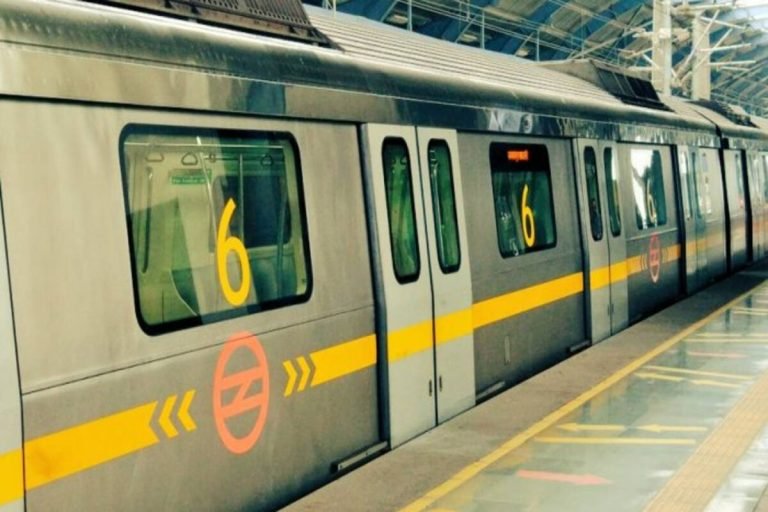
NEW DELHI (Metro Rail News): In the morning today several commuters faced inconvenience after services were briefly affected on a section of Delhi Metro’s Yellow Line.
The Delhi Metro Rail Corporation (DMRC) tweeted about the slow movement of trains between Rajiv Chowk and Qutub Minar. However, after a few hours, normal services were resumed on the route.
DMRC tweeted
“Normal services have resumed. We regret the inconvenience,”.
The Yellow Line is one of the busiest lines in the Delhi Metro network, ferrying thousands of passengers from Delhi to neighboring Gurgaon in Haryana.
The route measures almost 49 km and has a total of 37 stations. It connects Samaypur Badli in North Delhi to HUDA City Centre in Gurugram. The stretch connects prominent areas such as Delhi University, New Delhi and Old Delhi railway stations, Connaught Place, INA Market, AIIMS and Hauz Khas to name a few.
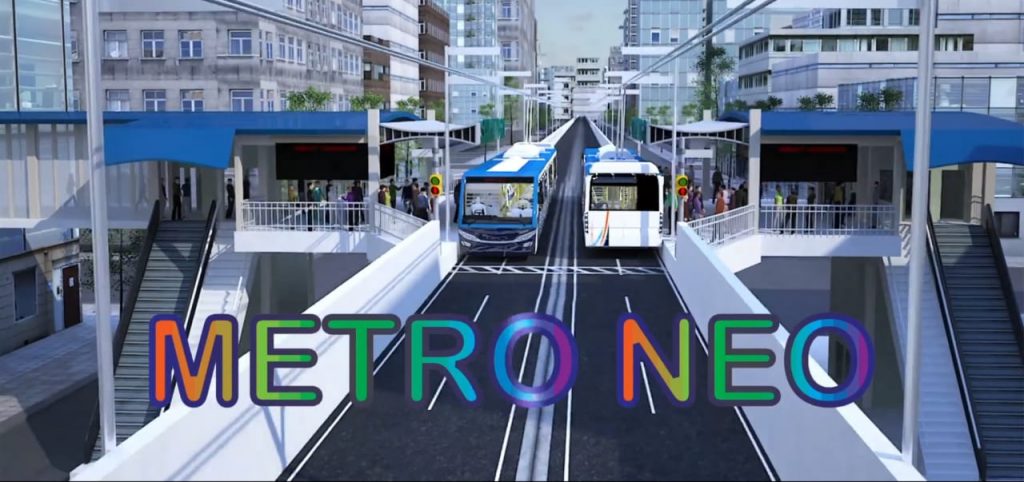
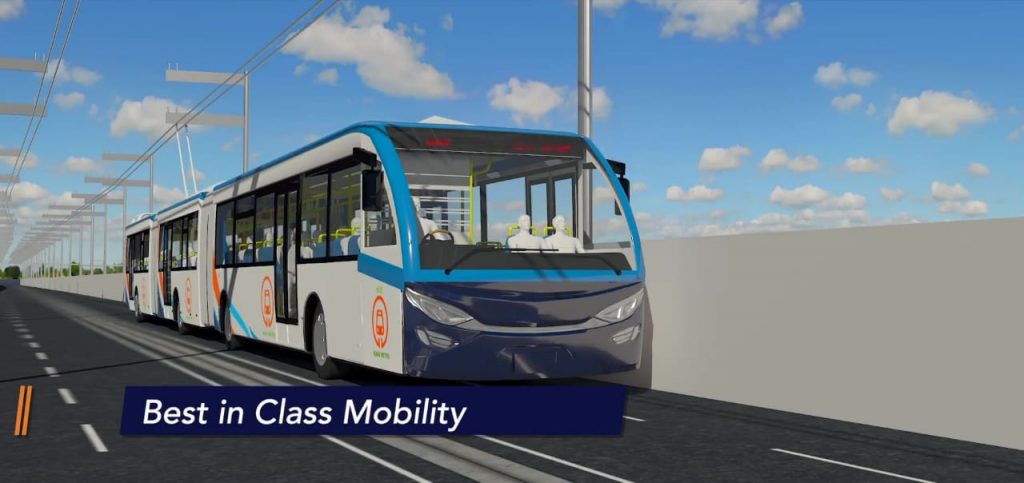
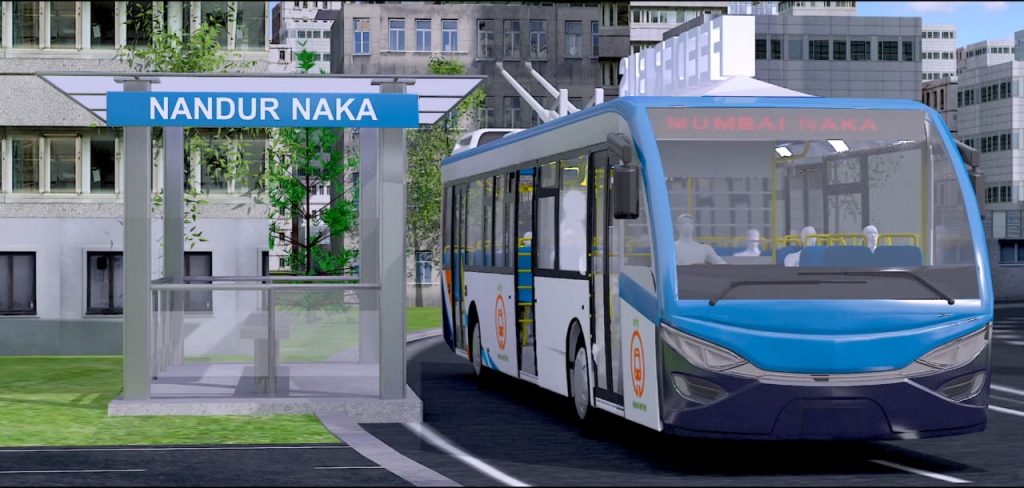
Nashik (Metro Rail News): Maharashtra cabinet on August 28, 2019, has approved Nashik’s first-of-its-kind Mass Rapid Transit System “Metro Neo” Which will not run on metal tyres (technically known as rails), but instead have rubber tyres. It help in better connectivity across the city. Like all lines, the corridor will be elevated. The Metro’s swanky coaches will operate on electricity and battery and ply on elevated viaducts with state-of-the-art terminals.
The project will be executed at an estimated cost of ₹2,100 crore and will be jointly implemented by Maha Metro, City and Industrial Development Corporation (Cidco) and Maharashtra Industrial Development Corporation (MIDC) said Mr. Brijesh Dixit, managing director, Maha Metro. The cabinet approved two corridors Shramik Road to Nashik Road, which is 18.45km long, and a 9.45km-long Gangapur to Mumbai Naka corridor in Nashik.
Nashik’s Metro Neo Project Corridor Route Map
According to Dixit, the “unique” Metro in Nashik is the first in the world where electricity-run coaches will be plying under the mass transport system. He said the concept was designed to make the project “financially viable” in the tier-II city. “This has not been done anywhere. The coaches of Metro Neo will have the comfort of the Metro coaches, but will run on tyres and not rails. We had to come up with a new model to make it financially viable,” Dixit told HT. The Metro will have a capacity of carrying 8,000 commuters during peak hours.
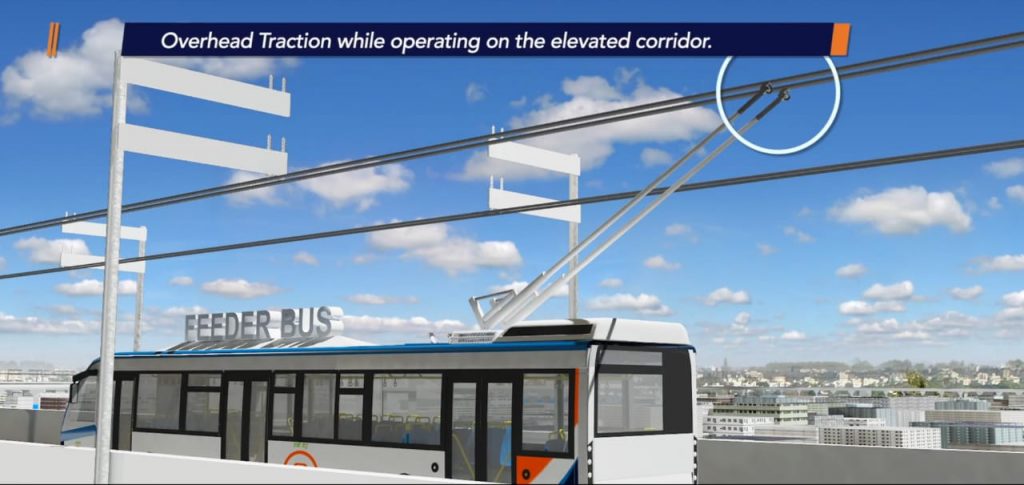
Ramanathan Subramanium, executive director of Maha Metro, said the coaches will run on overhead electrical cables (OHEs). “The elevated structures will have basic infrastructure like bus stops. The routes are planned in a way that it will connect important locations including railway stations, MIDC, etc. As the coaches will run on tyres, it will come down through a ramp, and operate around the city too as a feeder route,” he said.
Metro Neo Explained Video
The system could be upgraded to light rail transit (LRT) system subsequently, when the ridership goes up. “We can put rails on the viaduct and get new brakes to run on it,” Dixit said
MUMBAI
(Metro Rail News): Mumbai
Metro Rail Corporation’s (MMRC) managing director, Ashwini Bhide, said
underground Metros were ideal but could not be executed in the city due to
several, particularly financial, constraints.
She said,
“The ideal situation could be that all Metro lines are underground. But for a
country and a city like ours, where we have a huge resource crunch, we have
tried to find a solution.”
She said she
was not the most competent person to explain the decision to build elevated
Metro corridors, but said the city’s geographical makeup put a lot of
restrictions on planning public transport projects.
Ms. Bhide, who was addressing citizens at the V-Citizens Action Network event in Colaba, answered a series of questions regarding Metro 3, which is being built from Colaba to SEEPZ, including the contentious issue of a car shed proposed to be built in Aarey Colony.
The car shed
has been opposed by citizens and environmental groups as it involves axing
2,702 trees.
Recently,
the Brihanmumbai Municipal Corporation’s Tree Authority too stalled the
proposal for cutting trees after it received 82,000 objections from citizens.
Several
citizens questioned the need to have it in Aarey Colony and asked why the yard
was not possible in a site in Kanjurmarg, which is being proposed for the yard
of Metro Line 6. “That land was not made available because there are private
claims on it, litigation is on since 1996,” she said.
The land was still not available with the Mumbai Metropolitan Region Development Authority, which was looking for other options for Metro Line 6, she said. “Moreover, the land is 10 km away from our last stop. So it would have meant extending the corridor by 10 km and revising the whole design, financial closure, getting new approvals. We were still willing to do it provided the land at Kanjurmarg was available at the time,” she said.
She said the
MMRC was “seriously concerned” regarding the Aarey issue as the first set of
trains were expected to arrive by November 2020. If the depot is not ready by
then, they would have no place to keep the trains.
NOIDA (Metro Rail News): The Noida Metro Rail Corporation (NMRC) on Wednesday said it has started the process of hiring an agency that will carry out the feasibility study on two new Metro links — a 15km link from Sector 142 to Botanical Garden and another 3.8km link from Depot station to Bodaki.
“We have written to the Delhi Metro Rail Corporation (DMRC) and the Central government consultant agency, RITES, seeking their response about the feasibility study on the two proposed links. We will finalize the agency that charges the lowest fee for the study,” Alok Tandon, managing director, NMRC, and chairman of the Noida authority said.
The Greater
Noida authority, on May 31, 2019, had approved these projects and decided to
start work on their feasibility. The Uttar Pradesh chief secretary Anup Chandra
Pandey, who is also the chairman of the Greater Noida authority, had directed
the NMRC to expedite the work on the feasibility study and, later, on the
detailed project report of the two projects, given the importance of these
projects.
“An agency will
be selected in a month or so. After that, it will take about three months to
prepare a feasibility report on the two projects. Once the feasibility report
is submitted, the UP government will take a final call on these projects,” an
NMRC official, requesting anonymity, said.
The
feasibility study will be conducted on the basis of expected traffic of
passengers on the two routes, economic growth along the lines and the ridership
during peak hours, among other parameters.
The Greater Noida authority had approved the 14km link with an aim to provide direct connectivity between Greater Noida and Delhi via Blue Line. The link will branch out from Botanical Garden and end at Noida’s Sector 142 Metro station on the existing Aqua Line. This line will run parallel to the Noida-Greater Noida Expressway after branching out from the existing Botanical Garden Metro station.
The
Botanical Garden station also serve as NCR’s first interchange station, linking
commuters to Blue Line (Noida City Centre to Dwarka Sector 21) and the
Janakpuri West-Botanical Garden corridor.
The Greater Noida authority had approved the 3.8km link between the Depot Metro station and Bodaki village, where the Delhi-Mumbai industrial corridor is developing a dedicated industrial township.
At present, the 29.71km Aqua-Line connects Noida’s Sector 51 with Greater Noida’s Depot Metro station. And Bodaki village, through which the Delhi-Howrah railway line passes, is located only 3.8km away from existing Aqua Line’s Depot Metro station.
The Integrated Industrial Township Greater Noida (IITG) authority is developing a dedicated industrial township along the Delhi-Mumbai industrial corridor. The IITGL, in 2017, had started allotment of industrial plots in an integrated township spread on 335 hectares. The authority wants to extend this Metro link so that in future passengers, who want to reach the railway station and industrial areas in Bodaki can get better connectivity via the upcoming Metro link.
The DPR and
the funding pattern for these two projects will be decided later.
“Funding is not an issue because the Noida, Greater Noida authorities will have a major share and we will also get support from the center and state government. But first let the feasibility study come then only we will finalize other things,” said Tandon.
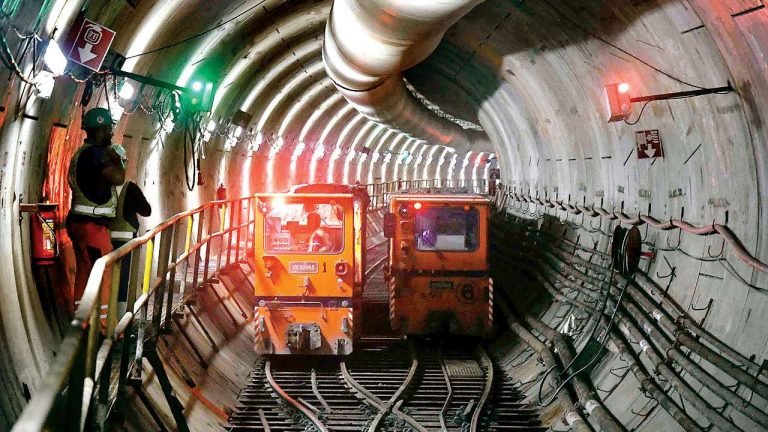
PUNE (Metro Rail News): The Maharashtra Metro Rail Corporation (MahaMetro) has finished digging an 18m-deep shaft at the College of Agriculture in Shivajinagar, marking the completion of a crucial step for the underground Metro rail section.
The shaft
will be used to lower the tunnel-boring machines, which will excavate the
tunnel for the underground route. A similar tunnel, 22m-deep, is being dug at
Swargate.
MahaMetro had initiated civil work on this shaft about 12 months ago. “Controlled blast technology was used to break the hard rock beneath the surface after the soil layer was removed in the first stage of digging. The shaft is square in shape, measuring 25 meters wide on each side, and 18 meters deep,” a MahaMetro official said.
MahaMetro,
which is executing two Metro routes in Pune and Pimpri Chinchwad — one from
Vanaz to Ramwadi and the other from PCMC to Swargate — now plans to level the
ground and construct a slab at the bottom to assist the landing of the
tunnel-boring machines. “All the necessary provisions will be made in time to
install the tunnel-boring machines and maintain the required depth.
Two parallel
tunnels will be dug once the machines are lowered through the shaft,” an
official said. MahaMetro expects to take delivery of the first tunnel-boring
machine in October. The excavation of the tunnel is expected to begin in November.
“A team of
MahaMetro officials will be visiting the Hong Kong-based company (which is
providing the machines) to conduct various tests on the tunnel-boring
machines,” an official said. Officials said that the tunnel-boring work will
begin from two ends — agriculture college and Swargate.
The digging at the Swargate site is underway and has been expedited once MahaMetro cleared various hurdles related to the side. The Swargate shaft will be four meters deeper than the one at agriculture college. An official said the difference in depth was because of the condition of the soil, rock, and the requirements of the project.
“The
difference will not affect the construction of the tunnel,” an official said.
Both the tunnels will meet in Kasba Peth area, at the underground metro
station.A MahaMetro official said that the work of
digging the tunnel will first start from the agriculture college end and will
be taken up later from the Swargate end. Meanwhile, MahaMetro said that it has
taken elaborate measures to dump the soil extracted from the shaft at
designated spots
VIJAYAWADA (Metro Rail News): Municipal minister Botcha Satyanarayana on Tuesday ruled out speculations on underground Metro rail line in Amaravati region.
Satyanarayana,
who reviewed the Amaravati Metro rail project at the secretariat on Tuesday,
said the underground railway line was not necessary for thinly populated areas
like Amaravati capital region.
Addressing the media he said: “Amaravati Metro Rail Corporation (AMRC) presented the detailed project report designed by SYSTRA. They have prepared estimates for the 67-km-long corridor at Rs 24,467 crore and proposed to construct an underground line in the Amaravati region by spending Rs 490 crore. But the earth grid Metro line is sufficient there.
Earth grid line costs around Rs 160 crore. We have decided to go for a cost-effective project.” The minister went on to say that the government has released Rs 187.40 crore lease amount due to farmers in the capital city region. He asked the farmers not to worry about the capital city project. Satyanarayana claimed that the opposition was trying to create panic by provoking farmers.
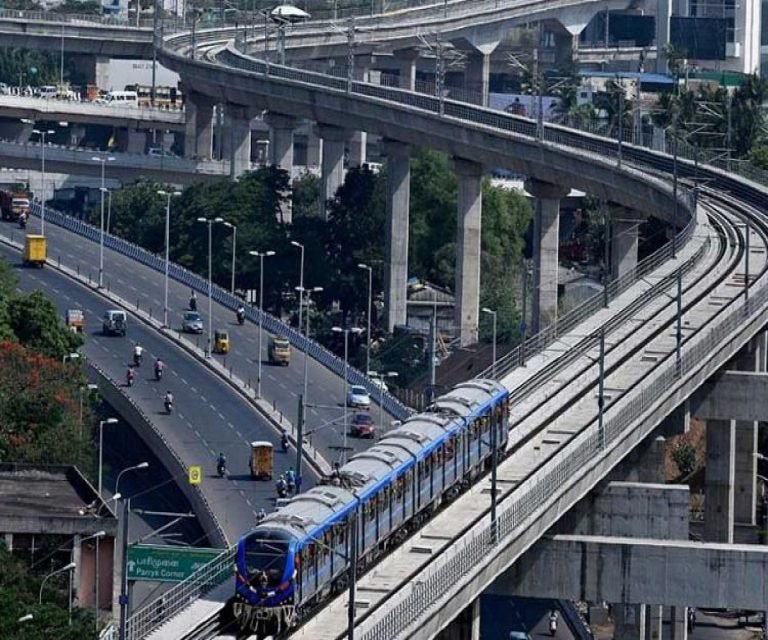
CHENNAI (Metro Rail News): Imagine a train pulling up every two-and-a-half minutes during peak hours on the city’s metro network. Sounds ambitious? That’s the frequency of service Chennai Metro Rail Limited (CMRL) hopes to achieve once the number of commuters touches 4 lakh a day.
The number is just over a lakh on weekdays now and averages 95,000 on weekends.
“The system is designed for 2½ minutes. Since we haven’t used it to an optimal level, we must validate it before we eventually increase the frequency.
We will
start the trials now to prepare ourselves when it needs to be implemented,” an
official said. At present, trains are run at five-minute intervals only during
peak hours on one corridor between Washermenpet and Airport via Anna Salai,
that too after commuters took to social media to complain about overcrowding.
CMRL doesn’t
have enough trains to run them every two-and-a-half minutes across both the
corridors throughout the day.
At present, 35 trains are operated during peak hours and 25 during non-peak hours. Officials said they would need 33 trains to run services every two-and-a-half minutes on a single corridor.
However,
CMRL has a fleet of only 42 trains to operate across the two corridors of
phase-1. An additional 10 trains are being manufactured for the 10km phase-1
extension.
Officials said increasing frequency is a big challenge and requires syncing of all critical systems with minimal failure. Systems including passenger information display on the platforms have to sync with daily train time table and platform screen doors have to efficiently function when trains arrive every two-and-a-half minutes. Point machines, a device used for trains switching tracks should also be failproof. All these critical systems will be checked during trial runs planned around midnight on Saturday.
“Reliability
of the overall system is critical and has to be tested. If there is a failure
in one train or in the signal system, the entire operation will go haywire,” an
official said.“We need at least two hours to prepare a train
and bring it out from the depot to the mainline. Induction and withdrawal of
trains to the depot itself is a big challenge,” an official said. While each
corridor is supposed to have a depot, CMRL operates two corridors with only one
depot. A second depot planned at Washermenpet is still under construction
KOCHI (Metro Rail News): A team led by the Commissioner of Metro Railway Safety (CMRS) will inspect the Kochi metro’s 5.60-km Maharaja’s College-Thykoodam stretch and the five stations en route on Friday and Saturday (August 30 and 31).
As regards civil work, the team will focus on structures like pile foundation, piers, girders, special bridges, and steel bridges. Bearings and various design aspects too will be inspected. As for the track, it will check aspects like gradients, horizontal curve, cross-level, derailment guard, weld joints, and turn-outs, said a release from Kochi Metro Rail Limited (KMRL).
In the electrical section, the team will inspect lifts and escalators, fire hydrants and fire-fighting system, third rail, auxiliary and traction substations, emergency tripping switch (ETS), and emergency telephone. In signaling, passenger help point (PHP), signaling system, public address system (PAS), and perimeter intrusion detection systems (PIDS) on platforms, apart from signaling and telecom equipment room, UPS room, and the automated fare collection (AFC) system will be inspected. The team will also examine station access and signages, the metro agency said.
Once the CMRS is satisfied with the quality and efficiency of the metro system, he will issue an authorization certificate, which is a pre-requisite to enable the commissioning of the extension.
Union Minister of State for Housing and Urban Affairs Hardeep Singh Puri and Chief Minister Pinarayi Vijayan will commission the eagerly awaited extension in the first week of September if everything goes according to plan. The tentative date of commissioning is September 3, while commercial operations will begin from September 4, metro sources said.
Sources in Delhi Metro Rail Corporation (DMRC) said passenger amenities in all the five stations on the stretch were ready. “Entry/exit is ready on both sides of the road for all stations except Ernakulam South where it is ready only on one side,” they added.
Dedicated parking space has been readied at the Thykoodam station. Designated parking areas already exist on the premises of the Ernakulam Junction railway station and beside the Vyttila Mobility Hub. A huge parking space for various types of vehicles is expected to come up as part of the second phase development work of the hub. A ground-level / elevated walkway linking the metro station and bus terminals proposed at the hub too will be built, it is learned.
Meanwhile,
the construction of medians beneath the metro corridor is almost over. They
will be landscaped too.
Greater
Cochin Development Watch (GCDW), a city-based NGO, had submitted a memorandum
to Chief Minister Pinarayi Vijayan a week ago, demanding a special fare of ₹10
between Ernakulam South metro station and Vyttila Hub, to attract more
commuters to the mass rapid transport system.
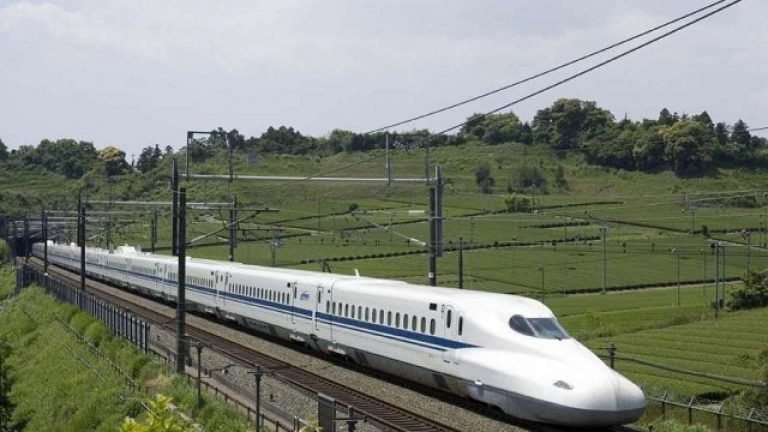
GUJARAT (Metro Rail News): On Tuesday, the High-Speed Rail Innovation Centre formed by National High-Speed Rail Corporation organized a seminar at IIT, Gandhi Nagar in Gujarat.
Achal Khare, Managing Director, NHSRCL and Dr.
Norimachi Kumagai, President, Railway Technical Research Institute (RTRI) Japan addressed researchers, students, and faculty of the Institute and discussed the maiden HSR project in India and technological aspects associated with it.
This was followed by
a panel discussion where the advisory council members interacted with the young
minds and also responded to the questions of students and faculty of IIT,
Gandhi Nagar.
During his address, MD/NHSRCL Shri Achal Khare said, “India
has long been a technological powerhouse and young Indian minds are bubbling
with innovative technological ideas. NHSRCL would like to collaborate with them
and provide them a platform to develop sustainable and indigenous technological
solutions for High-speed railways in India.”
The High-Speed Rail Innovation Centre
Trust has a mandate to undertake targeted, applied collaborative research to
solve issues raised by the railway industry to enhance railway safety,
reliability, productivity, efficiency, and sustainability in order to ensure
customer satisfaction.
The trust will also leverage Indian
technical capabilities and develop indigenous capabilities in relevant fields
of High-Speed Railways to develop professional expertise in all aspects of
High-Speed Railways so as to provide innovative, indigenous, cost-effective
solutions, technological guidance, strategic analysis, and advice to the Indian
Rail Transportation Industry on significant challenges and opportunities.
The trust will also provide
eco-friendly and environmentally sustainable solutions. It will also contribute
to the development of HSR specific standards in India.
HSR Innovation Centre which was
registered on January 22, 2019, is managed by a Board of Trustees Chaired by
Managing Director, NHSRCL and supported by Executive Council, which is assisted
by the Advisory Council to review nature of the projects to be undertaken by
the Innovation Centre.
WEST BENGAL (Metro Rail News): India-based railway wagon builder Titagarh Wagons has decided to exit its French rolling stock manufacturing subsidiary Arbel Fauvet Rail (AFR).
The Indian
firm decided to leave AFR just weeks after a commercial court in Paris ordered
the liquidation of the French subsidiary.
Titagarh
Wagons vice-chairman and MD Umesh Chowdhary said: “We have resolved to move out
from AFR, as it was making losses of 4-5 million Euros annually for the last
three years, due to a general slowdown, and it required more capital. Also, we
decided to pump in funds where growth lies.”
Titagarh
Wagons acquired AFR in 2010, following which it was renamed AFR Titagarh. Since
its acquisition, Titagarh Wagons has invested more than Rs1bn ($13.93m) in the
company.
Chowdhary
told PTI that the Indian rail wagon builder will now put more focus on
manufacturing metro coaches.
Titagarh Firema recently emerged as the lowest bidder to supply 102 metro coaches for Pune Metro Rail in India. The tender was issued by Maharashtra Metro Rail.
The scope of
works under the contract includes design, manufacturing, supplying, testing and
commissioning of the metro rail units. Titagarh will also provide necessary
training to Pune Metro personnel.
Overall, the
value of the contract is approximately Rs11.25bn ($156.73m).
The majority
of the metro coaches will be built in its Indian manufacturing plant in Nagpur
while some of the units will be delivered by the Italian facility.
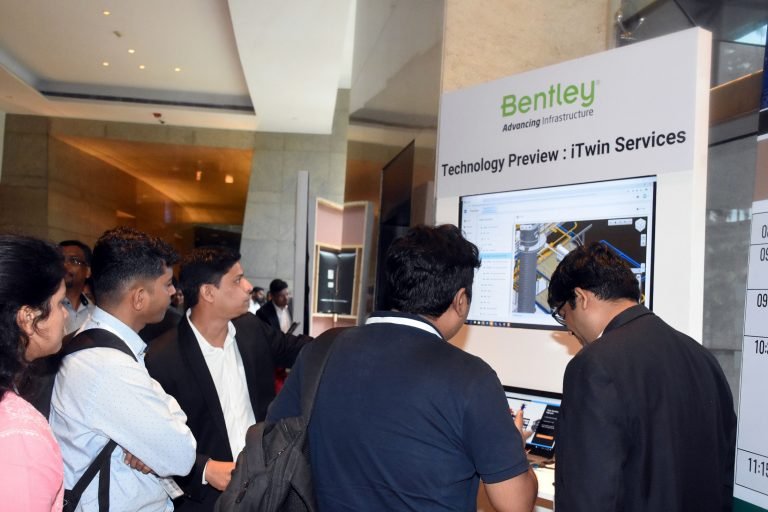
MUMBAI (Metro Rail News): Bentley Systems, Incorporated, the leading global provider of comprehensive software and digital twins services for advancing the design, construction, and operations of infrastructure, recently held its Going Digital 2019 event in Mumbai. More than 330 infrastructure professionals attended the event, which featured live demonstrations of Bentley Systems’ solutions and services that help professionals learn how to integrate digital context, digital workflows, and digital components into their infrastructure projects, enabling better decision making for improved project outcomes and better performing infrastructure assets.
Phil Christensen at the keynote address of Going Digital 2019
In his keynote presentation, Phil Christensen, senior vice president, Reality Modeling, iTwin Services, Bentley Systems, discussed how infrastructure digital twins empower users with continuous and comprehensive design review, immersive visualization, and analytics visibility to understand the impact of change and predictively model the performance of a project or infrastructure asset in the real world. He highlighted the benefits of digital workflows and how organizations can use technologies such as 3D/4D visualization, reality modeling, mixed reality, and geotechnical engineering for immersive visualization and analytics visibility.
Phil Christensen said, “It was great to see such an enthusiastic turnout for our event in Mumbai. Digital workflows are becoming integral to every infrastructure project—from design through to operations. And what we’re demonstrating here is that going digital is not merely a convenience or a useful tool, it is a necessity for designers, engineers, constructors, and owner operators to make informed decisions, optimize asset performance, and ensure the resilience of cities, sites, and buildings. Leveraging digital twins for analytics and immersive visualization of real-time project and performance conditions is a vital piece of the going digital journey.”
Participants attended insightful sessions with industry leaders from Siemens and Microsoft discussing digital twin technology and cloud solutions for industry to accelerate the digitalization of plants and smart infrastructure around the world. Paul King, industry sector director, construction, Bentley Systems gave a technology update on digital solutions and processes that can help initiate improvements in project performance and how companies that embrace emerging technologies can gain a strong competitive advantage. He also showcased Bentley’s project delivery solutions that are enabling better project team collaboration and safer, more efficient construction in the field.
The Going Digital 2019 event also included industry forums for attendees to learn about technology and solutions for their specific interests including Digital Cities; Geostructural; Rail, Road and Airport; and Process Plant.
Bentley’s next Going Digital 2019 event will be held on 19 September in Moscow.
About Bentley Systems
Bentley Systems is the leading global provider of software solutions to engineers, architects, geospatial professionals, constructors, and owner-operators for the design, construction, and operations of infrastructure. Bentley’s MicroStation-based engineering and BIM applications, and its digital twin cloud services, advance the project delivery (ProjectWise) and the asset performance (AssetWise) of transportation and other public works, utilities, industrial and resources plants, and commercial and institutional facilities.
Bentley Systems employs more than 3,600 colleagues, generates annual revenues of $700 million in 170 countries, and has invested more than $1 billion in research, development, and acquisitions since 2014. From inception in 1984, the company has remained majority-owned by its five founding Bentley brothers. Bentley shares transact by invitation on the NASDAQ Private Market. www.bentley.com
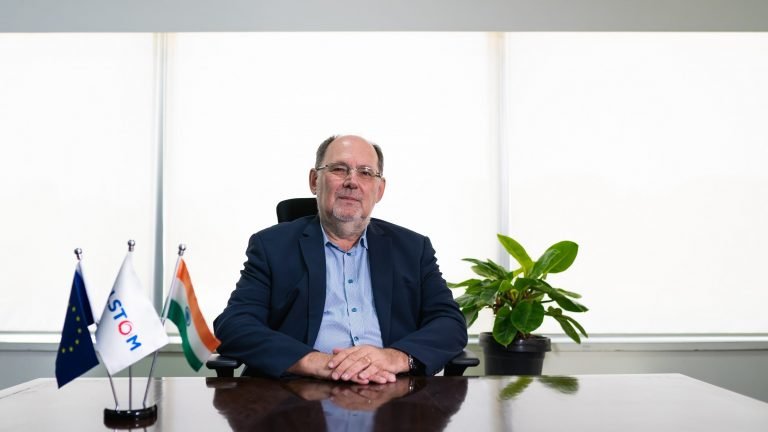
Mr. Alain Spohr, Managing Director, India & South Asia, Alstom has a keen understanding of the country’s business environment and also its culture and growth trajectory. Mr. Spohr has over four decades of experience in leadership and managerial roles. Mr Spohr’s strong exposure in industrial and factory operations have helped steer companies through rapid localization and cost reductions, helping business verticals secure significant market share and overall development. In this current role, his key focus is to expand Alstom’s business across all locations for optimized delivery of on-going projects within India and South Asia.
With several large projects underway in the mainline and urban networks, Alstom is uniquely positioned to meet India and Asia Pacific’s changing and growing mobility needs, believes Alain Spohr, Managing Director for India and South Asia. In an exclusive interview with Metro Rail News, Spohr talks about the recent 100th Made in India Trainset, manufacturing facility at Sricity, CBTC technology, Future expansion plan, company’s projects and strategies.
Metro Rail News:Firstly, Congratulations for rolling out 100th Made-in-India metro trainset. What is your current market share in India?
Mr. Alain Spohr: Thank you. The milestone of rolling out 100th ‘Made-in-India’ trainset is indeed a matter of pride for us. The global vision of Alstom is to become the preferred partner of our customers for transport solutions, and delivery of the centurion set to Kochi Metro reinforces this vision.
Urban transport sector in India is evolving and we are contributing to this phenomenon significantly. Currently, Alstom is part of a large number of important mobility projects in the country. Our flagship rolling stock manufacturing facility at Sricity has delivered rolling stocks for both international and domestic projects. Rolling stocks for Chennai, Lucknow, Kochi and Sydney metro projects were manufactured and supplied from Sricity. Our order book for rolling stock is healthy. We are currently gearing up to deliver Mumbai Line 3 and Montreal Metro.
Apart from rolling stock, we also provide the latest and advanced Urbalis 400 communications-based train control (CBTC) solution and other heavy engineering solutions. Our first CBTC solution was deployed at Kochi Metro. Alstom India won all the new CBTC projects awarded in FY18. Presently, India has 473 km of CBTC under execution, of which Alstom is executing close to 40%. We also won the signalling contracts to equip Mumbai Metro Line 3 as well as Mumbai Line 2A, 2B and 7, and are equipping Pune Metro lines 1 and 2 with Urbalis 400.
Metro Rail News:How “Make in India” initiative help you to set up a global manufacturing centre at Sri City, Andhra Pradesh, India
Alstom_100 TS from Sricity_Infographic
Mr. Alain Spohr: Make-In-India has encouraged companies to manufacture and invest in India. Alstom has been a strong supporter of the initiative and promotes manufacturing and job creation at the local level. We have synchronised our business goals with the government’s outcome-focused initiatives. As a result—from manufacturing to localisation to employment—we have been able to contribute significantly to ‘Make in India’.
Sricity plant is Alstom’s first global manufacturing centre for
rolling stock in the Asia-Pacific region. Established in 2012, the facility
currently employs 600+ workforce and has a production capacity of 240 cars per
year. In the last six years, Sricity facility has established itself as the
manufacturing hub for both domestic and international clients.
As far as international orders are concerned, we completed the order of delivering 22 Metropolis trains for Sydney Metro in December last year. After the timely and successful delivery for the Sydney project, we are gearing up to commence production for Mumbai Metro Line 3, which is Alstom’s biggest urban rolling stock contract in the country. Mumbai Metro Line 3 will be 33.5-km long and will be the first and longest underground metro line in Mumbai. In addition to this, the facility is also gearing up to commence production of its second international order – Montreal metro—for which we will supply 106 trains comprising 212 coaches.
Metro Rail News:What are the features of new metro coaches and where It will be delivered?
Mr. Alain Spohr: The new Metropolis metro coaches will be delivered for Mumbai Metro Line 3. Being the business capital of the country, Mumbai requires a sustainable transport system which can match the international standards. Mumbai Metro Line 3 is Alstom’s biggest urban rolling stock order in India.
Alstom Metropolis has high
benchmarks in terms of reliable and attractive metro trains. It has an extensive
track record, comes with a wide range of configurations, has low lifecycle
costs and a keen focus on the passenger experience. The Metropolis trainsets
are configured to suit customer’s requirements, be it design, length, width or
seating arrangements. The solution is fully scalable, capable of working in
multiple units or being lengthened by adding additional cars. Metropolis not
only operates in driver mode but also driverless, leading a growing trend for
automatic train operation (ATO).
Alstom is also leading in innovation
with designing energy-efficient products. Metropolis is a great example of
that. Our initiatives and solutions include full electrical braking, light
weight design, highly efficient power converters, regulation of climate control
according to passenger load, and LED lighting. Metropolis displays low
lifecycle costs due to extended maintenance intervals and easier maintenance.
The Mumbai metro cars will also
have 75% motorisation, as stipulated by the Ministry of Urban Development
guidelines. This will enable quick acceleration and deceleration, thereby
bringing about greater efficiency in operations. It will be Mumbai’s first and
India’s second UTO (Unattended Train Operation) project.
Metro Rail News:What is the current capacity and expansion plan for Sricity facility?
Mr. Alain Spohr: Sricity has a production capacity of 240 cars per year. The factory is currently scaling up to double production capacity and also introducing the latest industrial technologies.
Metro Rail News:What is new in CBTC technology?
Mr. Alain Spohr: The communications-based train control (CBTC) system is a continuous, automatic train control system, which offers improvement in essential headway and average speed performance. Alstom’s state of the art CBTC solution is Urbalis400, which uses moving block automatic train protection to shorten headways between trains. This means that more trains can be deployed, resulting in 30% higher capacity on an average. The technology is designed for metros with heavy ridership. Alstom is the first company to introduce CBTC in India with Kochi and Lucknow metro. We would also be deploying our latest generation of CBTC solution – Urbalis 400 at Mumbai Metro lines 3, 2A, 2B and 7, along with Pune Metro lines 1 and 2.
Globally, from Mexico to Italy and Singapore to Canada, clients all over the world testify to Alstom’s project management capabilities in conducting the installation and migration process. We are today a preferred partner to many transport authorities wishing to revamp and increase the capacities of their urban rail networks with Urbalis 400.
Metro Rail News:What are the next big orders expecting you for Rolling Stock?
Mr. Alain Spohr: India is a fast-emerging market in terms of sustainable mobility, and we have been a key contributor to a host of metro projects being implemented currently in the country. Several metro projects are coming up, and as a key transport player with strong project references in the country, we would be actively participating in the upcoming opportunities in the market. As the Government is pushing for smarter cities with better mobility solutions, we hope that a lot of new opportunities will be coming our way in the near future.