KEC International bags Rs. 144.65 Cr contract for Patna Metro’s Electrification work

DELHI (Metro Rail News): KEC International on Wednesday arose as the lowest bidder for the 25KV Overhead Equipment (OHE) charge arrangement of Patna Metro’s Phase 1 venture. In this 30.91 km network Package, PE-03 is the third charge related bundle which highlight two, for the most part, raised lines with 24 stations including 2 exchanges at Khemni Chak and Patna Junction Railway Station.

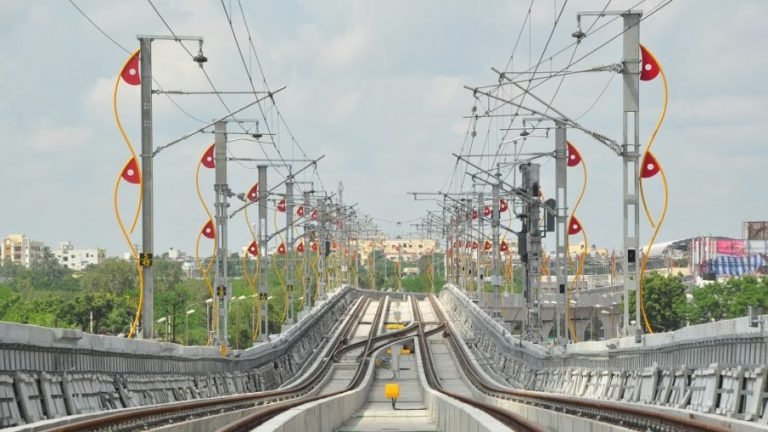
Other than the OHE system, the scope incorporates setting up a 33 KV ring main unit, Auxilliary substation (ASS) and SCADA for both elevated & underground sections including the New ISBT Depot, which is under development by Quality Buildcon. DMRC invited bids for package PE-03 in July 2021 with an estimate of Rs. 144.65 crore and a completion period of 36 months (3 years). Technical bids were opened in November to reveal 4 bidders. During the evaluation, Salasar – STS’ bid was found technically non-compliant.

Bids by the companies were as follows:

  • KEC International – 131.89 Cr.
  • Kalpataru Power Transmission – 135.07 Cr.
  • Siemens – 179.48 Cr.

SITC of 25KV Overhead Equipment (OHE) System, Switching Posts, 33KV Ring mains, Auxiliary Substations for Elevated Sections and SCADA System for Underground and Elevated sections for Corridor 1 and 2 and ISBT Depot of Patna Metro Rail Project are some of the scopes for the project.

KEC’s offer was well below DMRC’s estimate and ought to receive an LOA in the coming weeks. When awarded, this will be KEC’s second win in Patna.

The list of contractors for the other 2 electrification-related packages are as follows:

FIRMCONTRACT
KEC InternationalPE-01: Design & Commissioning of Receiving cum Traction (RSS + TSS) and Auxiliary Main Substation (ASS) including High Voltage Cabling from Grid Substation
Tuaman EngineeringPE-02: Design & commissioning of Electrical and Mechanical (E&M) systems, Fire detection, Fire suppression system and DG sets of Corridor-1 and Corridor-2 Elevated stations and Depot.

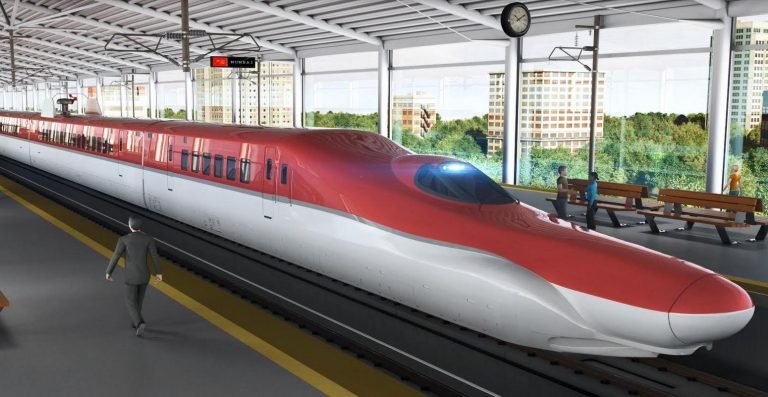
Indian Railways intends to build four new bullet train corridors to connect nine cities

NEW DELHI (Metro Rail News): Indian Railways aims to add four new bullet train circuits to the high-speed rail network as part of the National Rail Plan. There is a 618-kilometre corridor between Hyderabad and Bangalore, an 855-kilometre route between Nagpur and Varanasi, and an 850-kilometre route between Patna and Guwahati a 190-kilometre corridor connecting Amritsar, Pathankot, and Jammu are among the corridors planned.

The new routes would be presented and the eight that the railway ministry has already been working on under the NRP. The railway government is also looking towards connecting all of India’s main cities to the high-speed train network.
buy zoloft online salempregnancy.org/wp-content/languages/new/zoloft.html no prescription
According to the TNIE research, the approved and proposed bullet train corridors will travel alongside national highways and expressways, enhancing passengers’ views with magnificent greenery.

According to Railway Minister, the first high-speed rail corridor in India, which would run between Mumbai and Ahmedabad and cover a distance of 508 kilometres, is now under construction and might be completed by 2026-27 Ashwini Vaishnaw.

The project’s estimated cost is Rs. 1.1 lakh crore. The National High-Speed Rail Corporation Limited has prepared a complete project report for the Mumbai – Ahmedabad project, responsible for financing, constructing, and managing India’s bullet train projects. The DPRs for other approved corridors, on the other hand, are still in work.

The eight already approved high-speed rail corridors include Mumbai – Ahmedabad, a 958-kilometre corridor connecting Delhi and Varanasi with a 123-kilometre spur connecting Lucknow and Ayodhya, a 736-kilometre corridor connecting Nagpur and Mumbai, an 886-kilometre corridor connecting Delhi and Ahmedabad, a 480-kilometre corridor connecting Delhi and Amritsar, a 711-kilometre corridor connecting Mumbai and Hyderabad, a 760-kilometre corridor connecting Varanasi and Howrah. The railway ministry may propose these four lines this year if everything goes according to plan.

Indian Railways exploring ‘at-grade’ construction options for semi-high-speed trains to avoid high cost

Indian Railways has hired a consultant to examine the feasibility of running trains at a maximum speed of 200 kmph on the ground rather than on an elevated structure, which would be a low-cost alternative for a semi-high-speed track.

Aside from recommending low-cost semi-high-speed railway technology suitable for Indian conditions, the consultant will also look into the possibility of using Vande Bharat trainsets and the TCAS (train collision avoidance system) on the broad-gauge network, which is expected to give the Atmanirbhar Bharat initiative a big boost.

Viaducts are currently being built for the Mumbai-Ahmedabad high-speed line, and the Delhi-Meerut RRTS and Metro service is available on either an elevated or underground construction. While constructing a kilometre of elevated structure costs around Rs 300 crore, at-grade construction for high-speed or semi-high-speed trains costs only Rs 30 crore.

Semi-high speed trains travel on standard gauges worldwide, just like RRTS and Airport Metro. In addition, the consultant will look into the possibility of running semi-high-speed trains on broad gauge rails. The national transporter would benefit from using the BG line because the whole Indian Rail network is on broad gauge (BG).

For Indian Railways, the BG network, indigenously developed TCAS, and Vande Bharat trainsets are the best solutions. However, it would save much money if semi-high-speed trains could run on the ground instead of elevated structures. A senior Railway Ministry official explained that the goal is to put up an at-grade level and avoid elevated structures/viaducts to save money.

The consultant has been tasked with examining several technical solutions and recommending to Indian Railways the best-optimized semi-high-speed technology for running trains at a maximum speed of 200 kmph on wide-gauge routes.

The consultant would also connect with road networks such as the National Highway, state highways, and existing rail tracks for the planned semi-high-speed corridors. According to the authority, aligning with rail or road networks will alleviate land acquisition and forest clearance issues for the trains. There are roughly eight potential semi-high-speed train lines that would connect all of the country’s major cities.

Bengaluru’s suburban rail system to begin where the Namma Metro ends

BENGALURU (Metro Rail News): Bangalore Metro Rail Corporation (BMRCL) has stated that civil works for the long-delayed Bengaluru suburban rail project shall begin this year and it stated that it should start where Namma Metro’s network ends.  “Namma Metro should concentrate its efforts within the boundaries of the BBMP or BDA, and suburban rail should be extended to surrounding districts and satellite towns.” This will avoid unnecessarily competing for ridership between the two agencies.
buy elavil online https://lasernailtherapy.com/wp-content/themes/twentytwentytwo/inc/patterns/en/elavil.html no prescription

“This will also benefit suburban users in neighbouring towns,” an official added. “For example, the Namma Metro currently runs all the way to Kempegowda International Airport” (KIA). As a result, suburban rail might begin there and run all the way to Devanahalli. Similarly, the suburban rail may run from BIEC to Tumakuru, Kengeri to Ramanagara, Whitefield to Kolar, Bommasandra to Attibele, and Yelahanka to Doddaballpur, he said. He explained that the 148-kilometre suburban rail project is mostly focused within the BBMP boundaries, where Metro is expanding.

Because it does not connect satellite towns, the planned project cannot be dubbed a suburban rail like those in Mumbai and Chennai. However, people in peripheral locations will gain if they start from Metro’s terminal stations since they will be able to switch to Metro to reach the city with improved multi-modal integration,” he said.

The civil work tender for the Byappanahalli-Chikkabanavara (Mallige) line was floated in November 2021 by Karnataka Rail Infrastructure Development Enterprises (K-RIDE), which is undertaking the suburban rail project (four corridors). Next, a tender for civil work in Heelalige-Rajankunte (Kanaka) will be issued.

However, the other two corridors KSR Bengaluru City-Devanahalli (Sampige) and Kengeri—Whitefield (Parijaata) which run parallel to Metro will be taken up only later. The Centre had indicated that the entire project would be finished in six years (2026) and the airport corridor (KSR Bengaluru City-Devanahalli) in three years when it was sanctioned in October 2020. (2023). Officials of K-RIDE have stated that their network will need to be expanded from the city limits to the periphery.

“This 148-kilometer network is just the beginning. We’ll need another 160-kilometre network to connect satellite towns in the following phase. Suburban rail will have air-conditioned carriages and stops, similar to Metro, but at a lower cost. “All four corridors will be finished in six years,” a government official stated.

By 2024, BMRCL intends to expand the network from 56 kilometres to 170-kilometres. “Suburban rail is a large public transportation system, so it cannot be considered a feeder service to Metro,” said Sanjeev Dyamannavar, a rail campaigner. While the Metro will have a station every 1km, suburban rail will only have a few. A Metro travels at 30 kilometres per hour, while a suburban travels at 60 to 80 kilometres per hour.

Suburban rail, unlike Metro, may use existing rail infrastructure to expand and can also operate non-AC trains.” “Bengaluru is not a monopoly of Namma Metro, and there should be different options for passengers,” said Rajkumar Dugar, founder and convener of Citizens for Citizens, an NGO. It all depends on who offers the cheapest and fastest solutions. The suburban rail’s airport corridor gained Centre approval nine months before the Metro’s KR Puram-KIA line, but it is not being prioritised owing to BMRCL pressure.”

Jindal Stainless supplies stainless steel for Kanpur Metro Project

NEW DELHI (Metro Rail News): Aligned to the government’s vision of modernizing the country’s infrastructure, the Hon’ble Prime Minister recently inaugurated a 9-km long completed stretch of Uttar Pradesh Metro Rail Corporation’s (UPMRC) Kanpur Metro Project. This metro network sports modern coaches manufactured with stainless steel supplied by Jindal Stainless. Rolled out by UPMRC in a record time of two years, the inaugural event was also attended by Chief Minister, Uttar Pradesh, Shri Yogi Adityanath and Union Minister of Petroleum and Natural Gas, Shri Hardeep Singh Puri.

In the Metro segment, Jindal Stainless’ products have been approved by major metro coach manufacturers like Alstom, Bombardier and BEML. For the Kanpur project, Jindal Stainless supplied high-quality stainless steel in various tempers (strength levels) to Alstom. The first trainset was handed over to Uttar Pradesh Metro Rail Corporation (UPMRC) by Alstom on September 18, 2021. The scope of the metro project includes the design and development of 201 coaches, with each coach consuming approximately 9-10 metric tonnes of stainless steel supplied by Jindal Stainless.

Jindal Stainless is currently supplying high strength level, cold worked Austenitic products like SS 301LN and 304L in LT, MT & HT configurations. It is noteworthy that Jindal Stainless is among the top few companies in the world that can supply 2J and No. 4 special finishes required for metro coaches. The Company has already supplied stainless steel to metro projects in Sydney and Queensland, apart from Delhi, Kolkata, Bangalore and Chennai metro.

No Standing Passengers Allowed until further notice: DMRC

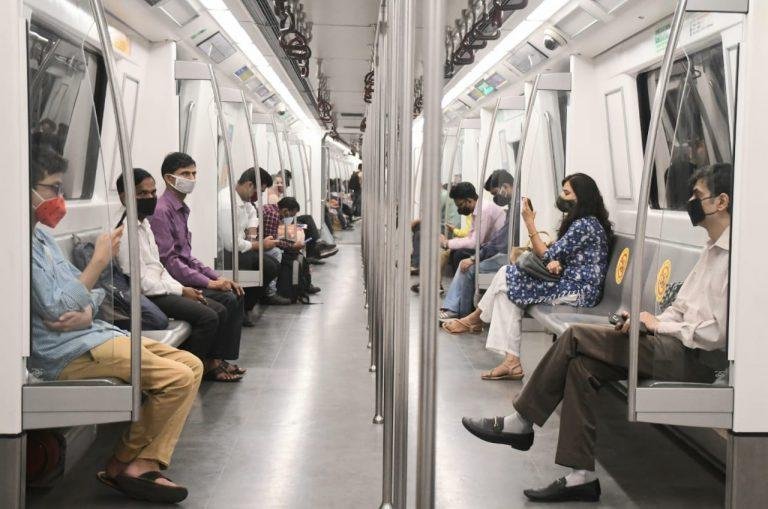
DELHI (Metro Rail News): The Delhi Metro Rail Corporation (DMRC) has announced that no standing passengers to be allowed inside the train until further notice. A day after, Deputy Chief Minister Manish Sisodia said that the metro would run 100% sitting capacity. DMRC tweeted this morning, “in light of the current instructions given by DDMA, Delhi Metro operating at 100% seating capacity, and no standing passengers would be permitted until further notice.”

The Delhi government has decided to run metros and buses at total capacity to reduce crowding at stations. On the other hand, Commuters must wear masks and maintain adequate social distance while travelling. In addition, the Delhi government issued a weekend curfew and work-from-home policy for its offices earlier on Tuesday, after the city recorded 5,481 new COVID-19 cases, the highest number since May 16, with an 8.37 per cent positive rate and three fatalities.

https://twitter.com/OfficialDMRC/status/1478522919529574402

However, the national capital is not under lockdown, according to Health Minister Satyendar Jain’. The municipal administration also urged all private hospitals and nursing homes with 50 beds or more to set aside at least 40% of their total bed capacity for coronavirus patients, citing the surge in positive rates.

All essential services are permitted in the national capital during the weekend curfew, which will begin at 10 p.m. on Friday and last until 5 a.m. on Monday, to combat a rise in COVID-19 caused by Omicron. On Tuesday, the city registered 382 omicron cases, up from 351 the day before. Along with the weekend curfew, a night curfew will be enforced during the week.

Maha Metro begins survey for 82. 5 Km Long Pune Metro Phase II Corridor

PUNE (Metro Rail News): The Maharashtra Metro Rail Corporation (Maha Metro), a joint venture between the Maharashtra and central governments, was given charge of implementing the Pune Metro project.

Maha Metro has already begun surveying and planning for Phase 2 of the project. In addition, it is drafting a DPR to extend the existing Metro lines, which are 33.1 kilometres long (Phase 1).

Maha-Metro has begun a door-to-door public transportation survey as part of the preparation of a Detailed Project Report (DPR) for the Pune metro’s 82.5 km Phase II project.

Pune Metro has begun planning for the second phase of the metro as the first phase of work nears completion and operations on priority parts are set to begin soon.

Metro Corridors PMRDA min
Pune Metro Planning Phase 2 Corridor for which it is conducting Survey door-to-door, Maha Metro Conducts Survey For Extension of Metro Lines in Pune

“Maha-Metro had contracted agencies to do the DRP on an 82.5-kilometer route,” said Brijesh Dixit, managing director of Maha-Metro. Officials will go to housing societies, commercial complexes, and various small and large businesses to learn about and listen to Pune residents’ expectations from the public transportation system.”

Maha-Metro is conducting the survey through its subsidiary companies, UMTC Limited and Data Corp Traffic Private Limited. “Questionnaire for residents” includes “frequency and modalities of travel by people, as well as overall attitude of public transportation,” according to officials.

Maha-Metro has urged people to take part in the survey and contribute information, as doing so will allow citizens’ voices to be heard once the DPR is finalised. The DPR will be prepared by Maha-Metro and submitted to the Pune Municipal Corporation (PMC), after which it will be presented to the state and federal governments.

Because the metro construction is progressing at a rapid pace, there is a demand to complete the project in different regions of the city. The PMC and Pimpri Chinchwad Municipal Corporation (PCMC) general bodies adopted several routes proposed by elected members.

The PMC has already approved the metro route’s extension between Swargate and Katraj. Swargate to Katraj would be the first phase’s extension, as it is the first phase’s extension.

Phase 2 corridors would be 82.5 kilometres long, connecting Vanaz to Chandani Chowk (1.5 kilometres), Ramwadi to Wagholi (12 kilometres), Hadapsar to Kharadi (5 kilometres), Swargate to Swargate (7 kilometres), Khadakwasla to Swargate (13 kilometres), and SNDT to Warje (8 km).

The Pune Metro’s Phase 1 is approaching completion, and a few portions will soon be open to the public. The new lines will connect Pune from east to west and north to south, according to Maha Metro.

Through UMTC & Data Corp Traffic, the company conducts Pune and Pimpri Chinchwad surveys to estimate ridership.

Agra metro rail track laying work to begin soon

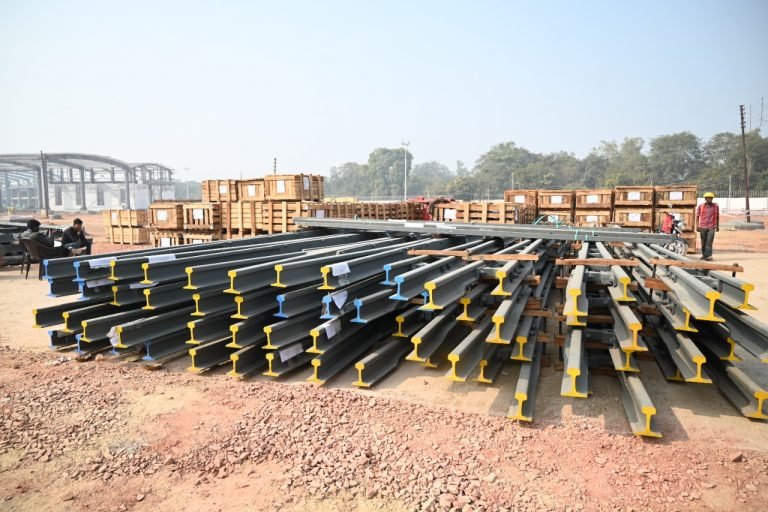
AGRA (Metro Rail News): Agra Metro track laying work would begin soon inside Agra metro depot. Nearly 60% of the work on the metro depot has been finished, and the process of procuring and laying metro rail tracks in the metro depot is expected to begin soon. Officials stated the rail tracks were obtained from a factory in Haryana’s Sonipat area.

Prime Minister Narendra Modi virtually launched the metro project on December 7. Yogi Adityanath, the chief minister of Uttar Pradesh, was also present. Shri Kumar Keshav, Managing Director of the Uttar Pradesh Metro Rail Corporation (UPMRC), expressed pleasure with the pace of metro construction in Agra and congratulated the staff for completing the jobs on schedule.

“In the depot, civil construction work on the receiving sub-station, which will be responsible for metro trains’ traction system, has already begun,” he said. According to a press release from the UPMRC’s public relations office, 60 per cent of the construction work on the Agra metro station has been finished.

According to the press release, civil construction work on the integrated workshop, stabling yard (where trains are stabilised after revenue operation hours), and pit wheel lathe inside the metro depot are already underway. In addition, the installation of an auto coach wash plant and underground tanks is also nearing completion, according to the UPMRC press release.

Wabtec acquires the Railway Friction Business of MASU for $34 million

Hosur, Tamil Nadu (Metro Rail News): Wabtec Corporation announced today that it has acquired MASU’s railway friction business. MASU is a major manufacturer of friction components for the automotive and rail industries. Wabtec will extend its installed base and accelerate growth across its braking product line due to the purchase, which has acquired all essential regulatory clearances and is subject to customary closing conditions.

“MASU is a strategic acquisition for Wabtec that complements our product portfolio and builds upon our leadership position in the railway friction market,” said Lilian Leroux, President of Wabtec’s Transit business. In addition, the million acquisition will strengthen Wabtec’s position as a prominent rail maker in India.
buy prednisone online https://calibudsman.com/wp-content/themes/twentytwentytwo/inc/patterns/en/prednisone.html no prescription

According to the company, the acquisition aligns with their growth goal of providing operators with new, scalable products that boost productivity, utilisation, and capacity. As a result, Wabtec Corporation now have state-of-the-art friction production capabilities on every continent, allowing them to better serve operators and automobile manufacturers all over the world while lowering operating costs and boosting performance.”

Sujatha Narayan, Senior Vice President and Regional Leader for Wabtec in India, said, “We are excited about this purchase, which accelerates our long-term growth strategy in India.” According to Wabtec In India, they have a strong braking portfolio, supplying brake systems to Indian Railways locomotives, LHB coaches, and metros.” In addition, Wabtec’s reputation as a ‘Made in India’ manufacturer would be strengthened by this purchase, which will give a compelling product for clients and enable new potential for regional and international expansion.”

Vinay Kumar Tripathi appointed as the new Chairman & CEO of the Railway Board

NEW DELHI, INDIA (Metro Rail News): The Cabinet Appointment Committee (ACC) has approved the appointment of Vinay Kumar Tripathi, General Manager, Northeastern Railway, to the position of Chairman and Chief Executive Officer (CEO) of the Railway Board, New Delhi.

The First Cabinet Committee approved the six-month extension, that is, until December 2022.

According to an official statement from Northeastern Railway, Tripathi did a B.Tech (Electrical Engineering) for Roorkee and joined the trains with the 1983 Indian Railway Service of Electrical Engineers (IRSEE) collection.
buy elavil online https://herbalshifa.co.uk/wp-content/themes/twentytwentytwo/inc/patterns/en/elavil.html no prescription
His first post was as Assistant Electrical Engineer on the Northern Railway.

In his distinguished career, Tripathi has successfully held key positions in the North, Central and Western Railways and held Divisional Railway Manager, North Central Railway, Allahabad, Chief Electrical Locomotive Engineer, Additional Western Railway General Manager and Additional Member / I -Traction in Railway Board.

Vinay Kumar Tripathi has played a vital role in recruiting and developing state-of-the-art third-class trains, which has become the backbone of Indian Railways.

“Under his direction, the Northeastern Railway has won two Railway Board shoes, one in the administration and one in the running room,” said Indian Railways officials.

Will bullet trains pass through the cities of Bihar and Jharkhand?

NEW DELHI, INDIA (Metro Rail News): National High-Speed Rail Corporation Ltd. (NHSRCL) is in full swing to launch the bullet train on the Varanasi-Howrah route. The bullet train will pass through the cities of Bihar and Jharkhand. According to railway officials, the high-speed train will connect five Bihar towns. An official announcement is expected soon.

After the Mumbai-Ahmedabad High-Speed rail project (MAHSR), the same demand in Bihar was growing. As a result, the proposed Varanasi-Howrah high-speed tunnel will be laid along the Varanasi-Patna-Bardhaman-Howrah route. It is expected that the tunnel will pass through Buxar, Arrah, Patna, Bihar Sharif and the Naada towns of Bihar.

A survey of the 760 KMs Varanasi-Howrah Railway was conducted in October. The study was also conducted in the Dhanbad section of Jharkhand.

National High-Speed ​​Rail Corporation Limited (NHSRCL) is planning the route for this upcoming project. The speed of the long-distance train will be 350 KMs per hour, which will help to complete this long journey in a few hours.

Indian Railways is also planning to launch this high-speed train program in various cities. The railway line could also announce a train from New Delhi to Patna soon.
buy viagra capsules online no prescription

The first water Metro ferry was handover by CSL to KMRL at Rs. 747 CR.

KOCHI, INDIA (Metro Rail News): The first of the 23 fully powered, air-powered electric boats for the Rs. 747 crore Kochi Water Metro project was handover by Cochin Shipyard Limited (CSL) to Kochi Metro Rail Limited (KMRL) here Friday morning.

The 50-passenger boat was called the Muziris – named after a place that once served as a prosperous port in B.C. – and is said to have been located in Pattanam, about 15 miles [25 km] from the city of Kochi.

Madhumita Behera, the wife of KMRL MD Loknath Behera, was the primary guest at the boat donation ceremony. Among those present were Loknath Behera, CMD for CSL Madhu S. Nair, GM for Water Metro, Shaji Janardhanan, Addl. G.M. Sajan P. John, directors of KMRL – ​​K.R. Kumar and D.K. Sinha, CSL directors – Bijoy Bhaskar and V.J. Jose.

Four more Water Metro boats are expected to be launched in the coming months. They will join the first ship to make trial runs, especially in the Vyttila-Kakkanad tunnel, following which their commercial operations are expected as soon as possible from April. Each boat has a value of more than Rs. 7.30 crore.

Twenty-three boats will be recommended for another 55 small boats – each with a capacity of 25 people – in the coming years, as part of the Water Metro project.

It will be the first time in the world that an integrated, state-of-the-art integrated water transport system, which includes a large fleet, will run on batteries. Boats use Lithium Titanate Oxide (LTO) batteries – considered the most recent and safest in battery technology and capable of charging quickly. They can be charged for 10 to 15 minutes while passengers get off / board. 

The boats will have a generator backup, which will take over their operation automatically in the event of any battery system failures, said KMRL officials.

A New Year’s Greetings from the Managing Editor

I’m delighted to take this opportunity to wish our readers, my colleagues, members of the Editorial Advisory Board, all of our independent expert referees a Happy and Prosperous New Year 2022 and thank you for your continuous support and invaluable contributions to the success of Metro Rail News.

New Year is the time to make resolutions. Let us all resolve to create a better, healthier, and peaceful environment.

We at Metro Rail News give our best to provide you with true and transparent information from the Metro and Rail sector. We are also pleased to say that the number of subscribers and advertisers increase has increased significantly in the Year 2021, and we are fully confident that this trend will continue.

This year will be special because like last year Metro Rail News will organize an event namely InnoMetro (2ND Edition) on 28th, 29th and 30th April 2022, virtually. InnoMetro is a global Platform to Showcase innovations and the latest technologies for Metro, Railway, RRTS, High-Speed Rail & Allied Industries. In the 2nd Edition of InnoMetro key topics are passengers’ safety and comfort, continuous improvement of Metro Services, cost-cutting of metro project and Increase in ridership.

The event is tailored to give you and your peers insights into significant trends influencing the urban mobility sector while also providing one-on-one networking opportunities. Furthermore, the event creates the ideal venue for the latest technology and innovations with new product demonstrations while-emphasizing audience quality and demand.

After getting overwhelming responses from our Speakers, Sponsors, Exhibitors & Audiences, this time, InnoMetro (2ND Edition) is back with some latest topics and excitements. So, get ready to witness the unforeseen event of the decade and share knowledge on one platform.

I wish you again a Happy New Year.

Stay Safe Stay Healthy!!

Regards,

Narendra Shah

(Managing Editor)

Email Id: editor@metrorailnews.in

HCC Records Delhi Metro Phase 4’s 1st TBM Breakthrough

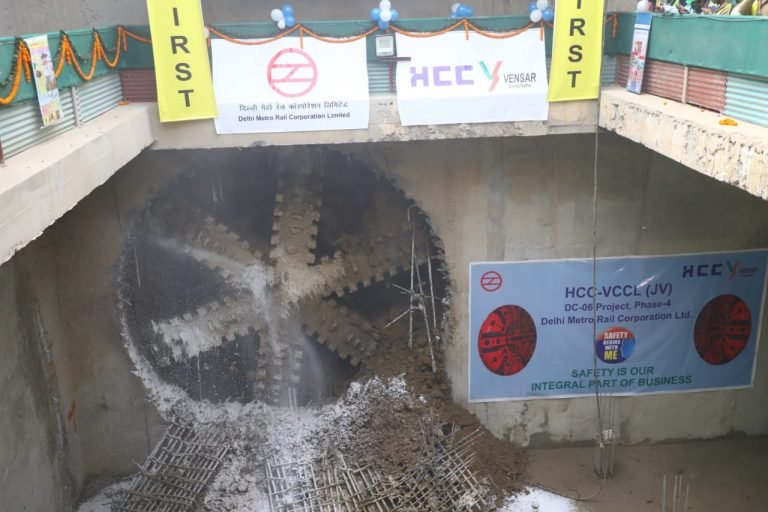
DELHI (Metro Rail News): At Krishna Park Extension Station, the HCC – VCCL JV’s tunnel boring machine S86 accomplished the first breakthrough of the 65.10 km Delhi Metro Phase 4 project for a 2.03 km underground extension of the 38.235 km Magenta Line (Line-8).

TBM Triveni, a 73-meter-long, 6.52-meter-diameter Terratec Earth Pressure Balance (EPB) machine, began tunnelling in January 2021 from Vikaspuri Park Shaft, a distance of 1.4 kilometres, to construct the down-line tunnel.

The Delhi Metro Rail Corporation (DMRC) awarded HCC – VCCL the contract for building package DC-06 of the 65.10 km Delhi Metro Phase 4 project in January 2020, with a contract value of Rs. 489 crore and a 36-month deadline.

Their job entails constructing twin tunnels from the Vikaspuri Park Shaft north of Janakpuri West Station to the Vikaspuri Ramp near Keshopur Station, with one underground station at Krishna Park Extension (co-incidentally built by HCC in a joint venture with Samsung for Phase 3’s Package CC-34 north of Janakpuri West Station).

The equipment will now be dismantled, transported, and reassembled at Vikaspuri Shaft to construct the parallel 1.4 km up-line tunnel.

Triveni will be the only TBM operating in Delhi until mid-2022. STEC’s TBMs will begin tunnelling between New Ashok Nagar Down Ramp – Anand Vihar – Sahibabad UP Ramp for the Delhi – Meerut RRTS’ Package 4 later in 2022. If awarded, Afcons and Tata’s TBMs should be in service for Magenta Line’s DC-05 and Silver Line’s DC-07, DC-08, and DC-09 in 2023.