

RRTS to reduce travel time from Delhi to Neighboring States

DELHI (Metro Rail News): The forthcoming Regional Rapid Transit system (RRTS) corridor in Delhi is likely to reduce the travel time from different locations in the NCR and other adjacent places like Haryana and Rajasthan to National Capital. Passengers will be able to travel from Ghaziabad to Haryana in just 45-50 minutes through Delhi-Panipat Corridor, and Delhi-Gurgaon- Alwar RRTS corridor will help travellers to commute from Delhi to Neemaran in around 70-75 minutes.The Central government had approved the Delhi-Panipat RRTS corridor. However, early this month, the government said to Rajya Sabha that the Delhi government did not approve financial aid for the Delhi SNB and Delhi-Panipat corridors. However, they have got the approval of the Haryana and Rajasthan governments.The Delhi-Panipat corridor, which is 103 km long, will connect Delhi with Sonipat and Panipat in Haryana. It will also link Murthal, Ganaur, Samalkha, and Panipat to Delhi with high-speed rails. There will be 17 stations on this line. Delhi will have six stations ( Sarai Kale Khan, Indraprastha, Kashmiri Gate, Burari, Alipur and Mukarba Chawk ). With the help of this project, people will be able to reach Murthal in about 40-50 minutes and to reach Panipat from Delhi, it will take around 65 minutes.The Delhi-Gurgaon-Alwar Corridor will be developed in three phases. In phase one, the 107-km-long SNB Urban Complex (Shahjahanpur-Neemarana-Behror) will be constructed, which will link Gurgaon, Manesar, Panchgaon, and Rewari. Commuters will be able to travel to Neemarana from Delhi in just 70-75 minutes.
In the second phase, the SNB- Sonatala line will be extended to Shahjahanpur, Neemrana and Behror. SNB Alwar will be constructed in the third phase. The Delhi-Gurgaon-SNB-Alwar RRTS will also go through Manesar, Bawal and Neemrana, which are industrial areas that would ease the journey and increase the productivity of the people travelling.
Pune Metro Line 3 Completes Erection of 300 Piers, Accelerating Project Work
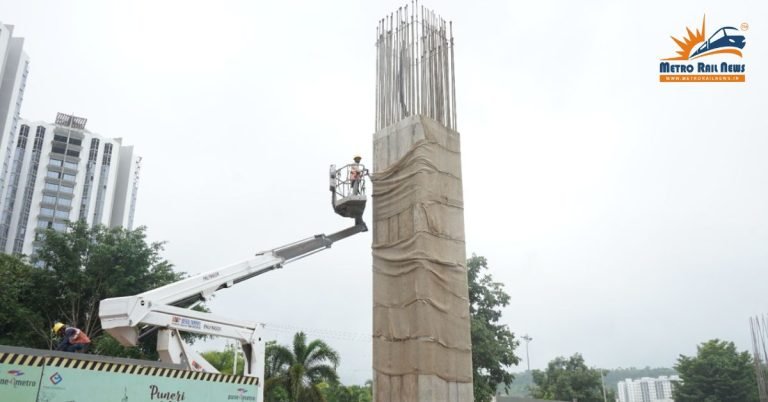
PUNE (Metro Rail News): The Pune Metro Line 3 project, connecting the IT hub of Hinjewadi to the central business district of Shivajinagar, has made significant progress across several sections. Construction of the piers, which form a crucial part of the project, has seen a recent acceleration, with the erection of 100 piers completed in just 60 days. This brings the total number of piers erected to 300, a major milestone in the project’s development.The joint venture between Tata Group and the Pune Metropolitan Region Development Authority (PMRDA) is overseeing the construction of the metro rail system on a public-private partnership basis. Tata Group has established the Pune IT City Metro Rail Limited as a special purpose vehicle (SPV) for the project’s implementation.The piers, which are being constructed according to strict design and safety standards set by the Bureau of Indian Standards (BIS), are a special circular shape with a diameter of 2000mm, fully compliant with the design parameters of the metro rail system. The project developers are committed to following all construction safety parameters and quality control measures to ensure the project is completed on time.The Pune Metro Line 3 will provide easy, convenient, and affordable public transport options between Hinjewadi and Shivajinagar, benefiting the citizens of Pune. The project will be developed and operated on a design, build, finance, operate, and transfer (DBFOT) basis by the SPV, Pune IT City Metro Rail Limited (PITCMRL), for a concession period of 35 years, including the construction period.
About Pune Metro Line 3:
Pune Metro Line 3 is a 23 km elevated metro rail project connecting Hinjawadi to the central business district of Shivajinagar. It is a public-private partnership project awarded by the Pune Metropolitan Region Development Authority (PMRDA) to a consortium consisting of Tata Group’s TRIL Urban Transport Private Limited (TUTPL) and Siemens Project Ventures GmbH.MMRDA plans to combine flyover and Metro line expansion for better connectivity
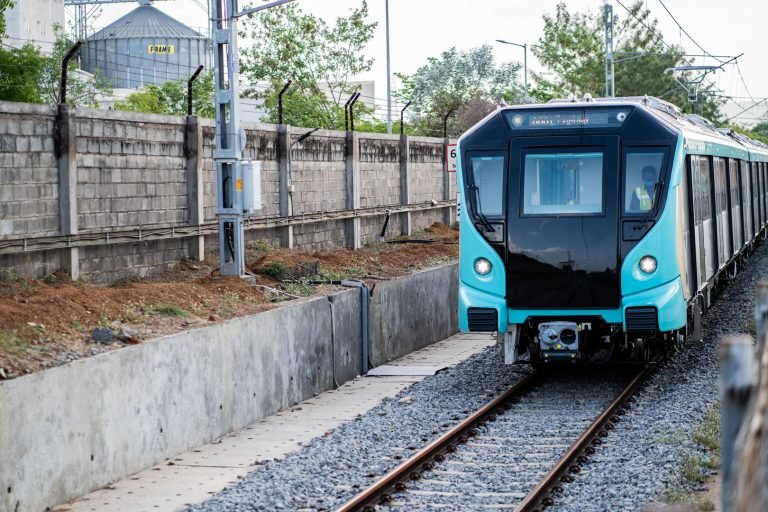
MUMBAI (Metro Rail News): MMRDA (Mumbai Metropolitan Region Development Authority) is likely to build a combined 2.58 Km road flyover below Metro line 6 ( Swami Samarth Nagar-Vikhroli) to provide additional transport facilities.The elevated Mumbai Metro 6 runs through Jogeshwari, WEH, and Powai, comprising a 15.31 km elevated corridor which will form a vast metro network connecting four other metro corridors – Metro line 2A, Metro 3 Cola Bandra SEEPZ, Metro 4, and Metro 7.As per MMRD, Metro 6 will have 13 stations, and 66 % work has been completed. In addition, the civil work on metro stations on line 6 is 51.50 per cent complete.According to SVR Srinivas, MMRDA Commissioner, the Mumbai Metro Network is being constructed by the authority to provide rapid transportation services to people within a short travel distance. Metro line 6 will offer rail-based connectivity between Western and Eastern suburbs and play an essential role in an integrated public transport network for people.
CMRL to conduct second survey to improve Chennai Metro patronage

CHENNAI (Metro Rail News): Chennai Metro Rail Limited (CMRL) is planning a second survey to improve patronage by understanding commuter needs. Over a period of nearly a month, questionnaires will be distributed to passengers throughout the 54-km network and 41 stations, with an aim to cover at least 20,000-25,000 persons.The survey will ask questions about passengers’ profiles, reasons for using the Metro, travel to and from the station, and general suggestions to improve commuter amenities. Officials hope to enhance the current weekday ridership of 2.5 lakh passengers.This is the second survey, with the first one leading to the introduction of improved signage, last-mile connectivity, and rectifying issues in the parking system, resulting in a gradual increase in ridership.“Signage was improved at stations, last-mile connectivity was added in areas like Manapakkam and Taramani, issues in the parking system were also rectified. It helped us understand the commuters’ needs. Importantly, after implementing their suggestions, we saw a gradual increase in ridership. Hence, we are doing the survey again to improve the services,” the official added.
Chennai Metro to operate driverless metro on Poonamalle – Powerhouse line
CHENNAI (Metro Rail News): By August 2024, Chennai Metro rail is planning to bring the first set of three-coach driverless trains to the city.
Covering 118.9 km of the city, these trains will be first operated at the Ponamalla-Powerhouse stretch in 2026 as part of the forthcoming phase 2 Chennai Metro Rail System.
At present, there are four-coach trains running on line 1; further, line 2 will have – three and, post that, six-coach trains.According to an official, “once the coaches arrive individually, it will be connected to the train. Post that, the train would undergo some series of static and dynamic tests, which includes traction testing, train control, management system, passenger information systems, brake system, etc. These tests will be conducted first within the tracks at Poonamalle depot. Followed by the delivery of signaling systems, systems will be integrated, and trains will be further inspected in order to figure out any glitches and failures. The exact process would go for a minimum of 10-12 months.”CMRL has ordered 26 driverless trains to run the stretch as the Poonamallee-Power house stretches a larger section of the corridor for 26.1 km.
Due to differences in design, control, and signalling systems, phase 1 trains can’t run on phase 2. Also, for phase 2, the model and colour of driverless trains have not been confirmed yet.
In October and November, a few more sets were expected to arrive. However, the first set is already scheduled to be delivered by August. RDSO (Research Designs and Standards Organization) will certify the trains before it is officially into operation.
Union Budget Allocates Record 164.77% Increase in Funds for Kolkata Metro Projects
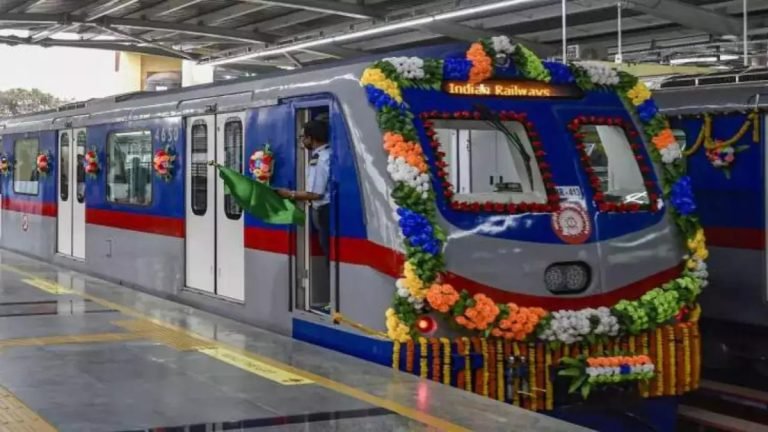
KOLKATA (Metro Rail News): In this year’s Union Budget tabled in the Parliament, Kolkata Metro has been allotted Rs. 3220.25 Crores for different on-going Metro projects. This is a massive 164.77% higher than the 2022-2023 budget proposal of Rs. 1216.25 Crores.The total Plan Outlay for Metro Railway has increased by an unprecedented 153.36% and is fixed at Rs. 3496.54 Crores.As adequate funds are available, Metro Railway plans to open new Metro routes and extend existing routes in the year 2023. The New Garia to Hemanta Mukherjee stretch of New Garia to the Airport via the Rajarhat Metro Project (Orange Line) has already been inspected by the Commissioner of Railway Safety, N.F. It is expected that his mandatory approval to start the commercial services on this stretch will be received very soon.After that nod, commercial services on this 5.4-km-long stretch will likely start in February 2023.This stretch will be further extended to Salt Lake Sec-V (a length of 9.82- km) in October 2023. In addition, the Noapara to Bimanbandar stretch (7.04 km) of the Noapara-Bimanbandar- Barasat Metro Project (Yellow Line) will be inaugurated in the same month.Commercial services on the Purple Line from Joka to Taratala have already started. This service will be further extended from Taratala to Majherhat (1.24 km) by October 2023.Target has also been fixed to extend much-awaited Metro services from Sealdah to Howrah Maidan (7.25 km) by December this year. Once achieved, Metro will run for the first time under a mighty river like Hooghly in this country. As a result, commuters coming from the suburbs can reach places like Esplanade, Sealdah or Salt Lake quickly and smoothly without facing any traffic snarls.Metro is planning to extend its wings very fast this year, and a total of 30.75 kms will be added to the Kolkata Metro network with the existing 47.93 kms.Shri Arun Arora, General Manager, Metro Railway, has said, “These extensions and opening of new routes will be this year’s Puja Gift to the people of Kolkata.”
Two Additional Racks to Arrive in March for Mumbai’s Colaba-Bandra-Seepz Metro-3
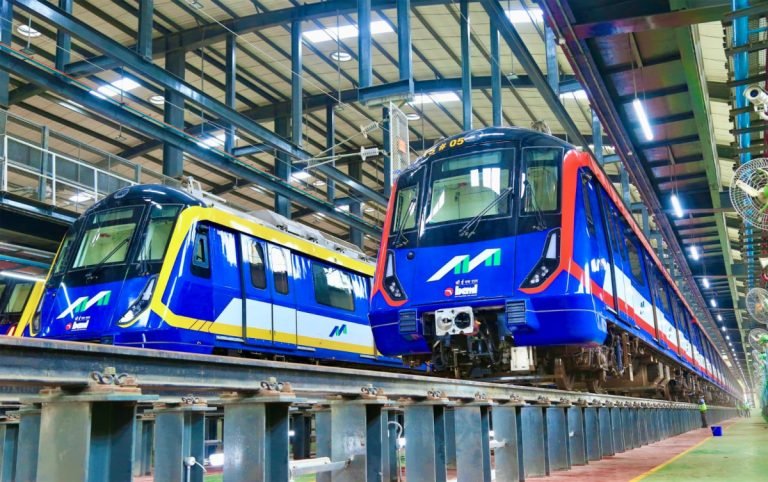
MUMBAI (Metro Rail News): The Mumbai Metro Rail Corporation Limited (MMRCL) will receive two additional trains for the city’s first underground metro rail, the Colaba-Bandra-Seepz Metro-3, in March.This is in addition to the two trains that are currently undergoing testing. Furthermore, with 84% of the work on phase-1 between Aarey and Bandra Kurla Complex (BKC) completed, MMRCL officials have been conducting trials of two metro trains from Sariput Nagar to Marol Naka.The MMRCL needs a total of 31 trains to operate the 33-kilometre route of Metro-3, with the remaining trains for phase-1 scheduled to arrive as per plan. 76% of the work on phase-2 (BKC to Cuffe Parade) is complete, and the car depot facility of Metro-3 will be ready before phase-1 begins, with over 50% of the depot work completed so far.
Minister Rama Rao Accuses Centre of Ignoring State’s Requests for Hyderabad Metro Rail Phase II
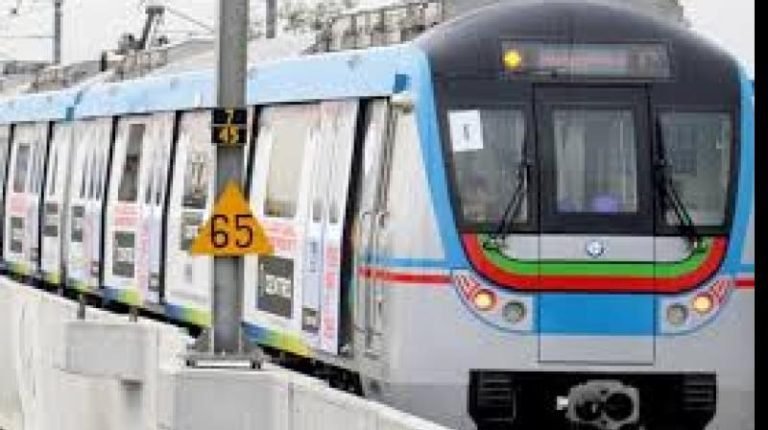
HYDERABAD (Metro Rail News): The Minister for Municipal Administration & Urban Development (MA&UD), K.T. Rama Rao, criticized the central government for failing to provide financial support for the second phase of the Hyderabad Metro Rail project.During the Question Hour at the Telangana Legislative Assembly, Rama Rao stated that the central government had ignored the state government’s requests for support for the extension of the metro rail on the BHEL-Lakdikapul and Nagole-L.B. Nagar stretches.The second phase of the Metro Rail project includes two components: the 31-km Airport Express Metro from Raidurg Metro Station to Shamshabad Airport and the 26-km BHEL-Lakdikapul stretch as the 5 km gap between Nagole and L.B. Nagar.The state government has received funding of ₹6,250 crores for the Airport Express Metro, a wholly state-owned project expected to be completed within three years.The second component, estimated to cost ₹8,455 crores, has been submitted to the central government for approval as a joint venture between the centre and the state. Once approved, the project will take four years to complete, according to Rama Rao.He added that the central government is questioning the viability of the Hyderabad project, despite granting 20% of the estimated cost and a sovereign guarantee for metro projects in cities such as Bengaluru and Chennai and smaller cities such as Gorakhpur, Varanasi and Prayagraj.Rama Rao stated that the central government is treating Hyderabad with a “vengeful attitude.” In response to a supplementary question from the Congress party floor leader Mallu Bhatti Vikramarka about the higher fares than initially proposed, Rama Rao explained that the initial fares were proposed under the Municipal Tramways Act. Still, all metro rail projects in the country were brought under the Metro Railways Act. According to this act, the PPP concessionaire agency has the right to revise the fares.
Prime Minister Modi Flags Off Two Vande Bharat Trains in Mumbai
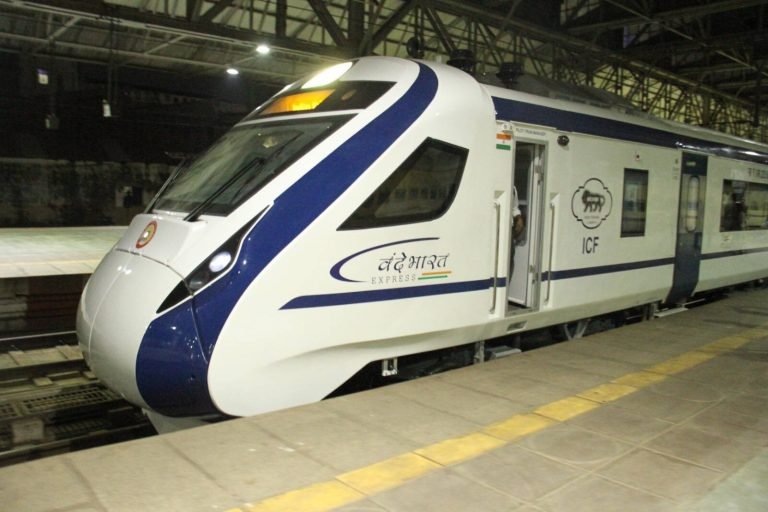
MUMBAI (Metro Rail News): The Prime Minister, Shri Narendra Modi flagged off two Vande Bharat trains at Chhatrapati Shivaji Maharaj Terminus in Mumbai. The two trains are Mumbai-Solapur Vande Bharat and Mumbai-Sainagar Shirdi Vande Bharat.Upon arriving at Platform no. 18 of Chhatrapati Shivaji Maharaj Terminus, the Prime Minister inspected the Mumbai-Sainagar Shirdi Vande Bharat. He also interacted with the train crew and the children inside the coach.The Prime Minister reiterated the need for improving public transport for 21st-century India as it will lead to massive ease of living for the citizens. This thinking, he pointed out, is behind the launch of modern trains, the expansion of the Metro, and new airports and ports.The Budget also strengthens this thinking as for the first time, 10 lakh crore were allocated exclusively for infrastructure development. In this railway’s share is 2.5 lakh crore, he added. The Prime Minister said that the Rail Budget for Maharashtra also witnessed an unprecedented rise and expressed the hope that with the efforts of the double-engine government, connectivity in Maharashtra will move ahead rapidly.Governor of Maharashtra, Shri Bhagat Singh Koshyari, Chief Minister of Maharashtra, Shri Eknath Shinde, Deputy Chief Minister of Maharashtra, Shri Devendra Fadnavis, Union Minister for Railways, Shri Ashwini Vaishnaw, Union Minister for Micro, Small and Medium Enterprises, Shri Narayan Rane, Union Ministers of State, Shri Ramdas Athawale and Shri Kapil Moreshwar Patil, and Ministers from Government of Maharashtra were present on the occasion among others.Addressing the gathering, the Prime Minister, Shri Narendra Modi said that it is a huge day for Railways in India, especially for advanced connectivity in Maharashtra as this is the first time that two Vande Bharat trains have been flagged off on the same day. He underlined that these Vande Bharat trains will connect economic centres such as Mumbai and Pune to centres of faith, thereby benefiting those travelling for college, office, business, pilgrimage and agricultural purposes. He said that travelling to sacred places like Shirdi, Nasik, Trimbakeshwar, and Panchvati will be made easier with the new Vande Bharat trains which will give a boost to tourism as well as pilgrimage. “The pilgrimages of Pandharpur, Solapur, Akkalkot and Tuljapur will also be made more accessible with the Solapur Vande Bharat Express”, he said.The Prime Minister said that the Vande Bharat train is a grand picture of modern India. “It is a reflection of India’s speed and scale.” Commenting on the speed of the launch of Vande Bharat Trains, the Prime Minister informed that so far, 10 Vande Bharat trains have started operating connecting 108 districts of 17 states of the country. The Prime Minister expressed happiness that many projects were launched today that will enhance the ease of living. He said that the elevated road will connect eastern and western suburban areas and the underpass, he said, is significant.Mumbai-Solapur Vande Bharat Train and Mumbai-Sainagar Shirdi Vande Bharat Train are the two trains that were flagged off by the Prime Minister at Chhatrapati Shivaji Maharaj Terminus, Mumbai. This will be an important step towards fulfilling the Prime Minister’s vision of building better, more efficient and passenger-friendly transport infrastructure for New India.Mumbai-Solapur Vande Bharat Train will be the 9th Vande Bharat train in the country. The new world-class train will improve connectivity between Mumbai and Solapur and will also facilitate travel to important pilgrimage centres like Siddheshwar in Solapur, Akkalkot, Tuljapur, Pandharpur near Solapur and Alandi near Pune.Mumbai-Sainagar Shirdi Vande Bharat, the 10th Vande Bharat train in the country will improve connectivity to important pilgrimage centres in Maharashtra like Nashik, Trimbakeshwar, Sainagar Shirdi, and Shani Singanapur.To ease road traffic congestion and streamline the movement of vehicles in Mumbai, the Prime Minister dedicated the Santacruz Chembur Link Road (SCLR) and Kurar underpass. The newly constructed elevated corridor from Kurla to Vakola and from MTNL Junction, BKC to LBS Flyover at Kurla will enhance much-needed East-West connectivity in the city.These arms connect the Western Express Highway to the Eastern Express Highway thereby connecting eastern and western suburbs efficiently. The Kurar underpass is crucial to ease traffic on the Western Express Highway (WEH) which connects Malad and Kurar sides of WEH. It allows people to cross the road with ease and also vehicles to move without having to get into the heavy traffic on WEH.
Delhi-Meerut RRTS project sees first tunneling breakthrough by Afcons Infrastructure
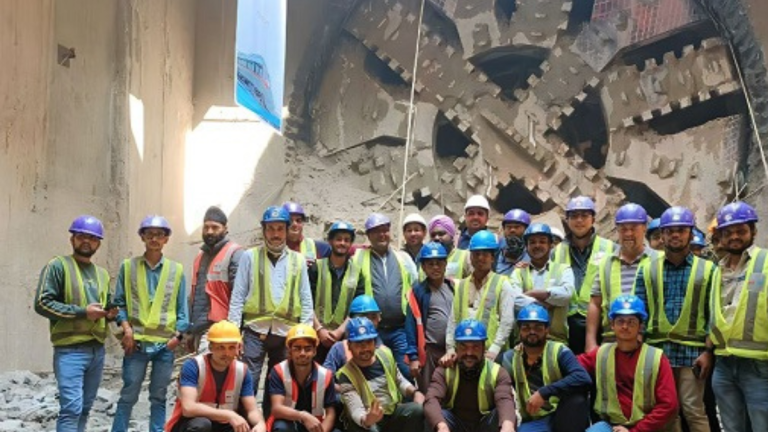
NEW DELHI (Metro Rail News): Sudarshan 8.2, a 7.51m diameter Terratec Earth Pressure Balance (EPB) machine operated by Afcons Infrastructure, achieved the first breakthrough in the tunnelling process for the Delhi – Meerut RRTS project of 82.15 km.This tunnelling drive began at Bhaisali RRTS Station in April 2022 and extended 1824 meters, the longest of Package 8. After a pit stop at a mid-shaft located 695.85 meters south of Bhaisali, it proceeded to Meerut Central Station. Afcons was given the civil construction contract for Package 8, worth Rs. 1529.10 crores, in November 2020, with a 1310-day (3.6 years) time limit.The project’s scope encompasses the construction of six pairs of tunnels from the Brahampuri DN Ramp to the Begumpul UP Ramp, along with three underground stations at Meerut Central, Bhaisali, and Begumpul, utilizing the cut and cover method.This marks the first breakthrough for S89 and the third of six planned breakthroughs for Afcons Infrastructure as part of Package 8. Previous breakthroughs were achieved by TBM S90 at the Begumpul Station in October 2022 and by TBM S88 at the Meerut Central Station in December 2022.
Larsen & Toubro Records Significant Milestones in Chennai Metro Line-3 Construction
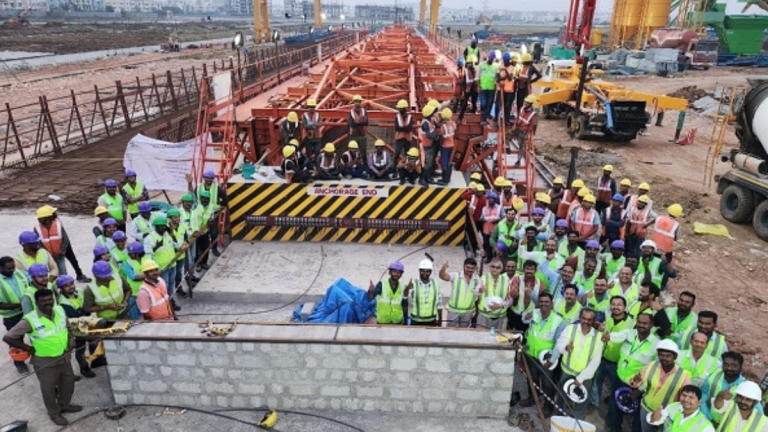
CHENNAI (Metro Rail News): Larsen & Toubro has recently achieved two noteworthy accomplishments in constructing the first 10 km elevated portion of Chennai Metro Line-3 between Nehru Nagar and Sholinganallur.This section of the 118.9 km Chennai Metro Phase 2 project, known as Package CP08 EV-01, includes nine elevated stations at the southern end of Line-3, which will run for 45.8 km, connecting Madhavaram to SIPCOT 2 and have a total of 49 stations.The milestones are the casting of the first set of 27.90m long U-girders for the line’s superstructure and the casting of the first pile cap at Sri Sowdeswari Nagar on Old Mahabalipuram Road for the substructure. Larsen & Toubro’s casting yard features a 146m long casting bay, which can cast five 165-ton U-girders simultaneously.The company is also working on adding another U-girder casting bay. However, the commercial operations for this elevated section depend on completing the 21 km twin tunnels (by Tata Projects and L&T) and track work between Madhavaram and Nehru Nagar, so it is likely to open by 2027.An elevated stabling yard will be built at SIPCOT, similar to the one in Wimco Nagar, but I believe it will need more support for commercial operations.
Odisha Government Plans Mega Metro Rail Project to Connect Puri and Bhubaneswar
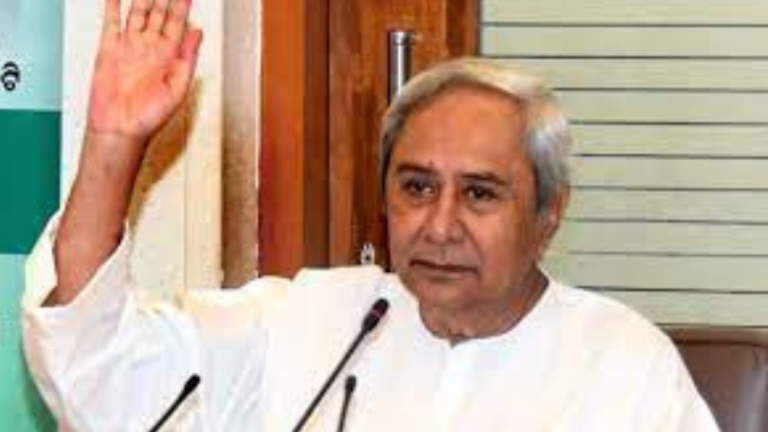
Odisha (Metro Rail News): The State government of Odisha is reportedly planning to introduce a Mega Metro Rail project between Puri and Bhubaneswar, with Konark in between, to make travelling easier for daily commuters and tourists.It is said that Odisha Chief Minister Naveen Patnaik has already consulted the Railway Ministry and finalized the rail route. To raise anticipation, the Secretary to Odisha Chief Minister Naveen Patnaik (5T) V.K. Pandian has posted on Instagram, “A fantastic news coming soon…. Very soon for Odisha. Jai Jagannatha”.Apart from this, the State government has been working on making Puri a World Heritage City, and various developments have been going on for the Ekamra Kshetra (temple city of Bhubaneswar) and Arka Kshetra (Konark Sun Temple). In addition, the Mega Metro Rail project is believed to reduce the time to cover the 64 kilometres between Puri and Bhubaneswar to less than half an hour.
GODREJ and RENMAKCH sign MoU for collaboration in Railways, Metros & High Speed Rail
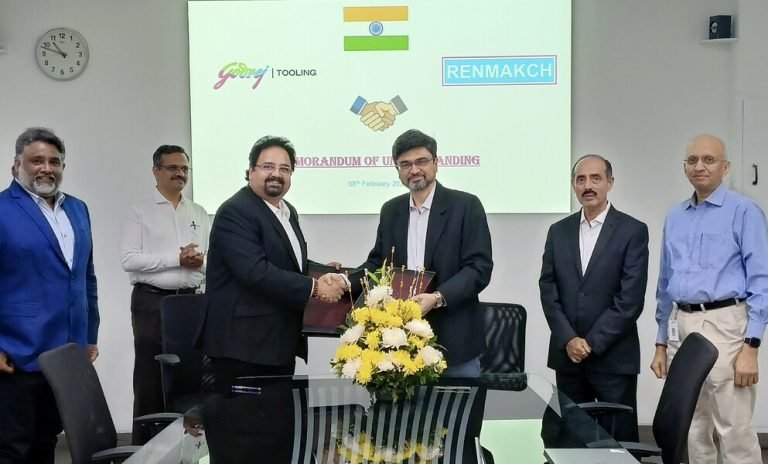
MUMBAI (Metro Rail News): GODREJ & Boyce Mfg. Co. Ltd. and RENMAKCH India Pvt. Ltd. have inked a memorandum of understanding (MoU) to collaborate in the railway, metro, and high-speed rail sectors by leveraging their respective capabilities.GODREJ, a multi-segment manufacturer, provides customized solutions to various industry domains, including the Indian Railways. RENMAKCH is a comprehensive solution provider in the field of Railways, Metros, and High-Speed Rail, offering depot equipment manufacturing, rolling stock component manufacturing, installation and maintenance services, and turnkey projects. RENMAKCH also has manufacturing joint ventures with various renowned European manufacturers of state-of-the-art depot equipment for Railways, Metros, and High-Speed Rail. The two companies have signed an MoU to work together in this sector, leveraging their respective capabilities.The partnership between GODREJ and RENMAKCH has created new opportunities for collaboration and shared business interests in their respective fields, both now and in the future. This collaboration is a significant step towards the Indian government’s “Make in India” and “Atmanirbhar Bharat Abhiyan” initiatives.
Maharashtra Govt and NHSRCL get Nod for Mumbai-Ahmedabad Bullet Train Project
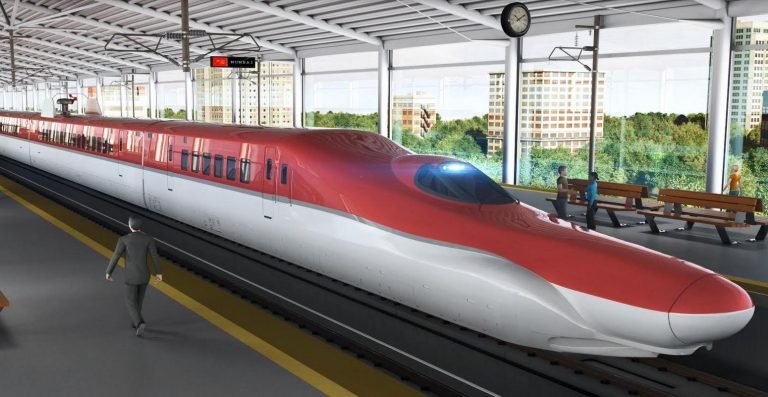
MUMBAI (Metro Rail News): Bombay High Court gave the Mumbai-Ahmedabad bullet train project a go-ahead, dismissing a plea brought by Godrej & Boyce company concerning the land acquisition by the Maharashtra government and the National High-Speed Rail Corporation Limited (NHSRCL) in Mumbai’s Vikhroli area. The court said the project was of “national importance and in the public interest”. However, a division bench of Justice RD Dhanuka and Justice MM Sathaye concluded that collective interest was more important than private interests and thus refused to stay with the project.The Godrej & Boyce Manufacturing Company Limited brought a petition to question a September 15, 2022, order from the Maharashtra government that gave them a compensation amount for their land acquisition for the Mumbai-Ahmedabad High-Speed Rail project.Out of the total 508.17 km of the rail track, 21 km is planned to be underground, with an entry point at the Vikhroli area. The division bench affirmed that the compensation and proceedings started by the government authorities were legal.The Maharashtra government deposited Rs 264 crore as compensation for the land owned by Godrej for the Mumbai-Ahmedabad bullet train project in October 2022. Despite this, the state government and the NHSRCL had repeatedly accused the company of delaying the entire project. In response, the company authorities argued that the land acquisition was “unlawful” and included “multiple and patent illegalities”.