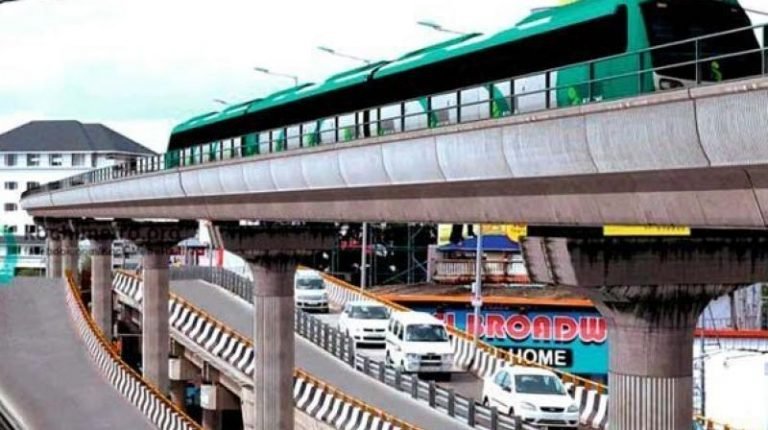
New Delhi: Lucknow Metro Rail Corporation (LMRC) is likely to invite bids for use of commercial space at eight of its stations on a revenue share basis for 10 years, on the lines of Delhi Airport modernisation.
Trial runs of the first phase of the ₹7,000-crore Lucknow Metro are expected to kick off in December.
“The contracts will have a reset clause at the end of 10 years, which will allow the Metro to re-invite bids on a revenue share basis,” Kumar Keshav, Managing Director, LMRC, told to Media.
The Metro which includes civil work is expected to start its run by December 1 on 8.5 km of the 23km track, said Keshav, who was in Delhi to receive the APJ Abdul Kalam awards for innovation in governance.
Asked how they managed to reduce the time taken for Lucknow Metro project implementation, Keshav, who was earlier with Delhi Metro, said they worked on civil construction simultaneously. For instance, apart from setting the foundation column on site, most of the other work was pre-cast site.
LMRC also saved considerable cost and time in installing the signalling system by inviting a common bid.
“Unlike most of the Metros in India, we had a common signalling and rolling stock bid. This allowed us to save time. We did this work in 65 weeks, instead of the 90 weeks done in Delhi Metro. We have also saved costs in the signalling system by one-fourth, as compared to Delhi Metro,” he said, adding that the cost of signalling systems for Lucknow Metro were 25 per cent lower than envisaged in the detailed project report prepared by the Delhi Metro.
Moreover, Lucknow Metro, which has an approved funding of € 450 million from the European Investment Bank, plans to draw down €100 million over the next few months, as the currency hedging cost will be borne by it. “We would like to delay the draw down of funds, as we have to start repaying the loan immediately,” said Keshav.
Meanwhile, LMRC is looking to use small and medium enterprises for use of solar power. While it cannot put solar panels on station rooftops as there are overhead wires that could be dangerous for people to access for cleaning the panels, LMRC plans to install panels with one mega watt capacity on the coach-maintenance depot. The contract is for supplying power for 25 years and it should not be more than ₹ 6 a unit, said Keshav.
At present, Lucknow Metro, which aims to start operations by this December, has an agreement with the Uttar Pradesh Power Corporation Limited for power purchase at the rate of Rs. 5.6/unit.
New Delhi: Delhi Metro Rail Corporation on Friday stared ‘Swachha Metro’ campaign to promote PM Modi’s “Swachh Bharat Abhiyan” and inspire youth and children towards importance of cleanness in environment.
The Delhi Metro Rail Corporation, in its endeavor to spread the message of cleanliness and to promote clean & green environment has taken the initiative of running a specially decorated train with slogans and greetings on the occasion of Diwali. This train will run on Line-6 i.e, ITO to Escorts Mujesar with tastefully decorated exteriors to promote importance of cleanliness in the true spirit of ‘Swachh Bharat Abhiyan’ to inspire public especially, youth/children.
The exterior of this six coach train have been exclusively decorated in colorful theme of nature, spirit of festivity along with display of prize winning slogans on ‘Swachhta’. These slogans were part of an ‘online slogan writing competition’ organized by DMRC from 3rd to 7th October 2016 under its ‘Swachh Metro’ campaign. The Diwali Greetings include one liner messages to the public to provide clean and green future to their children by saying ‘No to Crackers’.
Delhi Metro at present carries around 30 Lakh passengers daily (weekdays) with a network of 213 KM and 160 Metro stations. Such an initiative has the potential to spread the message on importance of cleanliness and inspire everyone to contribute in the ‘Swachh Bahrat Abhiyan’, a Government of India initiative, by keeping their surroundings clean and staying away from any such act which damages the environment/surroundings.
New Delhi: The Delhi Metro Rail Corporation (DMRC) conducted trial runs on a 13.5 km stretch between Kalindi Kunj Depot and Botanical Garden, Noida. Earlier in August, trial runs were held on the Kalkaji Mandir-Kalindi Kunj stretch on the same corridor. This corridor is also known as Magenta Line.
Trials also will be held of new UTO (Unattended Train Operations)-enabled trains which will be test run on these tracks to check their performance and mechanism. These driverless trains will increase the frequency of trains to every 90 seconds.
The Magenta Line will have 23 stations out of these 15 are underground and eight are elevated which covers across its 34.273 km length.
The stretch where the trials were done Botanical Garden and Kalkaji Mandir consists of nine stations – Botanical Garden, Okhla Bird Sanctuary, Kalindi Kunj, Jasola Vihar, Shaheen Bagh, Okhla Vihar, Jamia Milia Islamia, Sukhdev Vihar, Okhla NSIC and Kalkaji Mandir.
Botanical Garden station in Noida will be the first interchange station in NCR (National Capital Region) and will allow passengers to connect with Blue Line (Noida City Centre-Dwarka).
Delhi Metro is gradually progressing towards the completion of civil work on all its corridors. Trial runs were commenced on the ITO-Kashmere Gate section of Delhi Metro’s Purple Line in August this year.
Kochi: The Kochi Metro Rail Ltd (KMRL) has completed short-listing general consultants for implementation of the Rs.740-crore integrated water transport project (Water Metro).
Three consortiums of agencies have been short-listed from among the 15 bidders responded to the expression of interest (EoI) floated by the KMRl earlier this year.
After technical evaluation, the short-listed firms will be asked to submit the request for proposal (RFP) within 45 days. The consortium of agencies are the ‘AECOM Consortium’ (Aecom India Pvt Ltd, Urban Mass Transit Company Ltd and Zebec Marine Consultants & Services Pvt Ltd); Egis Consortium (Egis India Consulting Engineers Pvt Ltd and Egis International) and Inros Lackner Se Consortium (Inros Lackner Se, Gopa, Tata Consulting Engineers Ltd and Fibroplast Marine Pvt Ltd).
As per the tender, the scope of the work of the general consultant includes project management; planning and construction; supervision for finalisation of routes; study on the type of boats to be purchased; and construction of new jetties.
The consultant will also look into the other aspects including navigation; OCC and other systems; dredging; approach roads and associated infrastructure; boat jetty area development including commercial retail and operation; and maintenance.
“The general consultant will be reviewing the detailed project report (DPR) prepared by the UMTC and suggesting revisions and modifications,” said KMRL officials.
Implementation of the Water Metro project will make Kochi the first Indian city with water connectivity as a feeder service for the Metro Rail.
Kochi: Kochi Metro Rail works are progressing as per schedule and the first phase from Aluva to Palarivattom can be commissioned by April next year, Union minister for urban development, M. Venkaiah Naidu said. He was addressing the media after attending a review meeting of Centrally funded projects in Kochi on Tuesday. The minister was apprised about the current status of works including civil works and trial run of coaches and plans for the next phases. Rajiv Gauba, secretary Urban Development and chairman of Kochi Metro Rail Limited and top officials of KMRL and Delhi Metro Rail Corporation attended the meeting.
As the city lags behind in implementation of the Rs 1,000 crore Smart City programme, the minister directed to speed up selection of Project Management Consultant and consultancies. The minister also asked to explore possibilities for public-private participation in Smart City and AMRUT schemes. “Kerala has vast natural resources which should be utilised effectively. Rainwater harvesting has to be made mandatory for every household. All urban local bodies should think of augmenting revenue sources,” he said.
The state failed to comply with the time schedule of the projects due to Assembly polls. However, the minister hoped that the state would be able to effectively cope with the time delay. “The Centre is satisfied with the progress of various projects being undertaken,” he added. The minister handed over Swachhta certificate to Kattappana municipal chairman Johny Kulampilly for attaining the open defecation free status. Dr K. Vasuki, State Suchitwa Mission executive director received Rs 10 crore from the minister for Swachh Bharat Mission project. KMRL managing director and Cochin Smart Mission Limited CEO Elias George and other officials also attended.
New Delhi: The Delhi Metro Rail Corporation (DMRC) today started the process of adding 258 more coaches to its fleet to augment its carrying capacity on the Blue, Yellow and Red lines of the network.
In order to substantially increase the carrying capacity of the three main corridors of Delhi Metro, orders have been placed for the procurement of 258 additional coaches with 162 of these coaches being provided by Bombardier, and 96 coaches by Bharat Earth Movers Limited (BEML).
The first two coaches of the order to Bombardier were pressed into service today with the conversion of one more six coach train into eight coach configuration on the blue line. The other supplier, BEML will also commence supplying its coaches by the end of the year or early next year.
The new eight coach train was inducted from the Yamuna Bank depot today in the presence of DMRC’s Managing Director, Dr. Mangu Singh and other senior officials.
The 258 additional coaches will be utilised on the blue, yellow and red lines as per the following plan:
· 14 new eight coach trains will be added on the Yellow Line.
· 03 new eight coach trains will be added on the Blue Line.
· 10 coaches will be used for converting 6 coach trains into 8 coaches on the Yellow Line.
· 74 coaches will be used for converting 6 coach trains into 8 coaches on the Blue Line.
· 38 coaches will be used for converting 4 coach trains into 6 coaches on the Red Line.
All the 258 coaches are expected to be delivered by end of 2017.
The Delhi Metro currently operates with a fleet of 227 train sets comprising of 128 six coach, 58 eight coach and 41 four coach trains across all its corridors. A total of 71 trains operate on the Blue Line, 60 trains run on the Yellow Line and 29 trains operate on the Red Line. These three lines together carry over 20 lakh passengers every day.
A total of 924 coaches have been ordered for the forthcoming phase of Delhi Metro including 504 coaches for the new Phase 3 corridors. 162 coaches have already been added on the standard gauge green and violet corridors in the last couple of years which has substantially boosted carrying capacity on these sections, especially the ITO – Faridabad Violet line.
Mumbai: It is raining metro lines, at least announcements, in the Mumbai Metropolitan Region. On Wednesday the Mumbai Metropolitan Region Development Authority (MMRDA) in a meeting chaired by chief minister Devendra Fadnavis approved the 24km Thane-Bhiwandi-Kalyan metro (code-named line 5) at a cost of Rs 8415 crores. The line will have 17 stations.
It must be among the quickest of decisions in the infrastructure sector in the area because just last month, on September 18, during the foundation-laying ceremony of a bridge over river Ulhas near Kalyan, Fadnavis had promised the people of Kalyan-Dombivali a new metro line. “The State Government will definitely bring Metro to Kalyan-Bhiwandi-Dombivli. The DPR is in progress and a decision will soon be taken once technical formalities are completed”, Fadnavis had said during the September 18 ceremony.
Mumbai’s inadequate east-west connectivity also got a boost with the approval on Wednesday of the 14.5-km long Lokhandwala-Jogeshwari-Vikhroli-Kanjurmarg (codenamed line 6) corridor will have 13 stations and cost Rs.6,672 crore.
Fadnavis further launched the logo conceptualized for Mumbai Metro Corridors which he described saying, “The Metro Logo is in two colours – Turquoise Blue and Dark Blue. The Turquoise Blue, according to colour psychology, has a refreshing and calming effect affording a sense of relaxation and represents efficiency and innovation. The Dark Blue spells out responsibility, honesty and strong moral principles. These two clearly describe our commitment while we present various Mumbai Metro Corridors to the city and its metropolitan region”.
Both these decision are expected to give boost to the real estate sector of the areas where the metro lines have been approved though by when these two projects would be completed is anybody’s guess.
The 17 stations on the Thane-Bhiwandi-Kalyan Metro-5 corridor are as under –Kalyan APMC, Kalyan Station, Sahajanand Chowk, Durgadi Fort, Kon Gaon, Gove Gaon MIDC, Rajnouli Village, Temghar, Gopal Nagar, Bhiwandi, Dhamankar Naka, Anjur Phata, Purna, Kalher, Kasheli, Balkumbh Naka, Kapurbawdi.
The 13 stations on the Lokhandwala-Jogeshwari-Vikhroli-Kanjurmarg Metro-6 corridor are as under – Lokhandwala Complex, Adarsh Nagar, Momin Nagar, JVLR, Shyam Nagar, Maha Kali Caves, SEEPZ Village, Saki Vihar Road, Ram Baug, Powai Lake, IIT Powai, Kanjurmarg (W), Vikhroli-EEH.
Noida: If you are looking forward to parking your car at stations along the 29.7 km Noida-Greater Noida Metro route and hopping on to a train to work or destination, this is news you could use. Having decided to have parking facilities at each of the 21 Metro stations along the Metro corridor, Noida Authority on Wednesday said that land has been earmarked for the same. While nearly 4,000 square meters of area to house a minimum of 100 vehicles has been identified at nearly all the stations, for some stations 10,000 to 12,000 square meters of land has been reserved. Officials of Noida Metro Rail Corporation (NMRC), Noida Traffic Cell and Noida Authority conducted a survey of the parking space at stations on Wednesday.
As per officials, land has already been identified at all the sanctioned Metro stations along the Noida-Greater Noida track. The parking area at each station will be demarcated within the next 15-20 days. The actual transfer and handing over the land to NMRC will take place after that. The total parking area around Metro stations is different at each station depending on available land. The parking facilities are envisaged to generate up-front as well as recurring revenue for NMRC to supplement its fare-box collections in the operations phase, officials said.
Officials further said that at least two Metro stations on the route will also have retail outlets, eateries and coffee shops as NMRC has decided to lease out space for business development. The move will give commuters more options to shop and grab a bite while generating additional revenue for the Noida Metro. “We have worked out the feasibility and the number of parking spaces to be developed for four as well as two wheelers,” said Shailendra Bhatia, Officer on Special Duty, NMRC. “We also plan to develop some stations into business hubs. These will be holistic in nature and come complete with malls, retail shops, offices, parking area, police post and restaurants,” he explained. “The aim is to make the Metro stations user-friendly,” Bhatia said.
Meanwhile, pre-engineered building (PEB) work was started on Wednesday at the sector 71 Metro station by Santosh Kumar, Managing Director, NMRC. “A steel roof will be put into place at platform level. The roof will also have solar panels on top.
The concept of PEB is one where the fabrication is completed in a controlled environment with the latest technology, and then subsequent erection is carried out,” he explained. “Work on all 21 stations will be completed next year by August 2017,” Yadav added.
Request for Qualification cum Request for Proposal regarding Selection of General Consultant for Metro Rail Projects at Bhopal and Indore
Bhopal: The Madhya Pradesh Metro Rail Co Ltd.(MPMRCL) intends to implement Metro Rail Projects in Bhopal and Indore. MPMRCL hereby invites online proposals from reputed and eligible firms through the Request for Qualification (RFQ) cum Request for Proposal (RFP) for “General Consultancy Services for Implementation of Bhopal and Indore Metro Rail Projects”.
Interested consultancy firm/JV/Consortium may submit their duly filled proposal in the prescribed format available on e-procurement website www.mpeproc.gov.in on or before 22 November 2016 15:30 Hrs.
For more details please visit the official website of MPMRCL or click here.
From long romantic journeys to super-speedy adventures, riding the rails has long held an allure for travellers. I still remember the excitement I felt the first time I took the train from Paris to Bordeaux as a child, passing through spectacular scenery and stopping at different destinations along the way. When travelling by rail, your journey becomes an integral and delightful part of your holiday experience, and savouring the view from your seat is as much part of the holiday as arriving at the destination.
Pierre-Yves Guillaume, APAC Head of Rail & Ground Transportation
Half a century ago, Japan built the world’s first high-speed rail network – known as yume chotokkyu – literally, the “super-express of dreams.” Fast forward to today, high-speed rail has become a dream come true for travellers all around the world. They can now visit many cities of their choice in comfort and style, while enjoying breath taking scenery on board a high-speed train. The rail travel market has grown nearly tenfold in the past 25 years, and the growth is largely driven by Asia Pacific. Multi-billion Dollar networks are already underway in countries such as Singapore and Malaysia, with the high-speed rail (HSR) line linking Singapore and Kuala Lumpur expected to start operations around 2026.
With so many transportation options now available to choose from, be it air, rail, bus or car-sharing, we are seeing the rise of multi-modal travelling. As Asia Pacific works towards a multi-modal travel future, how can rail become better integrated into the entire travel ecosystem to offer a smoother experience for travellers?
“Railing” in the Asia Pacific audience
According to our report, Future Traveller Tribes 2030: Understanding Tomorrow’s Traveller, high-speed rail is expected to make up 30 percent of new track worldwide by 2030. We are tracking exciting momentum in the rail industry as high-speed rail networks develop in Asia Pacific, with Japan alone moving over 400 million rail passengers per year, and China adding no less than 8,000 kilometres of high-speed track by 2020[1].
With this transformation in motion, one of the key areas that rail players need to address is that of making rail (not only high speed) more accessible to both the travel seller and the passenger. It should be easier for travellers to search for, and book, their flight, hotel and train ticket at the same time, from the same place.
Today if you want to book a cross-border or multi-modal journey, it can still be frustrating given the complexity and challenge of the booking process. From personal experience, it can often include some lengthy navigation on various travel sites to even find out the rail options on offer in some countries. Despite the huge growth and opportunity in Asia Pacific, rail content is not nearly as searchable and visible to travel sellers, or travellers, compared to other modes of transport.
Linking rail to the ecosystem
At present, many travellers do not consider train services as part of their journey, because it does not show up as an option in their online searches for route information. It’s likely that international visitors are also not familiar with the rail options at their destination, or they are unaware that rail can in fact be a favourable option for shorter domestic transits.
The integration of rail content in the Global Distribution System (GDS) is a crucial step towards increasing this visibility for travellers. By making rail travel routes available through local travel agents as well as online giants such as Expedia, travellers will have more choices available to them at all stages of trip planning. Not only that, travellers can then book and pay for different journey options in a single transaction, instead of going through the existing convoluted process of identifying multiple routes and purchasing multiple tickets.
For instance, Amadeus Air-Rail Display allows travel agents to easily compare rail and air journey times and check availability on popular air-rail routes, all in a single display. Travel sellers can leverage this platform to sell rail more efficiently, making the booking of rail travel much easier for both agents and travellers.
In fact, one of the most common multi-modal travel options is booking your flight and your connecting airport to city rail ticket with it. Through integrated solutions such as Amadeus Airport Express, travel agencies can easily add an airport express train ticket to a traveller’s flight or hotel room at the moment of booking. If you’re anything like me, this definitely eases the stress of arriving to an unfamiliar city, not speaking the local language and trying to navigate the local airport ticket office to buy a train ticket. Instead, you can proceed through departures and hop on your train to the city centre stress free!
There are huge opportunities for rail companies to innovate and provide more personalised travel services, bringing a ‘door-to-door’ experience one step closer to reality. As we embark on the multi-modal journey, collaboration between key industry players is key to overcome the challenges and enable the traveller of tomorrow a seamless travel experience from their initial search right through to arrival at their destination.
(This article is written by Pierre-Yves Guillaume, Head of Rail & Ground Transportation, Amadeus APAC and published without any change.)