Home Blog Page 813

Gurgaon Metro | Rapid Metro Gurgaon phase-II for south Gurgaon open to public

0
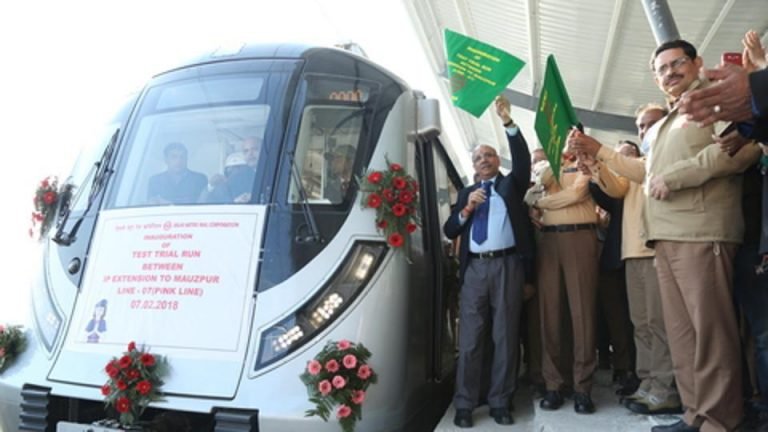
Gurgaon Rapid Metro Phase-II launched

Gurgaon: After missing several deadlines, the second phase of Rapid Metro was thrown open to public on Friday. The first train was flagged off by Rajiv Banga, MD and CEO of IL&FS from DLF Phase 1 metro station at 2 pm, following which it was thrown open to public after 3pm.

The line will benefit upscale residential colonies of south Gurgaon including DLF Phase 1, 4 and 5, Sushant Lok, Suncity and group housing societies in Sector 56. It will also cater to corporate and commercial establishments on the golf course road.

Rapid metro officials said the new route will be covered under 22 minutes. Seven trains will be running on the 6.6-km track at an interval of five minutes.

The second phase has five stations at DLF Phase 1, Sector 42/43, Sector 53/54, Sector 54 chowk and Sector 55/56. Parking space will be available at Sector 42-43 and sector 54 chowk metro stations.

The line starts from Sikanderpur Metro station that is connected to the Delhi Metro’s Yellow Line near Bristol Chowk and terminates at Golf Course Extension T-junction.

After construction started in April 2013, the 6.6-kilometre line was supposed to be completed by 2015, but it got delayed by 18 months due to the golf course road-widening project, shifting of gas lines and underpass project on the golf course road.

Rapid Metro’s daily operations will start at 6.05 am and the last train will terminate at Sector 55/56 station at 12:36 am.

Each train will have three coaches with six seats in each coach reserved for women,senior citizens and the physically handicapped persons.

In Phase 1 , Rapid Metro was covering six stations on its 6.1-km track – Sikanderpur, DLF Phase-2, Belvedere Towers, Cyber City, Phase-3 and Moulsari Avenue.

The Rapid Metro was launched in 2013 and is India’s first fully privately funded Metro service.

Advertisement1
InnoMetro_2026

Mumbai Metro | MMRDA allocates Rs 3,210 crore for Metro rail projects

0
Nagpur Metro Rail project

Mumbai: Maharashtra​ Chief Minister and Chairman​ of​ Mumbai Metropolitan Region Development Authority (MMRDA)​, ​Devendra Fadnavis, during the 142nd Authority meeting​ on Wednesday ​approved Rs​ ​6,976.50​ ​crore budget for the year 2017-18 presented by MMRDA. The budget clearly highlights the intent of the State as it spares large sums to projects such as Metro corridors, Mumbai Trans Harbour Link, Monorail Phase-II, development of Mumbai Metropolitan Region with flyovers, creek bridges and road network and development of water resources besides prioriti​s​ing the Bandra-Kurla Complex to improve its connectivity and infrastructure.

​MMRDA has spared Rs1,000​ ​crore each for the Dahisar to DN Nagar Metro-2A corridor (18.5-km, 17 stations, Rs​ ​6,410 crore) and the Andheri (East) to Dahisar (East) Metro-7 corridor (16.5-km, 14 stations, Rs.6,208 crore). The Colaba-Bandra-SEEPZ Metro-3 corridor has received Rs​ ​800 crore boost and DN Nagar to Mandale Metro-2B (23.5-km, 22 stations, Rs.10,986 crore) and Wadala-Ghatkopar-Thane-Kasarvadavli Metro-4 corridors (32-km, 32 stations, Rs.14,549 crore) have received Rs.200 crore each. The recently approved Thane-Bhiwandi-Kalyan Metro-5 (24-km, 17 stations, Rs​ ​8,416 crore) and Swami Samarth Nagar-JVLR-SEEPZ-Vikhroli Metro-6 corridors (14.5-km, 13 stations, Rs​ ​6,672 crore) have been given a token grant of Rs​ ​5 crore each.

Likewise, the second phase of the Monorail corridor running from Wadala to Sant Gadge Maharaj Chowk has also received Rs​ ​208-crore boost, which is expected to run this year. On completion, the entire 20-km Chembur-Wadala-Sant Gadge Maharaj Chowk will prove to be very helpful reaching commuters to areas that are not connected by rail based transport.

The provision of Rs1,200-crore has paved way for the speedy implementation of the Mumbai Trans Harbour Link project (22-km, Rs.17,843 crore). The Link will provide direct access to Navi Mumbai, new International Airport and will be a convenient gateway to Mumbai-Pune Expressway and further to Southern India. The Link will also help develop the main land.

The ​MMRDA further allocated Rs700-crore for the development of Mumbai Metropolitan Region and the road network therein. The development of flyovers, creek bridges and road network will certainly provide excellent connectivity with the city of Mumbai as also other areas.

“I want to ensure that any one should be able to reach anywhere in one hour and the commute must be easy, comfortable and congestion-free”, said Fadnavis. “The Metro corridors are the future of this city. The Mumbaikars should feel proud to use public transport rather than private vehicles. Use of public transport saves time, fuel and also improves environment”, said Fadnavis.

“The immense potential of the metropolitan region has attracted an allocation of Rs.700 crore. The region is full of opportunities and is attracting people, in turn, requiring infrastructure development on the whole. The Authority has been implementing various projects in this region like flyovers, ROBs, creek bridges and road network to develop the region”, said UPS Madan, Metropolitan Commissioner, MMRDA.

The Authority has made provision of Rs​ ​75-crore for the improvement of Bandra-Kurla Complex. The ​MMRDA has also made a provision (Rs​ ​50 crore) for the construction of an elevated road extending the Santacruz-Chembur Link Road up to Vakola bridge on the Western Express Highway.

Similarly, two flyovers and an elevated road will be constructed, for which a provision of Rs​ ​20 crore has been made in the budge, at Chheda Nagar to rid the traffic chaos that is being created by the innumerable vehicles assimilating at Chheda Nagar from the Santacruz-Chembur Link Road and the Eastern Freeway. There will be a 680-meter long and 3-lane wide flyover from Sion towards Thane running parallel to the existing 3-lane flyover. Another 1240-meter long 2-lane flyover will run from above the existing Chheda Nagar flyover and carry the traffic coming from Navi Mumbai towards Thane. ​T​here will be a 650-meter long and 2-lane elevated road to connect the existing Chheda Nagar flyover with Amar Mahal Junction flyover. The estimated cost of the project is Rs.249 crore.

The Authority has further allocated Rs.300 crore for the development of water resources. The 403 MLD Surya Regional Water Supply Scheme has been undertaken to provide bulk water supply to Mira-Bhayandar and Vasai-Virar Municipal Corporations as also the Rental Housing Scheme and villages in the western sub region of MMR. The project entails of collecting water from Surya Dam, treating the same at Surya Nagar and distributing it by laying 88-km long pipeline. The estimated cost of the project is Rs.1,611 crore and the implementation will begin this year.

Another significant budgetary provision of Rs50-crore has been made for the grand memorial of Dr.Babasaheb Ambedkar. The Memorial will come up on Indu Mill’s 4.84 Hectares of land ​and will comprise ​of a ​Commemorative Stupa, Auditorium, Assembly hall, Museum, Library, Landscape Garden, Parking spaces, etc.

Advertisement1
InnoMetro_2026

Lucknow Metro | VP, European Investment Bank along with his team visits the metro project

0

Lucknow: Mr. Andrew Denis McDowell, Vice-President, European Investment Bank (EIB) along with his six team members today visited Lucknow Metro and praised the speed and quality of the Project which is being implemented under the leadership of Shri Kumar Keshav, Managing Director, LMRC.

The EIB team was immensely impressed with the Lucknow Metro Project and the way it is moving ahead so fast in such a quick time. “We are very excited for this project and feel very proud to be a part of this Metro Project”, said Mr. McDowell. “This is one of our most important projects that we have funded”, the Vice-President added.

Alighting from the Chaudhary Charan Singh Airport this morning, Mr. McDowell along with his team members straightaway visited the Sachivalaya Underground Metro Station site to take a glimpse of the tunnelling activities and the two Tunnel Boring Machines (TBMs) which are in operation these days for the underground section of the project.

Afterwards, the EIB team visited the administrative office of Lucknow Metro where a presentation was given by Shri Kumar Keshav, Managing Director. The Vice-President, EIB and the Managing Director, LMRC signed papers related with disbursement of the second tranche of the EIB loan amount to Lucknow Metro.

The European Investment Bank (EIB) is going to sign an agreement with the Government of India (GoI) tomorrow for disbursing 250 Million Euros (Appox. Rs 17, 52, 50, 00000) to Lucknow Metro as the second tranche of the loan amount for this Metro Project.

Earlier in March, 2016, ­a foreign loan agreement for 450 Million Euros (equivalent to          Rs 3,502 crores) was signed between the Government of India (GoI) and the European Investment Bank (EIB) in Brussels during the visit of the Hon’ble Prime Minister of India to Belgium.

The funds had to be released by the European Investment Bank in two tranches of 200 Million Euros and 250 Million Euros respectively. The first tranche of 200 Million Euros has already been received by LMRC and an agreement for disbursing the second tranche of 250 Million Euros will be signed between the Government of India (GoI) and the European Investment Bank (EIB) tomorrow in New Delhi.

The visiting EIB team comprised Mr. Andrew Denis Mcdowell, Vice-President, Ms. Maria Shaw Barragan, Deputy Director, Global Partners Department, Ms. Angela Marcarino, Head of Division, Mr. Andrew Rosser, Senior Advisor to the Vice-President, Ms. Sunita Lukkhoo, Senior Loan Officer, Operations in Asia and Pacific Division, Mr Richard Willis, Media Officer, Communication Department, Secretariat General and Mr. Donal Cannon, Head of External Office in New Delhi.

Source: LMRC Press Release.

Advertisement1
InnoMetro_2026

Delhi Metro | DMRC’s ridership crosses one billion mark in 2016-17

0

New Delhi: The Delhi Metro Rail Corporation (DMRC) has releases its cumulative ridership data for the financial year 2016-17. According to press release, the cumulative ridership of the Delhi Metro within this financial year crossed the one billion mark (100 crores) on 29th March 2017 for the first time, further establishing DMRC as the mass transportation backbone of the National Capital Region (NCR).

DMRC further clarified  that since 1st April, 2016, a total of 1.001 billion (100.165 crores) passengers have traveled by the Delhi Metro till last night, registering a 6.56 percent growth in average daily ridership since the last financial year 2015-16. The average daily ridership has increased by 43 percent in the last five years.

YearRidership

(in millions)

Average daily ridership (in millions)Network length
2012-13702.95 (70.29 cr)1.93190
2013-14801.70 (80.17 cr)2.20190
2014-15870.91 (87.09 cr)2.39193
2015-16946.95 (94.69 cr)2.59213
2016-17

(Till 29thMarch, 17)

1001.65 (100.165 cr)2.76213

The Delhi Metro today ranks 10th in terms of ridership among the 34 top Metro systems of the world.

“The Delhi Metro currently operates with a fleet of 227 train sets comprising of 128 six coach, 58 eight coach and 41 four coach trains across all its corridors.
buy viagra oral jelly online no prescription

The process of adding 258 new coaches to the fleet to augment the carrying capacity of the system has been started since last October and the process is scheduled to be completed by the end of the next financial year.”, added by an official.

Advertisement1
InnoMetro_2026

My 6 years innings at Bangalore Metro ends in April 2017 – K.L. Mohan Rao

0
K.L. Mohan rao, Principal, BMRC Training Institute

It seems the other day I joined Metro Rail Corporation, as a Founder Principal of BMRC Training Institute. A Mechanical engineer by profession, been a enterprenuer for more than 25 years in the field of Aluminium fabrication, electro colouring, PU coatings, with specialization in computer site planning and installation. Carried out turn key jobs for the major computer room installation in Bangalore through Computer maintenance corporation Ltd.

Entered the field of contract in with the leading PSU’s like HAL, ITI, BEML and Major projects with the Garrison engineers south.

Established a huge anodising and electro colouring, semi automatic plant with 21 ft tanks, in the year 1991 investing more than 21 lakhs of hard earned money.

Went through a very turbalant challenging life, because of huge financial loss and pressure from bank, financial institutions, ESI, PF, Customs & sales tax. It appeared that the end of a self made entrepreneur, without financial backing and even mental support. The pressure was so much that, go to any place whether marriage, birthday or funeral, there was some face, which reminded of the financial commitment to them. The world seems to be merging on me with tha bank recalling, the working capital and the financial institute threatening to the auction all my properties.

The attitude and the commitement towards my family with the only son gave a strength to fight. Thus started a new era from a turn key contractor to a labour contractor. It took a lot of strength, courage to survive for the sake of my son. From a owner of a Maruthi Van, life started with a borrowed Hero Puch.

A frank discussion with a client giving an honest financial back ground and shifting most of the machines, to their premises with a promise to deliver in time and a minimum of 20 % savings in the total project started the labour contractor’s life. Burning away the pride of being a factory owner and ego’s travelling from a four wheeler to a two wheeler. Meeting people knowing fully well of being looked down upon, more so by the relatives and so called friends. Keeping only one motto “Hum honge Kaam yaab, Ek din”. Went on from 6 lakhs to nearly 3 crores labour contract with the timely help of the client not only financially but also getting an engineering seat, followed subsequently, by getting a MBA seat for my faithful well behaved, supporting great son of mine.

Thus started a new Era of relationship with educational Institutions and getting support from most of them.

As a labour contractor, could come out of debts from nearly 33 people, Bank and financial Institutions. But all these has costed me my youth and converted into a 50 year old man full of wisdom and an attitude to give back to the society. My gratitude to the great Institutions what is today called as PES IT University.

At one stroke, took a decision to bulldoze the factory and converting it into an empty land to be later getting into a joint venture with a builder. A new life started there, where training came into my life. Became the chairman of the Builders Association of India, Karnatak Centre., in 2002 and with the grace of god, managed to train and employ more than 5500 Civil engineers and Artisans in the leading construction Industries.

Was invited by the Govt of Karnataka to head as Founder Director of Koushalya Shaale, an enterprise of Rajiv Gandhi Rural Housing Corporation, in the year 2009. After making this unit self sustaining, switched over as consultant to IAPMO- International Association of Plumbing & Mechanical Officers and RMCMA (Ready Mix Concrete Manufacturing Association).

A major change in life came in by an invitation from the Managing Director of BMRCL in 2011 to establish a training centre at Baiyappanahalli, with an initial contract for 3 years. This was extended by 2 years and then 1 year. One of the best, rewarding, satisfied career of my lifetime in this great organization BMRCL. Today I would like to move on to my next goal of training and employing atleast 1 lakh rural and urban educated and uneducated unemployed youths of Karnataka, in this lifetime.

I pray God to give me health and strength to work towards this goal.This is a zest of my life from graduating from BMS Engineering college in 1975, 1st employment as Asst. Engineer in Bharat Gold Mines, KGF, then Production In-charge in a private company ECIE.

(The writer is Principal at Bangalore Metro Rail Corporation Training Institute, Bangaluru. This article was first published in pulse)

Advertisement1
InnoMetro_2026

Haryana Metro | HMRCT to start metro rail project from Delhi to Kundli (Sonipat)

1
Representational image only

Panchkula: The Haryana government today said Kundli in Sonipat district will be connected with the Metro rail service soon.

The project for connecting Kundli with metro rail was approved in the 22nd meeting of the Haryana Mass Rapid Transport Corporation that was chaired by Chief Secretary D S Dhesi, an official release said here.

The metro rail line will be extended from Narela in Delhi to Kundli, covering a distance of about 4.
buy viagra capsules online no prescription

86 km, it said.

Apart from this, other under-construction metro rail projects were also reviewed in the meeting, the release said.

These included the Sikanderpur to Gurgaon Sector 56, YMCA Faridabad to Ballabhgarh and Mundka to Bahadurgarh projects.

The latter two are slated to be completed by December this year, it said.

(This article has not been edited by Metro Rail News’s editorial team and is auto-generated from an agency feed.)

Advertisement1
InnoMetro_2026

Bangalore Metro | BEML bags Rs 1,421 crore contract for supply of metro coaches to BMRC

0

Bengaluru: The Bharat Earth Movers Limited (BEML) has won a Rs 1,421-crore contract from Bangalore Metro Rail Corporation (BMRCL) for supply of metro cars.

“BEML Ltd…has bagged a prestigious order of Rs 1,421 crore from Bangalore Metro Rail Corporation for supply of 150 seats of intermediate metro cars to augment the existing 3 car trains supplied by BEML to 6 car trains,” the company said in a filing to the BSE.

It said BMRCL MD Pradeep Singh Kharola and CMD, BEML, Deepak Kumar Hota have exchanged the contract agreements for supply of intermediate metro cars to BMRCL from June 2018.

The contract is scheduled to be completed by December, 2018.

BMEL has forayed into manufacturing and supply of hi-tech metro cars during 2002 and as a leading rolling stock supplier has so far supplied over 1,000 metro cars to Delhi, Bangalore and Jaipur Metro Corporations.

(This article has not been edited by Metro Rail News’s editorial team and is auto-generated from an agency feed.)

Advertisement1
InnoMetro_2026

Delhi Metro | UNFCCC registers DMRC’s Solar Power initiative as CDM project

0

Bonn, Germany: The Delhi Metro Rail Corporation’s initiative to install roof top solar power plants at its premises has become the first ever Clean Development Mechanism (CDM) Project to be registered with the United Nations Framework Convention on Climate Change (UNFCCC) for any Metro or Railway system in the world.

The project has been registered under the ‘small scale category’ for those with a installed solar capacity of less than 15 MW. The DMRC run roof top solar facilities have an installed capacity of 14.983 MWp which translates to an estimated electricity generation of 19,687 MWh annually.

A total of 31 grid connected roof top solar power facilities across the stations, depots, Receiving Sub Stations and residential colonies of DMRC were identified for this project.

The project is expected to generate an estimated 18,506 CERs (Carbon credits), though the exact number of CERs will be available only after verification audit scheduled mid next year.  The project was registered in a record time of eight months, on 25th March, 2017, about two months ahead of schedule.

This is the fifth climate change project to be successfully registered by DMRC. Two more projects are in the stage of registration presently.
buy priligy online blackmenheal.org/wp-content/languages/new/noprescription/priligy-no-prescription.html no prescription

Delhi Metro had earlier been certified by the United Nations (UN) as the first Metro Rail and Rail based system in the world to get carbon Credits for reducing Green House Gas Emissions as it has helped to reduce pollution levels in the city by 6.3 lakh tons every year thus helping in reducing global warming.

The UNFCCC has already registered the Delhi Metro in two categories for promoting Clean Development Mechanism and earn carbon credits: Regenerative Braking and Modal Shift’.

DMRC has come up with a solar policy of its own to utilize as much solar power as possible for its ever increasing energy needs. It plans to produce 50 MWp of solar power by the year 2021.  DMRC is trying to utilise the space available at its stations, depots, residential areas and parking facilities to install solar power facilities.

Advertisement1
InnoMetro_2026

Delhi Metro | DMRC gets a mass transit wallet from the RBI

0

New Delhi: The Delhi Metro Rail Corporation (DMRC) has got a wallet licence from the Reserve Bank of India. Interestingly, the DMRC has got a mass transit prepaid payment instrument (PPI) issuer licence. The RBI website shows that DMRC was given the licence last month and is valid up to March 31, 2022.

Note that the RBI introduced in July 2015 a new semi-closed pre-paid instrument for mass transit services to help move on from cash-based systems to electronic means. The new instrument will allow users to load Rs 2,000 and have a minimum validity period of six months from the date of issue.

Some of the other features of the new instrument are:

– No cash-out or refund will be permitted from these wallets.
– The instrument can also be used at other merchants whose activities are allied to or are carried on within the premises of the issuing mass transit system. An example:  The Delhi Metro could issue a wallet service which can be used to buy food at the food stalls in the station.
– The issuer may decide upon the desired level of KYC, if any, for such PPIs
– The instrument must have an Automated Fare Collection application related to the transit service.

Note that ICICI Bank had launched a smart card for the Delhi Metro back in 2014. In July 2011, State Bank of India had also partnered with Bangalore Metro to launch NFC-enabled debit cards, that doubles up as travel smart cards.

Meanwhile, Axis Bank said it would be launching smart cards for commuters on the Bengaluru Metropolitan Transport Corporation  (BMTC) buses and Kochi Metro Rail to make digital payments.

Perhaps Kochi Metro and the BMTC could look into the wallet system as well. Metro Rail News had pointed earlier out that despite the huge potential, no one has tried to fix public transportation payments and it’s something that all wallet players could look into.

Hong Kong has a smart card for digital payments called Octopus card which can be used for all public transport in the city. London has Oyster card which can be used to pay for fares for the London Underground, London Buses, the Docklands Light Railway (DLR), London Overground, Tramlink, some river boat services, and most National Rail services. Dubai has a electronic ticketing card called NoI card which can be used in all public transport systems.

Advertisement1
InnoMetro_2026

MEGA Metro | Recruitment of various posts in technical & non-technical discipline

1

Gnadhi Nagar:  MEGA or Gujarat Metro in inviting online applications for recruitment of 606 vacancies of junior engineer & station controllers as part of its latest project. Ahmedabad – Gandhinagar metro rail project is handled by Metro-Link Express for Gandhinagar & Ahmedabad (MEGA) Company Ltd which is a special purpose vehicle (SPV) jointly owned by Govt of India & Govt of Gujarat.

Recruitment Notice No.: MEGA /HR / OM-Rect. / 2017/1 Dated 24.03.2017

Total number of vacancies: 606

– Station Controller / Train Operator: 283 Posts
– Customer Relations Assistant: 31 Posts
– Junior Engineer: 99 Posts
– Maintainer: 193 Posts

Online registration of applications:  30.03.2017 to 30.04.2017

CLICK HERE TO APPLY ONLINE

Click here to view detailed advertisement. For more details please visit MEGA Metro’s official website.

Advertisement1
InnoMetro_2026