Home Blog Page 791

Delhi University students demands Student Metro Pass ahead of DUSU election

0
Delhi University Student demands Metro Pass

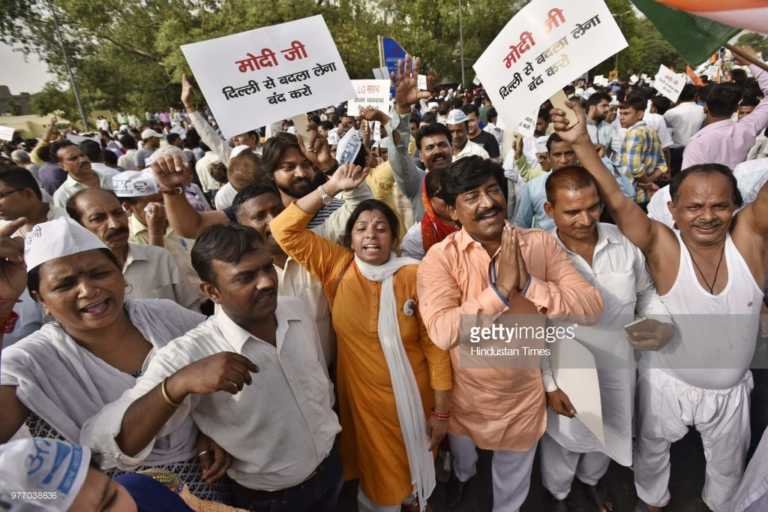
New Delhi: Ahead of Delhi University Student Union (DUSU) election, scores of members of the Left-affiliate All India Students Association (AISA) took out a rally titled “DU demands” in the University’s North Campus on Tuesday.

Demanding a violence free campus, hostel facility and metro concessional passes, the students submitted a memorandum under their campaign “Hinsa Nahi Hostel Chahiye, Fare Hike Nahi Metro Pass Chahiye.” The memorandum had 20,000 signatures of students across colleges and was presented to the Vice Chancellor.

Kawalpreet Kaur, President of DU AISA said, “In a country where more than 80% belong to the lower income group, quality and affordable education to all has to be the biggest priority for any model of development. But other than constructing more universities on those lines we must also focus on DU. On the one hand, DU is being made unaffordable to common students, and on the other, it is becoming a hub of hooliganism.”

The students also approached the Dean of Students Welfare raising concerns over special buses for them. “He promised us six University Special Buses for the time being which will be later increased,” Kaur said.

Another major concern of students was lack of hostel facilities at the campus. “I study in an outer campus college and I stay in Noida because of the unavailability of hostels in my college. Things would have been better if the university would have provided hostels to us Also, I spent more than Rs 100 everyday on metro,” said Shreya Kapoor, from the Indraprastha College for Women.

With DUSU elections to be held on September 12, campaigning is on in full swing here across the campus. And it remains to be seen if students’ concerns do get addressed.

Advertisement1
InnoMetro_2026

Mumbai Metro | MMRC washes hands of probable mishaps during Metro tunnelling

0

Mumbai: While Mumbai Metro Rail Corporation (MMRC) has said that the tunneling work for Colaba-Bandra-Seepz Metro-3 will commence in October, it has now washed its hands of, saying MMRC won’t be responsible for any collapse of old dilapidated buildings that may occur during the tunneling work and the contractors would be solely responsible for the same.

However, MMRC has said that the contractor is conducting a pre-construction survey of all the structures in the influence zone of Metro-3 alignment and during the tunneling all these structures will be monitored to avoid any untoward incident or accident.

Ashwini Bhide, Managing Director, MMRC, said, “We are using the latest technology when it comes to tunneling, which is very safe. There should be no scope for any structure collapsing or loss of life due to tunneling. However, in case of a collapse, it is the contractor who is responsible for the same and not MMRC.”

Bhide added, “The residents of those structures that are weak might be asked to shift for a week when tunneling is being carried out, if found necessary. The contractors would bear the expense for the same. While we also carried out a survey previously, even the contractors are carrying out the same preconstruction survey. If after all these studies too, there is any collapse, the contractors would be responsible.
buy lipitor online https://lasernailtherapy.com/wp-content/themes/twentytwentytwo/inc/patterns/en/lipitor.html no prescription

There are a total of 1,435 buildings on the whole alignment where the MMRC had prepared a report named Building Condition Survey prior to 2015. The report concluded with there being 16 buildings on the whole alignment where tunneling would be carried out in very severe category, 247 buildings in severe category, 405 in moderate category, 469 in slight category, 184 in very slight and 11 buildings in negligible category.

However, the contractors of MMRC are currently redoing the exercise named Pre-construction Condition Survey of these buildings. Homa Pouredehi, resident of JSS Road at Girgaum said, “My building is in habitable condition at present and we will continue to stay for many more years. But MMRC declared our building as “structurally unsatisfactory. We have not been taken into confidence. MMRC has not given any written commitment about structurally strengthening and making the building safe before and during tunnelling. MMRC has not clarified what happens if our building collapses during tunneling.”

Meanwhile, MMRC has already placed orders worth approximately Rs 2,200 crore for purchasing 17 tunnel boring machines (TBMs) required to excavate the city’s first underground corridor between Colaba and Seepz, have been placed by MMRC’s contractors.

Advertisement1
InnoMetro_2026

Hyderabad Metro | HMRL all sets to open the metro services in November 2017

1
Telangana
Representational Image

Hyderabad: Work on the ₹14,132-crore Hyderabad metro rail project has gathered pace with the Telangana government keen on commissioning one of the longest networks, a stretch of 30 km, at one go during Prime Minister Narendra Modi’s visit to Hyderabad in November.

While couple of stretches of 8 km and another one of 11 km are ready for commissioning and had secured various approvals, including rail safety, the State Government has decided to launch the project connecting two completed stretches across two lines running to a total distance of 30 km.

Chief Minister K Chandrasekhar Rao has requested Prime Minister to launch the project when he visits Hyderabad to take part in a Global Entrepreneurship Summit to be held here in November.

The concessionaire, construction major L&T, has been implementing the project, a 72-km long elevated metro corridor, connecting three dense stretches, under the public private partnership mode.

While the project was to be completed by July 2017, it faced several hurdles, including land acquisition in some segments and right of way in certain places. L&T has been given one year extension to complete the project.

Some of the crucial and complex rail over bridge links, interconnect stations, and smaller links are now being executed.

NVS Reddy, Managing Director of Hyderabad Metro Rail Ltd, said, “With the Chief Minister directing completion of the 13-km stretch between Miyapur and Ameerpet on Corridor I and Nagole to Ameerpet, a stretch of 17-km on Corridor III by November, the focus is on these stretches.”

Sources executing the project, requesting anonymity, stated that it is a race against time as the deadline is stiff given the critical links on railway lines, and some interconnect stations are in the process of being completed. Two such installations are now under execution at the Secunderabad junction, where a massive rail over-bridge is being installed and another at an interconnect where two rail lines meet at Ameerpet.

L&T has also simultaneously taken up transit oriented development at several locations. These are at advanced stage of completion.

To ensure the project gets ready for commissioning by November 2017, KT Rama Rao, Municipal Administration and Urban Development Minister, is monitoring the progress.The PMO team that tracks major projects in the country is also keeping an eye.

Advertisement1
InnoMetro_2026

Kochi Metro | KMRL begins construction work on third reach from Maharajas College to Thykoodam

0
Kochi Metro Construction Site (Representation image)

Kochi: The Kochi Metro construction in the third reach from Maharajas College to Thykoodam has commenced with the new contractor Cherian Varkey Construction Company and Vijay Nirman Constructions (CVCC & VNC) planning to carry out the activities from both ends.

“The construction activities are planned at both ends – Jos Junction and Thykoodam. A test pile has been done at Jos junction and soon the full scale construction by erecting barricades will start. The land in the Thykoodam-Pettah stretch is yet to be handed over,” metro sources said.

The Rs 300 crore project will include construction of elevated viaduct besides that of three metro stations – Ernakulam South, Thaikoodam and Petta, in the nine-km long section from Maharajas College to South station and from Kunnara Park to Pettah.

The construction work till Thykoodam is aimed to be completed in 20 months by March 2019, sources said.

The metro authorities are also planning to complete construction of the 90-metre long balanced cantilever concrete span diagonally over the railway lines at the South station by December.

Meanwhile, the metro authorities will hold the signaling trial in the five km section from Palarivattom to Maharajas College later this week. “We’ve started the preliminary works such as ‘Migration Planning’ – incorporating changes in the signaling and communication software to control the train operations from the Muttom Operation Control Centre,” they said.

Advertisement1
InnoMetro_2026

Nine cities to get 313 km of metro rail connectivity by March 2019

0

New Delhi: Nine cities will get an additional 313 km of Metro rail connectivity by March 2019, almost double the current 370-km operational length in eight cities since the first metro rail service in 1984. The cities include Lucknow, Nagpur, Kochi, Hyderabad, Delhi, Noida, Chennai and Bengaluru.

According to a media report, close to 537 km of metro tracks are under construction at present.

Aside from the Nagpur, Ahmedabad and Lucknow, projects approved by the current National Democratic Alliance (NDA) government, the rest were given the go-ahead by the previous United Progressive Alliance (UPA) government.

With respect to funding, the Central and the state governments follow a 50-50 equity venture model. The Centre gives assistance of up to 20 percent of a project’s costs, excluding land costs. It provides 14 percent equity and the subordinate debt accounting for about six percent. The remaining contributions are taken up by the state government in the form of loans.

An official of the housing urban affairs ministry told the media that the budgetary allocations for metro lines have increased to Rs 42,696 crore in the 2015-18 period. This is a 258 percent increase from the previous Rs 16,565 crore from the 2012-15 period.
buy orlistat online https://blackmenheal.org/wp-content/themes/twentytwentytwo/inc/patterns/en/orlistat.html no prescription

The latest cities to join the metro rail club are Lucknow, Ahmedabad, Hyderabad and Nagpur, expanding the number to 12 cities with metro rails.

Of these four budding metro rail cities, Lucknow will be the first city to open its 8.5 km rail to the public in a fortnight.

Advertisement1
InnoMetro_2026

Mumbai Metro | Environment report misleading on Metro-3 car shed’s proposed

0

Mumbai: Yuva Sena chief Aditya Thackeray today alleged that the environment assessment report provides misleading information about Aarey milk colony, where a car shed of the city’s Metro-3 project is proposed to be set up.

The construction of the car shed at the Aarey colony in suburban Goregaon would pose a threat to the area’s biodiversity, he further said.

A car depot of the Metro-3 Colaba-Bandra-SEEPZ corridor is proposed at the Aarey milk colony.

The Shiv Sena had earlier objected to the hacking of 2,298 trees in Aarey colony to make way for the car shed for the Metro line.

“We are not against the Metro (project) as I personally travel by it at times. But, officers have mislead the chief minister by stating that only mice are found in the area of Aarey milk colony,” Thackeray alleged.

“The environment impact assessment report has mentioned that only mice are found in this identified area.

The fact is that other animals, including leopards, are found over there. Hence, we are objecting to the location of the (proposed) car shed site here as it would end in large scale tree cutting and threat to the biodiversity,” Thackeray said.

He was speaking after attending a tree plantation drive today at the Aarey milk colony.

“The BMC has also omitted the car shed from its development plan, which was recently finalised and now the proposal is with the chief minister. Even other parties have opposed it,” Thackeray said.

(This article has not been edited by Metro Rail News’s editorial team and is auto-generated from an agency feed.)

Advertisement1
InnoMetro_2026

Delhi Metro | DMRC contract workers go on strike due to non-payment of salary

0
Delhi Metro project workers on strike at Jantar Mantar

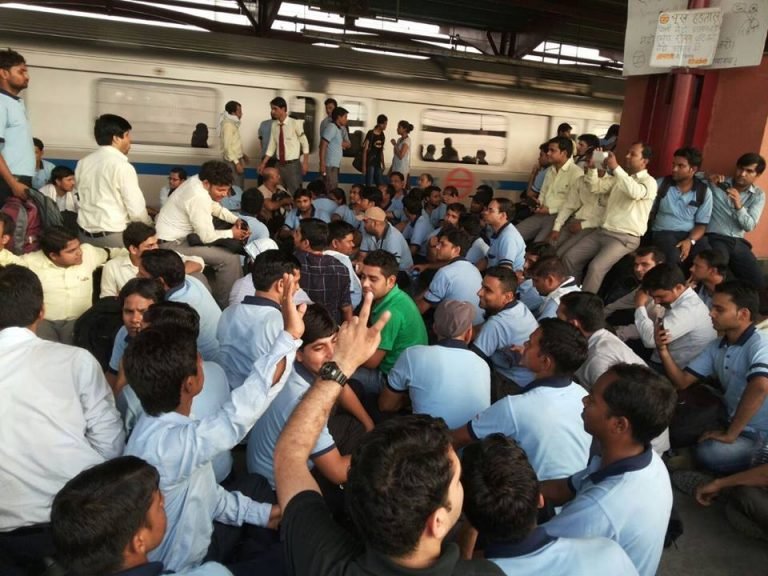
New Delhi: Metro travellers who use the Metro to commute to work will have to face a tough time as the contract workers of Delhi Metro Rail Corporation’s (DMRC) resorting to protests once again. The contract workers have been protesting since August 17 demanding pending payments since nine months from DMRC and FEMC Pratibha.

Apart from sending half of his monthly income home to his mother and three siblings in Katihar, Bihar, 19-year-old Anzar Alam saves a tiny sum every month for emergencies. But now that his village has been hit by a flood, he feels helpless. “I haven’t been paid in the last two months, so I have spent my savings on rent and food…I need money urgently so my family in Katihar can survive,” said Alam, one of the 1,600 labourers with the Delhi Metro Rail Corporation (DMRC) protesting at Jantar Mantar since August 17.

Along with the labourers, contractors too have taken to the streets demanding “pending payments of nine months from DMRC and FEMC Pratibha,” which, according to labour contractor Ashish Dwivedi, amounts to “Rs 25 crore”. “We are paid by FEMC Pratibha but nine months ago when we stopped work, DMRC intervened and assured us that they will pay us… since then, partial payments have been made over a month or two,” said Dwivedi, who has 300 labourers under him.

“A section of workers hired by one of DMRC’s contractors, M/s FEMC Pratibha have been agitating over alleged non-payment of dues for the last few days.
buy tadasiva online https://nouvita.co.uk/wp-content/themes/twentynineteen/fonts/en/tadasiva.html no prescription

DMRC would like to clarify that these workers have not been directly recruited or hired by Delhi Metro.”, said Anuj Dayal, DMRC Spokesperson.

DMRC also does not pay the salaries directly to these workers. The contractor has been directed to clear all dues and DMRC is also closely monitoring the situation. A Metro spokesperson added, “If labourer makes any complaint to DMRC regarding non-payment of wages, DMRC takes appropriate steps. In this case, no individual labourer has made complaints. This is the matter of dues between sub-contractor and the main contractor.”

Even as the rain brought the city to a standstill on Saturday, hundreds continued to sit on a dharna at Jantar Mantar, along with 25 labour contractors. “I have paid salaries of the 250 labourers under me for seven months by taking loans…I am in debt now, no longer capable of paying them, which is why we are protesting,” said contractor Babloo Tripathi.

The labourers and contractors also revealed that work on Delhi Metro phase III is on hold due to the protest. “At the moment, no work is happening at the nine Metro stations of phase III, which is already delayed by many months…if they don’t meet our demand, we will also put functioning metro service on hold, and lie down on the tracks in protest,” said Tripathi.

It is worth mentioning here that due to non-fulfillment of salary revision agreement, corruption in recruitment and illegal termination of a metro employee who was working as RTI Supervisor in Metro Bhawan over 9000 Delhi Metro employees were on protest in last month and the protest was stopped after a series of high level meeting in presence of Urban Development Secretary D.S. Mishra, Chief Secretary Govt. of Delhi M.M. Kutty, Principal Advisor Dr. E. Sreedharan and DMRC, MD Mangu Singh with Staff Council members after giving written assurance by the Delhi Metro administration. However, sources said that DMRC management still not fulfilled their demands as promised in the meeting.  The terminated RTI Supervisor not yet received his reinstatement letter from the DMRC.

Advertisement1
InnoMetro_2026

E. Sreedharan is not in favour of PPP model in metro rail projects

1
Dr. E. Sreedharan, The Metroman
New Delhi: E Sreedharan, famously known as the Metro Man, has always been a vocal critic of PPP (public-private-partnership). Therefore, his reluctance in executing urban rail projects on PPP mode is not new and if facts are to be believed the 85-year-old’s fear is not misplaced either.
Sreedharan in the past had said the construction of Airport Express Metro would have incurred 20 per cent less expenditure had Delhi Metro built it. In the case of Airport Express, the entire civil structure was done by Delhi Metro Rail Corporation (DMRC), accounting for 60 per cent of the cost. He had said the other 40 per cent could also have been done by DMRC with the help of a loan from Japan.
The project got delayed on several accounts and was finally salvaged by Sreedharan and launched in February 2011. In the airport line, DMRC invested 55 per cent of the cost (50 per cent of which was borrowed from Japan). Reliance Infrastructure, which was the only private player to come forward, invested in the rolling stock, electrification, and signaling.
According to latest media reports, the Metro Man has once again questioned the feasibility of PPP projects. PPP in India was tried out in Mumbai, Hyderabad, and the Airport line of Delhi, but the experience has not been good.
In Mumbai Metro Line 1, Reliance Infrastructure took almost seven years to complete 11 km of the relatively easier elevated line and they now claim to be losing Rs 50 lakh per day in revenue everyday despite the very high fares they are charging. In Chennai, the state and central governments invested all the money with borrowing from Japan.

The Union Cabinet on Wednesday cleared a new metro policy under which the future metro projects will now be tendered after evaluating their social and economic impact in addition to considering financial returns.

Taking note of the substantial social, economic and environmental gains from Metro projects, the policy stipulated a shift from the present ‘Financial Internal Rate of Return of 8%’ to ‘Economic Internal Rate of Return of 14%’ for approving Metro projects, in line with global practices.

The policy opens a big window for private investments, making the PPP component mandatory. “Private participation either for complete provisioning of Metro rail or for some unbundled components (like automatic fare collection, operation and maintenance of services, etc) will form an essential requirement for all Metro rail projects seeking Central financial assistance,” the new policy said.

The new policy provides for a rigorous assessment of new proposals and also proposes an independent third-party assessment by government-identified agencies.

Sreedharan has even said that no private company will come forward for construction of Metro rail as it is not a profitable investment. This could also be true since the metro projects are left to be taken up in tier II cities where the traffic volumes may not be as high as in Delhi and Mumbai.

Source: BS

Advertisement1
InnoMetro_2026

Delhi Metro | DMRC Phase-III have 18 more interchanging stations

0
Driverless metro trains

New Delhi: With the completion of Phase III of the Delhi Metro, the city will have as many as 27 interchanging stations, three times the existing number of 9. The new Pink line, which is expected to be fully operational by March 2018, will also increase the total distance covered by the Metro to 348 km.

The Pink Line, that will run from Majlis Park to Shiv Vihar and cover 38 stations, will have Azadpur, Netaji Subhash Place, and South Campus as interchanging stations. Commuters on the Orange Line (Airport Express) travelling from New Delhi Railway Station to Dwarka 21 will be able to interchange at INA and Lajpat Nagar. Similarly, for the Magenta Line between Janakpuri (West) and Botancial Garden, apart from these two terminating points, Hauz Khas and Kalkaji Mandir will also facilitate changing of trains for different lines. Mayur Vihar, Phase 1, Anand Vihar, Karkardooma and Welcome will serve as interchanging stations for the Violet Line. The total number of stations after Phase III starts running will reach 253.

Sources inform us that to ease the facilitation of utilising new stations and to avoid confusion, Delhi Metro Rail Corporation will use the colour corresponding to the line at the interchange terminals. It would also connect two stations with a foot overbridge, which will also be coloured as per the line they are connecting. For instance, Botanical Garden, a station for the Blue Line as well as the upcoming Magenta Line, the connecting foot overbridge will be painted in both blue and magenta. Currently, commuters are aided by floor stickers and arrow heads directing them to the correct interchanging station.

Advertisement1
InnoMetro_2026

Mumbai Metro-3 | Project affected residents plan to approach Bombay High Court

0
Bombay High Court
Bombay High Court

Mumbai: Affected by the construction of the Colaba-Bandra-Seepz Metro-3 underground corridor, residents of South Mumbai have said that they plan to approach the Bombay High Court. Their contention is that the Mumbai Metro Rail Corporation Ltd (MMRCL) is allegedly risking peoples’ lives by going ahead with the construction the said underground corridor.

They claim that the detailed project report (DPR) of the Mumbai Metropolitan Region Development Authority (MMRDA) for several elevated Metro projects has stated that underground stations are more prone to terrorist attacks, whereas elevated stations are not.

They claim that by going underground, MMRCL is allegedly undermining the safety of citizens.

Jamshed Sukhadwalla, a resident of Marine Lines and a structural engineer, said, “If what is mentioned in the report of the Delhi Metro Rail Corporation (DMRC) for MMRDA on Metro-2B is true, then it will also be applicable to the Metro-3 underground corridor. This means that by constructing the underground corridor, MMRCL is risking the lives of not only commuters, but also of people residing along the corridor.”

“We may have to take legal aid if the MMRCL puts our lives and property at risk,” Sukhadwalla added.

DNA had, on August 11, reported that K Vijaya Lakshmi, the chief of the transport and communication division at MMRDA, in a communication to a Vile Parle-based educational trust, had attached a DMRC report citing that the underground corridor for DN Nagar Mandale Metro-2B is not feasible.
buy lipitor online https://healthcoachmichelle.com/wp-content/themes/twentytwentyone/inc/en/lipitor.html no prescription

One of the reasons for this was a security threat.

However, the MMRCL has not commented on the issue yet.

MMRDA’s detailed project report on Metro projects had stated that underground Metro stations are more prone to terrorist attacks, whereas elevated stations are less prone to the same.

Advertisement1
InnoMetro_2026