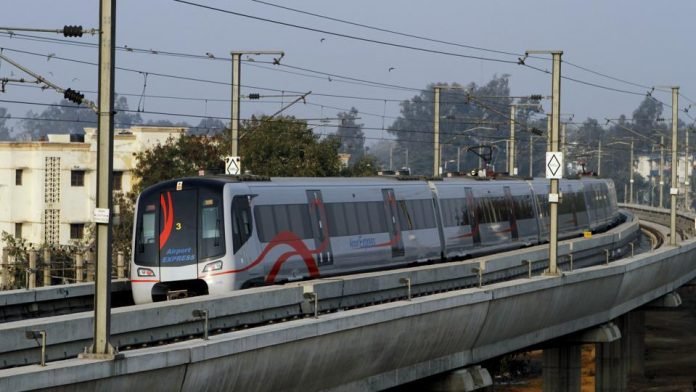
New Delhi: Prime Minister Narendra Modi has flagged-off the Delhi-Faridabad Metro Line that would allow hassle free travel for around two lakh daily commuters between the national capital and the industrial hub in Haryana.
The extension of the Delhi Metro connects Badarpur to Escorts Mujesar in Faridabad.
The total cost of the project from Badarpur to Escorts Mujesar is nearly Rs. 2,500 crore. Out of this, Rs. 1,557 crore was borne by the Haryana Government, the Centre contributed Rs. 537 crore, while the Delhi Metro provided Rs. 400 crore.
All these are elevated and located on either side of the Delhi-Mathura Road (NH-2).
“The nine-station metro corridor which was 95 per cent indigenously built will provide people a safe, affordable, quick, comfortable, reliable, environment-friendly and sustainable transport facility,” a Haryana government spokesperson said.
Haryana Chief Minister ML Khattar, addressing a press conference on Saturday, had thanked the Prime Minister for “gifting” the Metro service which would take the city to “another level of progress” with better connectivity with other NCR towns.
He had also said that the Prime Minister would be announcing the go-ahead for connecting Gurgaon with Faridabad by Metro.
Make in India Electric Locomotive by Alstom from Madhepura Facility
Alstom announced the completion of its first all-electric locomotive from its state-of-the-art locomotive facility at Madhepura in the State of Bihar, on schedule. In line with the Government’s and Indian Railways’ target towards 100% electrification and towards sustainable mobility, these new locomotives will not only bring down operating costs for the Railways but will significantly cut down greenhouse gas emissions as well.
This first locomotive is part of a €3.5 billion order comprising 800 electric double-section locomotives signed in 2015 which contributes to the Ministry of Railways’ public-private partnership programme to modernise the country’s rail infrastructure. This agreement remains the largest Foreign Direct Investment in the railways sector to date and has a strategic role in creating a multiplier effect on the economy. This contract is also one of the biggest contracts in the history of Alstom.
“Our operations in India are paramount to our business globally and we continue to stay committed to developing India’s infrastructure needs, improving the quality of services to citizens and investing in the nation’s economy,” said Henri-Poupart Lafarge, Chairman and CEO, Alstom.
Further commenting on the completion of the first electric locomotive, he added, “This project stands as a shining example of Alstom’s commitment to ‘Make in India’. Apart from creating thousands of jobs directly and indirectly, we have created a strong localised supply chain for this project, with 90% of the components for the prototype sourced locally.”
Thanks to its 12,000 horsepower, each double section locomotive, part of Alstom’s Prima locomotives family, has a hauling capacity of 6,000 tonnes and speed of 120km/hr, allowing faster and safer movement of heavier freight trains across the country, thereby reducing congestion for passenger train services and freight. Equipped with IGBT based propulsion technology, these locomotives will be compliant with Indian standards of freight transport and will have the ability to endure tough Indian climate and conditions. The locomotives were developed with the support of 6 Alstom sites in France: Belfort for the 6 first car bodyshells, and Ornans for the motors, Tarbes for the traction, Le Creusot for bogies, Villeurbanne for the train control monitoring systems and Saint-Ouen for the design.
In another significant development, Alstom announced three new contracts worth approximately €75 million – power supply contract from the Mumbai Metro Rail Corporation Ltd (MMRCL), contract for new train sets from Chennai Metro Rail Corporation and another power supply contract from Jaipur Metro Rail Corporation. This development shows Alstom’s growing footprint in the country, in both the urban space as well as the mainline space.
Additionally, phase 1 in the construction of the electric locomotive facility at Madhepura and the depot at Saharanpur is complete and work is progressing as per the contractual timelines. To give skilling and local hiring an impetus, focused efforts towards nurturing young minds in communities in and around Madhepura have been initiated. With the help of local NGOs, Alstom Foundation is working to foster better health care, education and dignified livelihood in the area.
New Delhi: Indian Railways plans to invest $11bn into a signalling system project across the country to improve the safety of journeys.
“We will bring the most modern technology of European Train Control System (ETCS) in India and it will be implemented across the country”, Union Minister of Railways Piyush Goyal said.
The South Western Railway division of the Indian Railways has produced a pre-feasibility report for the 160km Bengaluru suburban railway in the southern state of Karnataka, which was approved in 2014 but no work has been completed. This railway would require an investment of $1.8bn.
According to Goyal, 68km of the suburban railway network will be raised.
Indian Railways also plans to invest $7.6bn to modernise the stations and deliver advanced rail coaches. The company has also proposed an equal cost-sharing arrangement between itself and Karnataka.
“We can do a cost sharing of 50-50 between the state government and the Indian railways and against that, they (state government) can allow us to increase the Floor Area Ratio (FAR) or Floor Space Index (FSI) of all our stations to five, so that we can raise some revenue by developing the stations, making them modern and passenger friendly,” said Goyle.
Indian Railways has historically renewed 233km of track every month; this figure increased to 476km being renewed per month in December 2017.
Earlier, Indian Railways renewed 233 km of tracks every month but this figure was scaled up in December 2017 with 476 km of track being renewed.
Goyal added that the renewal work is being gradually scaled up to enable faster trains.
“In January, 2018, railways did 576 km of track renewal and in February we did 560 km … That is the scale-up to make the Indian Railways safer. With this, all the speed restriction will go away and we will have faster trains,” he said.
Bengaluru: Around 900 employees affiliated with Bangalore Metro Rail Employees Union have decided to go on indefinite strike from March 22 seeking various demands from the management. The union has given a notice the BMRCL management in this regard. The Metro employees demand perks and salary on par with Delhi and Jaipur metro employees.
The BMRCL Employees Union said though it is registered and affiliated to the Indian National Trade Union Congress, it has not yet been recognised. The Metro management warned that it would invoke provisions of the Essential Services Maintenance Act (ESMA) and action would be taken if anyone resorts to disrupting metro services. The BMRCL managing director Mahendra Jain told media that the Metro service has been declared as essential services under Essential Services Maintenance Act and stringent action would be taken if anyone resorts to disrupting metro services.
What are their demands?
Recognition of Bengaluru Metro Rail Employees Union Immediate implementation of 3RD PRC ( implemented by Delhi Metro) and arrears in a single instalment to be implemented from 01.01.2017.
As per 3rd, PRC gives 35 per cent perks. Also to obey the order of Central Public Enterprises.
Immediate implementation of Standing Orders Revise the BMRCL Employees’ Promotion Rules.
Removal of officers of other states from Office and Management positions and immediate removal of corrupt officials.
A delegation of Officers from the Deputy Commissioner for 5 years up to the parent company.
Stop harassment of employees, memo, letter, an apology on a day-to-day basis.
Employees have planned to protest in three locations:-
Front of BMTC Complex
BMRCL Corporate Office in Shantinagar and
Baiyappanahalli BMRCL office.
In a press release issued, the union alleged that the management harassed office bearers and active workers on false pretexts in all conceivable manner by resorting anti-union and anti-labour policies to suppress the union.
“The Majlis Park-South Campus section of the Pink Line of the metro network will be opened next week,” Urban Affairs Secretary DS Mishra said on the sidelines of an event at the Metro Bhawan in Delhi.
The 59-km Majlis Park-Shiv Vihar corridor (Line 7) of the metro network, also known as the Pink Line, is part of the Phase-III project. Starting last year, trial runs on its other stretches have also been conducted.
The Majlis Park-Durgabhai Deshmukh South Campus section has 12 stations, including three interchange stations at Azadpur, Netaji Subhash Place and Rajouri Garden.
“The metro train on this stretch will also cross Dhaula Kuan at a height of 23.6 m (as high as a seven-storey building) to reach South Campus from Majlis Park,” the DMRC said.
On February 7, trial runs began on the over 10-km elevated stretch (IP Extension-Maujpur) of the Majlis Park-Shiv Vihar corridor, on which the new signalling technology, Communication Based Train Control (CBTC), will be “rigorously tested”.
Image for representation purpose only copyright: respective Authority
New Delhi: One of Prime Minister Narendra Modi’s key electoral promises was a high speed rail network. And this is a promise he intends to keep. Over the past couple of years, concrete steps have been taken in that direction. If the rail budget in 2016 laid further groundwork necessary for the ambitious bullet train project, Budget 2017 did one better: Rs 18,000 crore was allocated to upgrade the Delhi-Mumbai and Delhi-Howrah corridors to allow trains to run at 160 kmph, against 70-90 kmph currently.
But the best is apparently to come. A top rail ministry official has told that the Indian Railways is set to announce a massive Rs 10 lakh-crore plan to construct high-speed train corridors connecting all the major cities next month. Covering almost 10,000 kilometres, the new rail lines will allow trains to run at 200 kmph. The Railways is reportedly also exploring options such as building single pillar, two track elevated corridors on top of existing/upcoming national highways or building the new rail lines parallel to existing rail routes on railway land to reduce the cost of construction. In fact, the aim is to halve it from Rs 200 crore per km to Rs 100 crore per km. Railway minister Piyush Goyal has asked his officials to work on speed, scale and skill to achieve early implementation of these projects. buy temovate online https://www.ecladent.co.uk/wp-content/themes/twentyseventeen/inc/en/temovate.html no prescription
The upcoming announcement will not only unveil the routes to be connected but also the funding mechanism. According to the report, loans from financial institutions and multilateral agencies along with monetising land bank will likely take care of that. The Indian Railways is also expected to roll out large tenders, inviting global majors.
Of course, high speed rail lines also need new trains. Currently, the fastest train in India is Gatiman Express, which runs at a speed of 160 kmph between Delhi and Agra. Coming soon – as early as June according to media reports – is the first Train 18 that will run just as fast. This set eventually aims to replace the Shatabdi trains and will pack ‘world-class’ passenger amenities such as GPS-based passenger information system, on-board Wi-Fi and infotainment, automatic sliding doors and zero discharge vacuum-based bio-toilets. Another train set called Train 20 is expected to follow in 2020, to replace the Rajdhani trains plying on longer routes.
New Delhi: To share or exchange ideas and experience among the metro railway projects in India, Ministry of Housing & Urban Affairs launched “I-METROS”, an association of all Indian Metro Rail companies today at the Conference on “Indian Metros: Collaborating for Excellence” held at Metro Bhawan, New Delhi. The platform will be a forum for exchange of ideas, pooling of knowledge and sharing of experience, best practices, innovations etc. among the Indian Metro Rail companies to nurture excellence in performance. MoHUA Secretary Sh. Durga Shanker Mishra, Cabinet Secretary Sh. P K Sinha, DMRC Managing Director, Sh. Mangu Singh and representatives from Metro organizations from all over the country were also present on the occasion.
Speaking on the occasion, Sh. Sinha said that suggestion for such a common platform for idea and experience sharing for all the Metros had come from the Prime Minister himself and that he was glad to see considerable progress in this direction. He expressed confidence that ‘I-METROS’ will go a long way if it progresses in the right way in terms of sharing of best practices and adoption of the latest technologies. Sh. Sinha also appreciated the journey of the Delhi Metro and said that Delhi Metro has been a real success story which has set benchmarks for other metro organisations in the country.
Secretary, Ministry of Housing and Urban Affairs, Sh. Durga Shanker Mishra said that, “The government has come up with a new Metro policy last year which will pave the way for creating an eco-system for the rapid growth and development of Metro systems in the country.”
Cabinet Secretary Sh. P K Sinha also released “The Operator’s Story”- a publication by World Bank and Railway and Transport Strategy Centre (RTSC), Imperial College London, on findings of the research on “What makes Metros successful”.
The conference on “Indian Metros: Collaborating for Excellence” was also attended by representatives of Metro systems from all over the world who are in Delhi to attend the management meeting of the Community of Metros (CoMET).
I-Metros Highlights
“I-Metros” is proposed to be a platform to provide a forum for exchange of ideas, pooling of knowledge and sharing of experience, best practices, innovations etc. among the Indian Metro rail companies to nurture excellence in performance.
This society will be registered under Society Registration Act-1860.
The objective of forming this association is to provide a common platform for all Metro rail companies for sharing experience, information, best practices, innovations etc.
This association will also undertake and promote techno-economic studies and research. It will safeguard the interest and rights of metro rail companies and will be resource tank of information for decision making.
Silky Agrawal who studied Master in Technology in Civil Engineering from Indian Institute of Technology, Gandhinagar graduated in 2015 and launched her start-up GeoCarte Radar Technology Private Limited and incubated at IIT Gandhinagar.
Since 2015, Silky has worked on number of prestigious projects using IIT Gandhinagar’s network that includes working for Shree Somnath Trust, railway station in Gandhinagar and CST in Mumbai along with Ahmedabad Metro Rail project. Here are some excerpts from his interview with Metro Rail News:
Can you please introduce yourself and also explain more about GeoCarte Radar Technology Pvt. Ltd. presence in Metro and Railway construction industry in India?
I am a former master’s student of Civil engineering at IIT Gandhinagar. With the soul of an engineer and heart of an entrepreneur, I have initiated a start-up “GeoCarte Radar Technology Private Limited”, working in the field of non-destructive geo-exploration using Ground Penetrating Radar. We are currently incubated at IIT Gandhinagar under the mentorship of Prof. Amit Prashant and Prof. Sudhir K. Jain, Department of Civil Engineering, IIT Gandhinagar.
We at Geo-Carte provide comprehensive professional services for all kind of non-destructive geo-explorations ranging from utility mapping to archaeological investigations and in many more domains using GPR. With our advanced technology we can map the underground utility services without digging and hence it can be of great use to several agencies in optimising the need of the new network, preventing the damage to the pre-existing utilities while installing the new ones, detecting leaks in existing pipes and in preparing the database of the same. This can save huge amount of money and time and can considerably reduce the undesirable delays in the projects. Adding to it, we have successfully completed several projects for utility mapping, road inspection, railway ballast investigation and archaeological investigation. We have worked with Larsen & Toubro on Ahmedabad Metro Rail Project to map the underground utilities to plan utility shifting at the location of proposed underground station and area besides where probably the utilities can be shifted. We have also worked with Indian Railways to explore the application of GPR for ballast investigation to improve the output efficiency of Ballast Cleaning Machine during the maintenance work. We have worked with many such esteemed clients on prestigious projects including Chennai Smart City Project.
Please could you give us some background as to your own career and what attracted you towards incorporation of GeoCarte Radar Technology Pvt. Ltd.?
During my master’s, I was working on a project, Archaeological Investigation using GPR at Dholavira. During initial stages, while calibrating the machine, we realised the machine is not good to work in all situations and there are few limitations to its performance, like poor quality data in high moisture soil content. Therefore, we tried several other methods to develop a tool which can analyse this weak signal data. After so many trials and error methods, we developed the advance analysis tool which can provide satisfactory solution in all soil conditions. Also, coming from business background family, never wanted to go for job, and my mentor Prof. Amit Prashant motivated to for start-up and supported me. And that’s how i ended up initiating GeoCarte.
Tell us a little bit more about your company and how it would typically be better for projects than more traditional methods?
GeoCarte is company fully focus for underground infrastructure mapping. Traditionally people go for trenching to get an idea about underground utilities or any features, however, it leads to damage of the pre-existing assets, its dis-continuous data, very time consuming, inconvenient and costly method. GeoCarte’s services provides the map of all the underground assets just by scanning and enables a company to plan any new project execution efficiently and reduces the chances of undesired delays in the projects due to scarcity of knowledge about subsurface features.
What is GeoCarte Radar Technology and how it works?
GeoCarte is a consulting organisation providing comprehensive professional consultancy services for all kind of geo-explorations ranging from archaeological investigations to utility mapping, ground water table investigation and assessing the condition or health monitoring of concrete structures. We at GeoCarte intends to serve our clients with our best approach to deliver outputs on time and guarantees that our services will exceed our fees. We provide services right from data collection on site, to data analysis, data interpretation and report preparation. We provide the output results in form of plan and sectional view which can be easily used and implemented in further processing by any engineer at site.
Ground Penetrating Radar (GPR)
As we know that your company use Ground Penetrating Radar (GPR) technology, Utility Mapping and Transportation Inspection services to infrastructure and construction industry. Please enlighten our readers more about your specialized product, technology & services and their salient features.
We have developed an advance analysis tool which can be used in difficult site conditions where the conventional tools fail to perform. We can provide satisfactory output result even in high moisture condition, high clayey content soil where GPR data contains weak signal and conventional methods cannot provide efficient output results. Moreover, we provide tailored and customised solutions to our customers for their specific requirements and purposes.
How were projects undertaken before GeoCarte Radar Technology Pvt. Ltd. became so prominent and what changes have been made?
Mostly people are unaware of these available technology and therefore they use traditional and conventional methods like, trenching, excavations, etc. which leads to damage of underground assets and cause undesired delays in the project leading to loss of time and resources. There are couple of companies in India providing services for subsurface utility mapping, however, they use conventional method which is not good enough for all site conditions.
What are the other kinds of players and how do you differentiate yourselves from them?
There are very few companies who provide similar services, however, the conventional commercial available technology alone is not good enough to perform in all site conditions. With our advanced analysis tool, we can provide enhanced subsurface profile. Also, we do provide services in different domains other than utility mapping and exploring new avenues of its application. We have worked on several archaeological projects, Indian railway project and many such challenging projects. We intend to provide superior quality services with more efficient technology and approach. 8. What are the measures you take with regards to quality control? With regards to quality control, specially for underground utility mapping we follow American standard codes ASCE-38-02 to maintain the quality of our output drawings.
Tell us about major metro & railway and infra projects undertaken by you and what are the challenges you face when it comes to catering to the Indian market?
We have successfully completed the underground utility mapping for a proposed underground metro station for Ahmedabad Metro Rail Project with L&T for the purpose of planning of pre-existing underground utilities. We are currently working on Chennai Smart City Project with Tamil Nadu Water Investment Company. We are going to execute several metro and smart city projects in coming months in several cities of India. The biggest challenge we face is to convince the government officials to adopt new technology. Also, Government corporations outsource everything to contractors, though they need to understand that the main client has the responsibility to know at first place about the existing assets before proposing or awarding any new project to the contractors.
What do you think about metro railway, rapid rail transit and high-speed rail revolution in the major metropolitan cities in the India?
It is the must required things in the big cities with very high population for convenience. Now a days it has become a great issue, by road due to heavy traffic, it is very difficult to reach to your places on time. And therefore, having public transport, like metros, rapid rail transits is a need of the hour.
Any other information, you want to share with us in respect to technology development in metro & railway, infrastructure and construction industries and how your company is well placed to capitalize on this or has capitalized on it.
Currently, in India during the smart city mission, there is a boom in infrastructure domain, and its a very good opportunity for any upcoming new technology in the country. Our technology bring the revolution in this smart city projects where, the existing cities are getting updated to smart cities, and there is so much unrecorded underground infrastructure unknown to anybody. Thus we have a great opportunity to work.
Suretech Infrastructure: Pioneering breakthrough technology in India
Suretech Infrastructure is a leading distributor of construction equipment in India. With experience of over 27 years in the Industry, SureTech has been a pioneer in bringing several breakthrough technologies to India. Our primary focus has been in Foundation engineering solutions. We are also a specializing in Earthwork machinery including excavators, Motor graders and excavator attachments.
To know the contribution of Suretech Infrastructure in metro & railway construction industries in India, Metro Rail News team conducted an interview with Mr. Sunil Newatia, Chairman of the Company. Here are excerpt from his interview:-
Please could you give us some background as to your own career and what attracted you towards incorporation of Suretech Infrastructure?
I am a management graduate from JBIMS and started this company in 1990 with foray into distribution of auto consumables like lubes, tyres and batteries. Navi Mumbai was being developed in those days and we sensed an opportunity in construction equipment business. We started our career in this industry with dealership of Telcon and subsequently Ingersoll Rand and other international brands
Tell us a little bit more about your company and how it would typically be better for projects than more traditional methods?
We have always focused on hi-tech and latest technologies and niche markets. Labour is getting more expensive and more difficult to get, and hence if you want to execute projects fast and efficient, you have to go foe mechanization. Pursuing this philosophy, we pioneered mechanization in OFC laying way back in 1998 by bringing in a trencher attachment for an excavator. Project implementation speed quadrupled using the trencher in place of manual labour being traditionally used to cut trenches.
As we know that your company offers specialized infrastructure and foundation engineering services to infrastructure and construction industry, please enlighten our readers more about your specialized product & services and their salient features.
We are today controlling 80%+ market share in driven piles technology which includes Vibratory Hammers, Impact Hammers, Vibro Floats etc. We are also leading in reverse circulation drilling technology. Besides these we have pioneered several excavator attachments like Milling Planers, Drum cutters, Tree handlers, tetrapod grabs, crusher buckets, screening buckets. Last year we brought in Spider excavators which can reach areas which no other equipment can. Currently one such equipment is working in Sikkim on a ropeway project.
How were projects undertaken before Suretech Infrastructure became so prominent and what changes have been made?
Traditionally projects were being executed using labour and mechanical equipment. When we entered this industry hydraulically operated machinery were already getting popular. Our role was to speedily bring the latest technology into the country. However, reluctance of large construction companies in modernizing and changing gear was a major impediment in speedy embrace of the new methodologies. For e.g. we have been trying to bring in screw piling technology into the country which is now very popular in USA, Europe and Australia. This method of piling reduces project implementation time by 75-80% and cuts ground contamination to zero. However, the project authorities have been playing truant and blocking introduction of this technology into our country
Multi Purpose Excavator (PC: KOBELCO)
What are the other kinds of players and how do you differentiate yourselves from them?
Our focus has always been of product support. This is the reason of our success and this is what differentiates us from others. For us the job starts after we sell and for others it ends there. We have become a supplier of choice due to our efficient service, troubleshooting and quick restoration of equipment under breakdown.
What are the measures you take with regards to quality control?
Basically quality control falls under the domain of equipment manufacturers and companies we represent. On our part, we have selected only the leading manufacturers to work with. As a policy we do not associate with Chinese companies as they are not consistent in quality and policy. Proper selection of companies to work with ensures that we associate with only ethical companies who believe in providing the best to their customers.
Tell us about major infra projects undertaken by you and what are the challenges you face when it comes to catering to the Indian market?
We have worked on Mumbai Pune Expressway, DMRC, Mumbai Ahmedabad 4 laning, several port projects across the country. The major challenge is convincing the customer that you get what you pay for! Someone who is selling for less will also provide that is worth only that much. We have never compromised on quality and thus do not sell purely on price.
What do you think about metro railway, rapid rail transit and high-speed rail revolution in the major metropolitan cities in the India?
Burgeoning population and growing traffic in metros as well as tier 2 and tier 3 cities, rapid transit and metro projects have become extremely necessary. We are already decades late in planning and due to political stupor. To speedily implement such projects we need to embrace technology. Using conventional methods is not going to help now.
What are your predictions for the construction and infrastructure industry in 2018?
We are expecting huge opportunities in infra as govt. has realized that we need to implement in 10 years what the western world achieved in 50! Several huge projects are already lined up and in pipeline. Why only 2018, we are upbeat that this shall continue for at least next 5 years.
The Mumbai Metropolitan Region Development Authority (MMRDA) issued tender notice on Thursday for construction of Ballastless Track work in main line for Line-7 corridor between Andheri (East) to Dahisar (East) of Mumbai Metro Rail Project.
“NIT No. MMRDA/MMRP/CA-21: Design, Construction, Manufacturing, Supply, Installation, Testing & Commissioning of Ballastless Track work in main line for Line-7 Corridor {Andheri (East) – Dahisar (East)} of Mumbai Metro Rail Project of MMRDA, Mumbai.”
Tender documents can be downloaded from 8th March 2018 to 24th April 2018. Pre Bit meeting scheduled on 20th March 2018 at 15.00hrs.
The deadline to submit tender documents by bidder in 25th April 2018.
The Line 7(Dahisar East – Andheri East) of Mumbai Metro Rail Project consists 16 stations; Dahisar East, Shreenath Nagar, Omkareshwar, Borivali Bus Stop, Thakur Complex, Mahindra & Mahindra, Bandongri, Kurar Village, Veet Bhatti, Aarey Road Junction, V. Nagar, Hub Mall, Bombay Exhibition Centre, JVLR Junction, Shankarwadi, Andheri East.
The estimated cost of entire project is ₹6,208 crore.
More information will be updated after notification of detailed notice inviting tender.
Pune: After introduction of new Metro Rail Policy and reviewing the proposal submitted by the state, the Central government on Wednesday, approved long awaited metro corridor between Shivajinagar and Hinjewadi in Pune on a public private partnership (PPP) basis.
“The nod has been received for the Hinjewadi-Shivajinagar Metro corridor by the Central government and they have approved Rs.1,300 crore as viability gap funding for the same. The Maharashtra government had already cleared this project which will be executed by the PMRDA”, Chief Executive Officer (CEO) of PMRDA Kiran Gitte said.
He further said that the secretary of economic affairs, officers from the urban development department, Niti Aayog , department of finance and other ministries were present at a meeting, along with PMRDA officials, to clear the project. Now PMRDA will be able to start administrative work and the tendering process.
Maharashtra Chief minister Devendra Fadnavis is being seen as the driving force behind the clearance for this Metro line happening on the fast track. Fadnavis wrote a letter to the finance ministry and requested the Centre to give priority to the Hinjewadi-Shivajinagar route, for which the state cabinet gave its nod on January 2 of this year.
This corridor covers 23.3km stretch between Hinjewadi and Shivajinagar and is expected to cost Rs.8,313 crore. Work is already on for the first two lines, between Pimpri-Chinchwad and Swargate, and Vanaz to Ramwadi. This corridor is projected as line-3 of Pune Metro Rail Project. buy tadalista online https://www.mydentalplace.com/wp-content/themes/twentytwelve/inc/en/tadalista.html no prescription