Home Blog Page 731

Gandhinagar | High-powered panel discusses terms and condition for MMTH tender

0
MMTH near surat railway station

Surat: On 25 June Chief Secretary J N Singh with Gujarat Government chaired the meeting of a high-powered committee in Gandhinagar. The main aim of this meeting was to fix the terms and conditions of the tender for Multi Model Transport Hub (MMTH) which is to come up near Surat railway station.

In this meeting municipal commissioner M Thennarasan and officers of state government and Indian railways were also present.

About Multi Model Hub

A Multi Modal Transportation Hub (MMTH) is identified as a transport node, which integrates various modes of public transport systems as well as it is integrated with passenger transit based activities. The hub serves as a single system that enables seamless passenger transfers. The major advantages of MMTH are the shared resources and passenger facilities, which decrease the land use requirements while it increases overall capacity of the system. Developing a multimodal hub integrating the railway station, regional bus service, BRTS, IPT gives boost to the city’s public transport network and decreases its dependability on the private vehicles. Thus, it impacts by reducing city traffic congestion, pollution and increases safety on streets.

About Project Detail

Ministry of Railways (MOR) as part of its policy of redevelopment of railway stations across the country on Public Private Partnership (PPP) model has entrusted through Rail Land Development Authority (RLDA) to ‘Indian Railway Stations Development Corporation Limited’ (here in after referred to as IRSDC) the work of redevelopment of the Surat railway station as a Multi Modal Transportation Hub with modern passenger amenities with fund generated from commercial development on leasehold rights for 90 (ninety) years of the vacant railway land and air space at the railway station along with responsibility of management of the passenger facilities at the station including collection of revenues from shops, stalls and other activities on areas licensed at the station (Railway Station Development Project).

  • Surat Municipal Corporation (SMC) – 3%.
  • Indian Railway Stations Develop Corporation (IRSDC) – 63%
  • Gujarat State Road Transport Corporation (GSRTC) – 34%.

Following are the few photos of project site:-

With this objective IRSDC, GSRTC & SMC with the support and suggestion of Govt. of Gujarat adopted integrated approach and form project specific Joint Venture Special Purpose Vehicle (SPV) to develop the Railway and Bus terminals, BRTS, City Bus, Metro and other transportation modes as international standard multi-modal interchange facility and the entire area in the vicinity of railway station and regional bus terminal as a Multi Modal Transportation Hub (Multi Modal Transportation Hub project).

Total project land area for development of Multi-Modal Transport Hub at Surat Railway Station are:-

A. Railway Station Area23,175
B. East side Railway Colony Area61,776
C. Railway Yard Area70,681
D. GSRTC88,340
E. SMC6080
F. Private Land**4263

Aim of the project
On behalf of the proposed SPV, IRSDC intends to develop a Multi Modal Transportation Hub (MMTH) which shall integrate all public transport modes such as City Bus, Bus Rapid Transit System (BRTS), State regional bus service, Metro Rail, Railways and intermediate public transport modes such as auto rickshaw and taxis. As part of the above, IRSDC seeks the participation of private entities for the Development of Multi Modal Transport Hub at Surat Railway Station including inter-alia all works related to, or incidental to, or required to be undertaken upon the project site in accordance with the provisions of the Development Agreement, and Applicable Laws, including the commercial development, as required to be undertaken (the Project) on Design, Build, Finance, Operate and Transfer (the DBFOT) basis

About floor space Index
Out of the total permissible FSI for development of project, built up area to be reserve for Administrative Zone, Operational Zone, Passenger Facility Zone, Passenger Transfer/Transit Zone, and Infrastructure Zone that is minimum development obligation requirement shall be deducted and balance will be available for commercial infrastructure.

The meeting discussed on allocation of floor space index (FSI) to private developer of MMTH by Surat Municipal Corporation (SMC).They finally reached to the allotment of 3.6 FSI to private party.

An officer of SMC said that, “By granting 3.6 FSI, the private party would be able to come up with his own design and plan for the project. The private party, who constructs MMTH, also needs to recover the cost and that would be possible only if FSI of 3.6 is granted to him.”

On 27 June Prime Minister Narendra Modi will assess the progress of the MMTH in a meeting with officials concerned through a video conference.
Advertisement1
InnoMetro_2026

Hyderabad Metro | Odourless Urinals to convert waste into Bio-Fertilizers!

0
Hyderabad Metro
Odorless urinals at metro station (credit: Nftv Channel)

Hyderabad:  In move to turn metro station green zone, Hyderabad Metro has set up odourless urinals at Miyapur Metro Station. These toilets convert the urine into bio-fertiliser which can then be used at several farms and gardens. The metro authorities are planning to install similar urinals at other metro stations as well.

HMRL MD Mr. NVS Reddy explaining successful working of waterless urinals at Miyapur Metro Station with bio-filtration
HMRL MD Mr. NVS Reddy explaining successful working of waterless urinals at Miyapur Metro Station with bio-filtration (Source: HMRL)

With this move commuters will be able to travel is hygienic environment. Riders will no longer have to close their nose while passing through public toilets at Hyderabad Metro Station.

As per a report publishes in national daily New Indian Express, currently there are three toilets placed at the Miyapur Metro Station. This has been put as part of the experiment to see the feasibility and use of them in totality. The estimated total cost of placing three toilets is around Rs 3 lakh. Apart from Miyapur, other stations where these urinals are operational are Rasoolpura, Kukatpally and JNTU.

Looking at the response and use, the Hyderabad Metro Rail (HMRL) authorities, are planning to install this eco-friendly toilets at the other stations in the city.

How do these toilets work?

As per the system in place that and breaks down the ammonia and urea components of urine and separates water. The urine is filtered as safe water that is directed to a soak pit via a channel. This odourless water can then be used for watering plants or cleaning floors.

The urine is collected in an anaerobic digester, where, in the absence of air, anaerobic microbes debase the urine, decreases stickiness and liquefy the solids. The urine subsequently enters the activated carbon filter, followed by a biofilter.

Explaining the utility of the by-product processed HMRL Managing Director, NVS Reddy shared that the ammoniacal nitrogen in the system is broken by a microbial strain, in which ammonia and nitrogen are separated. The nitrogen can be used as a nutritional supplement for plants and ammonia is used by microbes.

Advertisement1
InnoMetro_2026

In-principle approval given by government for six metro projects

0
Representational image only

New Delhi: Metro projects get further boost with central government giving in-principle approval for six metro rail projects in the country. The information was shared by union housing and urban affairs secretary, Durga Shankar Mishra.

The six projects that have been given a nod include: Agra, Indore, Bhopal, Delhi (phase-V), Meerut and Bhopal under the New Metro Policy. The central government officer also informed that similar approval has been obtained for the Delhi-Meerut stretch of Rapid Rail Transit System (RRTS).

Union housing and urban affairs secretary further shared that now the process for getting financial approval will begin. These projects receive certain funding from central government via Public Investment Board (PIB) whose approval is required. On the other hand central government has already forwarded the proposal of Delhi-Meerut RRTS to the finance ministry for appraisal.

Mishra stated that central government is committed to expanding metro projects in Delhi. The capital city cannot be left in lurch and some way has to be worked out for laying of phase –V project.  He also shared that owing to Delhi metro rail, six lakh vehicles has been averted. This has significantly helped in reducing the impact on environment by decongesting city roads.

The projects that have received in-principle approval have been given green signal as they match the New Metro Policy in place. As per the new policy for metro, certain components have to be made under public-private partnership. This is one clause that was objected by former Delhi Metro chief E Shreedharan.

In the meantime, the urban affairs ministry has informally standardised the rolling stock for all future Metro projects, which comprises the coach width and the configuration of trains with a set of three, six or nine coaches in every train. The uniform standards published in May also specifes the actual speed and design speed of trains besides the signalling system.

In order to push Make in India drive of Prime Minister Narendra Modi, metro rail firms have been asked to procure from domestic players. The aim is to promote standardisation of all systems and products that will lead to cost reduction as well as augment production in the country.


Advertisement1
InnoMetro_2026

E. Sreedharan to head committee that will set metro rail norms

0

New Delhi: In a move to streamline metro norms across the country, Prime Minister Narendra Modi has given green signal to formation of a committee. The panel will prepare standards for metro rail projects across the country. And the committee will be headed by none other than India’s very own Metro Man E. Sreedharan.

This announcement comes just after the inauguration of Mundka-Bahadurgarh section of the Delhi Metro Green Line.  This line is division of a series of phase-III launches that are likely to include about 170km more to the capital’s metro system this year. The 11.2-km fully-elevated Bahadurgarh corridor has seven stations.

PM Modi while inaugurating the new line via video conferencing had urged commuters to opt for public transport over private commute. He wishes that commuters travel via metro to work. Modi also added that the priority at the moment is to build a comfortable, affordable and convenient mode of urban transport for all the cities.

The cause of concern is the reduction in ridership in Delhi Metro since fare hikes last year.
buy propecia online https://pavg.net/wp-content/themes/twentytwentyone/inc/en/propecia.html no prescription

Modi said that in order to streamline process for metro, the central government is bringing out policy relating to metros. The committee to be headed by E. Sreedharan who has played a key role in development of metro network in the country. He felt that the policy will bring in greater coherence in all aspects of metro systems. The policy will also set a basic standard framework that will work as a guiding force.

The PM also added in order to boost ‘Make in India’, the government wants to encourage the trend of making metro coaches in India itself.

Acknowledging the help that India received from many nations for setting up Delhi Metro and other metro projects in the country, Modi added that now as it our turn to help. The country as a payback is helping other countries by designing their metro coaches and system.

Modi also pointed out that for all metro projects across the country the central and state government are working together.

Advertisement1
InnoMetro_2026

Delhi Metro | Metro services may stop on 30 June in Delhi-NCR, DMRCEU calls total shutdown

0

New Delhi: Delhi metro commuters may be in trouble. Metro services may be closed by 30 June for Delhiites, if on ongoing strike continue. On 19 June Delhi Metro Rail Corporation Employees Union (DMRCEU) started strike, they wore black band on their hand while working at their assigned place. And on 24 June thousands of employees gather near ITO metro station and decided to sit at the platforms of metro stations, depots, work places, and boycott Rest room, and their lunch time. This was the same day when Delhi Metro Rail Corporation (DMRC) was celebrating the inauguration of Mundka-Bahadurgarh corridor. And employees of DMRC were on strike, this ongoing strike issue is not a new issue. Their demands are as follow:-

  • To recognize DMRC Employees Union by the DMRC management.
  • To implement memorandum of undertaking signed between Management and staff council in letter and spirit.
  • To implement Schedule-A PSU pay scale and allowances for non-executive employees in line with executive employees.
  • To restate all terminated employees alleging fake charges under autocratic policies of the management  further  to take appropriate action against the official responsible for a huge loss of INR 4000 crore to DMRC due to irregularities in Delhi  Metro Airport express line project.

DMRC employees union further says that at every time DMRC tells that there is a budget problem but the major question arises that who is responsible for loss of INR 4000 crore? why employees has to pay for this, which was due to irregularities by the Delhi Metro management. Before starting the strike DMRCEU has already submitted 15 day notice to Delhi Metro Management which is going to end by 29th June.

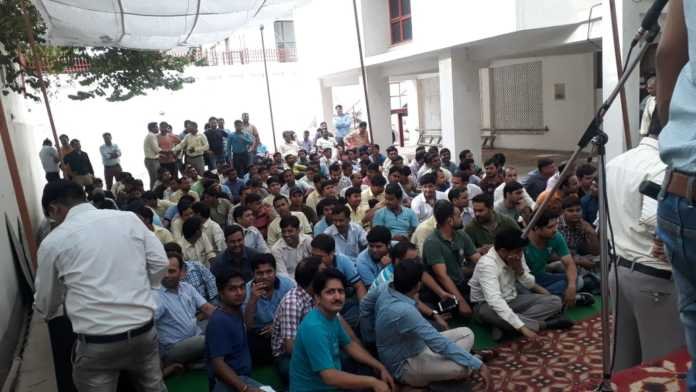
Here are some photographs of ongoing protest/strike by Delhi Metro employees since 19th June 2018-

All employees of DMRC are working hard to make the DMRC world class. And in return till now they have not received anything other than disappointment from DMRC.  In DMRC on the one hand executive employees are enjoying the great facility while non-executive employees are suffering.  We are demanding just what we deserve, for what we are working; we are fighting for our right. And if it not happens we will completely shut down the metro services from 30 June onwards.

“All employees of DMRC are working hard to make the DMRC world class. And in return till now they have not received anything other than disappointment from DMRC.  In DMRC on the one hand executive employees are enjoying the great facility while non-executive employees are suffering.  We are demanding just what we deserve, for what we are working; we are fighting for our right. And if it not happens we will completely shut down the metro services from 30 June onward”, stated in statement issued by DMRC Employees Union.

On 22 June a meeting was held between two representative bodies of the non-executive staff of DMRC i.e.  “DMRC staff council” and   “Delhi Metro Rail Corporation Employee’s Union.”   The main points of agreement are as follows:-

Memorandum of understanding signed between Staff Council and DMRC Employees Union
Memorandum of understanding signed between Staff Council and DMRC Employees Union (Source: DMRCEU)

To know the views of DMRC, when metro rail news team tries to contact with DMRC PR official, they refused to provide any information on this issues. Later metro rail news team has emailed a query to higher authorities of DMRC regarding this issues to know DMRC stand on ongoing strike by DMRC Employees Union since 19 June but till time of posting this news story no response has been given by the authorities.

seeking statement from DMRC
(E-mail seeking statement from DMRC)

At present DMRC is covering a distance of 288 km metro rail network along with 208 stations in Delhi-NCR. To operate and maintain the entire DMRC operations over 13000 employees working there. The average daily ridership of Delhi Metro is about 32 lakh. All this may get affect if strike does not stop.

Advertisement1
InnoMetro_2026

Nagpur Metro | Foot Over bridges in Nagpur, Ajni to be connected with Metro stations

0
Foot over bridge
Foot over bridge

Nagpur: Making commuting easy for public, the authorities in Nagpur have chalked out a plan to connect the Foot Over Bridges (FOBs) of Ajni and Nagpur Railway Stations with Nagpur metro stations. This is a significant move as it will extend more facilities to commuters. With FOBs connected to metro stations, riders will be able to move freely and reach the railway and metro stations without any hurdle or transport.

This will also save time of passengers who have to get down from railway to reach metro or vice-versa. Taking steps in setting up the FOBs connectivity, Rail India Technical & Economic Service (RITES) had given Detail Project Report (DPR) of proposed second phase of ‘Majhi Metro’ project in Nagpur. The aim is to boost public transport facilities in rural part of Nagpur district.

As per details Phase II will be covering rural areas of Nagpur district and will be act as an addition to the ongoing first phase work.  RITES have worked as expert consultant for designing and drafting of the DPR. The report has been submitted to the authorities after studying all facets concerning the second phase. The proposed Phase will be covering a stretch of 48.3 km length with 35 stations planned.

The work on Maha Metro – Nagpur is going well and is as per the schedule. The first phase of work is meeting all its timelines and authorities expect to roll out the operation soon. In Phase I there are 40 Nagpur Metro stations that will cover a stretch of 41.7 Km and has four corridors.

Once Phase I and II are completed, Nagpur city will have a Nagpur Metro network spread across 89 Km with 73 stations. With this development commuters will be able to travel easily from one part of Nagpur to another within short period of time. Common public will have access to comfortable and swift transport.

Taking connectivity to another step, the Ajni and Nagpur Railway Stations will be connected with metro stations via FOBs. This will make commuting easy and faster for commuters in Nagpur and those coming from outside.

Advertisement1
InnoMetro_2026

After LTSE left the monorail work the MMRDA is planning to start it again

1

Mumbai: The MMRDA is planning to operate and maintain the corridor on its own. It will hire and train new staff for conducting other activities and driving the trains.

Mumbai Metropolitan Region Development Authority (MMRDA) is now weighing options to continue the services. After the contractors who were operating monorail, the consortium of L&T infrastructure- Scomi engineering (LTSE) left, within six months the MMRDA is planning to start operations in the corridor.

R A Rajeev, the Metropolitan Commissioner MMRDA said that “We will start operations as soon as possible. We plan to start in the next six months. Whatever the decision, we will consider the cheapest alternative”.

R A Rajeev, the Metropolitan Commissioner MMRDA said that “We will start operations as soon as possible. We plan to start in the next six months. Whatever the decision, we will consider the cheapest alternative”.

After 10 years the construction began there are three possible options before the MMRDA to get work on the Chembur Sant Gadge Maharaj Chowk corridor backs on its feet.

The MMRDA is in talks with the IL&FS rail, which has emerged as the simple bidder after a long process in April.

The Reliance infrastructure bid for Rs 6,408 crore for operating and maintaining the monorail for 10 years while the IL&FS rail had quoted Rs 2,000 crore. It was estimated that for the operation and maintenance cost would be Rs 1,000 crore in 2016.

A senior MMRDA official said that “We are still negotiating with them on the cost. We are also considering other options”.

To operate and maintain the monorail the MMRDA has approached the Mumbai Rail Vikas Corporation (MRVC).

The MRVC is now considering the proposal and they even took a brief tour of the Wadala depot to understand operations of 19.7 km corridor.

MRVC still haven’t taken any decision on whether it will take the responsibility on running trains with the MMRDA regarding this.

Earlier the RS Khurana the chairman and managing director, MRVC said that “We are still in talks with the MMRDA regarding this. We have sought more details and only after looking into those will a decision be taken”.

Earlier the RS Khurana the chairman and managing director, MRVC said that “We are still in talks with the MMRDA regarding this. We have sought more details and only after looking into those will a decision be taken”.

An official said that  “If we do not get anybody else for operation and maintenance, we could consider operating it ourselves. But it will be a huge challenge, as we have no former experience of operating a corridor”.

“That is not our area of expertise and we will not be able to do it so soon. If we have to operate the corridor, we will need a lot more time” this was earlier said by the Sanjay Khandare, the additional metropolitan commissioner of MMRDA.

For the operation of the smooth corridor, the MMRDA will have to procure new rakes and spare parts. Rajeev said that “they have indulged in wrong practices by ‘cannibalising’ some of the new trains by taking their spare parts and putting them in the old trains”.

MMRDA is considering terminating the contract with (LTSE).

Rajeev asked that “We are examining the legal aspects. They have withdrawn staff from the site but there were some assets under their control. They have left them unmanned and if something happens to those, they should be held responsible. There is no letter of withdrawing or completion. Then how can their responsibilities be over?”.

Rajeev asked that “We are examining the legal aspects. They have withdrawn staff from the site but there were some assets under their control. They have left them unmanned and if something happens to those, they should be held responsible. There is no letter of withdrawing or completion. Then how can their responsibilities be over?”.


Advertisement1
InnoMetro_2026

Ahmedabad Metro | Before Lok Sabha election, metro rail set to roll on track

0
MEGA Metro Rail Project
MEGA Metro Rail Project (Ahmedabad and Gandhinagar)

Ahmedabad: The wait for many commuters in Ahmedabad is all set to end with the Ahmedabad Metro rail project likely to roll out before the financial year ends in 2018-19. As per the metro officials, work on 6km stretch starting from Vastral to Apparel Park is expected to be completed by the end of 2018. Additionally another stretch from APMC Vasna connecting Jivraj Park will be completed within 45 days.

It was in 2017 November that South Korean metro rolling stock manufacturer – Hyundai Rotem – was given the contract to supply 32 three-car trains for MEGA’s 39.26km Phase-1 project. The estimated cost for the coach is around 1,032 crore. The metro rail coaches will be made at the Changwon plant of the company and are expected to be delivered between April 2019 and July 2020.

IP Gautam, managing director, Metro-Link Express for Gandhinagar and Ahmedabad (MEGA) Company Ltd is looking to begin trail runs soon. To fasten up the process, MD has asked the South Korean company to deliver the coaches at the earliest. The company on the other had given assurance that the two of the three-car trains will arrive by January. In a meeting held on June 20 with the representatives of central government, the MD has asked to pre-pone the train deliveries in order to expedite the process so that metro officials can begin trail runs.

As per MEGA officials, each coach is of 3m wide and has the capacity to run at highest speed of 80 kmph, while carrying 782 passengers. These metro trains can run driverless and will have all necessary safety features including – LED route guide indicators, CCTV camera, passenger information display system and fire detectors.

As per Ahmedabad Metro officials, they want to complete the trail run and inaugurate the project before the Lok Sabha election. In order to meet this deadline they would want the coaches to deliver at the earliest. Metro officials are keen to increase the pace as they want the Ahmedabad Metro operational before election code of conduct is announced before the Loh Sabha election.

The total Phase-I project will possibly to be concluded by June 2020. Officials said the elevated corridor work has to be completed by end of 2019 and the underground tracks by June 2020.

Work on the 6Km underground rail route is going on in full swing with Tunnel boring machines (TBM) work going on at three locations in the city. The metro line will be on the Apparel Park and Kalupur metro line.

MEGA have assured that they will work in the Walled City area very cautiously. The officials are aware of the world heritage site on the route and are making all efforts to reduce the vibration owing to construction work. They have also chalked out a good traffic management plan to reduce inconvenience to the commuters.

Advertisement1
InnoMetro_2026

PM Modi approves the proposal to set up new committee for metro, headed by E. Sreedharan

0

New Delhi:  On the occasion of inauguration of extension of Green Line from Mundka to Bahadurgarh of Delhi Metro. on 24 June Prime minister approves the proposal to set up committee to lay down standards for metro rail systems in the country. The committee will be headed by E. Sreedharan, who is also known as Metro Man of India.

From 1995-2012, E. Sreedharan has served as Managing Director of Delhi Metro Rail Corporation (DMRC). Earlier this he worked as Indian Engineering Officer (IES). He has given new shape to metro transport for India.

Prime Minister said that, government’s priority was to build convenient, comfortable and affordable urban transport systems.

Further he said that, “Our government has brought out a policy relating to metros. This is because we felt aspects relating to metro systems need greater coherence and work as per a basic set of standards,” he said in his address.

Government wanted to boost ‘Make in India’ initiative by making metro coaches in the country. Several nations helped us in the making of Delhi Metro and other metros, and now, we are helping other nations by designing coaches for their metro systems Modi said.  Recently in Rae Bareli coach factory has open, can be taken best example of what Prime Minister wants to convey.

He added that, the process of making metro systems was also linked to cooperative federalism. “Wherever metros are being built in India, the Centre and the respective state governments are working together.”

Prime Minister further said that, “New India requires new and smart infrastructure. We have worked on roads, railways, highways, airways, waterways and i-ways. There is unparalleled focus on connectivity and ensuring development projects are completed on time.”

After the sudden fare hike of Delhi Metro, there was a great need to set up such kind of committee which can maintain the standard of metro. RTI has also provided the information regarding impact of Fare hike. As per the provided information five lakh people stopped travelling every day after fare hike.

Advertisement1
InnoMetro_2026

Sreedharan panel to submit report on standardisation of metro rail system in 3 months

0

New Delhi: Government statements say that already standard of design of metro coaches and signaling system have already been evolved but still there are many other numerous areas for which native standards need to be defined. Within three months a newly constituted committee headed by ‘Metro Man’ E Sreedharan on standardization of metro rail system across the country will submit its report.

Though standards have already been evolved for the design of metro coaches and signaling systems, there are numerous other areas for which indigenous standards need to be formulated. These include the layout of metro station, platforms, signage & displays, size of tunnels, fire protection systems, disaster management systems, environment-friendly and waste management systems, standards for solar panels at stations etc. was said by the press release from the government.

Though standards have already been evolved for the design of metro coaches and signaling systems, there are numerous other areas for which indigenous standards need to be formulated. These include the layout of metro station, platforms, signage & displays, size of tunnels, fire protection systems, disaster management systems, environment-friendly and waste management systems, standards for solar panels at stations etc. was said by the press release from the government.

The official added that Using a set of standard templates across the country would help bring down costs since similar providers can be used by multiple metro systems, said a senior official in the ministry of housing and urban affairs on condition of anonymity. There would also be a big scope to push for ‘make in India’ arrangements”.

The Sreedharan committee includes officials from the managing directors of metro rail corporation of various cities officials from the railways and one urban affair ministry official.More than 600 km of metro rail project is under construction and currently in the country in 10 different cities, about 490 km of metro lines are in operation. Apart from the investment envisaged by the state government, private partners and local bodies. The release says that the central government budget for metro rail is growing and it can be increased to about Rs 25,000 crore annually.

Advertisement1
InnoMetro_2026