Home Blog Page 719

Godrej moves HC over land for Ahmedabad-Mumbai bullet train

0
High Speed Bullet Train Project in India
Image for representation purpose only copyright: respective Authority

Mumbai: The Ahmedabad-Mumbai bullet train now finds itself in a new controversy with Godrej challenging the land acquisition. In a fresh controversy, Godrej has moved the Bombay High Court challenging the 8.6 acres of land located in Vikhroli area of Maharashtra.

The protest from Godrej group comes as the 8.6 acres of land is part of the business house real estate. The land will eat up Rs 500 crore worth of land and so Godrej has asked for realignment of land for the project.

Godrej has requested for realignment and even offered alternative land. This will only be possible if the National High-Speed Rail Corporation (NHSRC) – the nodal agency executing the project, concurs to realignment. In case if a compromise is not arrived at, Maharashtra government will have to forcibly acquire land for bullet train project.

With Godrej jumping into land acquisition problems, resistance for the popular bullet train project increases further. The project is already reeling under issues with regards to land acquisition. Both Gujarat and Maharashtra government are locked in a deadlock with many villages in both the states. In Gujarat it is 195 villages whereas in Maharashtra the government is on head-on collision with 104 villages. The 108-kilometre stretch in Maharashtra is among the most productive and fertile farm belts, well-known for its fruit plantations.

Despite of so many issues the authorities are confident at meeting the completion deadline of 2022. They are optimistic that the ride will open for public by August 15 in 2022.

High-Speed Bullet Train is an ambitious project of Prime Minister Narendra Modi’s government. The all-Japanese high-speed technology ‘Shinkansen’, the project investment has been estimated to be around Rs 1.10 lakh crore – 81 per cent of which will be covered by a soft loan with a 20-year moratorium on payments from the Japanese International Cooperation Agency (JICA).

In face of the land acquisition controversies, many feel that the deadline for bullet train will be extended further. Godrej is the new entrant opposing land acquisition along with farmers in Gujarat who have filed five writ petitions in Gujarat High Court.

On the other hand public hearing by the NHSRC in Palghar was interrupted for the second time in the row, by farmers a few weeks back.
Advertisement1
InnoMetro_2026

Delhi Metro | Corruption results fare hike, Delhi Govt. seeks CBI probe on Airport Line scam

0
Delhi Metro Airport Express Line
Delhi Metro Airport Express Line/Representational image

New Delhi: Delhi Metro aim was to provide facility to commuters with affordable prices. From last few months Delhi Metro Rail Corporation (DMRC) is continuously increasing fare by which its main motive of public services remain just for the name. Fare hikes need to be done for the maintenance of metro, statement given by Union Urban Affairs minister Hardeep Sing Puri, but the reason behind it is completely different. Delhi Metro has always remain silent when it comes to fare hike, employees salary issue, Rs 4000 crore scam on Airport Line project, Khyber Pass depot land scam, property business scam, poor infrastructure in Mundka staff quarters etc.

Recentally  Delhi Chief Minister Arvind Kejriwal has demanded a CBI inquiry, in the airport metro rail line reason behind its termination of the concession agreement of Delhi Airport Metro Express Private Ltd (DAMEPL). There is no report for Rs 4000 crore which was allotted for this line. Actually there was a loopholes in the base of this airport line. The detail project report that was prepared in this line was not only away from practicality, but also the decisions taken for this line also remained in the center of disputes rather than its characteristics. Arvind Kejriwal submitted letter to Union Urban Affairs minister Hardeep Singh Puri, a copy of this has been circulated to Home minister Rajnath Singh. Delhi chief minister said that when he received reports about impending liability of around Rs 5,000 crore faced by the Delhi Metro Rail Corporation (DMRC).


Delhi Metro Airport express line is the first Metro line in Delhi, which was constructed under Public Private Partnership (PPP), but this experiment was completely unsuccessful. The reason for this was that the Delhi Metro and it was not compatible with the private company chosen for the operation. Sources of housing and urban work ministry say that the foundation of this line, that DPR was created for this line was also far from reality and it was also questioned by the ministry, but the public investment board who raised the but later it was withdrawn by the ministry itself.

July 8 2012, operations on the Delhi Airport Express which will connects the New Delhi Railway Station to Terminal 3 of the Indira Gandhi International Airport, was came to halt. Delhi Airport Metro Express Private Ltd (DAMEPL), the company which is equally responsible to operate the line through with Delhi Metro Rail Corporation (DMRC), closed the line citing defects in the civil structure on the elevated section of the line. DAMEPL is a company promoted by Reliance Infrastructure, which is owned by Anil Ambani. Also wants to quit Delhi Airport Express project.

If this will be the condition of Delhi Metro, which has largest extending network among all the metro.Then Metro transportation will remain only for elite class of people not for the common people. There must be proper inspection for all this happening. No auditing by Comptroller Auditor General (CAG) till 2021 has upgraded the corrupt practices in Delhi Metro.

Advertisement1
InnoMetro_2026

Delhi Metro | Reva Ultra Mega Solar of Madhya Pradesh to supply solar power

0
Reva Ultra Mega Solar to supply solar power to DMRC

New Delhi: In the next two months, the Madhya Pradesh based Reva Ultra Mega Solar Ltd (RUMSL) will start giving green power to the Delhi Metro Rail Corporation (DMRC).

This will be the first project in the country which will supply power to an inter-state open access customer. The power purchase agreement (PPA) has been signed between the DMRC and RUSML for supply of solar power to run trains in Delhi.

The DMRC would get around 25 percent of the total power generated by the RUMSL. This arrangement would meet around 90 percent power demand of the DMRC, as claimed by Madhya Pradesh Renewable Energy Principal Secretary Manu Srivastava. The Delhi Metro Rail Corporation (DMRC) will get solar power from the Rewa Ultra Mega Solar Ltd (RUMS) within the next two months.

He further said that the RUMSL has started generating 10 MW power from July 6 this year. The project is estimated to meet 90 percent of the daily electricity demand of the DMRC. Besides, it would save Rs 1,400 crore of Delhi Metro in the next 25 years. The DMRC would pay around Rs 3.67 for per unit of solar power, including the transmission charge.

The DMRC would get around 25 percent of the total power generated by the RUMSL, which would meet around 90 percent power demand of the DMRC, told by the Madhya Pradesh Renewable Energy Principal Secretary Manu Srivastava. He added, “The Delhi Metro Rail Corporation (DMRC) will get green power from the Rewa Ultra Mega Solar Ltd (RUMS) within the next two months”. He said the RUMSL has started generating 10 MW power from July 6 this year. “The project is estimated to meet 90 percent of the daily electricity demand of the DMRC. Besides, it would save Rs 1,400 crore of Delhi Metro in the next 25 years”. The DMRC would pay around Rs 3.67 for per unit of solar power, including the transmission charge.

Currently, the DMRC is buying power at Rs. 7 per unit. Delhi metro presently has a network of 208 stations with 288 km stretch which has now crossed boundaries of Delhi to reach Noida and Ghaziabad in Uttar Pradesh easily and Faridabad and Gurgaon in Haryana.

The DMRC will get a benefit of 24 percent from the power produced from the Rewa Solar power while the 76% will get to the MP power management company limited which supplies power to the Discoms.  RUMSL will go full steam by this year-end.

“RUMSL is the joint venture between the Solar Energy Corporation of India (SECI) and Madhya Pradesh Urja Vikas Nigam (MPUVN) which has roped in private players in setting up the plant. Under the plant, three units of 250 MW each will produce a unit of green energy for less than Rs 3.67 per unit”, said Srivastava who is also the managing director of MPUVN.

As per the air quality data compiled by the World Health Organisation (WHO) for mega cities the Delhi was ranked as the sixth most polluted city in the world.

Advertisement1
InnoMetro_2026

Kochi Metro | Chennai Silks opens its showroom at MG Road Metro station

1

Kochi: Kochi Metro elevates itself into a shopping circuit with the second interconnection with The Chennai Silks. It’s a major milestone in the history of the 56-year old establishment, which is celebrating its 10th anniversary in Kochi this year.

It was indeed a day to rejoice for every shopaholic Kochinite when Chennai Silks, MG Road Kochi will become the second business establishment to connect with Kochi Metro as per the interconnection policy approved by Kochi Metro Rail Limited.

Commuters travelling via MG Road Metro station will now be able to shop at the favorite store. In fact, it is an additional reason to travel in a metro as you get to shop and ride in a comfortable, air-conditioned metro coach.

On Sunday, amidst fanfare and celebration, Chennai Silks opened its showroom. Cultural event was part of the inauguration ceremony.

Here are some of the glimpses from the event:

Kochi Metro recently completed one year and marked the anniversary celebration with several contests and cultural fest. Metro officials are making sure that they keep commuters interest in mind in order to motivate more people to take to metro over private vehicles or other means of public transport.
buy caverta online https://www.mydentalplace.com/wp-content/themes/twentytwelve/inc/en/caverta.html no prescription

With opening up of a new showroom, commuters can look forward to shopping at the metro station itself.

Advertisement1
InnoMetro_2026

Hyderabad Metro | Governor ESL Narasimhan takes a surprise ride in metro

0
Governor Mr E.S.L. Narasimhan and his wife boarded metro train unannounced from Begumpet and travelled to Miyapur. Inspecting metro works nearby, HMRL MD Mr NVS Reddy received them at Miyapur

Hyderabad: E S L Narasimhan, Governor of Andhra Pradesh and Telangana took a surprise ride in Hyderabad Metro. While touring in the metro, the Governor made observations and shared with metro officials. He has advised that ‘art museums’ akin to that in Moscow Metro stations be developed at few stations.

Without any prior information, the Governor along with his wife visited the Begumpet metro station. Like a commoner he boarded the metro train to travel of Ameerpet.

The Governor also congratulated Managing Director NVS Reddy, Hyderabad Metro Rail Limited (HMRL) and concessionaire L&T Metro Rail (Hyderabad) Limited – agency constructing the metro rail project. As per an official release, Narasimhan has suggested that few metro stations in the city be developed into ‘art museums’ – a feature seen in Moscow Metro stations.

The Governor has also asked HMRL to set up more shops at Hyderabad metro station that will help in catering to daily needs of commuters.

Since the visit was not planned, the MD who was inspecting Kukatpally area was not aware about it. L&T staff had alerted the MD over surprise visit by the Governor. Reddy rushed to receive Narasimhan at Miyapur Metro station. The Governor at first declined the reception accorded to him by MD. But later on insistence accepted it on the pretext that commuters should not face any problem.

Reddy later on took the Governor and his wife around Miyapur Metro station. They were shown public spaces, art centre inaugural plaza, eco-friendly waterless urinals and several other facilities. Governor and his wife were very impressed by the station and various amenities provided to commuters.

It was last year in November that Prime Minister Narendra Modi inaugurated the 30km stretch covering Miyapur and Nagole. This stretch is part of 72km long elevated metro network planned. As per the final plan there are 24 metro stations that are operational on the 30km stretch.

Advertisement1
InnoMetro_2026

Delhi Metro | CMRS to start inspection of Durgabai Deshmukh-Lajpat Nagar section

0
Delhi Metro’s driverless trains start their operation from Thursday between Majlis Park to Shiv Vihar
Image Source: Twitter

New Delhi: The Pink Line is the second new line of Phase III of Delhi Metro which was partially opened on 14 March 2018. There will be an inspection of Delhi Metro’s Pink line, from Durgabai Deshmukh South Campus to Lajpat Nagar stations. The inspection will be done by the Commissioner for Metro Rail Safety (CMRS) on July 23.

The inspection will concentrate on the way for the opening of the section, which is likely to be inaugurated early next month, the official said.

This stretch will have two interchange points INA and Lajpat Nagar. There are six new stations on this 8.10 Km stretch which are are Sir Vishveshariah Moti Bagh, Bhikhaji Cama Place, Sarojini Nagar, INA, South Extension and Lajpat Nagar.

The INA commuters now an can easily interchange with the Yellow Line and Lajpat Nagar station with Violet Line a big congratulation for all the shopping lovers for connectivity for two big hubs of shopping.

interchange plan of INA Metro Station
interchange plan of INA Metro Station (photo: steelguru)

Another achievement of DMRC as with the opening of this section, the Majlis Park to Lajpat Nagar section will become 29.66 km long and the entire operational project of the DMRC will reach 296 km with 214 stations.

Pink Line of Delhi Metro has not only extended the network of Delhi Metro but has also facilitated the commuters in large scale. Pink Line is connected with almost all the Line of Delhi Metro which has saved the time of commuters. Now it will be very easy for commuters to interchange line as Pink Line interconnects almost all the line of Deli Metro. It connects almost all the line of Metro at Azadpur for Yellow Line, Netaji Subhas Place for  Red Line, Punjabi Bagh West for Green Line, Rajouri Garden for Blue Line, Lajpat Nagar for Violet Line, INA for Yellow Line and soon Mayur Vihar-1 for the blue line.

Advertisement1
InnoMetro_2026

Delhi Metro | DMRC pulled up for deceptive co-branding of its station

0
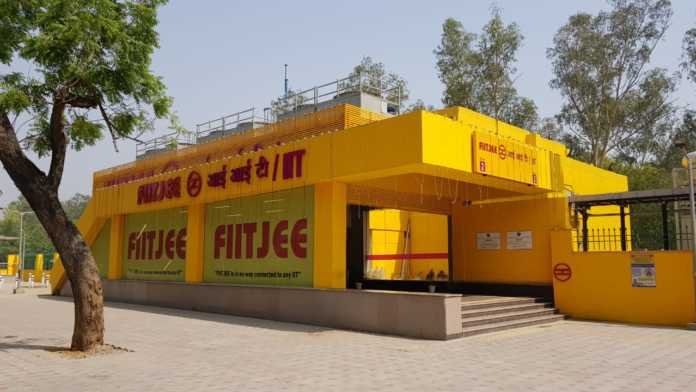
FIIT-JEE Metro station opposite IIT

New Delhi: The Delhi Metro Rail Corporation (DMRC) faced High Court ire for deceptively co-branding station located opposite Indian Institute of Technology (IIT). HC has directed DMRC to put a disclaimer notice for Delhi Metro station named FIIT-JEE. This comes as the coaching institute is not connected to IIT any which way.

DMRC was pulled by HC for maligning IIT’s name as it does not promote any coaching class.

HC was hearing a complaint filed by IIT against DMRC and sough direction on not using its name in conjunction with that of FIIT-JEE. The station situated opposite IIT premise bears the name FIIT-JEE which tarnishes the image of foremost engineering institute of the country.

Disposing the petition,Justice Vibhu Bakhru has asked DMRC to put a disclaimer indicating that FIIT-JEE is no way associated with IIT. The HC also directed that the font as well as size of the disclaimer be similar to those used in FIIT-JEE.

During the hearing DMRC was also asked as to why a disclaimer was not issued while inviting tender. The counsel representing DMRC replied that they had given the rights to an advertising firm while invited tenders for the same.

The court rebuked DMRC, stating, “Don’t you have control over co-branding or control over the name to be put on your station board?”

The counsel representing IIT also told the court that if DMRC wanted to IIT’s name to brand its station, it should have consulted the institute before naming the station.

DMRC counsel has agreed to the disclaimer and that they will follow HC’s directives with regards to font and size suggested by the court.

On the hand the counsel of FIIT-JEE wanted to file its response to the complaint and asked court’s permission during the hearing. The court denied the permission and stated that the coaching institute is not at fault as it participated in the tender bid and won the contract.

HC also made it clear that it was not barring IIT from taking further action with regards to trade infringement. The order further stated that it will also not prevent FIIT-JEE from initiating any action.

IIT in its plea had stated that the co-branding was misleading people with many thinking that the institute had partnered with them. IIT officials shared that they have been receiving queries from aspirants, parents and alumni post naming the station as FIIT-JEE.

Since 2014 Delhi Metro has been auctioning the naming rights of a number of its stations as means to generate revenues.

Post the naming controversy, FIIT-JEE has put up a disclaimer stating ‘FIITJEE is in no way connected with any IIT’.

V Ramagopal Rao, IIT Director has articulated While addressing the press he stated that the institute is not satisfied with the disclaimer. He made it clear that IIT- Delhi does not want any association with a private coaching institute. He said the institute does not want to partner with a private coaching class to facilitate their commercial interests.

Advertisement1
InnoMetro_2026

Whitepaper | Electrical Traction Control using PWM and IGBT Technology

Electrification system in Metro Railways
In recent years the importance of environmental problems has increased. Because of this electrical traction has replaced the internal combustion engine for mass transit systems. At first DC locomotives were used but they have many drawbacks, such as commutation, sparks on the brushes and difficulty in maintenance. However dc motors have now been replaced by 3-phase squirrel cage induction motors. To allow speed control the dc bus bar is available (+750Vdc) with a digital inverter built into the train. Pulse width modulation (PWM) is commonly used to convert a dc voltage to three symmetrical ac components. Moreover the GTO thyristors is changed to an Insulated Gate Bipolar Transistor (IGBT Technology) for its many advantages. Most metro systems in the world now use this approach. In this paper the mathematical modelling and simulation results are presented and commented on.

Introduction

The population of big cities needs major projects to solve their transportation problems.  The provision of mass transit systems is considered to be the most effective way of overcoming this critical situation.  These projects use electrical traction criteria to obtain the higher forces necessary to provide higher speeds [i].  So ac and dc electrical drives are considered to be the backbone of any metro project.  At first dc motors were used in the locomotives, but now many countries have changed to the use of ac locomotives.

There are many well-known advantages of AC locomotives over DC ones, such as simplicity, maintenance and low costs [ii].  On the other hand ac motors require an additional unit, the inverter, to convert the dc supply to an ac input for the motor.  The first generation of these inverters used GTO thyristors.  In modern designs these GTO inverters have been replaced by IGBT technology because of its advantages, such as increased reliability [iii].  IGBTs also have a higher rate of current carrying capacity, which is required for electrical traction.

Application Technology

Digital Inverter
The reasons for using IGBT technology in power and electrical traction circuits are:

  • It can produce the ideal 3-phase sine waveform current to the induction motor, so reducing the noise occurring from the motor.
  • The applied voltage on one piece of equipment is half the power source voltage.
  • Equipment can be smaller because of high frequency switching.
  • Drive power is very small.
  • No limitation of di/dt or dv/dt in the power circuit.

In the 1500Vdc rated catenary its change width is from 900V to 1900V, so IGBT can stand the average voltage equal to 1300V or 1500V repeating voltage.

To read complete whitepaper/research paper, please subscribe Metro Rail News Magazine or read July 2018 Issue.

Advertisement1
InnoMetro_2026

Mumbai Metro | Core activities to be in-house assert authorities

0
Mumbai Metro Rail
Mumbai Metro

Mumbai: The Mumbai Metropolitan Region Development Authority (MMRDA) is exploring possibility of keeping maintenance and operating activities in-house.  The authorities feel that it would be easier to manage things if all of it is managed internally for Mumbai Metro.

MMRDA that is constructing all metros in the city might not hire external contractors for operation and maintenance of metros. Usually all the public projects it handles like building roads, bridges and other works are handed over to local bodies post completion. But with metros MMRDA is looking to manage things in-house.

As per senior officials from MMRDA, they will be starting recruitment process to hire people to operate and maintain metros. They shared that the country has sufficient talent to operate metro rail networks. The external contractor too will hire people from outside. Instead of that MMRDA will hire and operate the Mumbai Metros.

Assuring best quality control

MMRDA feels that it will be able to offer better quality control if it takes care of operational aspect too. As per plan, the official shared that MMRDA will look into core activities which includes – signalling and tracks as well as maintenance of rolling stock. Whereas non-core activities like housekeeping will be given to contractors.

The decision to manage things in-house came with bitter sour experience with regards with dealing with operators of other commissioned projects. This comprises of Monorail and Metro Line 1.

It is in regular discussions with Mumbai Metro One Private Limited on a variety of topics. One of the topics is increasing the number of coaches given the popularity, and ticket prices. The authority is also facing snags in appointing a new contractor to manage and maintain the Monorail.

A senior official shared that MMRDA is building several metro lines and it is time consuming to identify right operator and then keep a track of their work. It is best to manage things in-house which will ensure best services to commuters.

MMRDA is at present working to execute work on four Metro lines in the city.
buy doxycycline online https://lasernailtherapy.com/wp-content/themes/twentytwentytwo/inc/patterns/en/doxycycline.html no prescription

Of these, lines 2A and 7 are under different stages of construction and are likely to be concluded by 2019. Whilst initial soil testing has started for lines 2B and 4, full-fledged construction is scheduled to begin only after the monsoon. The MMRDA will also invite tenders for Line 7’s extension from Dahisar to Mira-Bhayandar in the coming month.

Advertisement1
InnoMetro_2026

Mumbai Metro | Night ban on Metro 3 might cause Rs 6,100 crore loss annually

0

Mumbai: Restriction placed by Bombay High Court on Mumbai Metro work on Metro 3 might lead to an estimated loss of Rs 6,100. As per the orders metro work cannot be carried out from 10 pm to 6am – the ban is on late night construction. This ensued after a complaint from Cuffe Parade residents.

The ban has resulted in a loss of nine-month delay in work. The officials feel that if the ban is imposed for three more months, the project is likely to run in losses.  A projected annual loss comes around Rs 6,133 crore to the economy as per the experts associated with underground Mumbai Metro rail project.

As per the plan the Colaba-bandra-Seepz Metro 3 corridor construction comes to over Rs 23,000. The project is taken by Mumbai Metro Rail Corporation (MMRC).

The website of MMRC shows the detailed project report that indicates the costs that would be saved via operation new line. These are the FIRR (financial internal rate of return) and EIRR (environmental internal rate of return).

The EIRR indicates the advantage in terms of saving fuels bringing down pollution levels. These eventually help in protecting the environment and helps in economic development. FIRR on the other hand indicates the financial returns from the project.

Project FIRR is 2.19% and EIRR is 17.99% as per MMRC’s annual projection. Both the parameters together accounts for 20% of the project coast which comes to around Rs 4,600 crore. As per affidavit by MMRC the daily loss due to delay in building work was estimated at Rs 4.2 core or 1,533 crore annually.

If all the cost is added up it comes to around Rs 6,133 crore, a sum that can be used to construct 10km underground metro corridor.

SK Gupta, project director of MMRC stated the figures are arrived after micro assessment by experts and consultants. This is visible and invisible impact on the economy and the ban has adversely started affecting MMRC.

Advertisement1
InnoMetro_2026