New Delhi: Prime Minister Narendra Modi has flagged-off the Delhi-Faridabad Metro Line that would allow hassle free travel for around two lakh daily commuters between the national capital and the industrial hub in Haryana.
The extension of the Delhi Metro connects Badarpur to Escorts Mujesar in Faridabad.
The total cost of the project from Badarpur to Escorts Mujesar is nearly Rs. 2,500 crore. Out of this, Rs. 1,557 crore was borne by the Haryana Government, the Centre contributed Rs. 537 crore, while the Delhi Metro provided Rs. 400 crore.
All these are elevated and located on either side of the Delhi-Mathura Road (NH-2).
“The nine-station metro corridor which was 95 per cent indigenously built will provide people a safe, affordable, quick, comfortable, reliable, environment-friendly and sustainable transport facility,” a Haryana government spokesperson said.
Haryana Chief Minister ML Khattar, addressing a press conference on Saturday, had thanked the Prime Minister for “gifting” the Metro service which would take the city to “another level of progress” with better connectivity with other NCR towns.
He had also said that the Prime Minister would be announcing the go-ahead for connecting Gurgaon with Faridabad by Metro.
Station naming rights pushing up Delhi metro income
DELHI (Metro Rail News): The Delhi Metro Rail Corporation network expanding vastly over the last two years. the growing number of stations increase in non-fare revenue. Auctioning of semi-naming rights of many stations boosting the non-fare revenue of corporation.
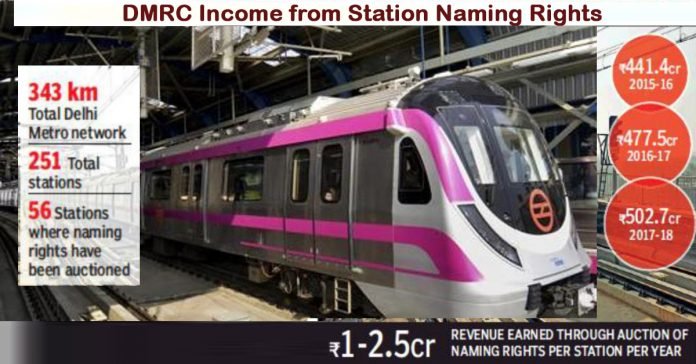
Mr. Mangu Singh, MD of DMRC Said that non-fare revenue has been going up in the last few years mainly because DMRC has been expanding its network as apart of the Phase III project. The entire metro network currently stands at 343 km with 251 stations Excluding the Noida-Greater Noida section, which is also built by DMRC
DMRC revealed in a reply to an RTI application that it earned Rs 441.4 crore in non-fare box revenue in the financial year 2015- 16, Rs 477.5 crore in 2016-17 and Rs 502.7 crore in 2017-18. The figures for the financial year 2018-19 are not yet available
“Naming right has been quite successful,” an exuberant Singh told TOI in a recent interview. “On average, we get around Rs 1 crore per station per year while some stations give almost Rs 2.5 crore per year, which is really good,” Said Mr. Singh.
“Apart from generating direct revenue through auctioning off naming rights, it also has added benefits. At most stations, the undertakings that have bought the naming right, also do the branding of the stations with colors associated with the respective companies”. Said MD, DMRC. this adds to the aesthetic of the station he added.
DMRC doesn’t have to worry about maintaining it as the company maintaining the exterior of the stations.
“We save on maintenance of these structures and also lighting and other aspects. It’s a good thing,” he said.
The revenue earned is fully used to pay back the loan taken from the Japan International Cooperation Agency (JICA) he added.
DMRC started auctioning naming rights of select stations to companies and public sector undertakings from 2014, which has been helping it in generating substantial revenue. In the last five years, DMRC has auctioned naming rights for a total of 56 stations across NCR.
According to the sources, The policies in Haryana and Uttar Pradesh are not very restrictive regarding the branding of stations.
KOCHI (Metro Rail News): The Kochi Metro Rail Ltd (KMRL) has initiated steps to set up an Advanced Metro Village, Which will elevate Kakkanad to the status of a major satellite city of Kochi. To generate non-ticketing revenue, KMRL had mooted the idea of setting up an ‘Advanced Metro Village’ at Kakkanad four years ago.
The company has floated tender inviting global agencies to prepare a concept plan and DPR (detailed project report) for the project. According to The plan is to set up a modernized and advanced entertainment zone in the 17 acres of KMRL land in Kakkanad. The zone will be similar to Times Square at Kuala Lumpur.
Berjaya Time Squares Theme Park: Malaysia’s Largest Indoor Theme Park.
According to the plans a hotel, condominium, indoor amusement park, shopping center planned by KMRL. It will be a huge facility which requires crores of rupees. “The detailed estimate will be drawn out after the preparation of a DPR for which the tender has been floated now,” official Said.
Image for representation purpose | Image copyright: Respective Authority
New Delhi (Metro Rail News): Bharatiya Janata Party (BJP), ruling party in center, is promising a High-Speed Bullet Train corridor between Kanyakumari and Chennai through its general poll manifesto and raising hopes of better connectivity for the people but the National High-Speed Rail Corporation Limited (NHSRCL) which is executing India’s first bullet train project between Mumbai and Ahmedabad, is missing several deadlines in land acquisitions for the bullet train project. The Government has set a deadline for December 2018 to clear the land acquisition roadblock.
Around 1,414 hectares land needed for the Rs 1.1 lakh crore Mumbai – Ahmedabad High-Speed Rail Corridor for which land required from 11 districts of Maharashtra. Palghar district will give the most around 280 hectares but less than a tenth has been acquired till date.
Although, the NHSRCL has already missed the December 2018 deadline for land acquisition whereas the project is scheduled to be completed by 2023.
Around 140 km north of the Mumbai, in Dehane village of Dahanu block of the district, around 40 people of the Warli tribe gather to articulate their resistance to the project. Rupesh Rawte, a 42-year-old farmer who has 1.5 acres, asks why they should give up their land for a train that is not for them. He said that we will only be looking at it as it passes by. It is not going to stop for us and we can’t afford it.
The villages in the area are mostly populated by the Warlis, who depend on paddy cultivation. Dahanu is better known for its sapota orchards.
“Around a third of the requisite land has been acquired. The NHSRCL has completed measurement surveys in 40 of the 79 villages in the district” said Sushma Gaur, Spokesperson of NHSRCL
She said that Lack of trust based on certain experiences and misconceptions about the project adversely affected the land acquisition process initially. Now, with the help of the district administration, people are coming forward and are participating in the land acquisition process. The acquisition is based on consent and is fair and transparent.
But her statement does not match with the ground reality. Pascal Dongalkar, a resident of Uplat village in Talasri, another administrative block about a half-hour drive from Dehane, said that there is no way they can get any land. The gram sabhas have opposed it. buy acyclovir online https://healthcoachmichelle.com/wp-content/themes/twentytwentyone/inc/en/acyclovir.html no prescription
Besides the bullet train, land acquisition for the Mumbai-Vadodara expressway will also be a factor in the election. BJP’s assurance of ST status to Dhangar community has also angered the Warlis as it would eat into the share of communities that are already in the ST category.
Kuala Lumpur-Singapore High Speed Rail (HSR) project
Kuala Lumpur (Metro Rail News): MyHSR Corporation Sdn Bhd (MyHSR Corp) to appoint a Technical Advisory Consultant (TAC)to review cost reduction options for the suspended Kuala Lumpur-Singapore High-Speed Rail (KL-SG HSR) project.
On April 8, 2019, MyHSR Corp Said in a statement, “An open tender to appoint the consultant, who will review the technical aspects of its recommended option for the project following its revision by the Malaysian Government,” Which was set up in 2015 to undertake the development and implementation of the railway line.
KL-SG HSR Project Route map
“The TAC will review and validate the proposed infrastructure assets within Malaysia, such as alignment, stations, and High-speed rail (HSR) maintenance facilities to validate the recommendation.
“This review is expected to include on-the-ground data collection activities such as topography survey data, soil investigation and ground condition assessments,” said the group
MyHSR Corp Chief executive officer (CEO) Datuk Mohd Nur Ismal Mohamed Kamal
MyHSR Corp Chief executive officer (CEO) Datuk Mohd Nur Ismal Mohamed Kamal said the group’s search for a TAC marks a significant development before the end of the project’s construction suspension ends on May 31, 2020.
“This tender marks an important step forward before the end of the suspension period in May 2020. We encourage all firms with the relevant experience to participate in this tender as the findings of this review will help us chart the right course for this project,” He Said.
Due to the suspension, MyHSR Corp has pushed back the commencement of the project service to Jan 1, 2031, from the initial Dec 31, 2026.
The HSR is one of a few Government mega projects launched by the previous Barisan Nasional (BN) Government that are currently subject to reviews by the current Pakatan Harapan (PH) Government over-inflated costs.
For more details about the tender documents and participation procedure, please write to editor@metrorailnews.in
Mumbai (Metro Rail News): The consortium of Mumbai Monorail operators, namely L&T and Scomi Engineering (LTSE) has alleged that the Mumbai Metropolitan Region Development Authority (MMRDA) does not have the expertise over monorail technology to operate it.
L&T and Scomi Engineering (LTSE), whose contract was terminated by MMRDA in December 2018 alleged that by terminating their contract and taking over commercial operations of Mumbai Monorail, MMRDA has put the safety of the public and the overall system at high risk. stated in the email written to MMRDA by the senior LTSE official.
Although, Mr. Murthy, Chief Operating Officer (COO) of Mumbai Monorail at MMRDA told, “They must have drafted, I don’t remember seeing such letter.” However, MMRDA did not deny receiving the same.
The MMRDA on December 14, 2018, had terminated the contract of LTSE citing non-performance. However, LTSE in a December 28, 2018, communication to MMRDA claimed that MMRDA’s decision may derail the commercial operations of the second phase between Wadala and Mahalaxmi since the authority does not have technical expertise.
The communication email sent by LTSE to MMRDA reads: “Considering MMRDA’s lack of expertise in operating and maintaining Monorail technology and its refusal to partake in a smooth takeover, it is inconceivable as to how the termination of a contract is in the larger public interest. We reiterate that by the action of this premature and abrupt termination of the contract, the complete Monorail system and its operations and maintenance has been put at risk.”
The MMRDA while terminating the contract had cited a host of issues, including ‘persistently disregarding instructions’, failure to start the second phase and failure to supply the balance five trains. Currently, 10 trains are in India of which only four are functional. The second phase of monorail got operational on March 4, 2019 while the first phase between Chembur and Wadala was operational in February 2014. The latter was in news for frequent breakdowns and technical glitches.
The consortium has also blamed MMRDA for the poor financial condition. LTSE’s letter states: “It is also a matter of record that repeated breaches of the contract by the employer (MMRDA), including refusal to nominate arbitral panel for adjudication of disputes on multiple occasions, have constrained contractor to take legal proceedings.”
The consortium has claimed that the amount of around Rs 1,800 crore under dispute that has been denied by MMRDA has actually impacted the financial capability of contractor LTSE to infuse funds on its own to make the system functional.
Delhi (Metro Rail News): The Delhi Metro Rail Corporation (DMRC) Phase-III project is over, a small section still remains unfinished and It will be completed by October 2019.
Although the first section of the 5.4km Grey Line of Delhi Metro under phase III, between Dwarka and Dhansa Stand, is scheduled to open in September 2019, the extension of this corridor to Dhansa Stand will only be completed by October 2019
The Delhi Metro network, after the completion of Phase III, stands at 343 kms with 251 stations. Excluding the Noida-Greater Noida section, which too was built by DMRC.
“The Grey Line was not part of the original Phase III project and was added much later,” a DMRC official explained.
The 4.2 km long Grey line of Delhi Metro connect Dwarka to Najafgarh out of which 2.7 km is elevated while the rest underground. There are a total of three stations on this stretch, Dwarka and Nangli are elevated while Najafgarh is an underground station.
“The progress of civil works on this section is over 93%,” a DMRC spokesperson said. “The line is targeted for completion by September 2019,” he added
In sync with most of the new corridors constructed by the DMRC, Grey Line, too, will have standard gauge tracks. Work on this corridor started in October 2017 when the Letter of Acceptance was awarded.
While the Dwarka-Najafgarh section will open to public first, the next section to be opened will be the corridors extension to Dhansa Stand, which is expected to be 1.2km in length and will be an entirely underground section. Dhansa Stand is the only station on this stretch
DMRC used two different methods For the construction of the underground corridor from Najafgarh to Dhansa stand, While 700 metres of the tunnel is being constructed by using the Tunnel Boring Machine (TBM), the remaining 290 metres will be constructed by the cut-and-cover method. Excavation work for the stretch where the cut-and-cover method will be used is expected to begin soon.
“Lowering of the Tunnel Boring Machine on the up line was done in January 2019. The tunneling work on both the up and down line is expected to be completed by October 2019. Over a hundred rings have already been installed as part of the tunneling work,” DMRC spokesperson said.
DMRC faced Heavy traffic on the stretch between Najafgarh and Dhansa Stand was a major challenge while carrying out the construction work, He added.
According to sources, the two primary reasons behind the project getting delayed were land acquisition and carrying out construction work in densely populated areas.
The Dwarka to Najafgarh section of Delhi Metro was first approved in May 2017 and work on the section was expected to be completed by April 2019, which was later revised to June 2019.
“In fact, the area between Najafgarh and Dhansa is so densely populated that a decision was later taken to make the stretch underground,” a DMRC official said.
Ahmedabad (Metro Rail News): The 6.5-km stretch (Vastral-Apparel Park) of Phase-I (41 km) of the Ahmedabad Metro Rail project being flagged off by Prime Minister Narendra Modi on March 4, 2019.
Union Cabinet approves the 28.2-km-long Phase-II of the project connecting the twin cities of Ahmedabad and Gandhinagar a few weeks earlier. It has taken four years for the Ahmedabad Metro network to be launched for public operatiob since the ground-breaking ceremony for the project was performed in March 2015.
The 69-km network would not only boost connectivity in the Ahmedabad-Gandhinagar urban region but also ease traffic woes for over 60 lakh people, especially in the highly congested areas. The Rs 16,000-crore Metro project is expected to be fully operational by 2024.
The Japan International Cooperation Agency (JICA) has extended a soft loan of Rs 6,066 crore for the project. This project is Funded by the Government of India and the Government of Gujarat on a 50:50 share basis and the project is being executed by the Gujarat Metro Rail Corporation Ltd (GMRC).
“Work on the Rs 10,773-crore Phase-I is in full swing. buy kamagra soft online https://lasernailtherapy.com/wp-content/themes/twentytwentytwo/inc/patterns/en/kamagra-soft.html no prescription
It comprises two corridors. The North-South Corridor from Agriculture Produce Market Committee (APMC) to Motera will cover 18.87 km, while the 21.16-km East-West Corridor will connect Vastral station in the east to Thaltej in western Ahmedabad. We are looking to complete Phase-I by July, 2020.” Said Mr. Amit Gupta, Chief GM, GMRC.
To purchase 96 Metro bogies (chair cars) , an order has been placed with Hyundai Rotem which would cost Rs 1,770 crore. The electrification work for Phase-I is being done by Siemens at an estimated cost of Rs 600 crore. Phase-II of the project would cost around Rs 5,500 crore, He added.
It would connect Motera station in Ahmedabad to Mahatma Mandir, the venue for the Vibrant Gujarat Global Summit, the biennial event for trade and investment organised by the Gujarat government since 2003.
The Gandhinagar Railway Station is the part of center station’s redevelopment programme which is a stone’s throw from Mahatma Mandir. The 2nd phase of the project would also connect Mahatma Mandir to the Gujarat International Finance Tec (GIFT) City. according to the blueprint, the entire network would have 54 stations, of which 32 would be in Phase-I and 22, in Phase-II.
In 2003 it was conceptualized and faced several hurdles till now. Gujarat was the second state in the country to propose a Metro network after the successful execution of the Delhi Metro rail project. While the Gujarat Infrastructure Development Board (GIDB) had engaged the Delhi Metro Rail Corporation (DMRC) for a feasibility study in 2004, fund constraints saw the project being put on the back burner by the then Narendra Modi government in the state.
In 2009, GIDB commissioned DMRC once again to prepare a detailed project report (DPR), with an SPV being formed to implement the project a year later. Construction work started in 2015 after the new Modi government at the Centre accorded the project necessary approvals.
A senior official of the state urban development department says, “besides providing its residents safe, efficient and environment-friendly connectivity, it would regulate urban expansion, allowing the urban authorities to use land for sustainable development.” while the Highlighting the benefits for Ahmedabad-Gandhinagar from a Metro network,
The Avishkar Hyperloop team from IIT-Madras wants to be on top of the hyperloop game.
Chennai, Metro Rail News: Avishkar Hyperloop is the student team of IIT Madras, doing indigenous design and development for building the First ever Self Propelled, Completely Autonomous Hyperloop Pod of India and also spearheading country’s attempt at SpaceX Hyperloop Pod competition 2019 with a goal to develop the fastest hyperloop pod ever built and win the competition. The team works with a vision to develop technologies for Future Mode of high speed transportation with its applications in various prominent fields including Defence, Logistics and Aerospace Industry. The team has built a prototype hyperloop pod that would take just 25 minutes to travel from Chennai to Bengaluru, is the only team from Asia to qualify for the International Hyperloop Pod Competition organised by Elon Musk’s Space X.
Almost 1,600 teams participated in the first round of the contest. Several rounds later, only 22 teams – 21 of them from the US and Europe – were shortlisted for the final. Last year, the Avishkar Hyperloop team qualified only for the preliminary design round as one of the 47 teams of the total 1,500 competing teams.
Hyperloop involves a sealed tube or system of tubes that allows a pod to travel without air resistance or friction, transporting people or freight objects at high speeds. Avishkar Hyperloop, founded and headed by Suyash Singh, claims their pod is likely to achieve 400 to 450 kmph during the finals to be held in July 2019.
Ankit Kukudia, who is the co-head the Avishkar Hyperloop team, along with Vinith Sharma, at the Centre for Innovation (CFI) at IIT-Madras, says,
“Considering the difficulty of the design round and the complexity involved in Hyperloop implementation, it is a really great achievement to be able to qualify for the final round in the second attempt.”
He adds, “We kept the design as basic as possible and put in a lot of work on the parts to reduce weight and increase the achievable top speed.”
Racing against the best
Elon Musk’s SpaceX runs the Hyperloop Pod Competition to design and build high-speed hyperloop pods. Open to student and non-student teams from across the world, it aims to test a subscale prototype transport vehicle. Teams that qualify for the final round will compete in the company’s hyperloop tunnel (one mile long and with an outer diameter of six feet), purpose-built for the competition at its Hawthorne, California, headquarters. The pod that clocks the highest speed will be declared the winner.
A graphic illustration of the hyperloop
SpaceX had announced the competition in 2015; three editions have been run so far – in January and August 2017 and July 2018. WARR Hyperloop, from the Technical University of Munich, won the competition in August 2017, clocking 323 km per hour, and again in July 2018 with a speed of 467 km per hour.
Explaining the technical details, Ankit says, “Our design was based on propulsion via linear induction motor and passive levitation using permanent magnets. It had a degree of credibility to it, which was liked by SpaceX.”
However, the design proved to be challenging for the team. “We are going with electric propulsion using DC motors,” Ankit says. “We are targeting speeds higher than 400 km this year within a distance of 1 km,” he explains.
Inspired by Elon Musk
The team’s founder, Suyash Singh, was inspired by Elon Musk and that sparked the idea of hyperloop technology for India in him. Ankit Kukudia and Vinit Sharma joined Suyash’s efforts. The team has now grown to a 30-people strong team, with members ranging from freshman graduates to PhD scholars. All team heads are post-graduates.
Ankit says, “Our team was basically made to lay the foundation for an indigenously developed hyperloop system for India.” Some members, including Suyash, Ankit, Vinit, Avinash Kumar, Denil Chawda, Nitin Srikar, Rakshit Bhatt, Kalpesh Pawar, and Anshul Singh, have been a part of the team from inception. The team is mentored by Professor Satya Chakravarthy, NCCRD Co-ordinator, IIT-Madras; Ravi Santhanam, an IIT-Madras alumnus; and Professor Boby George, CFI Advisor, IIT-Madras.
The pod in development.
Team Avishkar aims to develop India’s first self-propelled autonomous hyperloop pod and has been raising money through crowdsourcing on Ketto. Ankit says the team has “a larger vision” for the project. “Laying the foundation for an indigenously developed hyperloop system for India will take a few years; only after that, will it be tested on the tracks. We believe the team has a long way to go and we expect the student team to be involved till the hyperloop competition is held,” he says.
Speaking about where the project is headed, Ankit explains that the current intent is to work for two years and clock the highest speed possible. The team is also simultaneously working to incorporate a magnetic levitation in the pod and is making efforts to perfect that technology. Once a good speed is achieved, the team will work on optimising the payload and adjusting to the operating conditions before the pod can be tested on the live track, which is being built as well. “This may take five or more years,” Ankit says. The team plans to convert this project into a startup once it reaches the stage of commercialisation.
“Of course, it won’t be easy from the competition point of view since SpaceX wants us to improve on our previous design. But we are more than determined to not let our achievements end with this. We want to step up our game, keep developing, and winning the competition over the years,” Ankit says.
Hyderabad, Metro Rail News: Kalvakuntla Taraka Rama Rao popularly known as K.T.R, Former municipal administration minister said on April 5, 2019, Now the government is focusing on to de-congest Hyderabad city and expand it, especially in the East.
“We are saying ‘Look East’ now and it is intended to develop the IT sector in that region too and areas beyond Uppal and LB Nagar would be developed as part of that plan”, He Said.
The development work will be towards Pocharam, Medchal, Keesara, Shameerpet, and other sides. KTR said land registration rates would also be rationalised in different places.
He Said “One of the biggest initiatives of the state government would be to provide conclusive rights of title ownership to land owners“.
This would be the first time in the country that something of this nature would be taken by chief minister K Chandrasekhar Rao.
He explained that officials will necessarily check what type of land it is and if there is clarity on ownership at the time of land mutation and would proceed with the registration.
“If this were to be challenged later, it would be the government’s responsibility to defend the landowner and his rights,” he added.
KTR said something like this in Hyderabad and urban areas would be immensely helpful. The entire land in the state will also be GIS mapped.
While Addressing a meeting of builders, the TRS president said there was a long plan to construct metro rail along the entire 160km stretch of outer ring road. He said the government would also come up with subsidies for developing townships.
Out of the 72km metro rail planned in the city, 56km has been completed. The rest of it would be completed within a year.
“Centre govenment gave Rs 18,000 cr for Mumbai Metro but hardly anything to us,” he said
Explaining how chief minister KCR was interested in rooting out corruption, he had seen a twitter message to him recently about a person who brought to his notice about bribes being demanded by officials for registration of his land at Yadagirigutta
“I happened to meet the chief minister and mentioned this with him during an informal meeting that was taking place. The CM immediately asked me for the person’s telephone number and spoke to him for half an hour asking him the details and explained to him what he intended to do for bringing clarity in land records,” KTR said.
In the face of it, Gurneet Kaur seems intimidating. You only have to glance at her educational accomplishments. With an undergraduate degree in physics from St Stephen’s College, Delhi, Gurneet, 36, did her master’s in physics from IIT-Delhi. Finishing her Ph.D. in electromagnetic design in Germany, she then moved to the US and was a postdoctoral associate at the Massachusetts Institute of Technology (MIT).
But when you speak to her, her humility belies her considerable feats, which include being the only Indian woman engineer on Virgin Hyperloop One’s ambitious project for India.
Gurneet is Manager, Product, Systems Engineering, at Virgin Hyperloop One (VHO), helping develop the Hyperloop product portfolio and converting technology into customer solutions. Virgin Hyperloop One consortium’s hyperloop route will link central Pune and Mumbai in under 30 minutes, enabling more than 150 million passenger journeys annually. The Hyperloop concept, a form of transport introduced by Elon Musk in 2013, envisions transporting people at airline speed but at a more affordable cost.
Big her portfolio and responsibilities may be, but over a video call with HerStory from her office in Los Angeles, Gurneet exuded smiles, warmth, and calm confidence.
Gurneet’s story
Originally from Delhi, Gurneet was a school topper. And topping the board exams gave her a confidence boost to pursue greater ambitions.
“I was not particularly a genius. But I was very hardworking and persistent. Once I set my mind on something, I was very determined,” she tells YourStory media.
Gurneet leads a team of 12 people across LA, Dubai, and India.
Gurneet was drawn to science since childhood. Although engineering would have been the natural choice for anyone of her caliber, she was attracted to physics, which she calls “solid science”.
After her postgraduate studies, Gurneet took an off-track decision, unlike most of her fellow IITians, and chose to pursue a Ph.D. to get out of her comfort zone.
From India to Germany
The year 2006 brought with it a full scholarship for Ph.D. at Stuttgart University in Germany. While her family was worried since Gurneet had never even been outside India before, she was itching to explore the world and gain new perspectives. Her family gradually came around, even though no one in the family pursued science (her father was in economics, her mother a homemaker, and her siblings were into finance).
“My family was supportive eventually, even though they did not understand what I was doing. When I show them pictures of the lab, all they would ask was if it is safe. But they did not force me to come back home,” Gurneet says.
The German way of life
Around that time, the Indian community in Germany was burgeoning, and there was a community of students from India there on exchange programmes and internships. Gurneet was set on making the best of her time there, even when things did not get off to a smooth beginning.
Working on the project
She did not know the language, the education system was vastly different from the way things are done in India, and there were cultural differences to contend with as well. But Gurneet soldiered on. “I knew I was not going to go back because of teething problems. Once I settled down, I worked hard and took language courses to pick up German. My schedule was flexible enough to travel and understand the world better,” she says.
And the German way of life taught her many hard lessons. “I was not used to people saying no openly; we tend to help more to be polite in India. But now I appreciate it. It makes for easier conversations. But I never encountered racism in Germany. Thankfully, my colleagues were very supportive, and I never felt out of place. When I visited India a year later, I was a different person,” Gurneet adds.
The move to the US
Once she got her Ph.D., it was time for Gurneet to take the next big decision – either return to India, which offered minimal opportunities at the time, or move to an English-speaking country, and gain more exposure.
Around that time, she got married to Chiranjeev Kalra, who was working in the US. Immigration to the US in 2010 was easier than it is today. When the world-renowned MIT offered an opportunity for research, Gurneet did not think again. For two years at MIT, she investigated quantum information transport using experimental magnetic resonance techniques.
Gurneet explains, “Quantum computation is an approach that uses principles from quantum mechanics (superposition and entanglement) to perform operations on data much more quickly and efficiently than our present day ‘classical’ computers. Quantum computers take advantage of the fact that particles can exist in more than one state at a time. Instead of storing information as bits (on/off state), quantum computation uses qubits that can be both on and off simultaneously, enabling them to perform millions of calculations at the same moment. It is an active field of research pursued by the world’s most influential companies such as IBM and Google and many governments.”
Later on, Gurneet worked at Philips Healthcare in NewYork, as a design engineer for superconducting magnets for MRI systems.
Joining Virgin Hyperloop One (VHO)
In 2016, she moved to VHO as a product engineer.
“When I moved from New York to Los Angeles three years ago, VHO was one of the most exciting startups in LA. Having grown up in Delhi in the 90s, I had experienced firsthand the positive impact mass transportation modes (Delhi Metro in this case) could have on a common man. I immediately recognised the potential Hyperloop technology holds in improving people’s lives and the cities they live in. I knew I had to be part of this game-changing venture,” she recollects.
(In February 2018, VHO and PMRDA signed a landmark agreement to develop the project. In November 2018, following a Detailed Feasibility Study Report and a visit to VHO’s full-scale prototype, the government declared the Pune- Mumbai Hyperloop Project as a public infrastructure project with international consortium DP World and VHO as the Original Project Proponent.)
Gurneet at the VHO office in LA.
At VHO, Gurneet says five to 10 percent of her colleagues are from the Indian diaspora.
Gurneet is part of a team of 12 at Hyperloop, which brings all the tech together and integrates it for products’ requirement. The team is spread across India and Dubai as well, making web conferences a part of Gurneet’s daily routine.
Women in tech
When asked about her views on the miniscule number of women in tech, Gurneet points to the mindset problem.
“The social structure is unfavourable for women to join the workforce in India. But it will change over time, and has to begin at the microlevel. It starts with children growing up in a home where equality exists between the mother and father. If mother works and father stays at home to take care of kids, children learn equality.”
Recently, Gurneet’s team at VHO conducted a science workshop for girls in the five to 10 age group, to take the concept of Hyperloop to the masses. Gurneet says she was quite pleased at their curiosity and questions after a panel discussion on women engineers.
According to her, this is a generational change, and we are headed in the right direction. “Most parents are worried for their daughters’ safety at the workplace. They are reluctant to let the girls travel for the same reason. But this is slowly changing.” She adds that retaining women talent will not be hard for companies if women employees are allowed flexible work hours.
“Sometimes, even after six months’ maternity leave, you are not mentally ready to work for eight hours. As a mother, I go through this too. Balancing is an everyday job. It is always at the back of my head – am I not focusing enough on my family? Am I not focusing on my work? But I wanted to follow my dreams and be a role model to my children,” she says. Gurneet has a one-year-old daughter, Ishnoor, and a five-year-old son, Rabtej.
Gurneet says all women striking a work-life balance and changing status quo are her role models.
Change for India
From the US work culture, Gurneet has learned that openness, honesty, and trust can go a long way in keeping and growing talent. “At VHO, they never question the request for leave or working from home. They treat people as people, not just workers. There is a great gender ratio and diversity here, which attracts more talent.” She hopes that India will adopt such practices too.
“Gurneet also recommends changes in the Indian educational system. “We need hands-on training and our curriculum could do with some tweaking. Especially in science, experience matters the most. Grading should not be about problem solving and mugging up for exams. Emphasis should be on understanding concepts, not full attendance in course work,” she adds.
Gurneet has high hopes and great plans for India. With the kind of traffic congestion our metro cities face, Gurneet’s work at Hyperloop is believed to have the potential to change the way we live. The project entails construction of a 117.5 km corridor connecting Mumbai and Pune with an option to connect to the future Navi Mumbai International Airport.
“For the urban workforce, saving even 20 minutes during their daily commute is a big deal; working moms can save time now,” Gurneet says.