New Delhi: Prime Minister Narendra Modi has flagged-off the Delhi-Faridabad Metro Line that would allow hassle free travel for around two lakh daily commuters between the national capital and the industrial hub in Haryana.
The extension of the Delhi Metro connects Badarpur to Escorts Mujesar in Faridabad.
The total cost of the project from Badarpur to Escorts Mujesar is nearly Rs. 2,500 crore. Out of this, Rs. 1,557 crore was borne by the Haryana Government, the Centre contributed Rs. 537 crore, while the Delhi Metro provided Rs. 400 crore.
All these are elevated and located on either side of the Delhi-Mathura Road (NH-2).
“The nine-station metro corridor which was 95 per cent indigenously built will provide people a safe, affordable, quick, comfortable, reliable, environment-friendly and sustainable transport facility,” a Haryana government spokesperson said.
Haryana Chief Minister ML Khattar, addressing a press conference on Saturday, had thanked the Prime Minister for “gifting” the Metro service which would take the city to “another level of progress” with better connectivity with other NCR towns.
He had also said that the Prime Minister would be announcing the go-ahead for connecting Gurgaon with Faridabad by Metro.
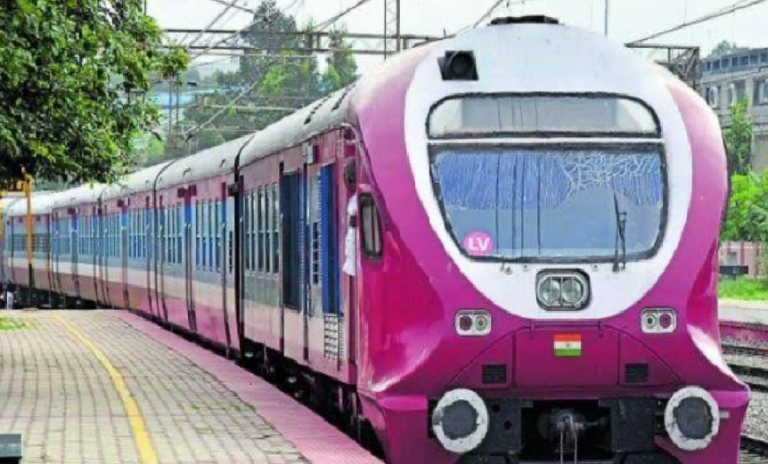
BENGALURU (Metro Rail News): The price structure of Bangaluru suburban rail network project will be based on the metro rail model, according to the 2020-21 Union Budget revealed on Saturday.
It means there won’t be a major difference between the ticket prices of Metro and suburban rail in Bengaluru, else in Mumbai and Chennai where rail reduce the price much less than Metro trips, according to a railway official. “The 148-km-long Bengaluru suburban transport project, with a cost of Rs 18,600 crore, will have fares on the Metro model. The finance minister Nirmala Sitharaman announced in Parliament that central government will provide 20% of the equity and help outer assistance of up to 60% of the project cost,”.
However, the cost of the Bengaluru suburban rail project has already increased by 1,600 crores. Still, Bengaluru suburban rail project is yet to take shape and facing repeated planning delays. The former Finance Minister Arun Jaitley had mentioned Rs 1,7000 crore as the price of developing a 160 km suburban rail network in 2018-19 budget.
The ‘Pink Book’ of Indian Railway 2018-19 which follows the budget proposals and list funding for projects, had mentioned allocation of only Rs 1 crore for the year of the Bengaluru suburban rail. After the document is tabled in parliament next week, most probably Feb 5th this allocation will be known. In 2019-20 Pink Book, the amount was Rs 10 crore. It’s been 37 years of telling that transport experts and Bengalureans who have been tracking the project were not impressed by the budget announcement but there had been little progress on the ground.
In July 2019, RITES, a government undertaking, submitted a revised detailed project report of including four corridors: KSR Bengaluru City Devanahalli, Byappanahalli-Chikkabanavara, Kengeri-Cantonment-Whitefield, and Heelalige-Rajanukunte to the railway. The number of suburban stations was decreased to 53 from 82 introduced earlier, and the length of the network was also revised from 161km to 148km. They will be executed through a special purpose vehicle called Karnataka Rail Infrastructure Development Enterprises, or K-RIDE. The final cabinet note is yet to be processed by the finance ministry. In November 2019, the Railway Board began the project. Once that happens, it will be placed before the Cabinet Committee on Economic Affairs.
It is likely to be the country’s first modern suburban train system, the network that rail planners have envisioned in Bengaluru. its stations will be going to have a different modern look than traditional stations as well as offering more facilities. There will be automated fare collection gates for smart card-based cashless travel. Fifty-three air-conditioned trains, with automated double-leaf sliding doors, will be deployed in the first phase. Railway sources said the minimum fare could be Rs 13 for less than 3km. In Chennai and Mumbai, a train trip for the same distance costs Rs 5 currently. “For a 15-km trip, the fare will be Rs 35 as against Rs 45 in Metro,” an official said.
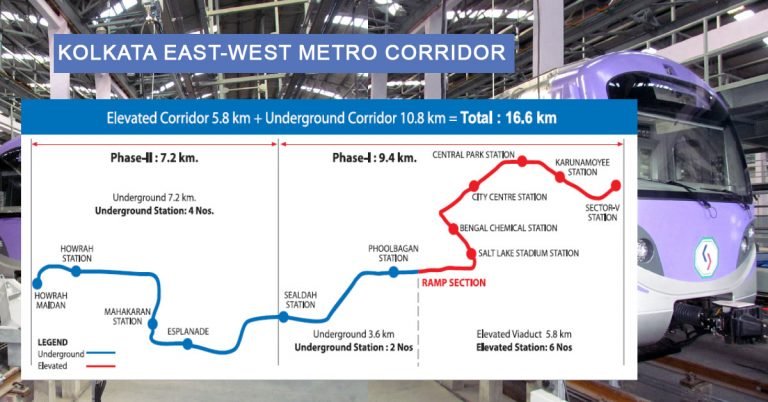
KOLKATA (Metro Rail News): The East-West Metro is all set to begin its journey on February 13, 2020, after the inauguration the distance between Information Technolgy hub of Sector-V in Salt Lake City to the Yuva Bharati Krirangan Stadium will be reduced, a Kolkata Metro official said on Monday. The construction of the East-West Metro, scheduled to cover a stretch of 16.6 kilometres, has been delayed owing to an aquifer burst at Bowbazar in central Kolkata in August 2019 during tunnel boring work.
The inaugural service of East-West Metro will start from February 13,” a Metro spokesperson said. As stated in the report, the necessary safety trials have been done in various areas like railway tracks, power cables and railway stations along with others for this operation. The shortened services of 5 km from Sector V to the stadium is likely to provide some relief to office goers and students of various educational institutes as well as different locations of the area.
The Kolkata East-West Metro, for connecting two cities of Kolkata and Howrah, expected to be completed by June 2021. However, its completion is likely to be delayed by up to one year due to an accident caused by an aquifer burst in Bowbazar area during drilling operations on August 31 last year.
Due to the accident, the Tunnel boring for the East-West corridor was stopped and it would restart only when the Calcutta High Court gives its nod. It is said by the KMRC to a division bench presided by Chief justice TBN Radhakrishnan in early September in connection with a PIL against tunnelling work in the crowded area in the city.
Several buildings at Durga Pituri Lane and Syakra Para Lane in Bowbazar had collapsed or developed cracks after an aquifer broke during tunnel boring and water and silt gushed in, leading to severe ground subsidence in the vicinity.
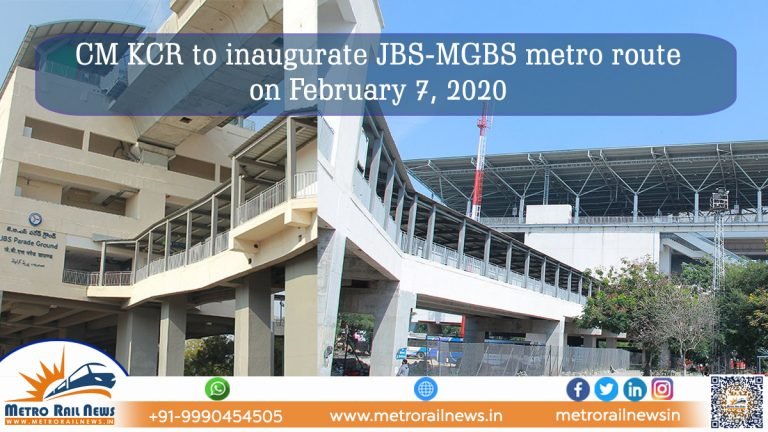
HYDERABAD (Metro Rail News): Chief Minister Telangana Shri K Chandrashekhar Rao (KCR) will flag off the much-awaited Metro Rail services on the Jubilee Bus Station (JBS) –Mahatma Gandhi Bus Station (MGBS) of Hyderabad Metro on Friday at 4 pm. This will be an extension of the public transportation facility for passengers shuttling between the north and south ends of the city.
With services on the LB Nagar-Miyapur and Nagole-Raidurg corridors, Hyderabad Metro already extends east and west connectivity in the city, another 11 km of Metro network will be added to the existing 58 km with the launch of commercial operations on the JBS-MGBS route. The 69-km network signals the completion of Phase I of the Metro project in the city.
Municipal Administration and Urban Development Minister KT Rama Rao tweeted “Chief Minister K Chandrashekhar Rao will inaugurate the JBS-MGBS Metro line on February 7 at 4 pm.”
Hon’ble CM Sri KCR Garu will inaugurate the JBS-MGBS Metro ? line on 7th Feb at 4pm
This will take the total length of Hyderabad Metro Rail to 69 KM @ltmhyd@hmrgov
The Commissioner of Metro Rail Safety (CMRS) had issued the mandatory safety certificate for the route last month. JBS-MGBS section is part of the JBS-Falaknuma corridor and has nine stations — JBS-Parade Grounds, Secunderabad West, Gandhi Hospital, Musheerabad, RTC Crossroads, Chikkadpally, Narayanguda, Sultan Bazaar and MGBS.
All the technical specifications and safety standards, especially dummy passenger evacuation tests and degraded mode operation tests etc., were completed as Hyderabad Metro Rail has been conducting trial runs for the last 45 days.
The emphasis was on signalling and safe train separation tests, brake test by the signalling and train control system, OHE-Rolling stock (Metro coaches) current collection tests, and passenger information announcements and display tests. buy amitriptyline generic buynoprescriptionrxonline.net/amitriptyline.html over the counter
Currently, over four lakh passengers are travelling daily on the other two corridors. Every day, about 780 trips are being operated, covering 18,000 km, with the punctuality of 99.8 per cent.
DELHI (Metro Rail News): The Delhi Metro Rail Corporation (DMRC) has released the admit card of recruitment exams 2020 for Executive and Non-executive Posts on Jan 3, 2020. The admit card 2020 is available online for 1492 executive and non- executive posts on DMRC official website wwww.delhimetrorail.com. All the candidates who have applied for Delhi Metro Recruitment 2020 can download the Admit Card from the official website.
Delhi Metro Recruitment 2020 Exam Date and Time
The Computer-based test (CBT) based DMRC recruitment exams will be conducted from February 17 to 26, 2020.
DMRC Assistant Manager & JE Exam
Candidates should note that the DMRC Assistant Manager Exam for Regular Executive will be held on February 17, 18, 19, 20, 21 and 26, 2020. The exam for Contract basis will be held on 17, 19, 23 and 26 February 2020. DMRC JE Exam for Regular Executive will be held on 17, 18, 19 and 20 February 2020 and for Contract basis will be conducted on 23 and 26 February 2020.
DMRC CRA and Asstt./CC Exam
DMRC CRA Exam is scheduled to be held on 17, 18 and 19 February 2020. The exam for the post of Asstt./CC and Architect Assistant will be held on 20 February, for Fire Inspector and Architect Assistant (Regular) post on 21 February, for Legal Assistant, Office Assistant, Stenographer and Stores Assistant on 23 February and for Assistant Programmer and Account Assistant on 26 February 2020.
The exam will be conducted in 3 shifts from 8:30 AM, 11:45 AM and 4:00 PM from 17 to 21 Feb and from 8:30 AM, 12:15 PM and 4:00 PM on 23 and 26 Feb.
The selection of candidates will be done on the basis of Computer-based test (CBT) and medical examination. While some of the posts may require other qualification stages, including Group discussion, personal interview and skill test.
All the candidates who don’t receive their admit cards should directly contact the DMRC.
The official notification from DMRC reads, “Non-Receipt of E-Admit Cards/Discrepancies, if any in E-Admit Card should be reported to DMRC Toll Free Help Desk No: 022-68202777, Email: dmrchelpdesk2019@gmail.com for addressing grievances.”
In December 2019 The Delhi Metro Rail Corporation Limited (DMRC), a joint venture of Government of India and Government of Delhi has started the registration process for the recruitment of 1492 regular and contractual Executive and Non-Executive Posts.
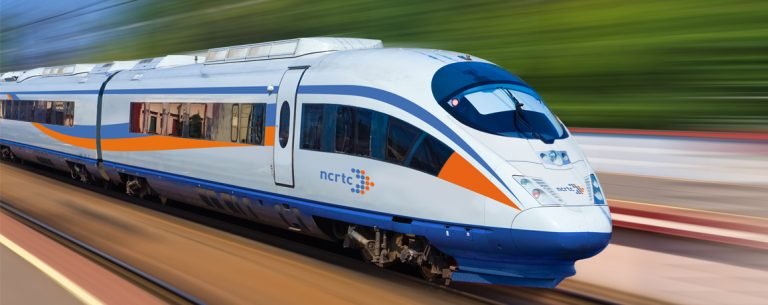
New Delhi, India (Metro Rail News): Finance Minister Nirmala Sitharaman on Saturday presented the second Union Budget of the Modi 2.0 government. In a major boost in regional connectivity in the Delhi-NCR, She allocated Rs 2,487 crore to the Regional Rapid Transit System (RRTS) projects in the Budget 2020-21. A total of Rs 20,000 crore has been allocated for Mass Rapid Transit System projects, which includes all the metro projects across the country and the RRTS project. NCRTC gets Rs 2,487 crores separately from union budget 2020-21. buy sildalis online https://www.adentalcare.com/wp-content/themes/medicare/editor-buttons/images/en/sildalis.html no prescription
Delhi Metro Rail Corporation, which has started work on its Phase IV project didn’t get any funds separately.
According to the source, Centre has provided a consolidated allocation for all metro projects and DMRC would ask for funds as per its requirement from the Union housing and urban affairs ministry, which is the nodal authority for all metro projects. three have been prioritised for implementation in Phase-I of the eight identified RRTS corridors to connect various NCR towns by the planning commission-appointed task force.
NCRTC official said that these include the Delhi-Ghaziabad-Meerut corridor, Delhi-Gurgaon-Alwar corridor and Delhi-Panipat corridor. “Civil construction of the 82-km Delhi-Meerut corridor is in full swing and piling and pier works are being done on the 17km priority section between Sahibabad to Duhai” he further added.
NEW DELHI (Metro Rail News): The country’s Finance Minister Nirmala Sitharaman has presented the Union Budget 2020-21 for the financial year 2020-21. In this budget, the Finance Minister has made many big announcements for the Indian Railways, Starting from the merger of the railway budget with the general budget in 2017. The Finance Minister said that the railway’s revenue is very low, so the land of the railway will be used to prepare solar energy. Also, 150 trains like Tejas will be run in the country.
Tejas trains will be connected to major tourist destinations of the country. According to the Finance Minister, by the year 2024, Indian Railways will be run completely by electricity. The Finance Minister did not say anything about the confirmed ticket. What did Railways get in this budget
Let us know that former Railway Minister Suresh Prabhu had said that everyone should get confirmed ticket by 2020 during his tenure. At the same time, Finance Minister Nirmala Sitharaman has said in her budget speech that PM Modi’s dream is to put more emphasis on making Indian Railways an economy’s growth engine.
The Finance Minister has said that Wi-Fi facilities have been made available at 550 railway stations in the country. Unmanned railway crossings have been completely eliminated. Also, 27 thousand kilometers of track will be electrified.
Let us know that while presenting the railway budget last year, Sitharaman gave the mantra of clean, safe and punctual rail travel. He said that now the Model Rental Law will be enacted and Public-Private Partnership (PPP) will be used in Railways. buy zithromax online https://pavg.net/wp-content/themes/twentytwentyone/inc/en/zithromax.html no prescription
The Finance Minister has said that crores of rupees will be required for the railway infrastructure. Therefore, participation in PPP mode will be increased in Railways.
Participation on PPP mode in Railways will be increased
In the General Budget 2020, the Modi government has suggested several measures to improve the infrastructure of Indian Railways. The Modi government has proposed the following 10 measures, listing the achievements of the railways within 100 days.
Installing a large solar power capacity along rail tracks on land owned by railways
Four stations and 150 passenger trains will be operated through PPP mode
More trains like Tejas will be connected to the prestigious tourist destinations of the country.
The high-speed train will be actively run between Mumbai to Ahmedabad.
18, 600 crores, a 148 km long Bangalore suburban transport project will be started, whose fare will be like the metro model.
The central government will give 20 per cent fund and 60 per cent money will be raised from outside.
National Infrastructure Fund of 6-100 lakh crore to be created
A national gas grid will be launched
27 thousand kilometres of the track will be electrified
Provision of 22 thousand crores for power energy
Delhi-Mumbai and Chennai-Bengaluru Expressway will be completed soon.
NEW DELHI, India (Metro Rail News): Union Finance Minister Nirmala Sitharaman presented the Union Budget 2020-21 in the Parliament Today. In her budget speech, she highlighted the allocation of funds for various sectors to boost the struggling economy of the country.
There was a lot of expectation from the Metro & Rail industry that the Union Government will announce measures to revive the industry. Here is how Industry leaders from Metro & Railway sectors responded to it and shared their opinions.
Former Karnataka CM upbeat over Bengaluru railways development, Said:
Former Karnataka Chief Minister and BJP leader Sadananda Gowda thanked PM Modi and FM Nirmala Sitharaman for allocating Rs 18,600 crore in the Union Budget for the development of 140 km Bengaluru Suburban Railway Network
Karnataka BJP MP Tejaswi Surya lauded the government for announcing high-speed connectivity between Bengaluru and Chennai. He called it a great step in further enhancing the South Indian region’s prosperity.
“Mark my words: With Suburban, Metro and Road infra, Bengaluru will become the undisputed leader in industry & innovation,” added Surya in his tweet.
Accelerating India’s Progress’ is the common intent of the Government and Tata Projects Ltd. The Union Budget 2020 is positive since it has taken serious and concerted efforts towards creating an enabling environment that brings together public and private players thereby creating mutual synergies geared towards achieving national developmental objectives. More such initiatives towards ensuring better-tendering processes, quicker payment mechanism and lower-cost funds are needed to spur the infrastructure and construction sector but this is a good beginning. We are certain that the government will chalk-out more such positive initiatives in near future after consultation with all industry stakeholders.
Mr.Alain Spohr, Managing Director of Alstom India and South Asia, said:
“First budget of the decade had tremendous expectations and the finance minister has presented a well-laid roadmap to meet them. The focus on leveraging technology and boosting transport infrastructure coupled with worthy goals of reducing emissions are laudable. However, the government could have done more to promote localisation and Make in India.
“Creation of five smart cities and modernizing transport infrastructure with a Rs 1.7 lakh crore allocation are commendable. Plus, the progressive initiatives by the Railways of promoting solar energy, upgradation of railway stations, electrification of tracks and operating 150 Tejas-like trains through the PPP model are welcome steps. The Bengaluru suburban transport project and the high-speed train between Mumbai and Ahmedabad will improve connectivity between important commercial hubs. All these initiatives taken together will improve opportunities for all”, he added.
Spohr said that domestic manufacturers can contribute massively to all these big-ticket projects envisaged by the government. But companies which have invested heavily to align with Make in India need a level playing field to counter import-oriented competition to contribute to nation-building.
“The government’s intent to reward innovation, investments, and entrepreneurship is in the right direction. But the key is speedy execution of projects where localisation and domestic manufacturing are given more encouragement”, he further added.
Mr. Amit Kapur, Joint Managing Partner, J. Sagar Associates, said:
The past month has seen a significant alignment in 3 critical policy documents of the Union Government focussed on Infrastructure development. The Budget seems to cement what the National Infra Pipeline (31st Dec 2019) announced – an investment target of Rs.103,00,000 crores (US$ 1.4 trillion) over 5 years with 78% projected to come from Union and State Governments. Around 58% of this is focussed on Energy and Transport and Logistics (roads, rail, ports and airports). Structural reforms (legislative, policy and contractual) are stated to be underway at the ministry levels. There is a stated focus on privatization and asset monetization of public sector assets, as also financial sector reform aimed at unclogging credit flows. If implemented well we can hope to see a shift from low productivity public assets to productivity-enhancing infrastructure, employment growth, boost to demand, easier business environment and higher competitiveness of Indian products.
“We will need to finance the growth in quick time and bring fundamental structural reforms to remove barriers to growth. How we realize the fruits of this ambitious infra push will depend on how effectively and efficiently India implements these announcements without allowing patchy state capacity and political economy overtake us. There is a need to build a quick bi-partisan national consensus around the economy cutting across the din unleashed by CAA and NRC related issues. I remain cautiously optimistic about the outcome”, he added
Manish Rathi, CEO and Co-founder, IntrCity by RailYatri “We welcome the focus and thrust on road transport with 1.7 trillion INR allocated towards the transport sector. The accelerated development of highways and Delhi – Mumbai expressway completion by 2023 will enable the growth of intercity bus travel. We see a wider industry focus and excitement in intercity transport due to the steps taken in Budget 2020. As a startup, it is encouraging to see the government take steps to encourage growth in the ecosystem. The removal of Direct Dividend Tax will attract more investors and in turn strengthen the ecosystem. The introduction of the Investment clearance cell at center and state level will encourage people in the remotest parts of the country to become entrepreneurs.”
Rajeev Joisar, Country Leader – India, Bombardier Transportation, Said
“Rail Budget has a strong focus on Safety and Passenger Experience“
We, at Bombardier, feel that reinforcement on public private partnerships (PPP) will gain momentum in the coming years in India resulting in faster development of railway infrastructure, including rolling stock. Setting up of Kisan rail through public private partnership will aid in ensuring efficient and safe railways in India.
We really appreciate the efforts of Indian Railways to explore the possibility of private train operation on their network. Bombardier is following the train operations project very closely and has already discussed the project with senior Indian Railway officials. It is too early at this stage to comment on our future course of action as we shall evaluate the project once tender specifications are finalised. We share Indian government’s vision to decongest India by rail investments with higher involvement of private sector in train operations as an initial project and outlining a safer railway system in India.
We are pleased with the allocation of funds from the Central government for the Bengaluru suburban rail system. Bombardier has been supplying our rail equipment for Mumbai and Kolkata suburban rail system and would be keen to supply our rolling stock, rail equipment and services to decongest the much-needed traffic in Bengaluru.
Bombardier has a strong focus on maintenance and services and we are pleased that the Indian Railways is stressing on digitalization, proven global technologies and move from manual inspection to machine assisted automatic identification which will help in providing safe, efficient and economical passenger and freight services.
Deployment of more passenger trains like Tejas on the Indian Railways highlights the commitment of Indian Railways and their focus on passenger comfort, safety, faster travel time and better connectivity to tourist destinations.
As Hon. Prime Minister Narendra Modi is looking to realise $5 trillion economy for India, Railways will play a crucial role in the growth of the economy and Bombardier is very keen to supply our rolling stock, signalling solutions, rail equipment and services to Indian Railways supporting his vision.
As our recent investments demonstrate, Bombardier is committed to the development of rail transportation in India, where we have built capabilities for around 60 years covering complete range of railway vehicle manufacturing, local engineering, strategic supplier base with around 2000 skilled employees delivering rail projects for domestic and foreign markets.
More reactions of Union Budget 2020 to from Industry Experts to be added soon
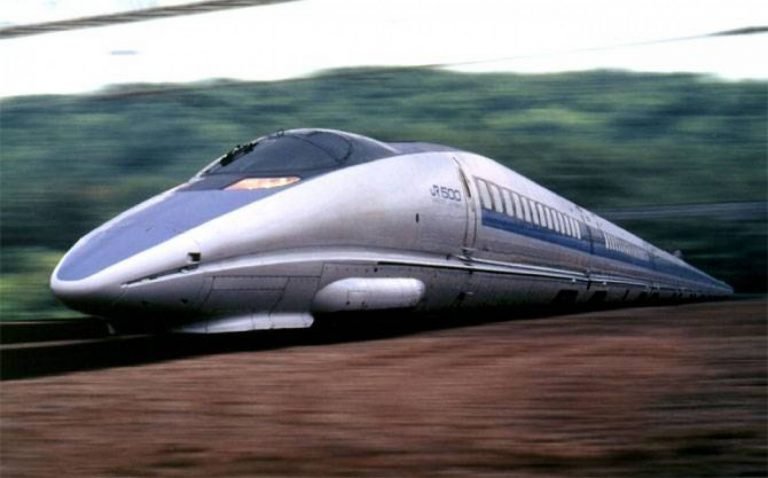
DELHI (Metro Rail News):Railway Board Chairman V K Yadav informed that the Indian Railways has identified six corridors for high speed and semi-high speed rail corridors on Wednesday. The detailed project report (DPR) of these six corridors will be completed within a year. These new corridors will join the under-construction Mumbai-Ahmedabad high-speed route.
Indian Railway identified six high-speed rail corridors are below
Delhi-Noida-Agra-Lucknow-Varanasi (865 Km)
Delhi-Jaipur-Udaipur-Ahmedabad (886) sections.
Mumbai-Nashik-Nagpur (753 km)
Mumbai-Pune-Hyderabad (711 km)
Chennai-Bangalore-Mysore (435 km)
Delhi-Chandigarh-Ludhiana-Jalandhar-Amritsar (459 km)
High-Speed Trains can run at a maximum speed of over 300 km/hr on a high-speed corridor, while on a semi-high speed corridor, the maximum speed can go beyond 160km/hr.
“We have identified these six corridors and their detailed project reports (DPR) will be prepared within the year. The DPR will study the feasibility of these routes which includes land availability, alignment and a study of the traffic potential there. After these things are studied, we will decide if they will be high-speed or semi-high speed corridors,” said Yadav.
Speaking on the status of bullet train land acquisition Mr Yadav Said that 90 per cent land acquisition work will be completed in the next six months.
“We need 1,380 hectare of land for the project. 1,005 hectare was private land of which we have acquired 471 hectares. 149 hectare was state government land of which we have got 119 hectares. buy vilitra online https://lasernailtherapy.com/wp-content/themes/twentytwentytwo/inc/patterns/en/vilitra.html no prescription
The remaining is 128 hectare which is railway land which has been given to the high-speed corporation,” he said.
Yadav also said that five bids for civil engineering work which includes track work and tunnels will be opened in March and finalised within six to eight months thence.
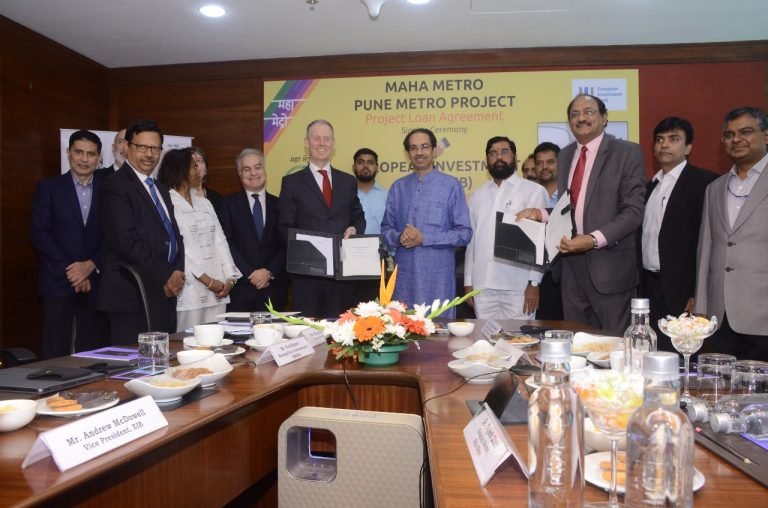
MUMBAI (Metro Rail News): The Maharashtra Metro Rail Corporation (Maha-Metro) signed a loan agreement of Rs 1,600 crore (Euro 200m) with European Investment Bank (EIB) on January 31, 2020, at Mumbai to fund Pune metro project.
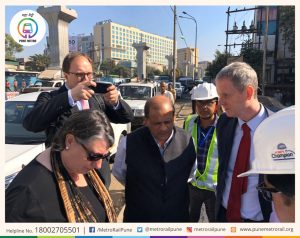
Andrew McDowell, vice-president, EIB and Team Visited Pune Metro Reach 3 on Jan 30, 2020
A team of EIB officials, led by Andrew McDowell, vice-president, EIB, even conducted a site inspection of the metro work progress in the city on Thursday.
The project agreement for disbursement of the first tranche of Euro 200m (Rs.1600 crs) from EIB, has been signed between Dr Brijesh Dixit M.D. Maha Metro and Mr. Mr Andrew McDowell, Vice President of EIB in the august presence of Hon. Uddhav Thackery C.M. Maharashtra & Hon Eknath Shinde, Minister Urban Development, GOM and Mr Ugo Astuto, Ambassador, Europian Union in India. Maha metro officials Mr Ramnath, Mr Sivamathan, Mr Hemant Sonawane and EIB officials were present on the occasion.
Maha Metro MD Dr. Brijesh Dixit Signed Rs. 1600 Crore Loan agreement with Mr. Mr Andrew McDowell, Vice President, EIB at Mumbai on Jan 31, 2020
On this occasion, Hon CM said this loan will be immensely helpful in speeding Pune metro project. Pune metro project will change the transport scenario of Pune city. Hon CM requested to the EIB official for continual partnership and funding of Nashik metro project and other infrastructure and green project in Maharashtra.
The funds from EIB would be utilized to finance civil works including the Underground section and depot works. The tenure of the loan is 20 years with 4-year moratorium and 16 year repayment period. The interest rate is floating and linked to Euribor.
The Pune Metro Project is a mega infrastructure project being executed by Maha Metro (50:50 JV of GOI & GOM) adhering to the best practices of quality, safety and sensitivity to the environment. Maha Metro has put in place a process defined quality assurance plan wherein there is Zero defect tolerance – thereby addressing the highest standard of quality in all respects. The intent of Maha Metro is to deliver to the citizens of Pune & Pimpri Chinchwad, a Metro Rail system of International Standard which is safe, reliable, easily accessible, comfortable, environmental friendly, energy-efficient and affordable.
The company was incorporated on 18th February 2015 and was given the task of Nagpur Metro Rail Project covering a route length of 38 km over 38 stations. The company has subsequently been reconstituted as Maharashtra Metro Rail Corporation on 23rd January 2017 and is currently executing the Pune Metro Rail Project, covering a route length of 32.5 kms with 30 stations. Estimated project cost is INR. 11,420 Crs.
The total debt funding envisaged for the project was Rs.5831crs. Maha Metro with the support of GOI (Govt of India), MoUHA(Ministry of Housing and Urban Affairs) & GOM( Govt of Maharashtra) has been able to achieve financial closure of the project by roping in two large bilateral/multilateral agencies AFD France and European Investment Bank headquartered at Luxemburg to co-finance the debt of the project.
The Physical Progress of Pune Metro is 37 %, while the financial progress is about 29.53%.
MUMBAI (Metro Rail News): Mumbaikar’s will be able to commute through Metro trains from one end to the other end of the city within 60 minutes as the Mumbai Metropolitan Region Development Authority (MMRDA) plans to complete its entire Metro Rail network of 337 km by 2026.
At present the MMRDA has undertaken 180km of Metro work on nine different corridors. Mr. R A Rajeev, Commissioner, MMRDA Said
The daily ridership across 14 Metro corridors (225 stations) will touch 1.3 crore per day by 2026 when all routes are commissioned. You can reach anywhere in the Mumbai metropolitan region from any place within 60 minutes by Metro
There are 1.9 crore commuters daily, of whom 43% travel by local trains. This could translate into the ‘super-dense crush load’ congestion of 12-18 persons per sq m on the local’s trains being reduced to the international norm of 6 persons per sq m.
He said that at present, railways (WR, CR) has a combined ridership of 80 lakh, BEST 34 lakh, and autos-taxi less than 10 lakh riders. The carrying capacity of the completed Metro network will be more than the existing load of Mumbai suburban trains.
Mr. Rajeev is being called ‘Modern Infra-Man’ as he is overseeing some of the most ambitious infrastructure projects in the country i.e. The Mumbai Trans Harbour Link (MTHL) from Sewri to Nhava-Sheva, The Multi-Modal Corridor, Integrated Ticketing System, and building of the Ambedkar Memorial.
The Metro network will reduce congestion on the roads too as more people will choose it over private vehicles and aggregator cabs. Now, the share of the population using public transport has dropped to 65.3%. Rajeev lamented that some of the arterial roads were choked mainly due to double parking and encroachment by shops, stalls or hawkers.
He pointed out that two lanes on LBS Marg remained unused due to encroachment and illegal parking and only one lane was operational in a single direction. Batting for dedicated bus lanes, he added: “There should be BRTS or dedicated bus corridors which should allow smooth passage to buses, especially those ferrying office commuters daily.”
“Metro rakes will run with six coaches, each capable of carrying 380 passengers. Every station will have a smart urban design, with 100m area underneath, left for share taxis, buses, electric cars/buses along with charging stations,” Said Rajeev, Returning to his favourite topic.
The stations will be designed to enable proper pedestrian movement and quick dispersal of people. “Slums in our influence area will be removed,” he added. Rajeev pointed out that MMRDA has changed from a planning body to an implementing body.
He is confident ridership in Mumbai’s Metro is guaranteed. “Ghatkopar-Versova is one of the busiest Metro lines in India. In all, 4.5 lakh persons use it daily. This year, we plan to inaugurate Metro lines 2A and 7. All-Metro routes are viable and not a single route is expected to run in losses,” he said