Home Blog Page 572

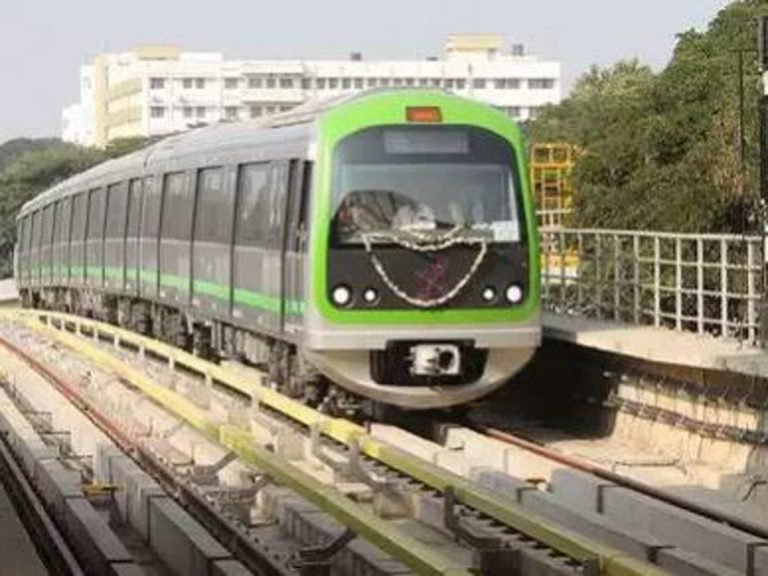
Kochi Metro to open Thykoodam-Petta Stretch, Trial run begins

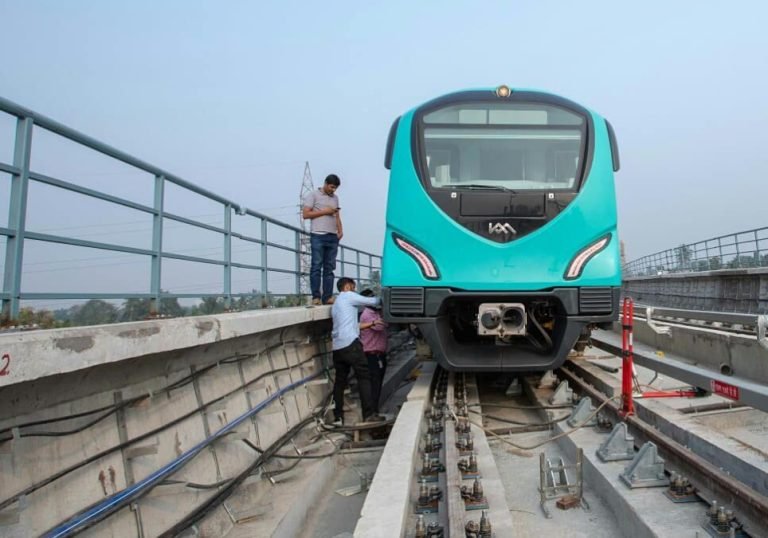
KOCHI (Metro Rail News): Kochi Metro Rail Ltd will stretch its service from Thaikkudam-Pettah. The trial run of the new facility conducted on Saturday. The KMRL authority informed that the inauguration of Pettah route is going to held on March last or April first week.

The trial run began from Thaikkudam at 7.40 am in the morning on Saturday. The officials examined the tracks and the functioning of the third rail, which generates power. At 8.20 am, the train departed from Pettah and reached Thaikkudam at 9.00 am.

Kochi Metro informed that inspections, including signalling and trial run, would continue in the coming days as well. The train took service at a speed of 5 km per hour on Saturday, and In the upcoming days, speed will be increased to 30 km/hr and 50 km/hr as part of the inspection. A load test will be carried out to monitor the capacity of the tracks.

Kochi Metro managing director Alkesh Kumar Sharma said that the first trial run was successful. Metro rail safety commissioner will also inspect the service,” 

 Representatives of Delhi Metro Rail Corporation (DMRC) who carried out the construction also took part in the inspection.

Though the works related to bridge and signalling were completed, works in the metro stations including laying tiles are pending.

The first phase of Kochi Metro to complete With the commencement of metro service in Pettah, the first phase of Kochi Metro will be completed. At present, Kochi Metro service is to be carried out from Aluva to Thaikkudam at a stretch of 23.65 km. There is 1.15 km distance between Thaikkudam and Pettah. With the launch of Petttah metro station, Kochi metro will have 22 stations.

Kochi Metro launched its first service from Aluva to Palarivattom on June 17, 2017. Later, the service was extended to Maharaja’s and Thaikkudam.

 KMRL is planning to extend the service to SN Junction and Thripunithura railway station in the second phase.

Chennai Metro allows a bicycle in trains

CHENNAI (Metro Rail News): In a first, Now commuters taking the Chennai Metro can bring their own bicycles on trains. The purpose of this move is encouraging people to use sustainable and eco-friendly transport, comes in the wake of many requests from passengers. But bicycles should be small and convenient.

As per the CMRL officials, many passengers have asked if they could take their bicycles in the Metro trains. This was however not allowed because of various reasons.

An official said, “We have been mulling the idea for sometimes, and have decided to let commuters take their bicycles in, as this will help many. Though we have provided cycles at several stations, some don’t use them because they have their own bicycles or due to other reasons.
buy apcalis oral jelly online https://calibudsman.com/wp-content/themes/twentytwentytwo/inc/patterns/en/apcalis-oral-jelly.html no prescription
Now they can just board from one station, get off at another, and cycle to their destination.”

Sources told commuters who take their bicycles would have to assure that their vehicles don’t utilise a lot of space or be a hindrance to the other passengers.

“Our request to commuters is to carry really compact bicycles or foldable ones and bring them safely, without causing any inconvenience to the other passengers,” stated an official.

Commuters were very happy about the decision. Swetha V, a resident of Alwarpet, said she used to took an auto to the Teynampet station, to head to Anna Nagar for work. “Every day, I spend nearly ₹50 on auto. I already own a cycle, and now I might as well cycle to the station,” she added.

Tirumala to get light rail transit system “Metrolite” Soon

HYDERABAD (Metro Rail News): Tirumala Tirupati Devasthanams chairperson Y V Subba Reddy met with NVS Reddy, The Managing Director of HMRL in Tirupati on Friday, where they addressed the possibility of a light rail transit system for the temple town to ease the traffic between twin ghat roads.

Reddy met the Dewasom board chairperson. The TTD chairman questioned if any rail-based transport solution could be devised for a journey from the foothills to the shrine.

When nothing concrete has appeared out of this informal meeting, the duo mulled over on whether a new line could be made across the hill or whether the existing 12-13 km long Ghat road could be used in setting up a rail system, as done in Hyderabad.

An official release from the TTD said that Mr Reddy suggested a light metro vehicle system for the terrain. It will help lakhs of devotees by reducing the travel time. Presently at least 1.5 lakh visitants visit the temple on any given day.
buy viagra generic myindianpharmacy.net over the counter

Namma Metro to run at 2-minutes frequency

BENGALURU, India (Metro Rail News): The three upcoming Namma Metro lines — Electronics City, IIMB and ORR-airport, the corridors to see trains running in every two minutes. Now passengers don’t have to wait long for another train. Credit goes to the advanced communications-based train control (CBTC) system.

During traffic hour frequency is 4 minutes and for non-traffic hours, it’s 10 minutes, in existing corridors. The distance-to-go signalling system is used at present, in which the minimum time between two trains is two-and-a-half minutes.

“The newer standalone lines like Electronics City, IIMB and ORR-airport are being designed for CBTC from the beginning,” BMRCL managing director Ajay Seth said.
Communications-based train control can train headway to less than 90 seconds.“The present signalling system can handle three minutes’ frequency. With CBTC, two-minute frequency is feasible, but reducing it to 1.5 minutes will require other operational improvements. Frequency doesn’t depend only on signalling, but also civil design, location of turn backs and length of underground sections,” he stated.

Bangalore Metro Rail Corporation Limited is also planning to upgrade the signalling system of the current Purple and Green lines. “The present systems are designed for 120-second frequency. Upgradation of existing lines will be necessary after 10 years once the ridership reaches 40,000 passengers per hour per direction (PPHPD). At present, it’s about 22,500,” Seth detailed.

It is stated by officials that repetition of trains will depend on actual requirement and Phase-2 platform lengths will be designed to accommodate only 6 car trains. The highest length will be 150 metres for elevated stations and 192m (platform and system rooms) for underground stations.

The state-of-the-art signalling system has already been implemented in new Metro systems in Kochi and Nagpur. Whereas RV Road-Bommasandra (Electronics City) line will be running by November 2021, the additional two corridors Gottige-Nagawara (IIMB) and Silk Board-KR Puram-Kempegowda International Airport (ORR-airport) will be operational by 2024.

“CBTC allows operation of trains without drivers but people are not ready to accept driverless trains. We have to instil confidence in passengers,” said an official. CBTC will assist maintain a safe distance between the trains with the help of sensors on the route and other systems.

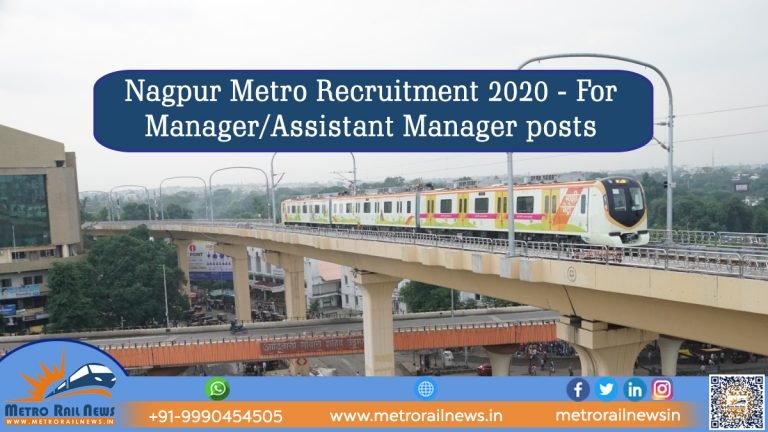
Nagpur Metro Recruitment 2020 – For Manager/Assistant Manager posts

NAGPUR, India (Metro Rail News): Maharashtra Metro Rail Corporation Limited (Maha Metro) invites applications from the qualified and experienced applicants for the position of Manager/Assistant Manager for Nagpur Metro Rail project on contract/deputation basis.

Read more about the eligibility guidelines specified below for the vacancy and eligible applicants can submit their application directly to Maha Metro. The last date to apply is 06-03-2020.

Nagpur Metro Recruitment 2020Details
 Job RoleManager/Assistant Manager
Education RequirementB.Tech/B.E
Total No. Vacancy5 Posts
Job LocationsNagpur
Age Limit40-35 Yrs
Experience5-10 yrs
Salary60,000 – 180000/Per Month
Posted on15-02-2020
Last date to Apply06-03-2020

Qualification Details:

1. Position: Manager(Work)- E2/ Assistant Manager (Work)-El (For NMRCL Project)
2. Qualification: Full-time B.E, B.Tech. in Electrical / Electronics /Electronics Telecommunication or equal discipline from a Govt. recognized Institute / University.
3. Minimum Experience (Post Qualification): At least 05 years’ of Executive / 05 yrs’ Supervisory experience in Operation Management in Metro Rail /Railways / Railway PSU’s / Metro Related Infrastructure Industries along with given;
i. The applicants having the experience in Metro Rail / Railway / Railway PSU’s: The applicants must be currently working in scale below in the IDA Pay Scale or CDA Pay Matrix with Level-IO / Level-08 (7th CPC) QR worked at least 03 yrs in the two-scale below in the IDA Pay Scale or CDA Pay Matrix with Level-08 / Level-07 (7th CPC), as on closing date.
ii. The applicants having the experience in Metro Related Infrastructure Industries: The applicants of Metro Related Infrastructure Industries, who have more than 05 yrs’ Executive / 05 yrs’ Supervisory experience in Operation Management and are drawing salary (CTC) of Rs. 1,00,000/- Rs. 80,000/-per Month (almost) are qualified to apply. The candidates either from ‘i’ or ‘ii’ should be well conversant with Train Operation, Maintenance, Training, Traffic works etc. of Railway / Metro Rail. Specific work Experience in Training of Operation Staff, Documentation for various statutory approvals, risk management is desirable. Professional Certifications of PMP, IAPM, CAPM or any other shall be included advantage.
4. Salary: The salary will be Rs. 60,000-180000 50,000-160000

Age Limit:

40 Yrs-35 Yrs

Pay-Scale

  • Manager: Rs 60,000-1,80,000 (IDA)
  • Assistant Manager: Rs 50,000-1,60,000 (IDA)

Selection Procedure

  • Shortlisted candidates will be called for Personal Interview followed by Medical Examination.
  • Preference will be given to candidates having experience from Railways, Metro Railways, Rail PSUs etc.

How to apply

Eligible and interested candidates can join by submitting their applications in prescribed format which can be downloaded from below.

Application Fee

Rs 400.00 for the unreserved (General & OBC) category. However, women and persons from SC/ST category are exempted.

Where to apply

To apply against vacancies under the Nagpur Metro Recruitment 2020, please submit your duly filled application form to the following authority by or before 6th March 2020.

The General Manager (HR)
Maharashtra Metro Rail Corporation
Metro Bhawan, Opp. Dr. Babasaheb Ambedkar College
Diksha Bhoomi, Vasant Nagar, Ramdas Peth,
Nagpur – 440010, Maharashtra

Click here to Download Application Form

To get jobs information from the other metro and railway projects, stay in touch with our Jobs Section.

State Govt allocates Rs 3,100 crore for Chennai Metro Phase 2 Project

CHENNAI, India (Metro Rail News): In a significant push to one of the Chennai’s most ambitious transport projects, the state has allocated 3,100 crores for 2020-21 for construction of Chennai Metro Rail Phase 2 Project spanning over 118.9km. The state government has also requested the Centre to approve funding for the project and provide 50% equity share capital as was done for Chennai Metro phase 1 project.
“In the budget for 2020-21, a sum of 3,100 crores has been allocated for the Chennai Metro Rail Project as share capital assistance, subordinate debt and pass-through loan assistance,” said Deputy CM and Finance Minister O Panneerselvam.

During the 2019-20 budget, the state allocated 2,681 crores for the phase-2 project as share capital and debt.

Funding from Japan International Co-operation Agency (JICA) has been obtained for a stretch of 52.01km from Madhavaram to Sholinganallur and from Madhavaram to Chennai Mofussil Bus Terminus (CMBT).
buy black cialis generic over the counter

Detailed designs are ready, and construction work on the project will begin shortly.

Financing from multilateral agencies including Asian Development Bank (ADB), Asian Infrastructure Investment Bank (AIIB) and New Development Bank is being firmed up for the remaining stretches of phase-2 from CMBT to Sholinganallur, Sholinganllur to SIPCOT, Siruseri and from Light House to Poonamallee bypass.

“Chennai now has a fully functional metro rail system. The reach of the Chennai Metro network must be extended further to get the benefits from it. Hence, the government accords high priority to the expeditious implementation of the three metro rail corridors of a total length of 118.9km, identified in phase-2 of the Chennai Metro Rail Project,” said Panneerselvam

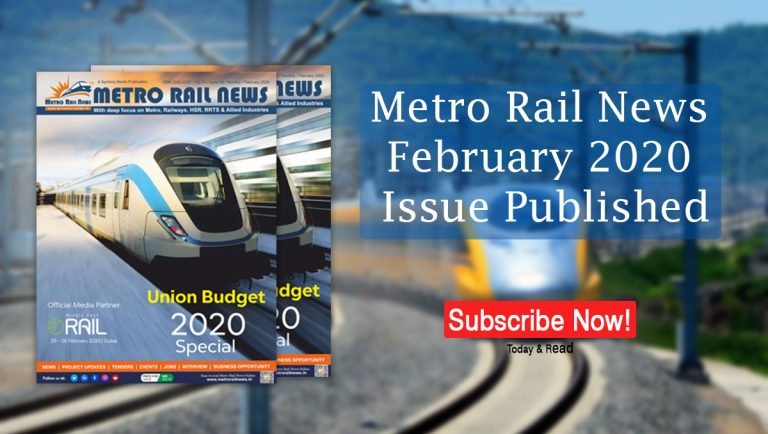
Metro Rail News Published Feb 2020: Union Budget Special issue

Dear Readers,

Metro Rail News published February 2020 – Union Budget Special issue, which will help you out to seeks the business opportunity in Metro and Railway Sector, Our February issue focuses on interesting topics such as an innovative idea for Metro & Rail in 2020 and also provides a cover story on Rail Industry Innovation Ideas for 2020. Union Budget 2020 Highlights and Industry Leaders Reaction. Mumbai Metro is chosen as our project of the month and exclusive Interviews of Shri Shri Vinod Kumar Yadav, Chairman, Railway Board, along with other regular columns such as new development in metro project, technology updates, Article, opinions, Awards, appointments, product watch, live tenders, Industry contract, upcoming events and current job openings.

Finance Minister Nirmala Sitharaman presented the most difficult budget of the decade on February 1, 2020, and This was for the second time that Sitharaman presented the Railway Budget along with Union Budget. Which brings more opportunity in Metro, Railway, RRTS and High-Speed Rail sector.

1.7 Lakh crore rupees to be provided for transport infrastructure in the coming financial year and Indian Railways to set up a Kisan rail for the transport of perishable goods. Centre will fund 20% of the 148 km Bengaluru Suburban Railway Network project, costing 18,600 crores with metro-like fares, will help raise 60% of the project cost.

In the next five years, 13.69 lakh crore would be invested on infrastructure for Railway Projects and target to achieve 11000 electrifications of Railway tracks. Station Redevelopment Projects and operation of 150 trains to be done under the PPP model. 550 Wi-Fi facilities to be installed at railway stations. National Logistics Policy will soon be released, creating a single-window e-logistics market.

To achieve higher export credit, a new scheme to be launched which provides higher insurance cover reduced premium for small exporters and simplified procedure for claim settlements. More TEJAS-type trains will connect iconic tourist destinations.

Large solar power capacity to installed alongside rail tracks, on land owned by Railways. High-speed train between Mumbai to Ahmedabad would be actively

To read the Metro Rail News February 2020 issue, kindly subscribe

Pune-Nashik Semi high-speed Rail corridor by 2024

MAHARASTRA (Metro Rail News): Maharashtra Railway Infrastructure Development Corporation (MRIDC) Seeking Approval from Railway board and Govt. of Maharashtra for Pune-Nashik semi high-speed train service, which aims to reduce the travel time between the two towns of Maharastra, will become a reality by 2024. Currently, the travel time among the two cities is around five hours.

Past week, the Central Railway gave its approval for the revised detailed project report (DPR) prepared by MRIDC. The agency will now ask approval from the Railway Board and Maharashtra government to begin work on the 231.716-kilometre double line.

The Maharashtra Rail Infrastructure Development Corporation Ltd (MRIDC also called MahaRail), a joint venture of the Maharashtra government and Ministry of Railways on 50:50 basis, will be executing the project.

The proposed train running speed will be 200 kmph and stop at a total of 24 stations — eight primary and sixteen small ones — crossing through the three districts of Pune, Ahmednagar and Nashik.
buy female viagra online no prescription

“The DPR for the ‘Greenfield Semi High-Speed Double Line Railway Network’ has received approval on February 10 from Central Railway. Now we are seeking formal approval from the state govt to start the construction between Pune and Nashik. Once, the approvals are granted by respective authorities, the project is estimated to be completed in 1,200 days from the date of financial closure,” Said MRIDC official.

The complete cost of the project has been pegged at about Rs 16,039 crore, of which Rs 3,208 crore is to be developed by both state and central govt’s, and the remaining cost will be borrowed from national and international agencies. The project will require the acquisition of about 1,300 hectares of land. Throughout the path of the route, the broadway double line will pass through 20 tunnels, which will have to be constructed.

“The semi-high speed trains will complete the Pune-Nashik journey within two hours. MRIDC has envisaged the coaching configuration of six rakes with a carrying capacity of 450 passengers per train… a total number of 48 trips made by six rakes in a day, for the initial phase, has been planned,” said an official.

The project target is to reduce the travel time between two rapidly growing cities of Maharashtra significantly along with act as a catalyst for the growth of the industrial corridor along the way by providing seamless connectivity to the industrial zones of Pune and Nashik such as Alandi, Chakan, Khed, Manchar, Narayangaon, Sinnar and Satpur.

“Apart from these MIDC areas, the proposed line will cater to another important special economic zone (SEZ), in Khed, Narayangaon and Manchar. This project will also benefit tourism and pilgrimage sites located on the Pune-Nashik corridor,” the official said.

This will be the first low-cost, semi high-speed railway corridor in the country. The project will also have other parts such as container depots along the rail corridor, a private freight terminal, dry port, a multimodel and commercial hub and warehouses at places suggested by local industries.

IRCTC to roll out Third Private Train Between Varanasi-Indore from Feb 20

New Delhi(Metro Rail News): The Indian Railway Catering and Tourism Corporation (IRCTC) is ready to introduce the third private train on the Varanasi-Indore route from February 20.

The Third private train named as the “Kashi Mahakal Express” will also have a night service, the PSU stated on Wednesday.

Another two private trains served by the IRCTC are the Lucknow-New Delhi Tejas and the Ahmedabad-Mumbai Tejas Expresses. Besides being a superfast air-conditioned train, the IRCTC has also prepared to offer tour packages covering the famous religious sites on the train’s route, a said by the IRCTC.

“Being the first long-distance overnight journey train, IRCTC has geared up to provided a host of facilities and services to passengers, including high-quality vegetarian food, onboard bedrolls and housekeeping services and onboard security services,” the statement read.

“Besides, every passenger travelling on the train will be covered with complimentary travel insurance of Rs 10 lakhs during the journey.” it is stated.

The booking for the train “Kashi Mahakal Express” can be made only on the IRCTC official website and also by its mobile application, ‘IRCTC Rail Connect’.

Moreover, the train will also have a pre-reservation period of 120 days with quotas reserved for general and foreign tourists.

The current booking facility will be open to the passengers at the station after the first reservation chart is ready, four hours to five minutes before scheduled departure. On top of that, passengers will also be automatically refunded the complete fare on cancellation of both waitlisted and confirmed e-tickets.

“The train will connect Jyotirlinga-Omkareshwar (near Indore), Mahakaleshwar (Ujjain) and Kashi Vishwanath (Varanasi), besides connecting the industrial and educational hub of Indore and Bhopal in Madhya Pradesh. The train will operate thrice a week between Varanasi and Indore via Ujjain, Sant Hiradnagar (Bhopal), Bina, Jhansi, Kanpur, Lucknow/Prayagraj and Sultanpur,” the IRCTC stated.

The tour packages will cover Kashi, Omkareshwar, Mahakaleshwar, Bhopal, Sanchi, Ujjain, Bhimbetka, Ayodhya and Prayag, as per the statement.

Nexus awards Stadler a contract worth 700 million pounds to deliver 42 metro trains

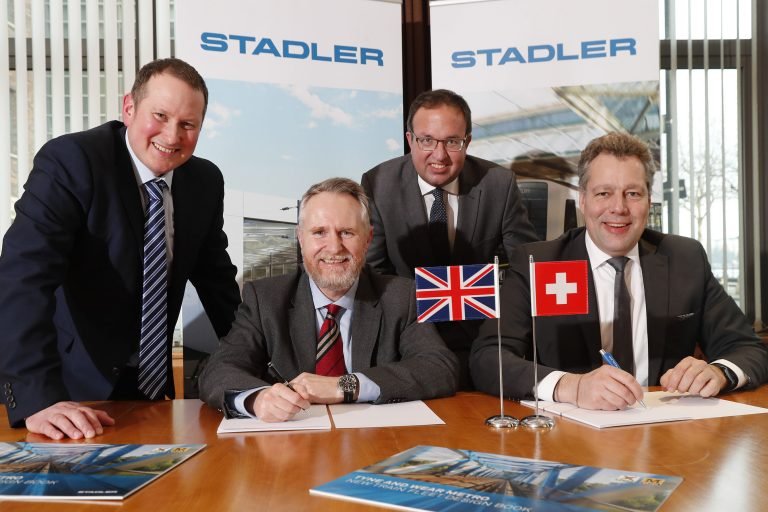
ENGLAND, United Kingdom (Metro Rail News): Nexus has declared that they have signed a deal with the Swiss train builder Stadler to produce the new train fleet for the Tyne and Wear Metro.

Stadler was announced as the producer for the new trains recently. However, now official thanks to the signing of this contract. The new trains will be delivered up to 2024 and will enhance comfort and reliability on the Metro Train.

The new upcoming trains will cut Metro’s high voltage power consumption by 30% while giving about 15 times better reliability than the current fleet. Modern features will provide benefit to the passengers that include wifi, charging points, AC and step-change inaccessibility. An automatic sliding step at each door of the new trains will make travel a breeze for wheelchair passengers along with people with children’s buggies, luggage or bicycles.

Stadler will produce 42 new trains, along with the option for ten more, build a new Metro maintenance depot and carry out 35 years of maintenance for the new fleet, and the deal is worth around 700 million pounds.

Works are scheduled to commence in 2023-2024 the new trains will completely replace the existing fleet. Stadler will work with local suppliers from the North-East of England to construct the new trains.

“The contract with Nexus represents an important milestone for Stadler in Great Britain. After Glasgow and Liverpool, this is the third metro operator to opt for a Stadler vehicle. We look forward to working with Nexus and our suppliers in the North East of England”, Ansgar Brockmeyer, sales director at Stadler, said.

“We have secured the best train builder in the world to make the new Metro fleet. It’s a historic moment in the proud 40-years history of the Tyne and Wears Metro service”, Director-General of Nexus, Tobyn Hughes, said.

“I am delighted that has now been made official with the signing of the contract with Stadler. The hard work now starts in making our new train fleet become a reality. It heralds a very exciting future for Metro, its passengers, and its workforce.

“We asked for the best trains for the best price, transforming the passenger experience and delivering huge energy savings. Stadler has delivered on all fronts, and we look forward to working with them and the extensive UK supply chain which will support them over the coming years.”