Home Blog Page 482

We Have Capability & Capacity to Meet Out Entire Requirements of Rails For Our Country : V R Sharma

0
Mr. V R Sharma, MD, JSPL.

Our Managing Editor Mr Narendra Shah and Our Senior Editor, Mr Manoranjan Kumar had a conversation with Mr V R Sharma, the Managing Director of Jindal Steel & Power Limited.
Here are some excerpts from the brief Conversation:-

Narendra Shah- JSPL has emerged as a leading manufacturer and supplier of Rails across India and the world today. What has been the strategy behind it?

V R Sharma – Delhi Metro started operation in the year 2002. They imported Head Hardened Rails from Japan and Europe. We, in JSPL, installed a Rail Mill in 1998. We were supplying Rails to Indian Railways for Railway Siding & yards.

The main track Rails were either imported or were supplied by SAIL, Bhilai. The consumption of Head Hardened Rails grade 1080 was increasing month after month because Delhi Metro commissioned its Phase-1, Phase-2 and declared Phase-3 expansion. 

We met Metro Rails Engineers and found that the suppliers of Head Hardened 1080 grade worldwide are very few. We found an opportunity in this business. Since it was a highly technical product, we started scouting the useful and cost-effective technology so that the cost of Metro Rails Tracks can be reduced. We found a world’s reputed supplier SMS-Meer, Germany who had developed the Rails Head Hardened (HH) technology. Our Rail mill is also built by SMS-Meer group, Germany.

In the year 2013, we placed the order on SMS-Meer to supply us Head Hardening facility and integrate the same in our Rail Mill. In the year 2016, we commissioned our Plant and first order we got from Iran for Head Hardened Rails for High-speed Rails tracks. Successfully we supplied 20,000 tons HH Rails to Iran Rails and the quality certification was done by international quality control agencies. This was the beginning. After having supplied to the overseas customer and after obtaining a good size of the order, we approached Indian Metro Rail projects.

1601467082807110001 attach 138207598831020440

Narendra Shah – How was the response from Indian Metro Rail projects and Indian Railways?

V R Sharma – Initially the response was slow but finally Metro projects started taking an interest. The basic reasons for interest were the inconveniences Metro projects were facing in most of the cases. 

1)To import HH Rails, the Metro projects were required to meet the conditions of foreign Rail suppliers in most of the deals such as –

a. Minimum order quantity (approximately 3000 – 5000 tons) to be given as per the demands of foreign Rail Suppliers.

b. Upfront opening of LC/TT Payment at least 4-6 months in advance.

c. Waiting time was too high, that is 4-6 months from tender floating to receipt of Rails.

d. Smaller lengths – 13 meter or 26 meter long Rails because of the sea route. Hence more number of weld joints are required.

e. The risk of currency fluctuation was on Indian buyers.


2)Buying locally from India is advantageous to the buyer.

a. We can supply as low as 500 tons quantity per order.

b. Our payment terms are flexible and customer friendly.

c. We deliver Rails up to project sites damage-free as the number of handling is reduced.

d. The delivery is done within 30-45 days or earlier if there is a specific request.

e. No risk of currency fluctuation.

f. Our Rails are RDSO approved and inspected by RITES (A Government of India Company).

g. We can deliver Rails in the length up to 234/260 meter which reduces the number of weld joints and laying is easier.

Narendra Shah- RDSO has recently approved 60E1 1175 Heat Treated (HT) Rails manufactured by JSPL for use in higher axle load & high-speed trains. How will this move change the future Rail business of your firm?

V R Sharma – The grade 1175 HT is an exciting product. Indian Railways asked us to develop this grade of Rails to enable them to carry heavy load/wagon that is 75 tons instead of 64 tons/wagon as of now.

We consulted our technology partner and finally, we produced these 1175 HT grades of Rails successfully. We believe that in the next 8-10 years the entire country will have 1175 HT grade of rail tracks. Now JSPL is fully approved for Main track Rails grade 880,  R260, 1080 HH and 1175 HT.  JSPL has already supplied Rails for the main track of Indian Railways.

Narendra Shah – Can you please tell how JSPL started its venture in the Rail business? How do you take it today as the Managing Director of the firm?

V R Sharma – The entire country’s mindset is changing after the campaign driven by Hon’ble Prime Minister, Mr Modi to go “ vocal for local”.

Indian Railways Engineers started utilizing the local sources as a substitute to imported Rails. Thanks to Hon’ble Prime Minister, Ministry of Steel, Ministry of Rails and Indian/Metro Railway Engineers.

Narendra Shah – What are the business prospects which you are looking for in the near future? Are you going to bring any new product for the Rail and Metro Sector?

V R Sharma – Indian Railways + Metro projects have projected 1.70 Million ton of demand of Rails per year. In addition, more than 2,00,000 tone Rails of 1080 grade are required by Metro Rails projects/Rapid Rail Projects in the country. Therefore, it is a huge market. The vocal for local will boost the sale of Rails from JSPL.

Narendra Shah – JSPL is already a key player in the Indian steel business and making good profits? How has the company performed in the last quarter?

V R Sharma – We made net profits in Q-4 of last year after a gap of more than 5 years. We are maintaining the same spirit in all subsequent months and quarter. During the Covid pandemic lockdown, we made an ever highest EBIDTA. In Q-2, we maintained the pace and earned EBIDTA more than Q-1. We have grown 19 % (YoY) in production and 30 % (YoY) in Sale and the EBIDTA margin is 31 %.

1601475881277110001 attach 138207686821070390
Rails manufactured by JSPL.

Manoranjan Kumar – Whom would you like to give its credit to?

V R Sharma – It is a complete teamwork and Mr Naveen Jindal is a farsighted person. Mr Jindal invested in Infrastructural steel making products rather than producing the commodities. He delegated his authority to his people so that they can work well and that is the reason the Company is doing well.

Manoranjan Kumar – The power sector is one of the most stressed sectors for the last few years. What is the status of the power business of JSPL?

V R Sharma – We are operating our power plants at 60 % capacity and the demand is picking up now. We have reached 70-75 % capacity utilization and in the next few months, we will reach to full capacity utilisation. We have requested the government of India for “One Nation One Tariff”, a policy which will enable the country to make the cost uniform across the country. The electricity prices are to be rationalized like telecom sector where its rate is uniform across the country.It will help revive the industry and create rapid industrialization across the country.

Manoranjan Kumar – The government of India had allocated a relief package of Rs 90,000 crores to the power sector. Has it brought any major change or something more is needed? Please express your views.

V R Sharma – The disbursement of Rs 90,000 Cr is definitely helping us because States are now in a position to pay on time for the electricity purchased by them.

Manoranjan Kumar- In which segment of the business, you are going to invest the most in the next financial year? What do you think about the power sector when it comes to investment?

V R Sharma – We are not going to invest in any of the businesses in the near future. We are going to make our company debt-free or lean debt company. We don’t want to take further loans from banks.

Manoranjan Kumar – What do you think about the future of the Steel and Power sector? Is the route for recovery going to belong for these sectors?

V R Sharma – The future depends upon the present. The current situation is very favourable for the steel industry. Most of the major/integrated steel plants are running @ 90-95% capacity utilisation. 

Manoranjan Kumar – When we come to the Rail business, there are a lot of foreign players in the market? How can the Make in India move get successful in the Rail Sector? What do you expect from the government?

V R Sharma – I would like to request the Government of India to remove restrictive clauses from Global/Local tenders that impede the domestic players. Secondly, the Government of India shall come up with a clear direction to Metro Rail projects and Indian Railways that there should be No Imports of Rails.

Once again will reiterate that the restrictive clauses in tenders to be abolished to make the dream of ‘Atmanirbhar’ true. Sometimes we find clauses in tender documents of Rails that the supplier should be in profit during the last 3 financial years. Such clauses are detrimental to new suppliers. The Rails are sold on the basis of technical merits as per norms laid by RDSO and inspection by RITES (Government of India Co.).

The entry of foreign suppliers of Rails should be banned because local capacities & capabilities are available. If foreign suppliers want to avail share of Indian business then they should make an investment in India and should produce Rails in India. The concept of Atma Nirbhar Bharat should be kept in view always.

Manoranjan Kumar- Different RRTS projects are coming up in different parts of the country. The Bullet Train Project is also gaining pace. With this, the demand for rails will increase? What are your plans for the expanding Indian rail market?

V R Sharma – The Rail projects being executed on credit lines facility from different countries like Japan are very unfavourable for the steel industry in India specially for Rail manufacture. The Japanese Government is supplying Rails to Dedicated Freight Corridors and to Bullet train project. Government of India should discourage such a credit line facility where steel products or Rails are coming from the country who extends credit limit. Technology like Signalling system, Engines, Safety gadgets, control panels may be supplied by credit line countries.

Manoranjan Kumar – You have already started supplying Rails to Kolkata Metro. How has been your journey with Kolkata Metro? Do you have any ongoing deals with other Metro Corporations?

V R Sharma – Yes. We have already supplied to Kolkata Metro and we are expecting next order soon. The supplies to Pune Metro are going to be started shortly. Still, global tenders are being floated. Government of India/Ministry of Urban development must work on Hon’ble Prime Minster’s vision “ Vocal for Local” and should ban imports of Rails because we have capability & capacity to meet out entire requirements of Rails.

Manoranjan Kumar – Please share your views about the Atma Nirbhar Bharat plan and Make in India initiative? What are the major things which are vital for the success of these initiatives? Kindly express your opinion.

V R Sharma – This is a positive development. Thanks to Hon’ble Prime Minister, Mr Modi. I am sure, the whole country will soon start working in this direction. We must buy/prefer local products. This will boost our economy. India can be Atma Nirbhar in steel with immediate effect.

Manoranjan Kumar – Kindly share a message for our readers.

V R Sharma- It’s time to localize and you will be a torchbearer in this process of localization.
Advertisement1
InnoMetro_2026

Kochi Metro plans to beautify Viaduct Medians: Businesses sponsor 215 medians

0

KOCHI (Metro Rail News): Kochi Metro Rail Limited has started to beautify Medians with the support of corporates and business community from Kochi. Already 215 of its medians from Edappally to Petta stretch have been given to sponsors who will maintain and beautify the medians with gardens.
Kochi Metro decided to beautify the medians as part of its endeavours to make a zero-carbon footprint system. Major Jewelers, hospitals, bakeries, textile shops and other institutions along the stretch have sponsored the medians. Cochin Shipyard, Petronet, Union bank and other banks also have sponsored the medians. The shipyard is currently maintaining 16 medians.
KMRL so far has found sponsors for close to 70 per cent medians in the stretch. At present, the sponsors are displaying their name in each median. KMRL has fixed a nominal one-time cost for sponsoring the median and they can choose either normal gardening or biodegradable gardening. The sponsor should spend money on the upkeep of the median for two years.
“KMRL has implemented several green initiatives. Maintaining all the medians was not practical and financially it was not sustainable so KMRL decided to find sponsors for the same. Several sponsors are coming forward to maintain the medians. The medians will not only look good but also help nature” said Alkesh Kumar Sharma IAS, MD KMRL.
“The gardens are maintained in such a way that only shrubs or plants suitable for different seasons are selected.
buy levitra soft online https://pavg.net/wp-content/themes/twentytwentyone/inc/en/levitra-soft.html no prescription
Shrubs are preferred and the same is kept in a decent height to prevent headlight glare. The sponsors are also managing the aftercare as well as maintenance for two years”, it said in a statement.

Advertisement1
InnoMetro_2026

Mumbai Metro Line-4A’s 1st Pier Cap Launched

0
Three companies in contention for bid for balance civil work in Mumbai Metro line 2B
Photo Copyrighted: MMRDA

MUMBAI (Metro Rail News): According to a news report, “workers from J Kumar Infraprojects and Sunder Cranes erected the first 9.5m wide pier cap of Mumbai Metro’s Line-4A (Green Line) on Ghodbunder Road in Owale, Thane West”.
This small 2.88 km northern extension of the 32.32 km Line-4 will connect Kasarvadavali to Gaimukh through new 2 stations at Gowniwada and Gaimukh. The contract for its construction through Package CA54 was awarded to J Kumar Infraprojects in September 2019 with a value of Rs 342 crore.
buy kamagra polo online https://lasernailtherapy.com/wp-content/themes/twentytwentytwo/inc/patterns/en/kamagra-polo.html no prescription

“Line-4A’s first pier was cast in early June 2020, and the timing of this launch – at 14 months from contract award – is slower than what J Kumar accomplished in 2017 for Line-7’s construction at Pathanwadi in 11 months from that line’s contract award. But with the COVID-19 related lock-down affecting construction work and its ecosystem between March – June and beyond, I’d consider the difference to be negligible”, the news report added.

Advertisement1
InnoMetro_2026

Union Home Minister Lays The Foundation Stone of Chennai Metro Phase 2 Project

0
Chennai Metro
Image for representational purpose only

CHENNAI (Metro Rail News): Union Home Minister today remotely inaugurated the foundation stone for the city’s 118.9 km Phase 2 project which will feature 3 new metro lines, 127 stations and 2 train maintenance depots.
The project was approved by Tamil Nadu state government’s cabinet in 2019 at an estimated cost of Rs. 69,180 crore and the Central Government’s cabinet approval is currently pending. Chennai Metro Rail Ltd. (CMRL) is in advanced discussions with Japan International Cooperation Agency (JICA) to fund part of Line-3 & Line-5, with Asian Infrastructure Investment Bank (AIIB) to fund part of Line-4 & Line-5, and with the Asian Development Bank (ADB) to fund part of Line-3 and Line-4.
Preliminary groundwork also started to develop the site for Villivakkam Station on Line-5. This is not the start of civil work for the station’s construction (its tender notice is currently pending), and just involves the relocation of a sewage pumping station and construction of a compound wall, panel room, DG room etc.

Advertisement1
InnoMetro_2026

Symbroj Media publishes November 2020 Edition of Metro Rail News Magazine

0
Metro Rail News Nov 2020 Issue Published

Symbroj Media has successfully published the November Edition of it’s esteemed publication, Metro Rail News Magazine.
In this Issue of Metro Rail News Magazine, we are featuring the Rails manufactured by JSPL in our Cover Story.
We are bringing to you the Exclusive Interviews of Mr. V.R. Sharma, MD, JSPL. It is also featuring a special interaction with Mr. Ramesh Munot – Director – Mandev Tubes Pvt.Ltd and an interview with Mr Mayank Agarwal, Head of Operations, Rapido.

The magazine is bringing information about two MRTS Projects namely Visakhapatnam Metro and Vijayawada Metro.

Our featured Articles include “Technology and Climate Change in Urban Transport”, “Smart Trains and connected Urban Rail” and “Improved Public Transport and Inclusive Mobility”.


We are bringing detailed information about DTS System, ATO, ATP, ATS and EI Systems through our ‘Focused System’ section.
On this occasion, Mr Narendra Shah, Managing Editor of Metro Rail News Magazine said, “We are delighted to bring out this special edition of the magazine in the auspices month of Diwali. As a Media Firm, we are not only confined to News publication but we are becoming a gateway for the businesses of Rail and Metro Sector”.

“We hope you like the magazine and it gets your love and support like previous ones”, said Mrs Priyanka Sahu, Director of Business Development at Symbroj Media Pvt Ltd.

To Read Subscribe Now

Advertisement1
InnoMetro_2026

Children from Vigyan Foundation Enjoy a Ride in Lucknow Metro

0
Children inside a Metro Coach.

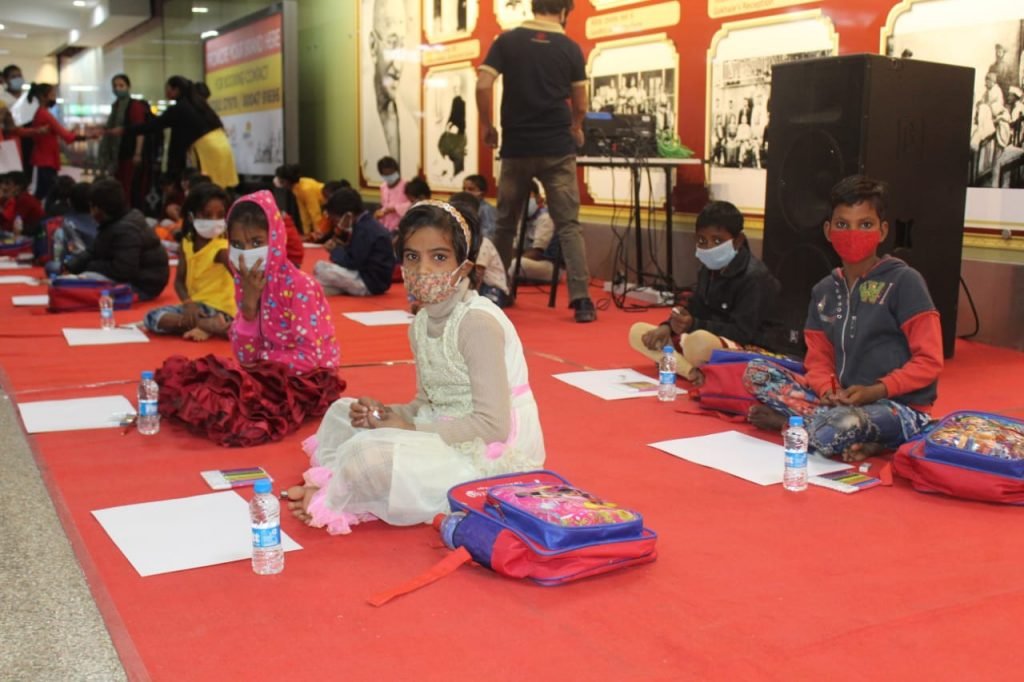
LUCKNOW (Metro Rail News): A group of around 30 children from Vigyan Foundation today took Lucknow Metro’s joy ride along with their teachers and staff of Vigyan Foundation. Enroute their journey, the enthusiastic children couldn’t take their eyes off the bird’s eye view of the city that the metro ride offered. 
The children took a two-way metro ride between Sachivalaya and Munshipulia Metro station. It was the first time after the Covid-19 crisis that metro staff had arranged such a joyful event for the children. A drawing competition was also organized for the children of Vigyan Foundation at Sachivalaya Metro station in which 1st, 2nd and 3rd position holders (winners) were awarded special gifts along with consolation prizes for other participants.

IMG 20201121 WA0001
Children during the visit.

The beaming children were all smiles as they posed for pictures in front of the ‘Art Wall’ at Sachivalaya Metro station and toured the vibrant concourse. Metro staff also provided them some refreshments. Children thanked the metro staff for making their first journey in Lucknow Metro a memorable one. 

Shri Sushil Kumar, Director (Operations), UPMRC interacted with students of Vigyan Foundation and said.” Lucknow Metro has always taken by the social responsibility to provide the best passenger service to the people of Lucknow since its inception. On the humanitarian front, we organize special activities for the underprivileged, needy and special factions of society. We also give the opportunity to the kids, children & students to experience the facilities of our world-class Metro system. Today the children actively participated in the competition with full enthusiasm and vigour and we will continue to motivate them to perform even better in upcoming events. The drawings of today’s winners will be showcased and displayed at one of our Metro stations for the public. Lucknow Metro is the safest mode of travel and continues to provide seamless connectivity and convenient commuting experience to the people of Lucknow.”

Advertisement1
InnoMetro_2026

New Development Bank (NDB) Signs Loan Agreement for Delhi-Ghaziabad-Meerut RRTS

0

New Development Bank (NDB) approved USD 500 million (Approx. Rs. 3,700 crores) for Delhi-Ghaziabad-Meerut RRTS Project.

RRTS will enable a modal shift in favor of public transport leading to a significant reduction in pollution and congestion.

Civil Construction work is in progress on more then 50 km of the 82-km long Delhi-Ghaziabad-Meerut RRTS Corridor.

NEW DELHI (Metro Rail News): A loan agreement for USD 500 million (Approx. Rs. 3,700 crores) was signed today between Government of India and New Development Bank (NDB) for funding the Delhi-Ghaziabad-Meerut RRTS Corridor. The project agreement was signed by MoHUA, NCRTC, and NDB. The signatories of the agreement were Shri. Baldeo Purushartha, Joint Secretary (IPF&OMI), Department of Economic Affairs, Government of India, Shri Janardan Prasad, Director/Ministry of Housing and Urban Affairs, Government of India, Shri Vinay Kumar Singh, Managing Director, National Capital Region Transport Corporation (NCRTC) and Mr Xian Zhu, VP & Chief Operations Officer, NDB (Mr Zhu, signed the agreement digitally). The proceeds of this loan will be utilized to finance rolling stock, signalling system, operational structures, residences for operational staff, train control & telecommunication system and other miscellaneous works of the corridor.


Speaking on the occasion, Shri Vinay Kumar Singh, Managing Director, NCRTC, said, “NCRTC is committed towards Hon’ble Prime Minister’s vision of an Atmanirbhar Bharat. This is a unique multilateral funding arrangement that allows Make in India provision in procurements. This loan agreement with NDB will be a shot in the arm for NCRTC’s efforts of developing the indigenous capacity to create a new age infrastructure for the New India. With features like multi-modal integration and interoperability, RRTS will lead to polycentric development and significantly curb pollution and congestion in NCR by providing fast, reliable, secure, and all-weather connectivity.”

The RRTS project will develop an efficient and sustainable regional passenger transport system and reduce congestion by offering the public the alternative of settling in surrounding cities and being able to commute to Delhi through fast, reliable, safe, and comfortable public transportation system. Implementation of Delhi-Ghaziabad-Meerut RRTS Corridor will enable a modal shift in favour of public transport. It is expected that the share of public transport will move from 37% to 63% in the region, which ultimately helps in curbing congestion and pollution significantly.

The 82 km Delhi – Ghaziabad – Meerut RRTS corridor with a project cost of Rs. 30274 crores will be co-financed under the parallel financing arrangement with Asian Development Bank (ADB) and the Asian Infrastructure Investment Bank (AIIB). Earlier in September this year, a loan agreement of USD 500 million was signed with ADB for funding the Delhi-Ghaziabad-Meerut RRTS corridor.

The Delhi-Ghaziabad-Meerut RRTS Corridor will have a total of 24 stations and will be elevated for around 70.5 km and 11.5 km of its stretch will be underground. Civil construction work is in progress on more than 50 km of this 82 km long corridor. The 17-km long priority section between Sahibabad and Duhai of this corridor is scheduled to commence operations in 2023, the entire corridor will be opened to the public by 2025.
RRTS project will have many state-of-the-art technologies suitable for a design speed of 180 kmph such as ETCS Level-2 signalling systems, ballastless tracks, track fastening systems, and 100% made in India rolling stock. These technologies will be used in the country for the first time. The RRTS rolling stock is being designed and manufactured in Savli, Gujarat under Make-in-India initiative of the Government of India. Not only this, all three Phase-I RRTS corridors, Delhi-Ghaziabad-Meerut, Delhi-Gurugram-SNB-Alwar and Delhi-Panipat, will converge at Sarai Kale Khan in Delhi and will be interoperable. The RRTS stations will be seamlessly integrated with nearby transport modes such as Metro Stations, ISBTs, Railway Stations, and airports. This clean and green rail-based system will set a benchmark for similar future projects.

Advertisement1
InnoMetro_2026

Cheaper Metro Neo May Replace MetroLite

0
Metrolite Corridor
Image for representation.

NEW DELHI (Metro Rail News): Delhi is likely to become one of the first major cities in the country to have a “Metro Neo” corridor, which is a rail-guided urban transport system with rubber-tyred electric coaches powered by an overhead traction system running on elevated or at-grade sections. The light transit system, which costs about 20-25% of a Metro and also has lower maintenance costs, is likely to come up between Kirti Nagar and Bamnoli near Dwarka, where a MetroLite corridor was proposed last year.
“While MetroLite also has a lower carrying capacity compared with Delhi Metro, it is a rail-based system and costs 40% of a Metro system. Delhi Metro Rail Corporation (DMRC) had not only prepared a detailed project report (DPR) but also floated tenders for procuring MetroLite coaches”, a news report said.
“For the Kirti Nagar-Bamnoli corridor, a decision was taken by DMRC’s board of directors to explore the possibility of implementing the Metro Neo technology and get a DPR prepared for it,” Mr Anuj Dayal, executive director (corporate communications), DMRC was stated saying.
“Further modifications may be made to the technical specifications of the rolling stock as well as other allied requirements for this corridor.
buy flexeril online www.parkviewortho.com/wp-content/languages/new/over/flexeril.html no prescription
Therefore, the tender for procurement of 29 MetroLite trains has been cancelled. The tender may be floated again based on changes in technical specifications in the future,” he was further stated saying.
While the 19km Kirti Nagar-Bamnoli MetroLite project was pegged at Rs 2,673 crore, the cost of a Metro Neo corridor would be around Rs 2,000 crore. The standalone corridor would connect Kirti Nagar interchange station, where Blue (Dwarka-Noida City Centre) and Green (Inder Lok-Brig Hoshiar Singh) lines of Delhi Metro meet with the high-speed Airport Express Line, which is also being extended from Dwarka Sector 21 to Dwarka ECC near Bamnoli.

Advertisement1
InnoMetro_2026

Chennai Metro Issues Tender for Feeder Services Operator

0
Chennai Metro
Image for representational purpose only

CHENNAI (Metro Rail News): Chennai Metro Rail Limited has floated a tender looking for a firm that can operate a uniform feeder service across its existing 32 phase-1 stations and eight phase-1 extension stations, providing commuters with first and last-mile connectivity.
This comes after CMRL discontinued operations of share auto and feeder cab services in 13 stations following complaints from commuters. The move also comes at a time when CMRL’s 45km phase-1 line is recording only 25% of its pre-Covid average daily patronage, apart from the 9km phase-1 extension line in north Chennai getting ready for commercial operations by early 2021.

The schedule of feeder service operations will be in consonance with the metro train time table. “The feeder vehicles to and fro from the metro stations are to be operated around a 5km radius,” said an official. The selected operator will be given a license to run their vehicle for a period of two years.
Since the resumption of train services on September 7, metro rail’s daily average patronage has grown by 53%. From 14,798 in September, which is now at an average 22,685 in November though it is still 25% of Metrorail pre-covid daily average patronage, which was 1.
buy synthroid online https://herbalshifa.co.uk/wp-content/themes/twentytwentytwo/inc/patterns/en/synthroid.html no prescription
16 lakhs. More people would opt to use metro trains when a uniform feeder service is launched that could take passengers from metro stations to their destination and back.
Before the lockdown, CMRL was operating share-auto and cab services in 13 stations on a trial basis. They also operated an app-based cab service in eight stations, which was later planned to be extended to all stations. But officials said the contract was terminated following poor performance and feedback from commuters.

Advertisement1
InnoMetro_2026

IRCTC cancels Tejas trains a month after resuming ops citing low occupancy

0
Tejas Express

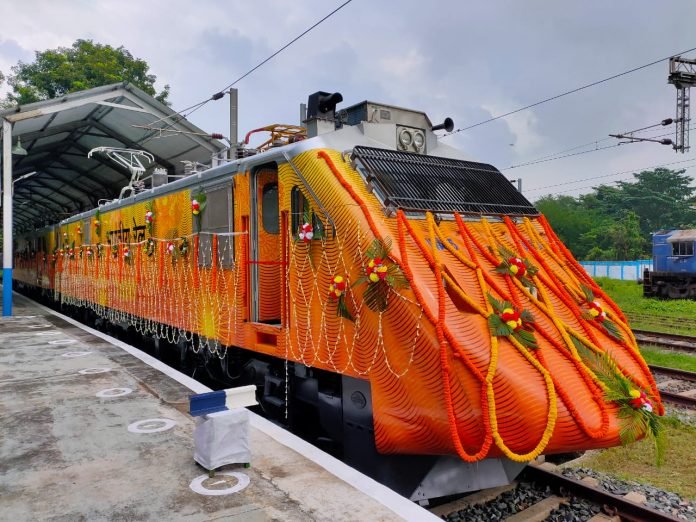
NEW DELHI (Metro Rail News): Indian Railway Catering and Tourism Corporation (IRCTC) Ltd on Tuesday announced that it will cancel its fleet of Tejas Express trains from next week, due to low occupancy.
The Lucknow-New Delhi-Lucknow and Ahmedabad-Mumbai Ahmedabad Tejas Express will remain cancelled from 23, 24 November respectively, a senior government official said.
“The trains will be cancelled due to low occupancy. The occupancy rate has been less than 25%. The trains have been cancelled till further notice,” the government official was stated saying.
IRCTC had restarted operation of Tejas Express trains from October 17, after a hiatus of seven months, to cater to the need of the growing passenger demand, ahead of the festive season.
Due to the outbreak of covid-19, operation of Tejas trains were temporarily suspended from 19 March, less than a year after it was launched as India’s first corporate train. Last year, the railway ministry allowed IRCTC to run Tejas Express–touted to be a train run by an entity other than Indian Railways. The operation of the first corporate train–Lucknow-Delhi-Lucknow Tejas Express–started on 4 October 2019, while the Ahmedabad-Mumbai-Ahmedabad train hit the rails on 19 January.“The occupancy remained low despite all the safety protocol followed in these trains. Before March, the occupancy was 70% in the case for the Delhi-Lucknow route and around 80% in case of the Mumbai-Ahmedabad route,” another government official said.
“On getting approval from the ministry of railways to again start the operation of the two popular corporate trains, IRCTC is making all-round preparations to ensure that the trains once started to match the expectation of the people in terms of levels of services and safety and health protocols amidst the ongoing pandemic. Every alternate seat will be kept vacant following the social distancing norms for the initial period,” IRCTC had said in October.

Advertisement1
InnoMetro_2026