Home Blog Page 364

Jangpura station to be built as transit hub on Delhi-Meerut RRTS line

0
Delhi-Meerut RRTS
Image Source: NCRTC

Delhi (Metro Rail News): According to a spokesperson of National Capital Region Transport Corporation (NCRTC), the Jangpura station on the Delhi-Meerut Regional Rapid Transit System (RRTS) corridor will be developed as a major transit hub with space for residential, commercial, and office complexes, as well as other facilities for which a detailed plan will be made.

As per the spokesperson, “We have invited bids to appoint a consultant to prepare an Influence zone plan so that Jangpura is developed as transit-oriented development (TOD) node. It will be about ensuring seamless connectivity with other modes of transportation, including last-mile connectivity, pedestrian-friendly area, provision for parking, urban furniture, street vending zones and others. In addition, the proposed station and stabling yard will be integrated.”

“The consultant will also map all current facilities and plan for the area’s development accordingly,” the spokeswoman stated, “as well as obtain all necessary approvals from all agencies.”

THIS YEAR, the NCRTC decided to extend its Delhi Meerut corridor, which was supposed to start at Sarai Kale Khan in Delhi and terminate at Jangpura.

According to the initial plan, Sarai Kale Khan, New Ashok Nagar and Anand Vihar were the only three stations in Delhi on the corridor, along with a stabling yard-cum-maintenance facility at Jangpura.  A stabling yard is a facility where trains are parked before departing on their next journey.

According to a second official, in addition to the stabling yard, Jungpura station would feature an operation control centre to monitor and control the time-bound operation of trains on all three corridors. In addition to Delhi-Meerut, the NCRTC is building the Delhi-Gurugram-SNB and Delhi-Panipat corridors.

According to NCRTC authorities, the Jangpura station, which spans 12 hectares, will become a significant transit hub and give a direct quick train connectivity to south Delhi.

The decision was made to enable smooth connectivity to individuals coming from Meerut, Ghaziabad, and other parts of Uttar Pradesh to the south Delhi area stated an NCRTC spokesperson.

As per the tender document, an 800-meter radius around the station will be developed in accordance with TOD policy, with a focus on the 500-meter radius (higher Floor Area Ratio).

The consultant will have to prepare a detailed traffic management plan for the area, as well as proposed measures for seamless connectivity with the road and mass transit networks around the station up to 100 meters or the next intersection of the road boundary beyond the TOD planning area, a senior NCRTC official explained.

The consultant will conduct a survey of current development, structures, plots, encroachments, key landmarks, Metro stations, and other amenities and assess their use. This will entail assessing the availability of public facilities and street furniture and identifying activity patterns, such as informal commercial areas and public space utilisation. It would also entail mapping of ongoing and completed infrastructure projects, as well as other public works, by various service providers, the source added.

The NCRTC is developing three RRTS lines, the first of which is the Delhi-Meerut corridor. The corridor’s construction began in 2019 and is projected to be completed by 2025.

Of the 82 KM route, 14 KM would be built in Delhi, including a 1.35 KM Yamuna bridge connecting New Ashok Nagar and Sarai Kale Khan stations. The bridge, which will run parallel to the Delhi Noida Direct Flyway, began construction in February of last year.

Advertisement1
InnoMetro_2026

Chennai Metro Phase 2 driverless trains tender being evaluated: CMRL

0
Chennai Metro
Image for representational purpose only

Chennai (Metro Rail News): As the Lighthouse-Poonamallee bypass corridor’s phase-2 network takes shape, numerous companies have begun bidding for electrification and the production of driverless trains that can operate on the corridor.

After CMRL opened technical bids earlier this week, three companies were announced as bidders for manufacturing 26 three-car driverless trains or 78 coaches to be operated on the corridor: Alstom Transport, BEML, and Titagarh Wagons.

Seven companies had also filed bids for the installation of overhead equipment (OHE), which is required to power trains on the route and at the Poonamallee depot. There are 30 stations on the 26.1-kilometre Lighthouse to Poonamallee bypass, including 13 underground stations.

An official said, “The plan is to open the elevated section from Power House to Poonamallee bypass first by 2025 and maintain the train fleet at the Poonamallee depot while opening the rest of the corridors in a few months.”

CMRL has already awarded the contract for laying tracks on the corridor. However, officials claimed that when the technical bids are evaluated, and financial bids are opened to disclose the lowest bidder, the contractor for train manufacturing and electrification work would be chosen.

According to officials, the elevated corridor on the Porur-Poonamallee bypass segment is nearly complete, with pillars placed in the middle of the Mount-Poonamallee Road over a distance of about 3 kilometres. The casting of viaducts that will be installed on the pillars to support ballast-less rails has also begun in the casting yards,

On Saturday, the municipal traffic police said construction work for the project would be diverted from the Chennai bypass junction to Kumananchavadi junction. When the 26.1 KM corridor opens to the public, metro trains will connect the city’s central areas, such as Mylapore, Nandanam, T Nagar, Kodambakkam, and Vadapalani, with the city’s west developing suburbs, such as Porur, Iyyappanthangal, Kumanan Chavadi, and the Poonamallee bypass, which are currently underserved by public transportation.

Advertisement1
InnoMetro_2026

DMRC hires McKinsey for planning major integration of metro services with e-commerce

0
Metro Rail Commuters During Pandemic Time
Metro Rail Commuters

DELHI (Metro Rail News): According to official sources, Delhi Metro has begun work on a futuristic project that aims to connect regular services with e-commerce using cutting-edge digital platforms. The DMRC has hired a leading consultancy firm to work on the plan.

According to the vision, for example, a rider may be able to order a product online while riding a metro train and have it delivered to their destination station via advanced digital platforms provided by the urban transporter.

A top official source stated, “We have started working on this vision, and a top consulting firm, McKinsey, has been hired to work on the plan that we have envisioned. However, the project is still in its “infancy”, and this is just a broader vision to upgrade our digital platforms so that commuters can also access e-commerce services while riding a Delhi Metro train.

The Delhi Metro Rail Corporation (DMRC) has relaunched its website and smartphone app, providing commuters with new features and convenience.

DMRC chief Mangu Singh, at the launch, had also said that the urban transporter is planning to integrate its digital platforms with “e-commerce in a big way” to allow commuters to get other services in the course of their journey. “In the next two-three years, we think this is likely to go on a next level,” he had said.

According to reports, the goal is to allow commuters to access e-commerce services while on the move using DMRC digital platforms. According to the vision, once a commuter completes their journey, the order placed, such as for groceries or something else, can be fulfilled at the destination station, where arrangements could be made for, for example, a digital locker that could be accessed with an OTP received on a mobile device or something similar.

The DMRC had previously stated that its revamped website is “among the world’s most feature-rich and advanced” interactive digital metro platforms. Officials added that riders of the Delhi Metro can now receive a prior alert notification when the train’s next station on the route is their destination, thanks to the company’s newly updated smartphone app.

Also, anyone may access real-time information on their planned journey path, including whether there is any snag or interruption on the route ahead, and it will even propose an alternate route, utilising the newly improved website.
buy filitra online https://healthcoachmichelle.com/wp-content/themes/twentytwentyone/inc/en/filitra.html no prescription

The Delhi Metro has begun the process of upgrading all of its existing Automatic Fare Collection (AFC) systems to be compliant with the National Common Mobility Card (NCMC) services, giving a significant boost to ‘Digital India.’ The work is expected to be finished by June 2023.

According to the DMRC, it has signed a contract with a consortium to carry out the NCMC as well as improve the entire ecosystem, including the AFC system, which will enable travel via “QR-based tickets, account-based tickets, and near-field communications (NFC) media.”

Prime Minister Narendra Modi launched the NCMC services on the Airport Express Line on December 28 of last year. Passengers from all around the country can use their NCMC-compliant RuPay debit card for seamless travel using this service. In addition, the same card can be used across the country for shopping, banking, and other transactions.

Officials indicated at the time that the DMRC’s system would be able to handle transactions from 23 banks using the RuPay debit card that they had issued.

Advertisement1
InnoMetro_2026

DMRC one step closer to ‘One Nation One Card’ Policy

0
In order to deploy the National Common Mobility Card (NCMC) in the network, DMRC has signed a contract to implement NCMC along with an upgrade of the AFC system, which will also allow travelling via QR Tickets and other digital means.

Delhi (Metro Rail News): DMRC in its ongoing efforts to implement the indigenously developed National Common Mobility Card (NCMC) across the entire Delhi Metro network, Delhi Metro has signed a contract with a consortium to implement the NCMC as well as upgrade the entire ecosystem, which includes the Automatic Fare Collection (AFC) system, which will also enable travel via QR Tickets, Account-Based Tickets, and Near Field Communications (NFC) Media.

It focuses on empowering the ‘One Nation One Card Policy’ motto. The contract agreement for this Automatic Fare Collection (AFC) work for the three priority corridors (Janakpuri West – RK Ashram Marg, Majlis Park – Maujpur, and Tughalakabad – Aerocity) under Phase-IV, as well as the upgradation of existing (operational) Phase-I, II, and III Automatic Fare Collection (AFC) system were awarded to a consortium of M/S Revenue Collection Systems (Thales), France SAS, and M/S Paytm Payments Bank Limited.

The introduction of the NCMC and QR tickets will allow for seamless transit across the country on metro railways and other public transportation systems and retail buying and purchases.

Passengers will also be able to use a mobile phone to enter or exit a metro station on its corridors with Mobile QR and NFC-based tickets.

The NCMC and QR code ticketing facilities are currently accessible in the Airport Express Line (23 KM) of the Delhi Metro from New Delhi to Dwarka Sec-21 (6 stations).
buy viagra oral jelly online no prescription
According to the contract, by June 2023, the remaining operational corridors of the Delhi Metro will be equipped with an NCMC and QR code compatible AFC system.

According to Dr Mangu Singh, Managing Director, DMRC, “The Implementation of NCMC along with QR Ticket (Paper QR and Mobile QR), Account-Based Ticketing (ABT) and NFC Media will push the country towards being a cashless economy. This will enable commuters to have integrated access to all public transport, and they need not to carry/purchase multiple cards for different usage. Implementation of above technology will bring DMRC at par with the leading metros worldwide. These innovations are going to herald a new era of travelling, comfort and enhanced mobility for Delhi-NCR residents.”

Mr Jean-Marc Reynaud, Vice President, Revenue Collection Systems (Thales), France SAS, stated, We are tremendously honoured to further strengthen our 20-year cooperation with DMRC with this contract, and are thrilled to join hands with PayTM Payments Bank. We are excited to be a part of this project, which will see the National Common Mobility Card implemented in accordance with the Indian government’s “One Nation, One Card” policy. Our long-term presence in India has allowed us to develop a network of strategic suppliers and brilliant engineers, enabling the government’s “Make in India” plan to become a reality and a source of strength for our operations.

We are happy to work with Delhi Metro Rail Corporation and Revenue Collection Systems (Thales), France SAS, to empower millions of commuters in the national capital with seamless, contactless transit, stated Mr Sajal Bhatnagar, Chief Business Officer, Paytm Payments Bank Ltd. We expect to continue working towards the digitization of the transit ecosystem in the country with smart mobility solutions with the launch of the NCMC card.”

Advertisement1
InnoMetro_2026

Rajasthan govt. allotted Rs 1,185 Cr for extension of Mansarovar-Badi Chaupar Metro Corridor in Jaipur

0
Jaipur Metro
Jaipur Metro

JAIPUR (Metro Rail News): The Rajasthan government has set aside Rs 1,185 crore to construct a 4.85 KM extension of the Mansarovar to Badi Chaupar Metro Corridor on both ends.

The East-West Metro Corridor will be extended from Badi Chaupar to Transport Nagar by the Jaipur Metro Rail Corporation (JMRC).

Similarly, plans are to build a two-kilometre elevated stretch from Mansarovar station to the 200-foot Bypass Junction on Ajmer Road to give Metro connectivity to the 200-foot Bypass Junction.

Once completed, The present 12 km East-West Corridor from Mansarovar to Badi Chaupar will be extended to roughly 17 km.

The Corporation had previously published a Phase-1C detailed project report (DPR) from Badi Chaupar to Transport Nagar and sought public input. According to the DPR, if the project is finished by March 2025, the anticipated project cost, including land costs and taxes, is Rs 866 crore.

In the Budget, Chief Minister Ashok Gehlot announced to connect satellite towns including Chaksu, Bassi, Chomu, Chandwaji, Bagru, Phagi with Metro Neo after preparing the project detail project report (DPR). 

Despite the CM’s pledge to amend the project’s DPR, the state government did not make any allocations for the long-awaited Jaipur Metro Phase-II, a 23.5 KM line proposed to be built between India Gate and Ambabari on Tonk Road.

Advertisement1
InnoMetro_2026

L&T and J Kumar Bags Delhi Metro Phase IV Silver Line’s Underground Work

1
Mumbai Metro Line 3
Image for Representation.

Delhi (Metro Rail News): Larsen & Toubro and J Kumar Infraprojects submitted the lowest bids on Thursday for the construction of two underground tunnelling packages (DC-09 and DC-08) for the 65.1 km Silver Line of the Delhi Metro Phase 4 project.

Both civil contracts were originally awarded to Afcons Infrastructure and Tata Projects Ltd. (TPL) in November-December 2021. All eligible bidders were asked to submit revised financial proposals because their bids were much higher than the Delhi Metro Rail Corporation’s (DMRC) predictions.

Both packages have a 42-month deadline and are backed by an Rs 8,390 crore ODA loan from JICA. DMRC initially had an estimate of 1349 Crores and Tata Projects Ltd. (TPL) were the original winner.

Package DC-08: This 6.116-kilometre section of the 23.622-kilometre Silver Line runs from Aerocity to Kishangarh and has four stations: Aerocity, Mahipalpur, Vasant Kunj, and Kishangarh.

CompanyBid Value (Crore)
J Kumar Infraprojects1611.85
Tata Projects1639.02
L&T1684.35
Afcons1854.99
ITD Cem1926.29
Gulermak2237.64

The work includes: Design and Construction of Twin Tunnel (Up & Down Line) by Shield TBM, Cut and Cover Tunnel box and four Underground stations namely Aerocity, Mahipalpur, Vasant Kunj and Kishangarh with Entry/Exits & Connecting subways from chainage (-) 760 mt. to 5356.285 mt. of Aerocity to Tughlakabad Corridor of Phase-IV of Delhi MRTS.

Package DC-09: This 6.51-kilometre section, with twin-tunnels smack-dab in the middle of the Silver Line, will run from Kishangarh Station’s east end (chainage 5356.285) to a ramp (chainage 11867.000) west of Saket G Block Station, passing through four stations: Chhattarpur (interchange with Yellow Line), Chhattarpur Mandir, IGNOU, and Neb Sarai.

DMRC initially had an estimate of 1428 Crores and Afcons infrastructure was the original winner.

CompanyBid Value (Crore)
L&T1737.22
Afcons1739.64
Gulermak1940.90
ITD Cem2028.40

The work includes: Design and Construction of Twin Tunnel (Up & Down Line) by Shield TBM, Cut and Cover Tunnel box, Underground Ramp and four Underground stations namely Chhattarpur, Chhattarpur Mandir, IGNOU and Neb Sarai with Entry/Exits & Connecting subways from chainage 5356.285 mtr. to 11867.000 mtr. of Aerocity to Tughlakabad Corridor of Phase-IV of Delhi MRTS.

J Kumar and L&T’s bids were 19% and 22% more than DMRC’s predictions, the chances of contracts being awarded are expected to be slim. Both firms’ management will most likely be invited to negotiations by DMRC, and if those fail, both will be going into a re-tender.

Following this development, here is the status of all four JICA-funded Phase 4 underground packages.

DELHI Metro Ppase IV Civil PackageStatus
Package DC-05: Derawal Nagar to RK Ashram, 7.46 km underground section with 6 stationsAwarded to Afcons Infra
Package DC-08: Aerocity to Kishangarh, 6.11 km underground section with 4 stationsJ Kumar is the lowest bidder
Package DC-09: Kishangarh to Saket G-Block, 6.88 km underground section with 4 stationsL&T is the lowest bidder
Package DC-07: Sangam Vihar to Tughlakabad, 6.477 km underground section with 3 stationsAwarded to Afcons Infra
Advertisement1
InnoMetro_2026

TATA-Siemens JV to Cast Pune Metro Line-3’s 1st Segment

0
Joint Venture of Tata-Siemens will develop the metro corridor for Pune Metro
Image Source: Twitter

Pune (Metro Rail News): On Friday, engineers from Pune IT City Metro Rail Ltd. began pouring concrete for the 23.3 kilometre Line-3 of the Pune Metro, which would connect Megapolis Circle in Hinjawadi to Civil Court in Shivajinagar.

The line’s viaduct, which is being developed by PMRDA on a PPP mode through a 35-year concession agreement signed with Tata’s TRIL Urban Transport Private Limited and Siemens Project Ventures GmbH (TRIL UTPL + SPVG), will be started with 8.5m wide segments cast at their yard in Tathawade.

The line’s civil construction will be handled by Tata Projects Ltd., while Siemens will handle system-related project management, turnkey electrification, signalling, communications, and depot work (equipment). For the line’s superstructure, roughly 7200-7500 segments are being cast. Rebar for several piers has begun to sprout along the line’s course in Hinjawadi and E-Square near Pune University.

Advertisement1
InnoMetro_2026

CMRL commences phase-2 project in the city

1
Chennai Metro
Representational Image

CHENNAI (Metro Rail News): Chennai Metro Rail Limited (CMRL) Phase 2 of the project has begun in the city. The Powerhouse in Kodambakkam to Poonamallee segment via Vadapalani and Porur has a June 2025 deadline, while the rest of the corridor has a December 2025 deadline.

The pillars were built near Porur Lake in the centre of the Mount-Poonamallee route, according to the officials. A 3-kilometer stretch of this elevated route has been built.

Workers are blocking traffic on several parts near Porur to prepare the site for construction, according to a report published by the Times of India.

Advertisement1
InnoMetro_2026

Eastern Railway GM meets RVNL to discuss Kolkata Metro Phase I plans

0
Kolkata Metro
Image for representational purpose only

Kolkata (Metro Rail News): On Thursday, Eastern Railway general manager Arun Arora met with RVNL officials to assess the twin Kolkata Metro corridors — Joka-Esplanade and New Garia-Airport — that are now under construction.

It comes after the meeting between railway minister Ashwini Vaishnaw and general managers of railway zones last week, during which Vaishnaw sought Arora’s opinion on whether to stick to the original plan when launching the first phase of both corridors — Joka to Taratala in the west and New Garia to Ruby along the EM Bypass — or extend the run further — from Joka to Majerhat and New Garia to Sector V.

While Metro Railway, the umbrella organisation for the city’s rapid transit system, has requested an extended Phase I for both corridors, RVNL, which is entrusted with implementing most of the city’s Metro projects, is keen to stick to the original launching plans of the truncated segments.

Both the Joka-Taratala section and the New Garia-Ruby segment, which are nearing completion, might be commissioned this year with the one-train-only system, which would eliminate the need for signals, according to RVNL.

From the Joka terminal to Taratala, only one rake will roll up and down the lines. Similarly, only one train will depart from New Garia’s Kavi Subhas terminal and go to Ruby before returning. So there won’t be any other trains on the tracks.

RVNL wants to start the sections without signals because it has only managed to float tenders for communication-based train control (CBTC) signalling for the two projects in January. So it won’t be possible to run multiple trains anytime soon.

CBTC will be available on all future Metro lines in the city, such as the East-West Metro. The CBTC signalling system is based on telecommunication, with trains travelling at 80 km on automatic signals that occur every two and a half minutes.

The CBTC system is complicated to implement, and any new Metro line would require long trial runs before the Commissioner of Railway Safety (CRS) would approve it. According to feasibility studies, a truncated Line 6 will connect Kavi Subhas to the Airport and cover the EM Bypass and New Town. It will only have significant ridership if it interlocks with the East-West Metro’s Sector V station.

Line 3, which will connect Joka in the city’s outskirts with Esplanade through Diamond Harbour Road, should also connect to Eastern Railway’s Majerhat station for meaningful ridership.

According to a Metro official, “Running single trains would have been okay had there been possibilities of getting enough passengers. But very few people would have used these sections, and the commissioning of these stretches would be a huge strain on Metro, which is already grappling with losses. We don’t want to land in a situation like the East-West Metro, which still doesn’t have enough footfall, even after the Phoolbagan extension.”

Advertisement1
InnoMetro_2026

DMRC awards contract to Johnson Lifts for advanced and indigenised lifts & escalators for Phase-IV corridors

1
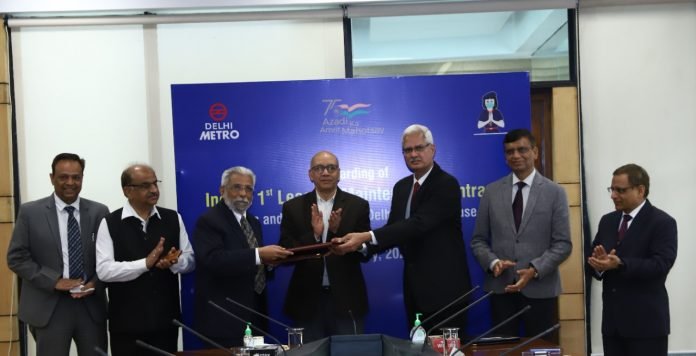
Delhi Metro has awarded the first contract for the lease and maintenance of Lifts and Escalators for the three priority corridors under its ongoing Phase-IV expansion.

DELHI (Metro Rail News): The Delhi Metro has awarded the first contract for the lease and maintenance of Lifts and Escalators for the three priority corridors under its ongoing Phase-IV expansion, using a Public-Private Partnership (PPP) model and greater indigenisation for metro rail systems in India.

According to a DMRC spokesperson, “This is a first of its kind historic financial model in this sector adopted in India for funding of public infrastructure project based on Public-Private Partnership (PPP) model.”

https://twitter.com/OfficialDMRC/status/1496801645899911172?s=20&t=dGGcZ7ENJbvNd9q6mJGdog

M/s Johnson Lifts, Chennai (vendor) will initially cover the total expense of designing, manufacturing, supplying, installing, testing, and commissioning the Lifts and Escalators and maintaining them for a term of 15 years under the PPP Model.

During these 15 years, the contractor will be responsible for all upkeep and maintenance. In addition, the equipment will be installed with online monitoring with the provision of their 24X7 online monitoring.

The contract agreements for the procurement of state-of-the-art, heavy-duty, indigenized lifts and escalators for the three priority corridors under Phase-IV were exchanged between Sh. Om Hari Pande, Director (Electrical), DMRC and Mr. John K. John, Chairman cum Managing Director, M/s Johnson Lifts in the presence of DMRC’s Managing Director, Dr. Mangu Singh and other senior officials.The Phase-IV priority corridors are – Janakpuri West – RK Ashram Marg, Majlis Park – Maujpur and Tughalakabad – Aerocity for which DMRC has awarded these contracts to procure around 179 lifts and 323 escalators to be commissioned across these corridors comprising a total length of 65 KM and 45 stations.Presently, DMRC is operating a network of approximately 390 KM with 286 stations, wherein around 1000 Lifts and more than 1100 escalators have been installed at different premises across its network for passenger convenience.

Advertisement1
InnoMetro_2026