New Delhi: Prime Minister Narendra Modi has flagged-off the Delhi-Faridabad Metro Line that would allow hassle free travel for around two lakh daily commuters between the national capital and the industrial hub in Haryana.
The extension of the Delhi Metro connects Badarpur to Escorts Mujesar in Faridabad.
The total cost of the project from Badarpur to Escorts Mujesar is nearly Rs. 2,500 crore. Out of this, Rs. 1,557 crore was borne by the Haryana Government, the Centre contributed Rs. 537 crore, while the Delhi Metro provided Rs. 400 crore.
All these are elevated and located on either side of the Delhi-Mathura Road (NH-2).
“The nine-station metro corridor which was 95 per cent indigenously built will provide people a safe, affordable, quick, comfortable, reliable, environment-friendly and sustainable transport facility,” a Haryana government spokesperson said.
Haryana Chief Minister ML Khattar, addressing a press conference on Saturday, had thanked the Prime Minister for “gifting” the Metro service which would take the city to “another level of progress” with better connectivity with other NCR towns.
He had also said that the Prime Minister would be announcing the go-ahead for connecting Gurgaon with Faridabad by Metro.
NAGPUR (Metro Rail News): The Union Minister Nitin Gadkari has asked MahaMetro to take over the city bus service from NMC to use it as a feeder service of Metro Rail if they can. The civic body had asked MahaMetro to take over the loss-making city bus service since the former suggested reforms in bus routes, according to media reports.
According to sources, Gadkari said efforts are on to introduce a new technology-based public transport system from Pardi to Jaiprakash Nagar Metro Rail Station to Wadi using the London/Orange Street project.
The Minister said that if traffic congestion does not ease out with the new flyover, then he will have to plan either an underpass or flyover at the T-Point where Inner Ring Road connects with Amravati Road at Wadi. He also added that people will be able to use the new public transport system in which a 50-seater bus will fly. This project will be from Pardi to Jaiprakash Nagar Metro Station to Hingna MIDC to Wadi to Variety Square.
HYDERABAD (Metro Rail News): The Hyderabad government has set aside a budget of Rs.1,500 crore for the Hyderabad Metro Rail Project, Rs.500 crore for Airport Metro connectivity and Rs.500 crore for Metro connectivity to the Old City. in the Assembly on Monday Finance Minister T Harish Rao said that the State government is taking all the right steps for the extension of the Hyderabad Metro in consultation with the concessionaire, L&T Hyderabad Metro Rail Limited.
“To connect the last 5.5 km in the Old City with the Metro Rail Project, there were several obstacles. As there were heritage buildings and places of worship, the work could not be taken up. By the time these issues were resolved, the Metro Rail project was in severe loss due to the lockdown imposed because of COVID-19,” he said. “The government was consulting the concessionaire for extension of the services to the older parts of the city”, he added.
Image for representation purpose only copyright: respective Authority
MUMBAI (Metro Rail News): The National High-Speed Rail Corporation Ltd (NHSRCL) has cancelled tenders floated in November 2019 for construction of the underground terminus at BKC for the Mumbai-Ahmedabad bullet train project because the state government has failed to hand over the land. Previously NHRCL had given 11 extensions to the government in hopes that they will get the land at BKC for construction soon.
According to NHRCL officials they received the approval of handing the land in 26th February, 2018 but the government has shown no willingness to hand over the land and their requests have gone unheard since September 2020.
The land area of 4.2 hectares at BKC was allotted by state with the condition that viability of the proposed International Finance and Service Centre (IFSC) be not compromised. The state also insisted that the cost of land should be adjusted against equity contribution of Maharashtra government.
To start the construction, MMRDA also needs to shift a BPCL petrol pump to an alternate spot. buy cenforce online https://www.adentalcare.com/wp-content/themes/medicare/editor-buttons/images/en/cenforce.html no prescription
Ven this task is not carried out yet. MMRDA in their response has mentioned presence of a Covid-19 care facility for its inability to hand over the land for the BKC terminal.
BKC station has been designed by NHRCL as an integrated structure underground station with the IFSC structure above it) to share load of 60m high building above it. The tender for the BKC station was proposed to be floated in November 2018. Later, MMRDA informed about the plan to raise the height of the IFSC building to 95m, which required a change in design. The tender was issued on November 20, 2019, with 19thMarch as date of submission. But pandemic and non-availability of revised design shifted the date of opening the tender on several occasions between 12thMay, 2020 and 31stAugust, 2020.
Mumbai Monorail COO Sacked Over Charges of Bribery and Corruption by MMRDA (Representational Image)
MUMBAI (Metro Rail News): The Mumbai Metropolitan Region Development Authority (MMRDA) has decided that the Monorail corridor will be linked with Colaba-Seepz underground Metro 3 line which will improve the connectivity to Mahalaxmi-Parel-Wadala areas.
Mahalaxmi Metro station which is under construction will be connected to the Chembur-Jacob Circle monorail corridor which will be extended by about 500 meters. The move is expected to make Monorail operations more viable and provide seamless connectivity to its commuters. MMRDA officials said that the discussions on how to go ahead with the extension and the cost of the project is ongoing. After that MMRDA plans to float bids for the construction of the additional track route and a station which will be named as Mahalaxmi Monorail station.
“We are planning to extend the Monorail route by around 450 to 500 meters and connect it with the Mahalaxmi Metro station. This will make the Monorail more viable considering it is in loss now, and also give commuters the option to travel from south Mumbai travel up to Chembur seamlessly via the interchange at Mahalaxmi Metro station. From here, commuters can take a Monorail and go up to Chembur,” said SVR Srinivas, Metropolitan Commissioner of the MMRDA.
“The current waiting period for Monorail is very high, say around 25 minutes or even more with just three trains. However, we have already placed orders for more rakes. They will start coming in phases in two years. Simultaneously, we also plan to start the construction of the extension of Monorail from Jacob Circle to Mahalaxmi Metro station”, he added.
According to the officials, the extension of Monorail beyond Chembur is under the planning stage but it is not under active thought at present. Plans to link Monorail with the Wadala-Thane Metro-4 corridor is being considered so it can be connected to thickly populated areas of central Mumbai, including Dadar, Lower Parel, Chinchpokli. On the other line, the Colaba-Seepz Metro-3 corridor will run from south Mumbai from places like Girgaon, Mumbai Central going further into central Mumbai’s hugely populated areas like Worli, Siddhivinayak Temple in Dadar, Mahim, Dharavi and further via airport to Seepz in Andheri. The MMRDA is also constructing the Andheri-Dahisar Metro-7 corridor that will be fully operational by year-end.
The Mumbai Monorail corridor which is being built at a cost of over ₹2,000 crores, starts from Chembur and passes via Wadala. The operations began in February 2014 but it has been receiving criticism due to poor ridership and multiple technical issues. Of the 10 rakes, only three are currently operational between Chembur and Jacob Circle and the ridership is below 50,000 commuters daily.
KANPUR (Metro Rail News): In order to recognise contribution and achievements of women globally, International Women’s Day is observed on 8th March every year. This year the theme of International Women’s Day is, “the role of gender equality in building a sustainable tomorrow”. There has always been active participation of women in every technical and non-technical department under the projects of Uttar Pradesh Metro Rail Corporation Ltd. (UPMRC). In Kanpur Metro Rail Project also women are creating success stories in their respective fields. Train Operations and Maintenance, Civil, Electrical and Signalling; women are playing important role in all departments of the company. Women’s share of participation in a total staff of UPMRC is almost 21%.
For the safety and security of women commuters both at the Metro stations and inside the trains, UPMRC has endowed the responsibility of running the day to day operations with the women workforce. It includes female Train Operators, Station Controllers, security personnel and housekeeping staff. They have been performing their job responsibilities and duties sincerely by taking special care of the differently abled passengers, women, children and senior citizens.
Shri Kumar Keshav, MD, UPMRC expressing his views on this special occasion said, “Metro is the safest mode of transport for women. She can move and travel anywhere in the Metro premises with complete ease and sense of freedom. Adequate number of women staffs are present at Metro stations. Besides, we don’t believe in provision of separate coaches for women, but ensures that the entire Metro premises and Metro trains are safe for women and we are performing this responsibility with utmost sincerity. We try our level best to give more opportunities to women in our organization and motivate them to take up higher responsibilities and enhance their performance. Our women employees wearing UPMRC uniform instils a sense of pride in each one of us. It is a matter of immense pride as the women workforce of UP Metro has taken long stride in transforming the organizational working environment. From security to technical, Kanpur Metro’s female staff has taken control and charge of all the departments thereby setting an example for other women.”
As a Mass Rapid Transit System (MRTS) of the city, UPMRC ensures 100% safety of women commuters in travelling from one place to another. It has taken the following measures to make women feel safe in the Metro system:
In case of any emergency, telephonic conversation with Train Operator can be established immediately by pressing Passenger Emergency Intercom (PEI). The CCTV footage of the PEI in use coach is automatically transmitted in Cab, Operations Control Centre, Depot Control Centre and Security Control room.
12 CCTV cameras per train and around 45 CCTVs are installed at every station for continuous surveillance.
Glass panelled see-through cubicles for Station Controllers & Ticket Vending Executives.
Properly Illuminated area with no dark spots at stations.
Presence of lady security personnel along with lady housekeeping staff at all stations.
RRTS rail track system is using unique precast track slab technology first time in India
DELHI (Metro Rail News): India’s first RRTS project under construction between Delhi to Ghaziabad and Meerut is a high-speed system with a design speed of 180 kmph. With an operating speed of 160 kmph and the station at every 5-10 km, it will cover 100 km in about an hour. It is very important to have an efficient and qualified rail track system to run the train at this high speed.
Since the RRTS project aims to significantly reduce the travel time, it is ultimately very important that the design of the selected track structure is suitable for high speed. It should be reliable and easily maintainable. The RRTS corridor is passing through the congested urban environment as elevated as well as the underground corridor. The selection of the ballastless track structure has been finalised after considering all these key factors.
The existing ballastless track system being used in metro rail projects in India is generally suitable for design speeds of up to 95 kmph. In the absence of high-speed ballastless track experience in the country, NCRTC has studied several internationally prevalent rail track systems to select an apt track system suitable for high speed, be reliable with low maintenance. Precast slab track system has been selected as track system for RRTS.
NCRTC adopted a strategy to identify a suitable track system for RRTS and first selected a “System Provider” who has complete knowledge and experience of the said system. After that, this technology was strategically acquired from this system provider for all RRTS corridors.
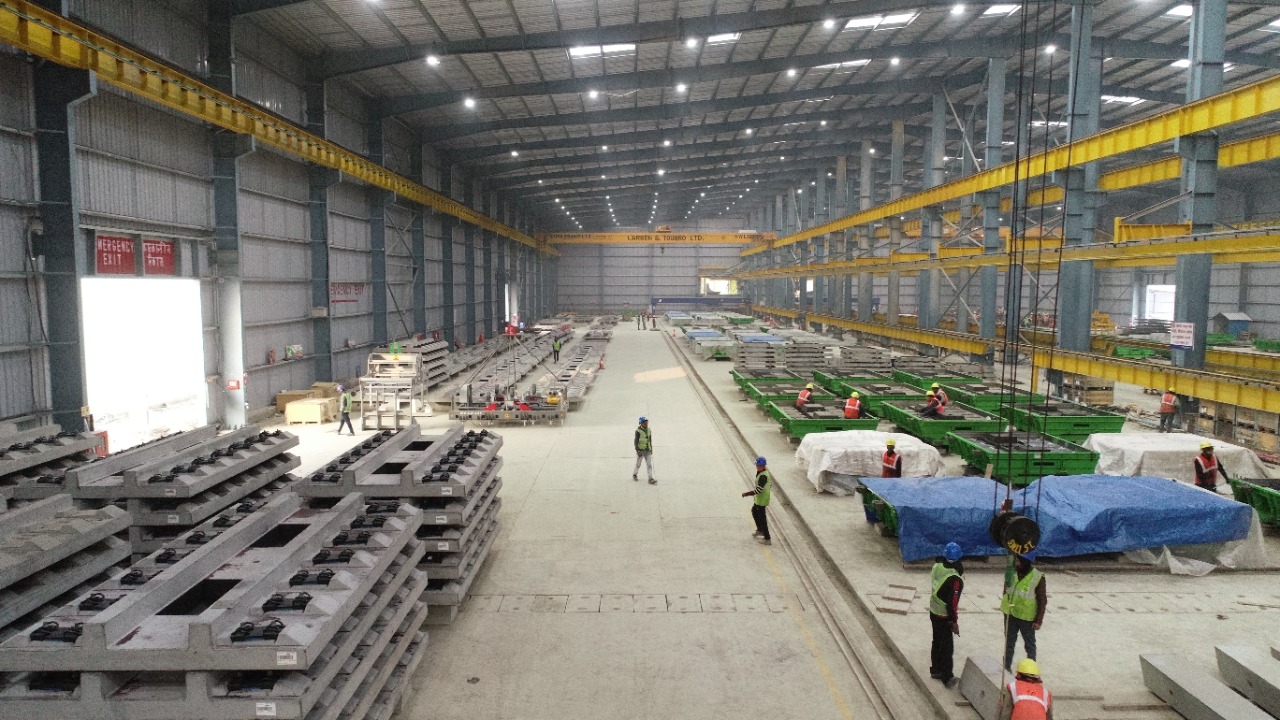
This technology is being used for the first time in India in the construction of the first Regional Rail of the country. The Precast Track Slab technology produces high capacity ballastless track slabs that have a longer life cycle and require less maintenance. Due to this, the overall life-cycle cost of the track is also low. These precast track slabs are being manufactured in a factory located at Shatabdi Nagar, Meerut. These track slabs are generally 4 m x 2.4 m in size and use elastomer as a separation layer. High-quality concrete is being used in the construction of these track slabs, due to which it has high strength and very good finishing.
RRTS Precast Track Slabs are being manufactured under the Make in India initiative. On average 90 precast track slabs can be manufactured daily in this factory. A total of about 42000 precast track slabs are to be produced for the entire Delhi-Ghaziabad-Meerut corridor, whereas for the priority corridor only, about 9000 track slabs are being made.
After the construction, these track slabs are transported on large trucks/trailers to the already built viaduct at the construction site and installed on the RRTS viaduct. Precasting helps in better quality as production takes place in a controlled factory environment and faster track laying and about 100 – 150 meters long track can be laid per day by one team through this process.
NCRTC has adopted the strategy of implementing uniform track structure across its different corridors and this precast track slab technology will be used for all under construction and upcoming RRTS corridors.
PUNE (Metro Rail News): Prime Minister Modi has visited Pune on Sunday where he inaugurated the Pune Metro Rail project around 11:30 AM and unveiled the statue of Chhatrapati Shivaji Maharaj on the premises of the Pune Municipal Corporation at 11 a.m. He will also lay the foundation stone of several other projects today while visiting the city.
After the inauguration, He took a ride from the Garware college to the Anandnagar metro stations. Prior to boarding the metro train, Modi unveiled a plaque relating to the project, took a review of the entire project from a senior MahaMetro official and proceeded to the booking counter for taking a ticket to board the train from the Garware college station.
PM tweeted this morning to inform about his visit to the city and said “Leaving for Pune where I will be taking part in various programmes including the inauguration of the Metro Rail Project, laying the foundation stone for various development works and attending the Golden Jubilee celebrations of Symbiosis University”.
The official on 5th March said that “The Prime Minister will inaugurate the Pune Metro Rail Project around 11.30 a.m. This project is an endeavour to provide the world-class infrastructure for urban mobility in Pune”. “A 12 km stretch of the total 32.2km Pune metro rail project will be inaugurated,” he added.
Hon’ble PM paid the fare by QR code
Hon’ble PM paid the fare by QR code – mobile-based mode and purchased the ticket. At platform Hon’ble PM pressed the button that made the signal green followed by waiving of the green flag for the inaugural train from Garware College station and PCMC station (through VC). Hon’ble PM and Hon’ble Governor of Maharashtra Shri Bhagat Singh Koshyari, Dy CM Shri Ajit Pawar, Industry Minister Shri Subhash Desai, UD Minister Shri Eknath Shinde, Pune Mayor Shri Murlidhar Mohol, PCMC Mayor Smt Mai Dhore. French Ambassador Shri Emmanuel Lenain, AFD India Director Mr Bruno Bosle boarded the inaugural run from Garware college metro station and alighted at Anand nagar metro station. During the travel Hon’ble PM interacted with the students including the divyang students.
At the Anand Nagar Station,99 Hon’ble PM wrote a message in the visitor’s book “I am happy that international standard metro rail service is starting in Pune city. Fast, safe and environmental friendly public transport is available to Pune citizens now. I congratulate all Pune citizens for the successful operation of metro”
Pune metro has two corridors. Vanaz to Ramwadi 15.7 KM (all elevated & 16 stations) & PCMC to Swargate 11.4 KM (6KM underground and rest elevated) with 14 stations. PCMC to Phugewadi section (7KM, five stations) of PCMC to Swargate corridor & Garware to Vanaz section (5 KM &5 stations) of PCMC to Swargate were opened for the public after inaugurated by Hon’ble PM today.
Lots of excitement was seen among Pune citizens at all the stations even before 3 pm when the services are going to started. Everyone rushed to a nearby station to travel on the first train ride after the formal opening of Garware station to vanaz station and PCMC station to Phugewadi station route.
Commuters in a queue for tickets
The minimum fare is Rs 10 and the maximum fare Rs 20 (return fare Rs 30). There is services after every 30 minute from 8 am to 9 pm of a day. People visited stations in thousands out of excitement and to be part of this historical moment. Women’s, children, students, Sr citizens, college students were taking photographs and selfies to keep memories of this historical run. Pune metro gallery “Dream Coming True” is star attraction for selfie.
On March 6, 2022, services started on both inaugural sections from 3 pm. Till 8.30 pm on Garware station to Vanaz station route 14251 passengers travelled and PCMC to Swargate route 4414 passengers travelled.
The foundation stone of the metro project was also laid by Mr. Modi on December 24, 2016, and this ambitious metro project is being built at the cost of more than ₹11,400 crores. The project will involve works such as river edge protection, interceptor sewage network, public amenities, boating activity etc. The Mula-Mutha River pollution abatement project will be implemented on the concept of “One City One Operator” at a cost of over ₹1,470 crores. A total of 11 sewage treatment plants will be constructed under this project, with a combined capacity of around 400 MLD.
During his visit, PM will launch 100 e-buses and e-bus depot constructed at Baner in Pune and will also inaugurate the R. K. Laxman Art Gallery. After this, the Prime Minister will kickstart the golden jubilee celebration of Symbiosis University at around 1.45 p.m.
Metro Coach Inside View
-
Image for Representation purpose only
MUMBAI (Metro Rail News): Alstom has cancelled the contract which the company won for the project of coaches for Mumbai metro’s fourth line and its extension (Mumbai Metro-4 and 4A) due to delays.
Mumbai Metropolitan Region Development Authority (MMRDA) awarded the contract to supply 234 coaches or 39 trains for the Metro-4 (Wadala-Thane-Kasarwadavali) and Metro-4A (Kasarwadavali-Gaimukh) to Bombardier Transportation in March 2021 which has been acquired by Alstom. They bagged the contract as they were the lowest bidder with a bid of Rs 1,198 crore. But there were delays in handing over land for a car depot and other issues with the project which led Alstom to pull out of the job.
Metro Line 4 from Wadala to Kasarvadavali is planned to be a 32.32 km long elevated corridor with 32 stations. The main aim of his project is to connect the Eastern Express Roadway, Central Railway, Monorail, the ongoing Metro Line 2B (D N Nagar to Mandale) and the proposed Metro Line 5 (Thane to Kalyan), Metro Line 6 (Swami Samarth Nagar to Vikhroli) & Metro Line 8 (Wadala to General Post Office). MMRDA previously said that this project would reduce the current travel time by 50% to 75%, depending on road conditions.
Now MMRDA is looking at alternative options for the depot and according to the sources, they may move it to the Mogharpada area in Thane. As per sources, Alstom was looking forward to strengthening the mobility infrastructure for the citizens of Mumbai and supporting the Make in India initiative.
The French company Alstom is currently executing a contract for Mumbai Metro Line 3, which includes a supply of rolling stock, power supply and signaling. According to officials, two train sets for Line 3 are ready and the third one is under production at factory in Sri City at Andhra Pradesh and they will soon be delivered to Mumbai Metro Rail Corporation Limited (MMRCL). Alstom has also assured us that they are engaged in other projects all over India and that this cancellation will not be a problem in any other projects.
Metropolitan Commissioner Srinivas said that work on metro projects in the city is progressing well and two lines, Mumbai Metro Line 2A and Mumbai Metro Line 7, may start operations soon. Mumbai Metro Line 2A will run between Dahisar and DN Nagar areas in Mumbai. Line 7 connects Dahisar East with Andheri East. Both these projects are built on elevated lines.
Last Mile Connectivity Initiatives Launched at Chennai Metro Stations
CHENNAI (Metro Rail News): In an endeavour to provide the Last Mile Connectivity to passengers travelling in metro trains, Chennai Metro Rail Limited (CMRL) in association with Uber, Taxi Service Platform and Rapido Bike Taxi Service Platform has launched last mile connectivity solutions at the Metro Stations. Rajesh Chaturvedi, Director (Systems and Operations) inaugurated this initiative today (05-03-2022) at Koyambedu Metro Station.
Uber Autos at Five Metro Stations
The last mile connectivity measures will provide pick up and drop off zones for Uber Autos at five Metro Stations in Chennai. During the first phase of this initiative, the exclusive designated zones are set up at Guindy, Alandur, Egmore, Koyambedu, and Thirumangalam Metro Stations, enabling users to have an enhanced and seamless commute experience. Uber will also provide ground support at these designated zones to ensure riders have access to Uber Autos round the clock. Additionally, it has rolled out a promotional offer of a 20% discount (max discount Rs. buy furosemide online https://myhst.com/wp-content/themes/twentytwentytwo/inc/patterns/en/furosemide.html no prescription
50) on Auto rides, to and from these five Metro stations.
The offer will be valid until August 31, 2022. To avail this offer, registered riders need to tap on the profile icon on the top right of the app’s home screen, select “Wallet”, scroll down to “Promotions”, select “Add Promo Code” and type in the code UBERCMRL.
Rapido Bike Taxi at 22 Metro Stations
Rapido Bike Taxi, a growing bike taxi and auto service platform will provide last mile connectivity services at total of 22 Metro Stations namely Airport Metro, Arignar Anna Alandur Metro, Guindy Metro, Little Mount Metro, LIC Metro, Government Estate Metro, High Court Metro, Thiyagaraya College Metro, Tiruvottriyur Metro, Wimco Nagar Metro, St. Thomas Mount Metro, Ekkattuthangal Metro, Ashok Nagar Metro, Vadapalani Metro, Koyambedu Metro, Thirumangalam Metro, Anna Nagar Tower Metro, Pachaiyappa’s College Metro, Kilpauk Metro, Nehru Park Metro, Egmore Metro, Puratchi Thalaivar Dr. M.G. Ramachandran Central Metro Station for commencing the services. Rapido also provides a 30% discount on rides, to and from the above said metro stations.
To avail the service, passengers can download the Rapido Bike Taxi app on iOS/android, login from their account, and start booking. Once booked, the amount and captain details appear on the homepage and their personnel will be at the pick-up location in no time.
Karnataka Chief Minister Basavaraj Bommai, while presenting state’s budget for 2022-23
BENGALURU (Metro Rail News): Chief Minister Basavaraj Bommai on Friday announced a new 37-km Sarjapur and Hebbal line at the cost of Rs 15,000 crore. He also offered minor relief to BMRCL by offering a minor extension of three months to the Outer Ring Road-Airport Line (Phase 2A & 2B Lines) and announced March 2025 as the new deadline.
The Sarjapur line was previously decided as a part of Metro Phase-3 and an announcement for this was made in the 2018-2019 budget. But last year the Detailed Project Report (DPR) for the Phase-3 line was finalized and only two corridors were announced.
On 4th March, in his speech, the CM said, “Action will be taken to prepare Detailed Project Report in the year 2022-2023 for construction of a new 37 km long new Metro line connecting Sarjapura to Hebbal through Agara, Koramangala and Diary Circle at an estimated cost of Rs 15,000 crore.”
The DPR for Phase-3 will be submitted to the Central government for approval, he added. This 45-km project is estimated to cost Rs 11,250 crore which will cover 32 kms on Outer Ring Road from Hebbal to JP Nagar and 13 km between Hosahalli and Kadabagere.
March 2025 is fixed as the deadline for completion of the 58.19 km line from the Central Silk Board to the Airport Line (Phase 2A and Phase 2B) during the budget speech. CM Bommai also announced connectivity between Bengaluru Metro and railway stations at a cost of Rs 55 crore. The connectivity will turn up at Whitefield, K R Puram, Baiyappanahalli, Yesvantpur, and Yelahanka. Lastly the CM restated that 33 km of metro lines will be added in the ongoing financial year.