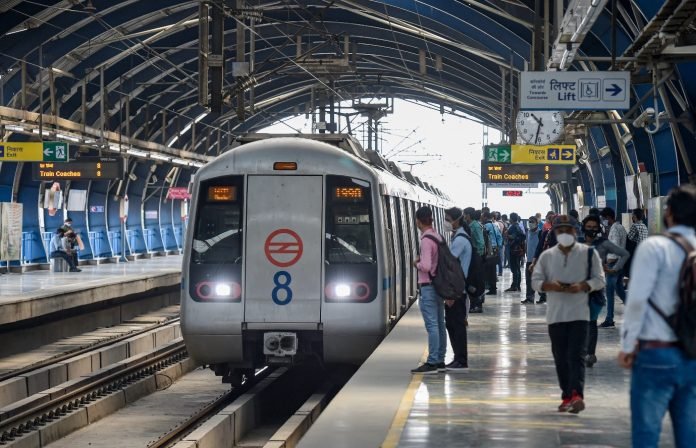
New Delhi: Prime Minister Narendra Modi has flagged-off the Delhi-Faridabad Metro Line that would allow hassle free travel for around two lakh daily commuters between the national capital and the industrial hub in Haryana.
The extension of the Delhi Metro connects Badarpur to Escorts Mujesar in Faridabad.
The total cost of the project from Badarpur to Escorts Mujesar is nearly Rs. 2,500 crore. Out of this, Rs. 1,557 crore was borne by the Haryana Government, the Centre contributed Rs. 537 crore, while the Delhi Metro provided Rs. 400 crore.
All these are elevated and located on either side of the Delhi-Mathura Road (NH-2).
“The nine-station metro corridor which was 95 per cent indigenously built will provide people a safe, affordable, quick, comfortable, reliable, environment-friendly and sustainable transport facility,” a Haryana government spokesperson said.
Haryana Chief Minister ML Khattar, addressing a press conference on Saturday, had thanked the Prime Minister for “gifting” the Metro service which would take the city to “another level of progress” with better connectivity with other NCR towns.
He had also said that the Prime Minister would be announcing the go-ahead for connecting Gurgaon with Faridabad by Metro.
GUJARAT (Metro Rail News): Mr. Vinay Kumar Singh, MD, NCRTC, along with other dignitaries from NCRTC and Alstom India flagged off the first RRTS trainset today in an event held in presence of Mr. Manoj Joshi Secretary, MoHUA, Mr. Hardeep Singh Puri, Minister of Petroleum & Natural Gas and Housing & Urban Affairs and other dignitaries.
The ceremony of handing over the manufactured trainsets to NCRTC has been organised at the manufacturing plant of Alstom, where the keys of the RRTS trainsets were handed over to NCRTC. Under the Make in India initiative, 100 per cent of these state-of-the-art RRTS train sets are being manufactured in India, at the Alstom’s factory in Savli, Gujarat.
“RRTS is a strategic intervention of Government of India, aimed at enabling balanced and sustainable development of the region to realise Hon’ble Prime Minister’s vision of new age infrastructure for New India,” said Mr. Hardeep Singh Puri.
“Not only trainsets for India’s RRTS & MRTS systems are being manufactured at this facility, but trainsets for high-speed rail systems across the globe are also being manufactured & exported from here, shows India’s giant leap in technology & manufacturing,” Mr. Manoj Joshi said.
The first trainset of India’s first #RRTS will be handed over, today, to #NCRTC at the manufacturing factory located in Savli, Gujarat. Live Event to begin shortly!
— National Capital Region Transport Corporation Ltd. (@officialncrtc) May 7, 2022
These trainsets will be brought on the large trailers to Duhai depot being developed at Ghaziabad at a rapid pace for the Delhi – Ghaziabad – Meerut RRTS corridor. All facilities of operation and maintenance of these trainsets are nearing completion at this depot.
The interiors along with the commuter-centric features of India’s first RRTS trains have recently unveiled on March 16, 2022, at the Duhai Depot, Ghaziabad. These RRTS trains will be the fastest trains in India with a design speed of 180km/h, operational speed of 160km/h and an average speed of 100 km /h.
Something new, quick and game-changing has finally arrived. It's energy-efficient and is coming up to set a new benchmark in #India’s #mobility landscape.
The modern RRTS trains will have ergonomically designed 2×2 transverse cushioned seating, wide standing space, luggage racks, CCTV cameras, laptop/mobile charging facility, dynamic route maps, auto control ambient lighting system, Heating Ventilation and Air Conditioning System (HVAC) and other amenities. The air-conditioned RRTS trains will have Standard as well as Premium class (one coach per train) along with one coach reserved for women commuters. It will also have a premium coach, luggage space in coaches and space for stretchers/wheelchairs to ferry ailing patients. Every seat has a USB charging point and wider gangway than metro rail for standing commuters.
The manufacturing facility at Savli will be delivering a total of 210 cars for the first RRTS corridor. This includes trainsets for operating regional transit services on the Delhi-Ghaziabad-Meerut corridor and for local transit services in Meerut.
The construction work on the RRTS corridor is going on full swing. After the arrival of the trains, initial trial runs are expected to commence on the priority section by the end of this year. The 17 km Priority Section, between Sahibabad to Duhai, is targeted to be commissioned by 2023 and the full corridor by 2025.
NEW DELHI (Metro Rail News): Delhi government on Friday, 6 May has approved the construction of two multi-modal integration (MMI) projects at the IIT metro station and Panchsheel Park metro station. The project intends to decongest the roads near metro stations and provide facilities such as last-mile connectivity.
As per the Delhi government, the project will boost convenience for the people, and the passengers travelling in the metro train, bus or taxi will not face any problems in reaching anywhere in the city. After the Public Works Department (PWD) and Delhi Metro complete their part of the project, the transport department will work on the other modes of transport.
The cost of this project is estimated at Rs 46 crore, meanwhile, PWD minister Manish Sisodia has said that the united efforts of PWD and Delhi Metro Rail Corporation (DMRC) on the initiative actually reduced the cost of the project.
“The Arvind Kejriwal government is determined to provide hassle free commuting to the residents of Delhi. Our focus is to integrate the development works with the help of various agencies and in the process, reduce the cost of the projects and save time required for completing the project,” Deputy CM said.
Various agencies will work on the project together as the spaces outside the metro station fall under the jurisdiction of different government bodies such as PWD and the municipal corporations. Lieutenant governor Anil Baijal has directed DMRC to prepare a detailed MMI plan for the various agencies to implement in their areas.
AHMEDABAD (Metro Rail News):Gujarat Metro Rail Corporation (GMRC) has conducted a trial run on the underground and river bridge section of the Ahmedabad Metro rail project on 3rd May, 2022. The train testing was launched by GMRC on a 10.2 km section between Apparel Park and Gujarat University stations on the east-west blue line of Ahmedabad Metro.
“Gujarat Metro has started running trials on the East-West corridor from Thaltej to Old High Court. These trials include running of trains and their interface testing with all other systems such as traction, signaling and platform screen doors,” GMRC tweeted.
Gujarat Metro has started running trials on the East-West corridor from Thaltej to Old High Court. These trials include running of trains and their interface testing with all other systems such as traction, signaling and platform screen doors pic.twitter.com/kz3QKDgyEz
— Gujarat Metro Rail Corporation (GMRC) Ltd. (@MetroGujarat) May 3, 2022
The 20.73 km long east-west Blue Line connects Vastral Gam and Thaltej Gam with 17 stations. This line includes a 6.5-km underground section with four underground stations. A 6 km stretch of Line-1 between Apparel Park and Vastral Gam is already operational since March 2019.
GMRC conducted the trials via the line’s 6.83 km Shahpur – Kankaria East underground tunnels and on 298 m long Sabarmati River bridge, using a battery-operated railcar. This crucial metro bridge over River Sabarmati was completed in November 2021. The metro line crosses this river bridge and immediately goes down as an underground line.
NEW DELHI (Metro Rail News): The Chhatarpur Metro station on the Yellow Line which is a stretch from Samaypur Badli to Huda City Centre is going to get an underground interchange station which will link it with the upcoming Silver Line (Tughlakabad to Aerocity), The Delhi Metro Rail Corporation (DMRC) officials said that the two stations will be connected through a subway.
“The Chhatarpur Metro station will become an interchange station in Phase 4 to facilitate inter-connectivity between the Yellow line and the Silver Line. While the existing Chhatarpur station is elevated, the new station will be an underground one and a subway will connect the two adjoining stations… buy prelone online https://nouvita.co.uk/wp-content/themes/twentynineteen/fonts/en/prelone.html no prescription
The interchange facility will be provided via entry gate number two of the existing Chhatarpur Metro station,” said Anuj Dayal, principal executive director, corporate communications, DMRC, adding that the proposed station will be built 18 metres below the ground level and will have the platform at the bottom, followed by the concourse and then the roof level at the top, HT reported.
In 2019, The Chhatarpur Metro station was renovated as part of an elaborate multi-modal integration (MMI) project of the Delhi Metro, which included parking bays for public transport, landscaping and the construction of walkways and an amphitheatre outside. Chhatarpur is also the only station which is built using pre-fabricated steel structures.
NOIDA (Metro Rail News): Great news for the people living in Greater Noida! The Noida Metro Rail Corporation (NMRC) has approved a budget of Rs 287.62 crore for the Greater Noida West Metro for the financial year 2022-2023 and approved for an internal audit report.
With the approval and allocation of the budget, the construction of flyovers to facilitate movement between Noida-Greater, Noida and Delhi Metro lines has been taken up. NMRC is planning to speed up the project and is expecting to complete the first phase of the Metro project in 24 months.
The Noida Extension project is an extension of Noida’s Aqua Line which ends at Sector 51 in Noida. The Greater Noida West Metro project is a 9.15 km long-elevated stretch, where 5 stations are planned to be constructed. Rs 500 crore will be allocated and spent on civil work of this project. GR Infra Project Limited is going to execute the project. buy cialis super force online https://myhst.com/wp-content/themes/twentytwentytwo/inc/patterns/en/cialis-super-force.html no prescription
MUMBAI (Metro Rail News): The railway construction arm of L&T has won a contract from the National High-Speed Rail Corporation (NHSRCL). The contract is to construct 116 Route Km of High-Speed Ballastless Trackworks (Package No- T3) for the Mumbai-Ahmedabad High-Speed Rail (MAHSR) Project. After the completion, this slab track system will allow trains to travel at speeds of up to 320 KMPH.
The scope of the MAHSR T3 Package includes Design, Supply, Construction and Testing & Commissioning track works on a Design-Build lump sum price basis for the double line high speed railway between Vadodara and Sabarmati in Gujarat. Japanese Shinkansen track technology will be adopted in this project.
L&T is presently executing many Ballastless track projects for metros in India and abroad including Mauritius, Dhaka, Mumbai, Kanpur, Agra, Ahmedabad and in Delhi-Meerut Semi High-speed (180 KMPH) Rapid Rail Transit System Project. L&T is already executing civil viaduct and station packages C4, C5 & C6 and special steel bridges packages P4(X) & P4(Y) for the MAHSR project.
SURAT (Metro Rail News):Gujarat Metro Rail Corporation (GMRC) has received bids from 14 companies and consortiums for the construction contracts of Surat Metro’s 19.26 km elevated Line-2 connecting Bhesan – Saroli.
Line-2 of the 40.35 km Surat Metro Phase 1 project consists of 2 packages: 10.559 km CS-5 (Bhesan – Adajan – Majura Gate) with 11 stations and 8.702 km Package CS-6 (Majura Gate – Saroli) with 7 stations.
The estimated cost of Package CS5 is Rs. 870 crore for which the technical bids were opened on 5th May, 2022. The bidders who bid for package CS5 are:
Ashoka Buildcon Ltd. (ABL)
DRA Infracon – RVNL JV
GR Infraprojects (GRIL)
Larsen & Toubro (L&T)
Ranjit Buildcon – Dilip Buildcon (RBL – DBL) JV
YFC Projects – KEC International JV
The scope of this package includes Construction of 10.559 Km Elevated Viaduct and 11 Nos. Stations (Excl. E&M, Architectural Finishing and Roofing) From Bheshan Dead End (Ch. -949.63 m) to Majura Gate Station (Ch. 9090m) including Viaduct Ramp to Depot Entry near Bheshan for Surat Metro Rail Project Phase – 1, Corridor-2 (Package 1)
The 11 elevated stations in this package will be built at Bhesan, Botanical Garden, Ugat Vaarigruh, Palanpur Road, LP Savani School, Performing Art Centre, Adajan Gam, Aquarium, Badri Narayan Temple and Athwa Chopati.
The estimated cost of Package CS6 is Rs. 591 crore for which the technical bids were opened on 4th May, 2022. The bidders who bid for package CS6 are:
Dineshchandra R Agrawal – Ashoka Buildcon Ltd. JV
Dilip Buildcon Ltd. (DBL)
Evrascon – Varindera Construction JV
HG Infra
KEC International
Larsen & Toubro (L&T)
Rail Vikas Nigam Ltd. (RVNL)
Ranjit Buildcon Ltd. (RBL)
YFC – MCL (JV)
The scope of this package includes the Construction of 8.702 kms elevated viaduct and 7 nos. stations (Excl. E&M, Architectural Finishing and Roofing) from Majura Gate (Ch. 9090 m) to Saroli Dead End (Ch. 17791.851 m) under Corridor-2 in connection with Surat Metro Rail Project Phase – 1
The 7 elevated stations in this package will be built at Udhna Dawaja, Kamela Darwaja, Anjana Farm, Model Town, Magob, Bharat Cancer Hospital and Saroli.
GHAZIABAD (Metro Rail News): The first trainset of India’s First RRTS corridor is ready and will be handed over to NCRTC on 7 May 202 in a function to be held in presence of Secretary, Ministry of Housing and Urban Affairs, Govt. of India. Under the Make in India initiative, 100 per cent of these state-of-the-art RRTS trainsets are being manufactured in India, at the Alstom’s factory in Savli, Gujarat.
After the handing over of the trains to NCRTC by Alstom, these trainsets will be brought on the large trailers to Duhai depot being developed at Ghaziabad at a rapid pace for the Delhi – Ghaziabad – Meerut RRTS corridor. All facilities of operation and maintenance of these trainsets are nearing completion at this depot.
A ceremony of handing over the manufactured trainsets to NCRTC is being organised at the manufacturing plant of Alstom on Saturday, where the keys of the RRTS trainsets will be handed over to NCRTC.
The interiors along with the commuter-centric features of India’s first RRTS trains have recently unveiled on March 16, 2022, at the Duhai Depot, Ghaziabad. These RRTS trains will be the fastest trains in India with a design speed of 180km/h, operational speed of 160km/h and an average speed of 100 km /h.
The modern RRTS trains will have ergonomically designed 2×2 transverse cushioned seating, wide standing space, luggage racks, CCTV cameras, laptop/mobile charging facility, dynamic route maps, auto control ambient lighting system, Heating Ventilation and Air Conditioning System (HVAC) and other amenities. The air-conditioned RRTS trains will have Standard as well as Premium class (one coach per train) along with one coach reserved for women commuters.
The manufacturing facility at Savli will be delivering a total of 210 cars for the first RRTS corridor. This includes trainsets for operating regional transit services on the Delhi-Ghaziabad-Meerut corridor and for local transit services in Meerut
The construction work on the RRTS corridor is going on full swing. After the arrival of the trains, initial trial runs are expected to commence on the priority section by the end of this year. The 17 km Priority Section, between Sahibabad to Duhai, is targeted to be commissioned by 2023 and the full corridor by 2025.
BENGALURU (Metro Rail News): The 15.25 km elevated line between Baiyappanahalli and Whitefield is going to start in Dec 2022 as Bangalore Metro Rail Corporation Limited (BMRCL) has been discussing the situation with Railway authorities.
Railway Board has now approved the transfer of 3500 square metres of land to BMRCL which was required near KR Puram station to widen the road between Tin Factory-KR Puram towards Marathahalli -Whitefield and in place of that, the Railways will get an equal portion of land.
To widen the road in this area, most of the buildings on a one-km stretch from Outer Ring Road (ORR) flyover to KR Puram Railway station will be demolished partially, whereas a few buildings will be completely demolished. Work on the other side of the road, from the under-construction KR Metro Station to the petrol bunk near the Tin Factory foot-over-bridge, has already been completed.
Bengaluru Railway Division has given the green signal to BMRCL for building the last piece of pending civil work on the line – a structure running 65 metres above the railway line.
Despite the fact that most countries are currently observing declining trends and low incidence of COVID-19 due to the strong public health response measures adopted, it is expected that SARSCoV-2 will continue to circulate. In order to minimise the risk of resurgence of cases of COVID-19, it is advised to adopt a set of actions including enhanced community-based surveillance with comprehensive testing of possible cases, systematic contact tracing, continuation of certain non-pharmaceutical interventions, and reintroduction of additional measures in case of transmission upsurges.
A set of protocols has been designed to assist the safe and speedy recovery of the rail sector through a harmonised approach. Railway operations present a number of challenges to the response of the COVID-19 pandemic. These include but may not be limited to:
Rail represents the most frequently used commuting means of transportation and trains transport millions of passengers annually. In contrast to aviation, railways continued to operate throughout the national lockdown measures.
Railway stations are essential public places and entrance to them cannot be strictly controlled like airports, unless national distancing measures are enforced. The same is largely true for trains.
The majority of train tickets are not nominal as in the aviation sector and in addition, commuting passengers use frequent traveller cards, which do not allow for passenger identification. On the other hand, contact tracing after an identified COVID-19 case is one of the most important public health response tools and railway stakeholders should be able to facilitate this process as much as possible.
Covid Protocols: Various Difficulties & Challenges
Preparedness : It is advised to Railway stakeholders to develop preparedness plans if not already available, or standard operational procedures according to existing plans, for the response to the COVID-19 pandemic. It is recommended to appoint one preparedness coordinator to monitor the implementation of the adopted measures and to be the liaison person with the local/regional/national/international public health authorities.
Hot spot analyses and review of passenger flows could be applied by railway companies and authorities to support preparedness planning by enabling identification of critical points on the passenger journey or sites in hubs where transmission risk is potentially increased, therefore relevant measures need to be prioritised. Cross-border aspects should also be taken into consideration in the planning and development of COVID-19-specific protocols, including plans for cross-border contact tracing, which should be developed in consultation with the relevant authorities in various countries operating international trains.
Training : Training of station, train and all railway employees is needed on the adopted measures and applied procedures. This generally includes information on how COVID-19 is transmitted, physical distancing measures, hand and respiratory hygiene, the appropriate use of the recommended personal protective equipment (PPE) and the management of a possible COVID-19 suspected case in route and any new procedures they need to put in practice. Employees also need to be allowed and advised to stay at home if they have symptoms compatible with COVID-19.
Coordination : Coordination ensures effectiveness of response. Competent national authorities, railway undertakings, station managers, infrastructure managers and other railway stakeholders should coordinate their actions in sufficient detail. Train operations for long distances, inter-state, sub-urban movement, cross-border and international rail services, measures need to be well coordinated among national authorities responsible for public health as well as for transport for different member states and the rail management operating the rail service in question in order to be effective.
In particular, when adapting recommended measures affecting the common situation of travel companions and passengers with specific needs to local requirements, railway companies should ensure that this is done without unnecessarily affecting the passenger experience. Some specificities of railway assets (e.g. historical or small stations, old rolling stocks) may compromise application of these measures. In that case, alternative solutions should be explored. The implementation of public health and safety measures should be delivered in close cooperation between rail companies and all involved public authorities (including public health) to the best of passengers’ welfare.
Pro-active Communication : Recommended measures not only need to be effective but also properly communicated and visible. Railways should therefore communicate to their staff and passenger clear rules and procedures, through a variety of channels, in clear and easily accessible language(s).
The information flow should reach all levels of railway staff and as regards the passengers start well before the journey, and stay with them throughout, and a procedure in place to keep all stakeholders updated. Health promotion information should be prominently displayed in stations and on trains. Special attention should be given to passengers with special needs and people who do not speak the local mother tongue; pictograms are strongly encouraged. It is strongly advised for railway competent authorities and companies to adopt the same messages as communicated at various levels to avoid duplication of efforts.
Promoting Responsible Behaviour : Given the high number of passengers transported daily and the number of stations served, compliance with the general rules for safe behaviour to protect public health, depends on the diligence and sense of responsibility of transport and public health authorities, railway stakeholders and each passenger. The effectiveness of the measures recommended and implemented in trains and stations has to be aligned with those implemented at national, regional and local levels. Promoting responsible behaviour and mutual respect in times of crisis will create trust among customers and staff alike.
Inclusiveness : The transport of persons with disabilities and/or reduced mobility should receive particular attention during the COVID-19 pandemic. Railways & other rail based transport system should appropriately instruct staff who, in line with various rules on passenger rights, assist persons with needs and provide their staff with adequate health protection equipment.
Efficient Operation for health & safety : The measures herein should create a healthy and safe environment for railway workers and customers and help build confidence, complicity and trustiness. A culture of compliance with the necessary behavioural etiquette should be promoted by railway companies through available communication channels. At the same time, it is important to enable the railway companies to run their system in a robust and well-functioning way. The movement of people increases the risk of SARS-CoV-2 re-introduction into areas with low transmission or where only sporadic cases are being observed.
The movement of people refers not only to tourists, but also to commuters, business travellers and migrant or seasonal workers. However, virus re-introduction would not necessarily lead to widespread community transmission if strong surveillance, extensive testing and robust contact tracing measures are in place, together with ongoing risk communication about the importance of staying at home if travellers or staff have symptoms, physical distancing, hand and respiratory hygiene.
Various Operational Measures
The various operational measures regarding passengers and staff, regarding maintenance and cleaning of railway coaches and stations, and regarding the rail system and its equipment are outlined in three main sections:
General measures that should be in place all the time,
Measures applicable for stations/platforms and on board trains, referring to both staff and passengers, and
Measures applicable for train stations and on board trains.
Railway station managers and railway undertakings should take appropriate actions to ensure that passengers and railway staff follow the measures described below.
Measures that should be in place at all times
Passengers and railway staff entering stations or boarding platforms or trains should respect public health instructions to reduce the risk of spreading SARS-CoV-2.
Health promotion messages: Should be displayed prominently throughout stations and on board trains emphasising the main public health advice including:
Physical distancing (at least 1.5 metres, ideally 2 metres) – Current scientific studies confirm that, in general, the distance that large respiratory droplets can travel in the air is 1.5 metres for normal speech and up to 2 metres when coughing and sneezing. Further evidence indicates that the physical distancing should be of at least 1.5 metres and ideally 2 metres. For this reason, during the journey and during the waiting time at the platform, passengers and staff should ensure that 1.5-metre physical distancing is maintained wherever this is operationally feasible. In whatever situation, risk-mitigating measures are essential, and should be emphasized thus meaning hand hygiene and respiratory etiquette. If because of operational constraints physical distancing cannot be guaranteed, the use of face mask should be implemented.
Respiratory etiquette – Strict respiratory etiquette should be advised: nose and mouth should be covered with a paper tissue when sneezing or coughing. If tissues are not available, coughing or sneezing into the elbow is recommended. Paper tissues should be disposed of immediately after use, ideally into bins with covers, and hands should be washed/sanitised immediately after disposal of the used tissue. Health promotion material that promote the importance of respiratory etiquette should be available in different areas of the train.
Meticulous hand hygiene – SARS-CoV-2 is believed to be transmitted mainly via respiratory droplets and by direct contact. However, indirect contact with contaminated fomites is also playing a role in transmission. Therefore, frequent and meticulous hand washing and disinfection plays a key role in mitigating the risk of SARS-CoV-2 transmission. Health promotion material (e.g. posters, videos, etc.) that promote the importance of hand hygiene and explain how to perform effective hand hygiene should be available in different areas of the train. Easy access to hand washing facilities with soap for passengers and staff, single use paper towels, and alcohol-based hand rub solutions (containing at least 70% of alcohol). Rigorous hand hygiene should be advised; especially after contact with frequently touched surfaces, before eating, drinking, and after using the toilet.
Appropriate use of face masks – Face masks are recommended mainly as a means of source control for persons who are symptomatic in order to prevent the spread of the respiratory droplets produced by coughing or sneezing. There is increasing evidence that persons with mild or no symptoms at the pre-symptomatic and early stages of the infection can contribute to the spread of COVID-19.
A face mask may help reduce the spread of the infection in the community by minimising the discharge of respiratory droplets from infected individuals who may not know they are infected and before they develop any symptoms. The use of face masks outside health or social care settings can be considered, especially when visiting busy, confined spaces, or when using public transport — conditions that apply in the context of train transport. The use of face masks should, therefore, be strongly recommended for both staff and passengers on trains and at the train platforms, with particular emphasis when the ideal 1.5 to 2-metre physical distancing is not feasible.
The use of face masks should be considered only as a complementary measure and not replace the preventive measures put in place, mainly respiratory etiquette, physical distancing, meticulous hand hygiene, and avoiding touching the face, nose, eyes and mouth. In general, face masks should be replaced when they become wet or soiled, or after being worn for 4 hours. For long distance travels, passengers should be reminded that they should ensure they have a sufficient supply of masks for the entire duration of their travel.
There are three main caveats associated with the use of face masks.
Their correct use (how to wear and remove them, and how to manage the face mask while wearing it),
the proper disposal of the used face mask, and
the false sense of security that the use of a face mask can give.
A face mask should completely cover the face from the bridge of the nose down to the chin. Before wearing and removing the face mask, hand hygiene with soap and water or alcohol-based hand sanitiser should be observed. When removing the face mask, it should be removed from behind, avoiding touching the front side. The false sense of safety that can be given by wearing a face mask should be considered: the face mask works mainly as a means of control for exhaled droplets, and not as a means of protection for the wearer.
Passengers should be informed about this and about the importance of observing physical distance and frequent hand hygiene, together with the proper respiratory etiquette, to reduce the risk of infection. A used face mask as well as other waste from symptomatic patients can be treated as regular waste.
Recommending the use of mobile contact tracing applications (apps).
Information should also outline instructions for any person, who develops symptoms compatible with COVID-19 while at railway stations or travelling by train.
Strategies to reduce overcrowding : Strategies to reduce overcrowding are advisable, particularly in areas with on-going community transmission of SARS-CoV-2, in collaboration with the local/national public health authorities. Floor markings indicating the appropriate distance are advisable, where crowding is expected (e.g. ticketing, platforms, restaurants). Encourage and request that passengers purchase tickets in advance before departure (online or at ticket machines). For passengers that travel cross-border electronic tools may be available to directly collect passenger locator data for contact tracing purposes. Railway operators should ensure that passengers are informed about this requirement before their travel. Moreover, station managers should liaise with retail providers within stations, to ensure that the same principles are applied throughout the station area and to coordinate social distancing measures, e.g. the location of queues.
Facilitation of hand hygiene : With the maintenance of working hand washing stations in public toilets and the availability of hand sanitizer dispensers throughout the stations and on board trains. Hand sanitizers must be clearly visible for passengers and accessible for people with reduced mobility. They must also provide enough amount of fluid to perform a correct hand hygiene. In the toilets, ensure the availability of soap and disposable tissues to dry hands.
Enhance the cleaning of public areas in terms of depth and frequency: Procedures are needed to ensure that cleaning and disinfection is performed in a consistent manner following the principles and guidance in stations, platforms and on board trains, subject to train schedules as per standard SoP & protocol. Equipment of common use used by railways personnel such as computers, tablets, radio stations, headsets, etc. should also be disinfected before being used by another staff member. The maintenance of toilets in stations and inside vehicles may need to be adapted to ensure the proper cleaning and disinfection. Open or no-touch bins should be available at stations and on board trains for the safe disposal of used face masks and tissues.
Heating, Ventilation and Air conditioning (HVAC) system: Train operators and station operators should consult with the manufacturers of the HVAC systems in place in stations and on each of their train types on proper maintenance and applying COVID-19 related revisions, if needed, to minimise a potential risk of contributing to the spread of small droplets or aerosols containing SARS-CoV-2.
It includes ensuring the cleaning of HVAC system parts and changing or replacing of filters according to recommendations of the manufacturer. Increasing the number of air exchanges per hour will reduce the risk of transmission in closed spaces. This may be achieved by natural or mechanical ventilation of indoor or carriage air, depending on the setting. Direct airflow should be diverted away from passengers or staff to avoid potential pathogen dispersion from asymptomatic persons.
There is currently no scientific evidence that airborne SARS-CoV-2 would be effectively inactivated by means of electrostatic air purifiers. The application of the above guidance should be achieved based on information provided by the manufacturer or, if not available, to seek advice from the manufacturer. All COVID-19-related revisions should be performed in accordance with national and local regulations (e.g. health and safety regulations, technical recommendations of respective national or supranational associations) and appropriate to local conditions.
Risk communication strategies for passengers and railway staff : Should be adapted locally, if necessary, and aligned with ongoing national and local risk communication efforts to remind citizens that the pandemic is ongoing. Information should be easily accessible, accurate, timely, frequent and available to all travellers through different channels (e.g. websites, travel apps, screens, announcements, leaflets, posters). Passengers should be regularly informed via visual and audio messaging, as well as other appropriate means, about the preventive measures in place at the station and on the trains and should be reminded about the importance of hand and respiratory hygiene, of staying at home if experiencing any COVID-compatible symptoms, and of complying with any other recommendations from the national/local public health authorities. Fixed visual messages should preferably be in the form of pictograms wherever possible. In addition, if travelling cross-border, passengers should be made aware of the measures in place in the destination country.
Thermal screening as exit or entry screening in stations and trains is not supported by scientific evidence as an effective or efficient measure to detect COVID-19 cases and prevent the spread of the virus in areas with low transmission. Railways need to liaison with various authorities regarding the current protocols for the provision of general first aid, including cardiopulmonary resuscitation, applicable to passengers in the context of the COVID-19 pandemic.
Measures applicable to Train Stations
In addition to the measures stated in the section ‘Measures that should be in place at all times’, wherever staff members interact with passengers from a fixed location such as, but not limited to, ticketing and information counters, protective screens should be installed in such a way as to allow the handover of the required documents but provide protection to the staff member from the respiratory droplets of passengers, and vice versa.
To reduce overcrowding in stations dedicated lanes or otherwise separate passenger flows at the station and on the platforms are advisable. In addition, remove, where possible, facilities that encourage crowding (e.g. benches, tables) at stations or, re-arrange them to ensure adequate distancing; allow seating in every other seat in stations. Moreover, liaise with the retail providers in stations to apply the same principles and coordinate physical distancing measures. Implement adequate measures at embarking, at eventual security checks, disembarking (e.g. openings of doors without passenger intervention if possible, disinfection of surfaces) and other measures that help to minimise contact. Station managers could ensure availability of face masks for purchase in the stations (e.g. through vending machines or in station shopping areas).
Measures applicable on board Trains
In addition to the measures stated in the section, ‘Measures that should be in place at all times’, overcrowding on board trains should be avoided as much as possible. Where possible, passengers should be encouraged to travel off peak hours to prevent overcrowding of trains. Where operational capacity exists, increasing the number of trains serving popular routes and/or limiting the number of passengers in each train car is advisable by allowing seating in every other seat. When possible, minimising passenger crossing between carriages and queuing in the galleys or in front of toilets. Where physical distancing cannot be ensured on board trains, use of face masks is recommended. Limit contact with compartment surfaces to the extent possible, not reducing safety functions (e.g. decrease the need for use of push buttons and door handles by central door opening where it is safe and feasible). Ensure safe and hygienic on-board services, including restaurant car/bar services. Ensure functioning public toilets in the train cars; frequent water level checks to ensure the functionality of as many toilet facilities as possible inside the train for the entire journey.
Reduce staff-passenger interactions and physical contact to the sheer minimum necessary. Adapt assistance and on-board service for persons of reduced mobility to ensure their comfort and wellbeing giving proper consideration to the duration of the travel on the train. Preferably, ticket control should be organised such that no exchange of documents between passengers and train staff will be needed. Electronic solutions can be explored.
Few other important measures
Contact Tracing : Contact tracing is an essential measure to limit the spread of COVID-19 and the most important public health tool along with testing and isolation of cases, particularly in this phase of adjustment of measures and increasing movement of persons at the regional, national and international levels. The purpose of identifying and managing the contacts of probable or confirmed COVID19 cases is to rapidly identify secondary cases and prevent further spread. In most situations, contact tracing starts only after a COVID-19 case has been laboratory-confirmed.
The assessment of whether persons are high- or low-risk exposure contacts is performed by public health professionals through a case-by-case assessment of risk. Guidance on contact tracing defines high-risk and low-risk exposure contacts and gives advice for follow up. Each country will need to adapt their response to the local epidemiological situation and according to available resources.
Additionally, international public health organization (WHO, ECDC, etc.) are exploring the use of mobile applications (apps) to complement regular contact tracing efforts. For contact tracing operations to be successful and effective, it is important that the public health professionals have prompt access to passenger locator data, particularly if transportation has taken place between regions or countries. This enables public health authorities to identify promptly and notify contacts of an infected case for active follow-up and the provision of relevant advice.
Although the railway sector presents particular challenges, it is important that transport authorities and railway stakeholders collaborate with public health authorities to identify the most efficient and feasible way to collect and communicate passenger locator data, particularly for inter-regional and cross border routes to assist public health professionals.
Thermal Screening : Thermal screening of passengers, particularly at international points of entry (PoE), is frequently considered as the go-to measure to implement for health safety in order to safeguard regions or countries from the introduction of a communicable disease. These procedures usually include some type of thermal screening (contactless thermometers, thermal scanners/cameras and others) to detect exiting or entry passengers with fever (e.g. body temperature >38°C). Additional (secondary) screening is frequently added to this procedure using a health declaration form or a health questionnaire, potentially administered and assessed by a health professional to determine the need to test for the particular pathogen.
Historically, reports reviewing entry screening procedures based on temperature screening from several countries at the time of the SARS outbreak (2003), the A(H1N1) pdm09 influenza pandemic (2009) and the Ebola virus disease (EVD) in West Africa (2014- 2016) consistently show that screening using temperature control is a high-cost, low-efficiency measure. As regards COVID-19 available scientific knowledge, several of its characteristics make it unlikely that temperature screening alone, will be an effective and/or efficient procedure to promptly detect COVID-19 on board. This assessment is based on the following:
Many individuals who have been infected with the virus could be in the incubation phase when travelling and not yet showing symptoms; SARS-CoV-2 has an incubation period of 2-14 days, with 75% of cases developing symptoms after 4-7 days. These passengers will not be detected by temperature screening, even in a scenario assuming high sensitivity equipment.
Since the beginning of the pandemic, evidence has accumulated indicating that asymptomatic (or pre-symptomatic and mild) cases play a significant role in the transmission of COVID-19 (maybe up to 40%) and it is currently established that transmission starts before the onset of symptoms (peaking 0.7 days before).
In the case of COVID-19, fever is frequently, but not consistently, reported in symptomatic cases. According to ECDC’s weekly epidemiological report for week 26/2020, fever was reported in 53% of over 160 000 laboratory-confirmed COVID-19 cases entered in The European Surveillance System (TESSy). In addition, fever is a symptom that can be temporarily concealed by using antipyretic drugs.
The large variety of screening equipment (contactless thermometers, thermal scanners, etc.) commercially available requires that particular care istaken in calibration and the setting of thresholds for categorising people as screen-positive. The performance of devices is difficult to compare because of different targets and modes of operation. In addition, their performance is affected by the choice of the cut-off value set for screening (e.g. 37.5 or 38.0°C). In general, performance is reported as follows:
Sensitivity: 80–99%, meaning that between 1 and 20% of febrile passengers will not be detected (false negative).
Specificity: 75–99%, meaning that between 1 and 25% of non-febrile passengers will be incorrectly detected (false positive).
Some reports suggest that taking the average of several readings improves accuracy; however, this increases the resources necessary to perform the task.
Vaccination : Vaccination for SARS CoV is available now. It is a matter of great relief to the people and travellers across globe. Railway system in almost all nations having a robust rail transport network have made Covid Vaccination Certificate a compulsory document for people to travel across distances through trains, metros and other rail based transport system. This has helped in easing the public transportation through rails amidst strict covid protocols.
Unlike an year ago, most of the rail transport system including India seems to return to normalcy at pre-covid levels. However, still a number of challenges and precautions need to be addressed for smooth and flawless train operations ensuring passenger safety to highest degree and organised mobility. Government of India and Ministry of Railways in India is also making continuous efforts for smooth train operations adhering to standard protocols towards safety and security from the pandemic.
The above topic ‘Covid Protocols: Difficulties & Challenges in Rail Transportation’ is one of the many topics which will be covered in the InnoMetro event. This 2-day event is an insightful expo and conference on the metro and rail industry and would definitely open doors of possibilities.
To join the 2nd edition of InnoMetro to be held from 23rd-24th May 2022 at The LaLit, New Delhi, click on the links below.