Home Blog Page 284

Telangana CM to lay foundation stone for Hyderabad Airport Express Metro on 9th December

TELANGANA (Metro Rail News):  Chief Minister of Telangana, K. Chandrasekhar Rao, will lay the foundation for the Hyderabad Express Express Metro next month.

The project’s 31 km length will link Shamshabad’s Rajiv Gandhi International Airport to Hitec City’s information technology hub.

The chief minister will lay the foundation stone on December 9, stated K. T. Rama Rao, minister of municipal administration and urban development.

“Hyderabad is Forging Ahead. Happy to announce that Hon’ble CM KCR Garu will be laying the foundation for Airport Express Metro on December 9,” minister KTR tweeted.

“This project starting at Mindspace junction to Shamshabad Airport will be 31 KM long & will be costing approximately Rs 6,250 crore,” he wrote.

The state government had set out Rs 377.35 crore for the project in the budget of 2022–2023.

In-depth project planning has already been done by the Delhi Metro Rail Corporation (DMRC).

Both elevated and underground parts will be on the projected Airport Express Metro. The underground portion of the length will be about 2.5 kilometres long.

Commuters can get to the airport in just 20 minutes when the project is finished.

The stations on the section are probably Bio-Diversity Junction, Nanakramguda, Narsingi, TS Police Academy, and Rajendranagar.

The city already boasts a 69-kilometre Hyderabad Metro Rail system that is fully functioning. Three corridors make up the elevated Metro.

The state has urged the central government to provide preliminary clearance to the Hyderabad Metro Rail Phase-II Project from BHEL to Lakdikapul, which will cost Rs. 8,453 crores and be a joint venture between the central government and the government of Telangana State (GoTS).

Delhi Metro commences operation of Metro services between Najafgfarh and Dhansa Bus Stand section of Grey Line

NEW DELHI (Metro Rail News): Delhi Metro has commenced the operation of Metro services between Najafgfarh and Dhansa Bus Stand section of the Grey Line through both Up & Down Line movement with an automated signalling system from, i.e, 25th November 2022. Till now, services in this section were being operated through a single line in manual mode.

Services on this Line will now be available with a headway of 07 minutes 30 seconds during peak hours (from the present 12 min)  and 12 minutes (from the present 15 min) during off-peak hours.

In addition, with the commencement of this double line movement, the run-time on Grey Line from Dwarka to Dhansa Bus Stand will also significantly decrease by approx 04 minutes and will be around 08 minutes.

GDA approves TOD zones on either side of RRTS corridor

GHAZIABAD (Metro Rail News): The Ghaziabad Development Authority (GDA) has designed the Regional Rapid Transport System (RRTS) route up to 1.5 km on either side as TOD zones. The latest approval, which will be included in the city’s Master Plan 2031, is anticipated to increase the value of properties near the zones. Continue reading to find out more about the recent development.

The Ghaziabad Development Authority (GDA) has approved the creation of a transit-oriented development (TOD) zone along the RRTS corridor to help the local real estate market. With this choice, TOD zones are established for up to 1.5 km on either side of the rapid rail track.

The Uttar Pradesh government introduced the TOD policy in September of this year. The more excellent Floor Area Ratio (FAR), which will be increased between 33 and 50 per cent of the base FAR of 1.5, will result from the policy’s incorporation. Due to this development, the influence zone will experience vertical growth, and multi-storey buildings will make it possible to add more floors.

Additionally, it is anticipated that the development of TOD zones will generate a yearly income of about Rs 1,500 crore, which will be split equally between the GDA and the NCRTC.

Brijesh Kumar, Secretary, GDA, has shared that the Authority has sanctioned the proposal on TOD around the seven RRTS stations. However, the Board has instructed the concerned officials to invite objections or suggestions from the public before including the same in the Master Plan-2031.

Areas like Guldhar, Duhai, Muradnagar and Modinagar in Ghaziabad will benefit significantly from the policy, opine GDA officials. In Ghaziabad, the land use is primarily agricultural, which will be utilised for mixed, residential and commercial use with this approval, boosting the area’s real estate sentiments.

The Pradhan Mantri Awas Yojana (PMAY) officials resolved to invest Rs 23 crore during the GDA board meeting to construct about 500 housing units in Noornagar.

The Board has also scrapped the ropeway project between Vaishali and Mohan Nagar.

Pune Metro conducted trial run from Garware College Metro to Civil Court Interchange Metro Station

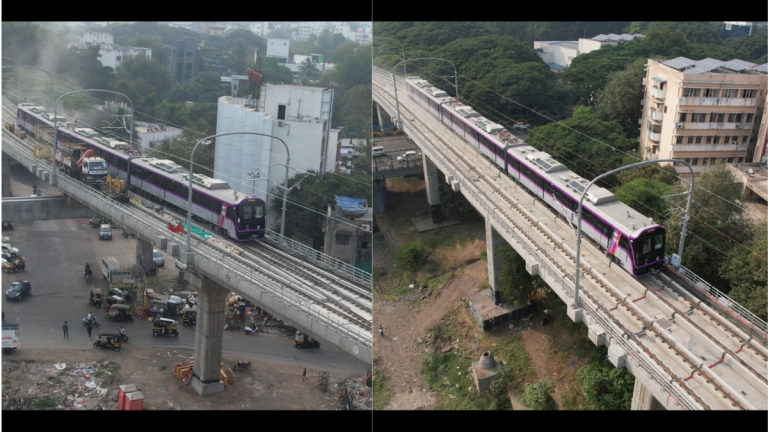
PUNE (Metro Rail News): On 25th November 2022, Pune Metro conducted a trial run from Garware College Metro Station to Civil Court Metro Station. The Metro train left the Garware college station at 2.30 pm. After crossing Deccan Station, Chhatrapati Sambhaji Udyan Station, and Pune Municipal Corporation Station (PMC), it reached the Civil Courts metro station at 3.10. Civil Court metro station is the interchange station where both the lines of the Pune metro meet. The length of this trial run route was 2.74 km. 

Metro officials celebrated this milestone with great enthusiasm and greeted the train with cheers upon its arrival at the Civil Court station. Track Department, Viaduct Department, O & M Department, Traction Department, Signal Department, Telecom Department, and Rolling Stock Department worked round the clock for this test. On 25th November test was conducted per the schedule and planned objectives. In the next few days, more trial runs will be conducted to check and inspect the systems’ working.

After the trial run from Garware College Station to Civil Court Station, a similar trial run will soon be conducted from Phugewadi Station to Civil Court Station. The work of Pune Metro stations is going in full swing on both lines of the Pune metro. Once the work on both lines comes to completion, the CMRS inspection will happen. These routes would be opened for citizens after the observations of CMRS are met.

On this occasion, the Managing Director of Maha Metro, Dr Brijesh Dixit, said, “Today’s trial from Garware College Station to Civil Court Station is a very important milestone. Civil Court Station is an interchange station connecting both lines of the Pune Metro. Soon Phugewadi Station to Civil Court Station will be tested, and this route will be opened for the public in the next few months.”

Hitachi Rail awarded €867 million to deliver digital signalling in central and northern Italy

ITALY (Metro Rail News): Hitachi Rail has been awarded a Framework Agreement worth €867 million as the leader of a consortium of companies to design and deliver European Rail Transport Management System (ERTMS) digital signalling on 1,885 km of the Italian rail network.

The new contract covers central and northern Italy – including Emilia Romagna, Tuscany, Piedmont, Lombardy, Liguria, Veneto and the Friuli-Venezia-Giulia regions.

The contract, awarded by Ferroviaria Italiana (RFI), follows the award of a €500 million framework agreement to Hitachi Rail for the design and implementation of ERTMS digital signalling on 700 km of rail lines across Italy in November 2021.

ERTMS is the most advanced system for the digital control of railways, allowing more trains to use the lines while improving speed and reliability. In addition, the technology will allow trains from neighbouring European countries to operate on Italian lines without interruption, creating one seamless rail system throughout Europe. ERTMS is already used on Italy’s high-speed rail lines, with the benefits extending to regional lines.

The technology includes a radio system enabling communication between the train and the track and automatic activation of emergency brakes in case of danger or if trains exceed the track’s speed limit. By regulating speed, acceleration and braking, the technology enables trains to travel across the network more efficiently, reducing energy consumption and the railway’s carbon footprint.

Hitachi Rail is a global industry leader in digital signalling and is the first provider to introduce ERTMS technology in Europe – in the UK, Italy, Spain, Sweden, and France – and the highly competitive markets of China and India.

Michele Fracchiolla, Executive Director, Europe & Australia – LoB Rail Control Hitachi Rail, said:

“We are delighted with this contract, which will allow us to implement digital signalling technology on an additional 1,885 km of the Italian railway network. ERTMS technology will bring huge benefits to passengers by enhancing train reliability, punctuality and frequency, with the aim of creating- an integrated European rail network.”

CUMTA approves Airport-Kilambakkam Metro rail line project

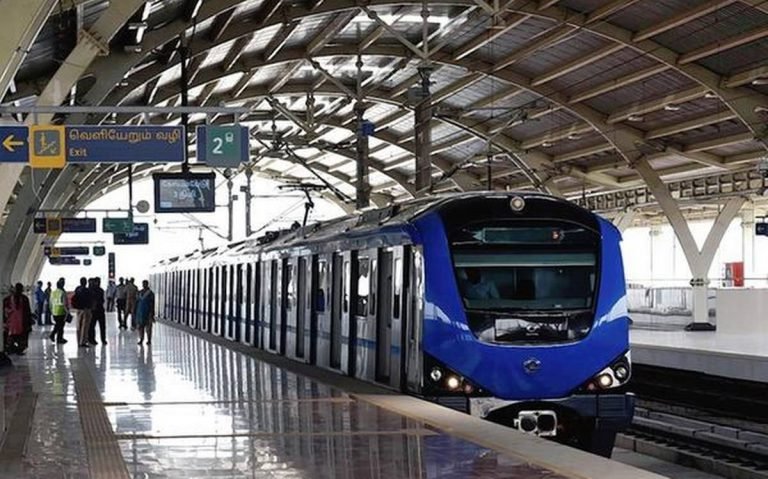
CHENNAI (Metro Rail News): The 15.5-kilometre airport-Kilambakkam Metro rail line has been approved for construction by the Chennai Unified Metropolitan Transport Authority (CUMTA).

With this, the project’s work will start soon. Intermodal connectivity would be available to commuters, allowing them to seamlessly transition between various means of transportation such as metro trains, MTC and outstation buses, and airports.

An estimated Rs 4,080 crore will be spent on the airport to Kilambakkam Metro train extension line.

It will connect several southern suburbs, notably the Kilambakkam under-construction bus terminus, with city core locations beyond Tambaram.

Localities in the southern suburbs, including Pallavaram, Chromepet, Tambaram, Irumbuliyur, Peerkankaranai, Perungalathur, Vandalur, and Kilambakkam, would be traversed by the extension line.

Namma Metro gets Karnataka Government approval for Phase 3 corridor

KARNATAKA (Metro Rail News): The Karnataka Government has given prior permission to the Namma Metro Phase III plan in Bangalore. The total length is almost 45 kilometres; corridor one will be roughly 32 km long, with 22 stations along the route, while Corridor 2 will be 12.5 km long, with nine stops.

Twenty-two stations will be located along Corridor 1, including Kempapura, JP Nagar phase IV, Kadirenahalli, Kamakhya Junction, Hosakerehalli, Dwaraka Nagar, Mysuru Road, Nagarbhavi Circle, Vinayaka Layout, Freedom Fighter’s colony, Sumanahalli Cross, Chowdeshwari Nagar, B.E.L. Circle, Nagashettyhalli, Bangalore Development Authority (BDA) Complex, JP Nagar phase V, JP Nagar, Papireddypalya, Kanteerava Nagar, Peenya, Muthyala Nagar, Hebbal Railway Station, and Kempapura.

Hosahalli, KHB Colony, Kamakshipalya, Sumanahalli Cross, Sunkadakatte, Herohalli, Byadarahalli, Kamath Layout, and Kadabagere are the nine stations that will make up Corridor 2.

The 11 interchange stations along both corridors will be linked to local bus, rail, and suburban railway stations for seamless connectivity. JP Nagar Phase IV, JP Nagar, Kamakhya Junction, Mysuru Road, Sumanahalli Cross, Peenya, BEL Circle, Hebbal Railway Station, and Kempapura are the nine interchange stations on ORR West. In addition, Hosahalli and Sumanahalli Cross are two interchange stations along the length of Magadi Road.

By 2028, the ORR West corridor is forecast to have roughly 4.6 lakh riders, compared to an estimated 1.7 lakh for the Magadi Road corridor. An estimated Rs 16,430 crore will be needed to complete the project. Since both corridors share Sunkadakatte, it will act as the depot.

The SPV (JV) model is used to carry out the project. The Karnataka and Indian governments each contribute 20% of the money, with the remaining 60% coming from other sources. Value-capture finance and creative financing through private engagement will also be promoted as part of the financing strategy.

The Karnataka government has also suggested two double-decker flyovers, one at Kamakhya Metro Station and the other at JP Nagar Metro Station. Each would be 1.5 kilometres long. The integrated structures (Flyover at level 1 and Metro at level 2), whose construction is expected to cost just over Rs 507 crore, will be built by BMRCL, with costs shared in a 3:1 ratio between BMRCL and BBMP.

Pune Metro Line 3 Unveils its official website

PUNE (Metro Rail News): The work of Pune Metro Line 3, aka Puneri Metro, on the Hinjewadi to Shivajinagar route is progressing rapidly. Pune IT City Metro Rail Limited (PICTMRL), a special purpose vehicle company of the Tata Group, and Pune Metropolitan Region Development Authority (PMRDA) are working on the 23-km stretch of the Project.

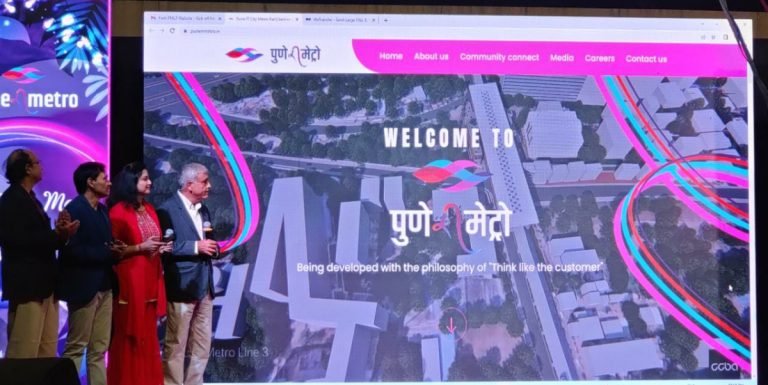
A website has been developed to provide comprehensive information about the Hinjewadi to Shivajinagar Metro Line 3, and it was unveiled on 24th November by Alok Kapoor, Chief Executive Officer of PITCMRL. Neha Pandit, Business Head of PITCMRL and Vivek Kharwadkar, Chief Engineer of PMRDA; Rinaj Pathan, Superintending Engineer PMRDA; Bharatkumar Baviskar, and other officials were present on occasion.

“For Hinjawadi to Shivajinagar Metro Line 3, this website is developed with a special focus on providing all information at one click. While designing and developing the mentioned website, special efforts are put into making it user-friendly and attractive, and simultaneously providing all the necessary information in an integrated form,” informed Neha Pandit, Business Head and Director of Pune IT City Metro Rail Limited.
“Since “the Hinjewadi to Shivajinagar metro line will be known as the Pink Line, it has been given special consideration in the website’s colour scheme. Currently, the website provides basic information about the route, community connection, and traffic management efforts and planning to the citizens. However, as the Project progresses, the website and the content will be updated accordingly, added Neha Pandit.
The formal unveiling of this website (preview) took place on 24th November. After completing some technical aspects, this website will be made open for all citizens within the next month.
About Pune Metro Line 3:
The Pune Metro line III is a ~23 Km elevated Metro rail project connecting the IT hub of Hinjawadi to the Central business district of Shivajinagar. It is a Public Private Partnership (PPP) project awarded by The Pune Metropolitan Region Development Authority (PMRDA) to a consortium consisting of Tata Group’s urban Transport Private Limited (TUTPL) and Siemens Project Ventures GmbH. The Project would be developed and operated on a Design, build, finance, operate and transfer (DBFOT) basis by a special purpose vehicle (SPV), Pune IT City Metro Rail Limited, or PITCMRL, for a Concession Period of 35 years, including the construction period.

Commuters can purchase Mumbai Metro tickets without going to counter

MUMBAI (Metro Rail News): Commuters of the Mumbai Metro One Versova-Andheri-Ghatkopar line may purchase tickets over WhatsApp without going to a ticket counter. The ticket will be delivered as a QR (Quick Response) code.

Commuters must send a WhatsApp “Hi” to 967000 8889. A direct link will be immediately sent that may be utilised to buy tickets.

The QR code will be sent once the payment has been made, and it must be verified at the Automated Fare Collection gate before being allowed to enter the platform.

The QR code will include information on the trip’s type (single/return), origin and destination, fare, and the date and time the ticket was issued.

Previously, commuters had to provide an OTP at the ticket counter to receive the QR code on their mobile device. According to a Metro official, the goal is to increase the number of riders who use digital ticketing methods.

Construction work on Patna Metro Rail starts at Bairiya Chak

PATNA (Metro Rail News): Preliminary construction on the Patna metro rail project has started. The metro rail depot will be constructed on about 76 acres of land at SH-1, Bairiya Chak in Paijawa, 47.4 acres of the area are proposed for a rail depot, while the remaining portions are for property development.

The depot will serve as the hub of the Patna metro rail project. It will accommodate both of the proposed corridors, Corridor I (Danapur-Khemnichak) and Corridor II (Patna Station-Patliputra Bus Terminal), by housing several essential amenities like parking, train repair and maintenance, testing track, stabling yard, depot workshop, operational control room, and an exclusive sub-station.

The project would cost Rs 13,925.50 crores, and the entire work should be finished by March 2025.

By 2027, the 17.9 km long Corridor-I will pass through 7.3 km of elevated and 10.5 km of underground metro lines. The metro stations will pass through Rukkanpura, Raja Bazaar, Patna Zoo, Vikas Bhawan, Vidyut Bhawan, and Patna Station.