New Delhi: Prime Minister Narendra Modi has flagged-off the Delhi-Faridabad Metro Line that would allow hassle free travel for around two lakh daily commuters between the national capital and the industrial hub in Haryana.
The extension of the Delhi Metro connects Badarpur to Escorts Mujesar in Faridabad.
The total cost of the project from Badarpur to Escorts Mujesar is nearly Rs. 2,500 crore. Out of this, Rs. 1,557 crore was borne by the Haryana Government, the Centre contributed Rs. 537 crore, while the Delhi Metro provided Rs. 400 crore.
All these are elevated and located on either side of the Delhi-Mathura Road (NH-2).
“The nine-station metro corridor which was 95 per cent indigenously built will provide people a safe, affordable, quick, comfortable, reliable, environment-friendly and sustainable transport facility,” a Haryana government spokesperson said.
Haryana Chief Minister ML Khattar, addressing a press conference on Saturday, had thanked the Prime Minister for “gifting” the Metro service which would take the city to “another level of progress” with better connectivity with other NCR towns.
He had also said that the Prime Minister would be announcing the go-ahead for connecting Gurgaon with Faridabad by Metro.
DMRC to use BEAM system in Patna metro project for real time monitoring to predict the TBM excavations during tunneling.
PATNA (Metro Rail News): The Patna Metro Rail Project has introduced a state-of-the-art mechanism to monitor the condition of buildings by implementing a suitable Instrumentation and monitoring system and Real Time monitoring while carrying out tunnelling work. DMRC is committed not only to providing hassle-free commuting to its riders but also to keeping people’s safety first as its top priority during the ongoing construction work. Several measures are being taken to put people at ease of their apprehensions regarding the tunnel process staying in nearby areas where tunnelling work is in progress.
Measures and monitoring systems used during the tunnelling work
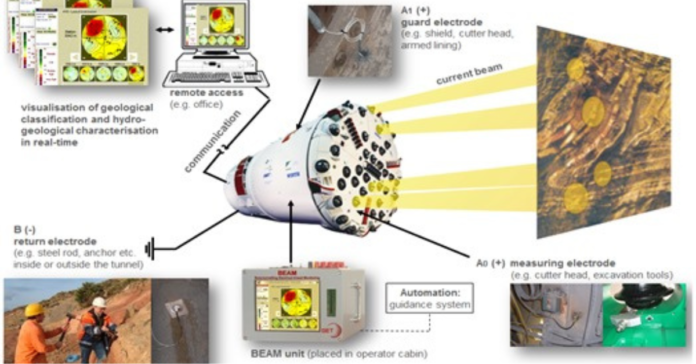
For the first time, BEAM (Bore Tunneling Electrical Ahead Monitoring) system is being used in India and the Patna Metro Project by DMRC to do real-time monitoring to predict the TBM excavations during tunnelling.
What is a Bore Tunnelling Electrical Ahead Monitoring (BEAM) system
The Bore Tunnelling Electrical Ahead Monitoring (BEAM) system is a geophysical ground prediction technique especially designed for TBM operations. BEAM is a non-intrusive focused-electrical induced polarization ground prediction technique, permanently operating while TBM advances.
According to the Instrumentation & Monitoring Plan of Underground stations and tunnel alignment, various instruments like Inclinometer (INC), Strain-Gauge(SG), Inclinometer-cum-Extensometer(I/E), Vibrating Wire Piezometer (VPZ), Multi Point Borehole Extensometer (MPBX), Convergence Point (CP), Ground Settlement Marker (GSM), Pavement Settlement Marker (PSM) to be installed in the alignment and Building Settlement Marker (BSM), Tilt Plate (TP), Crack Meters (CM), 3D Bi-reflex Targets (BRT) etc. have been installed on concerned buildings falling in the alignment.
Regular monitoring during TBM tunnelling is being done. Currently, the tunnelling drive is in progress in the Moin Ul Haq underground metro station, which is tunnelling towards the Patna University tunnel stretch.
It is to be noted that there are innumerable buildings which are centuries-old, and some are not in very good condition. The conditions of these structures are continuously being monitored as the tunnelling drive is progressing from Moin Ul Haq towards Patna University and PMCH. Utmost care is taken to ensure that tunnelling work does not affect any of the existing buildings in the surrounding areas.
Since Patna is one of the oldest cities, there are a number of structures and buildings falling in the alignment which are very old in age and of historical importance. Based on these factors, a Building Condition Survey was conducted in the underground metro alignment, and each building/structure falling in the underground metro station alignment has been listed based on the present condition of the building, severity, etc. This measure is taken for round-the-clock monitoring to ensure that there is no settlement of land anywhere or any damage is done to the structures above.
These measures help build the confidence of the people staying in these areas that Metro is not only going to change the face of local transportation, but it is also not compromising with the safety of people and buildings.
Škoda Group collaborates with TATA AutoComp systems to produce components for Indian Railways
MUMBAI (Metro Rail News): Tata AutoComp Systems, a major player in the Indian auto component industry, has entered into a Memorandum of Understanding (MoU) with Škoda Group, a prominent European company that makes parts and vehicles for public transportation. Their goal is to create a strong partnership focused on making components for the expanding railway and public mobility market in India.
According to Tata AutoComp, it is a major player in the supply of electric vehicle systems and parts, and this alliance will help it further diversify its business and bolster its position in the bus, metro, and railway industries.
Arvind Goel, who is the Chairman of Tata AutoComp, said that teaming up with Škoda Group will make their presence stronger in making the latest electrical equipment and parts for trains, subways, and buses in India.
Petr Novotný, President ( Components & Bus Mobility ), Škoda Group, expressed enthusiasm about their collaboration with TATA AutoComp Systems. He highlighted this partnership as an exciting chance to enter the Indian railway and bus public mobility market. He further emphasized that India’s immense potential, combined with its skilled workforce and high market demand, seamlessly aligns with Škoda Group’s growth strategy. Novotný affirmed their joint commitment to exploring fresh opportunities and devising innovative solutions to cater to the evolving needs of the Indian railway sector.
Apart from selling their own stuff, Škoda wants to get bigger in the train and city transport areas. This is what the company said.
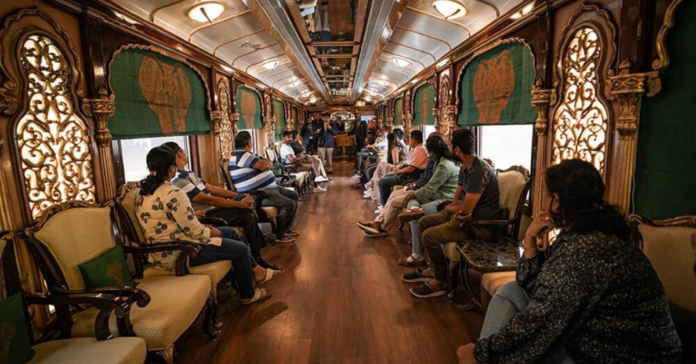
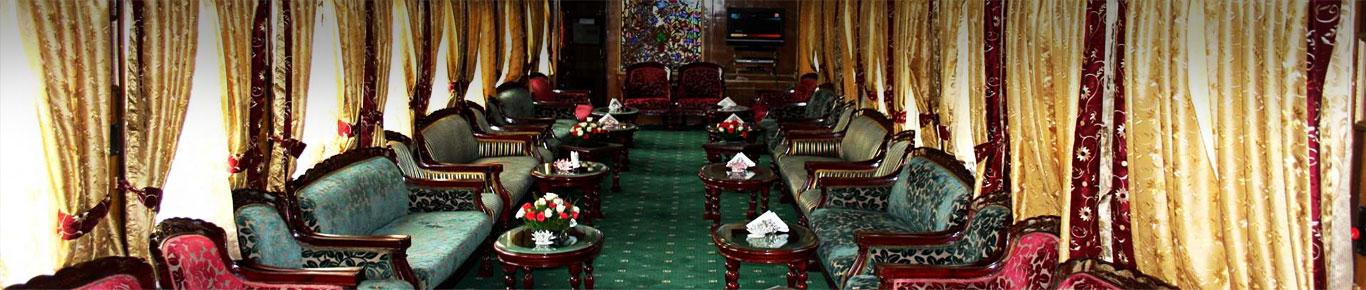
Travelling back in time and seeing the magnificent luxury and grandeur of a nation, if fascinates and attracts someone, then luxury trains in India may easily exceed anyone’s expectations. There are seven luxury trains in India, managed by Indian Railways and the IRCTC: The Maharajas Express, The Palace on Wheels, The Deccan Odyssey, The Golden Chariot, The Royal Rajasthan on Wheels (modelled on Palace on Wheels and follows a similar route through Rajasthan), The Royal Orient Train, The Fairy Queen Express and the Heritage on Wheels. These top luxury trains in India cater to travellers who want to explore India’s rich cultural heritage in style, luxury, comfort and elegance. Their opulence can be seen in their mind-boggling interiors, magnificent ambience, exquisite gastronomical fare, significant security systems, and virtually anything else anyone can think of. Travelling on these trains provides unparalleled comfort onboard and allows travellers to visit some of India’s most renowned tourist destinations. It is indispensable to join these luxury train journeys in India to discover India in ways that would otherwise be impossible.
The Maharajas Express: The Maharajas’ Express is the best of all Indian luxury trains and one of the five most extravagant and luxurious trains in the world. This half-mile-long train boasts professionals trained to provide the greatest level of hospitality, fully stocked bars, exquisite suites, butler services, and other amenities, and it is one of India’s most expensive trains. Tourists on board get to enjoy the country’s hidden scenic beauty, cultural tradition, demographic treasures and richness in the most prestigious way imaginable. It has been rated ‘World’s Leading Luxury Train’ consecutively in year 2012, 2013, and 2014.
Image from the Maharajas
Routes:
The Heritage of India:Mumbai–Ajanta–Udaipur–Jodhpur–Bikaner–Jaipur– Ranthambore–Agra–Delhi
Gems of India: Delhi–Agra–Ranthambore–Jaipur–Delhi
The Indian Panorama: Delhi–Jaipur–Ranthambore–Fatehpur Sikri–Agra– Gwalior–Orchha–Khajuraho–Varanasi–Lucknow–Delhi
Indian Splendour: Delhi–Agra–Ranthambore–Jaipur–Bikaner–Jodhpur– Udaipur–Balasinor–Mumbai
Treasures of India: Delhi–Agra–Ranthambore–Jaipur–Delhi
Operations Month
The Maharajas’ Express runs from October to April in a year and covers the five routes stated above.
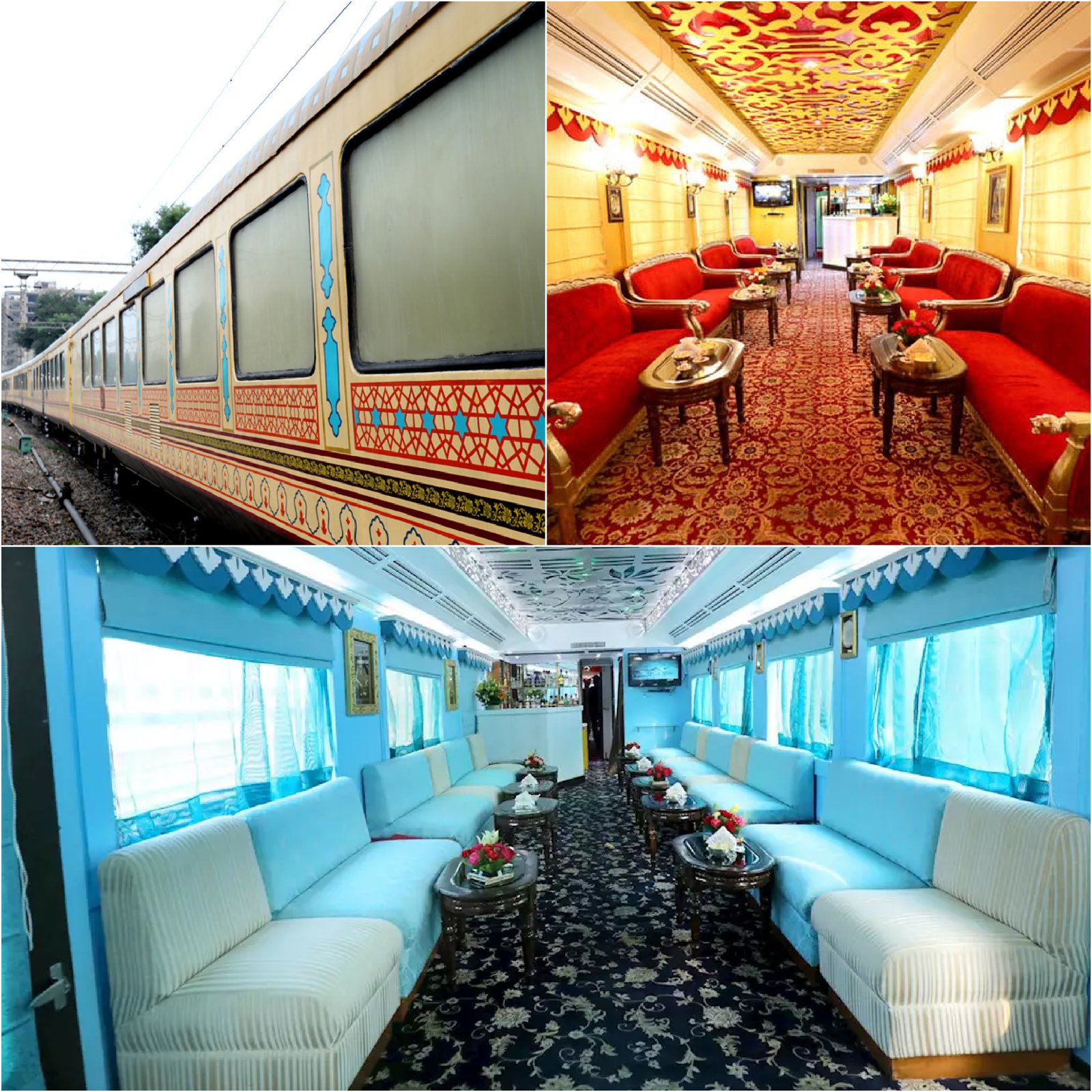
Palace on Wheels: Palace on Wheels is another luxury train ride in India that was renovated and re-launched in 2009 to boost tourism. Luxurious cabins, magnificent wallpapers, a well-stocked bar, considerate hospitality and local culture portrayed and displayed via the artful use of paintings and handicrafts – it’s very much like a castle on wheels that recreates the bygone era of kings and royal palaces! It’s no surprise that it has been voted as the fourth best luxurious and deluxe train of the world. This is one of India’s best royal trains and undoubtedly the most ideal choice if someone is planning a premium and luxurious trip to Rajasthan.
From September through April, Palace on Wheels is open for service. The seven-night, eight-day voyage includes seven stoppages where guests are taken on city excursions. This train’s main attractions include:
Delhi: India Gate, Lotus Temple, Qutab Minar, Humayun’s Tomb
Jaipur: Hawa Mahal, Amber Fort, Rajasthali, City Palace, Jantar Mantar
Sawai Madhopur & Chittorgarh: Ranthambore National Park, Chittorgarh Fort
Udaipur: Jag Niwas, Lake Pichhola
Jaisalmer: Yellow Sandstone Fort, ancient mansions
Jodhpur: Mehrangarh Fort, grand palaces, shopping tour in Jodhpur
Bharatpur: Keoladeo Ghana National Park
Agra: Fatehpur-Sikri, the Taj Mahal
The Deccan Odyssey: TheDeccan Odyssey is a 5-star hotel on wheels that takes visitors to some fascinating locations in India, inspired by the travel ways and style of the kings and emperors during different royal eras of ancient India. It is one of the best luxury trains in India and worldwide, featuring royal treatment for passengers, palace-like cabin decoration and interiors, multi-cuisine restaurants, lounges, a conference car, an onboard spa, and other cutting-edge amenities for passengers and travellers.
The Deccan Odyssey runs from October to April, with a duration of all six excursions spanning seven nights and eight days.
Golden Chariot: The Golden Chariot is one of India’s finest luxury trains, taking visitors to some of the most popular tourist destinations in South India. The Golden Chariot, which opened in 2008, is highly renowned for its exceptional service. The train features AC cabins with royal, elegant furnishings and interiors, bars, restaurants serving a wide range of cuisines, a tiny gym, an Ayurveda spa, and other 5-star amenities. Tourists regard it as one of India’s best luxury trains, and it has also been awarded as ‘Asia’s Leading Luxury Train’ in 2013.
Image from Golden Chariot
Routes
Pride of the South: Bangalore–Kabini–Mysore–Hassan–Hampi–Badami–Goa–Bangalore
The Golden Chariot runs from October to March, with duration of both routes extending to seven nights and eight days.
Royal Orient Train: To have an unforgettable experience, tourists need to embark on a graceful and royal journey with the Royal Orient Train and have a lovely experience travelling to major tourist locations onboard with one of India’s top luxury trains. Travelling by luxury train in India is an experience of incredible splendour and total chivalry. It is without a doubt India’s unrivalled royal train. The Royal Orient Train offers palatial-style comfortable accommodations, well-trained hospitality professionals, a multi-cuisine restaurant with the ‘Watering Hole’ Bar, spacious baths, a library and practically all facilities that come to mind while visualising oneself in a five-star hotel.
The Royal Orient Train operates all year and lasts seven nights and eight days. On the way, one can see and view the following city attractions:
Delhi : Qutub Minar, Red Fort, Jama Masjid and India Gate
Chittorgarh/Udaipur : Chittorgarh Fort, City Palace, boating in Lake Pichhola, Shilpgram, and Royal Gardens
Junagarh/Veraval: Ashokan Rock Edict, Darbar Hall Museum, Mausoleum of Nawab Mahabat Khanji, Somnath Temple on the shore of the Arabian Sea
Sasan Gir National Park: Lion Sanctuary
Dilwara: St. Paul’s Church and Mandir Beach
Palitana: Jain Temple atop Shatrunjaya Hills
Ahmedabad: Gandhi Ashram, Calico Museum of Textiles, Sidi Sayyad’s Mosque
Jaipur: Amar Fort and elephant ride, Hawa Mahal, City Palace, Jantar Mantar (observatory)
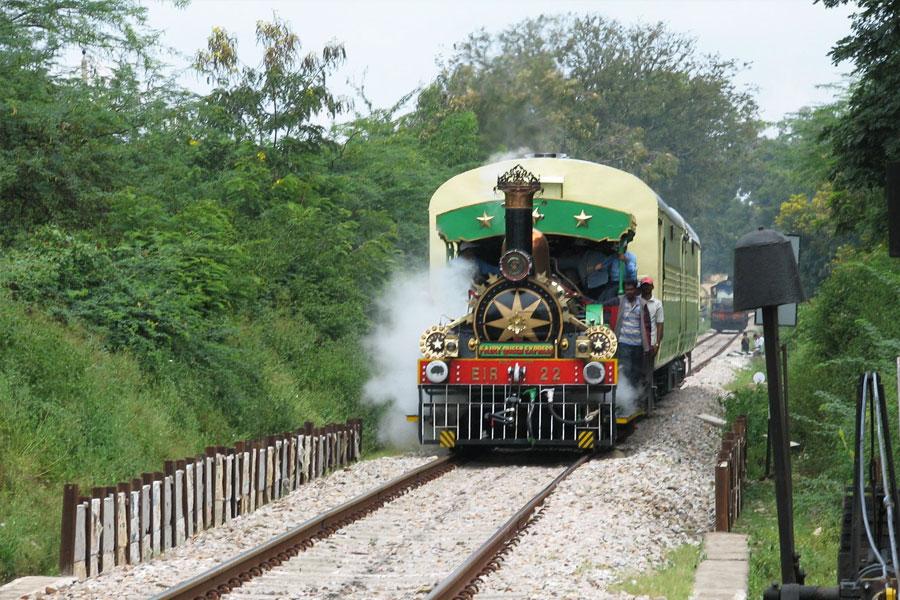
Fairy Queen Express: Last but not least, the Fairy Queen Express is one of India’s oldest trains, offering luxury rail experiences and train journeys. Fairy Queen, powered by the oldest serving steam locomotive built around 1855, has its own charm as it rambles across Rajasthan to Alwar. With a mention in the Guinness Book of World Records and a National Tourism Award, Fairy Queen easily ranks amongst one of India’s finest and most extravagant trains.
Image from Luxury trains of India
Route
Delhi–Alwar–Sariska-Alwar–Delhi
Operations Month
From October through March, on the second and fourth Saturdays of the month. The journey lasts one night and two days. Attractions at its two stoppages, Sariska and Alwar, include:
Sariska: Lake Palace, Sariska National Park
Alwar: Alwar Museum
The Heritage on Wheels: The Heritage on Wheels, one of India’s oldest luxury trains, shows the traditions and culture of Rajasthan that have been passed down from generation to generation in the most luxurious way conceivable. With interiors that never fail to carry the onboard passengers back to the golden days of the state, the Heritage on Wheels is one of India’s most expensive and premium trains. With local restaurants serving authentic and continental cuisine on the train’s floors and rooms that never fail to emanate the Royal vibes and emotions, this is one of those trains that everyone should experience at least once in their life. This luxury train in India is sure to offer a spectacular experience, treating passengers as if they were queens or kings.
Image from Luxury trains of India Route
Jaipur –Bikaner–Tal Chhapar and Shekhawati – Jaipur
Popular sights to view when going on the Heritage on Wheels for three nights and four days include:
Bikaner: Junagarh Fort, Haat, Camel Safari, Lalgarh Palace and National Research Centre
Tal Chhapar & Shekhawati: Laxmangarh Fort, Goenka Haveli, Sikar, Churu, Mandawa and Nawalgarh
Jaipur: Hawa Mahal, Amber Palace, City Palace and Jantar Mantar
NEW DELHI (Metro Rail News): NCRTC (National Capital Region Transport Corporation ) is nearly done with the civil work for the Regional Rapid Transit System (RRTS) project, which spans 82 km and connects Delhi, Ghaziabad, and Meerut. According to officials, the work in Meerut has been finalized, leaving just 2 per cent of the work pending for the Anand Vihar-Vaishali section.
Puneet Vats, chief PRO of NCRTC, mentioned that the underground civil construction of tunneling work for the RRTS project is expected to be finished in about a week. The remaining work is specifically in the Anand Vihar to Vaishali section. This means that the tunneling work is around 98% done. After the tunnels are ready, they will move on to laying tracks, setting up signals, and installing overhead equipment.
The underground tunnels for the RRTS project are wider than typical Metro systems, measuring 6.5 meters in width compared to the usual 5.8 meters. This is to accommodate the larger RapidX trains that will travel at a speed of 180 km/h. The tunnels also have cross-passages every 250 meters for easier maintenance and passenger evacuation in case of emergencies.
The NCRTC has already finished the first section of the RRTS project, a 17 km stretch in Ghaziabad from Sahibabad to Duhai Depot, which includes five stations and is awaiting inauguration.
Once this section is open for passengers, operations will continue from Duhai to Meerut in the next phase and then to Delhi. The final plan includes the metro module in Meerut.
The elevated corridor’s track laying is progressing quickly, with about 50% complete from Duhai to Meerut (south). Most of the viaduct is also done, with around 15 km remaining in different areas of Delhi and Meerut.
The RRTS project, costing around ₹30,274 crore, is expected to start operations in March 2025. The route covers 82 km and has 25 stations, with three in Delhi, eight in Ghaziabad, and the rest in Meerut.
NEW DELHI (Metro Rail News): RITES, a Central Public Sector Undertaking under the Ministry of Railways, has emerged as the lowest bidder in a tender floated by the Railway Board. The contract, with an estimated value of around ₹65.4 Crore, entails significant responsibility. The company is set to undertake testing and inspection of rails as per the stringent IRS T-12 2009 standards for Indian Railways.
The order covers the inspection of 60,000,000 MT of rail with inspection costs estimated to be paid in five years at a cost of Rs. 65.4 crore plus taxes.
The stipulated duration for the execution of the order(s)/contract(s) spans five years, with one-year extension.
Moreover, RITES Limited has recently inked a memorandum of understanding (MoU) with NHPC Limited. This strategic collaboration is geared towards providing comprehensive consultancy services for rail infrastructure facilities in NHPC’s hydropower projects.
RITES Limited holds the position of a prominent player in India’s transport consultancy and engineering sector. As a Miniratna (Category–I) Schedule ‘A’ Public Sector Enterprise, it delivers a variety of services across different sectors and covers a broad geographical scope.
Shri P Uday Kumar Reddy, General Manager, Metro Railway inspecting Orange Line
KOLKATA (Metro Rail News): Metro Railway’s General Manager, Shri P Uday Kumar Reddy, conducted a thorough inspection of the upcoming Orange Line stretch from Kavi Subhas to Jai Hind (Airport) stations on August 22, 2023. Accompanied by senior officials from Rail Vikas Nigam Limited (RVNL), along with all Principal HOD of Metro Railway, Shri Reddy examined various stations along the route and emphasized the importance of meeting deadlines. During the inspection, the team discussed the progress of the work and passenger facilities. Shri Reddy also assessed the traffic diversion and trial run on E.M. Bypass for pier construction.
Additionally, Shri Reddy examined various piers, including Pier No 156 and 157 at Tagore Park, as well as Pier No. 288 and 289. He also assessed the locations where Pier No 286 and 287 are soon to be constructed by RVNL near Metropolitan Crossing. Shri Reddy also inspected the site designated for the construction of Pier No 311, planned to be near Chingrighata Crossing.
Shri Reddy expressed gratitude to the State Government for their support in completing ongoing Metro projects. He optimistically anticipated that the Orange Line from Kavi Subhas to Beleghata will open by December 2023. Further extensions are planned, with the line reaching Salt Lake Sector V by June 2024 and City Centre 2 by December 2024. The entire stretch from Kavi Subhas to Jai Hind (Airport) is projected to be operational by June 2026. Before this, Shri Reddy inspected the North-South Corridor’s Jatin Das Park to Kavi Subhas stretch in the Metro system.
The Uttarakhand Metro Rail Corporation (UKMRC) is developing the Dehradun-Haridwar-Rishikesh Metro Corridor in order to provide residents with convenient travel options. The proposed metro system would connect Dehradun, Rishikesh, and Haridwar. The Haridwar-Rishikesh Metro line shall run parallel to the National Highway that connects the two cities.
The upcoming metro project shall consist of a 73-kilometer elevated track.
The Metro Corridor will serve over a lakh passengers daily.
The Uttarakhand Metro Rail Corporation Limited will carry it out.
Uttarakhand’s metro train project is scheduled to be completed by 2024. The detailed and comprehensive project report has been submitted to the state government and is expected to be approved soon. The initiative is expected to improve connectivity and enhance the pedestrian flow and footfall between Rishikesh (the ‘yoga capital of the world’) and Haridwar (a Hindu pilgrimage site in North India). Once operational, roughly one lakh commuters daily are estimated to use the Dehradun-Haridwar-Rishikesh Metro Corridor. This will significantly reduce road traffic.
Uttarakhand Metro Rail, Urban Infrastructure and Building Construction Corporation Limited have developed & prepared the comprehensive project report for Metro Neo, an innovative transportation system, in-house. It relies and is based on both the primary and secondary traffic and data analysis. In November 2020, the Ministry of Housing and Urban Affairs (MoHUA) specified Metro Neo standard specifications. The first Metro Neo project has been proposed for Nashik, Maharashtra.
Details of the project
The project is being carried out by Uttarakhand Metro Rail Corporation Limited.
The detailed and comprehensive project report will be approved by the state cabinet before being sent to the Union Ministry of Urban Development for perusal and approval.
Metro services are expected to begin operations in Dehradun within the next three years.
The Unified Metropolitan Transport Authority approved a 73-kilometer-long Dehradun-Haridwar-Rishikesh Metro Corridor in Uttarakhand in June 2020.
The Uttarakhand state government signed a memorandum of understanding (MoU) with the Delhi Metro Rail Corporation in December 2016 to provide its detailed project report.
The project’s estimated cost is Rs 40,150 crore.
The metro line’s tracks will be standard gauge.
Route Details
The 73-kilometer elevated metro will be completed in two stages. It will feature two lines that will connect at Nepali Farm on the banks of the Song River.
Phase 1 / Line-1: Haridwar – Rishikesh
Length: 32 Km
Number of Stations: Ten
Route Description: The projected metro line would begin near the Jatwara Bridge in Jwalapur (western Haridwar). It will then run parallel to the NH-34 Haridwar-Rishikesh highway. The metro line would end at Rishikesh’s Chandrabhaga Bridge.
Phase 2 / Line-2: Dehradun (ISBT) – Nepali Farm
Length: 41 Km
Route Description: The route will follow National Highway-7 from Nepali Farm to Dehradun’s Inter-State Bus Terminal (ISBT) via the Vidhan Sabha.
Conclusion
Uttarakhand, a Himalayan state in northern India, has 39,000 km of road network, two domestic airports, and 339.80 km of rail connections. The Uttarakhand Metro Rail Corporation (UKMRC) has announced plans to build state-of-the-art rapid transit systems in Dehradun, Haridwar, and Rishikesh in an effort to reduce traffic congestion in the state. According to MD Jitendra Tyagi, UKMRC GFX, the nation’s first Neo Metro would be deployed on two corridors in Dehradun, while the country’s first Pod cab will be introduced in Haridwar. The aforementioned initiatives aim to significantly increase the state’s environmentally friendly and cost-effective transport options.
The Neo-Metro, a mass transit system based on rubber tyres, will be powered by an overhead electric conductor and will run on a dedicated elevated track. On the other hand, Pod taxis are driverless electric vehicles that travel on specifically built tracks. These modern and futuristic public transportation systems will help improve connectivity and reduce traffic congestion in their respective locations. In addition, the UKMRC intends to build two ropeways in Haridwar and Rishikesh to improve the travel experience for pilgrims and spiritual seekers visiting the region. Ropeways and Pod taxis will be built using a public-private partnership (PPP) model, with equal funding from the central and state governments. The Neo-Metro project will be supported and financed jointly by the central and state governments.
The two Neo Metro routes, totaling 22.42 kilometres in length, will connect ISBT to Gandhi Bagh and FRI to Raipur, effectively covering the city’s breadth and length. The Neo-Metro trains would have a top speed of 70 kilometres per hour and an average speed of 25 kilometres per hour. The state government has already approved the project, which is now pending approval from the Union Ministry of Housing and Urban Affairs.
Latest Update
To relieve traffic congestion, the Uttarakhand Metro Rail Corporation (UKMRC) will build state-of-the-art rapid transit systems in Dehradun, Haridwar, and Rishikesh over the next four years. The first Neo Metro line in the country would run along two corridors in Dehradun. In addition, Haridwar will be home to the country’s first Pod taxi. The decision will significantly improve the state’s environmentally friendly and cost-effective public transportation. Neo-Metro is a rubber-tired mass transit system powered by an overhead electric conductor. It travels on an elevated track. Pod (Provide on Demand) taxis are driverless electric vehicles that travel on a specially built track.
Additionally, the corporation plans to build two ropeways in Haridwar and Rishikesh to improve the travel experience of tourists who come from all over the world for pilgrimage and spiritual solace. Ropeways and Pod taxis will be constructed under PPP, while the Neo Metro project would be shared equally by the Centre and the state. The two Neo Metro routes from ISBT to Gandhi Bagh and FRI to Raipur will span the city’s width and length (22.42 km).
Additionally, the corporation plans to build two ropeways in Haridwar and Rishikesh to improve the travel experience of tourists who come from all over the world for pilgrimage and spiritual solace. Ropeways and Pod taxis will be constructed under PPP, while the Neo Metro project would be shared equally by the Centre and the state. The two Neo Metro routes from ISBT to Gandhi Bagh and FRI to Raipur will span the city’s width and length (22.42 km).
The Neo-Metro train would have a top speed of 70 kilometres per hour and an average speed of 25 kilometres per hour. The project has already been approved by the state government and is awaiting clearance from the Union Ministry of Housing and Urban Affairs. The Pod taxis would travel 20.74 km with 21 stops in Haridwar. The main stretch of the Pod taxi will be 14.55 kilometres long, connecting Sitapur (Jwalapur) to Bharat Mata Mandir via three tributary stretches: City Hospital to Daksh Mandir, Valmiki Chowk to Laltaro Bridge, and Ganeshpuram to DAV School. The 2-kilometre-long ropeway will transport pilgrims in 9 minutes from Har Ki Pauri to Chadi Devi. UKMRC has stated that they are planning to construct Asia’s longest ropeway, measuring approximately 6.5 kilometres, in Rishikesh.
Mr Kumar Mangalam Birla, Chairman, Aditya Birla Group
MUMBAI (Metro Rail News): At the 64th annual general meeting (AGM) of Hindalco Industries Limited, Kumar Mangalam Birla, the company’s chairman, announced a proposed investment of approximately ₹2,000 crore. The investment aims to introduce new extrusion and fabrication technologies to India. These technologies play a vital role in the construction of Vande Bharat trains within the country.
We are enthusiastic about collaborating with the Indian railways and the ecosystem involved in manufacturing passenger coaches for the ambitious high-speed Vande Bharat trains. We have earmarked an investment of Rs 2,000 crore for this project, and we have established technological partnerships to introduce novel extrusion and fabrication technologies to India,” Birla stated.
Hindalco successfully introduced India’s first all-aluminium lightweight train, enabling increased speed and higher payload capacity. In the upcoming months, the company intends to launch three additional variations of freight wagons designed for specific purposes, such as transporting bagged cement and foodgrains.
Referring to the Indian railway’s objective of achieving net zero carbon emission and simultaneously increasing freight capacity, Mr. Birla emphasized that the company is fully committed to aiding the railway’s carbon reduction aspirations. He mentioned, “In the upcoming months, we have intentions to unveil three additional freight wagon designs that cater to distinct end-use purposes, such as transporting bagged cement and foodgrains.”
The chairman also talked about another ₹2,000 crore investment by the company. This investment will be used to establish the first-of-its-kind copper and electronic waste recycling facility. Currently, a lot of electronic waste is sent to other countries because India doesn’t have the right technology to extract valuable metals from it. This new facility will change that and contribute to India’s efforts for a circular economy.
PATNA (Metro Rail News): Gandhi Maidan underground metro station of Patna Metro Rail Project will serve as a lifeline to the transportation for one of the busiest localities of the city; the ‘Hub” of the new Patna with main market area starting from Ashok Rajpath. The 202m long under-construction underground metro station is located near Gandhi Maidan and Kargil Chowk.
Gandhi Maidan is the hub of the city with the major market area, administrative office of Government of Bihar, important buildings and colleges like Bapu Sabhagar, Gyan Bhawan, S.K Memorial, Gandhi Maidan Ground, Red- Cross Society and Magadh Mahila College etc. Hence, this underground metro station has been meticulously planned to facilitate seamless and hassle-free commuting. With the nearest metro stations at Akashvani and PMCH UG Metro stations, this station will ease the traffic load in one of the city’s busiest areas.
A Two-level underground Metro station:
• It will have two levels: with Concourse on level one and platform on level two.
• Ticketing and other commuter-centric facilities will be available at concourse level.
The Station will have Three Entry/Exit gates
a) Entry/Exit-1 will be in front of Red- Cross Society, Patna city Branch near Magadh Mahila college.
b) Entry/Exit-2 will be near Patna Collectorate approach road near present Bankipur Bus stand.
c) Entry/Exit-3 will be in front of Gandhi Maidan near Kali Mandir
d) Two lifts have also been provided at Entry/Exit-2 & 3, keeping in mind the needs of specially differently abled person and senior citizens.
Facilities for passengers:
The station has been planned with seven Escalators & five staircases for public usage, out of which one escalator and one staircase will be provided at each Entry/Exit for Entry of the passengers into station premises and four escalator and two staircases will be provided for movement of passengers from concourse to platform level.
Arrangements for emergency situations
In case of any emergency situation, the station is proposed to have two fire escapes (staircase) for public usage. By using these passengers will be evacuated from the platform to the concourse, and from there, any of three Entry/Exits can be taken to exit station premises. One firemen staircase (separately) is also there for Firefighters to enter station premises during Emergency situations.
It may be noted that Patna Metro is adopting multi-modal integration in addition to the Mass Rapid Transit System (MRTS) for the convenience of passengers so as to offer people hassle-free travel. With the start of the Metro in the city, people will be inclined towards public transports. Metro will not only be cheaper and convenient, but it will also reduce pollution too as it will bring down the number of vehicles on the road.
This month, RAPIDX, India’s first regional train service, is expected to begin operations on a 17-kilometre priority section linking Shahibabad and Duhai Depot. Sahibabad, Ghaziabad, Guldhar, Duhai, and the Duhai Depot are the five stations along the route. The stretch is part of the Delhi-Meerut Regional Rapid Transit System (RRTS) Project. Trains on the RRTS corridor have been designed to reach a top speed of 180 kmph. Along with the priority stretch, a 42-kilometre viaduct between Sahibabad and Meerut South Station has also been developed.
Following the priority segment, a 25-kilometre-long section encompassing Muradnagar, Modi Nagar South, Modi Nagar North, and Meerut South will be commissioned. The Delhi-Meerut Regional Rapid Transit System, development and construction works commenced in June 2019. The National Capital Region Transport Corporation (NCRTC), which is building the RRTS corridor, hopes to open the entire 82-kilometer-long Delhi-Ghaziabad-Meerut length to the public by 2025, along with Metro services in Meerut.
The trains are called RAPIDX because the acronym is easy to read and speak in a number of languages. The X in the name implies future-generation technology and the new-age mobility solution, in addition to speed and progress. It is also associated with youth, optimism, vigour and energy. The NCRTC, a joint venture operation of the Centre and the state governments of Delhi, Haryana, Rajasthan, and Uttar Pradesh, is developing the semi-high speed regional rail service across the National Capital Region (NCR).
The Making and the Features
The RapidX trainset is an Electric multiple unit (EMU) train designed specifically for the country’s RapidX (regional rapid transit) services. The train had been designed in Hyderabad, Telangana, by the French rolling stock company Alstom, and manufactured at Savli, Gujarat. The train has an aerodynamic design that decreases drag when it travels and advances at the top operational speed of 160 km/h. Though, the design speed of the RapidX is 180 Km/Hr.
Different From Metro & Conventional Railway
RRTS differs from metro in the sense that it caters to passengers who want to travel a longer distance with fewer stops and at a faster speed. RRTS differs from the conventional railway in a fact that it shall enable dependable, frequent, point-to-point regional transport at high speeds over a designated path. RRTS is a new, dedicated, high-speed, high-capacity, comfortable commuter service that connects regional nodes in the National Capital Region.
India’s Pride: The Make in India Initiative
Under the Chairmanship of the Secretary Ministry of Urban Development (MoUD), the Planning Commission established a Task Force in 2005 to build a multi-modal transit system for the Delhi National Capital Region (NCR). This was included in the NCR 2032 Integrated Transport Plan, with a focus on Regional Rapid Transit System (RRTS) connections between regional hubs. The Task Force identified eight corridors and prioritised three corridors for implementation: Delhi-Meerut, Delhi-Panipat, and Delhi-Alwar. The National Capital Region Planning Board (NCRPB) appointed M/s. Delhi Integrated Multi-Modal Transit System for Delhi-Meerut and Delhi-Panipat, and M/s. Urban Mass Transit Company Limited for Delhi-Alwar, to conduct feasibility studies and prepare the Detailed Project Report in March 2010.
There was a need for a new semi-high-speed trainset envisaged, specifically designed for semi-high-speed regional rail travel when the RapidX service was conceived. The train sets were intended to be locally produced in compliance with the Make in India programme after the NCRTC opened tenders for the same in 2019. In early 2020, the NCRTC finalised the procurement of train sets, which were to be produced in Savli by Bombardier Transportation. In accordance with the Make in India policy, the tender was finalised and settled with the condition of trains to have fifty percent of local components as opposed to the original requirement of 75 percent. The train’s design was revealed to the public later in the year. The train’s stainless-steel body has been designed and engineered to reach a top speed of 180 km/h.
Exterior
The train is built with a stainless-steel body and an aerodynamic nose cone to lessen air drag resistance when operating at high speeds. Because of its stainless-steel body, the train is fairly restricted and lower in weight.
Each car features six doors, three on each side, for simpler entry and egress, with the exception of the Business class, which has four doors, two on each side. Each vehicle features tempered safety glass windows that are double-glazed.
Interior
The train includes 2×2 seating with plenty of leg room for passengers. For peak hours, the aisles are equipped with grab grips and poles to accommodate standing passengers. It has an overhead luggage rack as it has been designed and developed for regional rail travel and service.
The train has onboard Wi-Fi, a public announcement and display system, an information and entertainment display, a dynamic route map display and an emergency communication facility and service.
The train sets have ambient lighting and temperature control systems to ensure efficient energy consumption. The train also has a designated wheelchair space.
In terms of safety, the train has a fire & smoke detector, CCTV, a fire extinguisher, and a door status indicator, as well as an innovative Train Control Monitoring System technology with predictive and condition-based monitoring capabilities.
Other Features
For the first time in the country, a railway system shall be opened for high-speed operation along its whole length. Along with the priority stretch, a forty-two-kilometre viaduct between Sahibabad and Meerut South Station has been constructed. Trains on the corridor are expected to travel at a maximum speed of 160 kmph.
Following the priority segment, a 25-kilometer-long section consisting of four stations-Muradnagar, Modi Nagar South, Modi Nagar North, and Meerut South-will be commissioned. Construction on the RRTS began in June 2019, with the entire length of 82.15 km corridor, as well as Metro services in Meerut, set to open in June 2025.
The necessary finance for the construction of this corridor, estimated at Rs. 30,274 crores, is being provided by multilateral help. The RRTS alias RAPIDX is co-financed by Asia Infrastructure Investment Bank (AIIB), New Development Bank (NDB), and Asian Development Bank (ADB).
According to internal projections, the train will carry approximately 800,000 passengers every day. Despite this high traffic volume, passenger revenue is projected to remain restrained. To solve financial issues caused by regulated fares, the NCRTC is investigating advertising avenues to supplement fare income.
Every RAPIDX train will include a separate women’s coach to ensure safe and comfortable regional travel for women. Moving from Delhi to Meerut, the women’s coach will be the second coach of the train set, just behind the premium coach. While travelling to Delhi from Meerut, it will be the train’s second-to-last coach, immediately before the premium coach. Diaper-changing facility has also been provided at every station.
Proper signage at the platform level and on the train door openings is being provided to identify these coaches. This reserved coach can accommodate seventy-two passengers for seating.
System Specifications
Operational: 0 Km
Under Construction: 82.15 Km
Approved: 209 Km
Proposed: 700 Km (Approx)
Design Speed: 180 Kmph
Operational Speed: 160 Kmph
Average Speed: 100 Kmph
Track Gauge: Standard Gauge (1435mm)
Rolling Stock: Aerodynamic (Stainless Steel/Aluminium Body)
Signalling: European Train Control System (ETCS) Level 2 of ERTMS
Traction: 1×25 KV AC Overhead Catenary (OHE)
Seating Arrangement: Transverse
Classes: Economy & Business (1 coach per train)
Conclusion
The RAPIDX, India’s first regional train service, will begin operations on the priority segment soon. Sahibabad, Ghaziabad, Guldhar, Duhai, and the Duhai Depot are the five stations along the route. Work on all these stations have almost been completed and are nearly ready for operations. This section is a part of the Delhi-Meerut Regional Rapid Transit System (RRTS). In a recent development by NCRTC (National Capital Region Transport Corporation), it has been stated that safety approvals from the Commissioner for Metro Rail Safety (CMRS) have been received, and the project is expected to be inaugurated by Prime Minister Narendra Modi in the coming days.