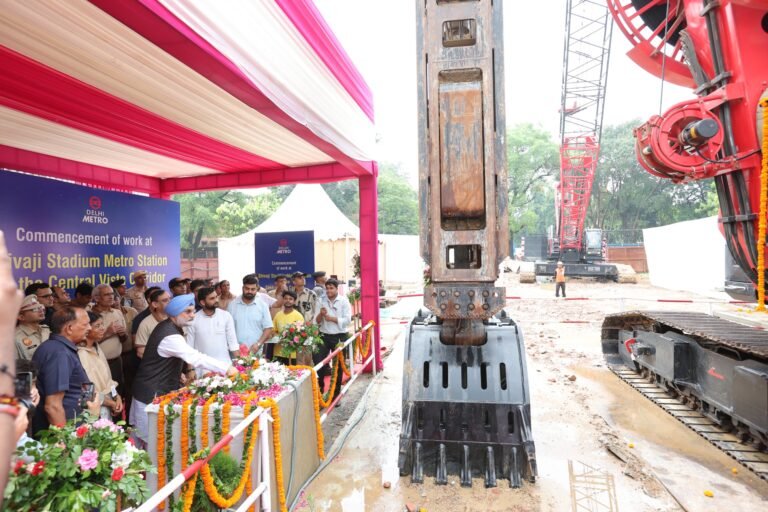
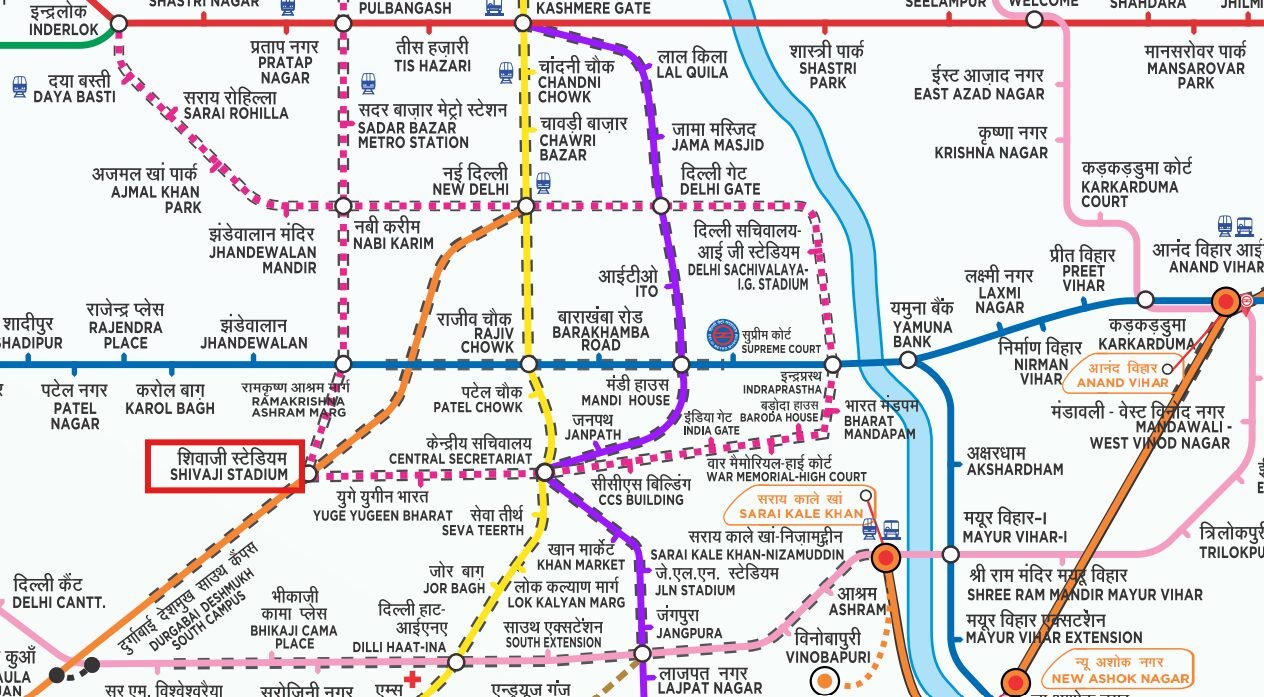
DELHI (Metro Rail News): Delhi Metro Phase 5(A) project along the Central Vista corridor has gained momentum with construction work initiated at Shivaji Stadium by Afcons Infrastructure Limited. The project is a part of the Magenta Line Extension and Shivaji Stadium will develop as an interchange station with the Airport Express Line (Orange Line) of the Delhi Metro. Further, an underground subway will connect Rajiv Chowk station with Shivaji Stadium station.
The Delhi Metro Rail Corporation (DMRC) announced through a press release on Tuesday (25th August) that the work on the Central Vista corridor’s Shivaji Stadium has started. This will be a part of the Magenta Line Extension from Janakpuri West to RK Ashram Marg. The interchange station on Magenta Line will be constructed beneath the underground Orange Line station.
Rajiv Chowk-Shivaji Stadium Subway
A 800-meter underground subway will connect Shivaji Stadium station (Orange Line and Magenta Line) with Rajiv Chowk station (Blue Line). The subway will have travelators to provide ease to pedestrians walking along the subway.
Rajiv Chowk is among the busiest stations of the Delhi Metro as it provides interchange between the Yellow Line and the Blue Line. After the construction of this subway, there may be some relief to the congestion at Rajiv Chowk as commuters will have a viable substitute with interchange facilities.
Delhi Metro’s Central Vista Corridor
Delhi Metro Map
The Central Vista Corridor of Delhi Metro covers around 9.913 km and it is projected to have 9 underground stations:
Shivaji Stadium (interchange with Orange Line)
Yuge Yugeen Bharat
Central Secretariat (interchange with Yellow Line and Violet Line)
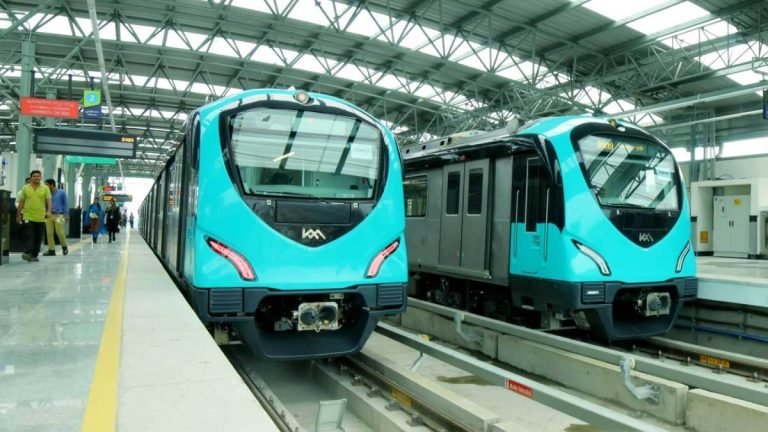
KOCHI (Metro Rail News): Kochi Metro Rail Limited (KMRL) requires eight additional trainsets to expand its fleet to 33 for smooth operations once the Pink Line or the Phase II opens. Without them, the time between trains could increase sharply and inconvenience passengers.
Even if funding is cleared, the new trainsets will take around two years to arrive after the order is placed. This creates a clear gap. So the funding issue of trainsets will further delay Phase II. Phase II is now promised for August 2027 already delayed from the original December 2025 target.
The system currently runs 25 trains from Phase I, 18 in daily service and seven kept as maintenance reserve. Procurement is stuck over funding. Although the Asian Infrastructure Investment Bank (AIIB) is ready to support, both the Union and Kerala governments must agree.
According to The Indian Express report, Shri Loknath Behera said that ‘‘Optimum utilisation of the resources of Phase I and Phase II will require eight more trains. With 33 trains, KMRL expects to maintain a 7-10 minute headway. Without the additional trains, the interval between services could increase substantially, around 20 minutes for Phase II operations.”
As a 50:50 project, KMRL plans to seek a central share.Until then, the state may have to bear the full estimated cost of ₹275 crore. The central government has given similar assistance to states including Maharashtra and Uttar Pradesh.
Current Progress of Kochi Metro Phase II:The Pink line
Kochi Metro Phase II consists of 11.2 km with 11 stations. Phase II network of Kochi Metro Rail project will connect the Central park of Ernakulam of Infopark and SmartCity via Kakkanad,with plans for multimodal links to buses, Water Metro, public bicycle sharing system and more.
The Pink Line itself is under construction, it is not operational yet. Officials plan to complete civil works around June 2027 and commissioning for August 2027.The original deadline was December 2025, Phase II had so many delays due to delays in approval of funding processes, land acquisitions and utility shifting.
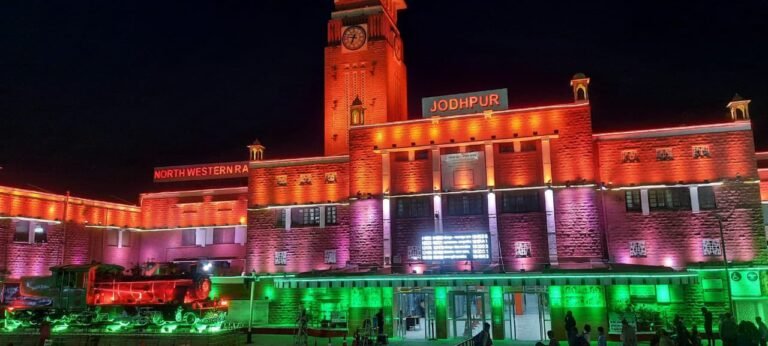
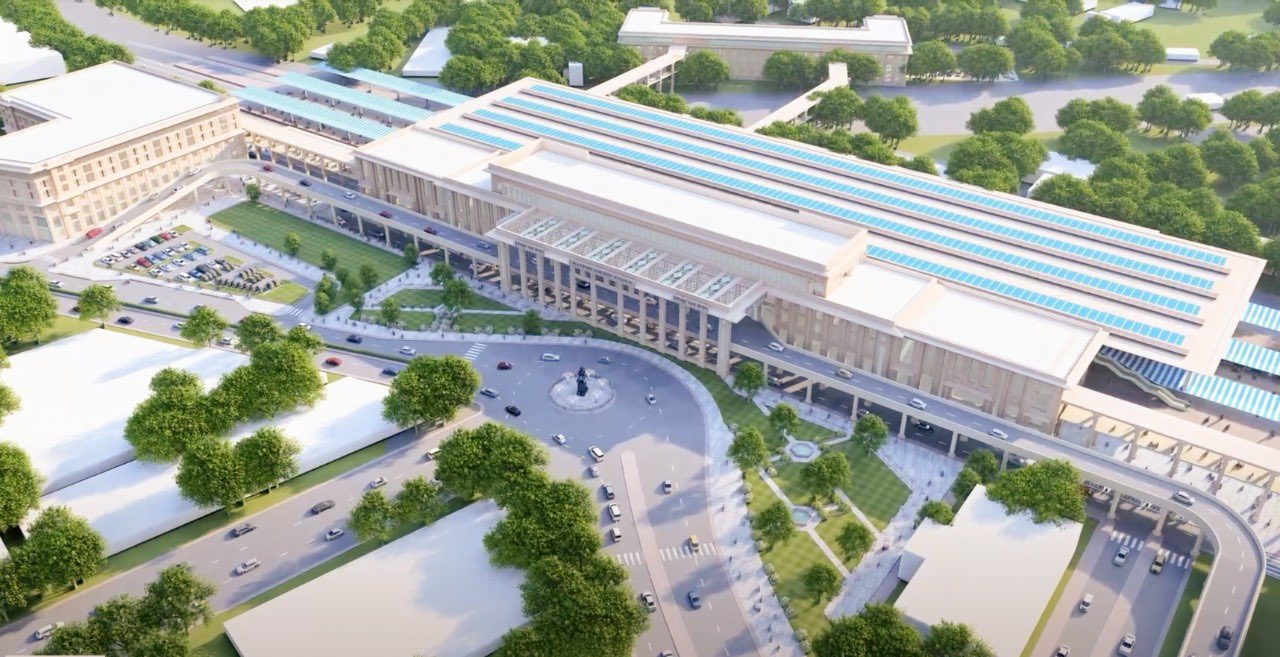
JODHPUR (Metro Rail News): North Western Railway (NWR) has invited bids for the balance works of the major redevelopment of Jodhpur Railway Station under an Engineering, Procurement and Construction (EPC) contract. The estimated cost of the tender is ₹469.20 crore.
(Proposed design for the redevelopment of Jodhpur Railway Station)
Tender details
Information
Details
Tender Number
DyCE-C-II-JU-EPC
Bidding Type
EPC – SIngle stage
Estimated Cost
₹469.20 crore
Earnest Money Deposit
₹9.38 crore
Completion Period
30 months
Pre-bid Meeting
24 August 2026, 11:30 AM
Bid Submission Deadline
16 September 2026, 3:00 PM
Scope of work
The tender covers the execution of balance works for major redevelopment of Jodhpur Railway Station of North Western Railways on Engineering Procurement & Construction (EPC).
About Jodhpur Railway Station
Jodhpur Railway Station serves as the main railway hub for Jodhpur, Rajasthan. The station operates under the North Western Railway zone and plays an important role in serving the city’s residents as well as tourists visiting the historic Blue City.
The station is known for its red sandstone heritage architecture and it has also received a Platinum rating as a green railway station. Passenger numbers change throughout the year, with more tourists during the peak season. The ongoing redevelopment under Amrit Bharat Station scheme aims to upgrade the station’s infrastructure while addressing the needs of passengers using one of Rajasthan’s important railway gateways.
GURUGRAM (Metro Rail News): The construction of the Gurugram Metro’s 2.2-km stretch between Hero Honda Chowk and Umang Bhardwaj Chowk is facing delays due to pending utility shifting and right-of-way (ROW) clearance. The Gurugram Metro Rail Limited (GMRL) has set November 2026 as the deadline for clearing the pending works and handing over the stretch for metro construction.
The National Highways Authority of India (NHAI), Dakshin Haryana Bijli Vitran Nigam (DHBVN) and Haryana Vidyut Prasaran Nigam Limited (HVPNL) have been directed to speed up the work. The issue is also being monitored at the Prime Minister’s Office (PMO) level.
GMRL Chairperson Smt.D.Thara and CEO Shri Chander Shekhar Khare inspected key locations of the metro project on August 23, 2026, to review construction progress and the pending clearance works. During the inspection, a November deadline was fixed for completing the outstanding works.
Why is the 2.2-km stretch delayed?
The main obstacle is utility shifting. Existing underground and overhead infrastructure occupies parts of the proposed metro construction area. These services have to be relocated before metro piers and other structures can be built.
The pending works include shifting a 1,600-mm water pipeline and feeder lines, along with other utilities by NHAI. HVPNL is responsible for shifting 66-kV overhead power lines, while DHBVN has to shift 17 feeders and dismantle existing electrical lines. NHAI also has to complete and commission the required substation works.
The delay is not limited to utilities. Buildings and encroachments along the proposed metro right of way also need to be cleared. Four buildings in Saraswati Enclave are affecting the metro works in Sector 10, while two buildings are affecting the proposed Sector 10 station, and four buildings are affecting the proposed Sector 37 station. Encroachments near Basai Chowk need to be removed.
According to Times of India’s report, a GMRL official said that ‘‘We have not been able to start work on the 2.2-km stretch because utility shifting is pending. A November deadline has been fixed to clear the right of way. The project is being monitored at PMO level, and strict timelines have been set for completing the pending works.
Progress of Gurugram Metro project
The Gurugram Metro project will cover about 28.5 km from Millennium City Centre to Cyber City and is planned in two phases.
Phase I covers about 15.22 km of elevated metro from Millennium City Centre to Sector 9, including a spur towards Dwarka Expressway, with 14 stations. Construction is progressing in other sections, with GMRL planning to begin U-girder launching by the end of August 2026.
Phase II will extend the metro from Sector 9 to Cyber Hub, covering about 13 km. The World Bank has approved a ₹1,409-crore loan for the phase, which has an estimated project cost of around ₹2,700 crore. The tender for Phase II is currently under evaluation by senior officials of GMRL and Haryana Mass Rapid Transport Corporation (HMRTC).
The clearance of the Hero Honda Chowk–Umang Bhardwaj Chowk stretch is therefore crucial for maintaining progress on Phase I and ensuring that the metro corridor can move through one of its key construction bottlenecks.
NEW DELHI (Metro Rail News): Delhi Metro Rail Corporation Limited (DMRC) has become the first metro organisation in India to receive the ISO 55001:2024 certification for its Asset Management System. The certification covers the Operations and Maintenance of Mumbai Metro Line-3 (Aqua Line).
ISO 55001:2024 is the latest international standard that provides a clear framework for managing physical assets throughout their full life cycle from planning and purchase to operation, maintenance, upgrades and eventual replacement. It helps organisations balance performance, risk and cost while improving reliability and long-term value.
This achievement marks an important shift for DMRC. The organisation has moved beyond traditional maintenance practices to a more strategic, risk-based and lifecycle-focused approach. Instead of only repairing assets, it now actively manages their performance, costs and long-term contribution to overall goals.
DMRC BECOMES INDIA’S FIRST METRO ORGANISATION TO ACHIEVE ISO 55001:2024 CERTIFICATION
The Delhi Metro Rail Corporation Limited (DMRC) has achieved ISO 55001:2024 certification for its Asset Management System for Mumbai Metro Line-3, becoming the first metro organisation in India…
— Delhi Metro Rail Corporation (@OfficialDMRC) August 23, 2026
DMRC secured the certification in record time by strengthening its entire asset management system. Key steps included improving the Strategic Asset Management Plan (SAMP), linking asset goals with safety and operational priorities, enhancing risk assessment and lifecycle planning, and training staff. The system is regularly checked through Key Performance Indicators (KPIs), audits and management reviews to keep it effective.
DMRC’s O&M role of Mumbai Metro Line-3
DMRC handles the Operations and Maintenance (O&M) of the 33.5-km Mumbai Metro Line-3 corridor that runs from Colaba to Bandra and SEEPZ. Its responsibilities cover a wide range of critical assets, including trains (rolling stock), traction power, signalling, telecommunications, stations, lifts, escalators, tracks and civil infrastructure.
The ISO 55001:2024 certification reinforces DMRC’s focus on safety, reliability, efficiency and sustainability by placing these goals within a globally recognised system. It also sets a new benchmark for structured and scientific asset management in India’s growing urban rail sector and shows DMRC’s ability to deliver world-class expertise beyond the Delhi-NCR region.
BENGALURU (Metro Rail News): Bengaluru Metro’s 58.19-km Blue Line to Kempegowda International Airport (KIA) will take longer to complete. The full corridor now has a March 2028 target, while the elevated section of the Pink Line could open in September. Greater Bengaluru Development Minister Krishna Byre Gowda announced the revised timelines after inspecting the Pink Line with Minister and Shivajinagar MLA Rizwan Arshad and senior officials on Saturday.
Bengaluru Metro’s Pink Line targeted for march 2027
Bengaluru Metro’s Pink Line will open in stages. Its 7.5-km elevated section situated between Kalena Agrahara and Tavarekere on Bannerghatta Road is now expected to open in September. The section was earlier expected to open by August 15, but Gowda said construction should finish by the end of August. However, BMRCL still needs one railway approval for the rolling stock. The minister expects the approval within the next 10 days. The opening will depend on the final approval from the Centre.
The minister also stated that the 13.75 km underground section between Tavarekere and Nagawara will be opened in March 2027. The Bengaluru Metro Rail Corporation Ltd (BMRCL) has been requested to start the trial runs from Jayadeva Hospital to MG Road in September. According to a senior BMRCL official:
The civil and track work on the underground section has now been finished.
Work on the air-conditioning, ventilation and Environmental Control System is currently in progress.
The electrical, mechanical and cabling work is currently progressing.
The installation of the platform screen doors is currently taking place.
Work on traction has been carried out as far as Shivajinagar.
The estimated cost of the Pink Line is about ₹12,000 crore, and the construction has suffered a number of delays caused by problems relating to the site and the method of execution.
Blue Line full opening moves to March 2028
Bengaluru Metro’s 58.19-km Blue Line will connect Silk Board Junction with KIA through KR Puram and Hebbal. BMRCL earlier expected the entire line to open by December 2027. The new target is March 2028. The minister also announced separate targets for different sections. Trial runs on the 19.75-km Silk Board-KR Puram section may start in October. Trials on the Iblur-Silk Board section may take longer, with services likely to begin in December or January.
The work that is still pending at Marathahalli and the Silk Board has had an effect on the schedule. At the Silk Board the metro viaduct will be extended by about 413.8 metres above the present flyover so that the trains will be able to reverse. The section from KR Puram to Nagawara is expected to open by mid-2027. The part of the route from Nagawara to Hebbal airport is now scheduled for either September or October 2027, cancelling the previous deadline of June 2027 for the Hebbal airport section.
Hebbal emerges as a key bottleneck
The construction taking place in Hebbal is one of the main challenges impacting the Blue Line schedule. The station is to be an interchange point for the Blue and the proposed Orange lines and there are plans to have four elevated metro tracks at that location with two tracks for each corridor. Clearances are also needed along the Outer Ring Road in the Nagawara-Hebbal area and these limitations are likely to have an impact on the progress of the construction, especially between Kempapura and Hebbal. The section of the Yelahanka IAF-airport terminal has also experienced delays, the contractor asking for until March 2027 to finish the work.
Revised project timeline
Line
Section
Latest Timelines
Pink Line elevated
Kalena Agrahara-Tavarekere
September 2026
Pink Line underground
Tavarekere-Nagawara
March 2027
Blue Line
KR Puram-Iblur trials
October 2026
Blue Line
Iblur-Silk Board trials
December 2026 – January 2027
Blue Line
KR Puram-Nagawara opening
Mid-2027
Blue Line
Hebbal-Airport opening
September-October 2027
Entire Blue Line
March 2028
Because of the new schedule, Bengaluru will have to wait longer for a direct metro link to Kempegowda International Airport. Some parts of the Blue Line may open in 2027, but the full 58.19-km corridor is now expected to open by March 2028.
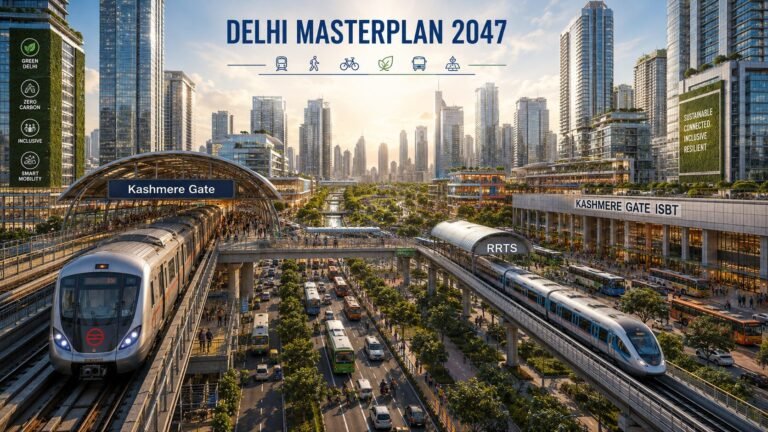
DELHI (Metro Rail News): Master Plan for Delhi (MPD) 2047 was announced by the Union Minister of Housing and Urban Affairs (MoHUA), Shri Manohar Lal Khattar on Thursday (21st August). This report proposed plans to develop Delhi’s urban infrastructure, mobility plans, and sustainability proposals. In the urban mobility sector, the plan to add 279 km of network to Delhi Metro and 6 new RRTS networks among several other announcements.
Delhi’s population is currently estimated at 2.40 crores which is expected to rise to 3.20 crores by 2047. The masterplan therefore focuses on solutions to reduce congestion and traffic in the city to foster better accommodation and connectivity for expected 80 lakh new citizens.
In this analysis we will assess the proposed developments on the urban mobility front with a detailed overview of projects around metro, RRTS, Transit Oriented Development (TOD), Multi-Modal Transport Hubs (MMTH) and all the major urban mobility announcements from the MPD 2047.
Delhi Metro: 695 km Metro Network by 2047
Delhi Metro is projected to expand its network from the present 416 km to 695 km by 2047. This will add a total of 279 km of metro network fostering last-mile connectivity and expanding metro network to different corners of the city and the satellite cities in Uttar Pradesh and Haryana.
The present network of Delhi Metro is 416 km (including the Rapid Rail to Cyber City and Noida Metro). The implementation of Phase IV and Phase V(A) are currently under construction while Phase V (B) is announced. The expansion will improve the connection across Delhi. Along with that, the idea for a 24-hour metro was also put forward to bring metro connectivity at all the time of the day.
7 RRTS & 3 HSRRedefining Mobility
Regional Rapid Transit Systems (RRTS) and High-Speed Rail (HSR) are going to transform regional connectivity and redefine mobility across the country. The centre of this change will be Delhi and the NCR area. In the MPD, Delhi is projected to expand its RRTS network to 7 lines with six new lines to be constructed by 2047. Further, three High-Speed Rail networks are also mentioned in the plan.
RRTS Network (Operational and Proposed)
Delhi-Ghaziabad-Meerut (Operational – 80 km)
Delhi-Gurugram-SNB-Bawal-Behror
Delhi-Panipat-Karnal
Delhi-Faridabad-Ballabgarh-Palwal
Ghaziabad-Hapur
Delhi-Bahadurgarh-Rohtak
Ghaziabad-Khurja
Delhi-Shahadra-Baraut
Further, the MPD 2047 mentions three HSR routes connecting Delhi with three major cities. These routes are:
Delhi to Varanasi
Delhi to Ahmedabad
Delhi to Amritshar/Chandigarh
Transit Oriented Development (TOD)
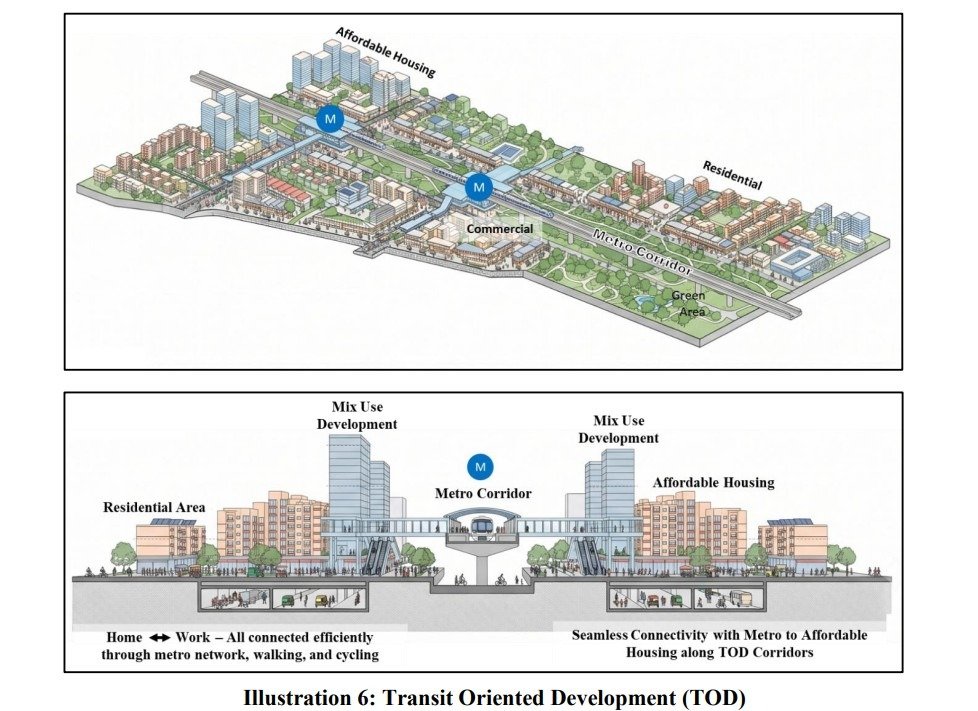
Transit Oriented Development (TOD) means constructing commercial and residential infrastructure around the metro corridors and RRTS networks, and stations. The motive of TOD is to align development with a mobility friendly infrastructure. Further, TOD can become a major source of non-fare box revenue for Metro and RRTS systems contributing to their financial sustainability.
The MPD 2047 plan focuses on TOD for the development of Delhi over the next two decades. Delhi Development Authority (DDA) has been appointed to implement the TOD plan across the city. Upon implementation, this will ease out travelling and also provide solutions for the city’s congestion and traffic problem. The plan also laid out regulation on the area and other requirements of the TOD Zones.
The plan is depicted through the image given below:
The TOD plan will rebuild the Metro systems and the RRTS as a commutation friendly zone. This zone will attract higher mobility across the corridor and unlock new opportunities for the whole economy. It will establish the Metro and RRTS stations as a commercial hub. Moreover, it will make use of the unutilized spaces around the corridor for commercial and residential requirements, making optimum utilization of land.
Multi-Modal Transport Hub (MMTH)
The plan proposes to develop three Multi-Modal Transport Hubs (MMTH) to improve connectivity among different modes of transport in Delhi. These MMTH are:
Areas to be Developed as MMTH
Anand Vihar-Karkardooma
Kashmere Gate
Nizamuddin-Sarai Kale Khan
These places will become a major hub connecting Railway, Metro, RRTS, ISBT, HSR and other public transport modes. Given the strategic significance, they will become a hub of economic and commercial activities.
AHMEDABAD (Metro Rail News): Gujarat Metro Rail Corporation (GMRC) has invited bids for a major civil construction package under the Ahmedabad Metro Phase-2A project. The ₹879.27 crore package covers 4.97 km of elevated viaduct, four elevated stations and 1.01 km of underground section, including an underground station.
Ahmedabad Metro Phase-2A tender details
Information
Details
Tender Number
GMRC/CONS/STNS+VDCT+UG/PH-2A/2026
Project
Ahmedabad Metro Phase-2A
Estimated Cost
₹879.27 crore, excluding taxes
Tender Security
₹8.79 crore
Completion Period
36 months
Bid Submission Deadline
28 September 2026, up to 3:00 PM
Pre-bid Meeting
5 September 2026, 11:30 AM
Scope of work
The tender covers construction of 4.97 KM Elevated Viaduct from Koteshwar Road Dead End to the start of ramp of Underground section, including 4 Nos. elevated Stations viz. Ashram Road, Koteshwar Prachin Mandir, Sabarmati River, Sardar Nagar And Design, Construction and Completion of 1.01 KM of Underground Section comprising Twin Cut & Cover Tunnel between Ramp to Dead End, including Ramp and 01 no. Underground Metro Station for Ahmedabad Metro Rail Project, Phase-2A.
About Ahmedabad Metro Phase-2A
Ahmedabad Metro Phase-2A is a 6.032-km airport extension corridor connecting Koteshwar Road with Sardar Vallabhbhai Patel International Airport. The corridor will have five stations, including four elevated stations and one underground station.
Ashram Road
Koteshwar Prachin Mandir
Sabarmati River
Sardar Nagar
Airport
The project received Union Cabinet approval in June 2026 at a cost of ₹2,169.04 crore. It aims to provide a direct metro connection towards the airport and improve integration with the wider Ahmedabad-Gandhinagar metro network. With the completion of Phase-2A, the operational metro rail network across Ahmedabad and Gandhinagar is expected to increase to 77.63 km.
GUWAHATI (Metro Rail News): The Northeast Frontier Railway (NFR) has finished track-linking work that connects Jogighopa Railway Station yard with the Multi-Modal Logistics Park (MMLP) GCT siding in Assam.
Northeast Frontier Railway (NFR) completed the Non-Interlocking work, enabling freight trains to directly access the national railway network from the MMLP. This allows freight trains to move directly from the logistics park onto the national railway network. The new link joins Lines 1 and 2 of Jogighopa station with the MMLP GCT siding.
The Jogighopa MMLP sits along the Brahmaputra River and is the first facility of its kind in Assam. It brings together roads, rail, air and waterways to handle the movement of goods.
Railway officials expect the improved rail connection to speed up freight movement and make supply chains more efficient. The park is set to work better as a key logistics hub. Trade, industry and logistics businesses in the region stand to gain from smoother freight operations. The stronger connectivity should also support economic growth and help the Northeast emerge as a gateway for international trade and regional links.
Earlier in August Divisional Railway Manager, Rangiya division, accompanied by the concerned Branch Officers, conducted a comprehensive Pre-Non-Interlocking works inspection and Window Trailing Inspection from Jogighopa Railway Station to Azara Railway Station in Jogighopa Station.
DRM/Rangiya, accompanied by the concerned Branch Officers, conducted a comprehensive Pre-NI inspection at Jogighopa Station today in connection with the proposed commissioning of the Multi-Modal Logistics Park (MMLP) GCT from JPZ Station, and inspected JPZ Station. Additionally,… pic.twitter.com/gh3EWXNdrD
— DRM/Rangiya Division, Northeast Frontier Railway (@DRM_RNY) August 8, 2026
Jogighopa MMLP, Assam
Located in Assam, spread across 200 acres, the park lies about 200 kilometres from Guwahati. It already connects to three major transport modes i.e. road, rail and inland waterways.
This multimodal setup is expected to lower transport costs and improve the overall movement of goods across the region. The facility is also positioned to boost trade ties with neighbouring countries such as Bhutan, Bangladesh and Nepal by making cross-border movement of cargo easier and more efficient.
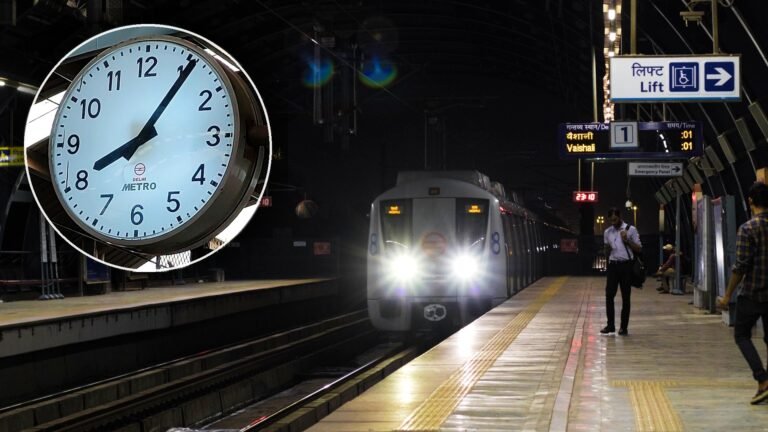
DELHI (Metro Rail News): Delhi Metro may join USA’s New York subway, Chicago, and Denmark’s Copenhagen Metro with a 24-hour services plan proposed by 2047. In the launch of Master Plan for Delhi (MPD) 2047 on Thursday (20th August), Shri Manohar Lal Khattar, Union Minister of Housing and Urban Affairs (MoHUA) announced a 24-hour city plan with a proposal to extend Delhi Metro’s services for 24-hour in a day.
According to a 2024 report of CNN, only three metro systems in the world run 24 hour a day. These are the New York subway, Chicago “L” and Copenhagen metro system. Besides, there are several other systems across the world including London Underground, which runs 24-hour service on certain days of the week.
Assessing the feasibility of the Idea
Before moving forward with the idea, the authorities must navigate some issues in the implementation of this plan. Delhi Metro Rail Corporation (DMRC) must assess a plan to do track maintenance and maintenance of the rolling stock during night and non-peak hour.
Another concern could be ensuring safe conduct on the metro premises during late night. Along with that the economic feasibility of the plan should be assessed to make it a viable addition on the metro’s revenue side.
‘24-Hour City’: Redefining Urban Life
A person on a late night train journey from Jaipur to Delhi may spend twice the amount that he paid for the journey, on cab service for mobility within the city. If the 24-hour metro plan is implemented then it will foster a seamless connectivity.
Connaught Place, areas near DU’s North Campus, Hauz Khas, Gurugram’s Cyber City and many other places in Delhi have a vibrant night life. The 24-Hour city plan may foster growing night life across other regions and enhance the development along the vibrant areas.
The MPD report mentions that “The concept of ‘24-hour city’ shall be promoted by identifying nodes, precincts or circuits to attract tourists and locals. Extending the duration of utilisation of work spaces, socio-cultural and commercial facilities will promote a vibrant night life and boost local economy.”