New Delhi: Prime Minister Narendra Modi has flagged-off the Delhi-Faridabad Metro Line that would allow hassle free travel for around two lakh daily commuters between the national capital and the industrial hub in Haryana.
The extension of the Delhi Metro connects Badarpur to Escorts Mujesar in Faridabad.
The total cost of the project from Badarpur to Escorts Mujesar is nearly Rs. 2,500 crore. Out of this, Rs. 1,557 crore was borne by the Haryana Government, the Centre contributed Rs. 537 crore, while the Delhi Metro provided Rs. 400 crore.
All these are elevated and located on either side of the Delhi-Mathura Road (NH-2).
“The nine-station metro corridor which was 95 per cent indigenously built will provide people a safe, affordable, quick, comfortable, reliable, environment-friendly and sustainable transport facility,” a Haryana government spokesperson said.
Haryana Chief Minister ML Khattar, addressing a press conference on Saturday, had thanked the Prime Minister for “gifting” the Metro service which would take the city to “another level of progress” with better connectivity with other NCR towns.
He had also said that the Prime Minister would be announcing the go-ahead for connecting Gurgaon with Faridabad by Metro.
MUMBAI (Metro Rail News): The Tunnel Boring Machine T60, named “Dhruva”, was installed on Mumbai Metro’s Red Line at Chhatrapati Shivaji International Airport’s Terminal 2 station.
It is the 2nd TBM to be commissioned by J Kumar Infraprojects (JKIL). It has been deployed on Red Line’s Line 7A, which runs between Gundavali & CSIA.
Increased Connectivity
The line 7A will be connecting Andheri East & Chhatrapati Shivaji International Airport along with expanding the existing Line 7. The new line will also provide direct connectivity to Metro 9, Metro 2A & Metro 7. It will provide people with direct connectivity from Bhayander to the International Airport.
Prior Deployment
The TBM was previously deployed on Mumbai Metro Line 3’s 4.94 Km package UGC-05 ( Dharravi-CSIA T1) & Package /uGC-06 ( CSIA T1- Marol Naka). The 06.68m Dual Mode Terratec Machine was refurbished at J Kumar’s yard for redeployment.
Scope of work
The TBM will build an approximately 2.49 km tunnel for the downline tunnel from CSIA Terminal 2’s station to Airport Colony station and a ramp on the Western Express Highway (WEH), with the initial drive expected to be finished in a month. The tunnelling project will be carried out at a depth of 12-28 meters and will be completed by June 2024.
The Contract
The contract for Package CA-48 was awarded to J Kumar Infraprojects (JKIL) in September 2019 with an estimated cost of Rs 1,998 Crore by the Mumbai Metropolitan Region Development Authority.
The scope of the contract includes
11.38 Km elevated Line 9,
Line 7A’s viaduct, ramp & underground tunnel,
2 Sttaions at Airport Colony & CSIA Terminal 2.
In the future, it will meet the under-construction Aqua Line and Gold Line linking to Navi Mumbai International Airport.
Line 7A
The 3.42 km long metro line running along the Western Express Highway will mix underground and elevated routes with 2.49 km of line running underground. The corridor will have two stations: Airport Colony and T2 Airport. The entire tunnelling of the project is expected to be finished by June 2024.
Discover the endless possibilities of our city’s Metro at InnoMetro, our flagship Expo and Conference. Be an active participant in shaping its future towards a more sustainable tomorrow. Stay informed and join us to take a step towards a brighter future.
According to the Ministry of Railways, a route with trains operating between 160 and 200 km/h is considered a higher-speed or semi-high-speed rail line, while the routes operating at less than 160 km/h are considered conventional rail lines. According to the UIC definition, a commercial speed of over 250 km/h for a newly built line or 200 km/h for an upgraded line is considered high-speed. As of July 2023, India has 508 km of high-speed tracks under construction, while 174 km in the Tughlakabad – Agra Cantonment support semi-high speeds.
The speed categorisation for Indian Railways is described as follows:
Speed
Type
Length
<110 km/h
Conventional rail
67,869 km
>110 km/h and <130 km/h
Group B lines
>130 km/h and <160 km/h
Group A-lines
>160 km/h and <200 km/h
Semi-High-Speed Rail
174 km
>200 km/h
High-Speed Rail
508 km
Details Indian Railways has no operational high-speed rail lines despite eight corridors being approved, with the corridor between Mumbai and Ahmedabad now under development. The Gatimaan Express and Rani Kamalapati (Habibganj)-Hazrat Nizamuddin Vande Bharat Express have a top operational speed of 160 km/h on the Tughlakabad-Agra Cantonment section of the route as of 2023. The first high-speed railway corridor (508 km) between Mumbai and Ahmedabad is now under development, with a maximum operational speed of 320 km/h planned. The corridor that shall use Shinkansen technology is being constructed and will run on a standard gauge rather than the more common broad gauge on the rest of the train network. It is estimated to take roughly three hours to carry passengers between the two cities, with ticket prices competitive with air travel.
This project was initially scheduled to be completed by December 2023, but due to land acquisition challenges and the COVID-19 outbreak, it is now estimated to be completed by October 2028. However, a section of this line between Surat and Bilimora will open in 2026. In its white paper ‘Vision 2020,’ released and submitted in the parliament on December 18, 2009, the Ministry of Railways projected the development of regional high-speed rail projects providing services at 250-350 km/h, as well as the planning of corridors connecting commercial, tourism, and pilgrimage destinations.
The newly elected government in 2014 expressed its desire to set up the Diamond Quadrilateral high-speed rail project, which had been envisaged to connect the cities of Chennai, Delhi, Kolkata, and Mumbai through a high-speed rail system. In the incoming president’s speech, this project was approved as a priority for the next government. Construction of one kilometre of high-speed railway track is expected to cost between Rs. 100 crore to Rs. 140 crore, 10-14 times the cost for conventional railway construction.
The proposed new high-speed rail lines will be standard gauge, although older tracks that could be modified to more incredible speeds will have a 5 ft 6 in (1,676 mm) broad gauge. Unless and until variable gauge systems are used, there will be no interoperability for passenger and cargo traffic between the new lines and the older upgraded tracks.
Efforts for speed enhancement: A brief history
1940s & 50s – The Steam Era: During the steam era of Indian railways, trains rarely reached speeds of 90 kilometres per hour. The introduction of the WP class locomotive was only achieved in the 1940s with a commercial speed of 100 km/h. When the electrification of the Bombay Division was completed, the transition from steam technology occurred. WCP-1 class electric locomotives were used to carry the coaches at speeds greater than 100 km/h, with a theoretical top speed of 120 km/h. Because of the two World Wars, Indian Railways could not extend electrification beyond the Bombay Division, so steam locomotives dominated the lines throughout the other parts of India.
1960s – Diesel Era: The age of diesel locomotives began in the 1960s when Indian Railways purchased ALCO’s WDM-1 and WDM-2 class locomotives. Although the WDM-1 locomotive failed to reach the 100 km/h mark, the subsequent WDM-2 and WDM-4 locomotives did so throughout most of the period of the decade.
1970s – Electric Train Era: In March 1969, India inaugurated the Howrah Rajdhani Express, five years after Japan inaugurated the Shinkansen, the world’s first high-speed rail, which ran at twice the speed of the Rajdhani Express. With the introduction of several electrification initiatives on main routes in the 1970s, electric locomotives quickly began to replace their diesel counterparts. During the 1980s, the WAP-1 electric locomotive broke the record for the fastest locomotive in India, reaching a top speed of 160 km/h during trial runs and being licenced and permitted for commercial operations at 140 km/h. In 1989, the WAP-1 hauled Shatabdi Express from New Delhi to Jhansi was the first train to reach a top speed of 140 km/h.
WAP-5 class locomotives, India’s first AC locomotives, were imported to haul fast, short trains like the Shatabdi Express. They also had fully mounted traction motors, which reduced track impact and allowed for more incredible speeds. The first batch of these locomotives arrived in India in 1995 and reached 130 km per hour speeds. During the trial runs, this locomotive set a speed record of 184 km/h, making it the fastest in India. With a top speed of 160 km/h, the WAP-5-hauled Gatimaan Express became India’s fastest commercially operated and run train in April 2016. The Vande Bharat Express, based on MEMU, was the second indigenously developed and manufactured semi-high-speed EMU train two years later. During its trial run, this train reached a speed of 180 km/h and was designed to travel at a maximum speed of 200 km/h, but due to track speed limitations, the train’s operational speed is limited to 130 km/h.
1980s Onwards – Proposals for high-speed rails: The then-railway minister, Madhavrao Scindia, proposed the Delhi-Kanpur high-speed rail line in the mid-1980s, but it was found to be financially unviable, so railways instead introduced Shatabdi trains that travelled at 140 km/h. Six elevated lines were identified in the Vision 2020 white paper 2009 for technical research on establishing high-speed rail corridors. The ‘High-Speed Rail Corporation of India Ltd’ (HSRC), founded on 25 July 2013 by Rail Vikas Nigam Ltd. (RVNL) for high-speed rail corridor projects, was replaced on 12 February 2016 by the ‘National High-Speed Rail Corporation Limited’ as the government company for high-speed rail corridor construction and operation.
2017 Onwards – Construction of high-speed rail: The construction of India’s first high-speed rail route, the Mumbai-Ahmedabad high-speed rail corridor, began in 2017 and is projected to be completed by 2028. The foundation stone laying ceremony occurred on September 14, 2018, in Ahmedabad, when Japanese Prime Minister Shinzo Abe and Indian Prime Minister Narendra Modi flagged off construction work in Ahmedabad. The maximum operational speed of the E5 Series Shinkansen trains is expected to be 320 km/h, with an average speed of 260 km/hr.
Network & Route
The network is designed and planned to have a top speed of 300-350 km/hr and to travel on elevated corridors to segregate high-speed train tracks to prevent trespassing. Systra, Italferr, RITES Limited, Mott MacDonald, INECO, PROINTEC, Ayesa, Japan External Trade Organisation (JETRO), and Parsons Brinckerhoff conducted feasibility studies.
Summary of proposed and under construction high-speed rail lines in India
Sr. No.
Proposed High-Speed Corridor
Speed (In Km/Hr)
Length (In Km)
Present Status
Planned Opening (As per NRP)
North
1
Delhi–Varanasi high-speed rail corridor
320
865
DPR under preparation
2031
2
Delhi–Amritsar high-speed rail corridor
320
480
Approved
2051
3
Delhi–Ahmedabad high-speed rail corridor
320
886
Land acquisition to begin
2031
4
Amritsar–Jammu high-speed rail corridor
320
190
Proposed
2051
East
5
Varanasi–Howrah high-speed rail corridor
320
711
DPR under preparation
2031
6
Patna–Guwahati high-speed rail corridor
320
850
Proposed
2051
West
7
Mumbai–Ahmedabad high-speed rail corridor
320
508.18
Under Construction
2026 (Surat – Bilimore)2028 (Entire Route)
8
Mumbai–Nagpur high-speed rail corridor
320
736
DPR under preparation
2051
9
Mumbai–Hyderabad high-speed rail corridor
320
711
DPR under preparation
2051
10
Pune–Nashik rail line
200
235.15
Land acquisition initiated
2027
11
Ahmedabad–Rajkot high-speed rail corridor
220
225
DPR Prepared
TBD
Central
12
Nagpur–Varanasi high-speed rail corridor
320
855
Proposed
2041
South
13
Chennai–Mysuru high-speed rail corridor
320
435
DPR under preparation
2031
14
Hyderabad–Bengaluru high-speed rail corridor
320
618
Proposed
2041
15
Silver Line (Thiruvananthapuram–Kasaragod)
200
529.45
DPR Prepared
TBD
Diamond Quadrilateral: The Diamond Quadrilateral Project is an ambitious initiative by India to connect the major cities of New Delhi, Kolkata, Chennai, and Mumbai with a high-speed rail network. Sections of this project are either under construction or have been approved.
High–Speed Diamond Quadrilateral: Proposed route, length and line
Sr. No.
Proposed High-Speed Corridor
Speed (In Km/Hr)
Length (In Km)
Present Status
Planned Opening (As per NRP)
1
Delhi – Kolkata
320
1576
DPR under preparation
2031
2
Kolkata – Chennai
320
1500
TBD
TBD
3
Mumbai – Chennai
320
1200
TBD
TBD
4
Delhi – Mumbai
320
1394
One Section Under Construction
2031
5
Delhi – Bengaluru
320
1900
TBD
TBD
6
Mumbai – Kolkata
320
1800
TBD
TBD
Semi – High-Speed Rail Operations
160–200 Km/Hr Track Upgrades: Indian Railways plans to enhance the speed of passenger trains on dedicated conventional tracks to 160-200 km/hr. Indian railways are also trying to upgrade current conventional lines to handle speeds of up to 160 km/hr, aiming to exceed 200 km/hr on new tracks with upgraded technology. Native organisations have already produced trains reaching up to 200 km/h. The Dedicated Freight Corridor Corporation of India is developing dedicated freight corridors across India to redirect cargo traffic away from passenger railway tracks, allowing passenger trains to reach speeds of 200 km/hr. The Indian Railways have divided the tracks into two groups. Tracks that support 110 Km/hr – 130 Km/hr are categorised as ‘Group B,’ whereas tracks that support 130 km/hr – 160 km/hr are designated as “Group A.” The routes listed below operate, are under development, or are planned to operate at speeds of 160 km/hr or above.
Upgrades to 160–200 Km/Hr Semi-High-Speed (1,676 mm (5 ft 6 in) Broad Gauge Tracks)
Route
Speed (Km/Hr)
Length (Km)
Opening
Notes
Tughlakabad – Agra Cantonment
160
174
5 April 2016
First Semi-High Speed (1,676 mm Broad Gauge) Track
Delhi – Mumbai
160
1,384
March 2024
Preliminary Work Underway.
Agra Cantonment – Howrah (Kolkata)
160
1,446
TBD
Preliminary Work Underway.
Chennai – Gudur
160
134.3
TBD
DPR Submitted
Chennai – Renigunta
160
134.78
TBD
DPR Submitted
Mumbai – Howrah (Kolkata)
160
1,965
TBD
DPR Submitted
Mumbai – Chennai
160
1,276
TBD
DPR Submitted
Chennai – Howrah (Kolkata)
160
1,652
TBD
DPR Submitted
Bengaluru – Chennai
160
362
TBD
DPR Submitted
Chennai – New Delhi
160
2,164
TBD
DPR Submitted
Bengaluru – Hyderabad
160
632
TBD
DPR Submitted
Chennai – Hyderabad
160
715
TBD
DPR Submitted
Howrah (Kolkata) – Puri
160
502
TBD
DPR Submitted
New 160–200 Km/Hr Semi-High-Speed (1,435 mm (4 ft 8+1⁄2 in) Standard Gauge Tracks)
Route
Speed (Km/Hr)
Length (Km)
Status
Delhi – Meerut
180
82
Under construction
Delhi – Alwar
180
164
Under construction
Delhi – Panipat
180
103
Approved
Delhi – Rohtak
180
70
Proposed
Delhi – Palwal
180
60
Proposed
Delhi – Baraut
180
54
Proposed
Ghaziabad – Khurja
180
83
Proposed
Ghaziabad – Hapur
180
57
Proposed
Delhi – Jewar
180
67
Proposed To connect with Jewar International Airport
Hyderabad – Warangal
180
146
Proposed
Hyderabad – Vijayawada
180
281
Proposed
Regional Rapid Transit System: The Delhi-Meerut Regional Rapid Transit System (Delhi-Meerut RRTS) is an 82.15 km long, semi-high-speed rail corridor that is now under construction and will connect Delhi, Ghaziabad, and Meerut. It is one of three rapid rail lines planned under Phase I of the National Capital Region Transport Corporation’s (NCRTC) RapidX project. The distance between Delhi and Meerut would be covered in less than 60 minutes at a top speed of 180 km/h. The project is expected to cost Rs. 30,274 crore and will include 22 stations as well as two depots in Duhai and Modipuram.
The National Capital Region Transport Corporation (NCRTC) is developing the Semi-High Speed Regional Rapid Transit System (RRTS) or Delhi RAPIDX to connect Delhi with its far suburbs by 8 Smart Lines with trains travelling at a maximum speed of 160 km/h. The aim and objective of RAPIDX is to minimise commuter reliance on road-based transport and improve regional connections within the National Capital Region. The RRTS system has been planned to operate underground within Delhi mainly, connecting to the Delhi Metro Rail system, offering locals a speedier alternative option to reach their destination (for example, nonstop service between Sarai Kale Khan and Kashmere Gate on the Delhi-Panipat line). In the rest of the world, comparable systems include London’s Crossrail, Paris’ RER, and Munich’s S-Bahn. The Delhi-Meerut RRTS Line is partially funded by an official development assistance (ODA) loan from the Asian Development Bank (ADB) and the Asian Infrastructure Investment Bank (AIIB).
The project is now under development, with work beginning on the 82.15 km Delhi-Ghaziabad-Meerut RRTS Line first. The 17-kilometer Sahibabad-Ghaziabad-Guldhar-Duhai segment has been prioritised and is scheduled to open in 2023. Bids for the Gurgaon segment of the 164-kilometer Delhi-SNB-Alwar RRTS Line were invited in November 2019, with the first contract awarded in April 2020.
Vande Bharat: The Indian Railways aims to expand the rail network. As part of this progress, the national transporter has deployed the indigenously manufactured Vande Bharat trains on multiple routes in India. It is India’s first ‘Made in India’, a medium-distance semi-high speed train service. These day train services connect major Indian cities that are less than a day’s journey apart, similar to the Shatabdi Express. Due to railway track speed capacity, multiple stoppages, and traffic congestion, the operating speed of the services is limited to 160 km/h on the part of the Delhi-Bhopal route and 110-130 km/h on other services. The train, known initially as Train 18, has been designed by the RDSO and manufactured by the Integral Coach Factory (ICF). The RDSO also standardised the specifications and the requirements. It had been developed and designed for low-cost maintenance and operating efficiency. A 16-coach Vande Bharat train costs around Rs. 115 crore. The services leveraging Train 18 sets were renamed Vande Bharat Express on January 27, 2019, with the inaugural run beginning on February 15, 2019.
Further, the Indian Railways is working on a mission mode to introduce two more Vande Bharat variants by the end of FY 2023-24. The Chennai-based Integral Coach Factory (ICF) is working tirelessly to design and manufacture the Vande Bharat Sleeper and Vande Metro coaches. In addition to ICF, the Railways of India will manufacture these semi-high-speed trains in two factories: Rae Bareli’s Modern Coach Factory and Latur’s Marathwada Rail Coach Factory. As of the present time, there will be three Vande Bharat variants: (a) Vande Bharat Chair Car, (b) Vande Bharat Sleeper Car, and (c) Vande Metro.
All three models will improve as well as enhance the passenger experience. The Vande Sleeper version will travel for more than 550 kilometres. It will replace existing superfast trains such as the Rajdhani and Duronto. The sleeper car format is planned to be available by February 2024. The Vande Metro format will cover less than 100 kilometres. This new model will eventually replace the present suburban and non-suburban, i.e. local trains.
Vande Metro: Following the advanced semi-high-speed train Vande Bharat Express’s success, the railways are planning to introduce the Vande Metro trains. According to the Railway Ministry, the Vande Metro trains will be introduced in the country by December 2023. The government plans to boost and enhance the trains’ production in 2024-2025. The new train rakes will be designed to provide job seekers and students with comfortable and economical commuting. Compared to the Vande Bharat Express trains, the Vande Metro is expected to be faster. The trains shall provide passengers with an easy, fast and quick shuttle-like experience. The trains are also expected to be comparatively more minor, with around eight coaches. This is a significant change from the Vande Bharat Express’s typical fleet of 16 coaches. The Vande Metro will run between cities close to one another instead of the Vande Bharat Express trains, which generally go between cities far apart. Most of the Vande Bharat Trains now in operation in India travel for approximately 500 km.
The Railways previously stated that these trains will run between cities approximately 100 kilometres apart. However, per the most recent information, the Vande Metro will be introduced in Mumbai first. The trains will operate as part of Mumbai’s local train system. Moreover, the Railway Board has already approved the purchase of 238 trains for the local network upgrade. Unlike the Vande Bharat Express, the Vande Metro has been planned to operate very frequently. The trains have been intended to run four to five times per day. Also, these trains are anticipated to be inexpensive for daily passengers.
Super High-Speed Rail
Maglev: Indian Railways examined and explored the possibility of running maglev trains to create a high-speed rail system that exceeds 500 kilometres per hour to transition from technology importer to producer and developer. Scientists from the Raja Ramanna Centre for Advanced Technology exhibited a training model based on MagLev devices with a top speed of 600 km/h in February 2019. Bharat Heavy Electricals Limited signed an agreement with SwissRapide AG in September 2020 to bring MagLev metro systems to India.
Hyperloop: There is currently no system in operation anywhere globally. Although human testing is being done, the suggested speed forecasts depend on considerable engineering breakthroughs and testing.
Mumbai-Pune Hyperloop: A 1,000 km/h system would take 14 minutes to commute between these two cities, compared to the present 3 hours, carrying 10,000 commuters every hour (5,000 in each direction). In January 2018, Hyperloop One presented a Detailed Project Report to the Pune Metropolitan Region Development Authority (PMRDA) with three terminal end-point choices in Mumbai: Dadar, Santacruz, and the Chhatrapati Shivaji Maharaj International Airport.
Amritsar-Chandigarh Hyperloop: In 2019, Virgin Hyperloop signed an agreement with Punjab to develop and establish a rail system which could cover a total distance of 226 km in 19 minutes, which would be at least ten times faster than a trip taken by existing transportation infrastructure like as road, rail, or flight.
Bengaluru-Chennai Hyperloop: Hyperloop One, based in Los Angeles, reached an agreement with the Karnataka government to conduct a feasibility study for this route, which is expected to reduce travel time to twenty minutes.
Conclusion
From Mumbai’s crowded commuter trains to midnight express mail trains that resemble a city on wheels to the incredible Darjeeling & Himalayan ‘Toy Train,’ railways are one of India’s most recognisable features. Without them, it is improbable that the country would have developed into the economic powerhouse it is today. However, as the country evolves, its railways are under increasing pressure to keep up and provide faster travel and more freight capacity to serve India’s burgeoning and expanding industries. Traditional systems, some dating back to the British Empire, may have served India well. Still, they are rapidly becoming obsolete, particularly compared to India’s neighbour and rival for regional supremacy, China. The network faces infinite competing demands to keep the country moving, serving all levels of society and communities, from the most miniature rural villages to some of the world’s most densely populated cities and towns.
Made up of more than 1.25 lakh kilometres of track in total, the Indian Railways (IR) network is the fourth largest in the world, operating nearly twenty thousand trains every day and serving almost 8,000 stations. Nearly thirteen thousand locomotives are available to haul approximately eighty thousand passenger coaches and almost three million freight wagons and coaches. The first Indian railways were proposed in 1832, seven years after the Stockton & Darlington Railway, the world’s first public rail line, opened in England.
The first stretch of the Great Indian Peninsular Railway, connecting Bombay (now Mumbai) and Thane, was not open to passengers until April 1853. When it opens and begins later this decade as part of the Mumbai-Ahmedabad bullet train line, India’s first high-speed passenger railway will connect the same two cities. Although India’s railways were primarily built for military purposes by the British, Indians embraced and welcomed them like no other, resulting in virtually insatiable demand and rapid expansion in the second part of the nineteenth century. In the pre-pandemic stage in 2019-20, IR carried more than eight billion passengers and hauled nearly 1.2 billion tonnes of freight. It is the country’s largest employer and, with 1.4 million staff, is one of the largest non-military organisations in the world.
However, compared to European railways and those of China, Japan, and Korea, average speeds remain frustratingly low. A few special express trains can reach 160 kmph or higher speeds, but the national average for long-distance express is only 50 kmph. In comparison, ordinary passenger and commuter trains barely exceed 32 kmph. Goods trains often travel from 24 to 75 km per hour. Congestion will worsen over the next 30 years unless new capacity is provided.
Seven trunk routes carrying forty-one per cent of all traffic account for sixteen per cent of the overall network. A quarter of IR’s network is operating at 100% to 150% of nominal capacity, which can have far-reaching consequences nationwide if there is a breakdown or any disruption. So, there seems to be three-pronged solutions to Indian Railways. Create a new generation of high-speed passenger railways between significant cities, build thousands of miles of additional high-capacity cargo railways known as dedicated freight corridors (DFCs), and electrify 100 per cent of the existing network by 2024.
It is a massively ambitious strategy, but the first DFCs are already operational, and electrification work continues to progress quickly. Three more Dedicated Freight Corridors totalling 5,750 kilometres are planned to accompany and go alongside the first pair of routes, which is expected to be completed this year. However, like Japan and China, India sees high-speed rail as the solution to lowering travel times, increasing capacity, and accelerating economic activity. An ambitious National Rail Plan, introduced in 2021, envisions high-speed trains connecting all major cities in north, west, and South India. Cities with populations of at least one million between 300 and 700 km apart are being prioritised.
India has partnered with Japanese technology engineers and is seeking financial assistance to help develop its first line, a 508-kilometre link between Mumbai and Ahmedabad in western India. If all plans are implemented, an additional 12 routes could benefit from high-speed connections in the future decades. The National High-Speed Rail Corporation Ltd (NHSRCL), set up to finance, construct and manage India’s bullet train projects, has also gained approval for eight new lines linking New Delhi and Varanasi (958 kilometres), Lucknow-Ayodhya (123 Km), Mumbai-Nagpur (736 Km), New Delhi-Ahmedabad (886 Km), New Delhi-Amritsar (480 Km), Mumbai-Hyderabad (711 Km), Varanasi-Howrah (760 Km) and Chennai-Mysore (435 Km).
In early 2022, four more routes had been proposed, bringing the total length to more than 8,000 kilometres. If approved, lines would also be completed between Hyderabad and Bangalore (618 kilometres), Nagpur and Varanasi (855 kilometres), Patna and Guwahati (850 kilometres), and Amritsar-Pathankot-Jammu (190 kilometres), making the world’s second most extended high-speed rail network. When Prime Ministers Narendra Modi and Shinzo Abe unveiled the Mumbai-Ahmedabad project in 2017, it was hoped that bullet trains would be operational in time for the 75th anniversary of Indian independence by August 15, 2022. Still, numerous challenges and delays have pushed completion back to at least 2028.
Given the rapid development of high-speed rail projects around the world, India must make a start at some point, and that time is now. Adapting and settling new technologies and lines takes time. For example, Japan’s Hokkaido Shinkansen took forty-two years to complete. We will be left behind if we do not begin immediately. It should be noted that while we are still in the planning stages of providing rail connectivity to strategically important areas and border locations, our arch-rival and neighbouring country, China, is well on its way to commissioning its more than 40,000 km long missile carrier high-speed rail corridor connecting every part of the country with combat readiness very soon. Even a much-underrated nation coming into existence nearly forty years after Indian independence in the early 80’s of the previous century, Bangladesh is developing a high-speed rail network.
Nevertheless, seen in the backdrop of the transformation Indian Railways is going through, the government must be desperate to see its flagship rail projects complete and deliver the promised benefits soon, not only to continue the pace of economic development controlling inflation, lack of capital formation and capital deficit in the populous country of the world but also to show its rivals that it too can deliver world-class 21st-century transportation.
Discover the endless possibilities of our city’s Metro at InnoMetro, our flagship Expo and Conference. Be an active participant in shaping its future towards a more sustainable tomorrow. Stay informed and join us to take a step towards a brighter future.
Coimbatore Suburban Railway Cum Coimbatore Broad Gauge Metro Railway or Kovai Metro Cum Suburban Railway is a Broad Gauge Metro and a Suburban railway planned for the city of Coimbatore. The circular railway route would serve Coimbatore Junction, Podanur, Vellalore, Irugur, Singanallur, Pilamedu, and Coimbatore North. Since this circular line runs through the critical portions of Coimbatore city and ends within the city limits, it shall undoubtedly help to relieve congestion on city roadways. The restoration of the former Main Line (Broad Gauge Vellore Station) Nanjundapuram Railway connection line, which is 1 km long, will help and assist in planning a circular urban electric train track. However, due to the proposed Coimbatore Metro, the project’s implementation is postponed.
Routes & Stations
These are the five routes.
Coimbatore Jn – Mettupalayam
Coimbatore Jn. – Pollachi Jn.
Coimbatore Jn – Tiruppur
Coimbatore Jn – Palakkad Jn
Coimbatore Jn – Irugur Jn – Podanur In – Coimbatore Jn (Proposed for Both Metro and Mainline Routes)(circular line as well as urban line).
As stated above, local passenger trains from Coimbatore Junction operate on all of the suburban routes except for the Coimbatore Jn – Irugur Jn – Coimbatore Jn (circular and urban line). Coimbatore North Junction (CBF), Podanur Junction (PTJ), Irugur Junction (IGU), Madukkarai (MDKI), Pilamedu (PLMD), Singanallur (SHI), Sulur Road (SUU), Periyanaickenpalayam railway station (PKU), and Somanur (SNO) are the other stations that serve the city. Other stations, such as Chettipalayam, Urumandampalayam, Veerapandi, and Pudupalayam, are no longer operating. However, the people have demanded the stations be reopened. The single-kilometre-long Nanjundapuram Railway connecting line was decommissioned soon after the Coimbatore North – Irugur section was completed.
The restoration of this Nanjundapuram Railway link line might help in the planning of a circular suburban electric train track connecting key train stations on Coimbatore’s outskirts, such as Mettupalayam, Irugur, Podanur, Pollachi, and others, to alleviate high and rising peripheral traffic. Residents of Nanjundapuram, Ramanathapuram, Redfields, Puliakulam, Sowripalayam, Udayampalayam, Singanallur, Varadarajapuram, Uppilipalayam, and Ondipudur in Coimbatore are expected to be benefitted from the reopening of the defunct Nanjundapuram Railway line and Station. Irugur by way of Nanjundapuram: This bypass route from Irugur to Podanur to Coimbatore was built many years ago when Coimbatore was only connected from Podanur as a branch from the Irugur-Podanur-Shoranur line.
It was done to allow trains from Erode to travel directly to Coimbatore. However, when Coimbatore was directly connected from the Irugur side through Pilamedu and Coimbatore North in 1953, this connecting line became obsolete and had been demolished. As the doubling work between Irugur and Coimbatore is underway, these double lines are expected to be used for suburban traffic if required and felt necessary. This can be said to be a sorrowful and despairing backdrop of the now-defunct Nanjundapuram Railway Station.
Mammalapuram
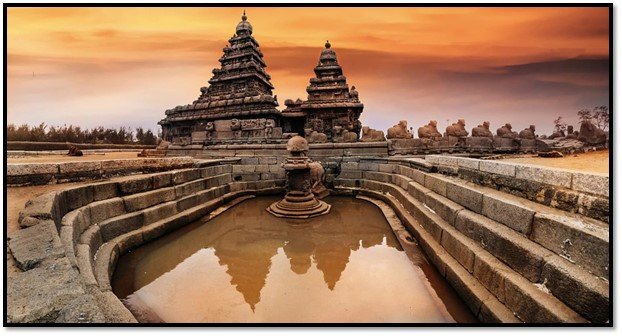
Mahabalipuram, also known as Mammalapuram, is a town in Tamil Nadu’s Kancheepuram district. It has a recognised seaport that dates back to the 7th and 10th centuries of the Pallava Dynasty, located on the Coromandel Coast of the Bay of Bengal. The best time of the year to see this well-known landmark of significant architectural and sculptural achievements is from November to February. It is stated that the demon king Mahabali was killed by Lord Vishnu, who gave the city the name Mamallapuram, which was later changed by King Pallava Narshima Varman, who was given the title Mamalla- also known as the great wrestler. The Pallavas built and constructed a coastal temple to honour Lord Shiva in the seventh century, and during their reigns, they sculpted magnificent and spectacular structures, architecture and establishments with an active seaport for decades; this area is now included in the World Heritage-listed temples and sculptures.
Mahabalipuram is well connected to the country’s major cities, including Chennai and Tamil Nadu. Various state and local tourist buses will take visitors to the historic city. Major routes connect Chennai to Mahabalipuram (54 km) and Bangalore (346 km). The nearest railway station is Mahabalipuram to Chengalpattu Junction (CGL) in Kancheepuram, 24 kilometres from the city. Taxis and cabs can be boarded from there to reach the magnificent city. Chennai International Airport is the closest airport to the city and connects all major cities in India and worldwide. From there, one may easily reach the beautiful city of Mahabalipuram. There are five Rathas, a shore temple, a Trimurthi cave, an Adivarah temple, a replica of Arjuna’s penance, and many other stunning sites that awaken tourists and guests.
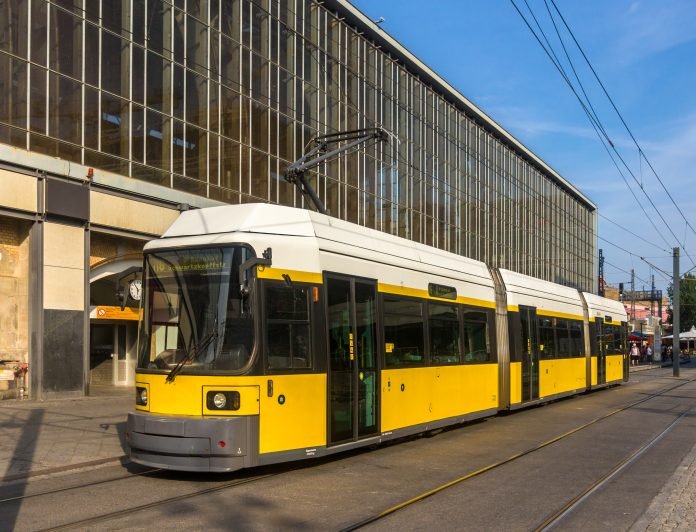
Tram Services
To improve services and attract more tourists to Mammalapuram, the state government has planned to develop and establish an extensive parking area and a tram service within the tourist town. The government has proposed an idea and initiative to emulate tramways in Bordeaux, France, and Basel, Switzerland, which enable tourists to acquire a sense of the location on the streets of the towns and tourist locations. It has been proposed to provide a centralised parking area for all tourist vehicles. The revenue department has also identified a location near the Karu Kathamman temple in the beach-front town and has submitted a proposal to the concerned department.
According to revenue department authorities, tram services have been planned to be established near the parking area. The projected tram service is scheduled and expected to go through town streets and narrow lanes, revealing the intricate and exquisite craftsmanship of the Pallava Kings and antiquities and artefacts around the town. Tourists can see the whole city and everything the town offers without walking and travelling for hours. Tourists must purchase a tram pass to enjoy the tram services, and they can hop on and off the tram at their leisure. The tram has been planned to pass through UNESCO-listed sites, including the beach temple, the ‘Five Rathas,’ Arjuna’s Penance, and Krishna’s Butterball, among others.
On the other hand, historians are sceptical of the idea, fearing that it may endanger heritage monuments. The historians, archaeologists and epigraphists, therefore, demand that the state government first form a committee comprising officials from the concerned departments and activists showing the route in which the tram will pass through the town. The popular tourist destination has been witnessing an upsurge in visitors since it was renovated and rebuilt for the second informal meeting of Prime Minister Narendra Modi and Chinese President Xi Jinping, which took place on October 11 and 12, 2019.
KANPUR (Metro Rail News): Operations on the priority stretch of Kanpur metro running between IIT to Motijheel began operation on Automatic Train Operation (ATO) mode from Sunday onwards. The operations were inaugurated after a Puja held at the IIT metro station on Saturday.
UPMRC tweeted, “ Kanpur Metro will run on ATO (Automatic Train Operation) mode on the priority corridor. Automatic operation of the metro will bring efficiency in safety and punctuality”.
Journey, so far
The trains on this line have been running in Automatic Train Protection (ATP) mode, which features an automatic braking system to avoid any kind of accident, keeping in mind passengers’ safety. Under this, operators used to play a significant role in train operations.
Journey, ahead
In Automatic Train Operations (ATO), the majority of operations related to trains will be automatic, ranging from motoring or braking to Platform Duty. Only door closing has been left upon the metro operator in order to avoid any sort of hurried response and ensure the highest level of passenger safety.
Puja being hed at the IIT station
Efficiency at its peak
The system will ensure the highest level of efficiency in the metro trains, ensuring negligible chances of human error. In this, the operator intervention is brought down to zero, ensuring zero human intervention that will lead to the highest safety and efficiency on the tracks.
Metro Trains
Metro services are divided into various categories like GoA1, GoA2, GoA3, etc. These grades inform about the level of automation that can be exercised with these trains. Kanpur Metro trains are GoA 3 Category trains.
GoA-3 is the 4th level of Automation to be exercised on Metro trains, where a train operates autonomously without any driver but can be intervened by human operators in command centres if thought necessary.
Necessary Pre-requirements
To run trains on the GoA-3 level of automation, a Communication-Based Train Control (CBTC) System is required. Along with this, an Automatic Train Supervision (ATS) System is also installed in order to control & adjust speed in abnormal conditions.
Kanpur Metro
Kanpur metro is being built at a cost of Rs. 11,076.48 Crores, with its First Phase, the Orange Line running between IIT Kanpur & Motijheel, being inaugurated in December 2021 by PM Narendra Modi. The remaining 14.9 km stretch of Orange Line between Motijheel & Naubasta is under construction.
Discover the endless possibilities of our city’s Metro at InnoMetro, our flagship Expo and Conference. Be an active participant in shaping its future towards a more sustainable tomorrow. Stay informed and join us to take a step towards a brighter future.
NEW DELHI (Metro Rail News): In an interview with the PTI, The DMRC Chief informed about the target freshly set by the Delhi Metro Rail Corporation (DMRC). Owing to the delays incurred by the COVID-19 pandemic, the project has already suffered plenty of time loss.
New Targets
The DMRC chief, in an interview with PTI, said, ”The first section of Delhi Metro’s Phase IV is to be opened by July 2024.” The Magenta Line from Janakpuri West-RK Ashram Marg runs along 28.92 Km with a 21.18 Km elevated structure & remaining 7.74 Km to be underground.
DMRC Chief also said, “ Besides the commissioning of the 2.5-3 km segment, the whole Majlis Park-Maujpur corridor is planned to be opened by March 2025.
Undergoing Projects
The DMRC is currently working on three projects simultaneously, namely
The first two are the extensions of the existing Magenta Line & Pink Line, while the third one is the Silver Line connecting the Violet Line & Airport Express Line at their respective ends. As a whole, DMRC is currently working on 65.2 Km of Three Priority Corridors spanning 45 stations.
Technological Breakthroughs
MD, DMRC said, ” The construction of phase IV has brought many firsts for the country, and ‘beam-technology enabled TBMs’ are being used in the Phase to assess strata layers in advance so that ‘there are no surprises’ during the drilling process”.
Work Status
When asked about the progress in Phase IV, the DMRC chief said. ” Overall, about 40 per cent of work has been completed”. He also said, ”I do not see any major cost overruns due to the pandemic. But, delay, as I have already told you, we have already shifted the milestones.”
Financial Health of DMRC
COVID-19 had a significant impact on the financial record of DMRC. The DMRC incurred losses for two straight years after the COVID-19 pandemic. In the third year, it generated an operational surplus of Rs 50 crore. Noe, in the coming year, it is expected to generate a surplus of Rs 600 Cr. The DMRC chief remarked, “ We are, in fact, inching back towards the normal”.
Major Achievements so far
The DMRC has been a pioneer in bringing new technologies to the nation. Some of its key innovations include:
The DMRC plans to adopt Unmanned Train Operations (UTO) very soon.
Discover the endless possibilities of our city’s Metro at InnoMetro, our flagship Expo and Conference. Be an active participant in shaping its future towards a more sustainable tomorrow. Stay informed and join us to take a step towards a brighter future.
NEW DELHI (Metro Rail News): According to an official statement, the Indian Railways earned Rs 95,929,30 Crore freight revenue between April & October.
Improvement in Revenue
Indian Railways earned a sum of Rs 92,345.27 crore in the same period. It has registered an improvement of Rs 3.584.03 crores in this fiscal year. Along with the sane, the Indian Railways hauled 887.25 MT of freight between April and October.
Freight revenue of Rs 14,231.05 Crore was already earned in October this year compared to Rs 13,353.81 Crore last year. This registers a growth of 6.57 per cent for October.
Growth in Freight Carriage
So far, Indian railways have registered an improvement of 36.12 MT in freight carriage in the same period. Additionally, an originating freight loading of 129.03 MT has already been achieved, compared to the 118.95 MT in October last year.
An improvement of about 8.47 per cent has already been recorded in Frieight Carriage for October.
Freight Carriage
Indian Railways is the national transporter of the country that carries freight of high volumes every year from one corner to another corner of the nation. The freight includes coal, iron, cement, food grains, fertilisers, etc. It also facilitates container service for the supply of goods.
Economic Perspective
From April to July 2023, the Indian Railways experienced a mere 1% growth in its freight volume and a modest 3% increase in its revenue. In contrast, the country’s economy has surged by 7%. This performance can be described as quite disappointing.
Furthermore, it’s worth noting that the Indian Railways’ share in the nation’s freight transportation has dwindled steadily, now standing at approximately 27%, a significant drop from the over 80% share it held at the time of India’s independence.
Role of Freight Carriage for IR
In the report delivered to Parliament on August 8, 2023, the Comptroller and Auditor General of India (CAG) revealed a recurring issue within the Indian Railways. According to the report, in the fiscal year 2021-22, passenger services across all categories incurred a significant loss of ₹68,269 crore. Notably, the profits generated from freight traffic were entirely offset by the need to subsidise passenger services, which has been an ongoing challenge for the Indian Railways.
This tells us tremendously about the role of freight carriage in sustaining the Indian Railways in the Long run, as this is the only segment that gets the IR a decent amount of revenue to balance its books.
Discover the endless possibilities of our city’s Metro at InnoMetro, our flagship Expo and Conference. Be an active participant in shaping its future towards a more sustainable tomorrow. Stay informed and join us to take a step towards a brighter future.
PUNE ( Metro Rail News): The Pune Metropolitan Region Development Authority (PMRDA) has undertaken the development of the 23.203 km long Pune Metro Line 3 Project connecting Maan Hinjawadi with the city centre at Shivajinagar on a Public Private Partnership (PPP) basis.
The State Government had accorded approval to undertake the said Project on Public Private Partnership model vide Government Resolution dated 09/02/2018. Accordingly, the Consortium of TRIL Urban Transport Pvt Ltd and Siemens Project Ventures GmbH was awarded the Project, and a Special Purpose Vehicle Pune IT City Metro Rail Limited was formed to undertake the said Project.
The Concession Agreement was signed on 21/09/2019, and the Appointed Date was declared on 25/11/2021, marking the start of construction work. About 45% of the project work is complete.
Since the Project is proposed on a PPP basis, Viability Gap Funding (VGF) of Rs. 1225 cr was envisaged from the Central Government. After the infusion of 100% equity by the Concessionaire and proportionate disbursement of debt by the banks, the PMRDA has applied to the State Government for disbursement of VGF to the tune of Rs. 410 cr out of the total VGF of Rs. 1225 cr.
The proposal was sent to the Department of Economic Affairs, Ministry of Finance, Government of India. PMRDA Commissioner, Shri Rahul Mahiwal and Chief Engineer, Smt. Rinaj Pathan continuously followed up on the disbursement of the said amount.
“With the timely receipt of the first tranche from the central government, no other financial difficulties have remained, and the project will progress as per schedule”, Rahul Mahiwal, Commissioner, PMRDA, said.
Discover the endless possibilities of our city’s Metro at InnoMetro, our flagship Expo and Conference. Be an active participant in shaping its future towards a more sustainable tomorrow. Stay informed and join us to take a step towards a brighter future.
CHENNAI (Metro Rail News): TATA Project’s TBM Podhigai achieved a breakthrough on Thursday at Madhavaram High Road Station under Chennai Metro’s Phase 2 project. It is Podhigai’s or S97’s very first tunnel breakthrough.
4th Breakthrough of Package TU01
It is the 4th of the 24 breakthroughs planned for 45.3 km of Line-3’s Civil Construction Package TU01. It connects Venugopal Nagar to Kellys.
P.C: Ananya Das
Commissioning
TBM Podhigai was commissioned in mid-January 2023. It took the TBM approximately ten months to cover a distance of about 1.4 kms to build the downline tunnel towards Kellys.
P.C: Ananya Das
Madhavaram Milk Colony to Kellys section
A total of 7 Tunnel Boring Machines have been mobilised in Madhavaram Milk Colony to Kellys section. The section lengths to about 9 km. The prospective plan is to construct twin tunnels in this section, which takes the total length of the Tunnel to 18 Km. It falls under the Corridor 3.
Update on Tunnel Boring
A total of 4 TBMs were launched from Madhavaram Milk Colony, of which
TBM Anaimalai achieved a breakthrough at Venugopal Nagar, boring a tunnel of length 415m.
TBM Nilgiri- achieved a breakthrough at Madhavaram High Road, boring a tunnel of length 1.4 Km
TBM Servarayan – achieved a breakthrough at Venugopal Nagar, boring a tunnel of length 415m.
P.C: Ananya Das
Corridor 3
Corridor 3 runs from Madhavaram Milk Colony to Siruseri Sipcot. It covers a total distance of 45.4 Km. The stretch has 47 stations, of which 28 are underground, and 19 are elevated. TATA was awarded the contract for Package TU-01 in May 2021 at an estimated cost of Rs 1999 Crore with a 42-month deadline.
Chennai Metro Phase:02
Chennai Metro Phase 2 expansion has been planned for 118.9 Km with 128 stations. It entails three corridors:
Corridor -3: From Madhavaram to SIPCOT -45.8 Km
Corridor -4: From Lighthouse to Poonamalle Bypass- 26.1 Km
Corridor-5: From Madhavaram to Sholinganallur- 47 Km
The expansion has been planned at an estimated cost of Rs 63,246 Crore. Currently, out of 61 Packages, 36 packages, including Civil, Track and System for Corridor 3, Corridor 4 and Corridor 5, have been awarded, and work is in progress.
Discover the endless possibilities of our city’s Metro at InnoMetro, our flagship Expo and Conference. Be an active participant in shaping its future towards a more sustainable tomorrow. Stay informed and join us to take a step towards a brighter future.
AHMEDABAD (Metro Rail News): Dineshchandra R Agarwal Infracon- Delhi Metro Rail Corporation (DRA-DMRC) JV has emerged as the lowest bidder for the Ahmedabad Railway Station Redevelopment Project at an estimated cost of 2383.59 Crores.
This is the second time that the Rail Land Development Authority (RLDA) has invited bids for the very same project, as the earlier bids were rejected owing to their high figures in the contract to the cost estimated by RLDA.
The redevelopment is being done under the Amrit Bharat Station Scheme. The scheme aims to modernise the Railway Stations.
Bidders
The other bidders include NCC, Afcons Infrastructure, ITD, & L&T. Among these, DRA-DMRC JV has submitted the lowest bid, less than RLDA’s estimated cost of Rs 2563 Crore.
Scope of the Project
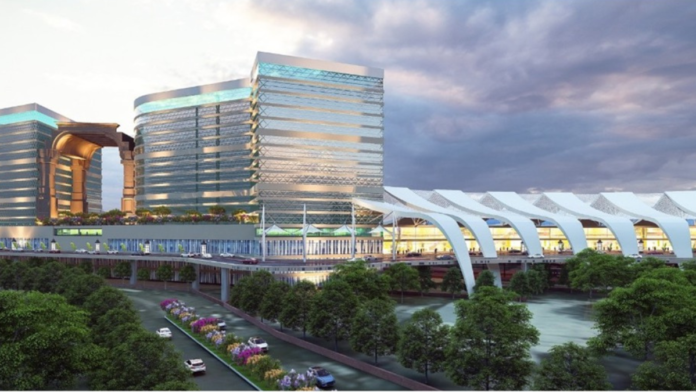
It involves Complete Transformation with Commercial, Retail & residential developments. It aims to integrate heritage sites like Btick Minar & Jhulta Minar. An Open amphitheatre has also been planned along the one at Adalaj ni Vav (Adalaj Stepwell). It also includes dedicated access roads, Multi-modal transit Hub buildings, development of surrounding areas, etc, into the project.
Design
The Modhera Sun Temple inspires the prospective design with an amphitheatre. The design will facilitate a city-centre look, seamlessly integrating various modes of Transportation into one place, be it Railway, metro, bullet train or even buses.
Existing Railway Station
Ahmedabad Railway Station is the biggest in Gujarat, with 12 platforms at one station. It also includes two minarets as remnants of Sidi Bashir Mosque, deemed Heritage Structures.
Facilities
The facilities available after the redevelopment include Spacious Roof Plaza, Retail spaces and cafeterias. It will ensure convenience & enjoyment for travellers. The redevelopment aims to connect both halves of the city by developing stations on both sides of the railway tracks. It will have ample parking space with smooth traffic flow.
Location Advantage
The redevelopment will integrate the various modes of transportation like metro, buses, HSR, etc.
Location
Distance (km)
HSR station
0.2
Narendra Modi Stadium
11
Sabarmati Riverfront
5.1
Sabarmati Ashram
6.9
It is situated at the very prime location of the city as significant locations are just in the vicinity. Ahmedabad railway station receives a daily footfall of roughly 52,843 commuters.
HSR Station
Ahmedabad Station for HSR is being constructed over existing railway platforms 11 & 12 by IRCON-DRA JV on the eastern end of the planned redevelopment railway station. It will be further integrated with the Saraspur side of the existing railway station.
Discover the endless possibilities of our city’s Metro at InnoMetro, our flagship Expo and Conference. Be an active participant in shaping its future towards a more sustainable tomorrow. Stay informed and join us to take a step towards a brighter future.
MUMBAI (Metro Rail News): IDBI bank has filed for bankruptcy proceedings against Mumbai Metro Line One Private Limited (MMOPL). Not long back, in August, SBI had also filed for bankruptcy proceedings against MMOPL.
The petition has been filed against MMOPL in the National Company Law Tribunal (NCLT), Mumbai. MMOPL is the authority operating the Blue Line from Versova to Ghatkopar. The amount of recovery against IDBI Bank stands at Rs. 133.37 Crores, with interests included.
MMOPL
Mumbai Metro One Private Limited (MMOPL) is a joint venture between Anil Ambani-owned Reliance Infra (RInfra) & MMRDa, with RInfra having a share of 74% while the remaining rests with MMRDA. It is a Special Purpose Vehicle (SPV) that was incorporated for the implementation of the 11.40 km Versova-Andheri-Ghatkopar line at an estimated cost of Rs 4,321 crore.
Total Debt
According to a rating statement from Brickwork Rating in November 2022, MMOPL had a bank loan of Rs 1650 Crores & ECB of USD 63.44 Million. Major lenders are:
Institute
Debt
Syndicate Bank
Rs 650 crore
Indian Bank
Rs 500 crore
SBI
Rs 200 crore
Bank of Maharashtra
Rs 200 crore
IDBI Bank
Rs 100 crore
Financial Situation of MMOPL
MMOPL’s net worth has eroded, and its current liabilities have exceeded its current assets. Additionally, it has an overdue obligation payable to its lenders. The metro firm reported a loss of Rs 345.26 Crore in FY2023 & Rs 388.70 Crore in FY2022.
Tussle with MMRDA
RInfra has filed various claims against MMRDA on account of damages incurred due to delays, land transfers, and changes in the designs. The amount of claims sums up to Rs 1,766.25 Crores, and the award remains reserved with the tribunal.
Impact on Commuters
Mumbai Metro Line 1 has the eighth-highest passenger density of any metro line worldwide. This particular development will have a major upheaval for the daily commuters on the Mumbai Metro Line 01. This development might disturb the continuity and quality of services on the line. As these Mass rapid systems are becoming the backbone of our Urban Life, such challenges need to be tackled with extreme care and confidence.
Mumbai Metro Line 1
Mumbai metro Line 1 runs on the Mumbai-Versova-Ghatkopar Line to cover a distance of 11.40 Km with a completely elevated stretch and 12 stations. It connects the eastern & western suburbs of Mumbai. The first metro service on the line was fagged off by the then Chief Minister of Maharashtra, Shri Prithviraj Chavan.
Discover the endless possibilities of our city’s Metro at InnoMetro, our flagship Expo and Conference. Be an active participant in shaping its future towards a more sustainable tomorrow. Stay informed and join us to take a step towards a brighter future.