Home Blog Page 159

NCRTC unveiled 1.6 km Long RRTS Bridge Across the Yamuna

0
RRTS-trainsets
Representational image only

DELHI (Metro Rail News): National Capital Region Transport Corporation (NCRTC) has unveiled the 25th bridge along the 22-kilometer stretch of the Yamuna River. This latest addition to Delhi’s infrastructure marvels is a 1.6-kilometer-long bridge as part of the Regional Rapid Transit System (RRTS), symbolizing progress in the city’s commitment to modernizing its transportation network.

The RRTS bridge is a crucial component of the rapid transit system that aims to connect various parts of the National Capital Region (NCR), providing a swift and efficient means of transportation for commuters. The inauguration of the 1.6km-long bridge underscores the city’s dedication to fostering sustainable and high-speed mass transit options.

The newly inaugurated bridge showcases advanced engineering and construction techniques, reflecting the ambitious vision of the RRTS project. Its strategic location on the Yamuna River not only facilitates smoother connectivity but also emphasizes the integration of water bodies into Delhi’s urban transportation infrastructure.

The 25th bridge on the 22-kilometer stretch of the Yamuna River stands as a testament to Delhi’s ongoing efforts to address the challenges of urban mobility. The RRTS project, with its network of high-speed trains and modern infrastructure, is expected to alleviate traffic congestion and reduce travel time for thousands of commuters in the NCR.

Government officials and transport authorities have lauded the completion of this milestone, emphasizing its role in transforming Delhi into a smart and sustainable city. The RRTS project aligns with the broader vision of creating a well-connected, environmentally conscious urban environment, promoting economic growth and enhancing the overall quality of life for residents.

As the 1.6km-long RRTS bridge becomes operational, commuters can look forward to a more efficient and time-saving travel experience. The continued development of Delhi’s transportation infrastructure, marked by the inauguration of this significant bridge, sets the stage for a future where the city’s connectivity is seamlessly integrated, fostering growth, accessibility, and convenience for all.

Advertisement1
InnoMetro_2026

CMRL Plans Metro Line Extension to Proposed Parandur Airport

0
Chennai Metro
Image for representational purpose only

CHENNAI (Metro Rail News): Chennai Metro Rail Limited (CMRL) has unveiled plans to extend the metro line to the proposed Parandur Airport. This visionary initiative underscores the commitment to providing efficient and sustainable mass transit options, further solidifying Chennai’s status as a forward-thinking metropolis.

The proposed extension project aims to integrate the metro network with the upcoming Parandur Airport, strategically aligning with the city’s growing demand for seamless and rapid transportation solutions. The expansion initiative is expected to enhance accessibility for passengers traveling to and from the airport, promoting a convenient and time-efficient commuting experience.

Chennai’s metro system has gained acclaim for its reliability, punctuality, and contribution to reducing traffic congestion. The extension of the metro line to the proposed Parandur Airport aligns with the city’s broader vision of creating an integrated and efficient public transportation network, catering to the needs of a burgeoning population.

The CMRL’s forward-thinking approach involves close collaboration with relevant stakeholders, including government authorities and aviation agencies, to ensure the seamless integration of the metro line with the upcoming airport. This collaborative effort is anticipated to yield a transportation hub that not only serves the immediate needs of travelers but also supports the long-term development and connectivity goals of the region.

Government officials and urban planners have expressed optimism about the positive impact of this metro line extension, emphasizing its potential to transform the way people travel to and from the airport. The project is expected to contribute to economic growth, job creation, and improved accessibility for residents and visitors alike.

As Chennai Metro Rail Limited lays out plans for the extension to the proposed Parandur Airport, the city anticipates a new era of integrated transportation, reinforcing Chennai’s position as a model for sustainable urban development. The envisioned metro link to the airport holds the promise of a more connected and accessible future for the residents of Chennai and those passing through its bustling transportation corridors.

Advertisement1
InnoMetro_2026

DMRC Invites Bid for Two Underground Tunneling Contracts of Patna Metro Line-1

0
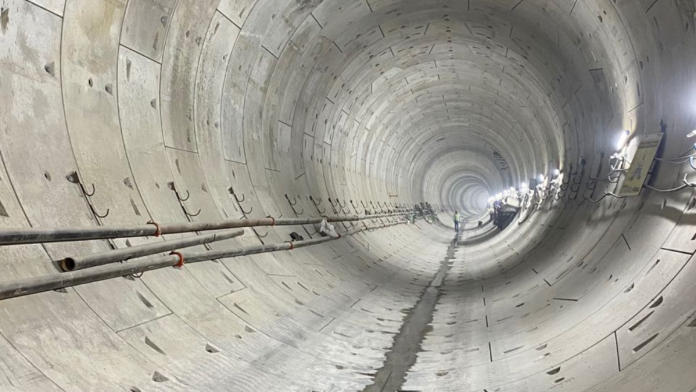
Delhi-Meerut RRTS tunnel

DELHI (Metro Rail News): Delhi Metro Rail Corporation (DMRC) has officially opened the bidding process for two underground tunneling contracts, PC05 and PC06 of the Patna Metro’s Line-1 connecting Danapur Cantonment to Khemni Chak.

This spanning approximately 8 kilometers within the broader 30.91-kilometer Phase 1 of the Patna Metro project, will link Rukanpura Ramp and Mithapur Ramp through the construction of twin tunnels using tunnel boring machines (TBMs).

Each contract encompasses three underground stations and comes with a strict 42-month construction deadline, with funding secured through a loan from the Japan International Cooperation Agency (JICA). These contracts mark the final two out of the six civil construction packages, as listed, for the entire project to progress to the tendering stage.

Upon reviewing the tender documents, it has been observed that the initially planned station at Chanakya National Law University (CNLU) near Mithapur has been excluded from the current scope of work.

Details of the contracts are as follows:

Package PC-05: Vikas Bhawan – Mithapur Ramp

  • Estimated Cost: Rs. 1683 crore (unconfirmed)
  • Stations: Vikas Bhawan, Vidyut Bhawan & Patna Junction
  • Pre-Bid Meeting: January 12, 2024, at 11 am
  • Bid Submission Deadline: February 13, 2024, at 3 pm
  • Technical Bid Opening: February 14, 2024, at 3 pm
  • Brief Scope: Design and Construction of Twin Tunnel by Shield TBM, Tunnel by Cut & Cover, Underground Ramp at Mithapur, and Three Underground Metro Stations, including Architectural Finishing, Water Supply, Sanitary Installation & Drainage Works of Stations on Danapur to Khemnichak Corridor of Phase-I of Patna MRTS.

Package PC-06: Rukanpura Ramp – Vikas Bhawan

  • Estimated Cost: Rs. 1377 crore (unconfirmed)
  • Stations: Rukanpura, Raja Bazar & Patna Zoo
  • Pre-Bid Meeting: January 15, 2024, at 11 am
  • Bid Submission Deadline: February 13, 2024, at 3 pm
  • Technical Bid Opening: February 14, 2024, at 3 pm
  • Brief Scope: Design and Construction of Twin Tunnel by Shield TBM, Tunnel by Cut & Cover, Underground Ramp at Rukanpura, and Three Underground Metro Stations, viz. Rukanpura, Raja Bazar & Patna Zoo, including Architectural Finishing, Water Supply, Sanitary Installation & Drainage Works of Stations on Danapur to Khemnichak Corridor of Phase-I of Patna MRTS.

Patna Junction Station will serve as an interchange between Lines 1 and 2. The ongoing construction of Line-2’s 14.05-kilometer tunnels connecting to Patna Junction is being executed by Larsen & Toubro as part of Package PC-03, awarded in December 2021.

Moreover, the Rukanpura Ramp of PC-06 will be integrated with the elevated section of PC-04, currently under construction by YFC Projects – Montecarlo JV. Simultaneously, Mithapur Ramp will connect to PC-04’s eastern section, also being constructed by YFC Projects – Montecarlo JV.

With these recent developments, the only major tender notice pending is for the project’s rolling stock (train) contract. The approval of JICA, coupled with the publication of PC-05 & PC-06’s notices, suggests that the tender notice for the trains is imminent.

Advertisement1
InnoMetro_2026

Shri Ashwini Vaishnaw, Minister of Railways inspects Amrit Bharat trains Rake at New Delhi Station

0
Hon'ble Minister of Railways, Communications and Electronics & Information Technology, Shri Ashwini Vaishnaw inspected the Amrit Bharat train rake at New Delhi railway station today

DELHI (Metro Rail News): Hon’ble Minister of Railways, Communications and Electronics & Information Technology, Shri Ashwini Vaishnaw inspected the Amrit Bharat train rake at New Delhi railway station today. Shri Vaishnaw appreciated the technology used in the newly built Amrit Bharat trains for ensuring maximum comfort to the travelling public. 

Shri Ashwini Vaishnaw inspected the Amrit Bharat train rake at New Delhi railway station

Amrit Bharat train is ready based o­n the push –pull technology. Speaking o­n the occasion Shri Vaishnaw said that it has two locomotives (one at front and o­ne at rear). Railways have tried to make the travel experience better for the passengers who used non AC coaches.  Amrit Bharat trains will be flagged off by Hon’ble PM Modi very soon.

The Amrit Bharat train is a push pull train for the common man. The new train has a locomotive at each end for a “push-pull” operation which allows for faster acceleration, hence resulting in travel time being reduced. The new train from Indian Railways has several new features keeping in mind the comfort of the common man.

The non A.C. train will have twenty two coaches with 12 Second Class 3- Tier Sleeper Class, 08 General Second Class coaches and two Guard Compartments. In the Guard compartment, there is a space for ladies in o­ne and Differently Abled passengers in another coach.

Some of the important features of the train includes:

  • Aerodynamically designed WAPS Locomotives o­n both ends with push pull configuration (Concentrated Power Train Set).
  • Jerk free semi-permanent couplers. Passengers can enjoy jerk free journey now.
  • Maximum permissible speed of 130kmph (speed potential)∙ 
  • Control couplers o­n end walls for push pull operation with locos at both ends of the train.
  • Improved design light with foldable snack table.
  • Fully sealed gangways.
  • Mobile charger with suitable holder and foldable bottle holder.
  • Aesthetically pleasing and ergonomically designed seats and berth with improved color blending.
  • Improved cushioned luggage rack.
  • Zero discharge (FRP) modular toilets.
  • Aerosol based fire suppression system in toilets and electrical cubicles.
  • Radium illumination flooring strip.
  • Faster acceleration for reduced travel time.
Advertisement1
InnoMetro_2026

Pramod Sharma Takes Charge as Director (Works) at NHSRCL

0

DELHI (Metro Rail News): In a significant development, Shri Pramod Sharma, a distinguished officer of the Indian Railway Service of Engineers (IRSE) 1989 batch, has assumed charge as the Director (Works) at the National High-Speed Rail Corporation Limited (NHSRCL). The announcement comes as the culmination of a noteworthy career dedicated to the planning and execution of large-scale railway infrastructure projects.

Sh. Pramod Sharma had been associated with NHSRCL since September 2020, where he held the position of Principal Executive Director (Contract) before stepping into his new role. His invaluable contributions to the Mumbai-Ahmedabad High-Speed Rail Project include playing a pivotal role in finalizing tenders for civil and bridge work, showcasing his expertise in project management and execution.

With an academic background rooted in excellence, Sh. Sharma graduated in Civil Engineering from IIT/Roorkee in 1988, where he not only excelled academically but also earned the prestigious ‘Chancellor Gold Medal.’ His commitment to the field has been further demonstrated through his involvement in projects such as the Udhampur-Katra New Line Project and the successful commissioning of doubling projects on the Northern Railway.

The Appointments Committee of the Cabinet has approved Shri Pramod Sharma’s appointment to the position of Director (Works) at NHSRCL. The appointment is on a deputation basis, with Sh. Sharma is expected to serve in this capacity until the age of 60 or until further orders, whichever comes earlier, in relaxation of the age requirement.

This development underscores the government’s commitment to leveraging experienced and capable professionals to drive the ambitious high-speed rail projects in the country. Sh. Pramod Sharma’s wealth of experience and expertise is anticipated to further accelerate the progress of critical railway infrastructure initiatives, bringing the nation closer to its high-speed rail aspirations.

The National High-Speed Rail Corporation Limited and the Mumbai-Ahmedabad High-Speed Rail Project, in particular, look forward to benefiting from Sh. Pramod Sharma’s leadership and vision in his new role as Director (Works). The railway community and stakeholders extend their best wishes to Sh. Sharma for a successful tenure in steering these transformative projects towards successful completion.

Advertisement1
InnoMetro_2026

Patna Metro’s commitment towards “Cleanliness and Sanitation” at all under-construction sites

0
Route Map of Patna Metro Project:

PATNA (Metro Rail News): Patna Metro Rail Project is committed to maintaining Cleanliness and sanitation at all under-construction metro sites. A dedicated team is deployed at each construction site daily for cleaning. However, people often stick posters and pamphlets on columns, boards, pillars and barricades, throw garbage around the barricades and spoil them by spitting on the barricades and warning signs. Not only does the effort to clear these barricades and boards take a lot of resources, but dozens of labourers clean up the spits. Therefore, it is an appeal to people that with little cooperation, we will be successful in keeping our city clean and beautiful but will also be able to save a lot of water and make good use of human resources. Therefore, Do not spit on the barricades, columns, boards and pillars installed by Patna Metro and also sensitize other people about this issue.

In addition to human resources, several gallons of water are wasted in cleaning it. About 64000 litres of water are used monthly to clean the barricades and boards installed under the Patna Metro Project, meaning more than 2000 litres of water are wasted daily in cleaning them. Due to environmental sensitivity, DMRC uses 40 per cent recycled water to reduce freshwater consumption.

Patna metro cleanliness drive 02

Due to the spitting and sticking of posters on these columns, boards, pillars and barricades, the warning messages get hidden, which can be dangerous for the commuters and the purpose of these warnings gets lost, due to which accidents may occur. These works are done in the public’s interest, but people are not sensitive towards them. Patna Metro Rail Project is ready to significantly change the city’s traffic system and rejuvenate its beauty.

Taking care of the city’s cleanliness and environment has been the priority of the Patna Metro project. Measures are taken for regular cleaning of the barricading and the dust accumulated below it so that the garbage/soil can be prevented from spreading on the road. As responsible citizens, we must come forward to save human and water resources and keep all the under-construction sites of the Patna Metro Rail Project clean and tidy by following the basic principles of cleanliness.

Patna Metro Cleanlisness drive 01

Intrigued by the future of Metro and its impact on our city? Join us at our upcoming InnoMetro event to delve deeper into this vital issue. Stay informed, get involved, and let’s ride the Metro towards a brighter, more sustainable future together.

Advertisement1
InnoMetro_2026

Texmaco Emerges Lowest  Bidder for Delhi Metro Magenta line’s Track Contract DT-08 

0
Delhi Metro
Delhi Metro

NEW DELHI (Metro Rail News): Texmaco has emerged as the lowest bidder for the Delhi metro Magenta Line’s contract DT-08. 

Scope of the Contract

The contract scope entails installing, Testing and commissioning the Ballastless Track, including the supply of MSS and buffer stop for Line-8 Ext. (Keshopur – Majlis Park – R.K. Ashram).

Entailed Packages 

The DT-08 contract entails the following packages for the deployment of standard Gauge rails: 

  1. DC-01A between Keshopur & Mangolpuri. 
  2. DC-01 between Mangolpuri & Haiderpur-Badli Mor
  3. DC-03R between Haiderpur-Badli Mor & Derawal Nagar
  4. Twin tunnels of underground package DC-05 between Derawal Nagar & RK Ashram

Bids Invited 

DMRC had invited bids for the contract in September 2023 with a 3-year deadline. Additionally, the package will be funded by the Japan International Cooperation Agency (JICA).

Financial bids 

The financial bids submitted by different firms are as follows: 

Firm Bid ( in Crore) 
Texmaco Rail117
Rahee Infratech127
Paras Railtech132
KPIL – AIPL JV155

The estimated bid for the contract from the DMRC side remains unknown. 

Further Developments 

A contract can be expected to be awarded in the coming months. Track laying is also active on Magenta Line’s 2.03 km underground Package DC-06 connecting Janakpuri West – Krishna Park Extension. 

Line 8 (Magenta Line)

It runs between Janakpuri West & R.K. Ashram (28.92 km). Its specifications are: 

Length: 28.92 km

Type: Elevated (21.18 km) & Underground (7.74 km)

Number of Stations: 22

Station Names: Krishna Park Extn, Keshopur, Paschim Vihar, Peeragarhi, Mangol Puri, West Enclave, Pushpanjali, Deepali Chowk, Madhuban Chowk, Prashant Vihar, North Pitampura, Haiderpur Badli Mor, Bhalaswa, Majlis Park, Azadpur & Ashok Vihar, Derawal Nagar, Rajpura, GG Sabji Mandi, Pulbangash, Sadar Bazar, Nabi Karim and RK Ashram Marg. 


Intrigued by the future of Metro and its impact on our city? Join us at our upcoming InnoMetro event to delve deeper into this vital issue. Stay informed, get involved, and let’s ride the Metro towards a brighter, more sustainable future together.

Advertisement1
InnoMetro_2026

Indian Railways Plans to Invest Rs 7 Trillion for Tracklaying in the Upcoming Decade 

0
Indian Railways
Representational image only

NEW Delhi (Metro Rail News): Plans are underway for the Indian Railways to invest Rs 7 Trillion for track laying spanning 50,000 kilometres to facilitate upcoming modern trains. 

Track laying Plans 

This impetus to the track laying program is one of the core initiatives of the Vision Document 2047 furnished by Indian Railways. The document discusses laying 100,000 kilometres of new alignment, including replacement and doubling, and gauge conversion works to be achieved in the coming 25 years, costing Rs 15-20 Trillion. 

This impetus is based on the success that the national transporter has achieved so far regarding its efficiency and productivity. 

Record So far 

Indian Railways has laid down 5,200 Kilometers of track so far in the year 2022-23, and it aspires to step up from this milestone and continue with the ground-breaking performance for the coming 8-10 years. The focus is replacing worn-out tracks to present a robust infrastructure capable of handling the increasing passenger traffic and modern technology trains. 

Budgetary allocation 

A sum of about Rs 50,000 Crore can be expected to be allocated for track laying in the upcoming budget to lay about 5,000-5,500 km of tracks, taking the increase in budget allocation to more than 50% from the FY24 budget estimate of ₹31,850 crore for new lines.

Per Km Cost 

As per the current estimates, it takes about Rs 15 Crore per kilometre of tracks. It is determined by variables like the price of steel and the availability of land for laying. Such tracks will facilitate high-speed and semi-high-speed trains. 

Annual Ridership 

The emphasis on expanding the railway network aligns with the anticipated increase in train traffic, encompassing both passenger and freight services. A study conducted by the railway ministry indicates that the current annual ridership of over 8 billion people is expected to reach 80 billion by 2030, necessitating a corresponding expansion in capacity.


Intrigued by the future of Metro and its impact on our city? Join us at our upcoming InnoMetro event to delve deeper into this vital issue. Stay informed, get involved, and let’s ride the Metro towards a brighter, more sustainable future together.

Advertisement1
InnoMetro_2026

Himcon Engineers India Secures Patna Metro Phase 1 Stations Finishing & PEB Contract

0
Patna-metro construction work/Representational image

PATNA (Metro Rail News): In a recent development, Himcon Engineers India emerged as the lowest bidder for the architectural finishing and pre-engineered building (PEB) roof contract PC-01A, covering five stations along the Priority Corridor of Patna Metro Phase 1. This corridor links Malahi Pakri to New ISBT, spanning a distance of 14.05 km.

The elevated stations covered under this contract include Malahi Pakri, Khemni Chak (an interchange station with Line-1), Bhoothnath, Zero Mile, and New ISBT. NCC Ltd. had previously been awarded the civil construction contract (Package PC-01) for the 6.107 km section in September 2020, with a 30-month deadline.

The Delhi Metro Rail Corporation (DMRC) had invited bids for the PC-01A contract in August 2023, estimating a cost of Rs. 74.95 crore and setting a two-year deadline. The technical bids, opened in November, revealed a total of seven bidders. The financial bid values are as follows:

  • Himcon Engineers India: Rs. 68.45 crore
  • Metcon India Realty and Infrastructure: Rs. 69.70 crore
  • Quality Buildcon: Rs. 69.73 crore
  • B. Rai Construction Company: Rs. 70.97 crore
  • Godrej and Boyce Mfg. Co.: Rs. 80.20 crore
  • Sam India Builtwell: Rs. 89.05 crore
  • Premco Rail Engineers: Rs. 103.18 crore

Himcon’s bid, coming in below DMRC’s estimate, positions them as the frontrunner for the contract, with the award expected in the coming weeks.

The scope of DMRC’s brief includes architectural finishing works, DFSE, roof sheeting of pre-engineered building (PEB) structures, and DC of external facade, WS, SI, drainage, and site development works at the aforementioned five elevated stations of the Patna MRTS Phase-I Project.

Despite this positive development, the overall progress of the Patna Metro has faced delays. A tender notice for the rolling stock (train) contract is still pending, suggesting that trial runs may be at least two years away. Additionally, a tender notice for the construction of Line-1’s approximately 8 km underground section is yet to be released, indicating a potential delay of at least five years in completing Phase 1 of the project.

Advertisement1
InnoMetro_2026

KPIL – Gulermak Awarded Rs. 762. 50 Cr Contract for Kanpur Metro Line-2

0
kanpur tunnel
kanpur tunnel

Kanpur (Metro Rail News): In a significant development for the Kanpur Metro Phase 1 project, Kalpataru Projects International Ltd. (KPIL) in a joint venture with Gulermak has secured the contract for the underground tunneling and construction work of Package KNPCC-11 on Kanpur Metro Line-2. The contract, valued at Rs. 762.50 crore, involves the design and construction of a 4.08 km section connecting Agriculture Depot to Double Pullia Ramp through twin tunnels and featuring three underground stations at Rawatpur, Kakadeo, and Double Pullia.

This marks the third underground package of the extensive 32.38 km Kanpur Metro Phase 1 project, following Line-1’s KNPCC-05 (Chunniganj – Nayaganj) and KNPCC-06 (Nayaganj – Transport Nagar).

The Uttar Pradesh Metro Rail Corporation (UPMRC) had invited bids for this contract in February 2023, estimating the project cost at Rs. 1025 crore with a 30-month deadline. After the opening of technical bids in July, KPIL – Gulermak JV emerged as the lowest bidder during the financial bid opening in October.

The scope of the contract encompasses the design and construction of TBM tunnel, cut and cover tunnel, ramp after Double Pullia, ramps in Agriculture Depot for mainline and depot connections, and the three underground metro stations – Rawatpur, Kakadeo, and Double Pullia. The architectural finishes and other related works are also part of the project.

This significant infrastructure development will be financed by the European Investment Bank (EIB) through a €650 million loan, approved in July 2020.

Looking ahead, the commencement of basic groundwork and pre-construction activities is anticipated in Q1 2024, with the actual construction work beginning in early Q2 2024. Tunneling works are projected to commence in mid-2025.

The KPIL – Gulermak JV, having secured this contract, is expected to utilize at least two tunnel boring machines (TBMs) for the construction of six tunnels. There is speculation that Gulermak might reuse their Terratec machines TBM Tatya (S92) and TBM Nana (S93) from Package KNPCC-05 (Permat Ramp – Nayaganj), where they each have one final tunneling assignment left. Confirmation on this is expected by mid-2024.

This milestone project is a crucial step forward for the Kanpur Metro, enhancing the city’s connectivity and reinforcing its position as a rapidly developing urban center.

Advertisement1
InnoMetro_2026