New Delhi: Prime Minister Narendra Modi has flagged-off the Delhi-Faridabad Metro Line that would allow hassle free travel for around two lakh daily commuters between the national capital and the industrial hub in Haryana.
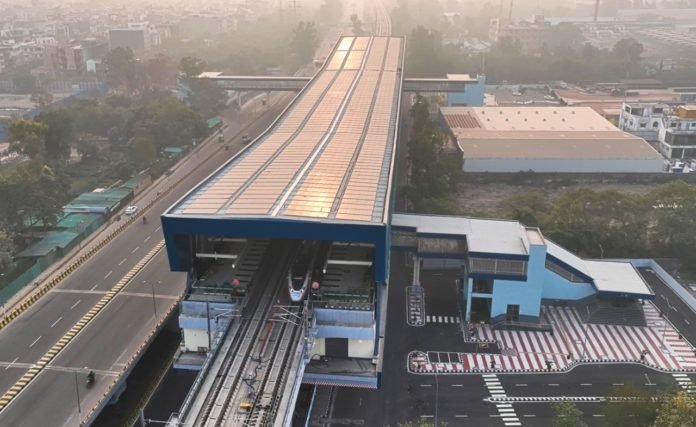
The extension of the Delhi Metro connects Badarpur to Escorts Mujesar in Faridabad.
The total cost of the project from Badarpur to Escorts Mujesar is nearly Rs. 2,500 crore. Out of this, Rs. 1,557 crore was borne by the Haryana Government, the Centre contributed Rs. 537 crore, while the Delhi Metro provided Rs. 400 crore.
All these are elevated and located on either side of the Delhi-Mathura Road (NH-2).
“The nine-station metro corridor which was 95 per cent indigenously built will provide people a safe, affordable, quick, comfortable, reliable, environment-friendly and sustainable transport facility,” a Haryana government spokesperson said.
Haryana Chief Minister ML Khattar, addressing a press conference on Saturday, had thanked the Prime Minister for “gifting” the Metro service which would take the city to “another level of progress” with better connectivity with other NCR towns.
He had also said that the Prime Minister would be announcing the go-ahead for connecting Gurgaon with Faridabad by Metro.
AGRA (Metro Rail News): The Commissioner of Metro Railway Safety (CMRS) recently concluded a thorough two-day safety evaluation of Agra Metro’s Phase 1 project, focusing on its vital 5.2 km Priority Corridor linking Jama Masjid to Taj East Gate.
This priority route, boasting a remarkable combination of three underground stations (Fatehabad Road, Basai, & Taj East Gate) and three elevated stations (Jama Masjid, Agra Fort, & Taj Mahal), was constructed rapidly to meet stringent timelines.
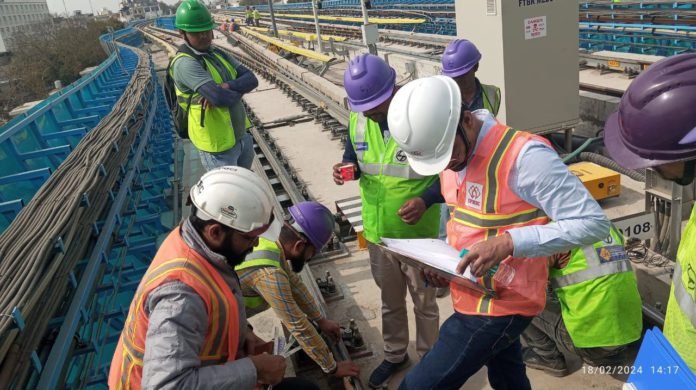
During the inspection, conducted on Tuesday and Wednesday, the CMRS meticulously assessed passenger amenities and control room facilities across all six stations. A detailed motor trolley examination of critical systems, including tracks provided by Larsen & Toubro, was carried out. The assessment culminated in a speed trial, with one of Agra Metro’s 3-coach Alstom trains achieving a top speed of 90 kmph.
Construction milestones were highlighted, including the commencement of work by Sam India Builtwell on the 2.4 km elevated package AGCC-01 in December 2020, and by Afcons Infrastructure on the 2.8 km underground section (part of the 7.93 km package AGCC-02) in April 2022. Notably, trial runs on the viaduct and through tunnels commenced in July 2023 and December 2023, respectively.
Reports suggest that the CMRS has already submitted their approval letter to UPMRC. While conditional in nature, the approval signifies a significant step toward operational readiness. The next steps entail UPMRC addressing any identified conditions promptly, followed by a compliance report submission to CMRS.
With the imminent launch of the Priority Corridor, Agra Metro is poised to become India’s 17th operational metro system, marking a significant milestone in the country’s urban transport landscape.
AHMEDABAD (Metro Rail News): Gujarat Metro Rail Corporation (GMRC) commenced trial runs on a 3.3 km elevated segment of the 28.25 km Phase 2 project of the Ahmedabad Metro on February 24, 2024, connecting Dholakuva to Gujarat National Law University (GNLU) in Gandhinagar District.
Despite ongoing electrification efforts, GMRC’s team utilized a Zephir battery-operated railcar mover to maneuver one of their Hyundai Rotem trains along a section of the elevated viaduct, constructed by Ranjit Buildcon (RBL) as part of the 6.478 km Package C2, linking GNLU to Gandhinagar’s Sector-1.
The primary objective of this trial was to ensure Schedule of Dimensions (SOD) clearances and assess the train’s interaction with the civil structure, aiming to identify and rectify any potential physical obstructions.
VNC – KEC – Emrail JV commenced track-work on this stretch in August 2023, followed by Ranjit Buildcon’s installation of the final U-girder in October 2023.
The commencement of comprehensive trial runs is contingent upon GMRC’s activation of the line’s Third Rail. Subsequently, they will conduct tests on various systems, including telecommunication, signaling, and train control, alongside assessing the behavior of the trains.
With the impending Lok Sabha elections, it is anticipated that the Gujarat Government will organize a formal event to commemorate the initiation of trial runs.
Ashwini Vaishnaw appoints as first Chancellor of Gati Shakti Vishwavidyalaya, Vadodara
AHMEDABAD (Metro Rail News): Ashwini Vaishnaw, the Union Railways Minister, announced on Friday that the initial phase of the Mumbai to Ahmedabad High-Speed Bullet Train project, linking Surat to Bilimora, is set to be operational by August 2026.
Disappointment with MVA Government
The minister voiced his frustration with the delays attributed to the previous Maha Vikas Aghadi government, led by former Maharashtra chief minister Uddhav Thackeray. He commended the current Shinde-Fadnavis administration for accelerating the project by overcoming obstacles related to land acquisition.
A Torch of Economic upliftment
Vaishnaw, while addressing reporters after inspecting the construction progress of the 508-km-long corridor in Mumbai, emphasised the significant economic benefits that the high-speed line will bring. He noted that the 284 km-long bullet train corridor viaduct in Gujarat has been completed, marking a significant milestone in the project’s development. During his visit to the Bandra Kurla Complex (BKC) and Vikhroli project sites, Vaishnaw reviewed the ongoing work to ensure its timely and efficient execution.
MAHSR Corridor
The Mumbai-Ahmedabad High-Speed Railway (MAHSR) is India’s initial high-speed train route connecting Mumbai and Ahmedabad. It is expected to cost around 1.08 lakh crore. The central government has agreed to contribute ₹10,000 crore, and Gujarat and Maharashtra will contribute ₹5,000 crore each. The remaining funds will be obtained through a loan from Japan at a meagre 0.1% interest rate.
Stay tuned for the updates!
Intrigued by the future of Metro and its impact on our city? Join us at our upcoming InnoMetro event to delve deeper into this vital issue. Stay informed, get involved, and let’s ride the Metro towards a brighter, more sustainable future together.
Nana TBM of the Kanpur Metro Records Breakthrough at Chunniganj
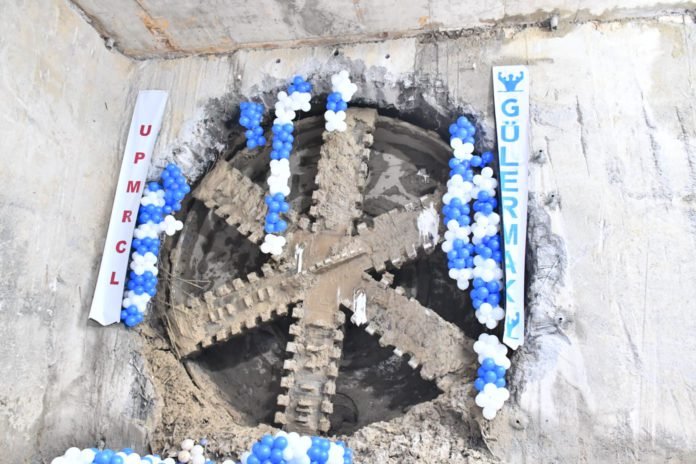
KANPUR (Metro Rail News): TBM S93, or the Nana, achieved a breakthrough at Chunniganj station of the 3.619-km long KNPCC-05 Package of the Kanpur metro.
KNPCC-05 Package
Excluding the ramp, the KNPCC-05 package on the 23.785 km Line-1, which links IIT Kanpur to Naubasta, spans 3619 meters and encompasses four stations: Chunniganj, Naveen Market, Bada Chauraha, and Nayaganj, each with a length of 215 meters.
Assignment completed
The Terratec TBM, boasting a diameter of 6.52 meters and stretching 120 meters in length, was utilised in the construction of a segment of the up-line tunnel for Kanpur’s Line-1, spanning 23.785 kilometres from IIT Kanpur to Naubasta. It successfully concluded its fourth drive within approximately 70 days.
The Contract
In March 2021, Uttar Pradesh Metro Rail Corporation (UPMRC) granted Gulermak – Sam India the construction contract for Package KNPCC-05, with a deadline of 36 months.
Assignment complete by TBM, so far
A list of the breakthroughs achieved by the TBM so far is below:
Bada Chauraha to Nayaganj (1025m) – December 2022
Chunniganj to Naveen Market (748m) – June 2023
Naveen Market to Bada Chauraha (516m) – September 2023
MacRobertganj to Chunniganj (420m) – February 2024
The next assignment of the TBM
The TBM Nana is slated for dismantling and subsequent storage, with plans for redeployment in early 2025 for tunnelling operations along the Kanpur Metro Line-2’s underground Package KNPCC-11. This project was awarded to the Kalpataru Projects International Ltd. – Gulermak JV in December 2023.
Kanpur Metro
Kanpur metro is being built for Rs. 11,076.48 Crores, with its First Phase, the Orange Line running between IIT Kanpur & Motijheel, being inaugurated in December 2021 by PM Narendra Modi. The remaining 14.9 km stretch of Orange Line between Motijheel & Naubasta is under construction.
Discover the endless possibilities of our city’s Metro at InnoMetro, our flagship Expo and Conference. Be an active participant in shaping its future towards a more sustainable tomorrow. Stay informed and join us to take a step towards a brighter future.
NOIDA (Metro Rail News): National Capital Region Transport Corporation (NCRTC) plans to submit the Ghaziabd-Jewar RRTS’s DPR by April 4.
Meetings Being Held
The NCRTC is already in for presentations for the upcoming route alignment. Presentations and meetings are already being held regularly between both.
Submission by April 4
“The NCRTC informed that it will ready the detailed project report of this project for further progress on April 4. After studying the DPR, we will send it to the Uttar Pradesh government for requisite approvals. Once the UP government and the government of India give all required approvals, the work on this project will be taken to the next stage,” said Arun Vir Singh, chief executive officer of the Yeida.
Speed Revolution
“The NCRTC will operate the RRTS and Metro on this corridor. The operation of the Noida airport is set to start in September-end this year. The entire proposed route of 25 stations will be developed in phase I. We have asked the NCRTC to design the operation of RapidX in such a way that it should not take over 50 minutes to reach IGI from NIA. With the maximum speed of 150 KMPH, it is possible to achieve this travel time,” said Singh.
Assignments done so far.
The NCRTC is ready with the ridership evaluations, conducting topographical surveys, designing the alignment, and planning stations along the route. Simultaneously, ongoing surveys encompass geotechnical analysis and environmental and social impact assessments.
Projected Ridership
“The alignment will have a ridership of 2.95 lakh passengers per day in 2031, growing to 5.23 lakh passengers in 2041 and to 6.32 lakh per day in 2051,” said Singh.
Approval
The DPR will be sent to the state government for approval.
Proposal
The feasibility report has suggested the following alignment:
37.15 Km long Metro/RRTS between Ghaziabad & Kasna
35.11 Km Long RRTS corridor between Kasna & Noida Airport
The first stretch will have 22 stations, 15 for the metro & 7 for the RRTs, while the second will have four stations.
Metro/RRTS between Ghaziabad & Kasna
The proposed local metro module between Ghaziabad & Kasna will have 15 stations: Siddharth Vihar, Sector 16C in Greater Noida, Ecotech 12, sectors 2, 3, 10 and 12 in Greater Noida, near Surajpur, Malakpur, Ecotech 2, Knowledge Park 3, Gamma 1, Omega 2, Phi 3 and Ecotech IE.
Ncrtc has suggested a local metro module on this route as it passes through the residentially populated areas of Noida & Greater Noida. The project, through this, aims to ensure that the residents of Ghaziabad, Greater Noida & YEIDA not only enjoy RRTs but also popper accessibility to metros etc.
RRTS Corridor between Kasna & Noida Airport
The Second stretch between Kasna & Noida Airport will be 35.11 km long with a total of 4 number of stations. The proposed stations are Dankaur, Yeida North (sector 18), Yeida Central (sector 21, 35) and the Noida airport.
The NCRTC has plans to develop the second stretch, too, with the same module as the first stretch, precisely with a parallel metro alignment to serve plans of the authorities of a township or something crops up in the region.
Funding
The proposed plan for the funding is as follows:
Agency
Share
Government of UP
50%
Government of India
20%
YEIDA + Greater Noida
30%
Noida Airport
The commencement of operations for the Noida airport is anticipated by December 2024, with a projected capacity to accommodate approximately 71 million passengers daily by the fiscal year 2042-43. To facilitate a seamless connection between the airport and its surrounding region, the state government has approached the NCRTC to prepare a feasibility report for constructing a high-speed train corridor to facilitate efficient transportation to and from the airport.
Are you intrigued by the future of Metro and its impact on our city? Join us at our upcoming InnoMetro event to delve deeper into this vital issue. Stay informed, get involved, and let’s ride the Metro towards a brighter, more sustainable future together.
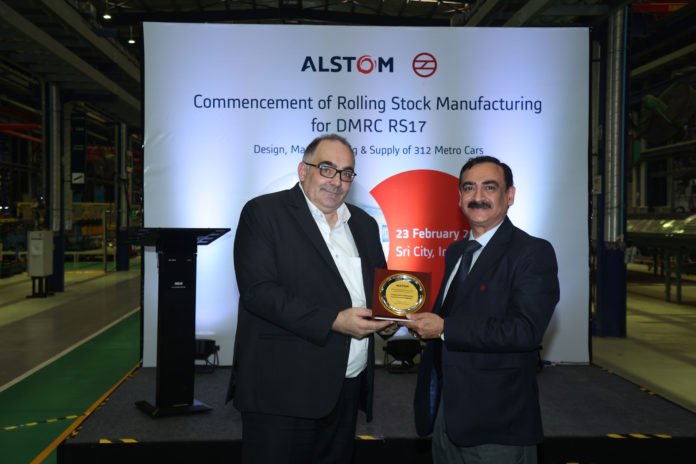
Mr.Olivier Loison, MD Alstom India & Vikas Kumar, MD DMRC at Alstom Sricity.
NEW DELHI (Metro Rail News): Alstom, a global leader in smart and sustainable mobility, today commenced the production of its world-class Metropolis trainsets for the Delhi Metro Rail Corporation (DMRC) Phase IV. Awarded in November 2022, this order aims to deliver 52 train sets, each comprising six cars. The project is designed to cater to three different lines of DMRC, with two lines being extensions of the existing Line 7 and 8 and the new Gold Line 10 connecting Aerocity to Tughlakabad, which covers a total distance of 64.67 km. The production was commenced at a commemorative ceremony led by leaders from Delhi Metro Rail Corporation and Alstom India.
Speaking about this milestone, Dr Vikas Kumar, Managing Director, DMRC, said, “The Delhi metro stands as the lifeline of our city, and the addition of new routes will greatly enhance connectivity in the national capital. We are glad that Alstom is commencing the production of Metro trains for the Delhi Metro’s fourth phase of expansion. We are sure the new age trains will ensure passengers a smooth and comfortable ride.”
On the occasion, Olivier Loison, Managing Director of Alstom India, said, “We have a longstanding association with the Delhi Metro, and it is a matter of pride for us to join India’s largest metro network in its continued growth and expansion. Our Metropolis metros have a noteworthy track record, low lifecycle cost, and keen focus on passenger experience, and we are honoured to build these modern trains for the commuters in Delhi NCR, further promoting the transition towards sustainable mass mobility solutions.”
The total value of the project is 312 million euros, which also includes the maintenance of 13 trainsets of the new line for 15 years. This 360-degree scope is a game-changer for India’s metro segment as it will be the first maintenance project for Delhi Metro outsourced to an OEM. The Line 8 extension will extend the Magenta Line from Janakpuri West to RK Ashram. In contrast, the Line 7 extension will connect the Pink Line between Maujpur and Mukundpur and improve DMRC connectivity another step above. Alstom has also been awarded the contract for supplying and commissioning the train-control and signalling solution for Delhi MRTS Phase-IV Mukundpur – Maujpur (Line 7 ext.) and Aerocity – Tughlakabad Corridor (Line 10). These lines will be equipped with Alstom’s scalable Communications-Based Train Control solutions (CBTC), which will operate with its Automatic Train Supervision (ATS) system.
Highlights of the Delhi Metro Phase IV
The Metropolis trains offer a unique design and a wide range of configurations and ensure the highest performance due to the perfect combination of proven and reliable components and innovations. These new trains are the most advanced state-of-the-art green vehicles, designed for a safe speed of 95 kmph and operational speed of 85 kmph, with GOA 4 driverless features, which makes them an environmentally friendly and comfortable metro solution for passengers of New Delhi.
Design specifications
Inspired by the tricolours of the national flag of India, the door pillar for the saloon interior of the trains will sport a mix of saffron, white, and green paint. The front of the train for Line 10 has a metallic gold paint, making it the first time for Alstom to use this colour for a metro project in India. Under the ‘Make in India’ initiative, these Metropolis trains have been completely designed in India and will be built at the manufacturing facility in Sri City (Andhra Pradesh). This is Alstom’s largest Urban Rolling Stock manufacturing site in India, with a strong delivery portfolio for major domestic and international projects.
Over the years, Alstom has provided over 800 metro cars in use throughout the Delhi Metro system, one of Asia’s largest rapid transit systems. Alstom has also partnered with DMRC for several other projects, including the successful implementation of the supply and commissioning of train control and signalling system for DMRC’s Red Line (L1), (Yellow Line (L2), Green Line (L5), Violet Line (L6), and Pink Line (L7) during Phase I, II & III.
Discover the endless possibilities of our city’s Metro at InnoMetro, our flagship Expo and Conference. Be an active participant in shaping its future towards a more sustainable tomorrow. Stay informed and join us to take a step towards a brighter future.
KOLKATA (Metro Rail News): Kolkata Metro Rail Corporation is likely to invite PM Modi to inaugurate its newly approved three lines of the Kolkata metro.
The Inauguration
The KMRC will pitch an hour-long plan to PM Modi to inaugurate the three lines. It will be followed by a ride in the metro up to Howrah or Howarah Maidan station after boarding the metro from Esplanade.
Stage of Approval
The railway board has yet to send the proposal to the PMO. The proposal’s core is to get the PM a ride on India’s First underwater stretch of the Kolkata metro.
The Three Lines
The three lines to be inaugurated are:
4.8km section between Esplanade and Howrah Maidan
5.4 Kms New Garia-Ruby Section on the orange line
Purple line’s 1.2 Km Extension up to Majerhat.
1.2 Km Extension up to Majerhat
Metro Railways Kolkata conducted the Taratala Majerhat Stretch of Kolkata Metro’s Purple Line trial on 13th Jan 2024 at 12.16 hrs. The trials were conducted for the 1.25 Km stretch in AC trial rake MR-417.
Esplanade and Howrah Maidan
Shri Janak Kumar Garg, Chief Commissioner of Railway Safety (CCRS), inspected all the stations from Howrah Maidan to Esplanade of Green Line for the second consecutive day on 06.02.2024.
New Garia-Ruby Section
The New Garia-Ruby portion of the New Garia-Ruby stretch of the New Garia-Airport Metro Corridor underwent a safety examination on January 30, 2023, according to the Commissioner of Railway Safety (CRS). In under seven minutes, the train completed the five stations in trial.
Discover the endless possibilities of our city’s Metro at InnoMetro, our flagship Expo and Conference. Be an active participant in shaping its future towards a more sustainable tomorrow. Stay informed and join us to take a step towards a brighter future.
PUNE (Metro Rail News): Pune Metro authorities have begun work on the land survey for its extension, namely PCMC to Bhakti-Shakti and Swargate to Katraj.
PCMC to Bhakti-Shakti Corridor
It is a 4.5 Km extension running elevated from PCMC to Bhakti-Shakti with four stations: Chinchwad, Akurdi, Nigdi and Bhakti-Shakti. The centre has approved it with a budget outlay of Rs 910.18 crore over 39 months.
Swargate to Katraj Corridor
It is a 5.5 Km extension running underground from Swargate to Katraj, with three stations: Market Yard Gultekdi junction, Saibaba Nagar and Katraj. It is yet to be approved by the centre. It is an extension of the existing Shivajinagar to Swargate route of the Pune Metro.
Reason Behind the Hurry
Pune metro is completing the land survey work beforehand so that actual land acquisition or construction can start immediately after approval.
Pune Metro
The Pune metro is a rapid transit system serving the city of Pune, encompassing three lines totalling 54.14 km. Currently, two lines are in operation:
Purple Line: Connects PCMC Bhavan to Swargate.
Aqua Line: Runs from Vanaz to Ramwadi.
Line 3: Extends from Hinjawadi to Civil Court via Balewadi.
Intrigued by the future of Metro and its impact on our city? Join us at our upcoming Inno Metro event to delve deeper into this vital issue. Stay informed, get involved, and let’s ride the Metro towards a brighter, more sustainable future together.
BANGALORE (Metro Rail News): Namma metro is all set to use AI for track monitoring in its upcoming lot of Driverless trains for the Yellow Line metro.
Track Inspection
Before beginning revenue service, a pilot train run with track and third-rail maintenance personnel aboard is conducted. These individuals visually inspect both the track and the third rail, which supplies electricity to trains via an additional rail adjacent to the tracks.
Personnel On-board
The inaugural journey of the day, known as the pilot train, comprises personnel from various teams, such as rolling stock, traction, signalling, and track maintenance. This train consistently maintains a reduced speed to examine all obstacles and potential issues along the route thoroughly.
AI into Play
The pilot train, equipped with a track monitoring system, autonomously assesses the condition of the track. If any anomalies are detected, it triggers alerts through AI software. By implementing this system in two train sets, redundancy is established to mitigate potential defects in one set. However, due to cost constraints, BMRCL has yet to outfit all train sets with this technology.
How does it work?
Monitoring primarily depends on a camera-based system, transmitting track images to a server. With AI assistance, the system produces alerts. Alerts are promptly sent to Operation Control Centers (OCC) via the Train Control and Management System (TCMS) if a significant issue arises.
Specifications
These are 6-Coach trains that will run on the tracks of Bangalore Metro’s Yellow Line. The coaches have electric signages above the doors to showcase routes, advertisements, notices, information, etc.
Driverless Technology
These driverless coaches will be introduced as a part of the Communication-Based Train Control (CBTC) System, commonly known as “Driverless Technology”. It will also reduce the headway to 90 seconds from the existing two & a half minutes. Although it will be driverless trains, the BMRCL has decided to deploy Loco Pilots to allay passengers.
The Contract
BMRCL awarded the contract for the same in December 2019. As per the contract, 4RS-DM 2 trains will be supplied by CRRSC, while the remaining 36 will be assembled locally by Titagarh Rail Systems in West Bengal.
Yellow Line
The 18.82 Km long under-construction metro line connects RV Road with Bommasandra. It is a fully elevated metro route with 16 stations. It connects with the Green Line of Bangalore Metro at RV Road Station & with the Pink Line at Jayadeva Hospital station. It is expected to open by early 2024.
Discover the endless possibilities of our city’s Metro at InnoMetro, our flagship Expo and Conference. Be an active participant in shaping its future towards a more sustainable tomorrow. Stay informed and join us to take a step towards a brighter future.
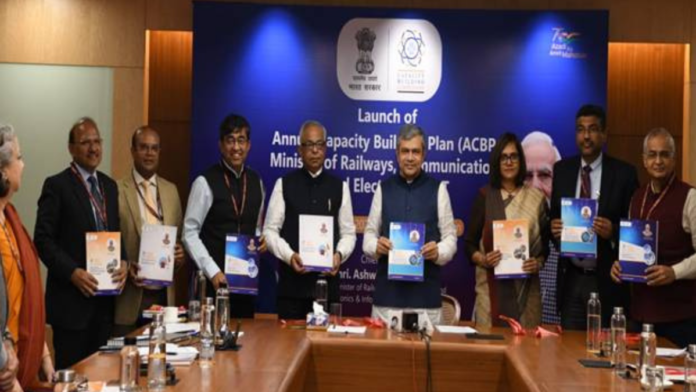
Union Minister, Shri Ashwini Vaishnaw, Launches Annual Capacity Building Plan for Ministries of Railways, Communications and Electronics & IT
NEW DELHI (Metro Rail News): The Union Minister for Railways, Communications and Electronics & IT, Shri Ashwini Vaishnaw, launched the Annual Capacity Building Plan for the Ministry of Railways, Communications and Electronics & IT on 22 FEB 2024.
The annual plan has been crafted to ensure capacity building and holistic manpower development, considering National Priorities, Emerging Technologies, Citizen Centricity and developing organisations, Institutions and Individuals. Staff from Post offices, Railways, BSNL and Common Service Centres (CSC) shared their experiences of iGoT Karmayogi training and how it has helped them develop their capabilities, improve their overall mindset towards their job and enhance their performance and ability to deliver the government’s services to the masses in a better manner.
Addressing the august gathering of over 1000 employees of Railways, Post, CSCs and BSNL at an event in Rail Bhawan, which was also graced by the Chairperson, Railway Board; Secretary, MEITY, Secretary, Department of Post; Secretary, Department of Telecommunication and Chairman of the Capacity Building Commission; Union Minister, Shri Ashwini Vaishnaw congratulated all the employees for their good performance in Mission Karmayogi. Shri Vaishnaw said, “be it Railways, Post, CSC or BSNL, all are service related departments and service industries require a different mindset as the interaction with customers and stakeholders in continuous and tt has a deep impact on the customers and the entire network. Prime Minister Shri Narendra Modi always says “Mind is never a problem, Mindset is,” and therefore, we need to make our mindsets solution oriented. Problems are faced by all but how we find solutions for these problems is important and this makes the difference between success and failure. Our thoughts dominate our action and these actions create our destiny”.
The Union Minister further stated, “Huge investments are being made in all four departments under the Prime Minister, Shri Narendra Modi led government and we have long term investment plans as they will lay the foundations for a ‘Viksit Bharat’ or developed nation. We should keep up the spirit and never be satisfied with our performance and always work towards a higher objective. By 2047 we need to make a ‘Viksit Bharat’ and we all have to work towards achieving this goal together”.
The Chairperson of the Railway Board, Ms. Jaya Varma Sinha, said, “it is a proud moment to be a part of the Annual Capacity Building Plan. Indian Railway, being the largest civil employer, has to have a robust training plan and it is very important to train and enhance capacities for all employees so as to improve our service delivery”. The Chairperson thanked the Capacity Building Commission for helping Indian Railways draft the capacity building plan. The Annual Capacity Building Plan of Railways has been prepared in partnership with the Railway Board, and the main tasks have been identified. Competencies and requirements mapped out for holistic development at the Individual and organisational level.
The Secretary, Department of Telecommunication said, “We will try to make the training process more dynamic in nature and ensure that it does not remain a one-time exercise. We would like to train people not just for their current work profile but also for the services they aspire for. We will make the training for vibrant and more role based rather than rule based.
Secretary, MEITY said this is a detailed exercise down to the lowest level in the Ministry. Over 6000 officers have undertaken 8000 courses, and we are helping create content for the government. The key outcome has been the training for CSCs. The training has made a significant difference, and we will ensure that new courses are added routinely.
The Secretary, Department of Posts asserted, “right from the beginning we were involved proactively with training and on 22nd June 2022, we launched a ‘Dak Karmayogi Portal’ and today we are at a good stage. Over 1.25 lakh staff joined for role based improvement in service delivery through training. We will try to ensure technology enabled workforce keeping in view the national level and ensure there is training on demand through knowledge experts. We have created master trainers and domain experts.
Discover the endless possibilities of our city’s Metro at InnoMetro, our flagship Expo and Conference. Be an active participant in shaping its future towards a more sustainable tomorrow. Stay informed and join us to take a step towards a brighter future.