Home Blog Page 138

RVNL Secures Rs 191 Crore Order from South Eastern Railway

Rail Vikas Nigam Limited (RVNL) announced in its regulatory filing that it has been selected as the lowest bidder for an Engineering, Procurement, and Construction (EPC) contract from South Eastern Railway.

GQplX7lX0AE 8oM

Scope of Contract:

GQpnorhWoAAiPKm

Under this contract, RVNL will be responsible for designing, supplying, erecting, testing, and commissioning 132 KV traction sectioning posts (SPs) and sub-sectioning posts (SSPs) in a 2x25KV system on the Raj Khaswan, Nayagarh-Bolani section of the Chakradharpur division of South Eastern Railway. This project aims to meet a 3000 MT loading target on an EPC mode basis.

Contract Value & Deadline:

The contract is worth Rs 191.53 crore and is scheduled for completion within 18 months (1.5 years).

Recent Achievements of RVNL:

In May 2024, Rail Vikas Nigam Limited secured multiple high-value contracts. These include a ₹187 crore contract from Nagpur Metro, a ₹72.7 crore project from Northern Railway, and a substantial ₹239 crore order from Southern Railway for various railway works.

Earlier RVNL was awarded a major ₹440 crore contract from South Central Railway. This project involves electrification and signaling works for the Aurangabad-Ankai doubling project in the Nanded division.

About Rail Vikas Nigam Limited (RVNL)

Rail Vikas Nigam Limited (RVNL), often referred to as the construction arm of Indian Railways, specialises in executing a diverse range of infrastructure projects. These projects encompass the construction of new railway lines, track doubling, gauge conversion, railway electrification, metro projects, and workshops. Additionally, RVNL undertakes the construction of major bridges, including cable-stayed bridges, as well as institutional buildings and other critical infrastructure developments.
Patna Metro: DMRC Advisor (Special Works) Conducts Inspection of Construction Sites

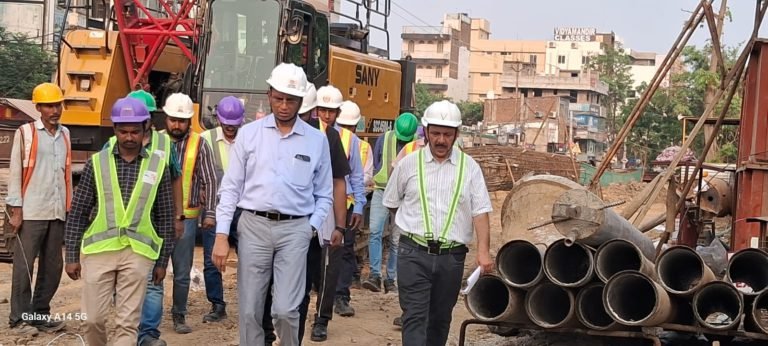
Patna (Metro Rail News): Shri Daljeet Singh, Advisor (Special Works) at Delhi Metro Rail Corporation (DMRC), conducted an inspection of the construction sites for the Patna Metro Rail Project. During the visit, he instructed officials to accelerate construction activities and commence pre-monsoon preparations at all metro stations.

a5965c35 384f 462a bb50 e240009da127

During the inspection, Shri Daljeet Singh examined the ongoing civil, electrical and track-related works at Malahi Pakadi, Cut and Cover, Bhootnath Road, ISBT Depot, Bihar Museum, Akashvani, Gandhi Maidan, PMCH, Patna University and Moin Ul Haq Stadium Metro Station construction sites.

Shri Singh instructed Metro officials to expedite construction progress at all sites before the monsoon arrives. He emphasised resolving encroachment issues promptly at the Malhi Pakadi site and completing pending pier work without delay.

c8e78165 9101 4d7a a062 8c9296829e1c

He directed officials to complete ground development work at Boothnath, Zero Mile, and ISBT Depot Metro Stations. This includes repairing footpaths around the sites and constructing access ramps for lifts. Additionally, he instructed officials to expedite the completion of entry and exit points and finishing work at all stations.

Liaison the construction being done by RCD on Badshahi drain near ISBT Depot so that the ongoing Metro construction work there can be expedited. Apart from this, the construction agency was instructed to make proper arrangements for lighting in the depot before monsoon, install high mast lights, and complete the RSS work soon.

The contractor responsible for construction at Bihar Museum was instructed to finish the roof slab construction work before the monsoon begins. Additionally, they were directed to repair the road adjacent to the Akashvani Metro Station site to ensure smooth commuting for the public.

c409d7f6 23e8 48a5 a95c df4313536ccd

At PMCH, he instructed to properly barricade the Metro construction areas and clearly mark the entry and exit points. At Patna University, he inspected the drive and site setup of TBM-1 and instructed to re-launch TBM-2 and commence mining work before the monsoon.

Shri Singh said that Metro is committed to minimum inconvenience along with the quality of work and safety of citizens in the areas around Metro construction sites. In view of this, footpaths and roads should be repaired everywhere around the Metro construction site so that people do not face any problems in commuting. 

36a6c81c 5944 4f32 a85a 92fd10cacd83 1

He also directed DMRC officials to ensure compliance from the contractors regarding the removal of encroachment from narrow routes parallel to the construction sites, parallel road arrangement to get rid of traffic jams around the Metro construction site, cleanliness, providing proper zebra crossing facilities for pedestrians at places where there is a change in the routes due to construction.

Besides inspecting the progress in the works of Patna Metro, Shri Singh also assessed the facilities available on the site for the Metro staff and workers like bathrooms, rest area, canteen etc.

State Govt. Approves Metro Projects in 4 Cities of Bihar

Patna (Metro Rail News): On June 20, Bihar Chief Minister Nitish Kumar approved the extension of the metro network to four additional cities in the state.

During a state cabinet meeting chaired by CM Nitish Kumar, approval was granted for new metro projects in the following cities of Bihar:

  • Muzaffarpur
  • Gaya
  • Darbhanga
  • Bhagalpur. 

“The state cabinet approved the Urban Development and Housing Department’s proposal pertaining to metro rail projects in Muzaffarpur, Gaya, Darbhanga and Bhagalpur. Now, the feasibility reports will be prepared after which the detailed project reports (DPR) will be finalised,” stated S Siddharth, Additional Chief Secretary (Cabinet Secretariat).

Additionally, he mentioned that the central and state governments will each cover 20% of the project costs while the remaining 60% will be covered by financial institutions.

Existing Metro Network In Bihar

Currently, work is underway on the Patna Metro Phase 1 project for which the foundation stone was laid by Prime Minister Narendra Modi on February 17, 2019. The project is being constructed with an investment of Rs. 13,365.77 crore.

Patna Metro Phase 1

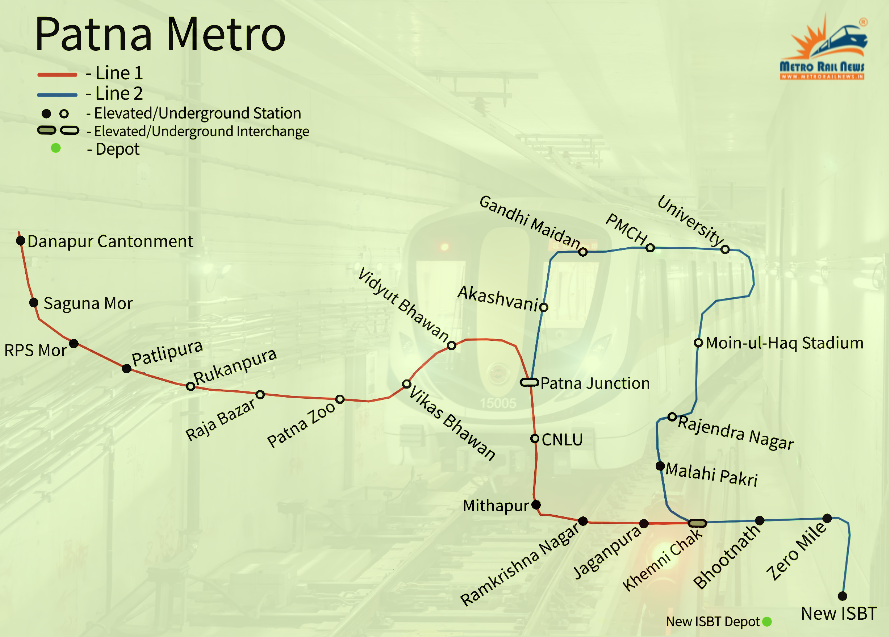
Patna Metro Phase 1 stretches 30.91 km across 2 corridors and 26 stations. Line 1, also known as the East-West Line, extends 16.86 km, connecting Danapur Cantonment and Khemni Chak via 8 elevated and 6 underground stations.

Line 2, the North-South Line, covers a total distance of 14.05 km, linking Patna Junction Railway Station with New ISBT through 5 elevated and 7 underground stations. Patna Metro Station will serve as the interchange between Line 1 and Line 2, facilitating a smooth transition for passengers.

The first section of Phase 1, which includes 5 stations, is expected to be operational by March 2025. Meanwhile, the entire Phase 1 is likely to be completed by 2027.

Chennai Metro: Swastik Overseas Wins Koyambedu Depot’s Machinery/Equipment Works Contract

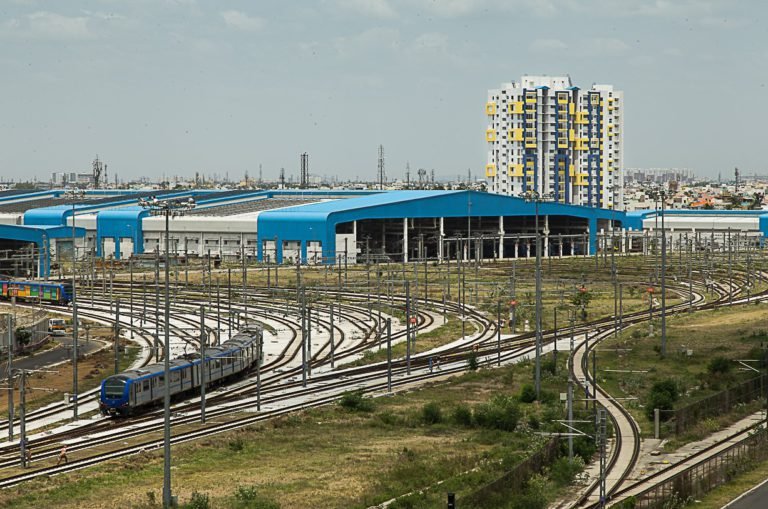
Chennai (Metro Rail News): Chennai Metro Rail has declared Swastik Overseas as the lowest bidder to carry out Machinery/Equipment works at Koyambedu Depot. The depot is located near Koyambedu Metro Station, which is part of the Green Line of the Chennai Metro network.

Scope of work

Under Package DM-1000, as part of the Phase 2 project, Swastik Overseas will be responsible for the design, manufacturing, supply, installation, testing, and commissioning of the following depot machinery and equipment works at Koyambedu Depot, along with the associated infrastructure works:

  • Automatic Train Wash Plant (DM-1001)
  • Installation of a Drying Station in the Existing Automatic Train Wash Plant (ATWP) (DM-1002)
  • Battery-Operated Rail Cum Road Shunter (BORRS) (DM-1003)
  • Bogie Turntable (DM-1004)
  • Racks for Storing Rolling stock HVAC, Traction conversion system, Auxiliary converter, Main transformer & AGTU-JIG (DM-1005) 
  • Rack for Koyambedu stores (DM-1006)
  • Battery-operated forklift (5T) (DM-1007)
  • Manual Mobile Scissor Lift Table (DM-1008)
  • Mobile Lifting Trolley (Hydraulic) – 5 Ton (DM-1009)
  • Hydraulic Lifting Trolley – 1 Ton (DM-1010)

Chennai Metro floated the tender with an estimated cost of Rs. 8.91 crore. Swastik Overseas emerged as the lowest bidder at an undisclosed price.

Recently, the joint venture of Taikisha and Swastik Overseas secured the Machinery and Plant (M&P) work contract for the Mandale Depot of the Mumbai Metro.

Chennai Metro’s Koyambedu Depot

Koyambedu Depot stretches over an area of 26 hectares The Depot’s construction contract was awarded to Larsen & Toubro in November 2010.  In December 2012, the first Metro train arrived at the depot from Brazil. The Koyambedu Depot, which includes the Chennai Metro’s Operational Control Centre (OCC), oversees the monitoring and management of metro train movements throughout the city. The depot spans 15 kilometres of track, including a dedicated test track for trial runs.

Pune Metro:  Feeder bus service launched from Ramwadi Station to Kharadi

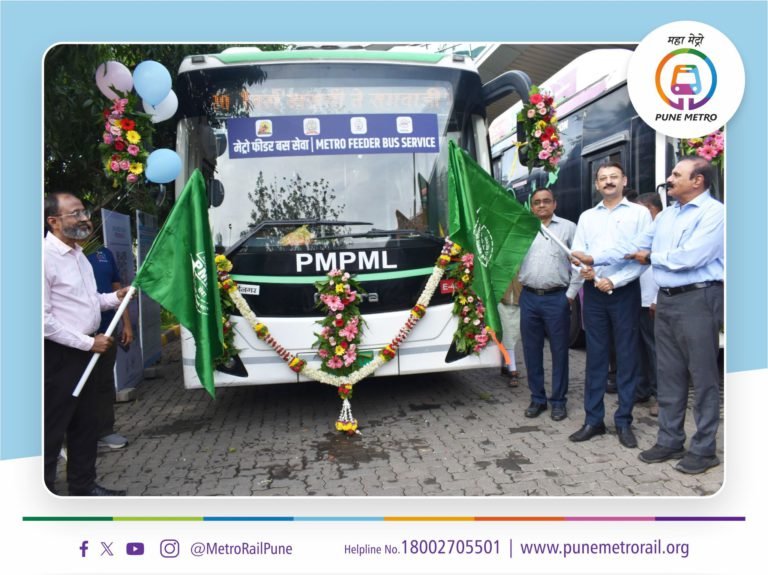
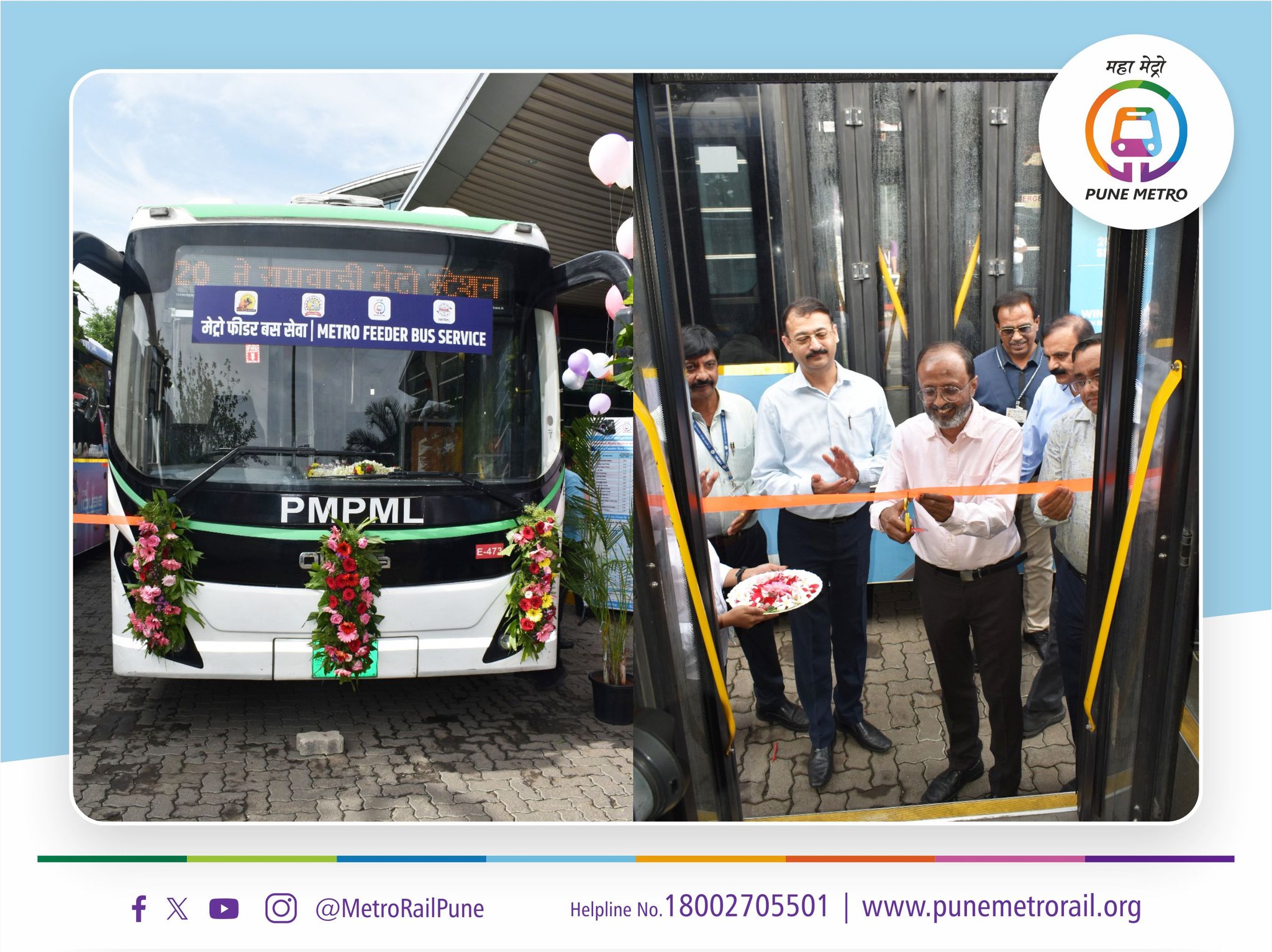
Pune (Metro Rail News): In collaboration with Pune Mahanagar Parivahan Mahamandal Ltd (PMPML), Pune Metro has launched a new feeder bus service connecting the Pune Metro’s Ramwadi Station to the World Trade Center and EON IT Park-Kharadi. This service began on June 19, 2024, and it aims to improve the daily commute for residents and workers in these high-traffic areas.

GQcMyqvXkAEhTO6

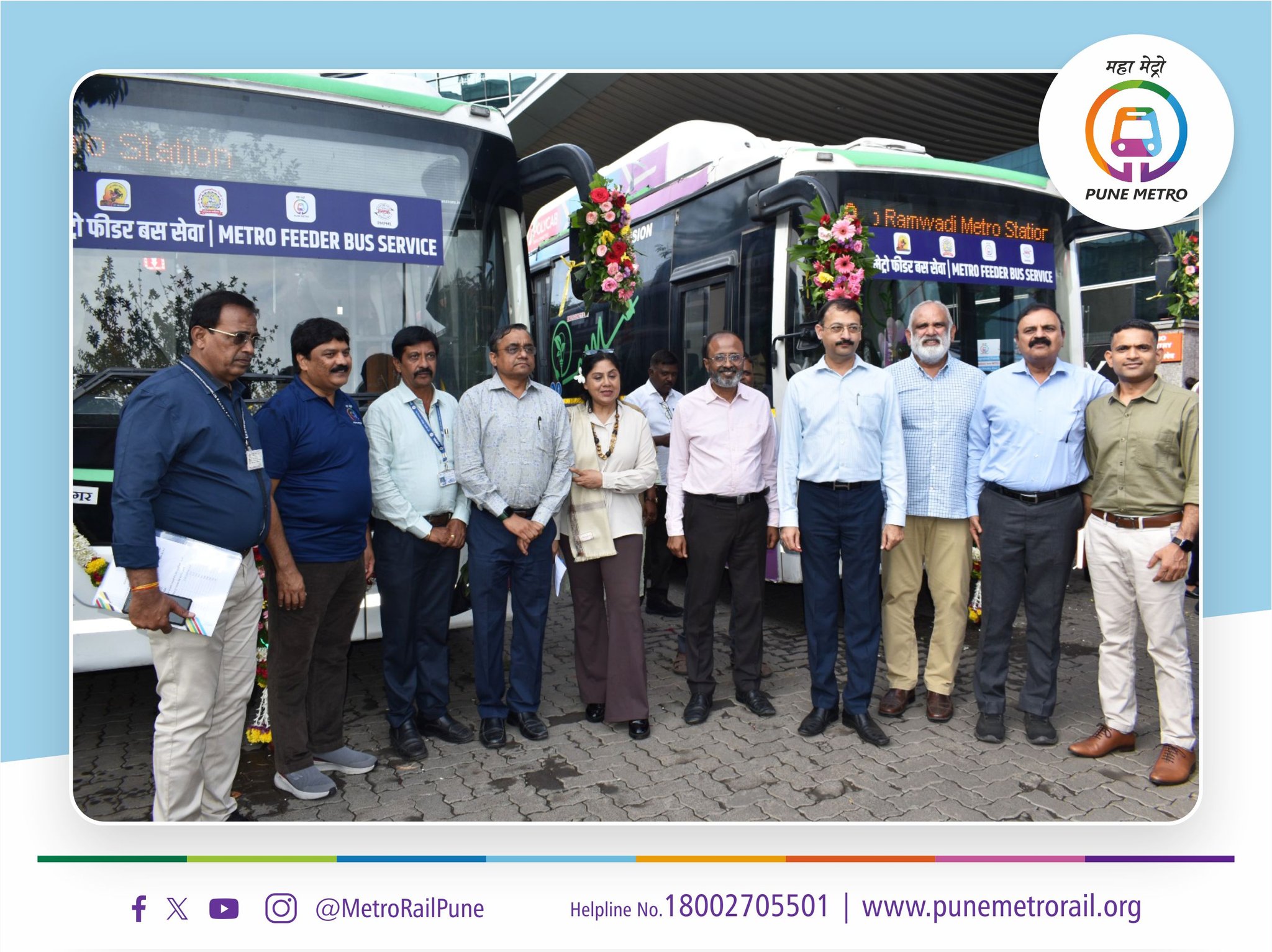
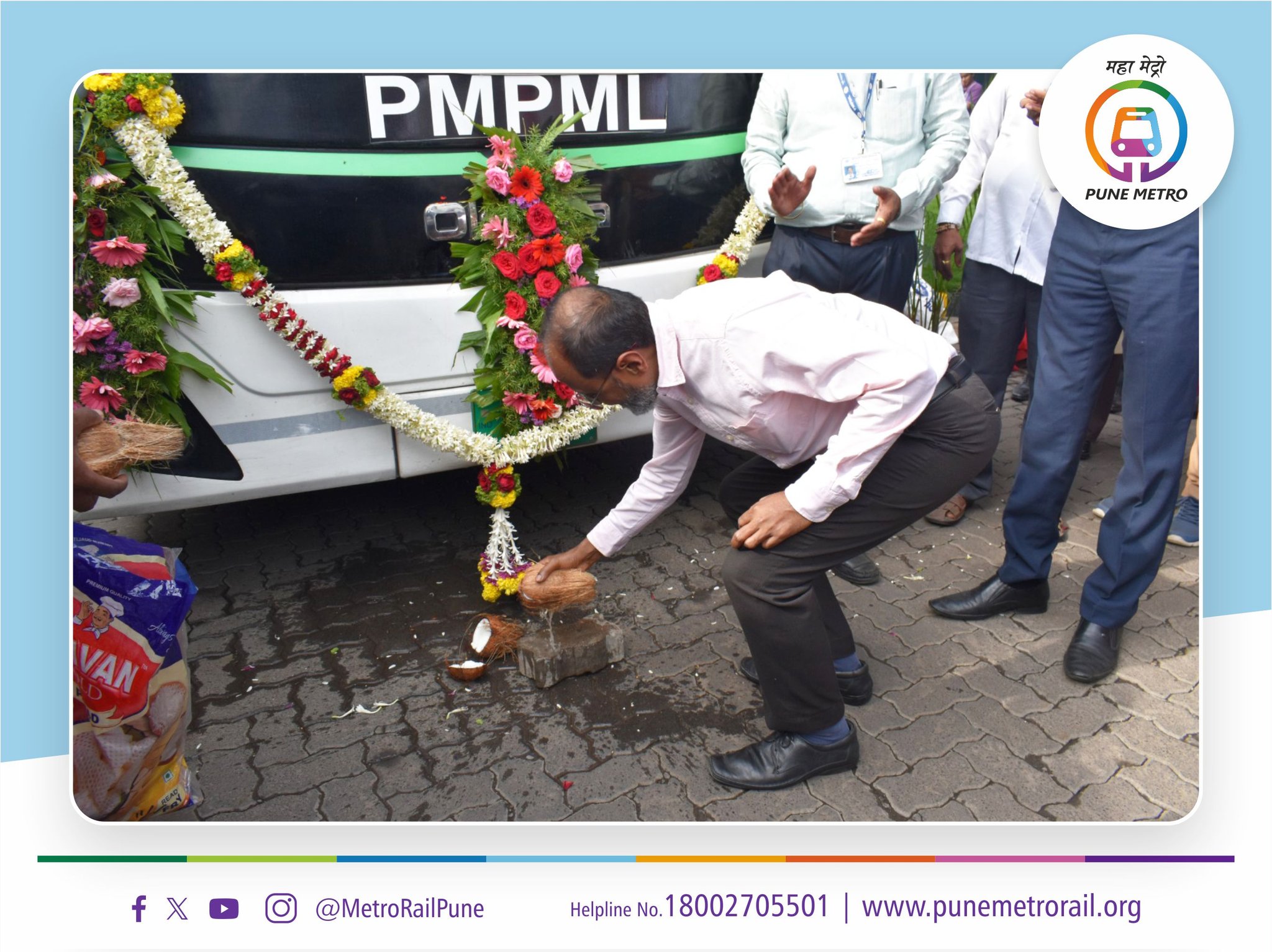
Sanjay Kolte, the Chief Managing Director of PMPML, officially inaugurated the service. The event was attended by various officials, including Vinod Kumar Agarwal, Director of System & Operations, Maha Metro.

GQcMyJCWkAAHeC8

On this occasion Shravan Hardikar, Managing Director of Maha Metro said, “This feeder bus service will greatly benefit the residents of Chandannagar, Vimannagar, Kharadi, and the employees working in the IT Parks in these areas, providing them with convenient access to the Ramwadi Metro station.

Pune Metro

Presently, Pune Metro is operating at its full strength on both its North-South Corridor (PCMC-Swargate) and the East-West Corridor ( Vanaz-Ramwadi) covering a total distance of 29 km.

The Ramwadi Metro Station serves as a crucial hub, linking various educational institutes, IT parks, Pune Airport, Special Economic Zones, and residential areas. Acknowledging the number of commuters traveling to and from this area for work, the newly introduced feeder bus service is designed to simplify and enhance their daily journeys.

Stops & Fare

GQcouqKbYAAfEj9

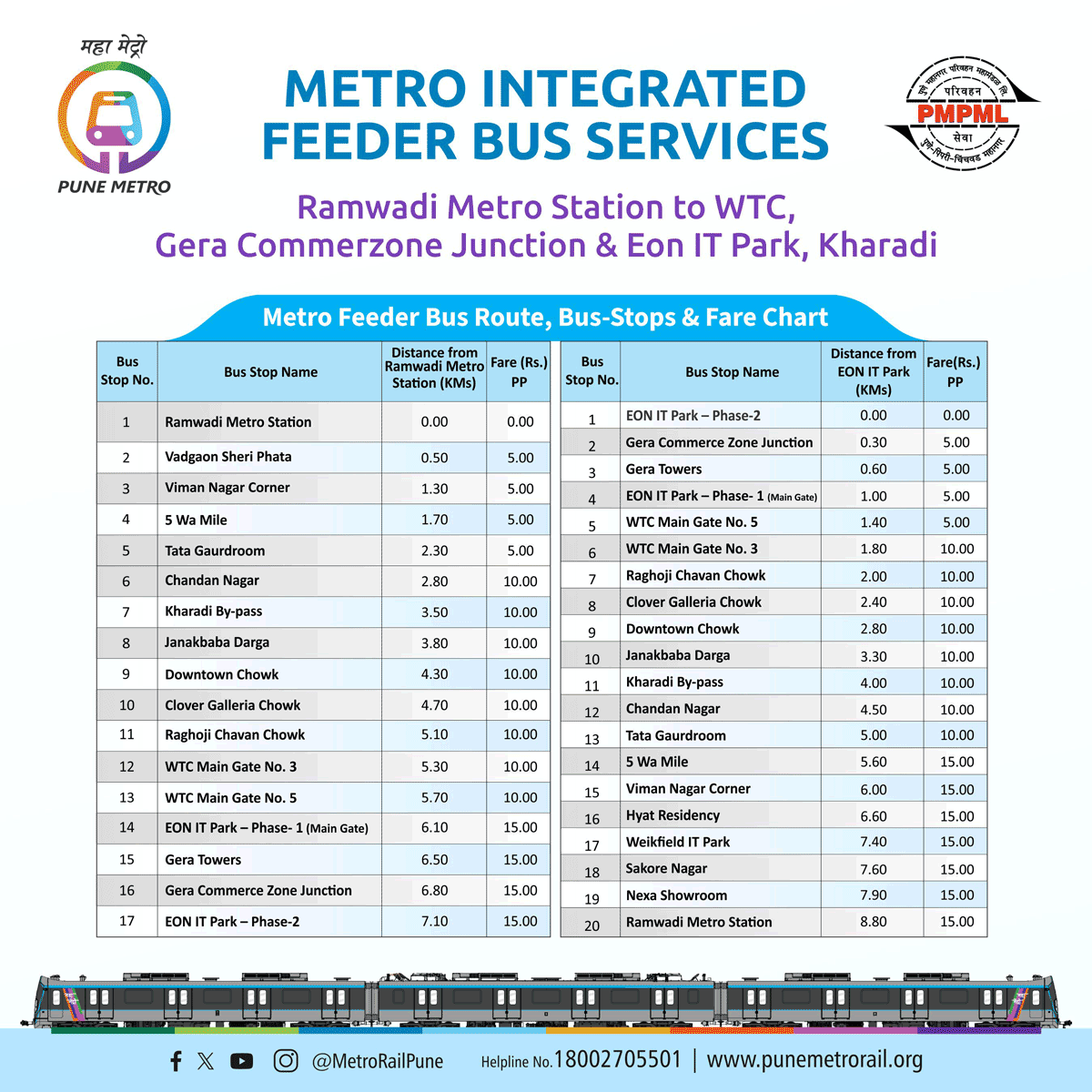
The feeder bus service will stop at the following locations: Ramwadi Metro Station, Vadgaon Sheri, Vimannagar, Chandan Nagar, Kharadi Bypass, Janak Baba Dargah, Silver Chowk, Raghoji Chavan Chowk, World Trade Center Gates 3 and 5, EON IT Park Phase 1, Gera Towers, Gera Financial Zone, and EON IT Park Phase 2.

GQcouHvaIAQy4vj

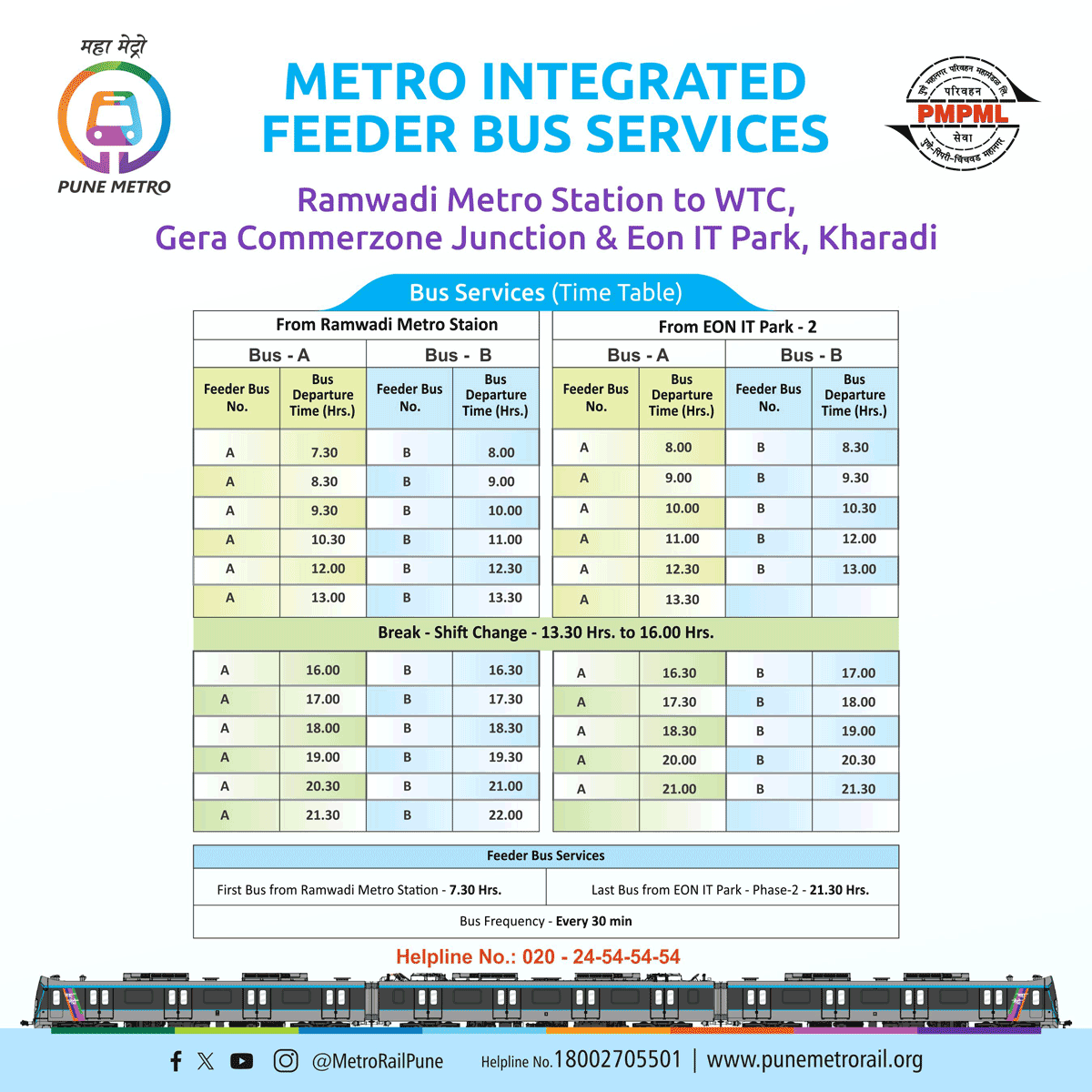
The fare for this service will be Rs. 5, Rs. 10, and Rs. 15, depending on the distance from Ramwadi station. The frequency of the service will be adjusted based on passenger demand and response.

GQcMxlzXwAAmWh9

Objectives of the Feeder Bus Service:

1. Enhance ‘first to last mile’ connectivity for Pune Metro passengers within an integrated transport framework.

2. Promote the use of public transport.

3. Increase ridership on the Pune Metro.

4. Reduce carbon emissions and pollution levels.

5. Alleviate traffic congestion by reducing reliance on private vehicles.

This new service route was carefully planned, taking into account factors such as minimum distance and travel time, current road conditions, the density of bus stops, population density in the area, and the number of employees working nearby. This initiative is crucial in establishing ‘first to last mile connectivity’ and promoting public transport.

Bhubaneswar Metro: 3 Firms Submit Proposals for Design Consultant Contract BCDD-02

Bhubaneswar (Metro Rail News): Following the opening of technical bids by the Delhi Metro Rail Corporation (DMRC) in May, three consulting firms have submitted proposals for the role of Detailed Design Consultant (DDC) under Package BCDD-02 of the Bhubaneswar Metro Phase 1 project.

route map 1
Bhubaneswar Metro Phase 1 Route Map

These firms are:

  • Ayesa India Pvt. Ltd.
  • Intercontinental Consultants and Technocrats Pvt. Ltd. (ICT)
  • STUP Consultants Pvt. Ltd.

Scope of work:

The scope of work entails engaging a Detailed Design Consultant (DDC) for architectural and building services, including E&M (Electrical and Mechanical), traction works, and civil works for the Depot and OCC (Operations Control Centre) building. 

This also includes proof-checking of substructures for viaducts, special spans including their superstructures, and stations from Biju Patnaik Airport to Trisulia Square. Additionally, it covers 750V DC traction and power supply works for elevated stations and depots, as well as RSS (Railway Signaling System) works.

Bidding Process 

In March 2024, DMRC initiated the bidding process for the consultancy contract, estimating it to be worth Rs. 22.20 crore and setting a deadline of 36 months. On May 22, the technical bids for the contract were officially opened.

Evaluation of the bids, which started in May, is currently in progress and expected to conclude within the next few months. Following this evaluation phase, the financial bids from the technically qualified bidders will be opened to identify the lowest bidder.

Bhubaneswar Metro Phase 1

Odisha’s State government approved the Phase 1 project in November 2023 at an estimated cost of Rs 6255.94 Crore. Phase 1 of the Bhubaneswar Metro will cover a total distance of 26.024 km through 20 elevated stations. It will link Trisulia Square with Biju Patnaik Airport of Bhubaneswar.

RRTS Corridor: NCRTC likely to initiate trials on the Delhi Section by late 2024

0

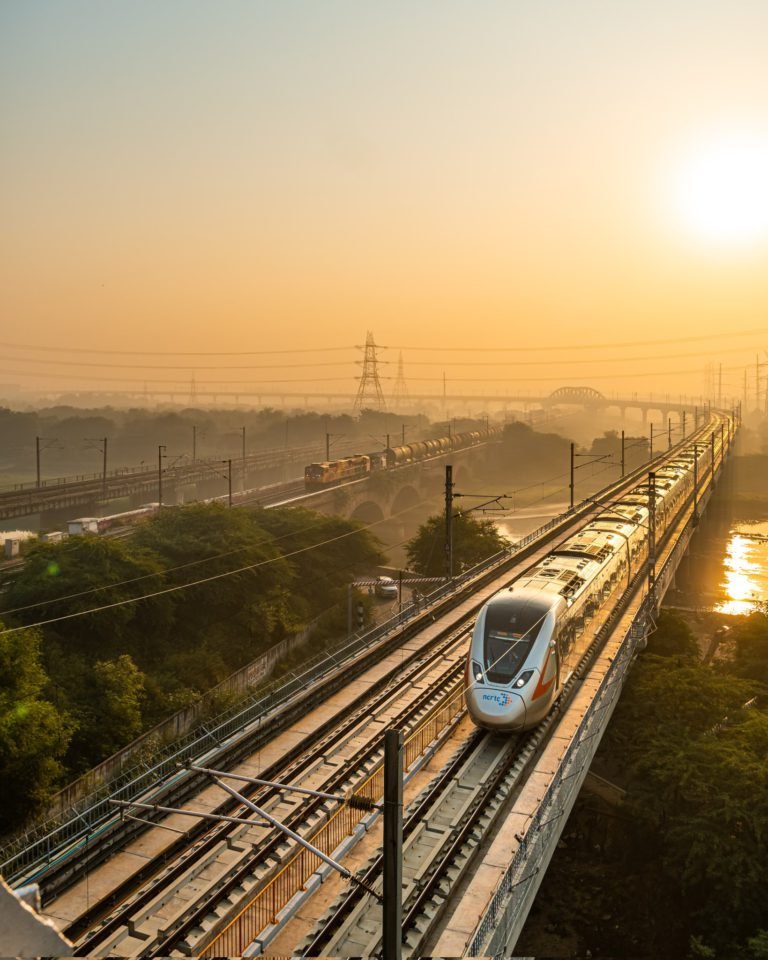
The  Delhi-Meerut RRTS corridor is likely to achieve a major breakthrough as the National Capital Region Transport Corporation (NCRTC), which is responsible for implementing India’s inaugural Regional Rapid Transit System (RRTS), prepares to conduct the first trial run of the Namo Bharat train on the Delhi section by late 2024.

Officials from the NCRTC have indicated that the civil construction of the viaduct in Delhi is nearing completion, with ongoing work progressing at the station premises.

Puneet Vats, chief public relations officer, NCRTC, said, “Construction of the RRTS viaduct in the Delhi section of the Delhi-Meerut corridor is almost complete. The trial runs are likely to be started in Delhi by the end of this year. The RRTS stations – Sarai Kale Khan, New Ashok Nagar, and Anand Vihar (underground) in Delhi – have already taken shape and finishing work is underway.” 

RRTS Corridor Map
RRTS Corridor Map

NCRTC plans to invite the Commission of Metro Rail Safety (CMRS) for inspection once the signalling and telecommunication work on the Delhi Section is completed. The CMRS inspection will focus on critical aspects necessary to start operations, including the interaction between infrastructure and rolling stock, track conditions, and signalling systems. Upon receiving clearance from CMRS, NCRTC will proceed to deploy the Namo Bharat Trains on this section for public use.

Delhi Section of RRTS corridor

The Delhi Section of the RRTS spans 9 km through an elevated section and 5 km via an underground section. According to officials, the viaduct construction for the elevated part has been finished up to the Sarai Kale Khan station. Currently, track laying and overhead electrification (OHE) installation are in progress at this location.

At present, The Namo Bharat trains are operational across eight stations covering a 34 km stretch from Sahibabad station to Modi Nagar North station of the 82 km RRTS corridor. As per the officials, the Meerut South RRTS station is almost complete and is expected to be commissioned by the end of the year. This addition will extend the operational length of the RRTS corridor to 42 km.

Indore Metro: State Orders New Feasibility Study for Underground Section Amid Public Concerns

Indore (Metro Rail News): To address public concerns and criticisms regarding the proposed route alignment of the Indore Metro, Technical experts have been instructed to conduct a new feasibility study for certain sections of the Indore Metro Phase 1 project.

On June 17, Urban Development Minister Kailash Vijayvargiya stated, “It seems the public and representatives of social organisations are unhappy with the present planning of some metro rail routes in the city. The participants have suggested changes, especially in the underground portion of the metro rail project.”

“Officials have been instructed to conduct a new feasibility survey on technical and financial aspects in view of these suggestions and submit a report within a month. Around 30 to 40 percent work of the metro rail project in the city has been completed. All decisions have already been taken at the level of the Central and state governments regarding this project,” he added.

He said, “The Metro may be built after a year, but the citizens should not be punished for it.”

Three Alternatives for Route:

According to a report by the Free Press Journal, three alternatives have been proposed for the Indore Metro. One option advocates running the metro underground from Bengali Square rather than near the High Court trisection. Another option is to begin the underground section from Agriculture College. A third alternative suggests directing the metro via Race Course Road instead of MG Road.

Indore Metro’s Journey:

In October 2018, the Central Government gave its approval for Phase 1 of the Indore Metro project. This phase spans a total length of 33.53 kilometres and encompasses 29 stations. Among these stations, 23 will be situated on elevated tracks, while the remaining 6 stations will be located underground.

The Priority Corridor of the Indore Metro, originally slated for completion by August 2023, is now anticipated to be completed and opened for public use by August 2024. However, Phase 1 is projected to be fully operational by 2027.

Pune Metro Line 3 to activate third rail electrification from 20 June

Pune (Metro Rail News): The adoption of the Third Rail System for the PMRDA-promoted Pune Metro Line 3 project aka ‘Puneri Metro’ represents a significant leap forward in sustainable and reliable urban transportation. As the overall work of Puneri Metro has gained a significant pace, the developers are now implementing the electrification for metro line 3. The 33,000 V, 50 Hz AC power cable and 750 V, DC third rail traction system will be activated from Thursday, 20th June 2024 at Hinjawadi.

All citizens and personnel are informed that the power supply system will be operational from the specified date. Unauthorised persons are strictly prohibited from approaching or working near the electrified areas to ensure safety.

The work of Pune Metro Line 3 on the Hinjewadi to Shivajinagar route has been jointly undertaken by Tata Group and PMRDA based on the Public Private Partnership (PPP) and Tata Group has established Pune IT City Metro Rail Limited as a special purpose vehicle (SPV) company for its implementation.

Section Details

Line: Pune Metro Line 3 (Pink Line)

Date of Electrification: 20.06.2024

Components:

33 kV ASS and TSS including 33 kV cable

750 VDC third rail traction system including 750 VDC cable of the test track

750 VDC stinger system of IBL-1 at Hinjewadi Depot

Safety First

It is the policy of the Tata Group not to compromise on quality and safety in all phases of the project, which was undertaken for the convenience of the citizens. The authorities have made an appeal to all individuals to adhere strictly to the safety guidelines and avoid any unauthorised access to the electrified areas, as citizens’ cooperation is crucial for a safe and efficient operation of the Puneri Metro.

About Pune Metro line 3:

The Pune Metro Line III is a 23 Km elevated Metro rail project connecting the IT hub of Hinjawadi to the Central business district of Shivajinagar. It is a Public Private Partnership (PPP) project awarded by the Pune Metropolitan Region Development Authority (PMRDA) to a consortium consisting of Tata Group’s TRIL Urban Transport Private Limited (TUTPL) and Siemens Project Ventures GmbH. The Project would be developed & operated on a Design, build, finance, operate & transfer (DBFOT) basis by a special purpose vehicle (SPV), Pune IT City Metro Rail Limited (PITCMRL) for a Concession Period of 35 years including the construction period.

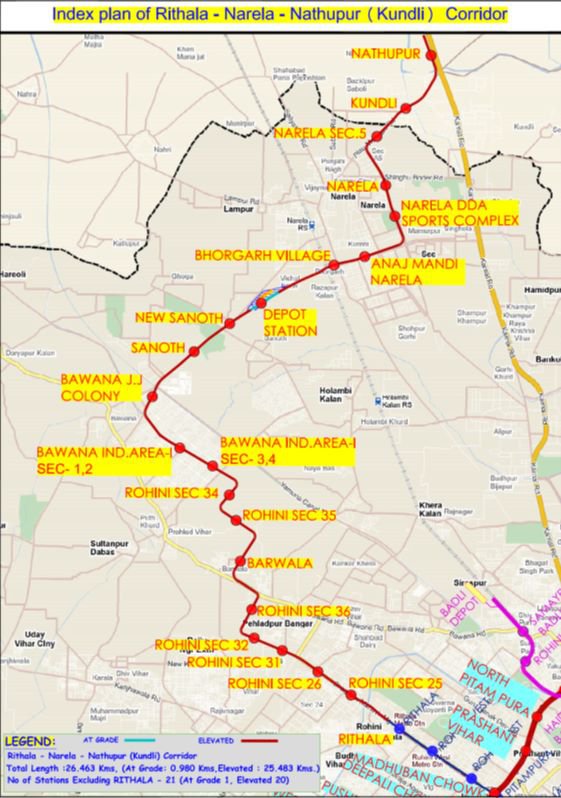
Delhi Metro: Centre Approves Rithala-Narela-Kundli Extension of Red Line

New Delhi (Metro Rail News): To better connect the northwestern region of Delhi, especially the ones near the Haryana border, the “Public Investment Board” of the Ministry of Finance has sanctioned the “Ministry of Housing and Urban Affairs DDG proposal to extend the existing Red Line of the Delhi metro.

Labeled as the “Rithala-Nerela-Kundli Metro corridor”, this extension of the Red Line will cover a total distance of 26.5 Km via 21 stations, thereby connecting the nearby region with the rest of the city.

Delhi Metro's Red Line's Extension
Image credit: DMRC

Financial Aspects of this Project


The total cost of the project will be Rs. 6,231 crores. Of this, it has been reported that the Delhi Segment” of the project (which has a cost estimate of Rs. 5,685.22 crores) will be funded by the Delhi Development Authority (DDA) in which-

  • The government of India will cover 40% of the project’s cost.
  • 37.5% will be covered through bilateral and multilateral loans.
  • Lastly, the Delhi Government will cover approximately 20% of the project cost.

Likewise, for “The Haryana Segment” (which costs Rs. 545.77 crores), 80% of the funding will be provided by the Haryana government and the remaining 20% by the central government.

Critical analysis of this funding distribution, at its core, showcases the Delhi and the Haryana government’s effort to provide better connectivity to the “Narela-Bawana-Alipur” areas with the rest of the city. A major reason for such infrastructural and connectivity-based upgradation is that upon completion, this corridor will bolster economic and regional development in these far-flung regions of northwestern Delhi and Haryan

Cause and Effect of the Extension of the Red Line of the Delhi Metro

it would provide seamless inter-state transportation between Ghaziabad (Uttar Pradesh), Delhi, and Kundli (Haryana). All this cumulatively shows that such infrastructural and transportation development projects will benefit the economy of North India, by boosting its social life, economic, and business perspectives. Ultimately, one can state that this will enhance the lifestyle, societal structure, and GDP of the Indian economy.